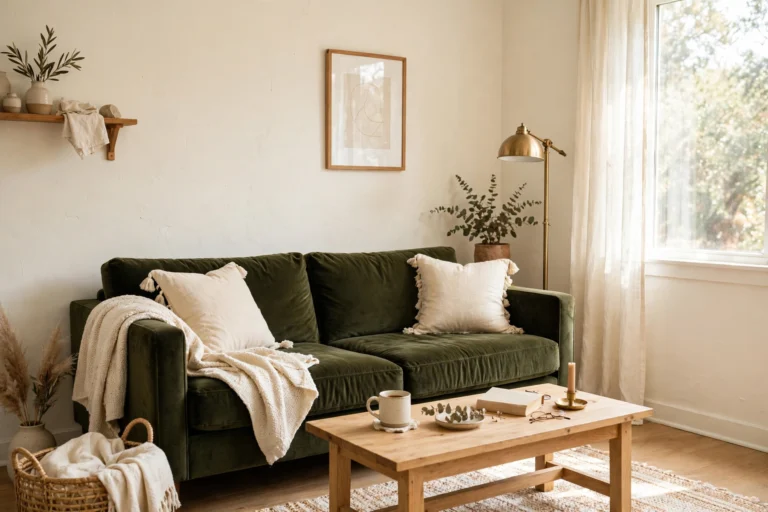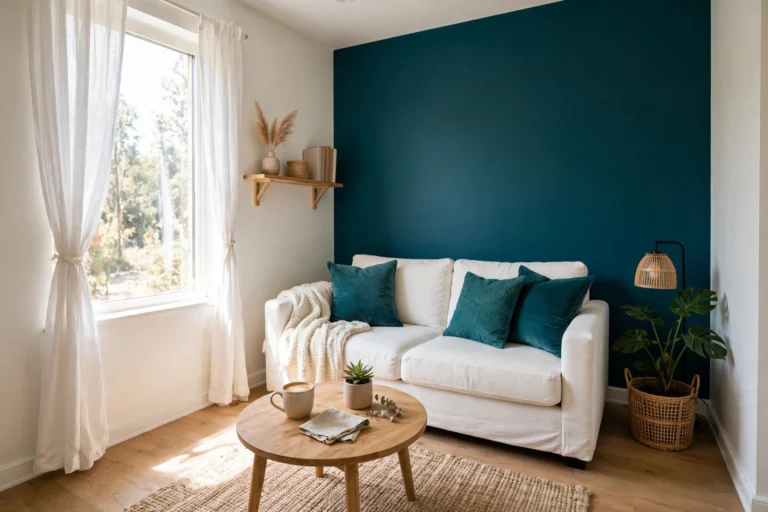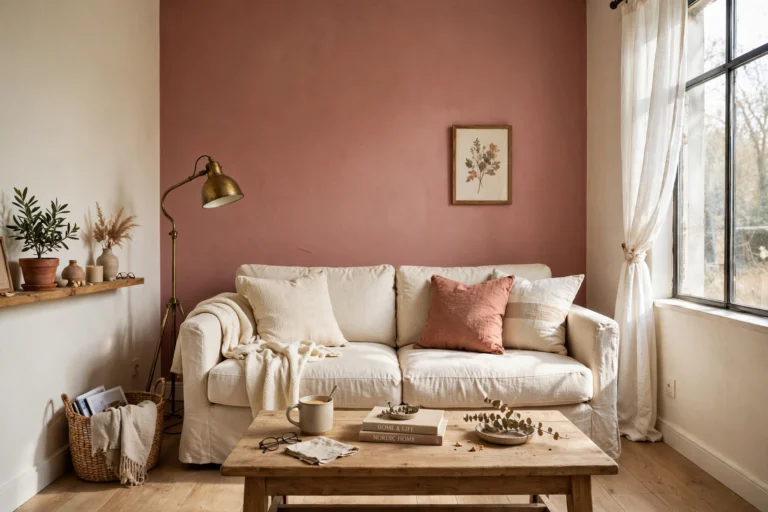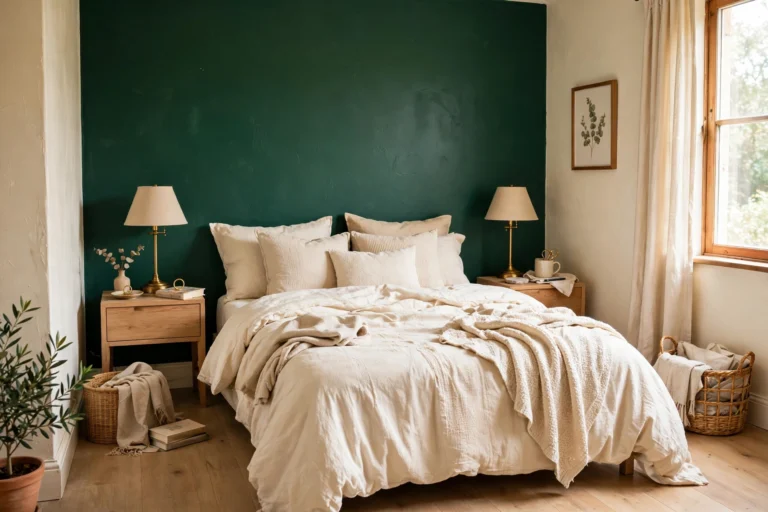
Half-Painted Walls for Small Rooms: 7 Ways to Place the Line (and Where to Stop It)
Half painted walls for small rooms work best when the split line sits at one-third of the wall height, or at chair-rail height between 32 and 36 inches (81 to 91 cm). That is the short answer. The longer answer is that the right height depends on your ceiling, your furniture, and which half gets the dark color. Get those three decisions right and a small room looks taller, calmer, and more finished. Get them wrong and the room looks chopped in half, which is exactly the mistake this technique is famous for.
Here is the original math behind this post. I worked out the stop line for the three ceiling heights you actually meet in small homes, 8, 9, and 10 feet, and I worked out how much paint each version needs. Our accent wall ideas for small bedrooms start from the same math: one accent wall, 10 feet wide with the color running 3 feet up, takes about 60 square feet of paint across two coats. One quart covers that with room to spare. All four walls of a 10 by 10 foot room need about 240 square feet across two coats, which means three quarts. No guessing, no leftover gallon sitting in a closet for three years.
Where to stop the line: half painted walls for small rooms by ceiling height
The single most useful number in this whole post is your ceiling height. Measure it before you buy anything. The split that looks great on an 8 foot ceiling can look lost on a 10 foot one, and the split that suits a tall room can crush a low one. Here is the table.
| Ceiling height | Low split (one-third) | Chair-rail split | High split (two-thirds) |
|---|---|---|---|
| 8 ft (96 in / 244 cm) | 32 in (81 cm) | 32 to 36 in (81 to 91 cm) | 64 in (163 cm) |
| 9 ft (108 in / 274 cm) | 36 in (91 cm) | 32 to 36 in (81 to 91 cm) | 72 in (183 cm) |
| 10 ft (120 in / 305 cm) | 40 in (102 cm) | 32 to 36 in (81 to 91 cm) | 80 in (203 cm) |
Three rules sit behind those numbers. First, never split the wall exactly in half. A 50/50 split draws a horizon line straight across the room and makes the ceiling feel lower, which is the opposite of what a small room needs. Professional painters who write about this technique agree on the same bands, one-third or chair-rail height for most rooms, two-thirds only when the ceiling can carry it. Second, the low split is the safest default in a small room. It grounds the furniture, hides scuffs, and leaves most of the wall light. Third, line the split up with something real when you can. A window sill, a chair rail, the top of a dresser, or a picture rail all make the line look intentional instead of random. A line that lands a few inches away from a feature, nearly touching it but not quite, is the one placement that always looks like a mistake.
One practical warning before you commit. In most US homes the bottom of a standard light switch sits at 48 inches (122 cm) from the floor. If your split lands right on a switch, you either stop just below it at 44 to 46 inches, or clear it completely at 54 to 56 inches. Measure where your switches and outlets sit before you tape anything.
Which half gets the dark color in a small room?
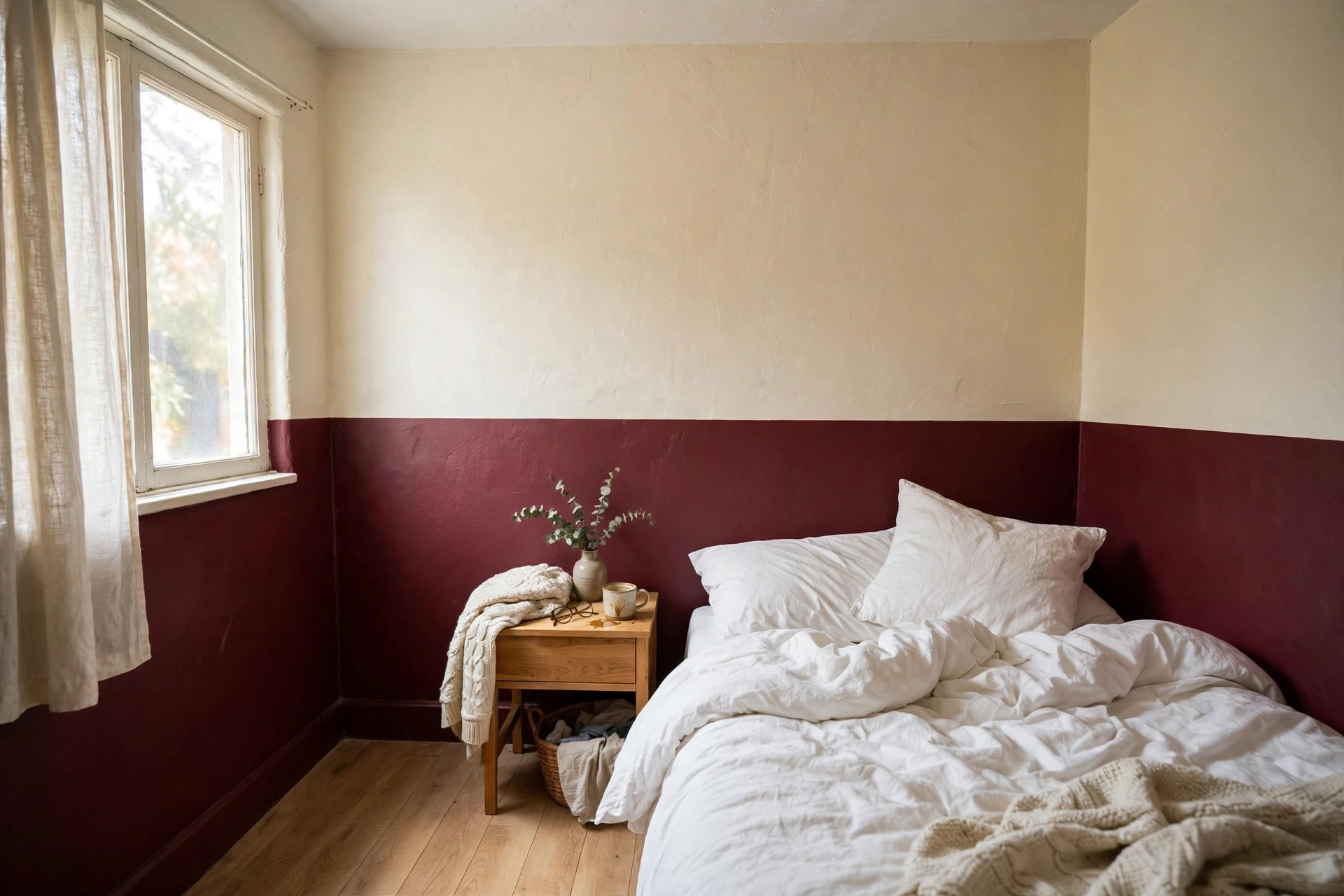
Put the dark color on the bottom and the light color on top. That is the answer for nearly every small room, and it holds for a simple reason. Eyes go to the lighter color first, so a light upper wall pulls your gaze up and the ceiling reads higher. A darker colour at the bottom can give the illusion of a higher ceiling, which is exactly what a small or dark room needs, and it hides the scuffs that collect near the floor.
A dark top half can work, but it is a mood choice, not a space choice. It makes a room feel cozier and more dramatic, and it also makes a low ceiling feel lower. In a small bedroom you sleep in, that coziness can be a win. In a small living room you work and eat in, it usually feels heavy by the second week. If you love a dark color, keep it below the line. That is the rule that makes half painted walls for small rooms work, and the same low split drives diy wall paneling ideas for small rooms: the drama stays low, and the room keeps its height.
The finish matters as much as the color. Use eggshell on the upper wall, it hides small flaws and bounces light softly. Use satin or semi-gloss on the lower half, it wipes clean where shoes, chairs, and pets hit it. Two different sheens on one wall also make the split look deliberate, even before anyone notices the color change.
7 half painted wall ideas that work in small rooms
1. The low dado in a small bedroom
Best for: bedrooms with low ceilings and a bed against the main wall. Main advantage: the line sits below the headboard, so the bed reads as part of the wall instead of blocking it. Watch out for: a headboard taller than 36 inches will cross the line awkwardly, so measure the headboard first. Verdict: the safest first half-painted wall you can do. If you only paint one wall, make it this one.
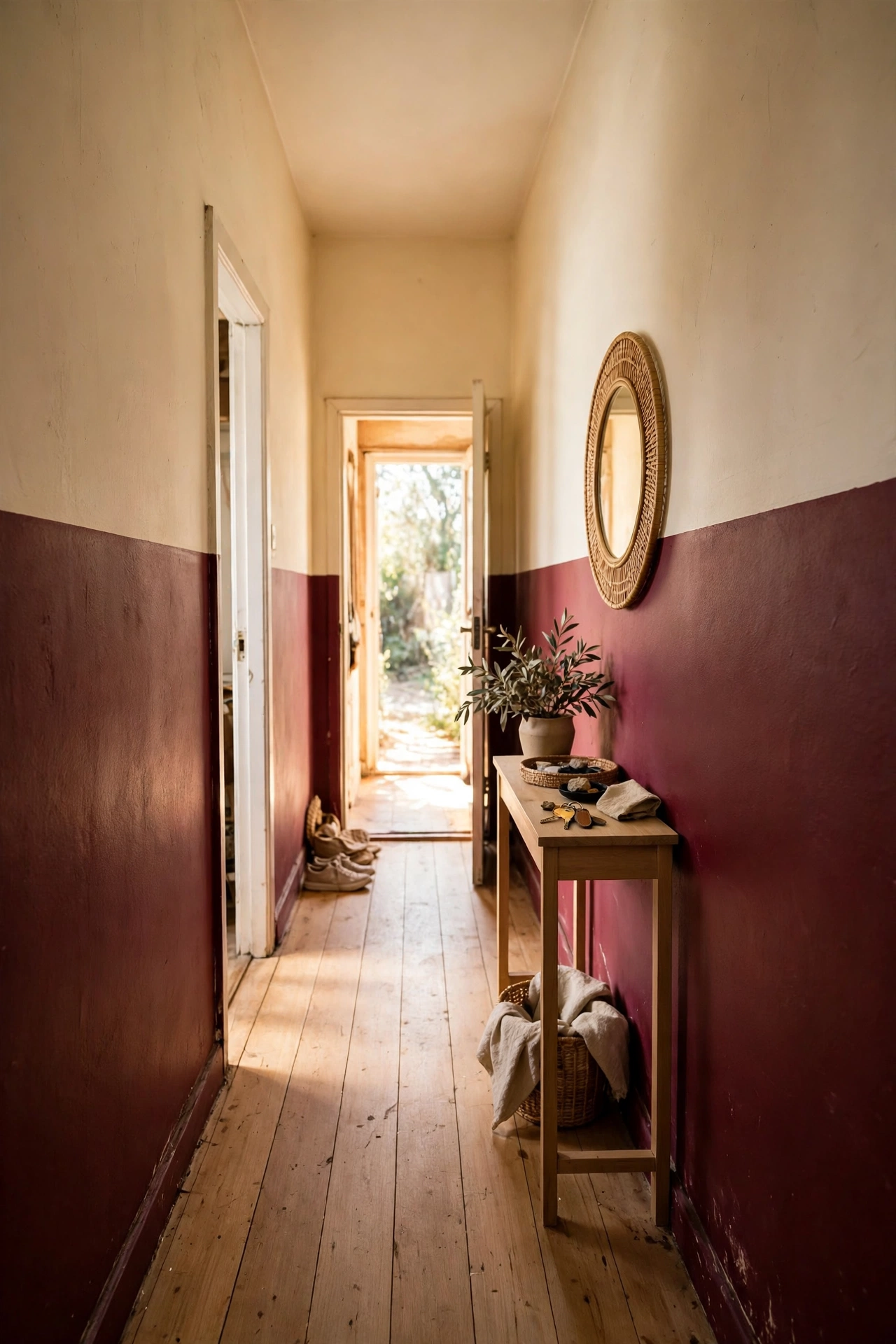
2. The chair-rail hallway
Best for: narrow hallways and entries that take scuffs from shoes, bags, and strollers. Main advantage: the dark lower half hides marks that would show on a plain light wall within a month. Watch out for: hallways are long, so a wobbly line shows from twenty feet away. Use a laser level, not your eye. Verdict: the highest-payoff spot in a small home, because hallways are where walls get punished.
3. The high split behind a sofa
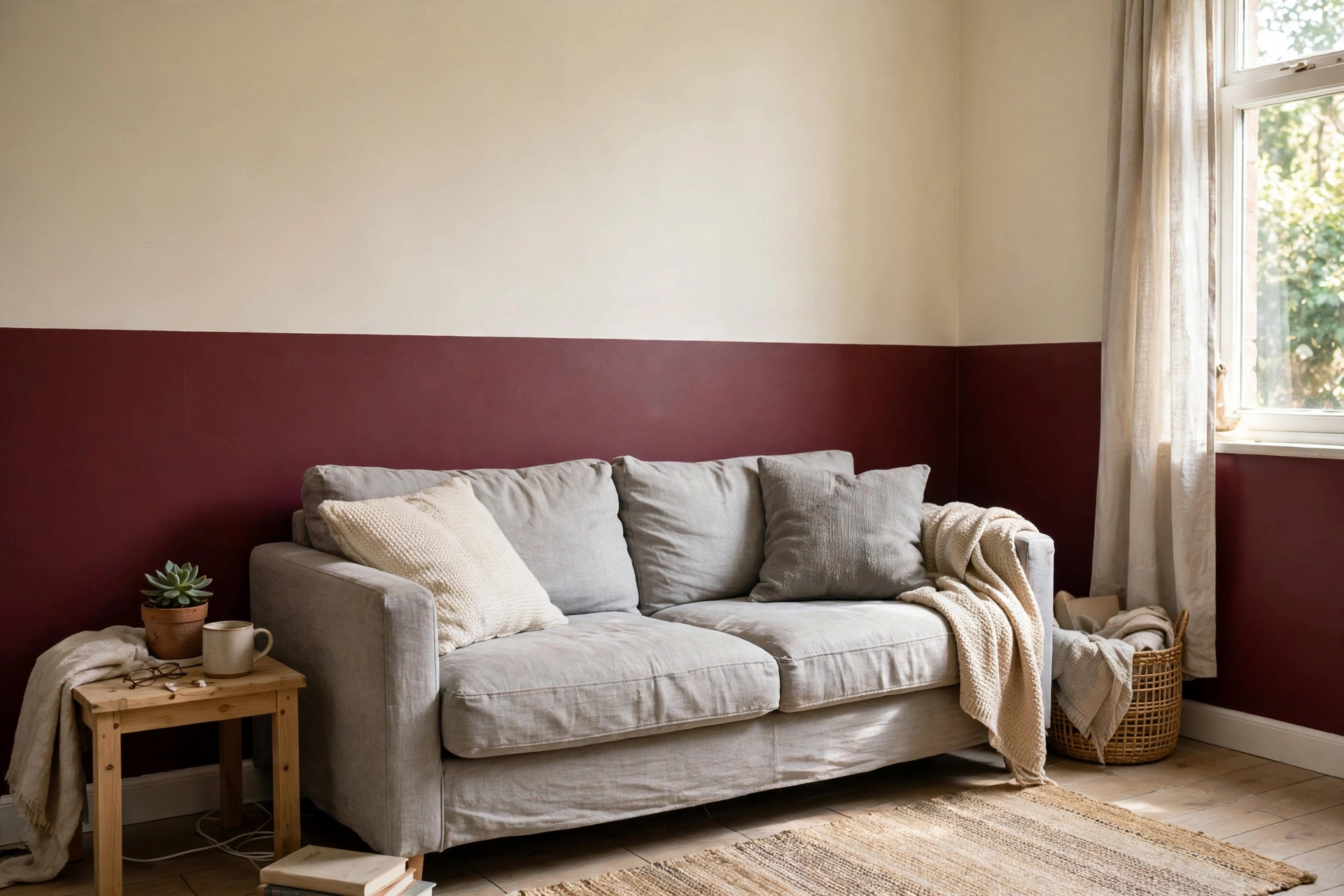
Best for: small living rooms where the sofa back sits at 30 to 36 inches. Main advantage: running the color up to 60 inches or so turns the wall behind the sofa into a backdrop, and the sofa stops looking like it is shoved against a blank wall. Watch out for: the line must clear the sofa back by a clear margin. A line that just grazes the top of the sofa looks like a measuring error. Verdict: bold and genuinely good looking, but only when the sofa height is measured first.
4. The two-thirds bathroom
Best for: small bathrooms with a vanity. Main advantage: lining the split up with the vanity top, usually around 32 to 36 inches, makes one clean horizontal line wrap the whole room. Watch out for: bathroom humidity. Use a satin or semi-gloss lower half and keep the tape line crisp, because moisture finds every soft edge. Verdict: the tidiest-looking version of the technique, and the one guests notice first.
5. The single feature wall
Best for: renters and anyone nervous about committing. Main advantage: one wall takes an afternoon and a single quart of paint, and the other three walls stay exactly as they are. Watch out for: pick the wall the bed or sofa sits against. A random side wall with a door in it will not carry the look. Verdict: the right way to test the technique before you do a whole room.
6. The diagonal split up the stairs
Best for: stairwells and split-level entries where a horizontal line would fight the slope. Main advantage: a diagonal line follows the stairs and turns an awkward wall into the feature. Watch out for: this is the hardest line to tape well. Mark it with a chalk line and check it from the bottom of the stairs, not just up close. Verdict: striking, but save it for your second half-painted wall, not your first.
7. The picture-rail top band
Best for: rooms with a picture rail or a high ceiling that still feels plain. Main advantage: painting just the top band, the upper 24 inches or so, in a deeper color frames the ceiling and hides uneven ceiling lines. Watch out for: keep the band the same depth all the way around, or the eye catches the change at the corners. Verdict: subtle and smart, and the cheapest version here, because the painted area is so small.
If you want a whole room in one color instead of a split, the opposite technique is color drenching, where the walls, trim, and ceiling all wear the same shade. It suits the same small rooms for the opposite reason, it erases lines instead of adding one. Pick one approach per room. A drenched room with a split wall in it just looks undecided.
How to paint a half painted wall in 7 steps
Materials: 1 quart of accent paint (or a sample pot for a single wall), painter’s tape, a 2 inch angled brush, a small roller and tray, a spirit level or laser level, a pencil, a tape measure, a drop cloth, and your existing light wall paint for the top half.
- Paint the top half first. Roll the light color over the whole wall, or at least a few inches past where your line will fall. Let it dry fully.
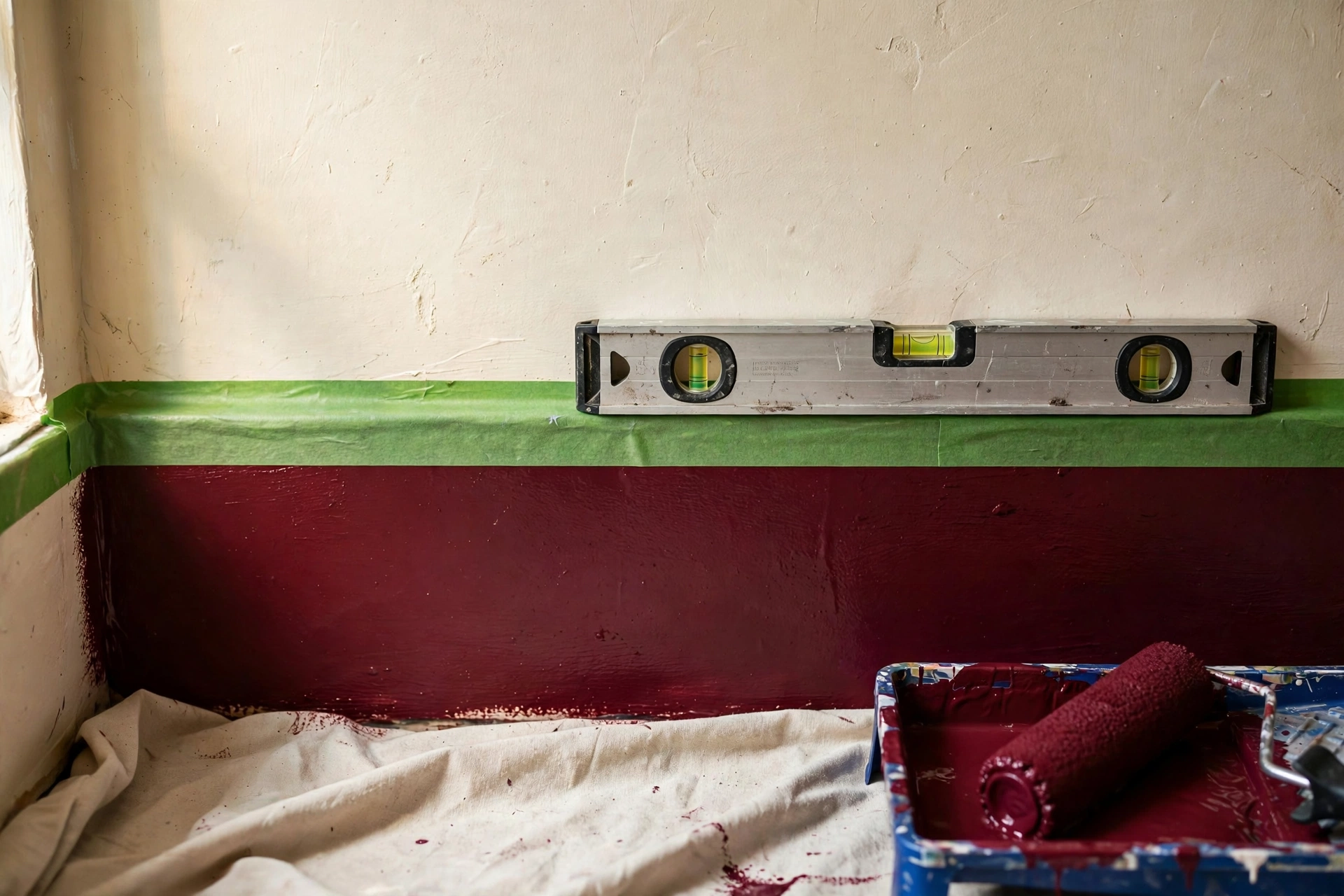
- Measure the line. Measure up from the floor at several points along the wall and mark each one lightly in pencil. Floors are rarely level, so measure from the floor at every mark, not from the ceiling down.
- Check the line with a level. Connect the marks with a long spirit level or a laser level. A line that drifts even half an inch shows across a whole wall.
- Tape the line. Run painter’s tape just above the pencil line, pressing the bottom edge down firmly. Tape in short runs of 1 to 2 feet so it cannot twist.
- Seal the tape edge. Brush a thin coat of your light top color over the tape edge and let it dry. Any bleed under the tape will be the light color, which is what seals the line crisp.
- Paint the lower half. Cut in along the tape with the angled brush, then roll the rest. Two thin coats beat one thick coat, and the second coat is what hides roller marks.
- Peel the tape while the paint is wet. Pull it off slowly at a slight angle as soon as the second coat is on. Wait until it dries and the tape can seal itself to the wall and tear the edge.
Total time for one accent wall is about 2 to 3 hours, including drying time between coats. A full room takes 5 to 6 hours spread across a day. Most of that is waiting, not painting.
What a half painted wall costs (as of November 2026)
Prices below were checked live in November 2026 at US retailers. Your store may vary by a dollar or two, and the roller kit and drop cloth are marked as check-listing because their prices change with the set.
| Item | Price |
|---|---|
| Accent paint, 1 quart (BEHR Premium Plus eggshell, Home Depot) | $33.00 |
| Painter’s tape, 1 roll (FrogTape Multi-Surface, Target) | $13.38 |
| Paint sample, 8 oz (to test the color first) | $3.00 to $5.00 |
| Small roller and tray kit | Check listing |
| Drop cloth | Check listing |
Two honest routes fall out of that table. The budget route is one sample pot at about $4 plus one roll of tape at $13.38, which comes to $17.38 and covers a single small accent wall if you already own a brush and roller. The full route is one quart at $33 plus tape at $13.38 plus a sample at $4, which comes to $50.38 and covers a whole small room’s lower half with two coats. Both totals are the sum of the checked prices above, not estimates. That quart math is the part most people skip when they plan half painted walls for small rooms, and it is the difference between one trip to the store and two.
Mistakes to avoid
Splitting exactly in half. The 50/50 split is the one placement nearly every guide warns against, and it still happens because it feels like the obvious choice. It is not. One-third or two-thirds, never one-half.
Taping with your eye instead of a level. Floors slope, ceilings slope, and your eye adjusts without telling you. The level is not optional on a line this long.
Painting the dark color first. The light color goes on first and gets painted past the line. If you reverse the order, every bleed shows dark on light and there is no easy fix.
Leaving the tape on until the paint dries. Peel while the second coat is still wet. Dry tape tears the edge and leaves a ragged line that no touch-up fully hides.
Forgetting the switches. A line that runs through a light switch or outlet plate looks unfinished. Move the line a few inches, it costs nothing and saves the whole wall.
Skipping the sample. A color that looks perfect on a swatch can go muddy or shouty across 30 square feet. The $4 sample is the cheapest insurance in this project.
What to skip
Skip the full-room two-tone in a room with textured walls. The tape cannot seal on heavy texture, and the line will bleed no matter how careful you are. Skip the diagonal split as a first project, it is genuinely harder than it looks in photos. Skip painting the lower half in flat or matte finish in a hallway or kids’ room, it marks the first week and cannot be wiped clean. And skip buying a gallon when a quart does the job. A gallon of accent paint is how a $50 project turns into a $90 project with a half-full can in the closet.
The best wall colors for small rooms are worth checking before you pick your two shades, because the split only works if both colors suit the light in the room. A north-facing room, for example, needs warm colors to fight its cool gray light, and the same split that glows in a south-facing room can look flat in a north-facing one. Choose the colors for the room you have, not the room in the photo.
Renter rules: ask first, reverse cleanly
Half-painted walls are a paint project, and paint is the one change most leases treat seriously. Check your lease before you buy anything. Most leases allow painting with written permission, some require you to repaint white before you leave, and a few ban it outright. Get the yes in writing, even if it is just an email, and keep it.
If you get the yes, paint over a light existing wall and keep the receipt for the original color. Reversing a half-painted wall means two coats of the original white over the accent half, which is a weekend afternoon, not a renovation. Tell your landlord that when you ask, it is a much easier yes than a vague request to paint.
If the lease says no, do not paint anyway. Renter-friendly wall ideas that need no paint at all, like removable panels and leaning art, give you most of the look with none of the deposit risk. The deposit you keep is worth more than any wall.
How this was made: the stop-line heights and paint quantities in this post were computed from ceiling heights and standard paint coverage, and the prices were checked live at US retailers in November 2026. No products were tested hands-on for this article.
What height should a half painted wall be?
Most half-painted walls split at one-third of the wall height, or at chair-rail height between 32 and 36 inches (81 to 91 cm). On an 8 foot ceiling, one-third is 32 inches. Taller rooms can carry a higher split closer to two-thirds. Avoid splitting the wall exactly in half, it cuts the room visually and makes the ceiling feel lower.
How do you split a wall in paint?
Paint the lighter color first, past the line, and let it dry. Measure up from the floor at several points, connect the marks with a level, and tape just above the line. Seal the tape edge with a thin coat of the light color, then paint the lower half in two thin coats and peel the tape off while the second coat is still wet.
Is it ok to half paint a wall?
Yes. A half-painted wall is a standard decorating technique, and it suits small rooms especially well because the light upper half keeps the ceiling feeling high while the darker lower half grounds the furniture. It works in bedrooms, hallways, bathrooms, and living rooms, and a single feature wall is an easy way to try it.
How high should the contrasting portion of a half-wall be?
There is no single fixed number. Take your reference from the room itself: chair-rail height at 32 to 36 inches for a classic look, one-third of the wall height for a balanced small room, or two-thirds for a bolder modern feel in a taller room. Line the split up with a window sill, a vanity top, or a chair rail when you can, and keep it clear of light switches, which usually sit at 48 inches.