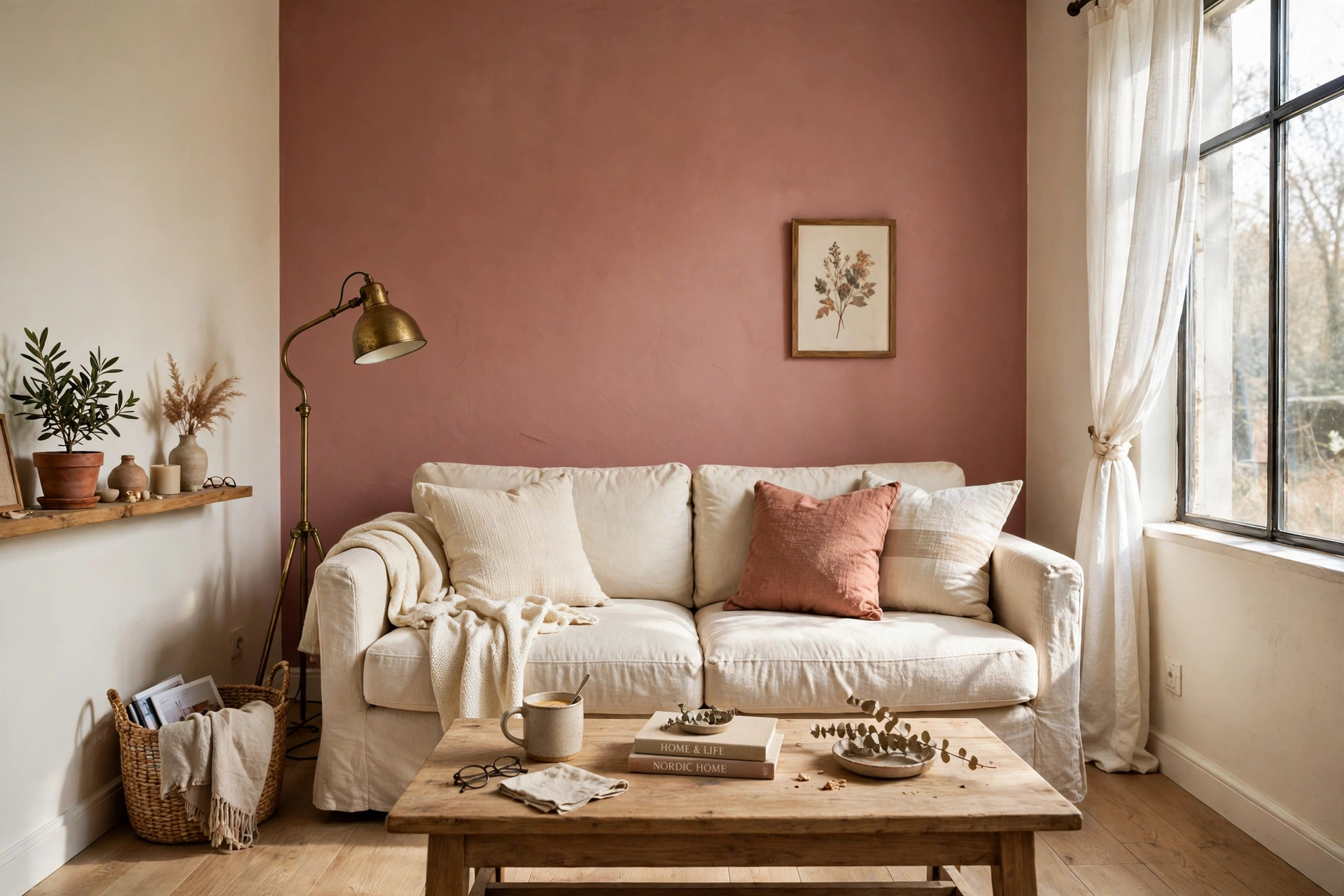
Best Paint Colors for Small Living Rooms: 7 Colors That Make a Tiny Room Feel Bigger
The best paint colors for small living rooms are warm whites, soft greiges, and one pale blue-green, ranked by how much light they bounce back. The brightest pick is Benjamin Moore Chantilly Lace at LRV 90.04, the most forgiving greige is Edgecomb Gray at LRV 63.09, and the only dark color that earns a place is Hale Navy, on one wall only. I sorted all seven colors by their verified light reflectance value, worked out that a 12 by 14 ft living room needs 2 gallons for two coats, and priced every paint line as of November 2026, and the best paint colors for small living rooms with dark furniture are ranked the same way. Pick by the number, not by the swatch, and the room will feel bigger the day the paint dries.
How do you pick the best paint colors for small living rooms?
Start with LRV, the light reflectance value. It is a number from 0 to 100 that says how much light a color bounces back. Pure white is near 100, black is near 0. A color above 80 will lift a dim room. A color between 55 and 65 gives depth without closing the walls in. Anything below 20 absorbs so much light it only works as an accent.
Undertone matters as much as LRV. A warm white with a yellow or pink undertone feels open in lamplight. A cool white with a blue undertone can read gray by 4 p.m. and make the room feel smaller, not bigger. Match the undertone to your floor first. Warm oak floors want warm paint. Cool gray floors can take a cooler color.
Here is the whole shortlist, sorted brightest to darkest by verified LRV. Every number below comes from the paint maker’s own published data.
| Color | Brand and code | LRV | Best for |
|---|---|---|---|
| Chantilly Lace | Benjamin Moore OC-65 | 90.04 | Dark rooms that need maximum lift |
| White Dove | Benjamin Moore OC-17 | 85.38 | Soft white that never reads stark |
| Alabaster | Sherwin-Williams SW 7008 | 82 | Warm white for north-facing rooms |
| Edgecomb Gray | Benjamin Moore HC-173 | 63.09 | The foolproof greige |
| Agreeable Gray | Sherwin-Williams SW 7029 | 60 | Cool greige for sunny rooms |
| Rainwashed | Sherwin-Williams SW 6211 | 59 | Soft blue-green depth |
| Accessible Beige | Sherwin-Williams SW 7036 | 58 | Warm greige for low light |
| Revere Pewter | Benjamin Moore HC-172 | 55.51 | Deeper greige, still light |
| Hale Navy | Benjamin Moore HC-154 | 6.3 | One accent wall only |
The gap between 90 and 55 is the whole decision. Above 80, the paint does the brightening for you. Between 55 and 65, the paint adds character and the room still feels open. Below 20, you are painting a feature, not a room.
Which warm white works best in a small living room?
Warm white is the safest answer, and the one most people get wrong. The mistake is buying the brightest white on the shelf. Stark white bounces light, but it also bounces every flaw, and under warm bulbs it can look flat and cold at the same time.
Chantilly Lace (OC-65) is my top pick for a living room that gets little natural light. At LRV 90.04 it reflects about 90 percent of the light that hits it, which is the highest of any color here. It has almost no undertone, so it stays white in morning sun and in lamplight. Best for: dark or north-facing living rooms. Main advantage: maximum brightness without a color cast. Watch out for: it shows every scuff and every uneven patch, so prep matters more than with any other color. Verdict: the brightest tool in the box. Use it when light is the problem.
White Dove (OC-17) is the softer choice, at LRV 85.38. It reads as a warm, creamy white next to Chantilly Lace, and it is far more forgiving on older walls. If your living room has textured plaster or a few dings you cannot fix, White Dove hides them better. Best for: lived-in rooms with warm wood furniture. Main advantage: soft and warm without going yellow. Watch out for: in a very dark room it can look dingy next to bright white trim, so keep the trim only slightly lighter, not stark white. Verdict: the white I would pick for most small living rooms.
Alabaster (SW 7008), at LRV 82, is the warmest of the three whites. It has a soft beige undertone that pairs well with honey oak and brass, and it is a strong pick when your room faces north and the light runs cool all day. If you want the full picture on direction, the guide to paint colors for north-facing rooms covers the cold-light problem in depth. Best for: north-facing living rooms and warm wood floors. Main advantage: warmth that never tips yellow. Watch out for: next to cool gray furniture it can look slightly creamy, so test it against your sofa fabric. Verdict: the cozy white. Pick it when the room feels cold, not dark.
If you are choosing between these three, the rule is simple. Dark room, Chantilly Lace. Lived-in room, White Dove. Cold light, Alabaster. The best wall colors for small rooms follow the same logic, and the same three whites top that list too.
What greige paint color makes a small living room feel bigger?
Greige, the mix of gray and beige, is where small living rooms get their character. A good greige adds depth that white cannot, and at LRV 55 to 63 it still reflects more than half the light in the room. The trick is picking the undertone that matches your light.
Edgecomb Gray (HC-173) is the most forgiving greige I found, at LRV 63.09. It is a warm greige with a slight green hint that shifts through the day, light and airy in the morning, warmer by evening. It works with oak, walnut, brass, black metal, and linen, which is why it shows up in so many small living rooms. Best for: any living room where you want color without commitment. Main advantage: it goes with everything and never reads muddy. Watch out for: in a room with very cool LED bulbs it can lose warmth, so use 2700K warm bulbs. Verdict: the one greige that almost never fails.
Accessible Beige (SW 7036), at LRV 58, is warmer and a touch deeper than Edgecomb Gray. It is Sherwin-Williams’ most popular warm neutral for a reason. In a low-light living room it holds its warmth where cooler grays would go flat. Best for: low-light rooms and warm wood floors. Main advantage: cozy and grounded without shrinking the room. Watch out for: next to very cool gray flooring it can clash slightly, so check it against your floor first. Verdict: the warm greige. Pick it when Edgecomb Gray feels too pale.
Agreeable Gray (SW 7029), at LRV 60, is the cooler cousin. It has a slight violet undertone and reads cleaner and more modern than Accessible Beige. It suits south-facing rooms with strong sun, where a warm greige would look too yellow by midday. Best for: sunny, south-facing living rooms. Main advantage: modern and clean without going cold. Watch out for: in a north-facing room it can tip gray and dull, so do not use it there. Verdict: the sunny-room greige. Pick it only when the room gets real sun.
Revere Pewter (HC-172), at LRV 55.51, is the deepest greige in this list. It is a little darker than Edgecomb Gray and reads more gray than beige. It works when you want the walls to have real presence, for example behind a dark sofa or a walnut media unit. That range, from Edgecomb Gray at 63 down to Revere Pewter at 55, is why greige leads most lists of the best paint colors for small living rooms. Best for: living rooms with dark furniture that need the walls to hold their own. Main advantage: depth without darkness. Watch out for: in a small room with one small window it can feel heavy, so keep the ceiling and trim white. Verdict: the boldest safe greige. Use it when the furniture is darker than the walls.
Does a soft blue-green make a small living room look bigger?
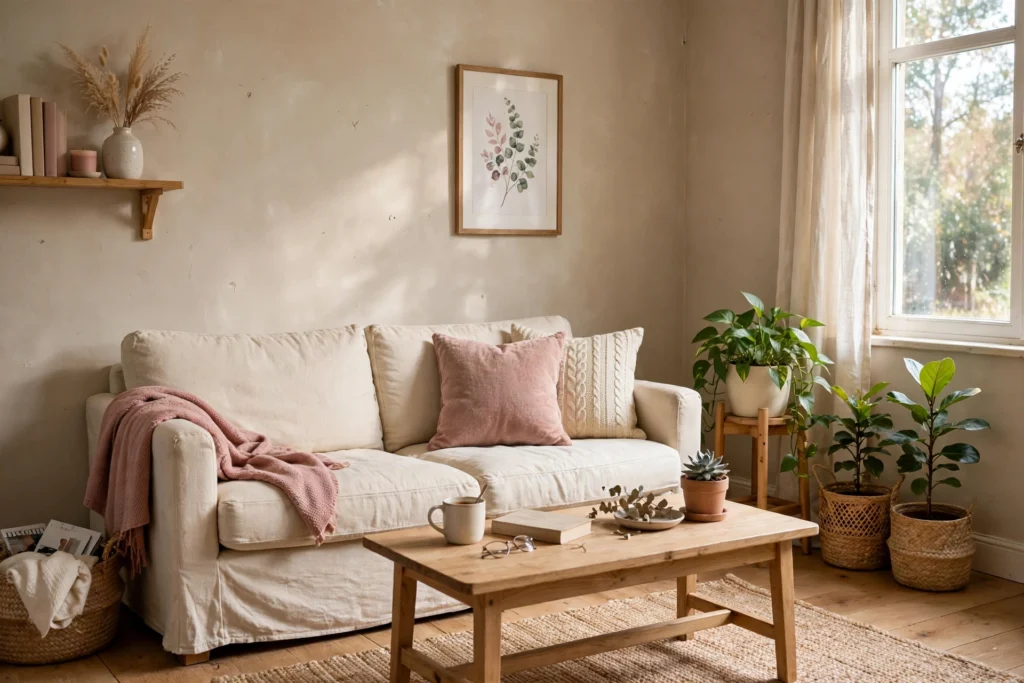
Yes, if it is pale and muted. A soft blue-green does something no neutral can do. It creates visual depth, so the walls feel farther away than they are. The key word is soft. A bold teal will close a small room in. A muted blue-green opens it up.
Rainwashed (SW 6211), at LRV 59, is my pick. It is a pale blue-green that reads almost gray in low light and fresh and airy in daylight. It pairs well with light oak, white trim, and brass, and it is one of the few colors that makes a narrow living room feel longer. Best for: narrow or long living rooms and rooms with good natural light. Main advantage: depth and calm in one color. Watch out for: in a north-facing room it can tip gray-blue, so test a large swatch first. Verdict: the only color pick in this list. Use it when white and greige feel too safe.
A second blue-green worth a swatch is Benjamin Moore Gossamer Blue. I did not print an LRV for it because I could not verify the number from the maker’s published data this week, and I will not guess at a figure. What the sources agree on is that it is a mid-light blue-green that behaves like Rainwashed, airy in daylight, grayer at night.
Can you paint one wall dark in a small living room?
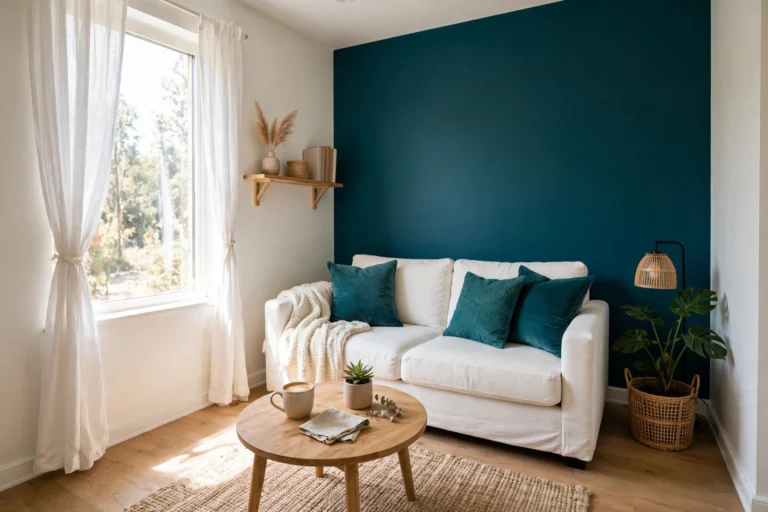
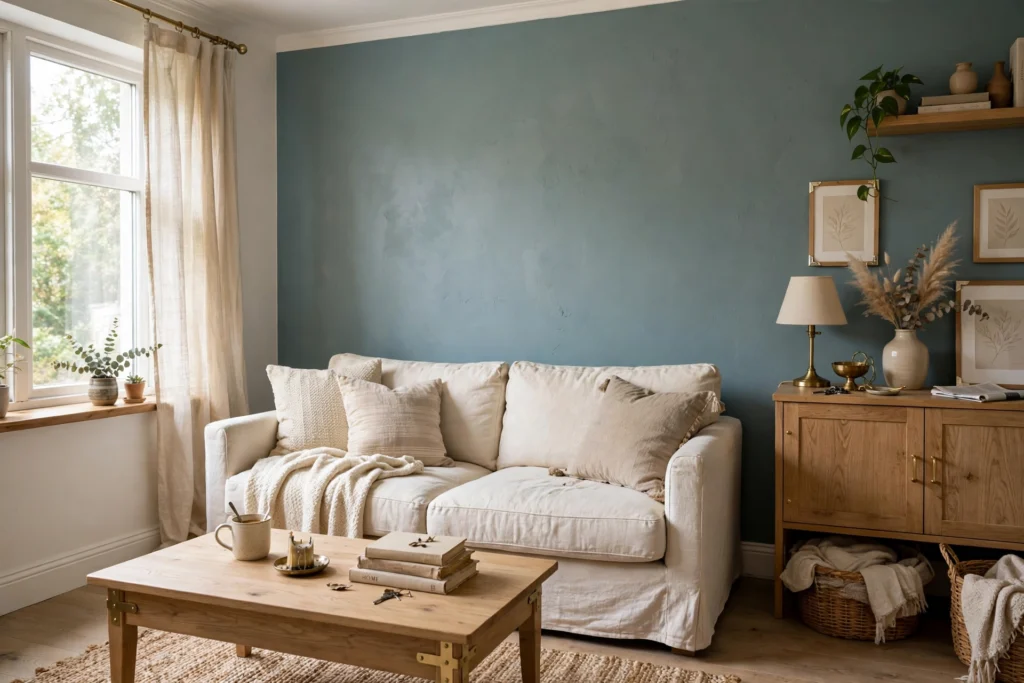
Yes, and it is the most underrated move in this list. One dark wall adds depth the way a window adds a view, and the same one-wall trick leads our guide to the best paint colors for small bedrooms. The rest of the room stays light, so the dark wall reads as a backdrop, not a box. The rule is one wall only, and it must be the right wall. Pick the wall your sofa sits against, or the wall with the fireplace or TV. Never paint the wall with the window dark, because you will kill the light coming in.
Hale Navy (HC-154), at LRV 6.3, is the dark pick. It reflects only about 6 percent of light, so it absorbs the wall behind the sofa and makes the room feel deeper. It pairs with warm whites on the other three walls, light oak, and brass. Best for: one feature wall behind a sofa or media unit. Main advantage: instant depth and a designer look for the price of one gallon. Watch out for: it needs two coats over white, and it shows roller marks if you rush, so use a good roller and keep a wet edge. Verdict: the drama pick. One wall, done well, beats four pale walls.
If you want the full menu of feature-wall treatments, from painted arches to wood slats, the accent wall ideas that add depth cover twelve treatments with costs. Paint is the cheapest of them, and navy is the most forgiving dark color to start with.
Which paint color suits your living room’s light direction?
Light direction decides more than taste does. The same color can look warm in a south-facing room and gray in a north-facing one. Here is the quick match.
| Direction | Light | Best picks from this list | Avoid |
|---|---|---|---|
| North-facing | Cool, indirect all day | Alabaster, Accessible Beige, White Dove | Agreeable Gray, Rainwashed |
| South-facing | Strong, warm sun | Agreeable Gray, Rainwashed, Edgecomb Gray | Hale Navy on the sun wall |
| East-facing | Warm morning, cool afternoon | Edgecomb Gray, White Dove | Very cool whites |
| West-facing | Cool morning, warm evening | White Dove, Rainwashed, Revere Pewter | Stark white |
North-facing rooms are the hardest, and they get their own full guide. If your living room faces north, read the paint colors for north-facing rooms before you buy, because the cold-light rules there are stricter than the general advice here.
Two more direction notes. A room with one small window behaves like a north-facing room even if it faces south, so pick from the north column. And a room with floor-to-ceiling windows can take a deeper color on every wall, because the light compensates.
How much paint and money does a small living room need?
This is the part most guides skip, and it is where budgets go wrong. Here is the math for a typical small living room, 12 by 14 ft with 8 ft ceilings.
Wall area is the perimeter times the height. The perimeter is 12 plus 14, doubled, which is 52 ft. Times 8 ft of height, that is 416 sq ft of wall. Subtract one door (about 21 sq ft) and one window (about 15 sq ft) and you get roughly 380 sq ft per coat. Two coats means about 760 sq ft of painting. At the makers’ coverage of 350 to 400 sq ft per gallon, that is 1.9 gallons, so buy 2 gallons. One gallon will leave you short halfway through the second coat, and a mid-wall paint run shows forever.
Paint prices, per gallon, as of November 2026, from live-checked US retail listings. Sherwin-Williams runs 30 to 40 percent off sales several times a year, so treat its list prices as the ceiling, not the floor.
| Paint line | Price per gallon | 2 gallons | Best for |
|---|---|---|---|
| BEHR Premium Plus | $29 to $41 | $58 to $82 | Budget route, rentals |
| BEHR Marquee | $50 to $55 | $100 to $110 | One-coat coverage claims |
| Benjamin Moore ben | about $61 | about $122 | Mid-range, good hide |
| Benjamin Moore Regal Select | $65 to $85 | $130 to $170 | The workhorse pick |
| Benjamin Moore Aura | $95 to $110 | $190 to $220 | Best coverage, richest color |
| Sherwin-Williams Cashmere | $83 to $88 | $166 to $176 | Smooth finish, low odor |
| Sherwin-Williams Duration Home | $96 to $101 | $192 to $202 | Washable, family rooms |
| Sherwin-Williams Emerald | $101 to $106 | $202 to $212 | Top line, often on sale |
Add supplies. A good roller set, tray, 2-inch angled brush, painter’s tape, drop cloth, and a stir stick run about $40 to $60. So the full project lands at about $100 to $140 on the budget route with BEHR Premium Plus, about $170 to $230 with Regal Select, and about $230 to $280 with Aura. Time is one weekend, roughly 6 to 8 hours spread over two days, with drying time between coats. That is the honest total, paint plus supplies, not just the price on the can.
One money tip that saves real cash. Buy the sample pots first, about $5 to $8 each, and test two finalists. A $16 test beats a $170 mistake. And if you use Sherwin-Williams, wait for a 30 to 40 percent off sale, which can drop Emerald below the price of Regal Select.
What you need, and the 7 steps
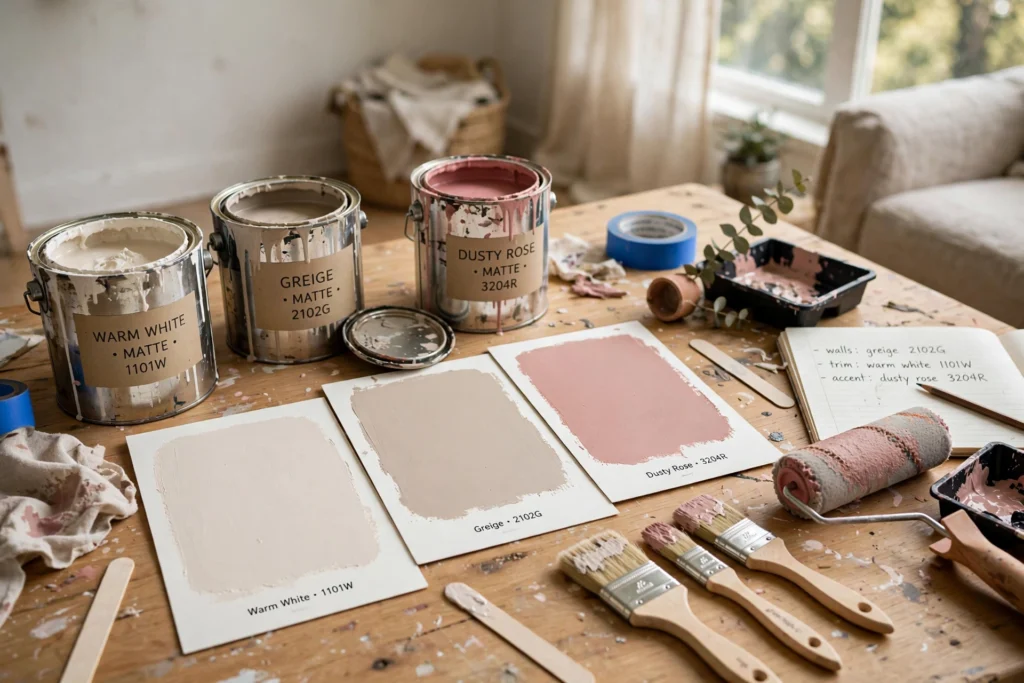
Materials list: 2 gallons of your chosen paint, 1 quart of primer if you are covering a dark color, a 9-inch roller frame with 3/8-inch nap covers, a 2-inch angled brush, a paint tray with liners, painter’s tape, a canvas drop cloth, a stir stick, a 5-in-1 tool, and sample pots of your two finalists.
Steps:
- Measure and buy. Measure the walls, do the math above, and buy 2 gallons plus primer if needed.
- Test large swatches. Paint a 2 by 2 ft square of each finalist on the wall you see most, and live with it for a full day.
- Prep the room. Move furniture to the center, cover it, tape the trim, and fill holes with spackle.
- Cut in the edges. Brush a 2 to 3 inch band along the ceiling, trim, and corners.
- Roll the first coat. Work in 4 ft sections, keep a wet edge, and roll from dry into wet.
- Let it dry, then roll the second coat. Wait the time on the can, usually 2 to 4 hours, then repeat.
- Peel tape and clean up. Pull the tape while the second coat is still slightly tacky, at a 45-degree angle.
Mistakes to avoid
Skipping primer over a dark color. A dark wall will ghost through one coat of light paint, and you will end up buying a third gallon. Prime first.
Testing on a tiny swatch. A 2-inch chip tells you nothing. Paint a 2 by 2 ft square and look at it in morning light, afternoon light, and lamplight.
Buying one gallon for two coats. The math above says 2 gallons. One gallon runs out mid-wall, and the overlap line never hides.
Ignoring the undertone against your floor. Hold the swatch against the floor, not against the white ceiling. The floor is the color the paint has to live with.
Painting the ceiling bright white against cream walls. The hard contrast line cuts the room in half visually. Use the wall color at half strength on the ceiling, or the same color in flat finish.
Using flat paint in a busy living room. Flat hides flaws but marks easily. Eggshell is the right finish for living room walls, satin for trim, flat for the ceiling.
What to skip
An accent wall on every wall. That is not an accent, it is just a dark room. One wall only.
The color of the year, untested. Trend colors are designed to photograph well, not to live with. If you love one, test it as the accent wall first.
The cheapest paint that needs three coats. A $29 gallon that needs three coats costs more than a $65 gallon that needs two, and it costs a weekend too.
Painting over wallpaper. It peels, it bubbles, and the seams show through. Strip it or leave it alone.
A dark ceiling in a low room. It can work in a tall room, and color drenching a small room has its place, but with 8 ft ceilings a dark ceiling presses the room down. Keep the ceiling light.
What if you cannot paint? A renter-safe color plan
Check your lease first. Most leases allow painting with permission and require you to repaint to the original color before you move out. Ask in writing, keep the answer, and note the original color name on the can if you can find it. Budget one extra gallon of the original white for move-out day, and keep the receipt. That is your deposit protection.
If the answer is no, you can still get the color without paint. Peel-and-stick wallpaper on one wall gives you the accent-wall effect and removes cleanly. Large-scale art, a dusty rose throw and cushions, and curtains in your accent color do most of what paint does, for less money and zero deposit risk. A tall bookshelf painted in your accent color, placed against the wall, reads as a feature wall from across the room.
Sources
- Paint prices per gallon, as of November 2026: thepricer.org cost-of-a-gallon-of-paint page (BEHR Premium Plus $28.98 flat, BM Regal Select $84.99 matte, SW Emerald $101.49 to $106.49) and the paintdeck.co Benjamin Moore vs Sherwin-Williams comparison (Aura about $109, Regal $79 to $85, ben about $61, Behr Marquee $50 to $60).
- LRV figures: Benjamin Moore and Sherwin-Williams published color data, cross-checked against color guides that cite the makers’ numbers (Edgecomb Gray 63.09, Accessible Beige 58, Revere Pewter 55.51, Agreeable Gray 60).
- Coverage rates: 350 to 400 sq ft per gallon for premium interior lines, 400 to 450 sq ft per gallon for Benjamin Moore Regal Select, per manufacturer ratings cited in 2026 brand comparisons.
How this was made: LRV figures and prices were checked against live sources on November 13, 2026, and the paint math was computed from the room dimensions in the article. No paint was tested in person and no color was tried on a real wall for this post.
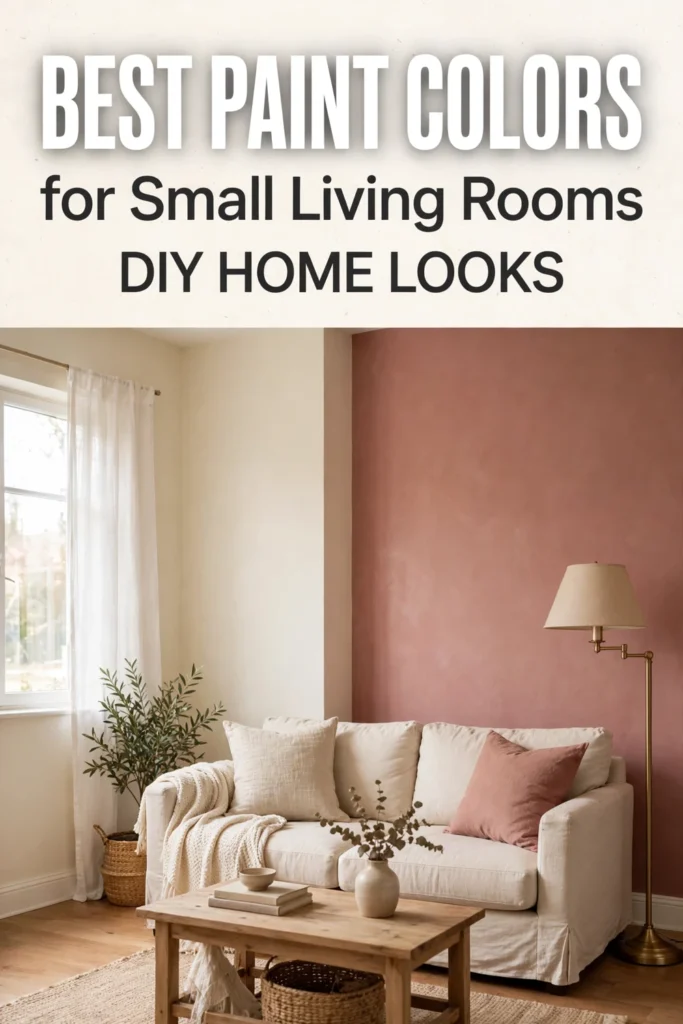
What is the best color to paint a small living room?
Light, warm colors with a high LRV are the best paint colors for small living rooms, because they reflect more light and make walls appear to recede. Warm whites like Chantilly Lace and White Dove, and soft greiges like Edgecomb Gray, are the safest picks. For character, add one pale blue-green or one dark accent wall, and keep the other three walls light.
What is the best wall color for a small living room?
A warm white with a yellow or pink undertone, such as Benjamin Moore White Dove or Sherwin-Williams Alabaster. It reflects light without going cold under artificial bulbs, and it pairs with almost any furniture. Avoid blue-based whites in small rooms, because they read gray by afternoon.
What color makes a small living room look bigger?
The colors with the highest LRV make a room look biggest, because they bounce the most light. Chantilly Lace at LRV 90.04 and White Dove at 85.38 are the top two here. But a pale blue-green like Rainwashed can also make a room feel bigger, because its cool tone creates visual depth that pushes the walls back.
Should you paint a small living room dark or light?
Light on three walls, dark on one wall at most. All four walls dark will shrink a small living room and eat the light. One dark accent wall behind the sofa, with light walls everywhere else, adds depth without closing the room in. If your room has only one small window, skip the dark wall entirely and stay light.