
Best Tension Pole Storage Systems for Renters and Small Rooms: 7 Picks That Hold Real Weight
The best tension pole storage systems for renters are the ones that match the job, not the ones with the biggest number on the box. A shower caddy, a closet shelf, and a book tower all use the same trick, a pole wedged between floor and ceiling, but they hold very different weights. This guide compares seven systems by load limits from the makers, ceiling-height fit, and prices checked in November 2026, plus a fit table and a cost table the top roundups skip. Nothing here was tested in our own home, and the post never claims it was. Every limit below is the maker’s own number.
How to pick the best tension pole storage systems for your room
Start with the job, not the product. A pole that holds shampoo bottles will not hold winter coats, and a closet system will not fit in a shower corner. A tension pole presses vertically between floor and ceiling. A tension rod presses horizontally between two walls. Poles carry weight down to the floor. Rods hang weight from friction, so they hold far less. If a listing calls a horizontal shelf a “tension pole,” read the photos, not the title.
My opinion, plainly: the heavy-duty claims are the overrated part of this category. The underrated part is measuring your ceiling first. A pole that almost fits is a pole that falls over at 2 a.m. Measure floor to ceiling in two spots, because floors slope, and use the taller number.
Measure first: will it fit your ceiling?
Most rental ceilings are 8 feet, which is 96 inches or 244 cm. Older flats can be 7 feet (84 in / 213 cm), and some newer builds run 9 feet (108 in / 274 cm). The pole’s range has to cover your ceiling with room to spare.
| System | Height range | Fits an 8 ft ceiling? |
|---|---|---|
| HAMITOR 4-tier caddy | 47 to 121 in (119 to 307 cm) | Yes, 25 in to spare |
| Bath Bliss 4-tier caddy | 48 to 101 in (122 to 257 cm) | Yes, 5 in to spare |
| ALLZONE 5-tier bookshelf | 92 to 116 in (234 to 295 cm) | Yes, 4 in to spare |
| BAOYOUNI 7-layer plant pole | 90 to 114 in (230 to 290 cm) | Yes |
| Prince Hanger closet system | Adjustable, floor to ceiling | Yes |
Check the floor too. A pole on thick carpet can wobble, and several roundups flag this on the ALLZONE bookshelf. A hard floor, or a small flat board under the foot, keeps it steady. Check what is above the pole as well. If your ceiling is a drop-tile grid or a false ceiling, stop. Tension poles need a solid, flat ceiling, and pressing one into a false ceiling can crack the panel. Our false ceiling designs guide explains which ceilings are solid and which are not.
The 7 picks, by job
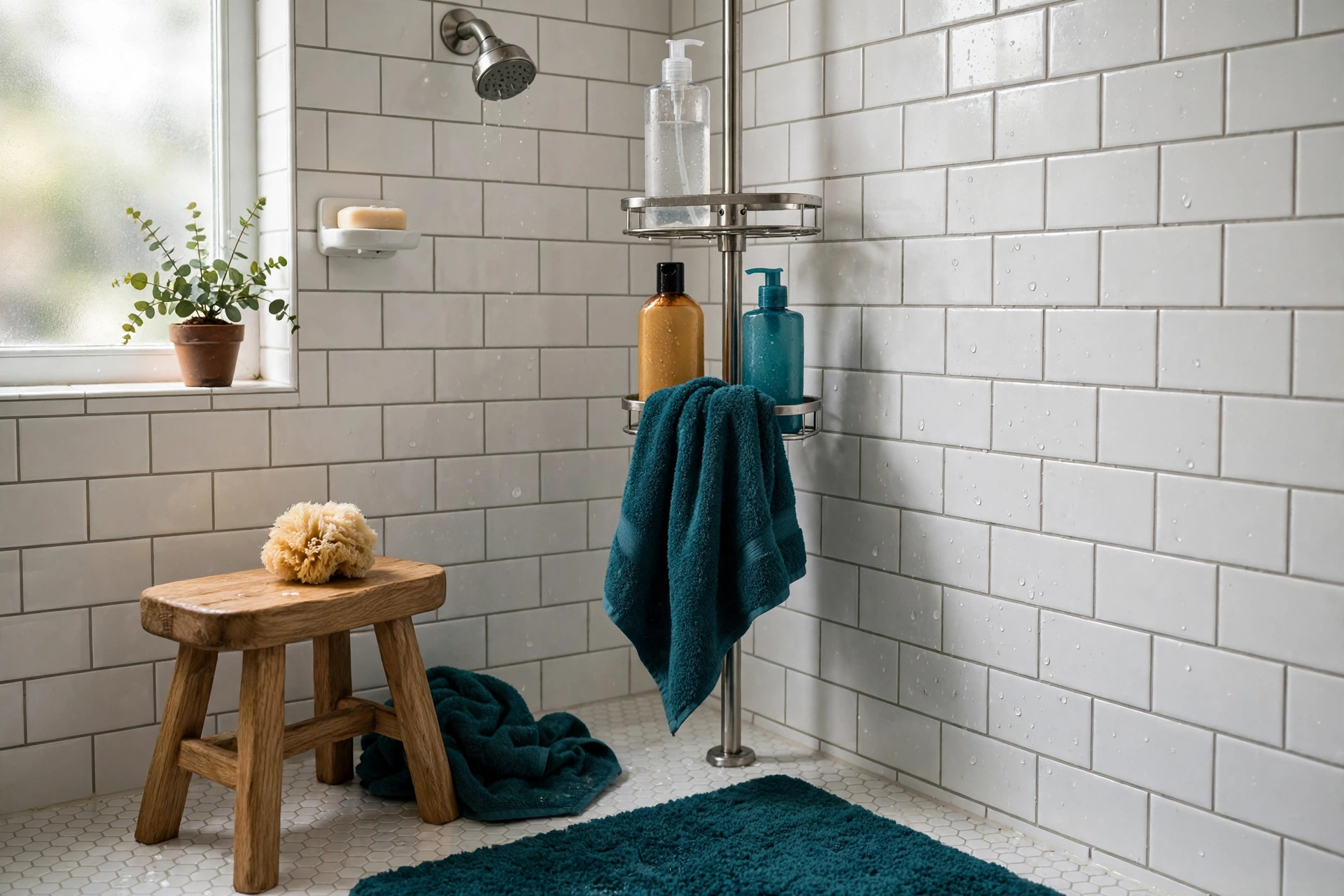
1. Best for the shower corner: HAMITOR 4-Tier Corner Shower Caddy, $29.69. Best for: a shared bathroom where bottles live on the tub edge. Main advantage: four rust-resistant baskets on a stainless pole, with a towel bar and hooks, and the baskets slide to fit tall bottles. Watch out for: the per-shelf limit is 20 lb on the Target listing, while some Amazon listings say 22 lb, so plan on 20. Verdict: the safest default shower pick, with 4.3 out of 5 from 3,724 ratings. Deposit risk: 1 out of 5. If the shower corner is only part of the problem, our renter-friendly bathroom storage guide covers the rest of the room without drilling.
2. Best budget shower caddy: Bath Bliss 4-Tier Tension Corner Shower Caddy, $19.99. Best for: a renter who wants the same corner storage for ten dollars less. Main advantage: the lowest verified price in this guide, on a spring-loaded pole that expands from 4 ft to 8.5 ft. Watch out for: the maker does not publish a per-shelf limit, so treat it as light bottles only. Verdict: buy this one if the budget is tight and the load is light. Deposit risk: 1 out of 5.
3. Best for a closet shelf: BAOYOUNI Expandable Closet Tension Shelf, $25.28. Best for: adding one more shelf inside a closet or cabinet without a single screw. Main advantage: it expands wall to wall and locks, and the maker rates it at 40 lb on flat, clean surfaces. Watch out for: it needs two solid facing walls, and textured walls grip worse than smooth paint or tile. Verdict: the cheapest way to add a real shelf to a closet, and the strongest per dollar here. Deposit risk: 1 out of 5.
4. Best for books and plants: ALLZONE 5-Tier Tall Bookshelf, $99.99. Best for: a living room corner that needs a bookcase without losing floor space. Main advantage: five open shelves on a floor-to-ceiling tension mount, with adjustable heights. Watch out for: it needs a ceiling of at least 92 inches, and it ships with an anti-tip kit that needs one small wall fixing, so ask your landlord before using that strap. Verdict: the best-looking pick here, but the only one that asks you to drill anything. Deposit risk: 2 out of 5, because of the strap.
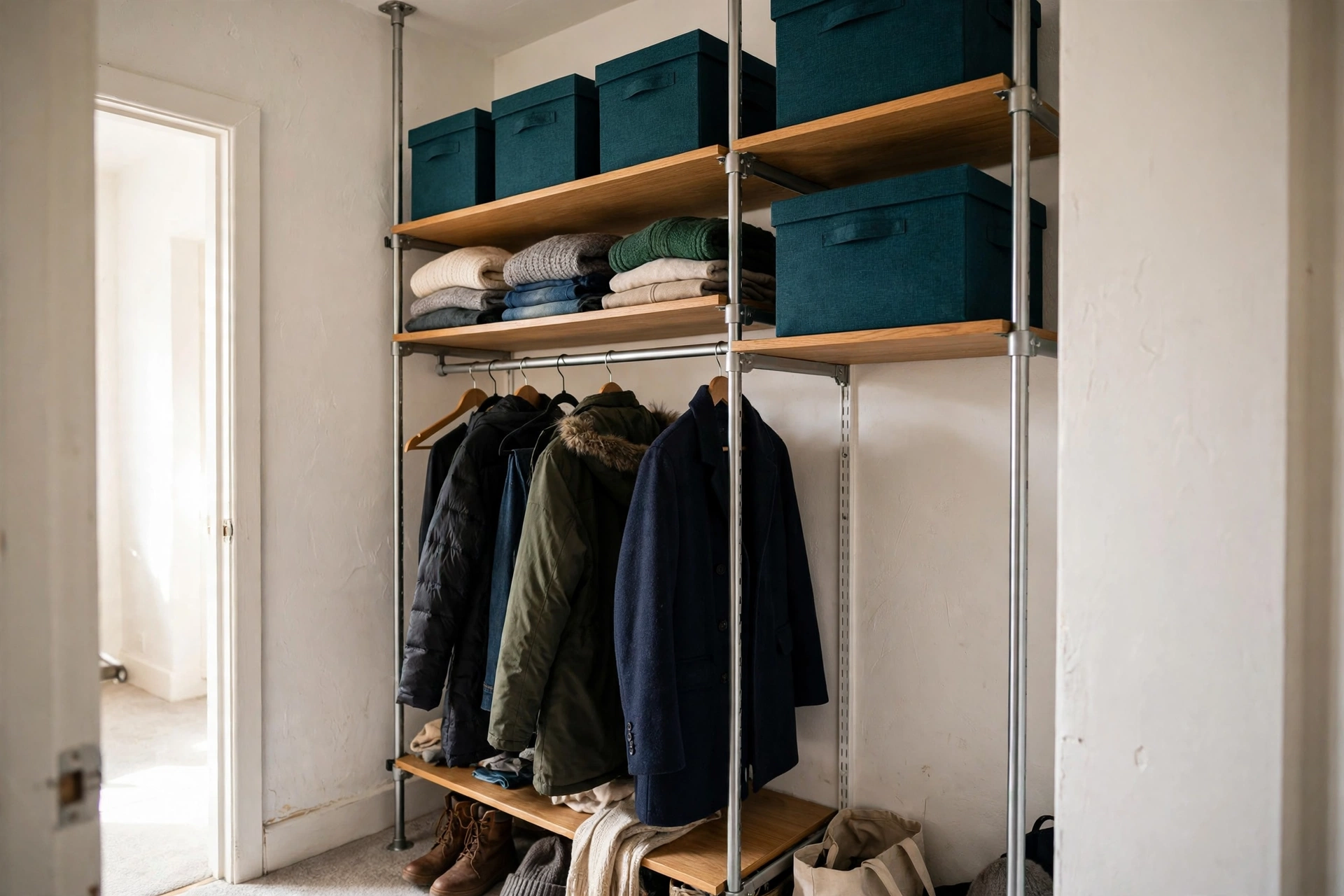
5. Best for heavy clothes: Prince Hanger Double 2Tier Closet System, about $100. Best for: a bedroom corner that has to hold winter coats, bins, and shoes at once. Main advantage: two steel poles carry the weight straight down to the floor, and each section is rated at 60 lb, the highest in this guide. Watch out for: the price is an older report from 2020, so check the current listing before budgeting. Verdict: the heavy lifter. If a drilled system is allowed in your lease, our reach-in closet systems comparison covers the screwed-in options. Deposit risk: 1 out of 5.
6. Best for plants: BAOYOUNI 7-Layer Plant Pole, about $75 to $80. Best for: a corner full of plants that has run out of windowsill. Main advantage: seven trays that rotate, so every plant can face the light, on a rust-proof pole. Watch out for: the price is from Australian and Canadian listings, $74.99 and $79.99, so US sellers vary, and wet soil is heavy, so keep the heaviest pots low. Verdict: a lovely corner piece, but check the US price first. Deposit risk: 1 out of 5.
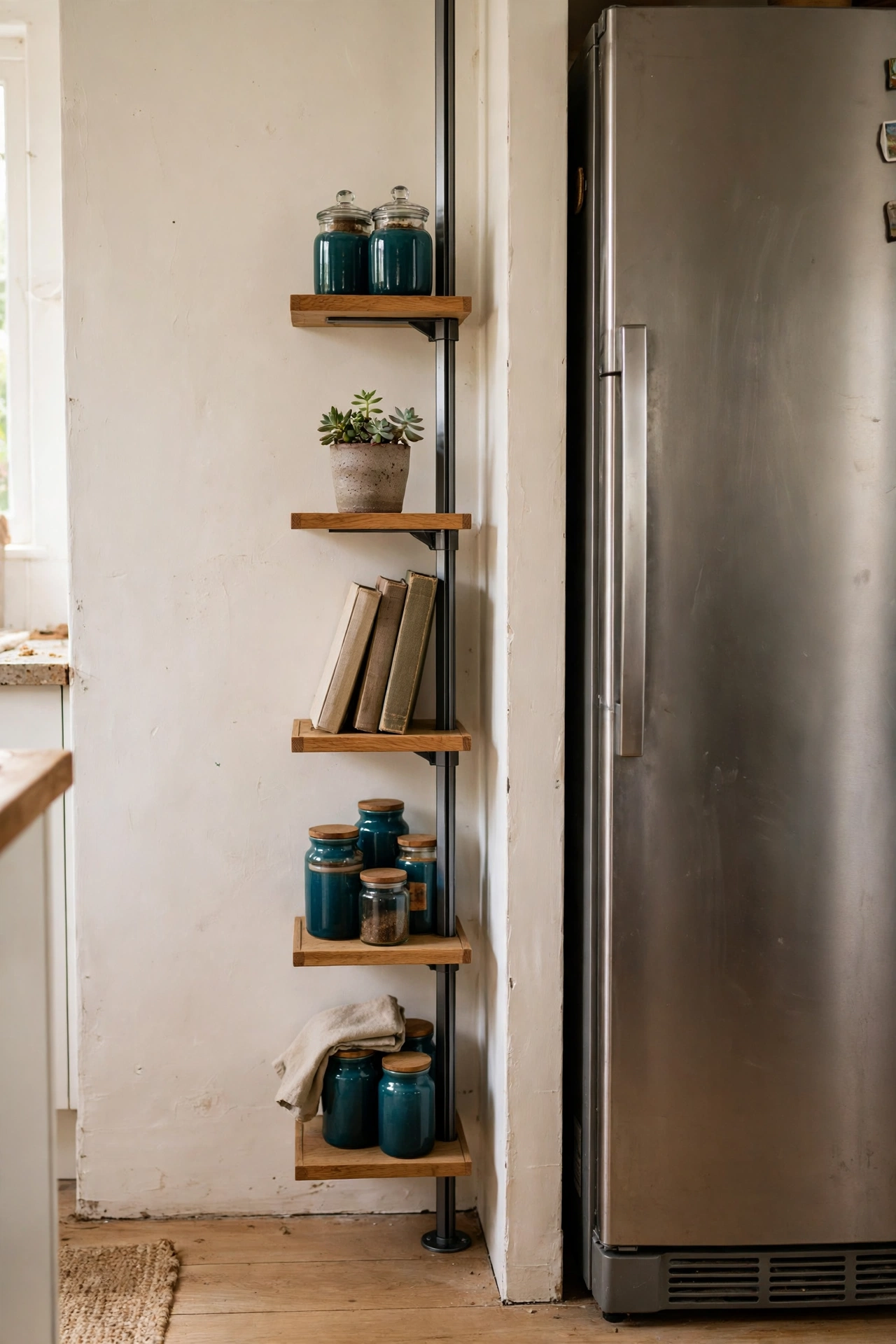
7. Best for a corner display: ALLZONE Tiered Tension Corner Shelving, 15 lb per tray. Best for: a corner that needs display space for books, plants, or bathroom supplies. Main advantage: one pole, four trays, each rated at 15 lb, which adds up to 60 lb across the unit. Watch out for: a metre of hardback books weighs 20 to 30 kg, which is 44 to 66 lb, so one tray holds only about 9 to 13 inches of hardbacks. Verdict: great for plants and light storage, wrong for a full book collection. Deposit risk: 1 out of 5.
What the load limits really mean
Makers quote the number that flatters them. The per-shelf number is the one to trust, never the whole-system total. The best tension pole storage systems earn their place here by stating a per-shelf limit at all.
| System | Per-shelf limit | Whole-system total |
|---|---|---|
| Prince Hanger, 2-pole | 60 lb per section | 60 lb per section |
| BAOYOUNI expandable shelf | 40 lb | 40 lb |
| Home in Bold shelf | 25 lb | 25 lb |
| HAMITOR caddy | 20 lb per shelf | 80 lb across 4 shelves |
| ALLZONE corner trays | 15 lb per tray | 60 lb across 4 trays |
| Geetery 4-pack shelves | 44 lb per shelf (maker claim) | 176 lb (maker claim) |
Two notes. The Home in Bold listing claims up to 50 lb, while a review roundup puts it at 25 lb. Trust the lower number. The Geetery 44 lb figure is a maker claim, not a test. Two rules follow. Load falls as the pole gets longer, because a longer pole bends more easily. And never load the top shelf heaviest. A tension-rod maker’s own guide to garment weights puts a leather jacket at 4 to 7 lb, which shows how fast a rail fills up, and a no-drill shelving glossary that puts most pole shelves at 20 to 40 lb in total backs up the light end of this table.
Which ceilings work, and which do not
Solid plaster or drywall on joists: yes, this is what tension poles are made for. A flat ceiling spreads the pressure, and the rubber cap protects the paint. Tiled bathroom ceilings: yes, if the tiles are flat and firmly fixed. Sloped ceilings: no, the pole cannot sit square, and it will slide. Drop-tile ceilings: no, the grid will bend or pop out. False ceilings: no, the panel can crack under pressure. If you are unsure what your ceiling is, press it gently. If it gives, do not use a tension pole there.
The renter check comes before you buy, not after it falls down. Read your lease for two lines: one about fixings in walls and ceilings, and one about damage at move-out. A tension pole needs no permission in most leases because it makes no holes, but the ALLZONE bookshelf’s anti-tip strap does need a fixing, so ask first. Photograph the ceiling and floor before you install, and check the pole every few weeks in a bathroom, because humidity can loosen the spring slightly. Removal takes minutes: release the tension, lift the pole out, wipe the caps’ marks off with a damp cloth. Tension poles are one tool in a bigger system, and our whole-home organization guide shows where each room’s storage belongs.
What it costs
Prices checked in November 2026. The starter kit is the budget route, two systems that cover the two most common jobs, a shower corner and a closet shelf. The best tension pole storage systems are not the priciest ones: the two cheapest picks cover the two most common jobs for $45.27.
| Item | Price, as of November 2026 | Source |
|---|---|---|
| Bath Bliss 4-tier shower caddy | $19.99 | Target |
| BAOYOUNI expandable closet shelf | $25.28 | Amazon |
| HAMITOR 4-tier shower caddy | $29.69 | Amazon |
| ALLZONE 5-tier bookshelf | $99.99 | TikTok Shop listing |
| Budget starter kit (Bath Bliss + BAOYOUNI) | $45.27 | |
| Recommended set (HAMITOR + BAOYOUNI) | $54.97 | |
| All four above | $174.95 |
Allow about 15 minutes to install one pole, and about 10 minutes to take it down again. No tools are needed for any pick except the ALLZONE bookshelf’s optional anti-tip strap.
How to install a tension pole in 7 steps
- Measure floor to ceiling in two spots and use the taller number.
- Check the ceiling is solid and flat, not a drop tile or false ceiling.
- Slide the shelves or baskets onto the pole at roughly the heights you want.
- Stand the pole in the corner and extend it until the top cap touches the ceiling.
- Twist or pump the tension mechanism until the pole is snug, then give it a firm push to test it.
- Tighten only as the maker directs. Over-tightening can mark soft plaster, so stop when it stops moving.
- Load the shelves heaviest at the bottom, lightest at the top, then check the pole again after a day.
Mistakes to avoid
Do not skip measuring. A pole that is 2 inches too short will not hold, and a pole forced into a low ceiling can mark the paint. Do not put the heaviest load on the top shelf. Do not use a tension pole on a sloped or false ceiling, and do not trust a single listing’s biggest number. The Home in Bold shelf is the cautionary tale: its listing claims up to 50 lb, while a review roundup puts it at 25 lb. Do not forget the bathroom humidity check. A pole that was tight in winter can loosen slightly in a steamy bathroom, so give it a twist every few weeks.
What to skip
Skip the cheapest no-name pole with no load rating at all. If the maker will not state a number, you are the test, and your shampoo bottles are the test subjects. Skip tension rods sold as pole systems, because a horizontal rod will not hold what a vertical pole holds. Skip the anti-tip strap if your landlord says no, and skip the bookshelf instead of drilling without asking. And skip buying two shower caddies when one good one holds the whole family’s bottles. One HAMITOR at $29.69 does the job that two cheap caddies pretend to do.
FAQ
How much weight can a tension pole hold?
It depends on the system. Light pole shelves hold 20 to 40 lb in total. A HAMITOR shower caddy holds 20 lb per shelf. A BAOYOUNI expandable shelf holds 40 lb. A Prince Hanger closet system holds 60 lb per section. Always plan around the per-shelf number, never the whole-system total, and keep heavy items low.
Will a tension pole damage my ceiling?
Not if the ceiling is solid and flat and you tighten only as the maker directs. The rubber cap spreads the pressure, and most renters remove the pole with no mark at all. Over-tightening can dent soft plaster, and a pole must never go on a drop-tile or false ceiling, which can crack or bend.
Do tension pole shelves work on all ceilings?
No. They work on solid flat ceilings, including tiled bathroom ceilings. They do not work on sloped ceilings, drop-tile grids, or false ceilings. They also struggle on thick carpet, where the foot can wobble, so use a hard floor or a flat board under the foot.
What is the difference between a tension pole and a tension rod?
A tension pole presses vertically between floor and ceiling and carries weight down to the floor, so it holds far more. A tension rod presses horizontally between two walls and holds weight by friction, so it suits light things like a single shelf of folded clothes. For books, coats, or full bottles, buy the pole.