7 DIY Wall-Mounted Folding Desk Builds for Small Rooms That Fold Flat When You Are Done
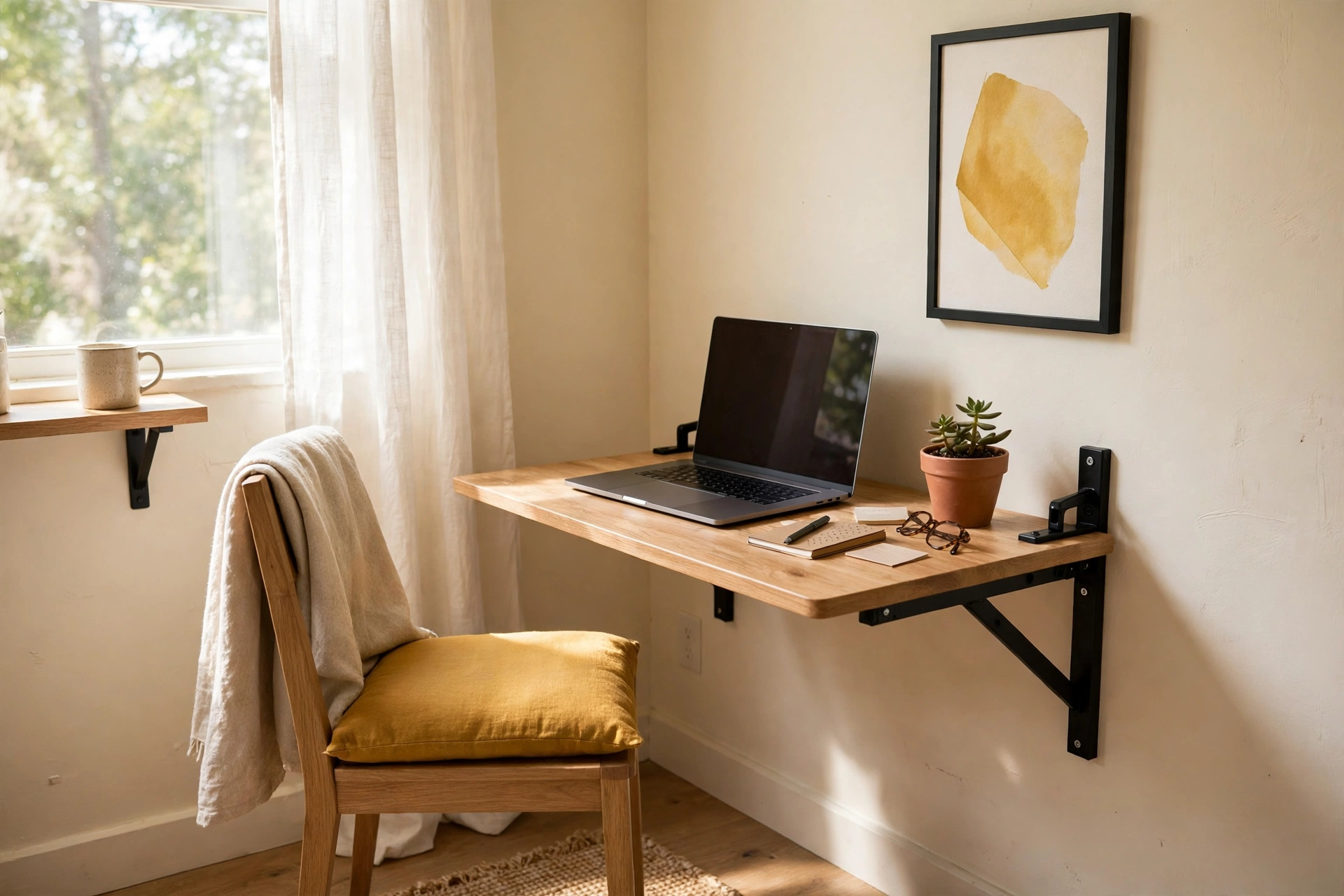
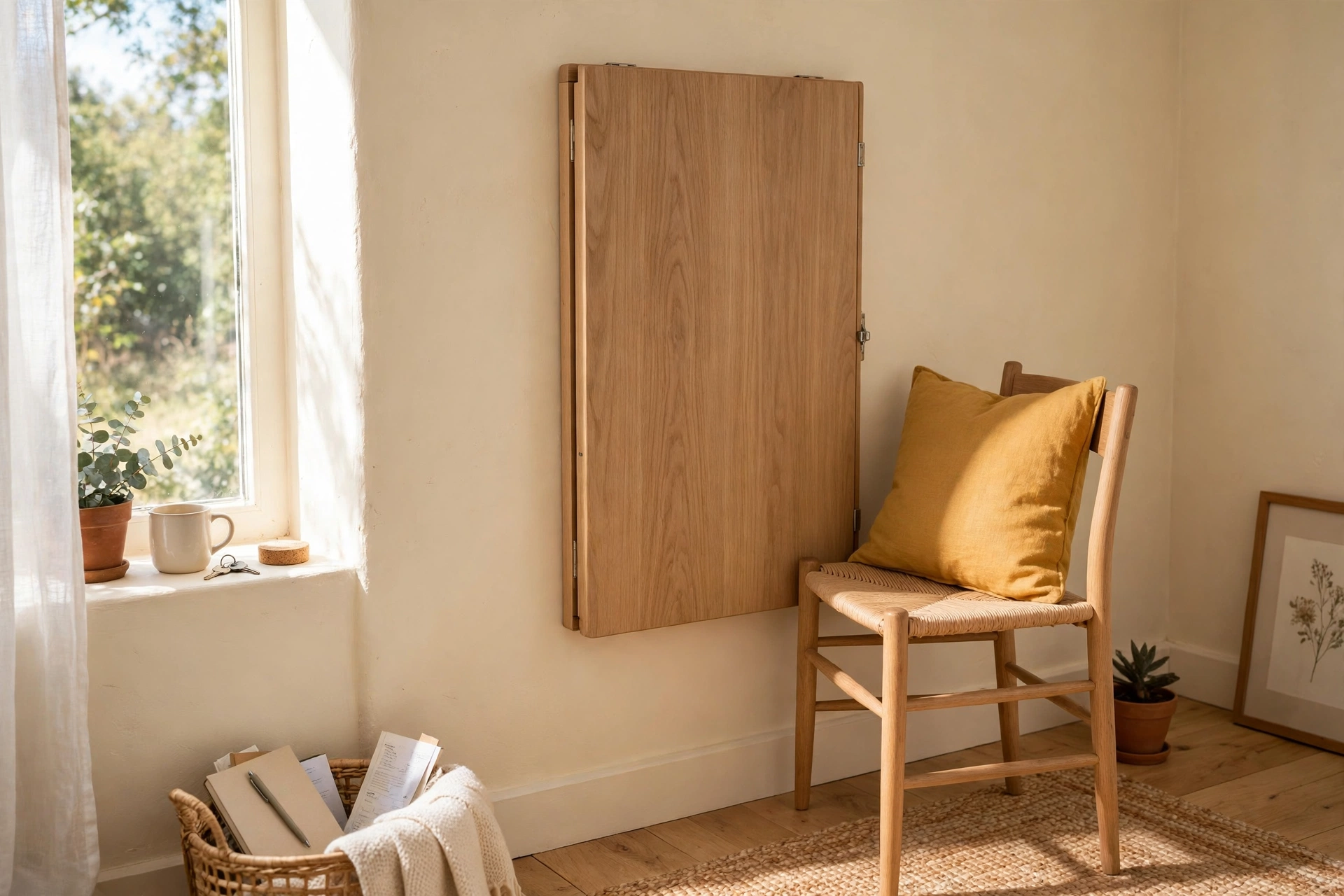
A diy wall mounted folding desk for small rooms is the cheapest way to get a real desk into a room that has no room for a desk. It folds flat against the wall when you are done, sticking out only about 5.5 inches (14 cm), and it costs $43 to $54 to build with folding brackets. I picked the seven builds below after checking what the top guides actually cover, and most of them skip the numbers that matter: how deep the desk should be, what the brackets really hold, and what it costs line by line. This post fills those gaps, with every price checked in November 2026.
How do you pick a diy wall mounted folding desk for small rooms?
Pick the depth first, then the support, then the width. Depth decides whether your knees fit and how much floor the desk eats when it is open. A 20 inch (51 cm) deep top is the sweet spot for most people: enough room for a laptop and a notebook, with real knee space underneath. Go 16 inches (41 cm) if the room is truly tight, and only go 24 inches (61 cm) if you run a monitor and a keyboard side by side.
The work zone is the part nobody measures. An open desk needs three bands of floor: the desk depth itself, the chair pull-out behind it, and whatever walkway is left. Here is the math for the three common depths, using a folded depth of 5.5 inches (14 cm) and a standard chair pull-out of 18 to 22 inches (46 to 56 cm).
| Open depth | Knee room | Chair pull-out | Total floor used open | Floor reclaimed folded |
|---|---|---|---|---|
| 16 in (41 cm) | Tight, laptop only | 18 in (46 cm) | 34 in (86 cm) | 28.5 in (72 cm) |
| 20 in (51 cm) | Comfortable | 20 in (51 cm) | 40 in (102 cm) | 34.5 in (88 cm) |
| 24 in (61 cm) | Full monitor setup | 22 in (56 cm) | 46 in (117 cm) | 40.5 in (103 cm) |
Read that last column twice. That is the whole point of this build. A 20 inch desk gives you back nearly 3 feet (88 cm) of floor every time you fold it up, which is why it beats a small fixed desk in a room under 120 square feet. If your room cannot spare 40 inches (102 cm) of open floor even some of the time, drop to the 16 inch depth or pick a different wall.
My opinion, straight up: most folding-desk guides are overrated on the build and underrated on the sizing. They show you a pretty desk and skip the chair. Measure the chair zone before you buy a single bracket, because a desk you cannot sit at is wall decor.
What size folding desk fits a small room?
Width is decided by your studs. Wall studs sit 16 inches (41 cm) apart in most homes, with about 14.5 inches (37 cm) of clear space between them. Every bracket and every cleat should land on a stud, so the width you pick has to play nicely with that spacing.
| Desk width | Studs it spans | What to watch |
|---|---|---|
| 24 in (61 cm) | 2 | Brackets near the ends land on only one stud. Use a wall cleat or toggle bolts for the other side. |
| 30 in (76 cm) | 2 to 3 | Works if you place the brackets to hit two studs. Good single-person size. |
| 36 in (91 cm) | 3 | The sweet spot. Two brackets plus a center line, and it matches most published cut lists. |
| 48 in (122 cm) | 4 | Two-person or monitor-plus-laptop width. Add a center bracket or a full-length cleat or it will sag. |
Height is the easy part and almost every source agrees on it: 28 to 30 inches (71 to 76 cm) for sitting, 36 to 40 inches (91 to 102 cm) for standing. Put a chair under it before you drill anything. Sit, reach, and check that your forearms rest flat. A desk at the wrong height is a sore-neck machine, and folding it away does not fix that.
Board thickness matters more than people think. Use 3/4 inch (18 to 19 mm) plywood or solid wood at minimum, up to 1 inch (25 mm) for a 48 inch span. Thinner boards sag in the middle within months, and no bracket fixes a floppy top.
Pick the support: folding brackets, piano hinge, French cleat, or gas struts
The support is the whole build. The top is just a board. Here is how the four common supports compare, with the load ratings the manufacturers actually print.
| Support | Rated load | Cost | Difficulty | Best for |
|---|---|---|---|---|
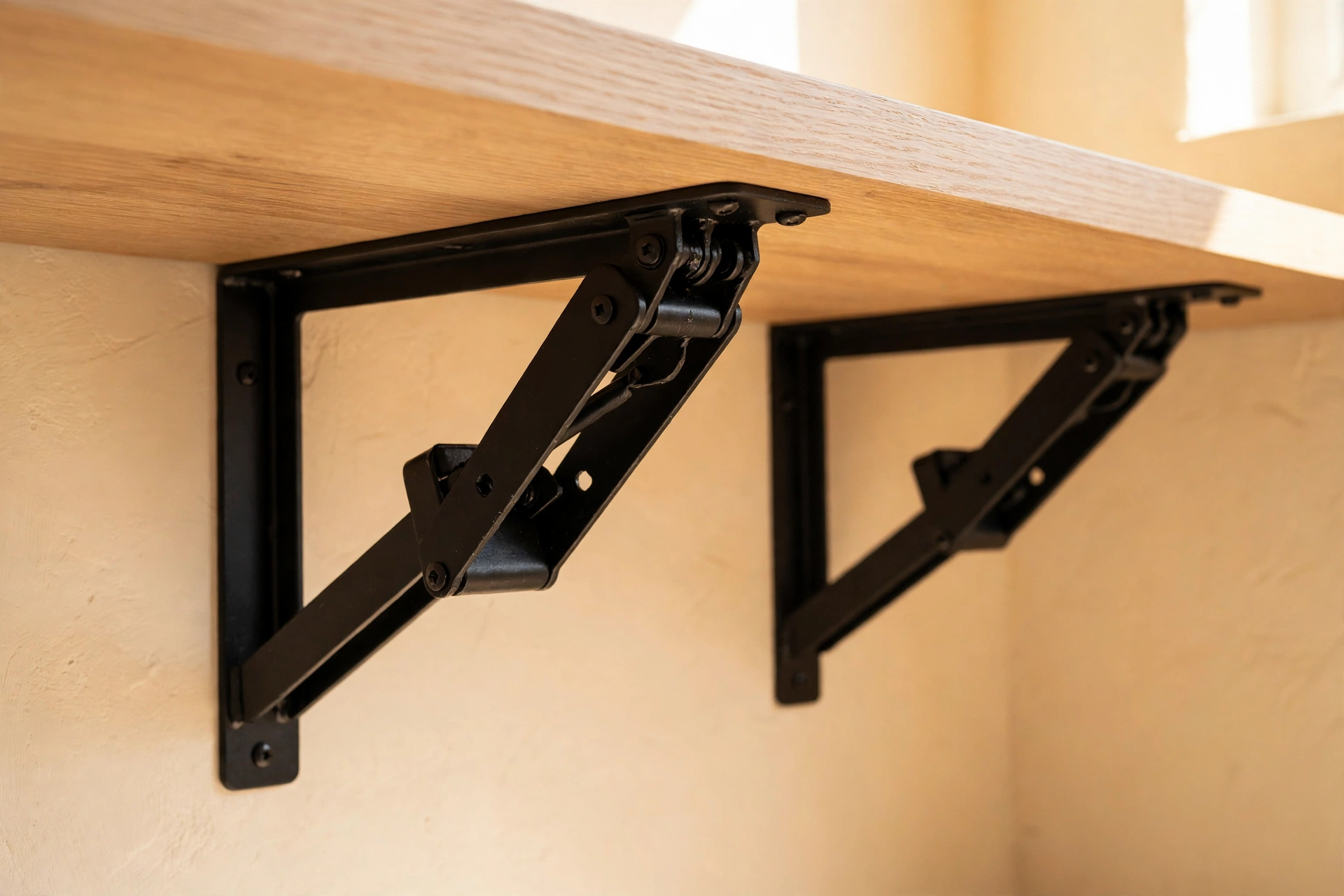
| Folding brackets (pair) | 150 to 330 lb per pair | $19.99 a pair | Easy | Most builds. Folds flat, locks open. |
| Piano hinge + fold-out leg | Hinge carries no rated load alone | $3 to $9 for a 30 in hinge | Medium | Wide tops where a leg is fine. |
| French cleat | As strong as the wall fixing | Lumber + screws | Medium | Cabinet desks and heavy loads. |
| Gas struts (pair, 100N) | 22 lb of lift each, assist only | $10 to $20 a pair | Easy add-on | Soft close and easy lifting. Not a support by themselves. |
A word on bracket ratings, because the numbers look wild. One listing rates a 12 inch pair at 250 lb, another rates a 16 inch pair at 330 lb, and a budget pair is rated at 150 lb. Those are manufacturer ratings for the bracket pair, tested in ideal conditions, and your wall is not ideal conditions. Treat the rating as a ceiling, not a promise. Plan your real load (laptop, monitor, books, elbows) and keep it under a third of the rating. A typical laptop setup weighs 20 to 30 lb all in, so even the 150 lb pair has plenty of headroom. The rating matters when someone leans on the front edge, which is exactly what happens in real life.
Gas struts confuse people, so here is the short version: a 100N strut lifts about 22 lb. A pair gives you 44 lb of lift assist. That makes the desk feel light when you fold it down and stops it slamming when you fold it up. It does not hold the desk up. Pair struts with brackets or a hinge, never instead of them.
Once the support is picked, the rest of the setup is the chair, the light, and the storage, and our budget home office ideas for small spaces cover all three around a desk like this.
The 7 best diy wall mounted folding desk for small rooms builds
Seven builds, from the simplest bracket desk to a no-drill version for renters. Each one has the same honest scorecard so you can compare them properly.
1. The folding-bracket plywood desk
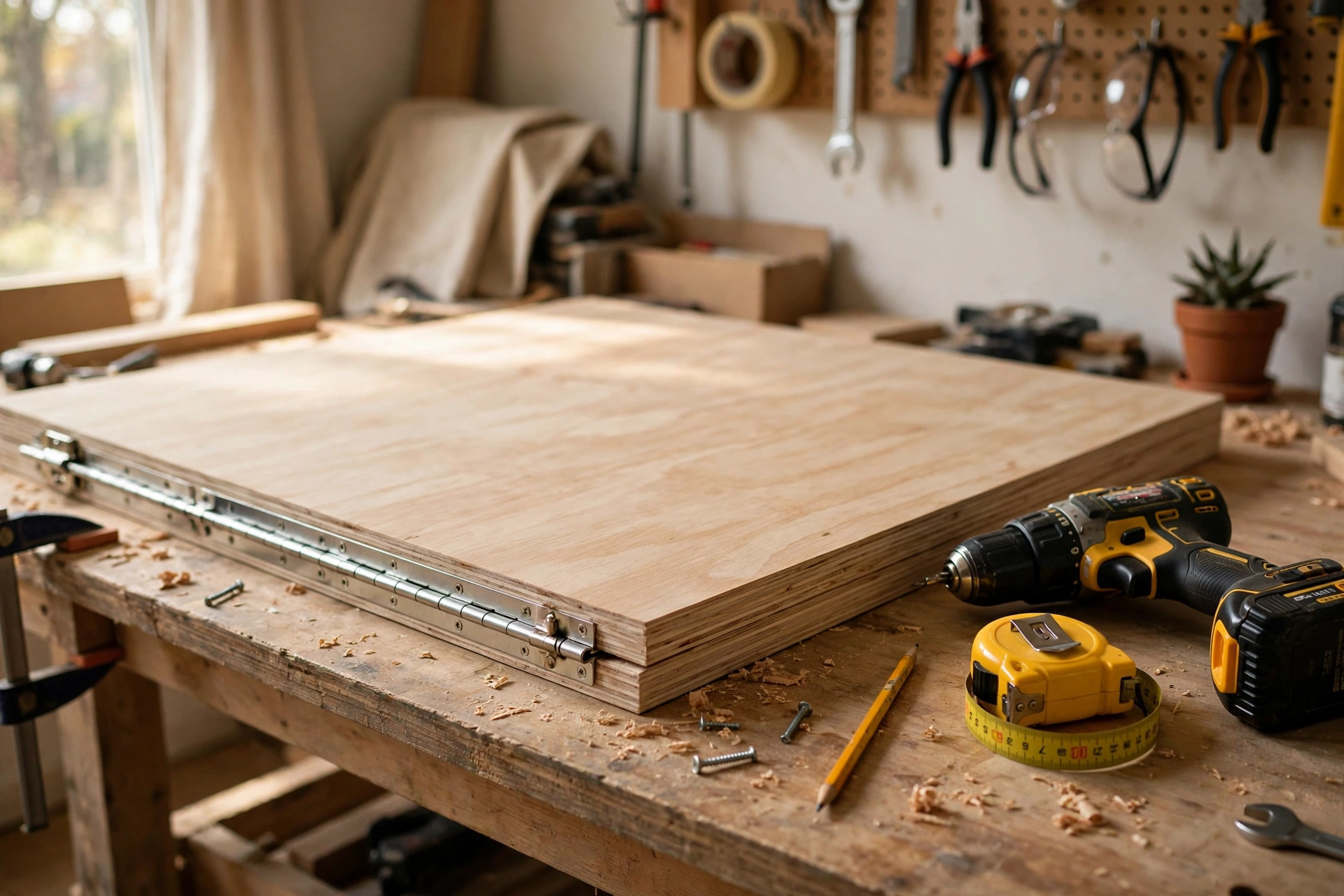
The standard build and the one most people should make. A 36 by 20 inch (91 by 51 cm) birch plywood top, a pair of 12 inch folding brackets rated at 250 lb, and a piano hinge along the wall edge. Two to three hours, one afternoon, done.
Best for: First-time builders and laptop workers.
Main advantage: Cheapest real desk in this post, $43 to $54 bare, and it folds to 5.5 inches (14 cm) off the wall.
Watch out for: Both brackets must hit studs. If one misses, add a horizontal cleat board first and mount the brackets to that.
Verdict: Build this one unless you have a specific reason not to.
Renter-Friendliness: 3/5 (four lag-bolt holes to fill at move-out, but small and easy to patch).
2. The French-cleat cabinet desk
The Bosch-style build: a shallow wall cabinet with shelves, and the desk top folds down from its base on a 45-degree French cleat. The published cut list uses a 57.5 by 26 cm top, which is about 22.6 by 10.2 inches, so scale it up to 36 inches wide for a proper work surface.
Best for: People who also need shelf storage above the desk.
Main advantage: The cleat spreads the load across several studs, so it handles heavy monitors without worry.
Watch out for: It is a weekend build, not an afternoon one, and the cabinet sticks out further than a flat desk when closed.
Verdict: The best build if you want storage and a desk in one wall unit.
Renter-Friendliness: 2/5 (more holes, heavier unit, harder to reverse cleanly).
3. The piano-hinge door-slab desk
The HGTV-style build: a 36 by 24 inch (91 by 61 cm) door slab as the top, a piano hinge along the bottom edge, and a fold-out leg or a pair of brackets underneath. A solid-core door is heavy and flat, which is exactly what you want.
Best for: People who want a deep 24 inch work surface for a monitor and a keyboard.
Main advantage: A door slab is cheaper per square inch than a cut plywood top and it never warps.
Watch out for: The door is heavy, so the hinge needs screws into a stud-backed cleat, not just drywall. And the fold-out leg eats floor space when the desk is open.
Verdict: Great if you already have a spare door. Not worth buying a new door for.
Renter-Friendliness: 2/5 (heavy unit, more wall fixing).
4. The bookshelf and fold-down desk combo
A narrow bookshelf with a fold-down desk built into its lower half, the kind This Old House published a full cut list for. It reads as furniture, not as a desk, which matters in a living room or a guest room. In a studio it has to share one room with the bed and the sofa, so place it with the same zone thinking as a studio apartment layout.
Best for: Guest rooms and living rooms where the desk is a second job.
Main advantage: The bookshelf hides the desk completely when it is folded, and the shelves are genuinely useful.
Watch out for: This is the most carpentry-heavy build here. If you have never cut a dado or fitted a magnetic catch, budget a full weekend.
Verdict: The prettiest option. Build it if you enjoy the woodworking, not if you just need a desk fast.
Renter-Friendliness: 1/5 (big, heavy, and needs serious wall fixing).
5. The standing-height fold-down desk
Same folding-bracket build as number 1, mounted at 36 to 40 inches (91 to 102 cm) instead of 28 to 30. Pair it with a tall stool or stand and work. If you already own one of the budget standing desks we compared, this is the wall-mounted version of the same idea for a room that cannot fit a freestanding frame.
Best for: People who stand to work and have no floor space for a standing desk frame.
Main advantage: Standing all day without giving up any floor when the desk is folded.
Watch out for: Standing desks need a deeper top than sitting desks, so go 20 to 24 inches deep, and check the height with your actual shoes on.
Verdict: A smart niche build. Skip it if you mostly sit.
Renter-Friendliness: 3/5 (same four holes as build 1, just higher up).
6. The statement desk
The do-daddy style build: a live-edge wood slab with a resin river, folded up it is wall art, folded down it is a desk. It costs $100 to $150 and takes 8 to 10 hours, mostly in the resin work.
Best for: People who want the desk to be a feature, not a fixture.
Main advantage: Nobody else has one. It is the only build here that looks better folded up than open.
Watch out for: Resin is messy, the slab is heavy, and the cost is triple the basic build. This is a project, not a quick fix.
Verdict: Build it for the look, not for the savings.
Renter-Friendliness: 1/5 (heavy, expensive, and hard to move).
7. The freestanding fold-down desk (no drilling)
The renter build. Instead of mounting to the wall, the fold-down top mounts to a freestanding leaning shelf unit or a tall bookcase that stands on its own feet. The top folds down from the shelf frame, the frame carries the load, and the wall gets zero holes. If your lease bans drilling outright, this is your build, and the same no-drill thinking works for hanging things around it too.
Best for: Renters with a strict no-drilling lease.
Main advantage: Zero wall damage. You take the whole unit with you when you move.
Watch out for: The shelf unit must be heavy and stable, or anchored to the wall with a furniture strap, or the whole thing tips when you lean on the desk.
Verdict: The only truly damage-free option in this post. Worth the extra floor space it takes.
Renter-Friendliness: 5/5 (nothing to repair at move-out).
What does a diy wall mounted folding desk for small rooms cost?
Prices checked live in November 2026. The bare build is the folding-bracket desk from build 1, sized 36 by 20 inches (91 by 51 cm).
| Item | Price (as of November 2026) |
|---|---|
| Folding brackets, pair, 12 in, rated 250 lb per pair | $19.99 |
| Birch plywood top, 36 by 20 in, share of a $60 to $80 4 by 8 ft sheet | $10 to $15 |
| Piano hinge, 30 in steel | $3 to $9 |
| Lag bolts, 4, 1/4 in by 3 in, about $1 each | $4.00 |
| Wood screws, #8, box of 80 | $5.99 |
| Bare build total | $42.98 to $53.98 |
| Gas struts, pair, 100N, optional soft close | $10 to $20 |
| Finished build total (with struts) | $52.98 to $73.98 |
Call it $43 to $54 bare, or $53 to $74 finished. Two cross-checks keep these numbers honest. One guide prices the hardware alone at about $34, which matches our brackets-plus-hinge-plus-fasteners line. A resin-art build from another guide costs $100 to $150, which is fair for that fancier build but double ours because of the resin and the slab. Time estimate: 2 to 3 hours for the bracket build, a full weekend for the cabinet or bookshelf versions. That leaves room in the budget for a chair and a lamp, and the whole desk zone still fits inside a home office makeover under $100.
How to build a wall mounted folding desk
Materials
- Birch plywood top, 36 by 20 in (91 by 51 cm), 3/4 in (19 mm) thick
- Folding brackets, pair, 12 in, rated 250 lb per pair
- Piano hinge, 30 in steel, with screws
- Wall cleat board, 36 by 4 in (91 by 10 cm), 3/4 in thick (use it if a bracket misses a stud)
- Lag bolts, 4, 1/4 in by 3 in, with washers
- Wood screws, #8, 1-1/2 in
- Magnetic catch (holds the desk closed)
- Gas struts, pair, 100N (optional, for soft close)
- Sandpaper, 120 and 220 grit, and Danish oil or paint for the finish
Tools
Stud finder, level, drill, tape measure, pencil, square, socket wrench for the lag bolts.
Steps
- Measure the wall and find the studs. Mark the desk height at 28 to 30 inches (71 to 76 cm) for sitting. Run the stud finder across the full width and mark every stud center with painter’s tape. Check the chair zone behind the desk before you drill anything.
- Cut the top and sand the edges. Cut the plywood to 36 by 20 inches (91 by 51 cm). Ease the front edge with sandpaper so it is comfortable on your forearms. Round the front corners slightly so they do not catch your clothes.
- Fit the piano hinge to the wall cleat. Screw the hinge to the back edge of the top first, then to the cleat board. The hinge knuckle should sit just proud of the top surface so the desk folds flat without binding.
- Mount the brackets into studs. Hold the cleat level on the wall, drill pilot holes into the studs, and drive the lag bolts with washers. Every bracket screw must bite into solid wood. If a bracket lands between studs, mount a horizontal cleat across two studs first and fix the bracket to that.
- Attach the top and test the fold. Hang the top on the hinge, open the brackets until they lock, and check the top with a level. Fold it up and down ten times. It should move smoothly and lock open with a firm click.
- Add the catch and the gas struts. Fit the magnetic catch so the folded desk stays shut. If you bought struts, mount them now, one per side, following the angle in the strut instructions.
- Finish and load it gradually. Oil or paint the top and let it cure fully. Load it in stages: laptop first, then the monitor, then the books. Check the brackets after a week of daily use and snug any screw that has settled.
Mount it safely: studs first
This is the section that keeps your desk on the wall. Drywall alone holds almost nothing. A screw in bare drywall holds a small fraction of what the same screw holds in a stud, and a desk loaded with a monitor is far heavier than that once someone leans on it.
Find the studs with a finder and confirm them with a thin pilot hole or a strong magnet that sticks to the drywall screws. Mark the centers, not the edges. Drive lag bolts at least 2-1/2 to 3 inches long so a full inch of thread bites into the stud. Use washers so the bolt head does not crush the bracket. If your wall is brick or block, switch to masonry anchors and an 8 mm masonry bit, and follow the anchor maker’s instructions exactly.
Can you mount it on drywall without finding studs? No, not safely, and that is the honest answer. Heavy-duty toggle bolts are the only exception, and they are a compromise: a 1/4 inch toggle bolt set holds real weight in drywall, but the mount still flexes more than a stud fixing, and you should keep the load light and the span short. If you cannot find a stud, mount a cleat across two studs and fix the desk to the cleat. That is the correct fix, and it is also the fix the top guides skip.
If you rent, the same rule applies. A landlord will forgive four small lag-bolt holes filled and painted. A landlord will not forgive a desk ripped out of the wall with a chunk of drywall attached. Studs first, always.
Mistakes to avoid
- Mounting into drywall only. The number one failure. Studs or a stud-spanning cleat, no exceptions.
- Brackets too close together. Two brackets 12 inches apart on a 36 inch top will sag at the ends. Spread them to within 4 inches of each end.
- A top thinner than 18 mm. A 1/2 inch top looks fine on day one and sags by month three. Use 3/4 inch minimum.
- Skipping the dry fit. Assemble everything on the floor first. Finding out the hinge binds after the cleat is bolted to the wall is a miserable afternoon.
- Overloading the front edge. The front edge is the weakest point. Keep heavy items near the wall and never sit or lean your full weight on the front lip.
- Forgetting the chair. A desk with no chair zone is wall decor. Measure the pull-out before you drill.
- Short hinge screws. The screws that come with cheap hinges are often too short for a 3/4 inch top plus a cleat. Buy screws that bite at least an inch into solid wood.
What to skip
- Cheap plastic brackets. They flex, they creep, and they fail without warning. Steel or nothing.
- A top deeper than 24 inches in a small room. The work-zone table shows why: a 24 inch desk needs 46 inches of open floor. In a room under 120 square feet, that is too much.
- A full Murphy bed and desk kit as a first build. The hardware kits alone cost several times our whole build, and the desk is the least important part of that purchase.
- Wall anchors rated below your planned load. If the anchor says 50 lb and your setup weighs 40 lb with you leaning on it, you are already over. Buy the next size up.
- A second folding desk in the same room. One good desk beats two cramped ones. If two people work from home, build one desk and give the second person a proper second zone with a real chair and their own light.
If you rent: check the lease first
Before you drill, read your lease for the alterations clause and ask your landlord in writing. Most landlords approve four small holes for a wall-mounted desk, especially when you promise to fill and paint them at move-out. Keep the email. Photograph the wall before you drill and after you repair it, the same way you would document any deposit-risk change. If the answer is no, build the freestanding version from build 7 instead. It needs no holes at all, and you take it with you when you move. The deposit math is simple: four filled holes cost you a tube of filler and a dab of paint, while a ripped-out drywall section costs you a chunk of your deposit.
Sources
- Folding bracket ratings and prices: DMSL 12 in folding brackets, 250 lb per pair, $19.99 (Amazon.ca listing B07Z3BW4SX); Storystore 12 in brackets, 150 lb per pair; YUMORE 16 in brackets, 330 lb per pair.
- Plywood prices: 3/4 in birch plywood, $60 to $80 per 4 by 8 ft sheet at big-box stores in 2026 (woodwiki.org 4×8 plywood guide).
- Piano hinge prices: steel continuous hinges $0.10 to $0.30 per inch (joyearmetalwork.com continuous hinge price guide).
- Gas struts: 100N cabinet struts, 2-pack $9.99 (Amazon.com), 4-pack $19.99 (Amazon.ca).
- Fasteners: lag screw 3 in by 1/4 in about $1.00 each; #8 wood screws, box of 80, $5.99; TOGGLER Snaptoggle 1/4 in, 10-pack, $13.99 (Tractor Supply).
- Build references: Bosch DIY wall-mounted folding desk (French cleat cabinet build, 2019); This Old House bookshelf with fold-down desk (full cut list, May 2026); do-daddy.com resin-art folding desk, $100 to $150, 8 to 10 hours; shresa.in heavy-duty folding table guide (Nov 2026); 3minread.com fold-down desk beginner guide (cut list, folded footprint 36 by 19.5 by 5.5 in).
- Desk height and board thickness: seated 28 to 30 in, standing 36 to 40 in; board 18 to 25 mm (do-daddy.com, shresa.in). Stud spacing 16 in on center (2021 International Building Code via 3minread.com).
Prices checked November 13, 2026. Prices move with the lumber market, so check the shelf price the week you buy.
How much weight can a wall-mounted fold-down desk hold?
It depends on the brackets, not the top. A pair of 12 inch steel folding brackets rated at 250 lb will hold a laptop, a monitor, and books with room to spare, because a normal laptop setup weighs 20 to 30 lb. The weak point is almost always the wall fixing, not the bracket. Mount into studs with lag bolts and the desk will hold its rated load. Mount into bare drywall and it will fail at a fraction of it.
Can I mount it on drywall without finding studs?
Not safely for a desk you actually use. Drywall alone holds very little, and a desk takes downward force plus the leverage of someone leaning on the front edge. The safe options are to mount into studs, mount a cleat across two studs and fix the desk to that, or use heavy-duty toggle bolts for a light, short-span desk only. If you rent and cannot drill, build the freestanding version instead.
What hinge should I use?
A steel piano hinge, also called a continuous hinge, cut to the width of your desk. Steel runs about $0.10 to $0.30 per inch, so a 30 inch hinge costs roughly $3 to $9. It spreads the load along the full back edge, which is why it beats two or three small butt hinges. Use screws that bite at least an inch into solid wood, and skip the short screws that come in the packet if they look flimsy.
Is it cheaper to build than to buy?
Yes, for a basic desk. The bracket build costs $43 to $54 bare, or $53 to $74 with soft-close struts. A ready-made wall-mounted folding desk of the same size usually costs more, and a Murphy desk hardware kit alone costs several times our whole build before you buy the board. Building wins on price and on fit, because you cut the top to your exact wall. Buying wins if you want a finished cabinet desk with no tools and no weekend spent building.