Best Air Purifier for a Small Bedroom: 6 Picks Sized by CADR, Not by Marketing
The best air purifier for small bedroom use is the one whose CADR matches your room, not the one with the biggest number on the box. That box number usually assumes one air change per hour, which is far too slow for a room you sleep in for eight hours. Size for four to five air changes an hour instead, and the choice gets simple: a 120 sq ft bedroom needs about 64 to 80 CFM, a 150 sq ft bedroom needs 80 to 100 CFM, and anything above 140 CFM is already more than most small bedrooms can use. This guide does the math for five real bedroom sizes, compares six picks on sleep noise, nightstand fit, and the full yearly cost, and tells you exactly where to put the unit so it works while you sleep. Prices checked November 2026.
What size air purifier do I need for a small bedroom?
Start with the room, not the product page. The formula engineers use is simple: required CADR equals room area times ceiling height times your target air changes per hour, divided by 60. AHAM, the appliance makers’ association, recommends 4.8 air changes per hour as the standard, and allergy specialists size for 5. The box figure, by contrast, often assumes 2 air changes per hour or less, which is why a unit rated for 1,748 sq ft may only keep 361 sq ft of air genuinely clean. Coway’s own marketing does exactly this with the Airmega Mighty: the listing claims up to 1,748 sq ft in an hour, while the maintained room is 361 sq ft.
Here is the table for standard 8 ft ceilings. Measure your room first, then read across.
| Bedroom size | CADR for 4 air changes/hr | CADR for 5 air changes/hr |
|---|---|---|
| 100 sq ft (10 x 10 ft, 3.0 x 3.0 m) | 53 CFM | 67 CFM |
| 120 sq ft (10 x 12 ft, 3.0 x 3.7 m) | 64 CFM | 80 CFM |
| 150 sq ft (10 x 15 ft, 3.0 x 4.6 m) | 80 CFM | 100 CFM |
| 180 sq ft (12 x 15 ft, 3.7 x 4.6 m) | 96 CFM | 120 CFM |
| 200 sq ft (10 x 20 ft, 3.0 x 6.1 m) | 107 CFM | 133 CFM |
There is a shortcut if you hate arithmetic. The EPA’s rule of thumb is that the smoke CADR should be at least two-thirds of the room’s square footage, so a 150 sq ft bedroom needs a smoke CADR of at least 100. That lands exactly on the 5 air changes column, which is no coincidence. Use the smoke CADR figure, not dust or pollen, because smoke particles are the smallest and the smoke number is usually the lowest of the three. That table is the whole shortlist method: measure the room, read the CADR, and the best air purifier for small bedroom use picks itself.
Two warnings before you shop. First, CADR is measured at the highest fan speed, which is also the loudest speed, so a unit that only just meets your number will have to run flat out to do it. Buy a little more CADR than the table says and run it on low overnight. Second, check for the AHAM Verifide seal. A room-size claim is only reliable when an independent lab has verified the CADR behind it. Levoit’s Core 300 carries full AHAM verification, and the Winix 5500-2 does too, but several popular models publish manufacturer figures only, and Coway’s Mighty is not currently on the ENERGY STAR room air cleaner list even though its CADR is widely quoted.
How quiet does a bedroom air purifier need to be?
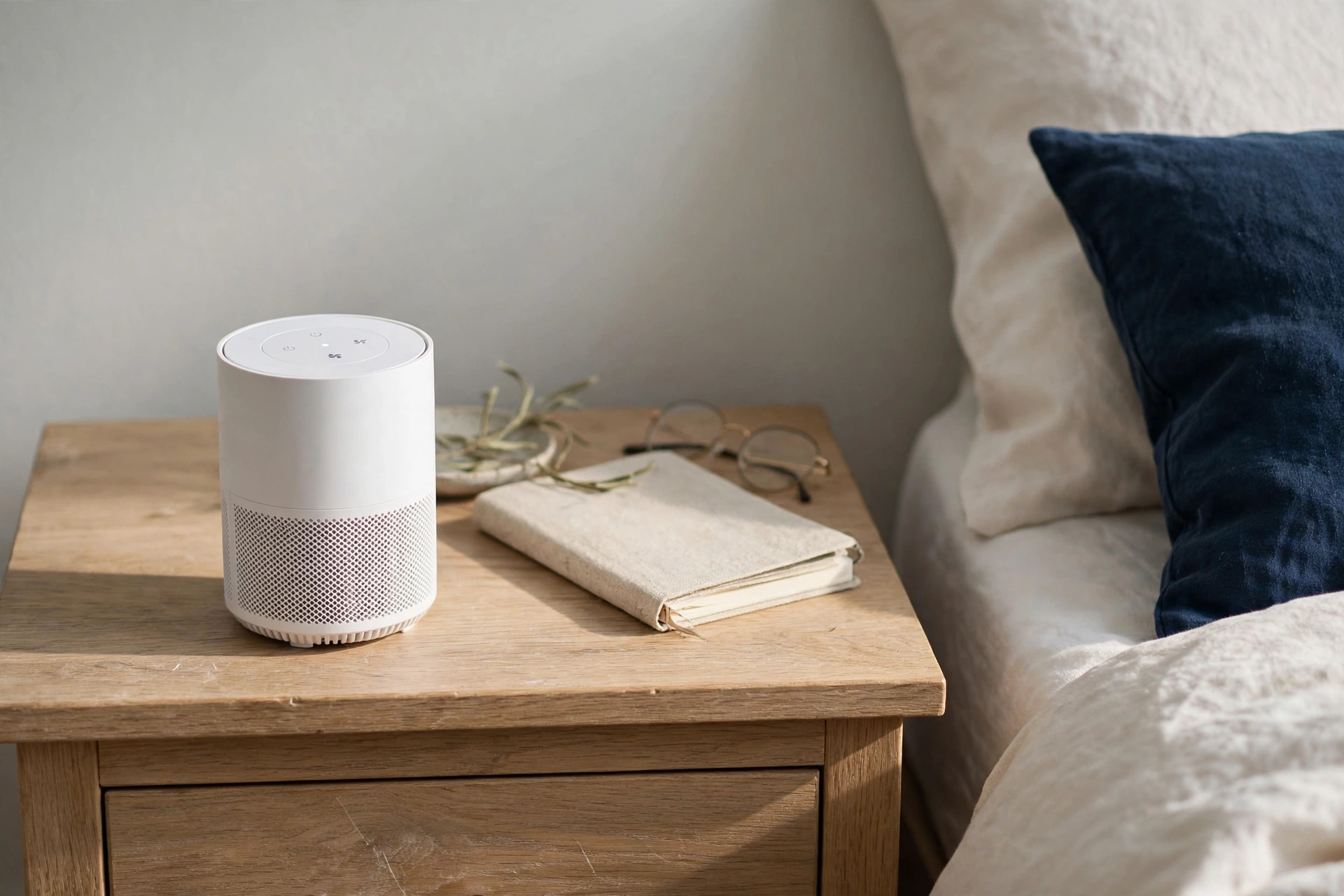
A purifier that keeps you awake gets switched off, and a switched-off purifier cleans nothing. That makes sleep-mode noise the most underrated spec in this category, more important than an extra 20 CFM you will never hear over your own breathing.
Here is what the six picks below actually do on their lowest setting, with the numbers as published in November 2026.
| Pick | Sleep-mode noise |
|---|---|
| Levoit Core 300S | 24 dB |
| Levoit Core 300 | 24 dB |
| Blueair Blue Pure 511 | 17 dB on low (Blue Pure family figure) |
| Coway Airmega AP-1512HH | about 30 dB |
| Winix 5500-2 | 28 dB |
| Levoit Core Mini | 25 dB |
For context, a quiet library sits near 30 dB and a whisper is about 20 dB. Anything at or under 25 dB fades out for most sleepers, and light sleepers should treat 24 dB as the ceiling. The Blueair is the quietest unit here on paper, and the Coway is the loudest on sleep mode, which is the price of its much bigger fan. One honest caveat: sleep mode drops the fan speed, and with it the CADR, so a unit sized exactly to your room will clean less overnight than the table promises. That is another reason to buy a little more CADR than you need and let the low setting do the work.
Display lights matter almost as much as noise. Every pick below has a sleep mode that dims or kills the display, except you should check the exact model before ordering, because base models sometimes drop the dimming feature the step-up model has. If the lights still bother you, a small piece of electrical tape over the display is a five-second fix that costs nothing.
Which is the best air purifier for small bedroom use?
Six picks, each with a job. Each pick below earns its place as a best air purifier for small bedroom candidate on verified CADR, sleep noise, or fit, not on marketing. Prices are live-checked November 2026 and dated in the cost table below. No affiliate links anywhere on this site.
1. Levoit Core 300S, the best all-rounder
Best for: most small bedrooms, 100 to 220 sq ft. Main advantage: AHAM-verified CADR of 141 CFM with an app, an auto mode, and a PM2.5 sensor, at a price that undercuts every rival with the same verified numbers. Watch out for: the app is the only real difference from the cheaper Core 300 below, so if you never open apps to run appliances, you are paying $65 for a remote control. Verdict: 4.5 out of 5, the best all-rounder in this guide and our top pick.
The Core 300S is the unit the small blogs keep landing on as their top pick, and the numbers explain why. Its smoke CADR of 141 CFM honestly covers about 219 sq ft at the AHAM 4.8 air changes standard, which is more than any normal small bedroom. It runs at 24 dB on sleep mode, draws 39.5 W at full speed, and its 8.7 in (22 cm) square footprint fits a standard nightstand with room to spare. The H13 HEPA filter catches 99.97 percent of particles down to 0.3 microns, and the activated carbon layer takes the edge off cooking smells that drift in from the kitchen. Replacement filters run about $25 a year. At $149.99 list (levoit.com, read November 10, 2026), it is the pick to beat.
2. Levoit Core 300, the best budget pick
Best for: anyone who wants the same clean air as the top pick without paying for Wi-Fi. Main advantage: the same AHAM-verified CADR of 143 CFM and the same filter as the 300S, for $84.99 on Amazon (November 10, 2026). Watch out for: three manual fan speeds and no auto mode, so you set it yourself and leave it. Verdict: the smart buy if you will never use the app.
The Core 300 and the Core 300S clean the same size room with the same filter. The 300S adds Wi-Fi, an app, and a sensor, and draws less power (39.5 W against 55.4 W). Over two years the power saving nearly erases the price gap: one independent comparison puts the two-year total at $346 for the Core 300 against $358 for the 300S. Buy the 300S if you want the app. Buy the 300 if you want the lowest price today and do not mind pressing a button. Either way, this is the cheapest honest CADR in the guide.
3. Blueair Blue Pure 511, the best for the smallest rooms
Best for: tiny bedrooms, dorm rooms, and light sleepers. Main advantage: the quietest low speed here at 17 dB, a washable fabric pre-filter you can rinse instead of replacing, and a compact cylinder that disappears on a nightstand. Watch out for: Blueair does not publish an AHAM-verified CADR for the plain 511, so you cannot check its room size against the formula the way you can with the Levoits. Treat it as a small-room-only pick. Verdict: the quietest pick, best in rooms under about 150 sq ft.
At about $99.99 on Amazon (October 19, 2026), the 511 sits between the two Levoits on price and below both on noise. Its one-button control is a feature, not a limitation, for a bedroom: there is nothing to fiddle with at midnight. The washable pre-filter is the genuinely useful bit, because it catches hair and dust before they reach the main filter and stretches its life. Filters for the 511 series run $20.99 to $29.99 at Target (November 2026), so budget about $30 to $40 a year. If you want the app-connected sibling, the 511i Max lists at $139.99 with a $29.99 filter rated for up to nine months.
4. Coway Airmega AP-1512HH (Mighty), the best for allergies and larger bedrooms
Best for: allergy households and bedrooms over 180 sq ft. Main advantage: the biggest verified-capacity fan here, with a smoke CADR of 233 CFM, an air quality indicator, and an eco mode that idles the fan when the air is already clean. Watch out for: at $229.99 on Amazon (November 10, 2026) it costs nearly three times the Core 300, its replacement filter set is $59.79, and its sleep mode runs about 30 dB, the loudest in this guide. Verdict: the strongest cleaner here, but only worth it if your room or your allergies need the extra capacity.
The Mighty has been the default recommendation for a decade, and it earns that status. Its honest room size is 361 sq ft at the AHAM standard, and at 5 air changes it still covers about 350 sq ft, which no other pick here touches. The 16.8 by 9.6 in (43 by 24 cm) body is a floor unit, not a nightstand unit, so measure your floor space before ordering. Two honest notes: Coway’s 233 CFM is the company’s own figure, because the Mighty is not currently on the ENERGY STAR room air cleaner list, and the price swings wildly with sales, from $154.98 in October 2026 to $229.99 in November, with a lowest-ever price near $105. If you can wait for a sale, do.
5. Winix 5500-2, the best for pets and odors
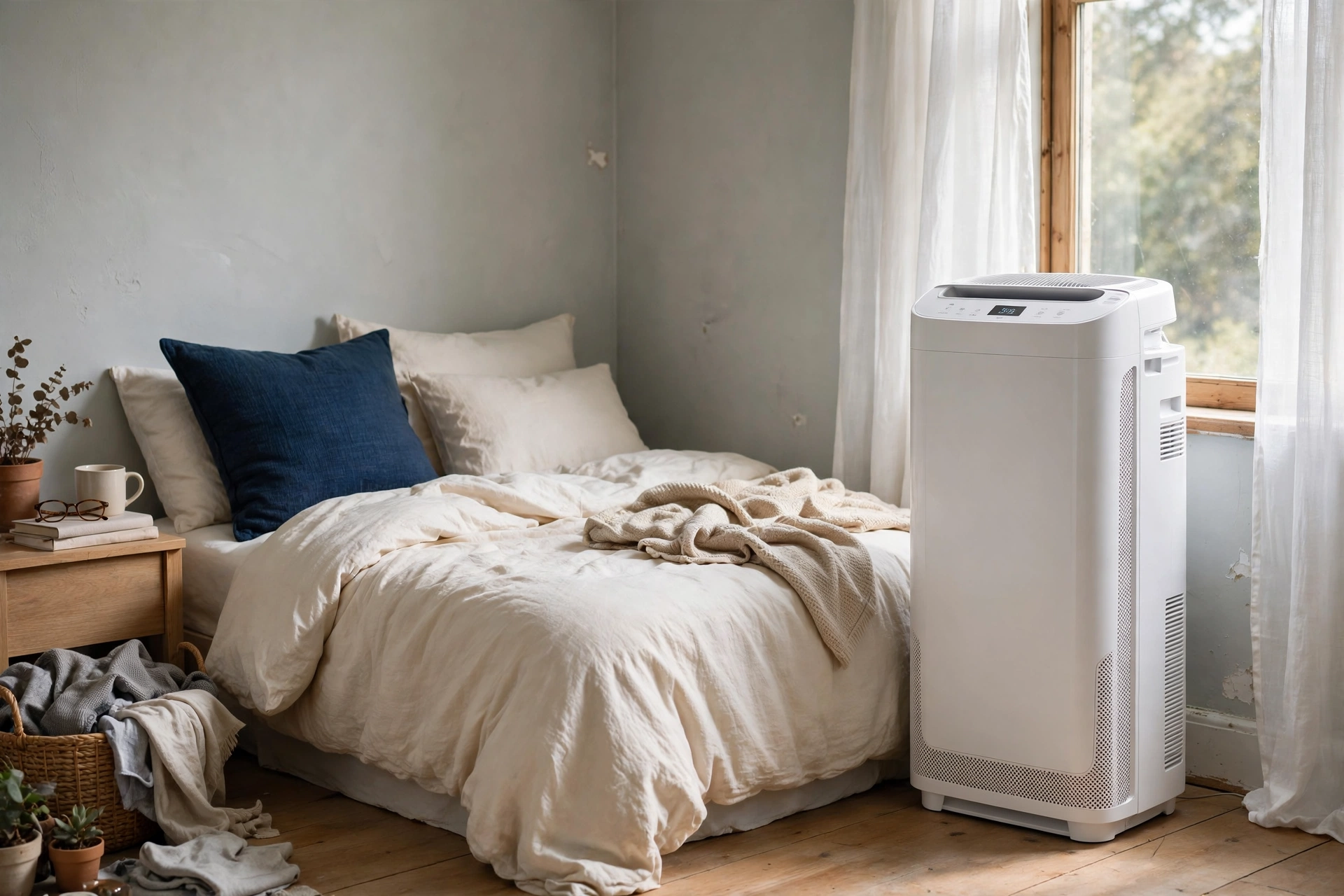
Best for: bedrooms with pets, cooking smells, or smoke. Main advantage: AHAM-verified smoke CADR of 243 CFM, a washable carbon filter, and PlasmaWave technology that breaks down odors the HEPA layer cannot touch. Watch out for: Winix has discontinued the 5500-2 in the US, so buy while stock lasts, and its successor, the Winix 5510, costs $179.99. Verdict: the best odor fighter here, with a discontinued-model warning attached.
At $156.00 on Amazon (November 11, 2026), the 5500-2 is the value play in the big-CADR class, sitting $74 below the Coway while delivering slightly more verified CADR. Its sleep mode runs 28 dB, and replacement filters run about $25 to $35 a year, with the carbon layer washable instead of disposable. The washable carbon filter is the unique advantage in this lineup: every other pick makes you buy a new carbon layer. If the 5500-2 is out of stock when you shop, the 5510 successor adds Wi-Fi and a 350 CFM CADR for the extra $24.
6. Levoit Core Mini, the best for a nightstand or a dorm
Best for: a nightstand, a desk, or a dorm room. Main advantage: about the size of a one-liter water bottle, USB-C powered at about 7 W, with a built-in night light and a 25 dB sleep mode. Watch out for: its honest room size is only about 73 sq ft at the AHAM standard, even though Levoit’s own rating claims 178 sq ft, because that claim assumes about 2 air changes per hour. Do not buy it for a full-size bedroom. Verdict: the only pick here that truly fits anywhere, but only for genuinely small spaces.
At $40 to $60 (November 2026; $59.99 with the night light at Target), the Core Mini is the cheapest real HEPA purifier in this guide, and its filter costs about $15 a set every six to eight months. Its CADR of 47 CFM is small, but so is the job: a dorm bed, a desk corner, or a nursery nook. For a dorm room it pairs naturally with the rest of a small-space setup, and our dorm room storage ideas for a Twin XL bed show how the same square footage holds both a purifier and a semester of belongings. If your bedroom is bigger than about 100 sq ft, step up to the Core 300 instead.
What does an air purifier cost to run for a year?
The sticker price is only the first year. Filters and electricity are the running bill, and they change the ranking. This table uses live-checked November 2026 prices, with filter costs as published by the same sources.
| Pick | Price (Nov 2026) | Filter per year | Year-1 total |
|---|---|---|---|
| Levoit Core 300S | $149.99 | about $25 | $174.99 |
| Levoit Core 300 | $84.99 | about $25 | $109.99 |
| Blueair Blue Pure 511 | $99.99 | about $35 | $134.99 |
| Coway Airmega AP-1512HH | $229.99 | $59.79 | $289.78 |
| Winix 5500-2 | $156.00 | about $30 | $186.00 |
| Levoit Core Mini | about $50 | about $20 | $70.00 |
Electricity is the smaller half of the running cost, and it is easy to compute. At the US average of 18.2 cents per kWh (EIA, October 2026), running a purifier eight hours a night for a year is 2,920 hours. The Core 300S at its maximum 39.5 W uses 115.34 kWh, which costs $20.99 a year. The Core 300 at 55.4 W costs $29.44. The Coway at 77 W costs $40.92. The Core Mini at about 7 W costs $3.72, less than a fancy coffee. All four figures are maximum-speed numbers: sleep mode draws far less, so the real bill is lower. The honest takeaway is that electricity never decides this purchase. Filters do. The Coway’s $59.79 filter set costs more than twice the Levoit’s, every single year.
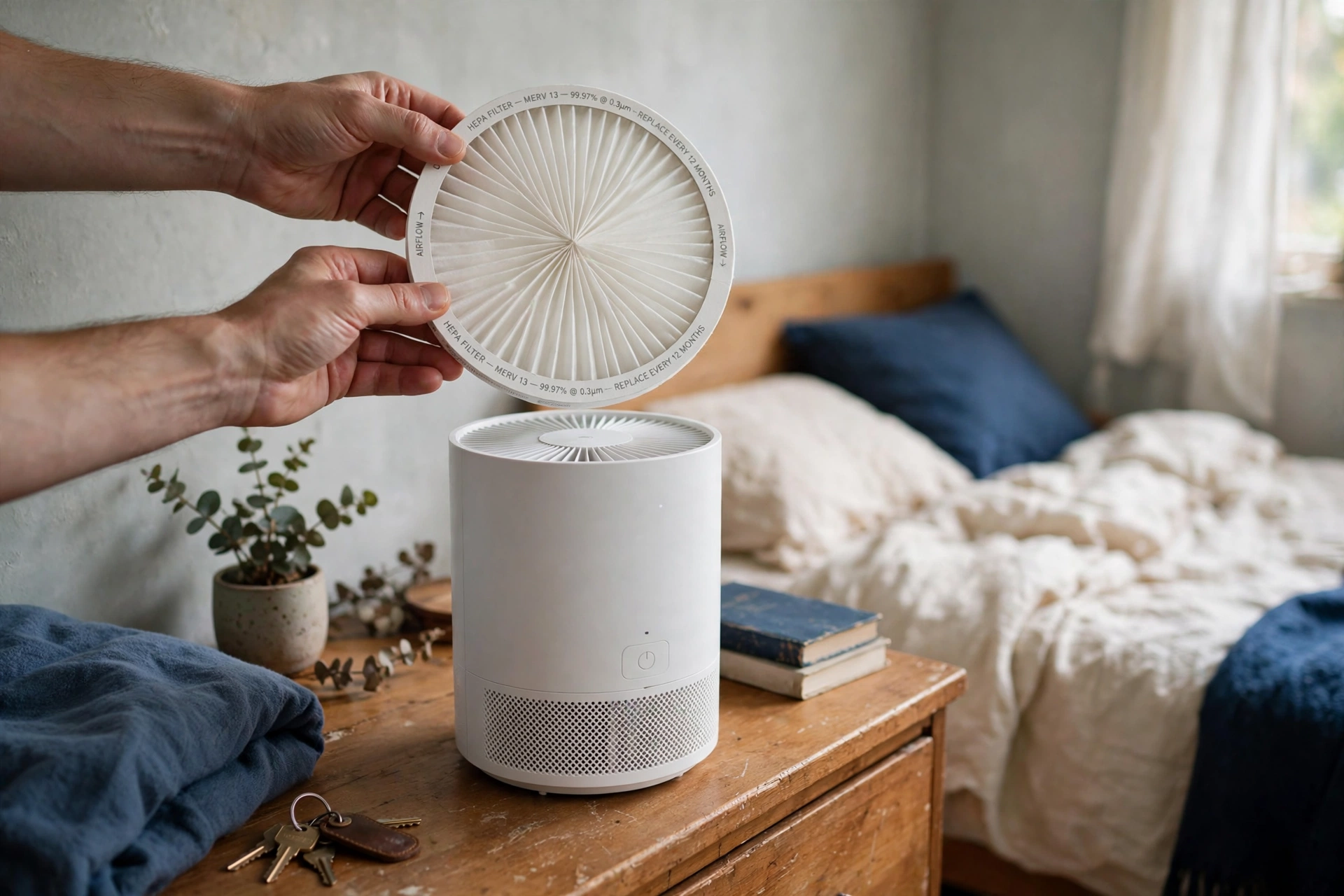
Plan on replacing the HEPA filter every six to eight months, sooner if you have pets. Vacuum the pre-filter monthly, wash it if it is washable, and write the install date on the filter frame with a marker so you are not guessing in June. The best air purifier for small bedroom budgets is the Core 300 at $109.99 for year one, not the dearest unit on the shelf.
Where to put an air purifier in a small bedroom
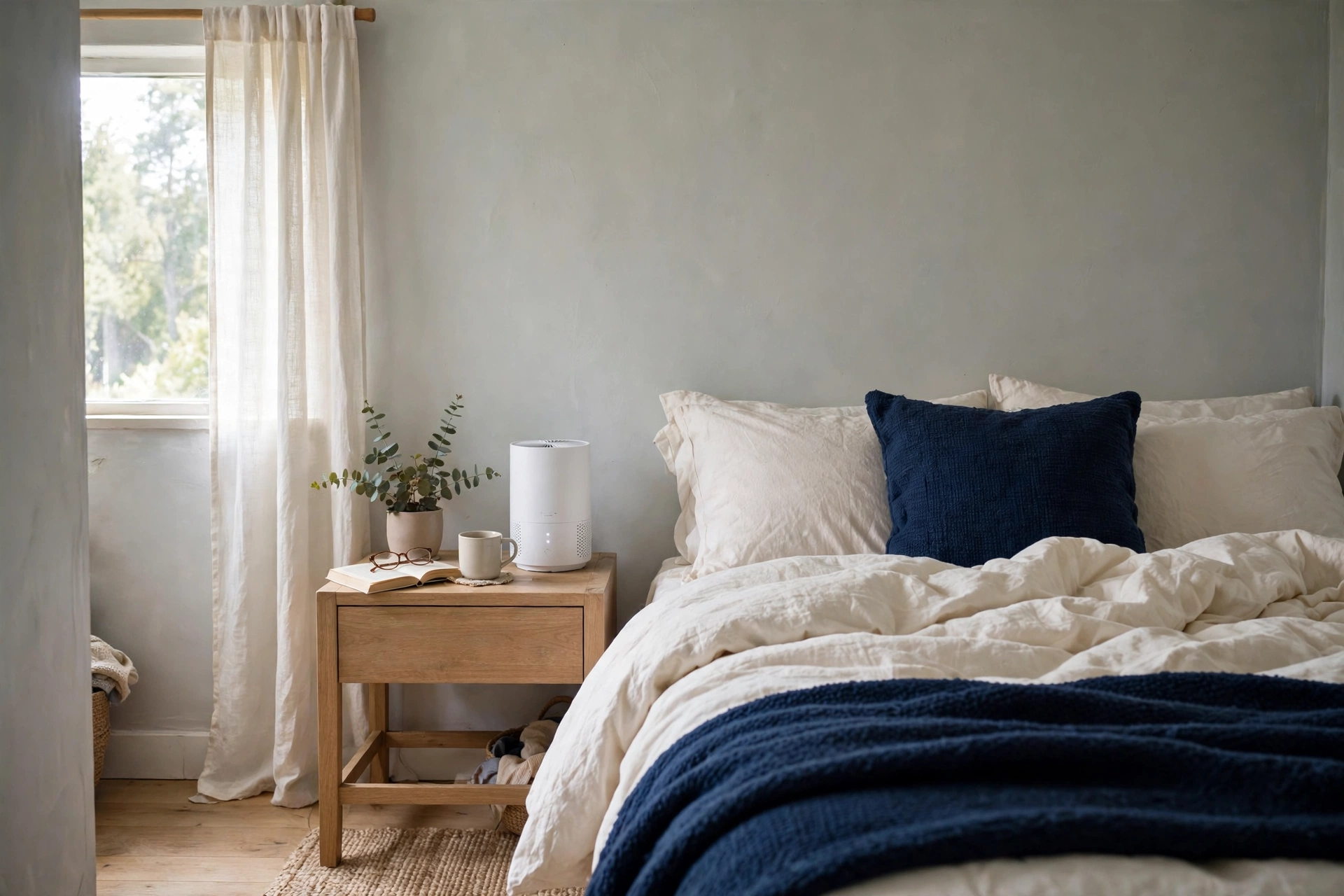
Placement decides whether the CADR you paid for reaches your lungs. The consensus across the placement guides is 3 to 6 ft (about 1 to 2 m) from the head of your bed, on a raised surface like a nightstand or a dresser, with the airflow crossing the bed rather than blowing straight onto your face. Blueair’s own guide puts it at 3 to 5 ft, and IQAir’s at 3 to 6 ft. One guide stretches it to 6 to 10 ft, but in a small bedroom that distance usually means the far wall, which is too far.
Four rules cover the rest. First, keep 1 to 2 ft (30 to 60 cm) of clearance on all sides, because a purifier pressed into a corner starves its own intake. Second, elevate it. A unit on the floor cleans floor-level air, and your breathing zone is 2 to 3 ft up. A nightstand or a dresser is better than the floor in almost every bedroom. Third, point the intake toward the bed and the output across the room, never directly at your face, because a steady draft all night dries out nasal passages and wakes light sleepers. Fourth, keep it away from your humidifier or dehumidifier, because damp air and filters do not mix. A purifier cleans air, it does not dry it, so if damp is the problem, the dehumidifier we compared for small apartments is the right tool, not a bigger purifier. And if your windows weep every morning, stopping condensation on rental windows is the fix to read first, because a purifier will not dry a wet window.
The nightstand test is the part nobody measures. A standard nightstand top is about 16 to 18 in (41 to 46 cm) wide. The Core 300S at 8.7 in (22 cm) square leaves room for a lamp and a phone. The Core Mini leaves room for almost anything. The Coway at 16.8 in (43 cm) wide does not fit a nightstand at all, and neither does the Winix. If the unit you want is wider than half your nightstand, put it on the dresser or the floor and run it on a higher setting during the day, then drop it to sleep mode at night.
How to size and set up your air purifier in 7 steps
Follow these in order. The whole job takes about 20 minutes, plus the time to let the unit run.
Step 1. Measure the room. Measure length and width in feet, multiply for square footage, and note the ceiling height. A 10 by 12 ft room is 120 sq ft (3.0 by 3.7 m, 11.1 sq m).
Step 2. Work out the CADR you need. Multiply square footage by ceiling height and by 4 for normal use or 5 for allergies, then divide by 60. A 120 sq ft bedroom with 8 ft ceilings needs 64 CFM at 4 air changes or 80 CFM at 5.
Step 3. Pick the unit with a little headroom. Choose a smoke CADR at least 20 percent above your number, so the unit can run on low overnight instead of flat out.
Step 4. Check the filter price before you buy. Look up the genuine replacement filter and its change interval. A cheap unit with a $60 filter costs more than a dearer unit with a $25 filter by the second year.
Step 5. Place it 3 to 6 ft from the head of the bed. Use a nightstand or a dresser, keep 1 to 2 ft of clearance on all sides, and angle the output across the bed, not onto your face.
Step 6. Run it on high for an hour before bed. Let it clear the room at full speed, then drop it to sleep mode when you get in. Run it all night: switching it off lets the room drift back toward its starting air quality within the hour.
Step 7. Write the filter date on the frame. Mark the install date on the filter with a marker and set a phone reminder for six months out.
Mistakes to avoid
Buying by the box number. The “up to 1,748 sq ft” figure on the Coway listing assumes about one air change per hour. Size by CADR and the 4 to 5 air changes table instead, or you will own a unit that looks powerful and cleans slowly.
Sizing exactly to the table. A unit that only just meets your CADR has to run at full speed, which is loud. Buy 20 percent more CADR than you need and run it quietly.
Putting it in a corner. Corners and walls choke the intake. The 1 to 2 ft clearance rule is not decoration, it is how the unit breathes.
Pointing it at your face. A steady draft all night dries your nose and wakes you up. Angle it across the bed.
Forgetting the filter bill. Check the filter price before you buy, not when the indicator light comes on. The Coway’s filter costs more than twice the Levoit’s, every year.
Running an ionizer overnight in a closed room. Some purifiers include an ionizer or UV stage that can produce ozone, which is a respiratory irritant. Choose a HEPA-only unit for the bedroom, or switch the ionizer off, and look for CARB certification if the unit has an ionizer at all.
What to skip
A second purifier for one bedroom. One correctly sized unit beats two small ones. The second unit just doubles the filter bill and the noise.
The biggest CADR you can afford. A 350 CFM unit in a 120 sq ft bedroom is a louder, dearer way to do a 100 CFM job. Match the room, then stop.
Washable HEPA claims on cheap units. A true HEPA filter is not washable. If a listing promises a washable HEPA, it is usually a washable pre-filter with a disposable HEPA behind it, and the listing is hoping you will not notice.
A purifier as a humidity fix. An air purifier cleans the air but adds no moisture, so pair it with the best humidifier for small bedroom use when winter air turns dry. If the room feels damp, a dehumidifier is the tool, and if the windows weep, the condensation guide is the fix.
Ozone generators sold as purifiers. They are not purifiers, they are irritant generators, and they have no place in a room you sleep in.
A note for renters
An air purifier is one of the most renter-friendly appliances you can buy, because it needs no drilling, no wiring, and no permission. It plugs into a standard outlet, sits on furniture you already own, and moves out with you in one trip. The deposit risk is effectively zero, which earns every pick here a 1 out of 5 deposit-risk rating, the lowest on this site.
Check two things in the lease anyway. First, confirm the landlord provides no air cleaning already, because some buildings with central HVAC include filtration, and doubling up wastes money. Second, if your building has old wiring, check the circuit before adding a second appliance to the bedroom. A purifier draws far less than the space heater we sized for small bedrooms, so it is rarely a problem, but a 15-amp bedroom circuit shared with a heater and a hair dryer is worth a glance at the breaker panel.
How this was made
This guide was researched from live search results and live-checked prices in November 2026. CADR and cost figures were computed from the published formula and the EIA electricity rate, not copied from any single roundup. No product was tested hands-on, and no claim in this guide comes from personal use. Prices change often, so check the current price before ordering.
Sources
Room sizing and the CADR formula follow the step-by-step guide at smallapplianceshub.com, which works the same calculation for bedrooms, living rooms, and offices. Placement rules follow Blueair’s bedroom placement guide, which ranks positions by effectiveness and sets the 3 to 5 ft distance from the head of the bed. Prices are dated November 2026 from the retailers and price trackers cited in the cost table. The EPA’s two-thirds rule for smoke CADR and the AHAM Verifide directory are the standards behind the sizing advice.
Is it OK to sleep with an air purifier on all night?
Yes. Air purifiers are built for continuous operation, and overnight is arguably the best time to run one, because you spend seven to nine hours breathing the same room’s air. Run it on sleep mode, keep it 3 to 6 ft from the head of the bed, and do not point the output at your face. Choose a HEPA-only unit, or switch off any ionizer, and avoid ozone-generating devices in a bedroom.
How close should an air purifier be to my bed?
Aim for 3 to 6 ft (about 1 to 2 m) from the head of your bed, on a nightstand or a dresser rather than the floor. That is close enough to clean the air you breathe and far enough that fan noise and airflow do not disturb you. Keep 1 to 2 ft of clearance around the unit and angle the output across the bed, not onto your pillow.
What size air purifier do I need for a small bedroom?
Use the smoke CADR, not the box coverage number. For a 120 sq ft bedroom with 8 ft ceilings you need about 64 CFM for 4 air changes an hour or 80 CFM for 5. For a 150 sq ft bedroom, 80 to 100 CFM. The EPA’s shortcut is a smoke CADR of at least two-thirds of the room’s square footage. Buy about 20 percent more CADR than the table says so the unit can run quietly on low overnight. That is how you size the best air purifier for small bedroom use without trusting the box.
Do air purifiers use a lot of electricity?
No. A bedroom purifier at full speed draws about the same power as a standard light bulb, roughly 40 to 77 W for the picks in this guide. Running one eight hours a night for a year costs about $21 for the Levoit Core 300S, $29 for the Core 300, $41 for the Coway Mighty, and under $4 for the Levoit Core Mini, at the US average of 18.2 cents per kWh. Sleep mode draws far less. Filters cost more than electricity over the life of the unit.