DIY Coat Rack Ideas for a Small Entryway: 8 Builds That Hold Real Winter Coats
A small entryway needs a coat rack that holds real winter coats, not a pretty row of hooks that pulls out of the wall by February. The short answer: build a rail sized to your household, mount it into studs with the hooks 60 to 66 inches (152 to 168 cm) off the floor, and space the hooks 6 to 8 inches (15 to 20 cm) apart. These eight diy coat rack ideas for small entryway builds are each measured, priced as of November 2026, and rated for deposit risk, so renters and owners both get a rack that stays up. The original element in this post is the computed rail-length table below, which turns your household size into an exact rail length, plus a load-limit table built only from manufacturer specs.
DIY coat rack ideas for small entryway: how long should the rail be?
Start with people, not with the wall. Plan one to two hooks per person who uses the entryway every day, then add one or two spares for bags and guests. A family of four needs at least eight hooks, and probably more if the kids are still in the layered-everything phase of life. Then turn the hook count into a rail length. Hooks spaced 15 cm apart need a shorter rail than hooks spaced 20 cm apart, and the table does that math for you. The length assumes a half-spacing margin at each end, so coats do not slide off the ends.
| Household | Hooks you need | Rail at 15 cm (6 in) spacing | Rail at 20 cm (8 in) spacing |
|---|---|---|---|
| 1 person | 3 | 45 cm (18 in) | 60 cm (24 in) |
| 2 people | 6 | 90 cm (35 in) | 120 cm (47 in) |
| 3 people | 8 | 120 cm (47 in) | 160 cm (63 in) |
| 4 people | 10 | 150 cm (59 in) | 200 cm (79 in) |
Measure your wall before you buy anything. A 200 cm rail does not fit a 150 cm wall, and a rail that runs into a door frame or a light switch is a rail you will have to move. If the table says your rail is longer than your wall, that is the post telling you to split the hooks across two rows or two walls, not to squeeze them closer together. Hooks packed tighter than 6 inches apart let coats bunch and crease, and the crowded hooks go unused.
DIY coat rack ideas for small entryway: how high should the hooks sit?
Hook height is measured to the hook itself, not to the top of the board. Adults hang everyday jackets at 60 to 66 inches (152 to 168 cm) above the floor. That range is easy for most adults to reach without stretching, and it lets a typical jacket hang clear of the floor. Long coats need the top of that range, 66 to 70 inches (168 to 178 cm), or the hem brushes the floor and picks up dirt. Children’s hooks sit lower, at 36 to 48 inches (91 to 122 cm), so kids can reach their own coats. Above an entryway bench, keep the same 60 to 66 inches, so short coats clear the seat. Our narrow hallway storage guide uses the same heights, and the same walkway rule applies here too: keep at least 30 inches (76 cm) of clear walkway, and 36 inches (91 cm) is better.
| Who uses it | Hook height |
|---|---|
| Adults, everyday jackets | 60 to 66 in (152 to 168 cm) |
| Adults, long coats | 66 to 70 in (168 to 178 cm) |
| Children | 36 to 48 in (91 to 122 cm) |
| Above an entryway bench | 60 to 66 in (152 to 168 cm) |
One more check before you drill: stand where the rack will go and mime hanging a coat. If you have to stretch, it is too high. If a coat would swing into the door swing, the rail is in the wrong place. Five minutes of miming saves a wall full of holes.
What holds the weight: studs, anchors, or adhesive?
A coat rack fails at the wall, not at the hook. A screw driven into a wall stud is the strongest common mount and the standard for a loaded rail. A screw into bare drywall with no anchor will pull out under a few winter coats. Drywall anchors only hold what the anchor maker rates them for, so read the rating on the box before you trust one with a wet wool coat. Adhesive hooks are honest about their limits too, and the table below uses only the makers’ own numbers.
| Mount | Rated load | Best for |
|---|---|---|
| Screw into a wall stud | Strongest common mount | Any loaded rail |
| Drywall anchor | Check the box rating | Light rails only, never a full family load |
| Command X-Large hook (3M) | 10 lb (4.5 kg) per hook | One heavy coat per hook |
| Command Large Utility hook (3M) | 5 lb (2.3 kg) per hook | Scarves, bags, light jackets |
| Command Large Double hook (3M) | 4 lb (1.8 kg) per hook | Light coats, hats |
| Folding gold wall hook | 40 lb (18 kg) per hook | Heavy coats, if screwed in |
A wet wool coat weighs more than a dry one, and a coat plus a bag on one hook can pass a 5 lb limit without looking heavy. When in doubt, use the stronger mount. The one honest rule in this whole post is that a rail screwed into two studs beats any adhesive, and a rail on adhesive beats a rail on bare drywall every time.
The 8 builds
Each build below carries the same verdict frame: best for, main advantage, watch out for, verdict, and a Deposit-Risk rating from 1 (no wall damage) to 5 (holes a landlord will notice). All eight are diy coat rack ideas for small entryway builds, and each one owns a different problem, so pick by your wall and your household, not by the photo.
1. The classic wall rail
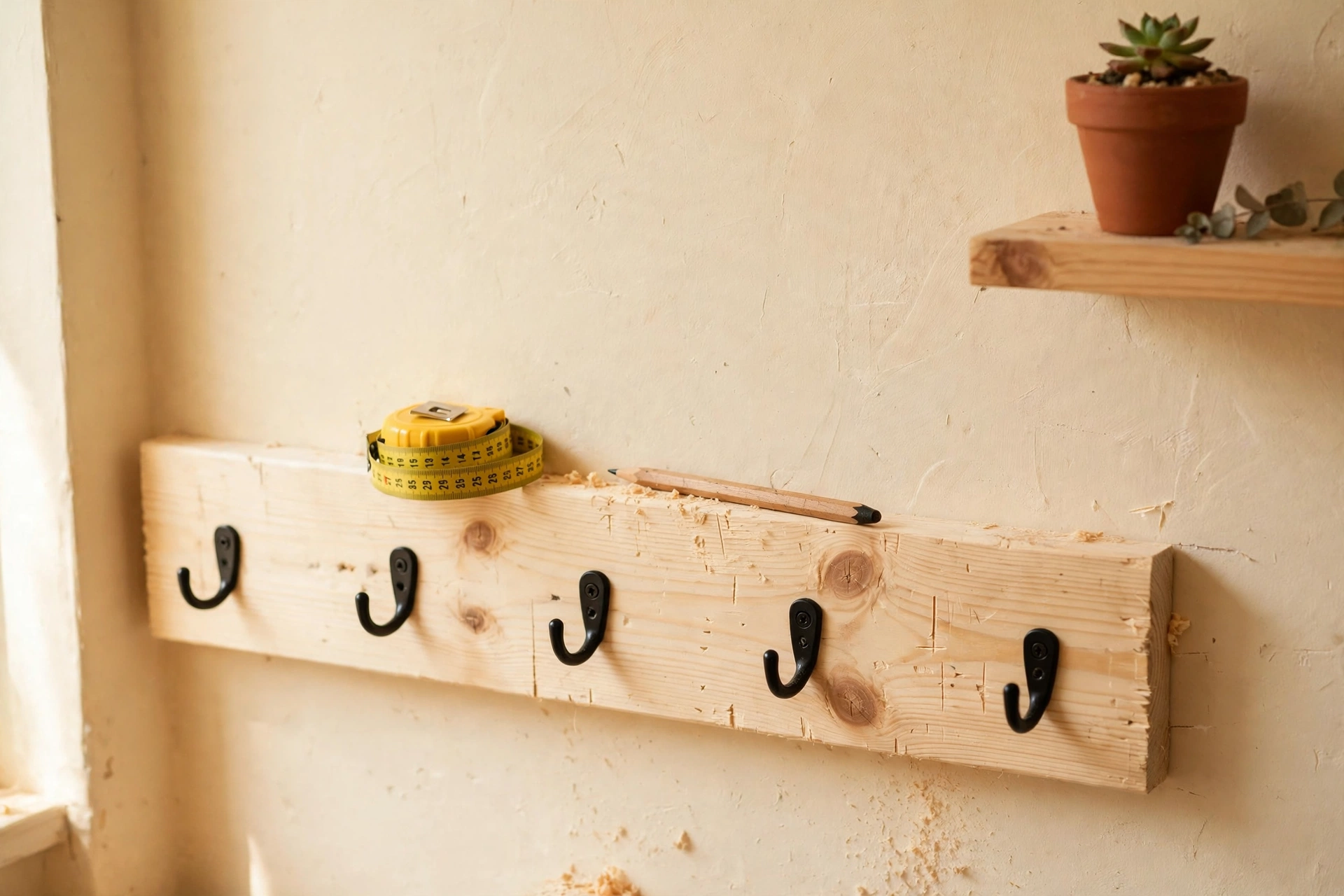
A 1 by 4 pine board with five metal hooks, screwed into two studs. This is the default build, and the step-by-step for it is in the HowTo section below. It costs $24.23 in materials, takes about an hour, and holds a family’s coats without drama.
Best for: most small entryways. Main advantage: the cheapest strong option, and every part is at one hardware store. Watch out for: the rail must reach two studs, so a short rail on a wide stud spacing needs anchors at the ends. Verdict: build this one first. Deposit-Risk: 3 out of 5 (screw holes, fillable before move-out).
2. The peg rail
Wooden dowel pegs instead of hooks, set into the same pine board. Pegs hold scarves and bag straps without the loop slipping off, and they look softer than metal hooks in a small hall.
Best for: scarves, bags, and kids’ coats. Main advantage: cheap dowels, and nothing sharp to catch a sleeve. Watch out for: a peg holds less than a metal hook, and a heavy coat slides off a short peg. Verdict: the best second rail, not the only rail. Deposit-Risk: 3 out of 5.
3. The industrial pipe frame
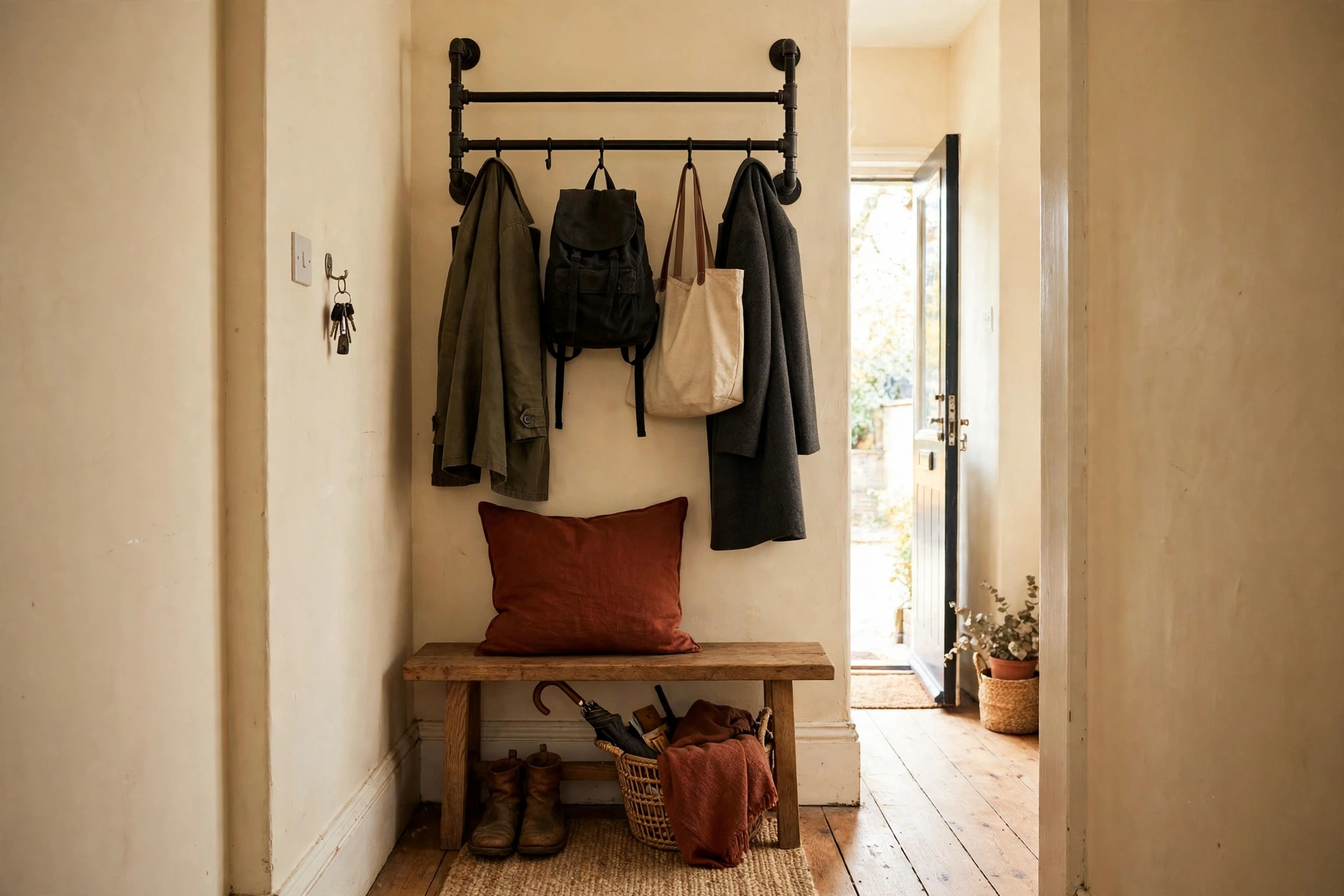
Black iron pipe flanges, elbows, and pipe, built into a frame that stands off the wall. Each flange spreads the load across four screw points, which is why this build holds the heaviest coats in this post.
Best for: heavy winter coats and a loft look. Main advantage: the strongest mount per screw point of any build here. Watch out for: pipe fittings cost more than wood, and the frame sticks further from the wall, so check the walkway clearance first. Verdict: the strongest look, overkill for one person. Deposit-Risk: 3 out of 5 (more holes than a plain rail).
4. The driftwood branch rail
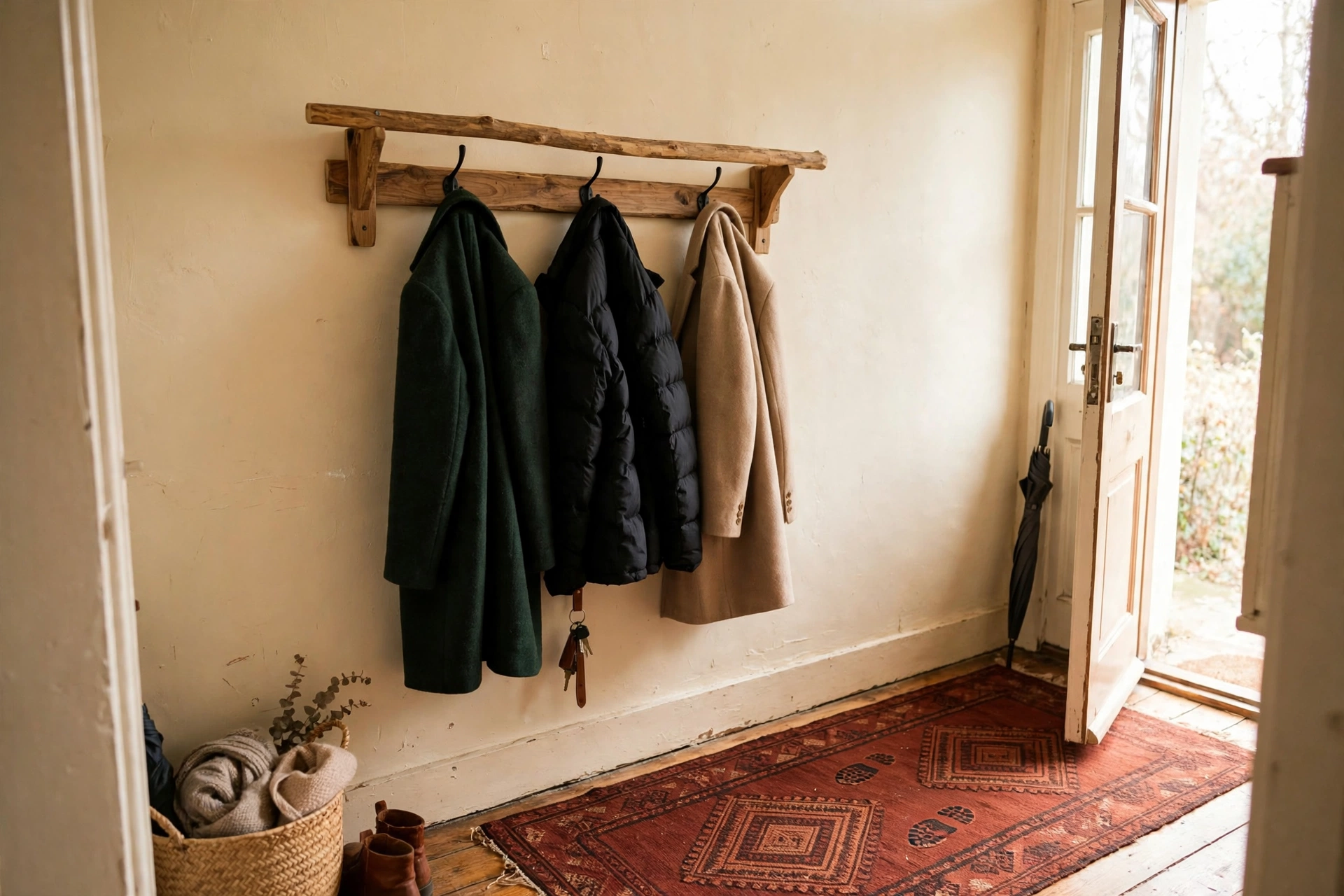
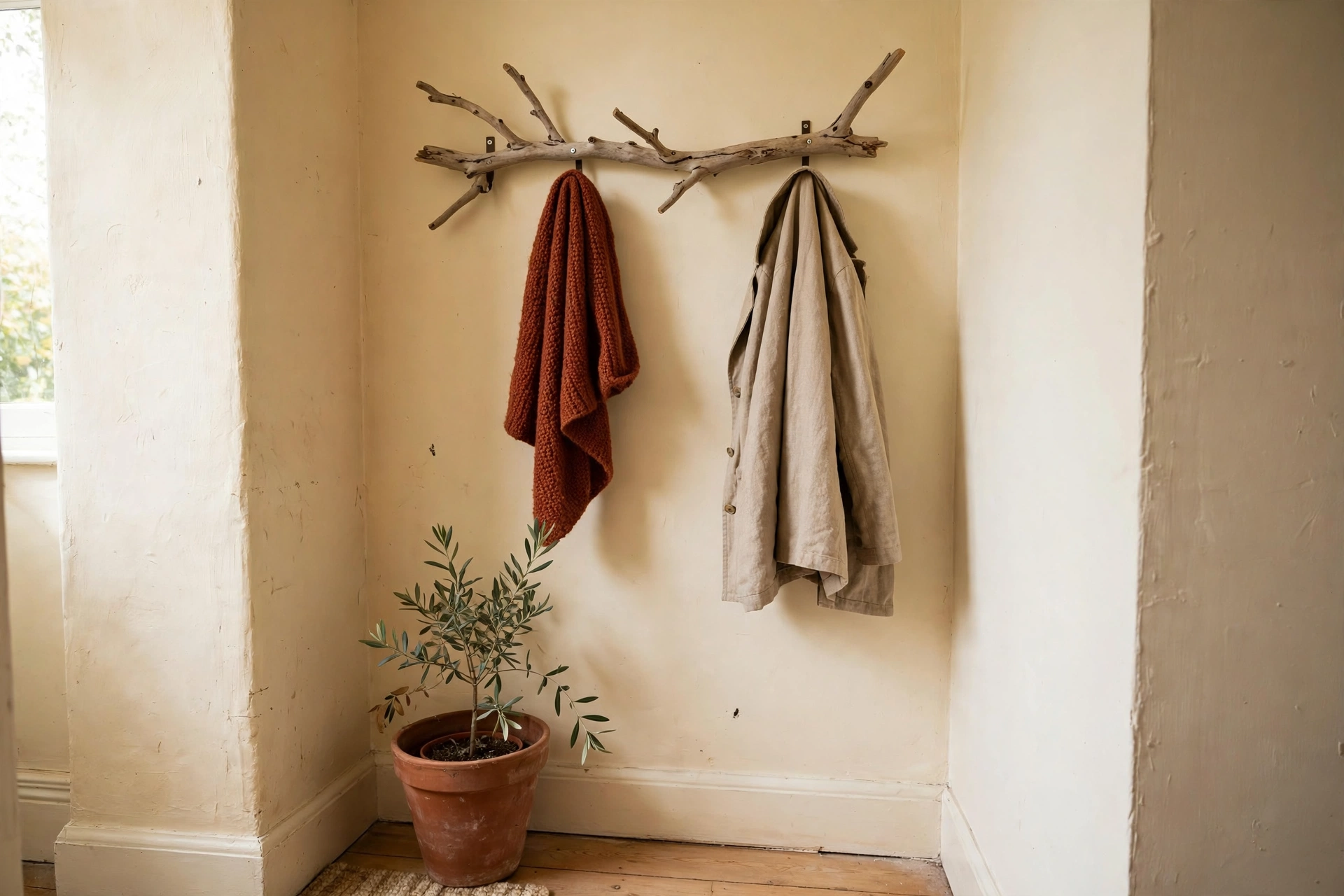
A solid fallen branch, dried and sealed, mounted on brackets with hooks or using its own offshoots as hooks. The branch is free, and no two are alike, which is the whole point.
Best for: character on a tiny budget. Main advantage: the main material costs nothing, and it looks like a design choice, not a budget choice. Watch out for: check the branch is dry and solid, seal it against shedding, and mount through brackets into studs because a branch is uneven and will not sit flat. Verdict: the prettiest cheap build, if you find a good branch. Deposit-Risk: 3 out of 5.
5. The no-drill adhesive rail
Command X-Large hooks straight on a smooth painted wall, or on a light board held by adhesive strips. No drill, no holes, and it comes off cleanly when you move out.
Best for: renters on smooth painted walls. Main advantage: zero holes, and removal is part of the design. Watch out for: 10 lb per X-Large hook is a real limit, and a wet coat plus a bag can pass it. Never stick to textured walls or fresh paint, and let paint cure fully first. Verdict: the renter default, but count the weight. Deposit-Risk: 1 out of 5.
6. The freestanding coat tree
A solid wood coat tree that stands in a corner and touches no wall at all. It moves with you, which no wall build can do.
Best for: renters who cannot touch the wall at all, and corners. Main advantage: zero wall contact and zero deposit risk. Watch out for: a loaded tree tips, so check the base width and keep the heaviest coats low. Verdict: the safest deposit choice, and the weakest use of floor space. Deposit-Risk: 1 out of 5.
7. The rack-plus-bench combo
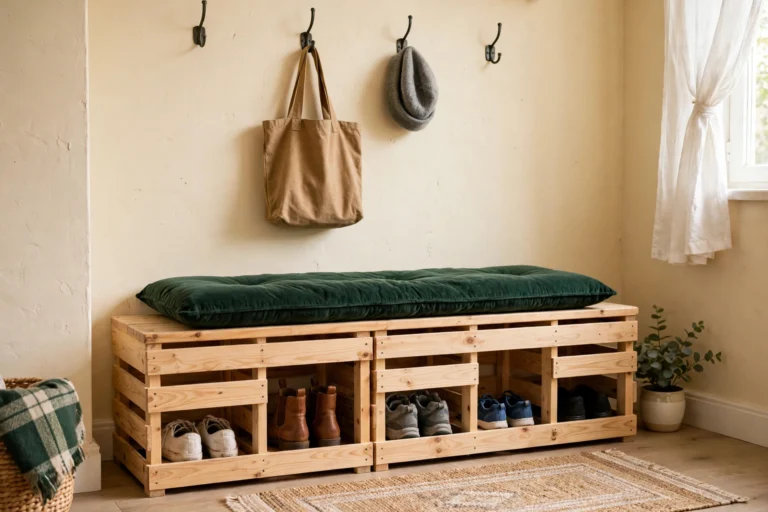
A wall rail mounted above a bench, so coats hang above and shoes and bags sit below in one footprint. The bench also gives you somewhere to sit while you put shoes on, which is why families love this build. Our DIY crate storage bench is a good bench half for this combo, and the shoe storage ideas for small entryways guide covers what goes underneath.
Best for: families, and one footprint for coats and shoes. Main advantage: the bench catches bags and shoes that would otherwise live on the floor. Watch out for: the bench eats floor space, so measure the walkway first and keep that 30 inch minimum clear. Verdict: the best build for a household with more than two people. Deposit-Risk: 3 out of 5.
8. The two-height family rail
An adult row at 60 to 66 inches and a kids’ row at 36 to 48 inches, with the rows offset so the coats do not collide. Kids hang their own coats, which is the only way the coat pile on the floor actually ends.
Best for: households with kids. Main advantage: kids can reach their own hooks, so coats stop landing on the floor. Watch out for: offset the rows horizontally, and keep the lower row for kids only, not as overflow for adult coats. Verdict: the one build that changes the daily routine. Deposit-Risk: 3 out of 5.
How to build the classic wall rail
Materials: one 1 by 4 pine board, 8 ft (2.4 m), cut to your rail length from the table above; five metal coat hooks; wood screws; wall screws and drywall anchors for any fixing that misses a stud; sandpaper; wood stain or paint if you want a finish. Tools: tape measure, pencil, stud finder, level, drill, screwdriver. Time: about 1 to 2 hours, plus drying time if you stain or paint.
- Measure the wall and count your hooks using the rail-length table above.
- Find the studs with a stud finder and mark them with pencil.
- Cut the pine board to length and sand the edges smooth.
- Mark the hook positions 6 to 8 inches (15 to 20 cm) apart, with a half-spacing margin at each end.
- Pre-drill the board and screw the hooks on.
- Level the board with the hooks at 60 to 66 inches (152 to 168 cm) and drive screws into the studs.
- Hang one coat per hook and check for movement before you load it fully.
DIY coat rack ideas for small entryway: what does it cost?
Prices live-checked in November 2026. The classic rail is the cheapest strong build, and the no-drill route costs about the same once you buy enough hooks.
| Item | Price, as of November 2026 |
|---|---|
| 1 by 4 by 8 ft primed pine board, Home Depot | $9.98 |
| Amazon Basics 5-pack metal coat hooks | $14.25 |
| Command X-Large hooks, 2-pack (3M) | $8.99 |
| Command Large Utility hook, 1-pack (3M) | $4.99 |
| Folding gold wall hooks, 2-pack | $8.99 |
| HomeDo 4-pack adhesive wooden hooks | $15.60 |
Two route totals, sums checked: the classic screw-in rail (board plus 5-pack hooks) comes to $24.23, plus screws and anchors, which most DIYers already have in a toolbox. The no-drill starter set (2 Command X-Large hooks plus 1 Command Large Utility hook, three hooks for one person’s coats) comes to $13.98. Prices move by store and week, so confirm the shelf price on the day you buy.
Renting? Check the lease before you drill
Most leases allow small nail and screw holes that you fill before move-out, but some ban wall mounting outright, and a few charge per hole. Read the lease first, and ask the landlord in writing if a rail is allowed. Photograph the wall before you drill and after you fill the holes, so the move-out inspection has a record. If the lease says no holes at all, build 5 or 6 above, the adhesive rail or the freestanding tree, and keep the deposit. Our small coat closet organization guide covers the closet half of this problem, and the small entryway organization guide covers the rest of the drop zone.
Mistakes to avoid
Mounting into bare drywall. A screw with no stud and no anchor will pull out under a few winter coats. This is the most common coat rack failure, and it takes the paint with it.
Spacing hooks under 6 inches apart. Coats bunch, crease, and overlap, and the crowded hooks go unused while coats land on a chair.
Mounting too low. Hooks under 60 inches let long coats brush the floor, where they pick up dirt and get stepped on.
Hanging a wet coat on an adhesive hook. Wet wool is heavy, and moisture weakens adhesive over time. Let coats drip by the door first.
Buying hooks before measuring. A rail longer than the wall, or hooks that run into a door frame, means a second trip to the store and a second set of holes.
What to skip
A coat tree in a hallway under 36 inches wide. It becomes the obstacle you walk around, and it will get knocked over.
Tiny decorative hooks rated for keys, used for winter coats. The rating is the rating. A 2 lb hook does not become a coat hook because it looks nice.
A rail with no end margin. Coats slide off the ends and land on the floor, which defeats the whole build.
Peel-and-stick hooks on textured walls. Adhesive needs a smooth surface. On texture it holds for a week, then drops a coat at 2 a.m.
Frequently asked questions
How high should a coat rack be?
For adults, hang a wall coat rack so the hooks sit 60 to 66 inches (152 to 168 cm) above the floor. For long coats, go up to 66 to 70 inches (168 to 178 cm) so the hem clears the floor. For kids, hang hooks at 36 to 48 inches (91 to 122 cm) so they can reach them.
How far apart should coat hooks be?
Space coat hooks 6 to 8 inches (15 to 20 cm) apart, measured center to center. Closer than 6 inches and bulky winter coats overlap and crease. Wider than 8 inches and you waste rail that could hold another hook.
How many hooks do I need for a small entryway?
Plan one to two hooks per person who uses the entryway every day, then add one or two spares for bags and guests. One person needs 3 hooks, two people need 6, and a family of four needs at least 10. Count bags as well as coats, or the bags end up on the floor.
Can I hang a coat rack without drilling?
Yes. Command X-Large hooks hold 10 lb (4.5 kg) each on smooth painted walls, and a freestanding coat tree needs no wall contact at all. Both come off cleanly. Avoid adhesive on textured walls or fresh paint, and do not hang a heavy wet coat on a hook rated for a light jacket.
Sources
Hook spacing and mount heights cross-checked against the Quirky Moose small-hallway coat rack guide and the WoodFurnist coat rack height guide, which both give 6 to 8 inch spacing and 60 to 66 inch adult heights. Hook counts per person and the 15 to 20 cm spacing also match the Hometweakz small entryway build. Load limits are the makers’ own numbers: 3M Command ratings and the folding-hook maker’s 40 lb rating. Prices are live-checked November 2026 listings from Home Depot and Amazon. The mount heights match our narrow hallway storage guide, and the walkway minimum comes from the same guide.