Best Humidifier for Small Bedroom: 6 Picks That Survive the Night
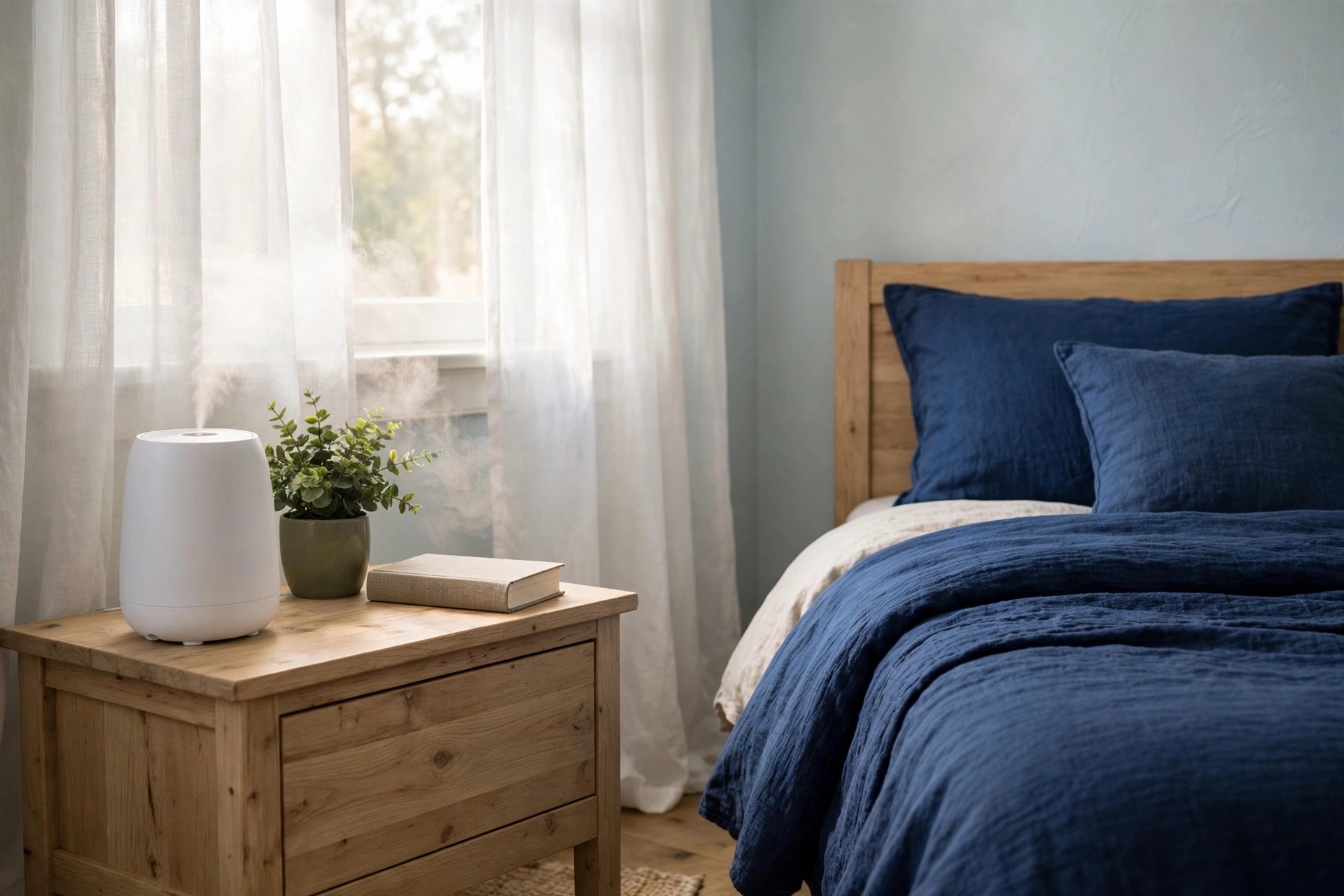
The best humidifier for small bedroom use is a 2.5 to 4 liter cool-mist unit that runs all night on one fill at 26 dB or less. I worked the numbers before picking anything. A 10 by 12 ft bedroom (3.0 by 3.7 m) holds about 27 cubic metres of air, and lifting it from 30% to 50% humidity takes only about 94 ml of water, so the tank is not the hard part. The hard part is surviving the night without a refill and without waking you up. Six models below do that job, with live-checked November 2026 prices from $29.78 to $69.99.
Dry winter air in a small bedroom is a simple problem with a simple fix, but most buying guides get the sizing wrong. They rank big-room machines and tiny desk toys side by side as if the room did not matter. It does. A unit that is too small runs dry at 3 a.m. A unit that is too big pushes a small sealed room past 50% humidity, and then the windows fog and the paint suffers. This guide fixes the sizing first, then compares six real models on the four numbers that decide a good night: tank size, runtime, noise and year-one cost. If your room is damp instead of dry, you need the opposite machine, the best dehumidifier for small apartments we compared earlier, not a humidifier.
What size humidifier does a small bedroom actually need?
Start with the room, not the box. Measure the length and width, multiply them, and match the tank to the result. A small bedroom in this guide is 100 to 200 sq ft (9.3 to 18.6 sq m), which covers most apartment bedrooms, guest rooms and box rooms.
| Job | Tank size | What it really does | Example |
|---|---|---|---|
| Desk or nightstand only | Under 2 L | Humidifies the air around you, not the room | Pure Enrichment MistAire |
| Small bedroom | 2.5 to 4 L | Holds a closed bedroom at 30 to 50% humidity overnight | DREO 3L, Levoit Classic 160 |
| Too big for the room | Over 4 L | Wastes money and risks over-humidifying a small sealed room | 6 L whole-room units |
Here is the math behind the middle row. Air at 20 C holds about 17.3 grams of water per cubic metre at saturation. A 10 by 12 ft bedroom with an 8 ft ceiling holds about 27 cubic metres, so raising it from 30% to 50% humidity needs about 94 grams of water, roughly 94 ml. A humidifier putting out 150 ml per hour covers that in about 40 minutes in a sealed room. Real rooms leak air, so expect one to two hours to feel the difference, and expect the machine to keep topping the room up all night. That is why runtime matters more than coverage claims. A full night is 8 hours at about 150 ml per hour, which is 1.2 liters. A 3 liter tank on low lasts about two nights. The same tank on high, at 250 ml per hour, lasts 12 hours, which is one night plus a morning. Buy the tank for the night, not for the headline coverage number.
The best humidifier for small bedroom sleep: 6 picks compared
Every pick below is a cool-mist ultrasonic unit except the last one, which is evaporative. All six are sized for a 100 to 200 sq ft bedroom. Prices were live-checked in November 2026 and will move with sales, so treat them as the price on the day, not a permanent fact.
| Pick | Tank | Runtime | Noise | Coverage | Price, Nov 2026 |
|---|---|---|---|---|---|
| DREO 3L (top pick) | 3 L | Up to 30 h | 26 dB sleep mode | Up to 300 sq ft (27.9 sq m) | $29.90 sale, list $39.99 |
| Levoit Classic 160 | 2.5 L | Up to 25 h | 25 dB | Up to 219 sq ft (20.3 sq m) | $29.78, list $39.99 |
| DREO HM311 4L | 4 L | Up to 36 h | 28 dB | Up to 300 sq ft (27.9 sq m) | $35.93, list $39.99 |
| Levoit Dual 150 | 3 L | Up to 25 h | Quiet, no dB listed | Up to 290 sq ft (26.9 sq m) | $43.99 |
| Pure Enrichment MistAire | 1.5 L | Up to 25 h | Quiet, no dB listed | Up to 250 sq ft (23.2 sq m) | $39.99 |
| Vornado EV100 | 1 gal (3.8 L) | Up to 24 h | Fan hum, no dB listed | Up to 300 sq ft (27.9 sq m) | $69.99 |
1. DREO 3L, best overall
Best for: most small bedrooms, first-time buyers, light sleepers.
Main advantage: the 3 liter top-fill tank runs up to 30 hours in sleep mode at 26 dB, which is two full nights without a refill, and the 360-degree nozzle aims the mist away from the bed.
Watch out for: it is ultrasonic, so tap water leaves white dust on dark furniture. Use distilled water or wipe the nightstand weekly.
Verdict: the safest buy in the whole shortlist. It is the cheapest way to get a real room-sized tank, a quiet sleep mode and a top-fill tank in one box. Our rating: 4.4 out of 5.
2. Levoit Classic 160, best budget pick
Best for: tight budgets, nurseries, anyone who wants one knob and no app.
Main advantage: the lowest year-one cost in this guide at $29.78, with a 2.5 liter top-fill tank that runs up to 25 hours on low at 25 dB. The single knob is the whole control panel, which is a feature, not a flaw, at 2 a.m.
Watch out for: coverage tops out at 219 sq ft, so a bedroom over about 12 by 15 ft (3.7 by 4.6 m) is too big for it. The tank is also the smallest of the room-sized picks, so heavy users refill every other day.
Verdict: the best humidifier for small bedroom budgets. It does the core job for the least money, and the only thing it gives up is headroom.
3. DREO HM311 4L, best for long runtime
Best for: people who hate refilling, dry climates, bedrooms that run the heat all night.
Main advantage: the 4 liter tank runs up to 36 hours, the longest in this guide, at 28 dB. Top-fill design and adjustable humidity control mean you set a target and stop thinking about it.
Watch out for: 28 dB is a touch louder than the 26 dB sleep mode on the DREO 3L, and the extra liter makes it taller on the nightstand, so check the shelf clearance above it.
Verdict: buy this one if refilling is the chore you will actually skip. The extra $6 over the DREO 3L buys a third night of runtime.
4. Levoit Dual 150, best with a diffuser
Best for: bedrooms that double as a work-from-home office, anyone who wants a diffuser built in.
Main advantage: a 3 liter tank, up to 25 hours of runtime, up to 290 sq ft of coverage, and an essential-oil diffuser tray in the same unit, so one box replaces two on a small nightstand. It uses a small filter sponge, and a 10-pack of replacements costs about $10.
Watch out for: Levoit lists no decibel figure for this model, so the quiet claim rests on user reports, not a number. The filter sponge is one more thing to replace.
Verdict: the most versatile pick. If the nightstand is crowded, the diffuser tray earns its keep.
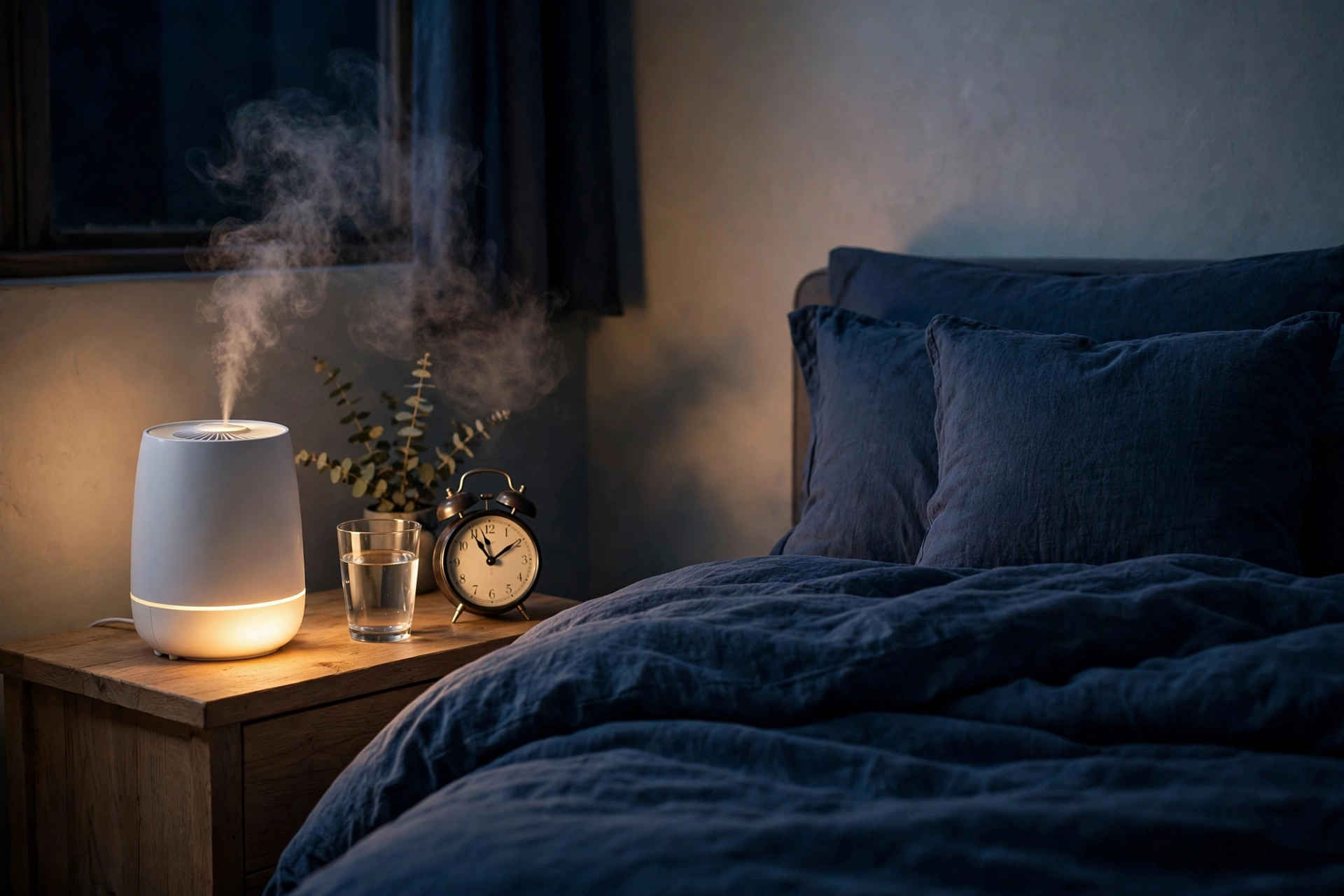
5. Pure Enrichment MistAire, best for a nightstand or desk
Best for: tiny nightstands, desks, dorm rooms, travel between rooms.
Main advantage: the smallest footprint here, a 1.5 liter tank (some listings round it to 1.7 L), an optional night light, two mist settings and a directional nozzle, all for $39.99, with a 5-year warranty.
Watch out for: this is a personal-air machine, not a room machine. A 1.5 liter tank at 150 ml per hour lasts 10 hours on paper and less in a dry room, so it will not hold a whole bedroom at 50% through a long dry night. Buy it for the air around the bed, not for the room.
Verdict: the honest small pick. It is the best humidifier for small bedroom nightstands where space is the constraint, and the wrong pick if you expect it to humidify the whole room.
6. Vornado EV100, best evaporative, no white dust
Best for: hard-water homes, dark wood furniture, anyone who hates white dust.
Main advantage: evaporative wick humidifiers do not spray minerals into the air, so there is no white dust at all, even with tap water. The 1 gallon tank covers up to 300 sq ft, and the 5-year warranty is the longest here.
Watch out for: it costs $69.99, the most in this guide, and the wick needs replacing every four to eight weeks, which is an ongoing cost on top of the unit. It also has a fan, so it hums more than an ultrasonic unit.
Verdict: the right pick when white dust is the deal-breaker. Everyone else gets the same humidity for less money from the ultrasonic picks above.
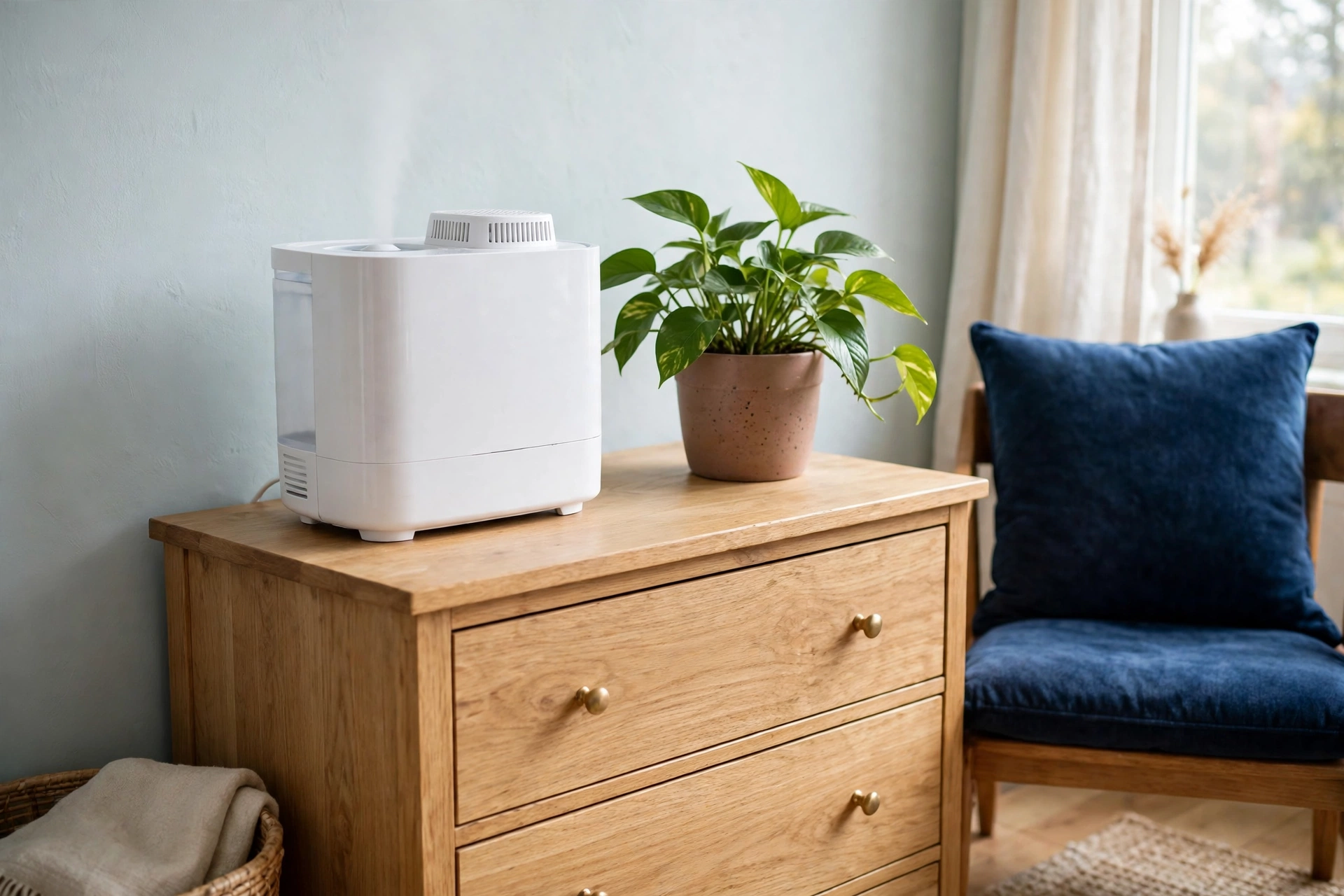
Ultrasonic vs evaporative: which one suits a small bedroom?
Most bedroom humidifiers are ultrasonic. A small metal disc vibrates and turns water into a fine cool mist. They are quiet, cheap and use little power. Their one real flaw is white dust. Tap water carries dissolved minerals, and an ultrasonic unit sprays those minerals into the room along with the water. They settle as a fine white film on dark furniture, TVs and electronics. Distilled water fixes it completely, and so does an evaporative unit, which blows air through a wet wick instead of spraying mist. Evaporative units cost more, need wick replacements and hum a little, but they cannot make white dust.
My take, after comparing the whole shortlist: ultrasonic wins for most small bedrooms, because distilled water is cheap and the machines are quieter and cheaper. Evaporative wins only when you know you will use tap water and you own dark furniture you care about. Either way, keep the room at 30 to 50% humidity and never humidify past 50%. The EPA says so plainly, because higher humidity encourages mold. Push the room past 50% and the windows tell on you, so learn how to stop condensation on windows in a rental before blaming the machine.
How loud is too loud? Sleep-mode noise in plain numbers
Decibels are the number most guides hide behind adjectives. Here are the actual figures, all from manufacturer listings, so treat them as comparisons, not lab measurements. None of the makers states the distance the figure was measured at, which is a real limitation of every dB claim in this category.
| Pick | Sleep-mode noise | What it sounds like |
|---|---|---|
| Levoit Classic 160 | 25 dB | Quieter than a whisper, about the sound of leaves rustling |
| DREO 3L | 26 dB sleep mode | A whisper, easy to sleep through |
| DREO HM311 4L | 28 dB | Soft, about a quiet library corner |
| Levoit Dual 150 | Not listed | User reports call it quiet, but there is no number to check |
| Pure Enrichment MistAire | Not listed | Marketed as whisper-quiet, no number published |
| Vornado EV100 | Not listed, fan hum | The only pick with a fan, so expect a low hum rather than silence |
A whisper is about 30 dB, so anything at 26 to 28 dB sits below it. In practice, the difference between 25 dB and 28 dB is small, and the bigger sleep problem is the light, not the sound. Pick a unit with a sleep mode that turns the display off, and keep the night light dim or off if you sleep in total darkness. A humidifier adds moisture; it does not clean the air, which is the job of the air purifier we picked for a small bedroom, so do not expect one box to do both jobs.
What does a humidifier cost to run for a year?
The sticker price is only the first cost. Year-one cost is the unit plus the extras it needs: filters or wicks, and electricity. Distilled water is the other running cost for ultrasonic units, about $1 per gallon at most grocery stores, and a small bedroom uses roughly a gallon a week in winter.
| Pick | Unit price | First-year extras | Year-one total |
|---|---|---|---|
| DREO 3L | $29.90 | $0, no filter needed | $29.90 |
| Levoit Classic 160 | $29.78 | $0, no filter needed | $29.78 |
| DREO HM311 4L | $35.93 | $0, no filter needed | $35.93 |
| Levoit Dual 150 | $43.99 | About $10 for a 10-pack of filter sponges | $53.99 |
| Pure Enrichment MistAire | $39.99 | $0, no filter needed | $39.99 |
| Vornado EV100 | $69.99 | Wick 2-pack, check the current listing price, replaced every 4 to 8 weeks | $69.99 plus wicks |
Electricity is the smallest line. The Levoit Dual 150 runs on 25 watts. Eight hours a night at 25 watts is 0.2 kWh, and at the US average rate of 18.2 cents per kWh that is about 4 cents a night, or about $1.09 a month for nightly use. The other picks run on similar wattage, so expect about $1 a month, not $10. The honest surprise in this table is how close the two cheapest picks are: the Classic 160 costs $29.78 for the year, and the DREO 3L costs $29.90, twelve cents more, with five extra hours of runtime and a bigger tank. That twelve cents buys the better machine.
How to set up a bedroom humidifier in 7 steps
You need three things before you start: the humidifier, a small hygrometer (about $10, sold at any hardware store), and low-mineral water, ideally distilled. Do not skip the hygrometer. The dial on the humidifier guesses, the hygrometer measures.
- Measure the room. Length times width gives the square footage. A 10 by 12 ft room is 120 sq ft (11.1 sq m). Match it to the sizing table above before you buy.
- Pick the tank for the night. Choose 2.5 to 4 liters for a small bedroom. Smaller tanks are for desks, bigger tanks are for bigger rooms.
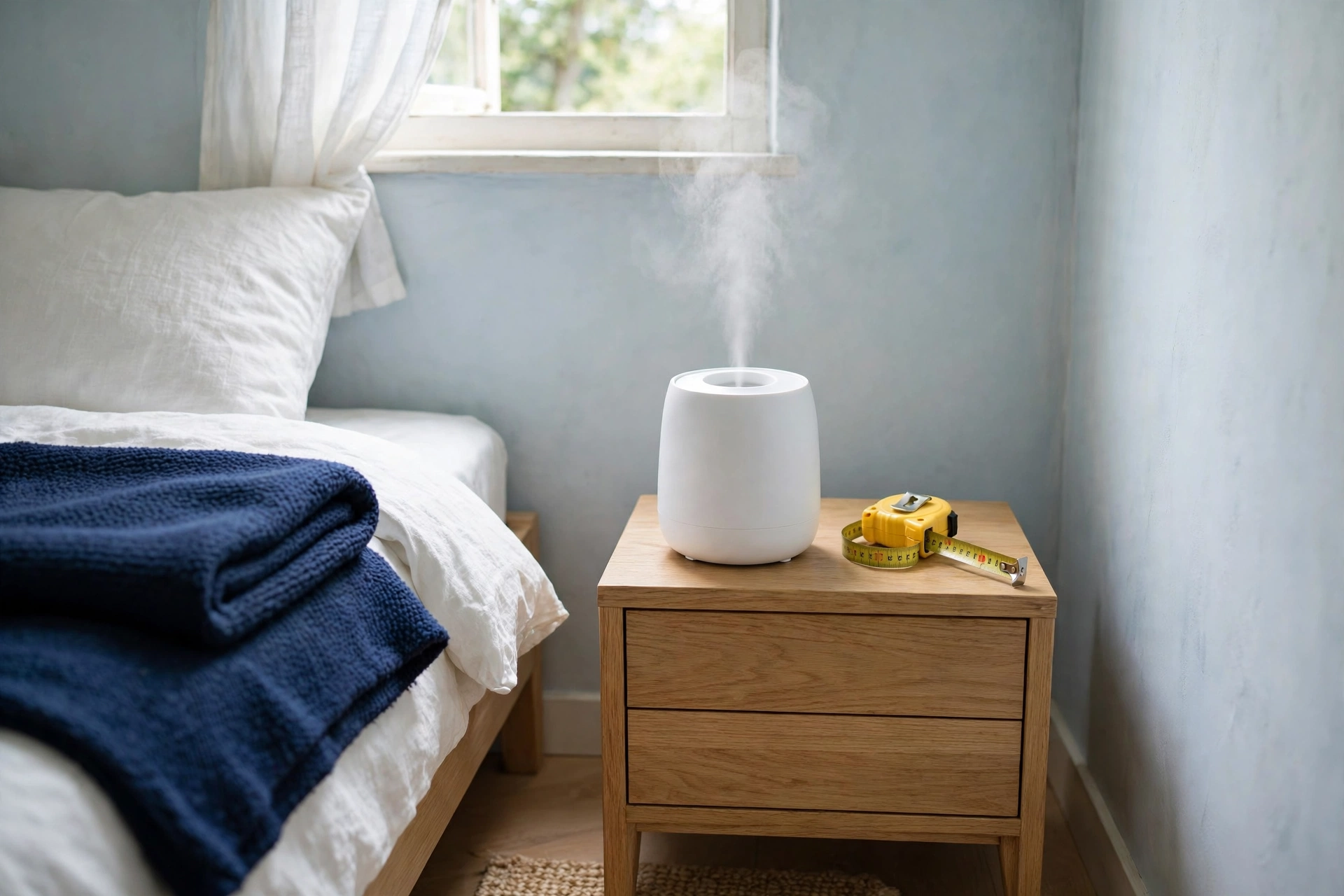
- Place it right. Put it on a nightstand or dresser at least 30 cm (12 in) from the wall and the bed, on a waterproof tray, with the nozzle aimed into the room, not at the bedding or the wall.
- Fill it with low-mineral water. Distilled water stops white dust and scale. If you use tap water, expect to wipe the tank and the nightstand more often.
- Set the target. Aim for 40 to 50% humidity, inside the EPA range of 30 to 50%. Start at 40% in cold weather and turn it down if the windows fog.
- Run sleep mode overnight. Low output, display off, night light dim or off. Refill in the morning, not at 3 a.m.
- Clean it every third day. Empty the tank, wipe every surface dry and refill with fresh water daily. Every third day, scrub the tank and interior to remove scale and film, then rinse well. That is the EPA routine, and skipping it is how a humidifier grows mold.
Dry winter air usually comes with cold rooms, and the space heater we picked for a small bedroom warms the same 10 by 12 ft box, so the two guides belong on the same shelf. Run the heater and the humidifier together and the room feels warmer at a lower thermostat setting, because moist air feels warmer than dry air at the same temperature.
Mistakes to avoid
Buying a desk humidifier for a whole room. A 500 ml bottle-top unit humidifies the air around your face. It will not move a 120 sq ft bedroom, and you will conclude humidifiers do not work. They do, at the right size.
Running it on high all night. High output empties the tank by 3 a.m. and can push a small sealed room past 50% humidity. Low or sleep mode is the overnight setting. High is for the first hour after you get home.
Using tap water in an ultrasonic unit. The white dust is not dirt, it is the minerals from your water. Distilled water or an evaporative unit are the only fixes. Wiping the dust off every day is not a fix.
Skipping the hygrometer. Without one, you are guessing. Guessing high grows mold on cold windows. Guessing low means the machine runs for nothing. A $10 hygrometer ends the argument.
Putting it on the floor or against the wall. Mist needs air around it. On the floor it wets the carpet. Against the wall it wets the paint. A tray on a nightstand, 30 cm from the wall, is the right home for it.
What to skip
Warm-mist units for a bedroom. They boil water, use more power and cost more to run, and the warm mist is a burn risk around kids and pets. Cool mist does the same job for less money and no risk.
Smart app control as a deciding feature. An app that turns the mist up from the sofa is nice, but the three numbers that matter are tank, runtime and noise. Pay for those first.
Built-in humidity displays. They measure the air right next to the machine, which is the wettest spot in the room. A separate hygrometer across the room tells the truth.
Oversized 6 liter whole-room units. In a 120 sq ft bedroom they are a waste of money and floor space, and they make over-humidifying easy. Save them for open-plan rooms.
Aroma pads as a reason to buy. Nice to have, never a reason to pick one model over another. The diffuser tray on the Dual 150 is a bonus, not the decision.
Renter note
A humidifier is the rare bedroom upgrade with zero deposit risk. It plugs in, sits on furniture you already own and needs no drilling, no mounting and no permission. There is nothing to reverse when you move out. The only renter risk is the same as for owners: over-humidifying. Keep it at 30 to 50%, watch the windows, and turn it down the moment they fog. That is the whole lease check.
How this was made
Prices, tank sizes, runtimes and noise figures were checked against live retailer and manufacturer listings in November 2026, and the room and cost math was worked from those published specs. No hands-on testing is claimed.
Sources
EPA, Use and Care of Home Humidifiers (30 to 50% target, clean every third day, low-mineral water). DREO, HM311 product page (4 L tank, 36-hour runtime, 28 dB, $39.99 list). Sleepopolis, Levoit Dual 150 review and Pure Enrichment MistAire review (prices and specs, updated November 11, 2026). The Honest Reviewers, Best Small Humidifiers for Desks, Offices and Travel (sizing rule, Levoit Dual 150 room rating). Lawncrat Supply, Best Humidifiers for Bedrooms (DREO 3L price $29.89 and rating 4.4 out of 5, specs checked October 26, 2026).
What size humidifier do I need for a small bedroom?
A 2.5 to 4 liter cool-mist unit is the right size for a 100 to 200 sq ft bedroom. It holds the room at 30 to 50% humidity overnight on one fill. Smaller units only humidify the air around you, and units over 4 liters risk over-humidifying a small sealed room.
Is a cool mist or warm mist humidifier better for a bedroom?
Cool mist is better for a bedroom. It uses less power, costs less to run and carries no burn risk around kids and pets. Warm mist only makes sense if you specifically want warm steam, for example during a cold, and even then the running cost is higher.
Will a humidifier leave white dust on my furniture?
Yes, if it is ultrasonic and you fill it with tap water. The mist carries dissolved minerals that settle as a white film on dark furniture and electronics. Distilled water stops it completely, and an evaporative humidifier like the Vornado EV100 never makes it in the first place.
How often should I clean a bedroom humidifier?
Empty the tank, wipe every surface dry and refill with fresh water every day, and clean the whole unit every third day to remove scale and film. That is the EPA routine. Skip it and the tank can grow mold and bacteria, which the mist then spreads around the room.