
How to Stop Condensation on Windows in a Rental Apartment: 7 Fixes That Save Your Deposit
The short answer
If you are wondering how to stop condensation on windows in a rental apartment, start with a number, not a product. Keep your indoor humidity between 30 and 50 percent, wipe the glass dry every morning, and ventilate in short bursts. That trio fixes most wet windows in a rental, and none of it touches your deposit, the same damage-free promise behind our guide to how to soundproof a rental apartment without damage. Here is the part most guides skip. A 12 by 10 ft bedroom (about 3.7 by 3.0 m) holds only around 280 grams of water in its air at 60 percent humidity, yet two sleeping people add roughly a litre of water to that same air overnight. The extra water has to land somewhere, and the coldest surface in the room always wins. That surface is your window. Once you see the maths, the fixes stop feeling random. You are not fighting the window. You are giving a litre of water somewhere better to go.
Why rental windows sweat first
Warm air holds more water than cold air. That is the whole story, and it explains why rentals suffer worst. Your breath, your shower, your cooking and your drying laundry all load the air with water vapour. When that warm, wet air touches cold glass, it cools past its dew point and the vapour turns back into liquid. The water you see in the morning is not a leak. It is your own air, wrung out by a cold pane.
Rentals get the worst of it for three plain reasons. First, older rental windows are often single glazed or tired double glazing, so the inside glass sits far colder than in a newer home. Second, small flats pack more moisture into fewer cubic metres. Two people, one bathroom and a drying rack in a 500 sq ft flat make a lot more vapour per room than the same two people in a house. Third, renters cannot just replace the window. The fix has to be removable, cheap and landlord-proof, which is exactly what this guide is built around.
First, check where the water sits
Before you buy anything, look at where the water actually is. The location decides whether the fix is yours or your landlord’s, and getting this wrong wastes money.
| Where you see it | What it means | Whose job it is |
|---|---|---|
| Inside face of the glass, worst at the bottom | Room humidity meeting cold glass | Yours, with the fixes below |
| Between the two panes, fog you cannot wipe | The seal has failed and moist air is trapped inside the unit | Your landlord’s, it needs a repair |
| On the frame, the sill or the wall below | Water has been pooling and soaking in | Report it in writing, then dry it daily while you wait |
| Only after showers or cooking | A burst of steam, not a constant problem | Yours, ventilation habits fix it |
Wipe the inside glass with your finger. If the fog clears, it is surface condensation and this guide will fix it. If the fog stays put between the panes, take a photo, note the date and report it. No film, tub or dehumidifier can dry the inside of a sealed unit, and a failed seal is a maintenance issue, not a lifestyle one. The full lease and deposit playbook walks through what to photograph and how to report damp in writing so the paper trail protects you.
The overnight water budget
Most condensation guides list tips without saying how much water you are actually fighting. Here is the budget, computed from standard air-moisture figures, so you can see why some fixes work and some barely dent the problem.
| Source | Water added | Notes |
|---|---|---|
| Two people sleeping, 8 hours | About 1 litre (1,000 g) | Breathing and skin moisture, every night |
| Air in a 12 by 10 ft bedroom at 60% humidity | About 280 g total | 8 ft ceiling, about 27 cubic metres of air |
| Same air at 50% humidity | About 235 g total | Only about 45 g less, the air itself holds very little |
| One moisture-absorber tub, per week | 200 to 400 ml | Pulled from the air near the window, not the whole room |
Read that table twice. Two sleepers add about a litre a night, but the bedroom air can only hold about 280 grams at a time. Roughly 700 grams a night has to go somewhere, and the cold glass is the easiest place to land. That is also why a desiccant tub alone cannot win. At 200 to 400 ml a week, one tub absorbs less than half of a single night’s output. Tubs help at the margins, right beside the worst window. They are not a strategy on their own. The strategy is to cut the supply and give the air a way out, which is what the seven fixes do.
How to stop condensation on windows in a rental apartment overnight: 7 renter-safe fixes
Every fix below is removable, needs no drilling and carries a deposit-risk rating from 1 (nothing to lose) to 5 (ask first). Together, these seven fixes are the practical answer to how to stop condensation on windows in a rental apartment without drilling a single hole. Start at the top and stop when the glass stays dry.
1. Measure first with a hygrometer
Best for: every rental, before spending on anything else. Main advantage: you stop guessing. A small digital hygrometer on the windowsill tells you the real number in seconds. Watch out for: cheap units can read 5 percent high or low, so watch the trend over a week rather than trusting one reading. Verdict: the single best $11 you will spend on this problem. Deposit risk: 1/5.
Keep it on the worst windowsill, not across the room. Check it morning and night for a week. If it reads above 60 percent, you have a humidity problem and the fixes below will move the number. If it reads 30 to 50 percent and the glass still weeps, your glass is simply very cold, and film (fix 5) matters more than drying the air. The EPA’s own guidance is the same target: keep indoor humidity between 30 and 50 percent, and always below 60 percent.

2. Ventilate in short bursts
Best for: every home, every morning. Main advantage: it is free, and it works fast. Watch out for: leaving a window cracked all day in winter just chills the room and the glass, which makes condensation worse, not better. Verdict: the highest-impact free fix there is. Deposit risk: 1/5.
Open the windows wide for 5 to 10 minutes, twice a day, once in the morning and once after cooking or showering. Short and wide beats a crack all day because it swaps the whole room’s wet air for dry outside air without cooling the walls and glass. In cold weather the outside air is dry even when it feels damp, since cold air holds very little water. Shut the windows, and the room warms back up with drier air inside, and if cold air still slips in through the gaps, learn how to draft proof a rental apartment with removable seals.
3. Move the moisture out at the source
Best for: bathrooms and kitchens, where most of the water starts. Main advantage: it stops the litre-a-night problem from growing. Watch out for: a bathroom extractor that hums but pulls nothing, usually because the vent is blocked or the filter is clogged. Verdict: boring, unglamorous, and responsible for about half the fix. Deposit risk: 1/5.
Run the bathroom extractor during every shower and for 20 minutes after, with the door shut and a small gap at the bottom so air can flow in. Put lids on pots when you cook, and run the rangehood if you have one. Dry laundry in the room with the best airflow, see how to dry clothes indoors in a small apartment without a dryer for the full rack, fan and humidity setup, never draped over a radiator in a shut bedroom, and keep the rack a hand’s width from the wall so air moves behind it. Small habits like these are the difference between a window that weeps and one that stays clear. And if your bathroom has no counter space for towels and bottles, keeping the room dry gets easier with storage that stays off the counter, like the no-drill ideas in our renter-friendly bathroom storage guide.
4. Put a moisture-absorber tub on the worst sill
Best for: the one window that always weeps first. Main advantage: silent, needs no power, and you can see it working as the crystals turn to liquid. Watch out for: it only dries the air right beside it, and a tub full of salty brine spilled on a painted sill is a mess, so keep it level and out of reach of kids and pets. Verdict: a useful sidekick, never the hero. Deposit risk: 1/5.
A refillable calcium-chloride tub rated for up to 250 sq ft (about 23 sq m) sits on the sill of the worst window and pulls 200 to 400 ml of water out of the air in a week. That is real water that never reaches the glass. Empty it when the lower chamber is two-thirds full, and refill it rather than buying a new tub each time. Do not expect it to fix a flat that reads 70 percent humidity. It is a local helper, not a dehumidifier.
5. Fit window insulation film on the worst window
Best for: single glazing and cold bedrooms. Main advantage: it warms the surface your air touches, which attacks the dew-point problem directly instead of chasing humidity. Watch out for: the tape can lift weak paint on removal, so test a corner first and never film an escape window shut. Verdict: the strongest single fix for cold glass, and fully removable. Deposit risk: 2/5.
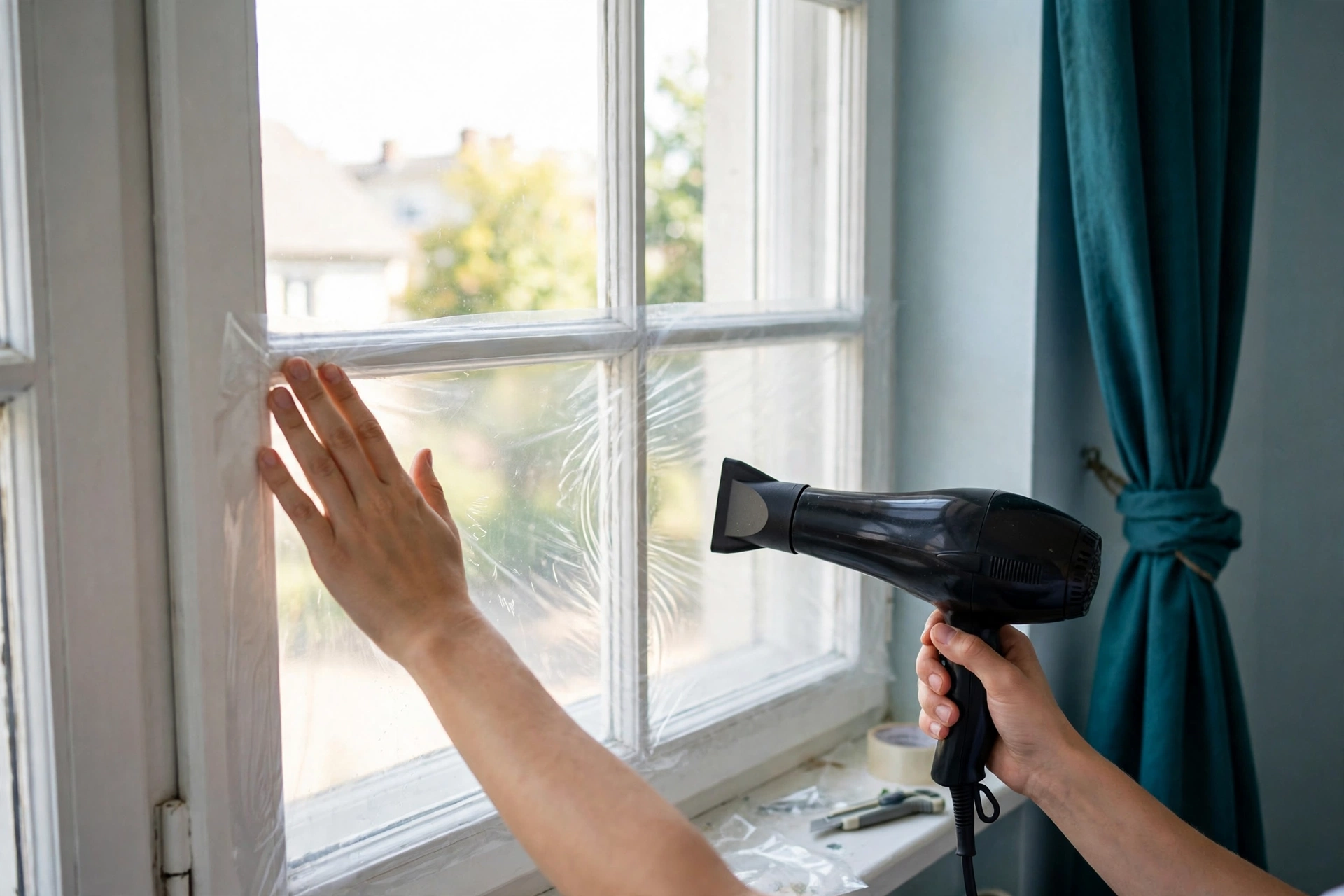
A shrink-film kit tapes clear plastic around the inside of the window frame, and a hairdryer pulls it taut. The trapped air pocket between film and glass raises the surface temperature, so your room air stops hitting its dew point on the pane. One 5-window kit covers five standard 3 by 5 ft windows (about 91 by 152 cm). Fit it on the coldest window first, usually the bedroom, and leave the windows you open daily alone. Check your lease first, and if the rules mention alterations, ask for written permission and keep the reply. At move-out the film peels off, and any tape residue comes away with warm soapy water.
6. Keep curtains and furniture off the glass
Best for: bedrooms where the curtains stay shut. Main advantage: free, instant, and often the whole problem. Watch out for: heavy lined curtains trap a pocket of cold, still air against the pane all night, which is exactly where condensation forms. Verdict: the fix most people skip, and the one I would check first after measuring. Deposit risk: 1/5.
Leave a hand’s width gap between the curtain and the glass at night so room air can brush past the pane. Open the curtains fully in the morning so daylight and warm air reach the glass. Move the bed or sofa a few inches away from the window wall so air circulates instead of pooling cold behind furniture. If your curtains pool on the sill, shorten the habit rather than the curtain: tie them back at night or hook them to one side.
7. Add a small dehumidifier for the worst room
Best for: flats that stay above 60 percent even after fixes 1 to 6. Main advantage: it actually removes litres, not millilitres, and it keeps working while you sleep. Watch out for: a big unit in a small room is overkill and noisy, and an empty-the-tank chore nobody does is a unit that stops helping. Verdict: the right last step, not the first step. Deposit risk: 1/5.
Measure first, ventilate second, and only then buy. A compact unit in the bedroom, run overnight with the door shut, can pull a litre or more out of the air while you sleep, which is roughly what two people add. Our guide to the best dehumidifier for small apartments compares seven compact picks that actually fit a rental bedroom, plus the $13 damp trap that wins when a machine is overkill. If you go this route, run it on a timer and empty it every morning as part of the routine below.
The 5-minute morning routine
Fixes work best as a habit, not a one-off project. This is the daily version of how to stop condensation on windows in a rental apartment, and it takes about five minutes.
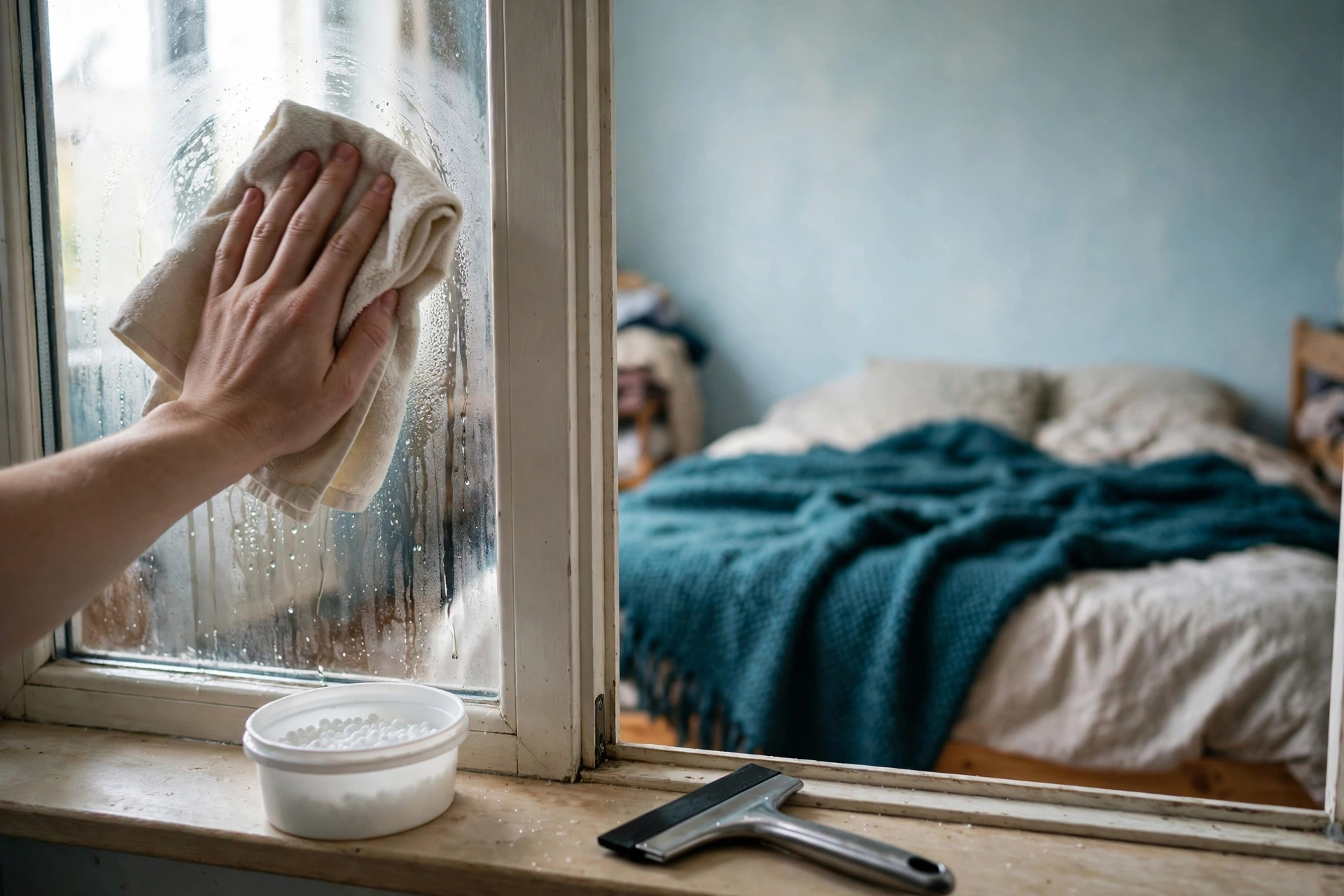
Materials: a digital hygrometer, an old towel or microfiber cloth, a small squeegee (optional), a moisture-absorber tub, a notebook or phone note for readings.
- Open the curtains first thing and look at the glass, the frame and the sill.
- Wipe the glass and sill dry from top to bottom with the towel, so no water sits and soaks in.
- Read the hygrometer on the worst sill and write the number down with the date.
- Open the windows wide for 5 to 10 minutes while you make breakfast.
- Check the absorber tub and empty it if the lower chamber is two-thirds full.
- Leave the bedroom door open for an hour after ventilating so air keeps moving.
- If you fitted film, check its edges once a week and press down any corner that has lifted.
Do this for two weeks and the notebook becomes your evidence. You will see which mornings are worst, whether the number is falling, and whether you need the next fix or the problem is already solved. If you ever need to show your landlord the damp, that dated log is worth more than a complaint.
What it costs
Prices checked live in November 2026. You do not need all of it. The cheapest route to learning how to stop condensation on windows in a rental apartment is the $14.58 start-here kit, a hygrometer and one absorber tub, and that solves most rentals.
| Item | Price checked (as of November 2026) | What it does |
|---|---|---|
| Digital hygrometer (TempPro TP50) | $11 | Shows your real humidity, morning and night |
| Moisture-absorber tub, one (DampRid Refillable 11 oz, 6-pack $21.49) | About $3.58 | Pulls 200 to 400 ml a week beside the worst window |
| Window insulation film kit, 5 windows (3M Indoor, 2141W-6) | $17.66 | Warms the glass surface so vapour stops condensing |
| Old towel for the sill | $0 | Already at home, dries the glass every morning |
| Start-here kit (hygrometer + one tub) | $14.58 | Measure, mop up, watch the number fall |
| Full-winter kit (hygrometer + film + 6-pack of tubs) | $50.15 | Every fix in this guide for one winter |
Time estimate: about 20 minutes to film one window, including cleaning the frame, and about 5 minutes a day for the morning routine. The film kit covers five windows, so one kit usually does a whole small flat.
Mistakes to avoid
Sealing the trickle vents shut. Those little slots above the window are planned ventilation. Blocking them traps humidity in, and the glass gets wetter, not drier.
Leaving wet towels on the sill. A damp towel against a cold frame keeps the wood wet all day. Wipe, then hang the towel to dry elsewhere.
Running a humidifier in winter. If your windows weep, your air is already wet. Adding moisture is the opposite of the fix, however dry your throat feels. Fix the humidity first.
Ignoring water between the panes. Fog you cannot wipe is a failed seal. Wiping harder will not help, and the unit needs replacing. Report it.
Wiping with a dirty cloth. A cloth that already smells musty spreads mould spores across the frame. Keep one clean cloth for the windows and wash it weekly.
What to skip
Antifog sprays. They work for a day or two, then the condensation comes back, and you are spraying chemicals on glass you sleep beside. Wiping and ventilation beat them.
A desiccant tub as the only fix. As the water budget shows, one tub absorbs less than half of one night’s output. Buy it as a helper, not as the plan.
Sealing the window shut with tape. It stops the draught and traps every gram of moisture inside. The glass gets wetter, and the tape can take paint with it in spring.
A big dehumidifier before measuring. Without a hygrometer reading you are guessing at the size, the running cost and whether you need one at all. Measure first, then buy the smallest unit that fits the job.
The renter check: lease, landlord, deposit
Every fix in this guide follows the same damage-free rules as our complete renter-friendly home upgrades guide. Follow them in order and you will know how to stop condensation on windows in a rental apartment and still hand back a dry, clean window. But check your lease before you start. Look for the clauses on alterations, adhesives and fixtures. Film and absorber tubs are removable, yet some leases still want written permission for anything stuck to a window frame. Ask in writing, keep the reply, and keep the receipts for everything you buy.
Report the problems that are not yours to fix. Fog between the panes, water running down inside the wall, black mould that keeps coming back after drying, and a window that will not shut are all maintenance issues. Report them in writing with dated photos, and keep a copy. If the mould keeps returning, that paper trail is what protects your deposit, because it shows the cause was the building, not you.
At move-out, reverse everything. Peel the film off slowly, wash any tape marks with warm soapy water, throw the tubs away, and wipe the sills clean. A dry, clean window at handover is the quietest deposit win there is.
FAQ
Why do my apartment windows get condensation in winter?
Warm, moist air from breathing, showering and cooking touches cold glass, cools past its dew point and turns back into water. Rentals suffer most because the glass is often single glazed or old, and small flats pack more moisture into less air. Keep humidity between 30 and 50 percent and the glass usually stays dry.
Is condensation on windows bad for renters?
Yes, if you leave it. Water that pools on sills every morning soaks into paint and wood, and the EPA warns that mould can start growing on a damp surface within 24 to 48 hours. Wipe it dry daily, keep humidity below 60 percent, and report failed seals or returning mould to your landlord in writing so the deposit risk sits with the building, not you.
What humidity level stops condensation on windows?
Aim for 30 to 50 percent relative humidity, and always below 60 percent, which is the EPA’s recommended range. On very cold nights you may need the low end of that range, since colder glass condenses at lower humidity. A $11 hygrometer on the windowsill shows you the real number.
Can I use window insulation film in a rental?
Yes, in most rentals, because it is fully removable. The film tapes to the frame and peels off at move-out, and the trapped air pocket warms the glass so condensation drops sharply. Check your lease for alteration rules first, ask for written permission if it is mentioned, and never film an escape window shut.
How this was made: prices were checked live in November 2026, humidity guidance comes from the EPA, and the water-budget math was computed from standard air-moisture figures, not from a lab test in this home.
Sources: EPA, Care for Your Air (indoor humidity 30 to 50 percent): https://www.epa.gov/indoor-air-quality-iaq/care-your-air-guide-indoor-air-quality · EPA, A Brief Guide to Mold, Moisture and Your Home (keep humidity below 60 percent, ideally 30 to 50 percent; dry wet areas within 24 to 48 hours): https://www.epa.gov/mold/brief-guide-mold-moisture-and-your-home · Prices: TempPro TP50 about $11 on Amazon (November 2, 2026 roundup); 3M Indoor Window Insulator Kit 5-window $17.66 on Amazon (October 20, 2026); DampRid Refillable 11 oz 6-pack $21.49 on Amazon; DampRid 10.5 oz tub rated up to 250 sq ft and up to 45 days per fill (manufacturer).