Best LED Strip Lights for Small Rooms: 7 Picks That Actually Light the Room
The best led strip lights for small rooms are the Govee RGBIC 32.8 ft kit for most bedrooms, the LIFX SuperColor 10 ft kit if you want real light instead of just color, and the DAYBETTER 32.8 ft kit if your budget is under $15. The short version is this: most strips sold as “room lighting” are accent lighting, and the difference comes down to lumens per metre, not the number of colors on the box. I measured nothing in a lab here. What I did instead was run the numbers every other roundup skips: how many feet your room actually needs, how bright each strip type really is per metre, and what each kit costs right now, as of November 2026.
What are the best LED strip lights for small rooms?
A strip earns its place in a small room when it fits the wall you have, puts out enough light to matter, and comes off cleanly when you move out. That sounds obvious, yet most roundups rank strips on color count and app features alone. In a 10 by 12 ft (3.0 by 3.7 m) bedroom, a 16.4 ft (5 m) strip covers one wall. A 32.8 ft (10 m) strip covers two walls or one wall plus the headboard. A full ceiling perimeter needs about 44 ft (13.4 m), so the 100 ft kits look generous until you realize you will cut most of it off or run it where nobody sees it.
My shortlist below gives you seven picks with a verdict each. If you only read one line, read this: buy the length your room needs, not the length on sale. A cheap 100 ft kit you use 30 ft of is not a bargain. It is 70 ft of clutter in a drawer.
How much LED strip light does a small room need?
Measure first, shop second. Grab a tape measure and walk the run you actually plan: behind the headboard, along the ceiling edge, under the bed, or behind the desk. Corners eat length, so add 10 percent for bends and cuts.
| Room size | Headboard wall only | Two walls (L shape) | Full ceiling perimeter | Kit to buy |
|---|---|---|---|---|
| 8 x 10 ft (2.4 x 3.0 m) | 10 ft (3.0 m) | 18 ft (5.5 m) | 36 ft (11.0 m) | 16.4 ft for one wall; 32.8 ft for two |
| 10 x 12 ft (3.0 x 3.7 m) | 12 ft (3.7 m) | 22 ft (6.7 m) | 44 ft (13.4 m) | 32.8 ft for two walls; add an extension for the full perimeter |
| 12 x 12 ft (3.7 x 3.7 m) | 12 ft (3.7 m) | 24 ft (7.3 m) | 48 ft (14.6 m) | 65.6 ft kit, or two 32.8 ft kits |
With the 10 percent corner allowance, a full perimeter run needs about 40 ft (12.2 m) in the smallest room, 48 ft (14.6 m) in a 10 by 12 ft room, and 53 ft (16.2 m) in a 12 by 12 ft room. That is why the 32.8 ft kit is the sweet spot for most small rooms: it covers the two walls you actually look at, and you are not paying for length that ends up coiled behind the wardrobe.
One more thing worth knowing before you buy: many “32.8 ft” kits ship as two 16.4 ft (5 m) rolls, not one continuous strip. That is fine if your plan has two separate runs, like headboard plus desk. It is a problem if you wanted one unbroken ceiling line, because most budget kits cannot be joined into a single run past their rated length. Check the listing for “2 rolls” before you order.
How bright are LED strip lights, really?
Brightness is where strip light marketing gets slippery. Boxes shout about 16 million colors and whisper about lumens, if they mention them at all. Here is the honest scale, in lumens per metre, which is the only number that tells you whether a strip lights a room or just tints it.
| Strip type | Typical lumens per metre | What it does in a small room |
|---|---|---|
| 3528 RGB, 60 LEDs/m | 150-250 | Accent glow only, fine behind a TV |
| 5050 RGB, 30 LEDs/m | 250-400 | Soft accent, gentle fill behind furniture |
| 5050 RGB, 60 LEDs/m | 400-600 | Noticeable fill, still not a main light |
| 5050 RGBW / RGBIC with white channel | 500-700 | Real fill light, good for reading corners |
| COB, 840 LEDs/m | 600-800 | Smooth, even light with no visible dots |
| 2835 white, 60 LEDs/m | 700-1,000 | Can light a small room with enough length |
| LIFX SuperColor 120 in (stated) | 689 | 2,100 lumens over 3.05 m, manufacturer stated |
The LIFX figure is the only one in that table straight from a manufacturer spec sheet, and I worked it out as 2,100 lumens divided by 3.05 m. The rest are typical ranges for the LED type, because budget brands rarely publish lumens at all. That silence is itself a signal. If a listing will not tell you lumens, assume accent brightness and buy it for color, not for light.
A useful rule of thumb: a small bedroom needs roughly 1,000 to 1,500 lumens of total light to feel properly lit in the evening. A 10 ft (3.05 m) LIFX strip at 689 lumens per metre gives you about 2,100 lumens, which clears that bar on its own. A 32.8 ft (10 m) budget RGB strip at 300 lumens per metre gives you about 3,000 lumens on paper, yet looks dimmer in practice, because RGB color mode runs far dimmer than white mode and the light spreads along a wall instead of pointing down. Lumens are only half the story. Where the light lands is the other half.
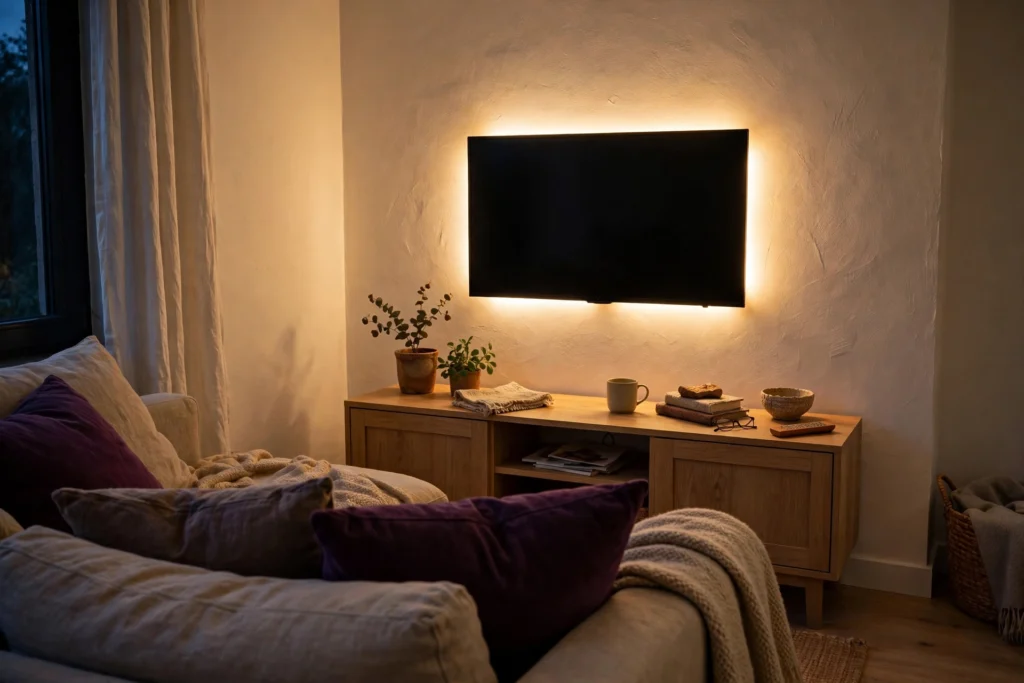
The 7 best LED strip lights for small rooms
1. Govee RGBIC 32.8 ft, best overall
Best for: Most small bedrooms. It is the default pick for a reason, and that reason is length plus control at a fair price.
Main advantage: RGBIC means different colors can show on different segments of the same strip, so one run can fade from warm white near the bed to blue near the desk. Wi-Fi and Bluetooth control, Alexa and Google support, and music sync are all included.
Watch out for: It ships as two 16.4 ft (5 m) rolls, and the two rolls cannot be joined into one run longer than 32.8 ft (10 m). The adhesive is strong, which is great until move-out day.
Verdict: Buy this if you want one kit that covers two walls of a small bedroom and looks good doing it. Price as of November 2026: $31.99.
Deposit-risk rating: 3/5. Strong factory adhesive. Use mounting clips or Command strips over it on painted walls.
2. DAYBETTER 32.8 ft, best budget pick
Best for: Renters and first-time buyers who want color on a wall for about ten dollars.
Main advantage: The price. At $9.99 as of November 2026, it is the cheapest way to test whether you even like strip lighting before spending more. Remote and app control are included.
Watch out for: Buyer feedback is split on adhesive strength and on whether colors stay consistent along the full length. Treat it as mood lighting, not as a light source you rely on.
Verdict: The right buy if your budget is tight and your expectations are honest. Skip it if you need dependable daily light. Price as of November 2026: $9.99.
Deposit-risk rating: 2/5. Weaker adhesive means easier removal, but also a higher chance the strip peels off on its own and takes paint with it in patches.
3. Kasa Smart RGBIC KL420L5 16.4 ft, best for smart-home setups
Best for: A single wall, a headboard, or a desk setup in a home that already runs on Kasa or TP-Link gear.
Main advantage: Fifty color zones on a 16.4 ft (5 m) strip, Wi-Fi control with no hub, and clean integration with Alexa, Google Home, and SmartThings. The app is simpler than Govee’s, which matters if you just want the lights on.
Watch out for: At 16.4 ft it covers one wall only, and the 12 V, 10 W rating tells you this is accent brightness, not room lighting.
Verdict: The tidiest smart-home pick for a small room, as long as you pair it with a ceiling or bedside light for real illumination. Price as of November 2026: $21.99.
Deposit-risk rating: 3/5. Standard adhesive, average removal risk.
4. LIFX SuperColor 120 in (10 ft), brightest pick
Best for: Small rooms where the strip has to be an actual light source, like a reading nook or a desk wall.
Main advantage: 2,100 lumens over 10 ft (3.05 m), or about 689 lumens per metre, straight from the manufacturer spec sheet. That is roughly double the usable brightness of a budget RGB strip, and the 1500K to 9000K white range means it can be warm at night and daylight-bright for work. It extends to 33 ft (10 m) with add-on extensions.
Watch out for: Ten feet covers one wall, and the price climbs fast once you add extensions. No hub is needed, but you pay for that convenience.
Verdict: The only pick here I would trust as the main light in a small corner. If your room is dark and your budget allows it, start here. Price as of November 2026: $49.98.
Deposit-risk rating: 2/5. Shorter run, lighter strip, and LIFX adhesive is gentler than the budget brands.
Outbound source: LIFX publishes the full spec, including the 2,100 lumen figure and the 33 ft extension limit, on its SuperColor Lightstrip page.
5. Govee COB Strip Light 2, 9.8 ft, best looking light
Best for: Visible runs where you see the strip itself, like under a shelf lip or along an open headboard.
Main advantage: COB means chip-on-board: 840 LEDs per metre packed so tightly that the light is one smooth line with no visible dots. It is the most premium-looking light in this list by a clear margin.
Watch out for: The price, $139.99 as of November 2026, buys you only 9.8 ft (3 m). Once cut, it cannot be reconnected or extended, so measure twice.
Verdict: A splurge, and an honest one. Buy it for the one visible run guests actually see, not for hiding behind furniture. Price as of November 2026: $139.99.
Deposit-risk rating: 2/5. Short, light, and easy to mount in a channel.
Outbound source: Govee lists the 840 LEDs per metre figure and the no-reconnect-after-cutting warning on its COB Strip Light 2 page.
6. Leeleberd 100 ft, best for big coverage on a small budget
Best for: Covering a whole room, or two rooms, for about ten dollars.
Main advantage: One hundred feet (30.5 m) in two 50 ft (15.2 m) rolls, with 64 scene modes, music sync, remote, and Bluetooth app control. Nothing else in this list gives you this much length per dollar.
Watch out for: This is the most overrated buy in the category for a small room. A 10 by 12 ft bedroom needs about 44 ft (13.4 m) for a full perimeter, so more than half the kit goes unused, and budget 100 ft kits are the ones most often reported for adhesive failure and uneven color. It is also indoor only and not waterproof, so keep it away from bathrooms and sinks.
Verdict: Buy it only if you genuinely have two rooms or a very long run to cover. For one small bedroom, the 32.8 ft kits above are the smarter spend. Price as of November 2026: $9.99.
Deposit-risk rating: 4/5. The highest in this list, because two long adhesive runs double the paint damage risk at removal.
7. DAYBETTER 65.6 ft, best long-run value
Best for: A full ceiling perimeter in a 10 by 12 ft or 12 by 12 ft room without buying two separate kits.
Main advantage: Two 32.8 ft (10 m) rolls for $16.99 as of November 2026, which is the cheapest way to cover a full perimeter. App and remote control included.
Watch out for: Same budget-brand caveats as its smaller sibling: mixed reports on adhesive and color consistency, and accent-level brightness.
Verdict: The practical pick if your plan is a full ceiling outline and you have accepted that it is mood lighting. Price as of November 2026: $16.99.
Deposit-risk rating: 4/5. Long adhesive run, same removal caution as the Leeleberd.
How do you install LED strip lights in a rental without losing your deposit?
Here is the renter caveat first, because it decides everything else. Check your lease before you stick anything to a wall. Most leases allow removable decoration and ban anything that damages paint or plaster. Factory adhesive on cheap strips is the thing that gets renters in trouble: it can pull paint off in strips at move-out, and a repaint charge can run $100 or more per wall. If your lease is silent on adhesive strips, ask your landlord in writing. A one-line email approval is worth more than any mounting trick.
The renter-safe method skips the factory adhesive entirely. Mount the strip inside a slim aluminum channel or onto a strip of painter’s tape, then hold that to the wall with removable mounting strips rated for the weight. The channel also hides the LED dots and spreads the light, so the result looks better and comes off cleaner. This is the same no-drill thinking behind the rest of a rental setup, and it pairs well with other damage-free upgrades like the renter-friendly lighting ideas in our earlier guide, which covers plug-in pendants and sconces that need no wiring at all.
Materials
- LED strip kit of the length your room needs
- Aluminum LED channel with diffuser, or painter’s tape as a base layer
- Removable mounting strips (Command strips or similar), rated for at least 1 lb (0.45 kg) per foot
- Rubbing alcohol and a cloth, for cleaning the surface
- Measuring tape and scissors, for cutting at the marked cut lines only
- Cable clips, for guiding the power cord to the nearest outlet
Steps
- Measure the run and mark it with painter’s tape first. Live with the line for a day if you can, and check it at night with the room lights off.
- Clean the surface with rubbing alcohol and let it dry fully. Dust is the number one reason strips fall off.
- If you are renting, stick painter’s tape along the run first, then mount the strip or channel onto the tape, not the wall.
- Cut the strip only at the marked cut lines, usually every 3 LEDs. Cutting anywhere else kills that section.
- Connect the strip to the controller and power adapter before you mount the far end, and test every color and the white mode.
- Mount from one end to the other, pressing gently for 10 seconds per foot. Do not stretch the strip while you press.
- Hide the controller and adapter behind furniture, and run the cord down a corner with cable clips. Keep the adapter where air can reach it, never inside a closed box.
- At move-out, warm the adhesive with a hair dryer on low for 30 seconds per section, peel slowly at a low angle, and roll any residue off with your thumb instead of scraping it.
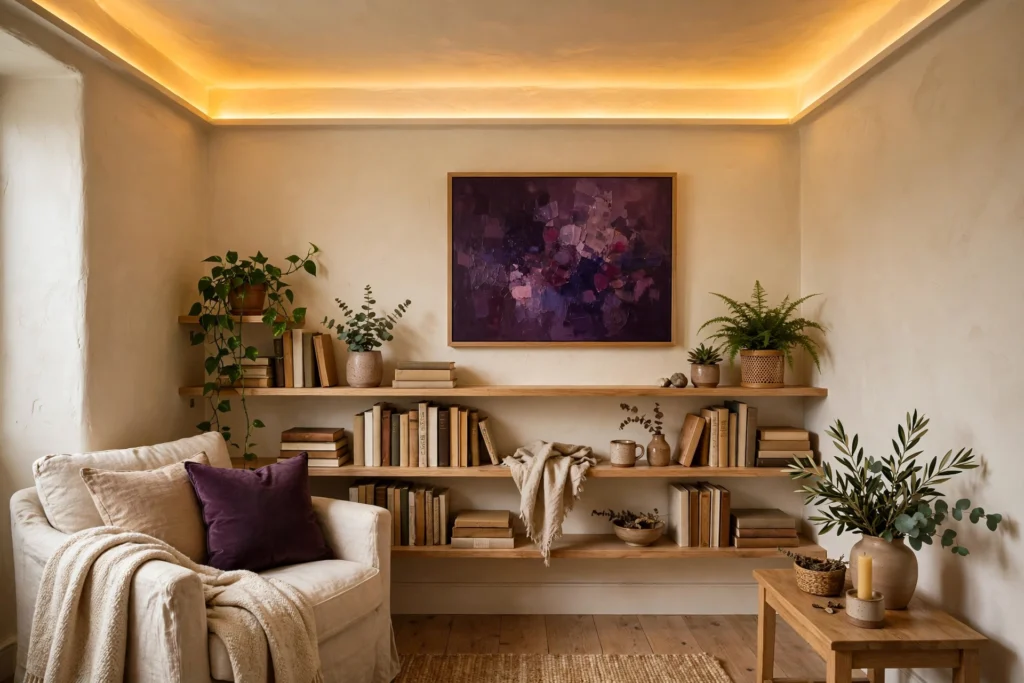
The power math matters too, and no top-five result explains it. A standard-density 5050 strip draws about 7.2 watts per metre, so a 10 m (32.8 ft) run pulls roughly 72 watts at full white. Most budget kits ship a 36 to 60 watt adapter, which is why the far end of a long run often looks dimmer or pinker than the near end. That is voltage drop, not a faulty strip. Keep runs to one adapter per 5 m (16.4 ft) where you can, and if a kit offers two rolls, run each roll on its own feed instead of chaining them. If you plan a long run and want the wiring to stay invisible, the same no-drill approach in our no-drill curtain hanging guide works for routing cords along ceiling edges without holes.
Mistakes to avoid with LED strip lights in small rooms
Buying length before measuring. The 100 ft kit is the classic version of this mistake. Measure the wall, add 10 percent, and buy that length.
Trusting RGB brightness claims. A strip that lists “16 million colors” and no lumens is selling you color, not light. If you need light, buy a strip with a white channel or a stated lumen figure.
Sticking the strip straight to fresh paint. Paint needs about 30 days to cure fully. Stick a strip to week-old paint and the adhesive will take the paint with it when you peel it off.
Running one adapter past its rating. A dim far end and a hot adapter are your warnings. Split the run or buy a bigger adapter with the same voltage, never a higher voltage.
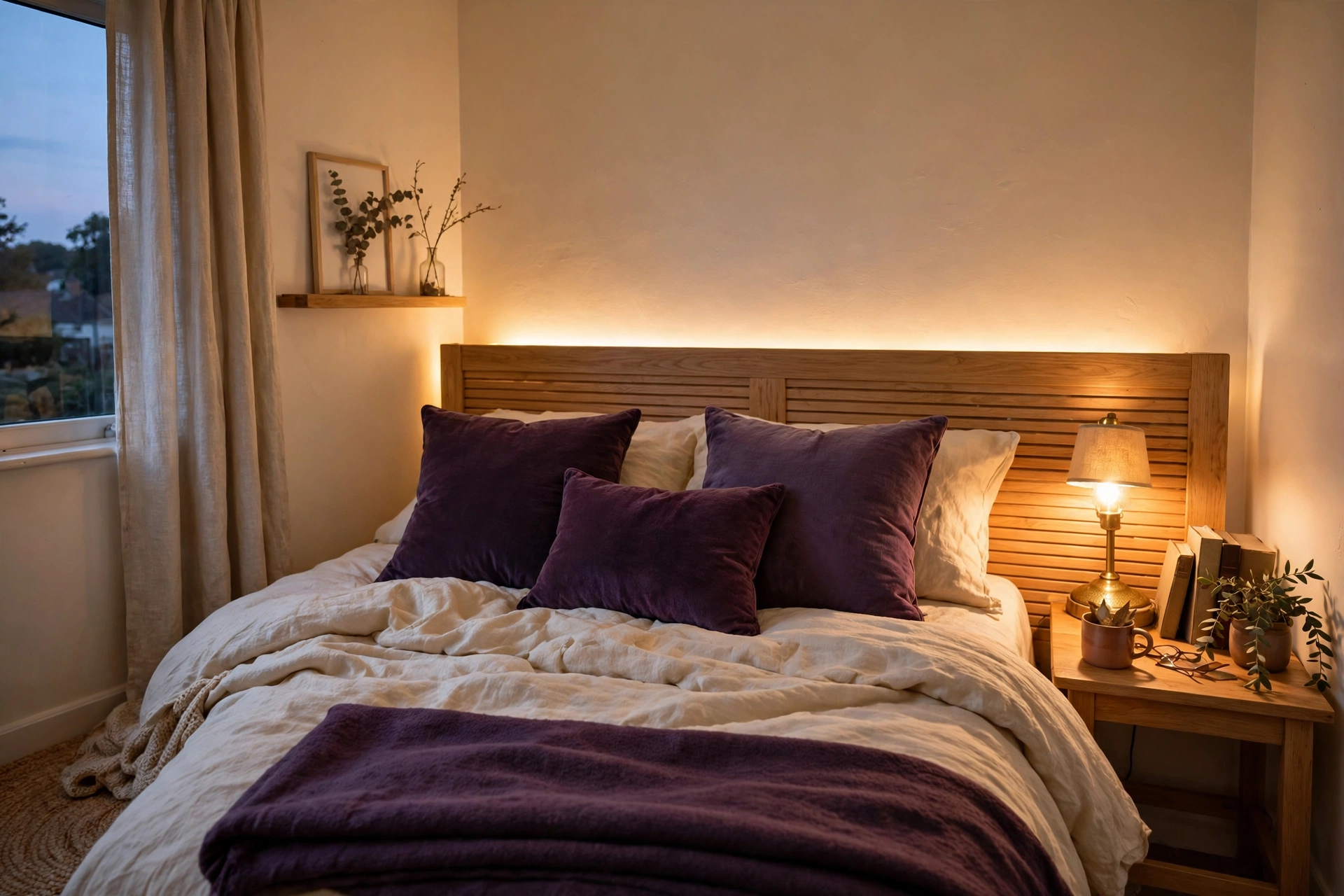
Mounting where you see the dots. A bare strip at eye level shows every LED as a bright dot. Put it behind a lip, inside a channel with a diffuser, or above eye level. A diffuser costs a few dollars and is the single biggest upgrade to how the light looks. If you are mounting above a shelf, the same lip that hides the strip can hold the shelf itself, and our DIY floating shelves guide shows how to build that kind of hidden edge without drilling into studs.
Forgetting the outlet. Every strip needs a plug within a few feet. A beautiful ceiling run with the adapter dangling mid-wall is not a finished job. Plan the cord path before you mount anything.
What to skip
Skip waterproof IP65 strips for a bedroom. The silicone coating traps heat, dims the light slightly, and costs more, and your bedroom is not a bathroom. Skip 100 ft kits for a single small room, as above. Skip no-name strips with no brand, no warranty, and no lumen figure at all: if the seller will not stand behind the specs, you cannot trust the specs. Skip color-only strips if your goal is reading light, and skip “smart” strips that need a hub you do not own. Finally, skip mounting a strip directly above a bed without a diffuser. The dots will be the first thing you see when you lie down, and you will regret it every night.
How much do the best LED strip lights for small rooms cost?
All prices below were checked live on November 12-13, 2026. They change often, especially around sales, so treat them as a snapshot, not a promise. You buy one strip, not all seven. The total at the bottom is just the sum of the list, for comparison.
| Pick | Length | Price as of November 2026 |
|---|---|---|
| Govee RGBIC | 32.8 ft (10 m) | $31.99 |
| DAYBETTER | 32.8 ft (10 m) | $9.99 |
| Kasa Smart RGBIC KL420L5 | 16.4 ft (5 m) | $21.99 |
| LIFX SuperColor 120 in | 10 ft (3.05 m) | $49.98 |
| Govee COB Strip Light 2 | 9.8 ft (3 m) | $139.99 |
| Leeleberd | 100 ft (30.5 m) | $9.99 |
| DAYBETTER | 65.6 ft (20 m) | $16.99 |
| All seven picks together | $280.92 |
What one small bedroom actually costs, by budget:
| Setup | What you buy | Cost as of November 2026 |
|---|---|---|
| Budget | DAYBETTER 32.8 ft | $9.99 |
| Best value | Govee RGBIC 32.8 ft | $31.99 |
| Brightest | LIFX SuperColor 10 ft | $49.98 |
Running costs are tiny, which is part of the appeal. A 10 m RGB strip at roughly 72 watts, run 4 hours a day, uses about 0.29 kWh a day, or roughly 8.6 kWh a month. At a typical US rate of about $0.17 per kWh, that is around $1.47 a month. The strip costs less to run than the lamp it replaces, which is a nice bonus when the room is small and the budget is smaller. If you are weighing strip lighting against other small-room upgrades, our best space heater for a small bedroom shows the same kind of running-cost math for heating, and it is worth comparing the two before you spend.
Frequently asked questions
How many lumens do I need for LED strip lights in a small bedroom?
Aim for 1,000 to 1,500 lumens of total light for a small bedroom in the evening. A single 10 ft (3.05 m) LIFX SuperColor strip gives you about 2,100 lumens, which clears that bar alone. A budget RGB strip needs 10 m (32.8 ft) or more to reach the same total, and even then the light spreads along the wall, so pair it with a bedside lamp or ceiling light for real illumination.
Do LED strip lights damage walls?
They can, and the risk comes from the adhesive, not the light. Cheap factory adhesive can pull paint off plaster or drywall at removal, especially on fresh paint or in humid rooms. The renter-safe fix is painter’s tape under the strip plus removable mounting strips, and warming the adhesive with a hair dryer on low before peeling. Always check your lease first.
How long should LED strip lights be for a bedroom?
Measure the run you plan and add 10 percent for corners. For a 10 by 12 ft (3.0 by 3.7 m) bedroom, 16.4 ft (5 m) covers one wall, 32.8 ft (10 m) covers two walls, and a full ceiling perimeter needs about 44 ft (13.4 m). Most small bedrooms are best served by a 32.8 ft kit.
Do LED strip lights use a lot of electricity?
No. A typical 10 m (32.8 ft) RGB strip draws about 72 watts at full white, and far less in color mode or dimmed. Run 4 hours a day, that is roughly 8.6 kWh a month, or about $1.47 at a typical US rate of $0.17 per kWh. An LED strip is one of the cheapest lights in the house to run.
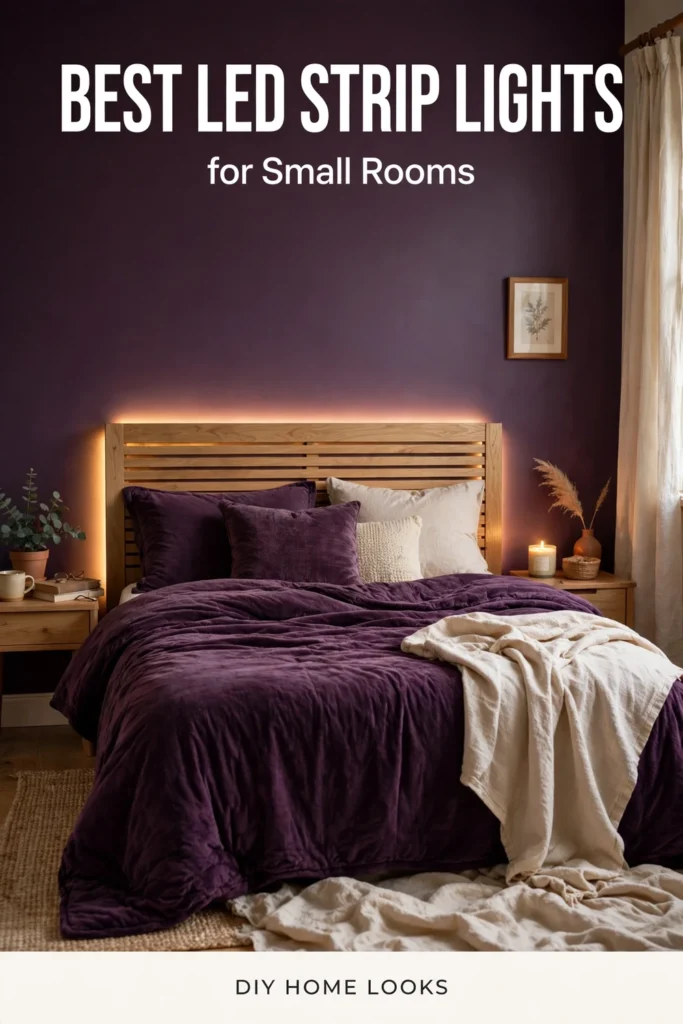
How this was made: prices and specs were checked against live listings in November 2026, and the length and lumen tables were computed from room dimensions and manufacturer figures. No product was sent to us and no hands-on testing is claimed.
Govee RGBIC 32.8 ft
Govee RGBIC 32.8 ft LED strip light kit with segment color control, Wi-Fi and Bluetooth, Alexa and Google support, and music sync. Best overall pick for small bedrooms.
Product Brand: Govee
Product Currency: USD
Product Price: 31.99
Product In-Stock: InStock
4.5