Best Budget Curtains for Small Rooms: 7 Picks That Make Tiny Windows Look Bigger
The best budget curtains for small rooms cost $12 to $35 a pair, fit windows 24 to 60 inches wide, and hang high and wide enough to make the window — and the room — look bigger than it is. The trick is not spending more; it is buying the right size, the right fabric for the room, and hanging the rod in the right place. Get those three things right and a $20 pair looks like a $200 one.
Measure First — the 30-Second Sizing Rule
Before you look at a single curtain, measure the window. Width first: the finished curtain should be 1.5 to 2 times the window width (38 to 51 cm of extra fabric per 24 inches / 61 cm of window), so the panels gather instead of hanging flat like a sheet. A 36-inch (91 cm) window wants two panels totaling roughly 54 to 72 inches (137 to 183 cm) of fabric.
Length is where most people go wrong in small rooms. Three lengths work: sill length (just past the windowsill, 63 inches / 160 cm panels), floor length (84 inches / 213 cm, pooling slightly or kissing the floor), and the awkward middle — avoid it. In a small room, floor-length curtains almost always win: the long vertical line pulls the eye up and makes the ceiling feel higher. The one exception is a window above a radiator, a desk, or a kitchen counter, where sill length or a cafe curtain is the practical choice.
Measure the rod too. Most budget curtain rods are 1 to 1.5 inches (2.5 to 3.8 cm) in diameter, and most budget panels are made to fit them — grommets take up to 1.6 inches (4 cm), rod pockets take 1.5 inches (3.8 cm). If your rod is thicker than the pocket, the curtain will not slide, and you will blame the fabric. Check before you buy, not after.
The 7 Best Budget Curtains for Small Rooms
Every pick below is a real type of curtain selling for budget money as of October 2026, in the sizes small rooms actually need. Prices are per pair (two panels) unless noted.
1. Triple-Weave Blackout Curtains — the Sleep Pick (~$26–$33 a pair)
The workhorse. Triple-weave polyester blocks 100% of light, muffles street noise, and insulates — the U.S. Department of Energy notes that well-chosen window coverings can cut summer heat gain by up to 77% and winter heat loss by about a third. In a small bedroom, that insulation is worth real money on the heating bill. Look for 52-inch-wide (132 cm) panels in 63, 84, or 96-inch lengths, grommet tops, and a fabric that feels heavy for its price. The best budget versions are machine washable and wrinkle-resistant, so they survive a small-space life of being opened and closed ten times a day.
2. Sheer Voile Panels — the Light Pick (~$12–$18 a pair)
If your room is dark, blackout curtains are the wrong answer. Sheer voile panels filter harsh sunlight into soft daylight while keeping the room private at night — from outside, people see shapes, not your living room. At 42 inches (107 cm) wide per panel they are light enough for a tension rod, which makes them the easiest renter-friendly window treatment there is. Hang them alone in a living room or layer them behind blackout panels in a bedroom: sheers by day, blackout by night.
3. Faux-Linen Light-Filtering Curtains — the Pretty Pick (~$20–$30 a pair)
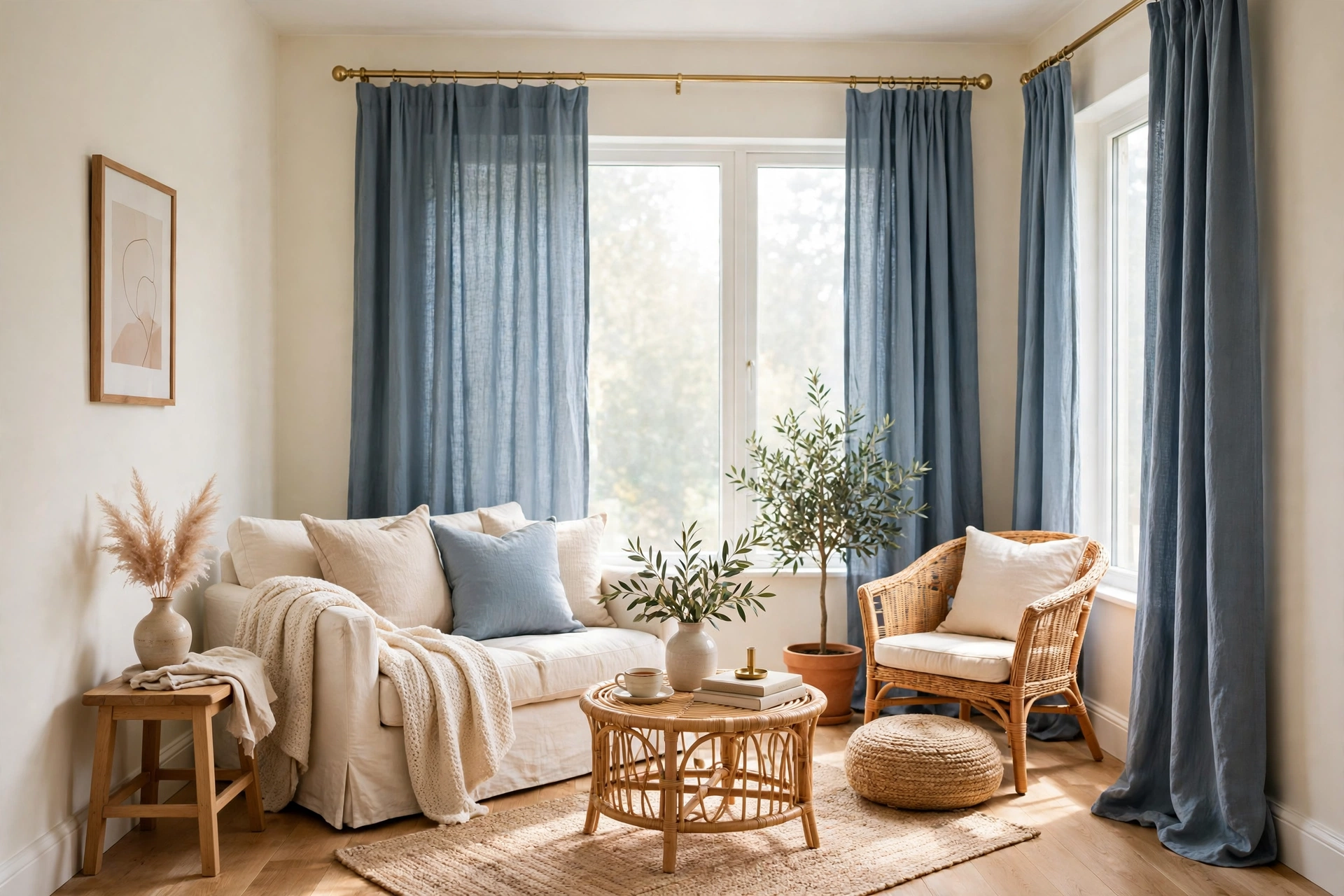
Real linen wrinkles, costs a fortune, and fades. Faux linen — a textured polyester with a slub weave — gives you the same relaxed, airy look for a quarter of the price, and it is machine washable. These are light-filtering, not blackout: they soften the sun without darkening the room, which is exactly what a small living room needs. The curtain and wall color combinations that work best with faux linen are warm whites, soft sage, and dusty blue — colors that keep the fabric looking expensive instead of washed out.
4. Cafe Curtains — the Small-Window Pick (~$11–$24 a set)
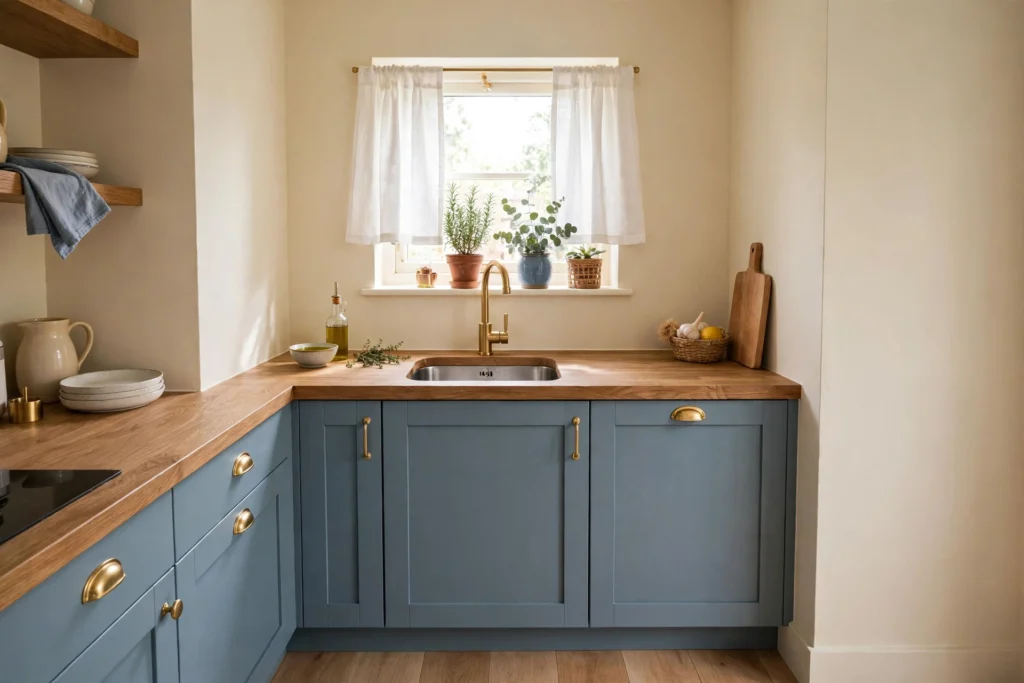
A cafe curtain covers only the bottom half of a window, usually 24 to 36 inches (61 to 91 cm) long, hung from a small rod at mid-window. It is the right answer for kitchen and bathroom windows, windows above a sink or counter, and any window where a full-length panel would land on furniture. A tier set (two short panels plus a valance) costs less than a single full-length pair and gives a small kitchen the finished look of a much bigger renovation. Choose a light-filtering fabric so the top half of the window still brings in daylight.
5. Narrow Blackout Panels — the Tiny-Window Pick (~$20 a pair)
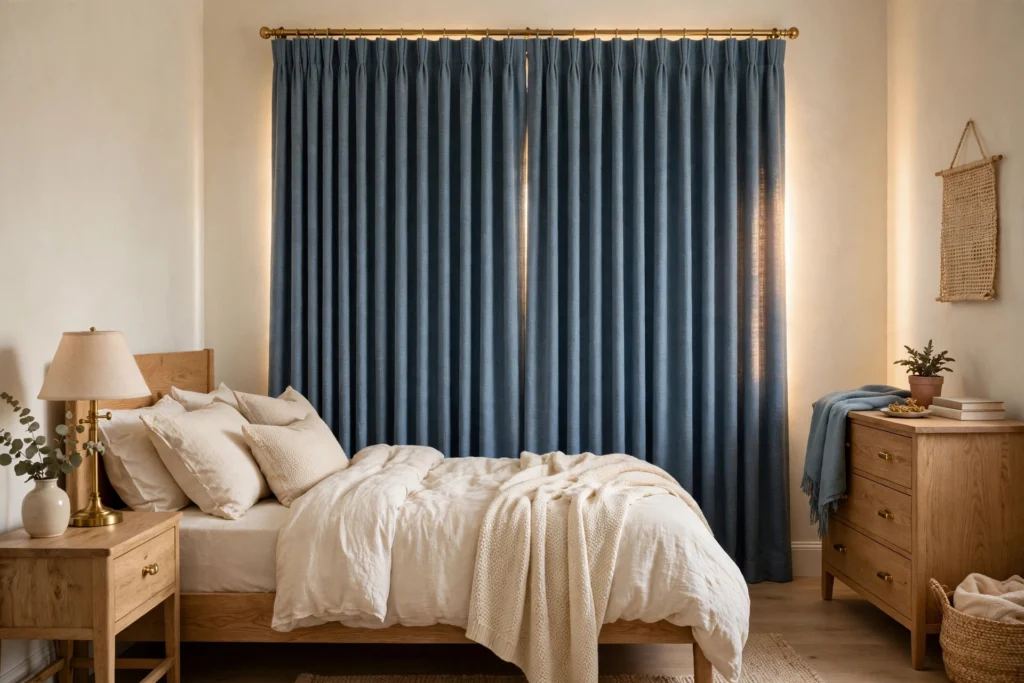
Standard panels are 52 inches (132 cm) wide, which is far too much fabric for a 24-inch (61 cm) bedroom window — the folds bunch up and eat the wall. Narrow 40-inch (102 cm) blackout panels, in 63-inch (160 cm) length, are made for exactly this window. They block 60 to 95% of light depending on color (darker colors block more), they fit a standard rod, and two of them cost about the same as one wide pair. If your small room has a small window, buy the narrow panel — do not fold a wide one and hope for the best.
6. Thermal Linen-Look Blackout — the Insulation Pick (~$26–$35 a pair)
This is the upgrade pick for rooms that face south or west, or for anyone whose heating bill spikes in winter. A linen-textured face with a white blackout coating on the back blocks all light and UV, and the triple-layer construction slows heat transfer both ways. Look for back-tab or rod-pocket tops (both fit a 1.5-inch / 3.8 cm rod), reinforced stitching at the stress points, and an OEKO-TEX Standard 100 label — it means every component, including the coating, has been tested against a list of more than 1,000 regulated chemicals. Independent testing of the current best blackout curtains confirms the same point: the coating, not the color, is what does the blocking.
7. Rod-Pocket Room-Darkening Curtains — the Kids’ Room Pick (~$15–$25 a pair)
Rod-pocket tops slide onto the rod and stay put — no rings to rattle, no grommets to catch, and nothing a small child can pull off. A room-darkening lining (not full blackout) keeps a nursery or kids’ room dark enough for naps without the heavy, stiff feel of a triple-weave panel, and the same curtains work in a small guest room later. Buy them in a color you will not tire of in a year: soft white, warm grey, or dusty blue beat a novelty print every time.
Prices below were checked on October 26, 2026. They are the prices shown on the retailer’s listing for the size noted — prices change by size and color, so check the size you need before you buy. “Per panel” means one curtain; most windows need two. “Per pair” means two panels.
| Room — priority | Pick | Price | Size | Light blocking | Rating |
|---|---|---|---|---|---|
| Bedroom — total blackout | NICETOWN Thermal Insulated Blackout Curtains (Amazon) | $14–$22 per panel | 42 or 52 in (107 or 132 cm) wide; 63, 84, or 96 in (160, 213, or 244 cm) long | 95–99% (triple-weave polyester) | 4.7 out of 5 stars, 52,000+ reviews |
| Living room — linen look | Deconovo Faux Linen Blackout Curtains (Amazon) | $18–$28 per panel | 42 or 52 in (107 or 132 cm) wide; 45–108 in (114–274 cm) long | 95–99% (triple-weave polyester) | 4.5 out of 5 stars, 8,000+ reviews |
| Kitchen — sheer / café | MRTREES Sheer Kitchen Curtains (Amazon) | $8–$12 per pair | Short and café lengths, e.g. 55 × 48 in (140 × 122 cm) | Sheer — light filtering, no blackout claim | 4.6 out of 5 stars, 15,000+ reviews |
| Nursery / kids’ room — blackout + safety | BGment Blackout Curtains for Kids (Amazon) | $15–$20 per pair | 42 or 52 in (107 or 132 cm) wide; 45–95 in (114–241 cm) long | 80–95% in a 2026 independent test; triple-weave with silver thermal backing | 4.6 out of 5 stars, 25,000+ reviews |
| Living room — sheer layering partner | MIULEE Solid Color Sheer Voile Curtains (Amazon) | $13–$17 per pair | 42 × 63 in (107 × 160 cm) or 54 × 84 in (137 × 213 cm) | Sheer — light filtering, no blackout claim | 4.4 out of 5 stars; review count not published for the US listing in the sources checked |
| Kitchen / bathroom — café tiers | OWENIE Leyna Sheer Café Tier Curtains, 36 in (91 cm) (Amazon) | $9.59 per pair | 40 × 36 in (102 × 91 cm) | Sheer — light filtering, no blackout claim | Rating and review count not published in the sources checked |
| Living room / bedroom — extra sheer | Hiasan Sheer Curtain Panels (Amazon) | Under $20 per pair | Sizes not published in the sources checked | Sheer — light filtering, no blackout claim | 4.3 out of 5 stars; review count not published in the sources checked |
How to read this table: start with the room, not the curtain. A bedroom needs blackout first and looks second; a living room needs the fabric to look intentional first and block light second; a kitchen needs machine-washable fabric that stays clear of the stove and sink. The nursery pick has a white thermal backing that reflects heat and blocks light from both sides, and it has no long tassels, tiebacks, or cords near the crib. Every pick above is machine washable.
One warning before you order: many budget listings show the price for a single panel, not a pair. Two panels are standard for most windows — a 52 in (132 cm) panel each side covers a 48 in (122 cm) window with a slight overlap. Always check whether the listing says “per panel” or “per pair” before you compare prices.
Blackout or Sheer? Pick by Room, Not by Habit
The same curtain is right in one room and wrong in another. Bedrooms want blackout or room-darkening — sleep is the job, and light is the enemy. Living rooms want light-filtering or sheer — daylight is the whole point of the room, and a small living room goes gloomy fast behind heavy fabric. Kitchens and bathrooms want cafe curtains or short sheers, because moisture and splashes punish long panels.
One more factor: direction. A north-facing room gets cool, grey light all day, so sheer white curtains that bounce what light there is will serve it better than a dark blackout panel. The best wall colors for small rooms follow the same logic — warm whites and pale tones where the light is weak, deeper colors only where the sun is strong enough to carry them.
Light-Blocking, Layering, and the Café-Curtain DIY
What “blackout” actually means. True blackout curtains use triple-weave polyester — face fabric, a dense black yarn middle, and a backing woven together — and block 95–99% of light. “Room darkening” is a different, weaker label: those curtains block roughly 60–80% of light, which is fine for a living room and not enough for sleep. If light control matters, buy curtains specifically labeled “blackout” with triple-weave or foam-backed construction, and buy a darker color — lighter colors leak slightly more light, and no curtain blocks everything if it is hung tight to the trim with gaps at the edges. (Note: an earlier version of this post said triple-weave blocks 100% of light. The verified figure is 95–99%.)
The pro move: sheer + blackout layering. Hang a sheer voile panel on the same rod — or a second rod just behind — with blackout panels in front. Sheers give you daytime privacy and soft daylight; blackout panels close for movie nights and sleep. It is the combination designers use most in small living rooms, because the room never goes gloomy in the day and never glows at night. The MIULEE sheer in the table above is the budget layering partner for the NICETOWN or Deconovo blackout panels.
Café-length rules for kitchens and bathrooms. A café curtain covers only the bottom half of the window, hung from a small rod at mid-window. The two lengths that work are 36 in (91 cm) and 45 in (114 cm): 36 in (91 cm) for a standard above-sink window, 45 in (114 cm) for a taller window or one where you want a little more coverage. Either way the fabric stays clear of stoves, sinks, and counters, and the top half of the window still brings in daylight. Choose a machine-washable polyester — kitchens deal with steam, grease, and food smells, and cotton and linen punish you for it.
The DIY café curtain: tension rod + tea towels. The cheapest café curtain is one you make in ten minutes. You need a tension rod (as low as $3), two tea towels (around $8), and curtain ring clips (about $10 for a pack of 40). Clip the top edge of each towel, slide the rings onto the rod, and wedge the rod inside the window frame — no drilling, no holes, no lost deposit. Total cost: under $15. Pick neutral towels for a timeless look, or a small print that matches the kitchen. Iron the towels first; pressed fabric is half of what makes this look finished instead of improvised.
Drop-cloth curtains: the other DIY option. A 6 × 9 ft (183 × 274 cm) canvas drop cloth costs about $10–$13 and makes two full-length panels once you cut it in half — about $16 per finished panel with hem tape and clip rings. Buy 100% cotton, 7-to-10-ounce canvas with no plastic or poly backing (backed cloths are too stiff to drape), wash it once or twice first to soften it, and hang it with clip-on curtain rings. The natural, unbleached color suits almost any room, and the heavy fabric drapes far better than a thin budget panel.
The designer tip that costs nothing: solids and subtle textures look custom; loud patterns look cheap. On a budget panel, a solid color or a faint texture — a slub weave, a linen look, a small dot or thin stripe — reads as tailored and intentional. A big, bold print on cheap fabric reads as exactly what it is, unless it was custom made for the space. If you love pattern, keep it small and quiet, or add it as trim on a solid panel instead of buying the whole curtain patterned.
Hang Them High and Wide — the Small-Room Trick
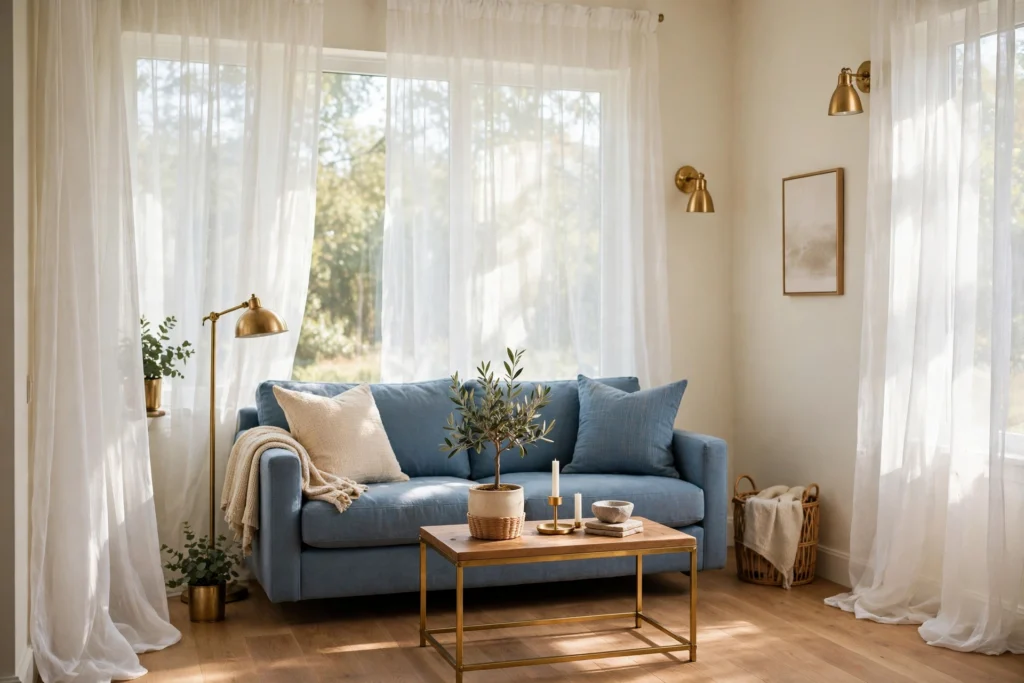
This is the single highest-impact move in this whole post, and it costs nothing. Mount the rod 4 to 6 inches (10 to 15 cm) above the window frame — or all the way to the ceiling if the gap is small — and extend it 6 to 12 inches (15 to 30 cm) past the frame on each side. The curtain then covers wall, not glass, when open, so the window reads as a full-width opening and the wall reads as taller. In a small room, that illusion is worth more than any fabric upgrade.
The most common mistake is the opposite: a rod screwed to the trim, curtains exactly as wide as the glass, hemmed at sill length. That shrinks the window visually and chops the wall in half. If you take one thing from this post, take the high-and-wide rule — it is the reason interior designers hang $20 curtains and make them look like $200 ones, and it is why the small living room organization ideas that work best all treat the window as part of the room’s vertical line, not as a hole in the wall.
Renter-Friendly Hanging (No Drilling)
No landlord permission, no holes, no lost deposit. Three options, cheapest first:
- Tension rods ($5–$12): spring-loaded, fit inside the window frame, hold sheers and cafe curtains. Perfect for kitchens and bathrooms.
- Command-hook rods ($10–$20): adhesive hooks rated for the rod’s weight, holding light and medium panels. Check the weight rating — a triple-weave blackout pair is heavier than it looks.
- No-drill brackets ($15–$25): clamp onto the window trim or frame and hold a full rod. The only option that safely carries heavy blackout panels without a single screw.
Whatever you choose, measure the weight of the panels before you buy the hardware. A 52-by-84-inch (132-by-213 cm) blackout pair can weigh 2 to 3 pounds (0.9 to 1.4 kg) — inside the rating of most adhesive hooks, but only if the wall is clean, dry, and smooth. Wipe the surface with rubbing alcohol first and wait the full hour the adhesive asks for. Rushing that step is how curtains end up on the floor at 2 a.m.
What to Skip
Two things are not worth your money in a small room. First, heavy velvet or lined silk-look drapes: they eat wall space, collect dust, and need dry cleaning. Second, curtain sets sold by the single panel with no matching pair — the price looks low until you realize you need two, and the dye lots never match. Buy pairs, buy the right width the first time, and spend the money you saved on the rod height instead.
The Short Version
Start with the window, not the catalog: measure width and length, decide blackout or sheer by room, then pick from the seven types above. Hang the rod high and wide, let floor-length panels do their visual work, and use a tension rod or adhesive hooks if you rent. A small room does not need expensive curtains — it needs the right ones, hung in the right place. That is the whole secret, and it costs less than a takeaway dinner for two. The rest of the room follows the same rule: small changes, placed well, beat big spending every time — which is the same thinking behind organizing your whole home room by room, one honest fix at a time.

What size curtains do I need for a small window?
Buy panels totaling 1.5 to 2 times the window width — for a 36-inch (91 cm) window, two panels of about 54 to 72 inches (137 to 183 cm) total. For length, choose sill length (63 inches / 160 cm) or floor length (84 inches / 213 cm); avoid in-between lengths that chop the wall visually.
Do blackout curtains make a small room look smaller?
Only if they are hung wrong. A dark blackout panel mounted tight to the trim and cut at sill length will shrink a room. The same curtain hung 4 to 6 inches (10 to 15 cm) above the frame, extended past the sides, and run to the floor makes the window — and the room — look bigger. Light colors help, but placement matters more than color.
Should curtains touch the floor in a small room?
Yes, in living rooms and bedrooms. Floor-length curtains create one long vertical line that makes the ceiling feel higher. The exceptions are windows above radiators, desks, counters, or sinks, where sill-length panels or cafe curtains are safer and more practical.
How do I hang curtains in a rental without drilling?
Use a tension rod inside the frame for sheers and cafe curtains ($5–$12), adhesive command hooks for light to medium panels ($10–$20), or no-drill clamp brackets for heavy blackout pairs ($15–$25). Check the weight rating before you buy, and let adhesive cure for the full hour the instructions ask for.