Bedroom Storage Without a Closet: 7 Options Compared by Cost, Capacity and Floor Space
A bedroom without a closet still needs to hold a full wardrobe, and bedroom storage without a closet works best as a small system, not one magic piece of furniture. You need one place to hang clothes, one place for folded clothes, and one hidden place for everything you do not wear this week. Get those three jobs covered and even a 10 by 10 foot bedroom feels calm again.
Here is the number that decides most of this guide. A standard hanger is about 2 inches (5 cm) wide, so a 48 inch (122 cm) rail holds 24 hangers. At $59.99, that works out to $2.50 per hanger of hanging space. An armoire at $350 holding the same 24 hangers costs $14.58 per hanger. That one calculation tells you why the rack wins on value and the armoire wins on looks. Everything below is measured the same way, with prices checked in November 2026.
Measure first: four numbers before you buy anything
Bedroom storage without a closet fails most often before the furniture arrives. A wardrobe that fits on paper can still block a door or swallow the walkway. Measure these four things and write them on your phone.
First, the wall. Measure skirting board to skirting board, floor to ceiling. Most compact wardrobes are 31 to 36 inches (79 to 91 cm) wide and about 71 inches (180 cm) tall. If your room does have a closet, small closet organization ideas will stretch it further, but this guide assumes there is no closet at all. Second, the depth. A hanger is 17 to 19 inches (43 to 48 cm) wide, so you need at least 20 inches (51 cm) of clear depth or sleeves will push past the frame. Third, the swing. A hinged door needs its full width in clear floor space, and a drawer needs 18 to 22 inches (46 to 56 cm) to open while you stand in front of it. Fourth, the walkway. Keep at least 24 inches (61 cm) clear in front of any storage piece, and 30 inches (76 cm) if you can.
Test the wall at the foot of the bed first, then the long wall beside the bed, then any alcove. Judge each spot by whether the route still works when the doors or drawers are open. One safety rule covers every tall piece below. Anchor tall freestanding furniture to the wall with the anti-tip kit in the box, following the maker instructions. A loaded 71 inch wardrobe is top-heavy, especially on carpet.
Bedroom storage without a closet compared: all seven options, same numbers
| Option | Price (Nov 2026) | Floor space | Hanging capacity | Stated load rating | Renter-friendly (1-5) |
|---|---|---|---|---|---|
| Freestanding garment rack | $49.99-$89.99 | 4-5 sq ft | 24-32 hangers | 242-765 lb total | 5 |
| Narrow two-door armoire | $350-$650 | 4-5 sq ft | 24 hangers + shelves | Varies by maker | 5 |
| Storage bed (drawer or lift) | $250-$600 | 0 extra sq ft | 0 hangers, 4.5+ cu ft hidden | Varies by maker | 5 |
| Under-bed bins (pair) | $19.98 | 0 extra sq ft | 0 hangers, 4.5 cu ft | N/A | 5 |
| Tall narrow chest of drawers | $120-$250 | 2-3 sq ft | 0 hangers, 6-7 drawers | Varies by maker | 5 |
| Over-door organizer + hooks | $8-$25 | 0 sq ft | 0 hangers | 5-10 lb per hook | 5 |
| Cube shelving unit (Kallax style) | $70-$150 | 3-4 sq ft | 0 hangers, 8-16 cubes | 10-15 kg per cube | 4 |
Prices are checked market prices as of November 2026, not personal receipts. The rack prices come from Target listings, the armoire range from a current buying guide, and the bin price from IKEA under-bed boxes under $20 each.
1. Freestanding garment rack: the cheapest real closet
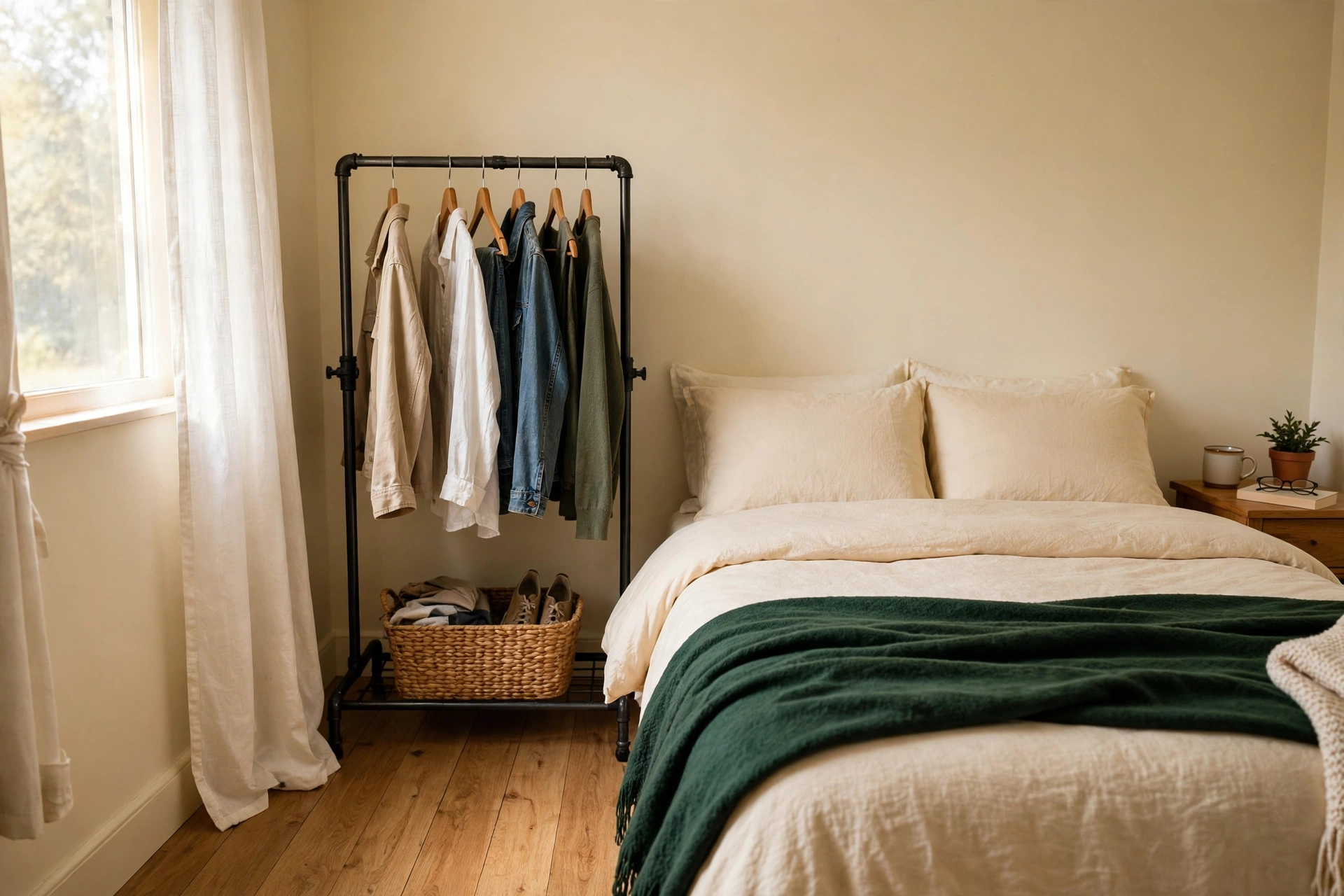
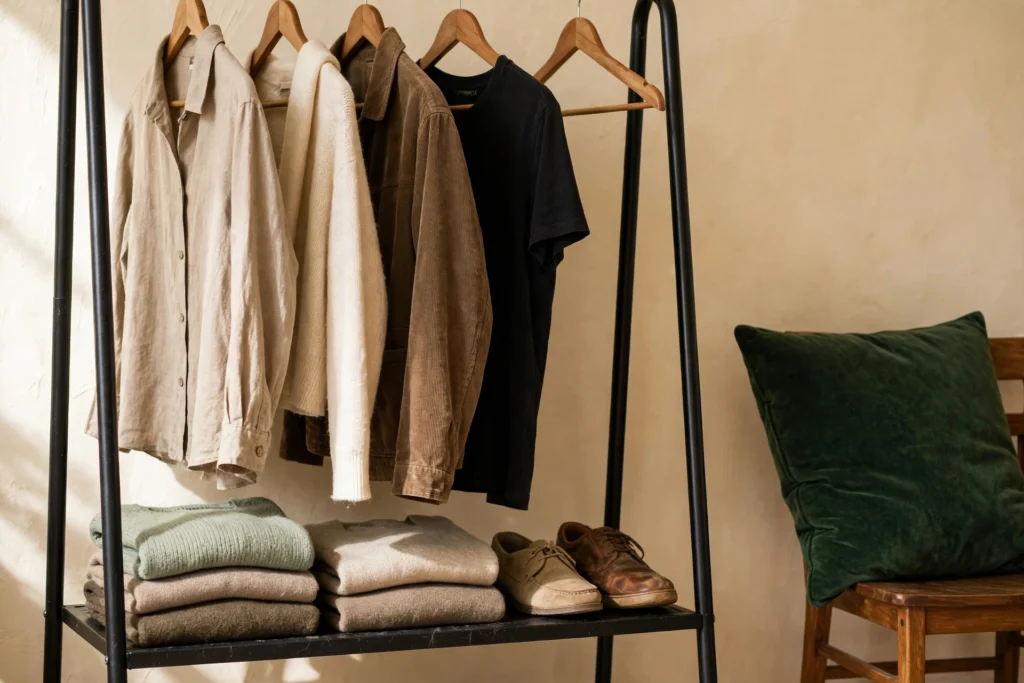
A freestanding rack is the closest thing to a closet you can buy for under $60. It needs no drilling, no assembly drama, and it moves with you. The SONGMICS 65 inch rack at Target costs $49.99 with a stated 242 lb total load, and the wire-shelf model at $59.99 lists 55 lb per rail and 415 lb total. That 55 lb per rail number matters. A rail loaded with 24 winter coats weighs roughly 30 to 40 lb, so a 55 lb rail has real headroom and a cheap 20 lb rail does not.
Best for: renters and anyone who wants hanging space today. Main advantage: lowest cost per hanger we found, $2.50 or less, and zero holes in the wall. Watch out for: thin tubes bow under a full winter wardrobe, and open clothes collect dust. Buy by the stated load rating, not by the word heavy duty in the title. Verdict: for bedroom storage without a closet, the rack is the default first buy. The same rack-first approach carries over to a whole one-room home, and our studio apartment with no closet guide uses the same three-job system. Renter-friendly: 5/5.
2. Narrow two-door armoire: the one that looks like furniture
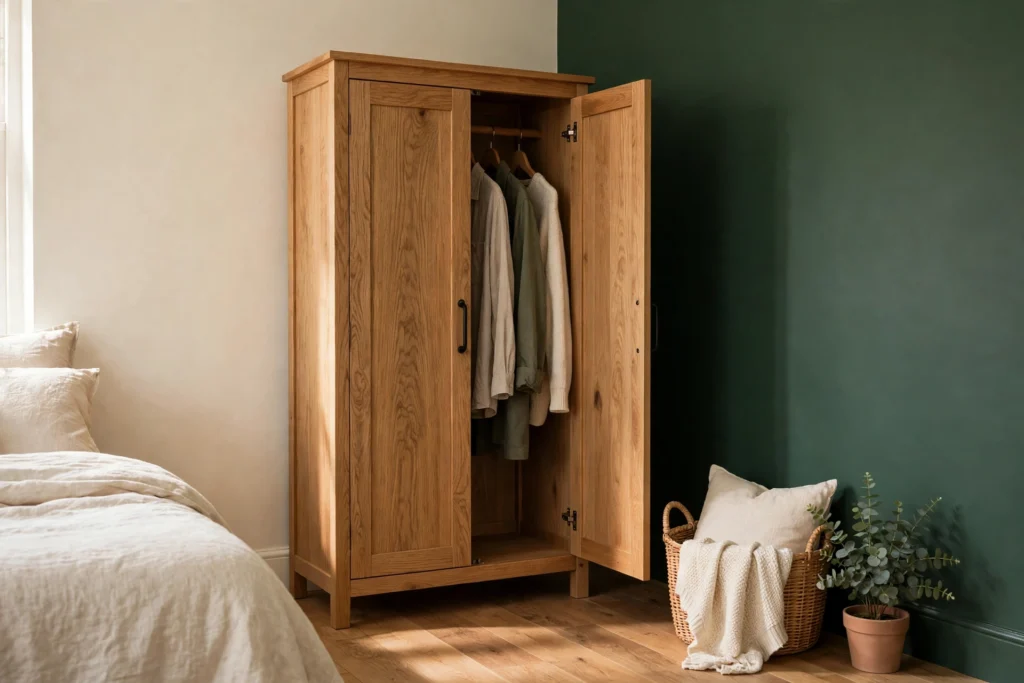
If you buy only one piece, this is the considered choice. A compact armoire around 31.5 inches wide, 19.7 inches deep and 70.9 inches tall (80 by 50 by 180 cm) holds a hanging rail on one side, shelves on the other, and two or three drawers below. Doors hide everything, which is the whole point. An open rack shows every wrinkled shirt. An armoire shows a calm wooden front.
Best for: bedrooms where the storage sits in plain sight and you want it to look deliberate. Main advantage: hanging, folding and drawers in one footprint, with dust control built in. Watch out for: the price. At $350 to $650 it costs six to ten times a rack for the same 24 hangers, and it needs 20 inches of depth plus door swing. Owners who can build in should compare reach-in closet systems first, since a built-in beats any freestanding piece on capacity. Verdict: worth it if the room is also your living space. Overrated if the rack sits in a corner nobody sees. Renter-friendly: 5/5.
3. Storage bed: the hidden closet under your mattress
A storage bed adds no furniture to the room at all. Drawer beds give you two to four shallow drawers under the mattress. Hydraulic lift beds raise the whole platform on gas struts and reveal a compartment the size of the bed. Either way, the space already exists. You are just using it.
The math is kind. Two under-bed bins measuring 36 by 18 by 6 inches (91 by 46 by 15 cm) hold 4.5 cubic feet (127 liters) between them, about 34 gallons. A lift bed holds far more, since the whole under-mattress area opens up. If you are buying a new bed anyway, this is the best storage per dollar in the room, because the footprint is already paid for.
Best for: anyone buying a bed, and small rooms where one more cabinet would block the walkway. Main advantage: the largest hidden volume with zero extra floor space. Watch out for: lift beds cost more than drawer beds, and daily items buried under a mattress get annoying fast. Keep off-season and spare bedding here, not daily clothes. Verdict: the smartest upgrade if a new bed is already on the list. Renter-friendly: 5/5.
4. Under-bed bins: the $20 start
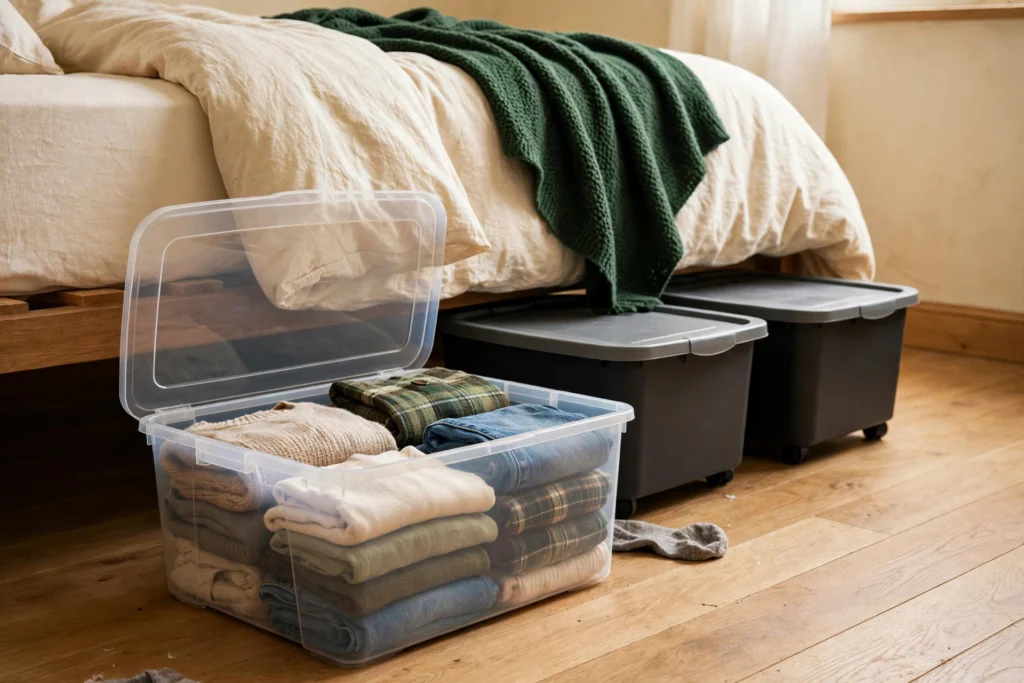
You do not need a new bed to use the space under the one you have. A standard queen frame clears about 6 to 9 inches (15 to 23 cm) of floor-to-frame space. Shallow lidded bins slide straight in. IKEA lists multiple under-bed boxes under $20, and a pair at $19.98 holds that 4.5 cubic feet we computed above. If you want the full tour of that hidden space, our under-bed storage ideas cover bins, drawers and risers in detail. Clear bins beat opaque ones because you can see what is inside without pulling every bin out.
Best for: seasonal rotation, spare bedding, shoes you wear twice a month. Main advantage: the cheapest hidden storage in this guide, and it works in every bedroom. Watch out for: dust. Lids matter. Open-top bins under a bed become dust trays in a month. Verdict: buy this first, whatever else you buy. Renter-friendly: 5/5.
5. Tall narrow chest of drawers: the folded-clothes workhorse
Hanging space gets all the attention, but most of a wardrobe folds. A tall narrow chest, sometimes called a lingerie chest or semainier, stacks six or seven drawers in a 2 to 3 square foot footprint. It is the right answer when floor space is tight but wall height is free. Top drawer for daily smalls, middle for tees and knits, bottom for denim and hoodies.
Best for: folded clothes in rooms too narrow for a wide dresser. Main advantage: the most folded storage per square foot of floor. Watch out for: tall chests tip. Anchor it, always, and never open two full drawers at once. Verdict: the perfect partner to a garment rack. Rack hangs, chest folds. Renter-friendly: 5/5.
6. Over-door organizer and hooks: the free square footage
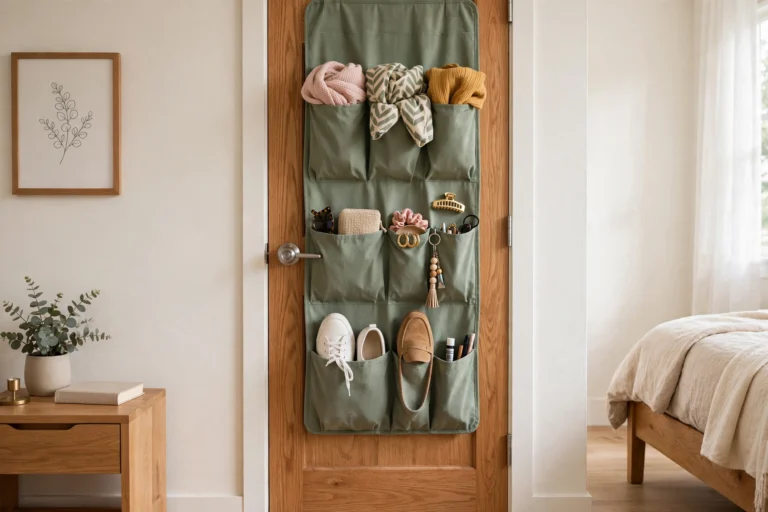
The back of your bedroom door is storage space you already own. An over-door organizer at $8 to $25 holds shoes, scarves, accessories and smalls without taking a single square foot of floor. Add a peg rail or a few adhesive hooks behind the door for coats, hats and tomorrow’s outfit. In a rental, adhesive hooks are the no-drill answer, and they peel off cleanly at move-out.
Best for: accessories, shoes and the outfit you need at 7 in the morning. Main advantage: zero floor space, near-zero cost, fully reversible. Watch out for: weight. Most over-door hooks hold 5 to 10 lb each. A bag full of books will bend the door hardware. Verdict: every no-closet bedroom should have one. Renter-friendly: 5/5.
7. Cube shelving unit: the flexible middle ground
A cube organizer like the IKEA Kallax turns one piece of furniture into hanging-adjacent storage, folded stacks, baskets and display. A 4 by 4 unit holds 16 cubes, a 2 by 4 holds 8, and each cube carries roughly 10 to 15 kg. Fill the lower cubes with fabric bins for socks and tees, keep the top cubes open for books and a plant, and the unit reads as furniture, not storage.
Best for: rooms that need folded storage plus display, and studios where a tall unit can also mark the edge of the sleeping area. Main advantage: reconfigurable. Bins, baskets, drawers and open shelves all fit the same grid. Watch out for: open cubes show clutter. If a cube looks messy, it needs a bin, not more tidying. Verdict: the best-looking budget option after the armoire. Renter-friendly: 4/5. It is freestanding, but a tall unit should be anchored.
Clothes rack vs armoire: the honest head-to-head
This is the decision most readers actually face, so here it is plainly. The rack costs $49.99 to $89.99, holds 24 to 32 hangers, takes 4 to 5 square feet, and shows everything. The armoire costs $350 to $650, holds about 24 hangers plus shelves, takes the same 4 to 5 square feet, and hides everything. Per hanger, the rack costs about $2.50 and the armoire about $14.58. Per square foot of floor, they tie. The difference is entirely visual: do you want to see your clothes or not?
Our opinion, stated plainly: the armoire is overrated for small bedrooms. Most buyers pay five times more to hide clothes that a $15 rail cover or a curtain would hide just as well. The rack plus under-bed bins is the underrated combination. It costs under $100, holds a full wardrobe, and leaves the room feeling open. Spend the armoire money only when the storage sits where guests see it every day.
Which combination fits your room size
| Room size | Buy this combination | Why it works | Total (Nov 2026) |
|---|---|---|---|
| 10 x 10 ft (3 x 3 m) | Rack + under-bed bins + over-door organizer | No piece wider than 48 in, zero extra floor beyond the rack | $94.96 |
| 12 x 12 ft (3.7 x 3.7 m) | Rack + tall chest + under-bed bins | Room for a chest beside the rack, still keeps 30 in walkways | $214.96 |
| 12 x 12 ft, wants hidden storage | Narrow armoire + under-bed bins | Doors hide the wardrobe, bins take the seasonal overflow | $369.98 |
The 10 by 10 total is computed by addition: $59.99 rack plus $19.98 for two bins plus $14.99 over-door organizer equals $94.96. The 12 by 12 total adds a $120 tall chest. The armoire total uses the $350 low end of the range plus the same $19.98 bins.
How to set up the $94.96 system in one afternoon
You need the rack, two under-bed bins with lids, one over-door organizer, a pack of adhesive hooks, and a tape measure. Budget about two hours, including assembly.
- Measure the wall and mark the rack spot with painter’s tape, keeping 24 inches of walkway clear.
- Assemble the rack and check the stated load rating on the box before you load it.
- Hang one hanger type only. Mixed hangers create visual noise no tidying fixes.
- Put daily clothes on the rack, off-season clothes in the lidded bins under the bed.
- Hang the over-door organizer and load it with accessories, not heavy bags.
- Stick adhesive hooks behind the door for tomorrow’s outfit.
- Step back and check the walkway. If you have to turn sideways, move the rack six inches.
Mistakes to avoid
Buying the cheapest rack. A $11 single rod looks fine empty and bows under real clothes. Check the per-rail load rating and buy at least 40 lb per rail for daily use.
Skipping the tape measure. A wardrobe that is two inches too wide blocks a drawer or a door swing. Measure first, buy once.
Storing daily clothes under the bed. Under-bed space is for seasonal and spare items. Daily clothes buried under a mattress become the pile on the chair.
Forgetting the anchor. Tall chests and armoires tip, especially on carpet with a full top drawer. The anti-tip kit in the box takes five minutes. Use it.
Mixing hanger types. One hanger style, one color if you can. An open rack with matching hangers looks like a boutique. Mixed hangers look like a sale rail.
What to skip
Skip the boutique open wardrobe systems that need wall tracks and a drill unless you own the place. They look beautiful in photos and cost $400 or more before you hang a single shirt. Skip vacuum bags for daily clothes too. They save space but every retrieval becomes a chore, so the clothes stop getting worn. And skip buying all seven options at once. Start with the rack and the bins, live with them for two weeks, then buy the next piece only if a real gap shows up.
Renter note: check the lease first
Everything in this guide is freestanding except the optional wall anchor, and that is the point. Before you drill anything, even a small anchor screw, check your lease for the alteration clause and ask the landlord in writing if the answer is unclear. Most leases allow freestanding furniture without permission and allow small anchor holes that you fill before move-out. Keep the anti-tip hardware and the original boxes, photograph the walls on move-in day, and you will get the deposit back. If the lease bans all drilling, skip the anchor and choose the rack, bins and over-door options, which need no holes at all.
What is the best storage alternative for a very small bedroom?
A freestanding rack plus under-bed bins is the answer for most readers, and it is also the cheapest complete system for bedroom storage without a closet. The rack holds 24 hangers in 4 to 5 square feet, the bins add 4.5 cubic feet of hidden space, and the pair costs under $80 with live-checked November 2026 prices. A hydraulic lift bed holds more, but only if you are buying a bed anyway.
How do you store clothes without a closet or dresser?
Hang daily clothes on a freestanding rack, fold the rest into a tall narrow chest or cube shelves, and hide off-season items in lidded bins under the bed. Add an over-door organizer for accessories. Those four pieces cover hanging, folding, hidden and small-item storage with no built-in closet and no dresser.
How can I hide my clothes without a closet?
Use a narrow armoire with doors, or hide an open rack with a zipped rail cover or a curtain on a tension rod. Matching hangers and one rail cover turn an open rack from cluttered to deliberate in about ten minutes. Keep the rail to one hanger type and one color family for the calmest look.
Do garment racks bow under heavy clothes?
Cheap ones do. A rail rated under 40 lb will bow under a full winter wardrobe within months. Check the stated per-rail load rating before buying. The Target models in this guide list 55 lb per rail, which holds 24 winter coats with headroom. If the listing gives no load rating, do not buy it for daily use.
How this was made: prices and load ratings were checked live on retailer listings in November 2026, and the capacity and cost-per-hanger figures were computed from those published specs and standard hanger measurements. No products were tested hands-on.