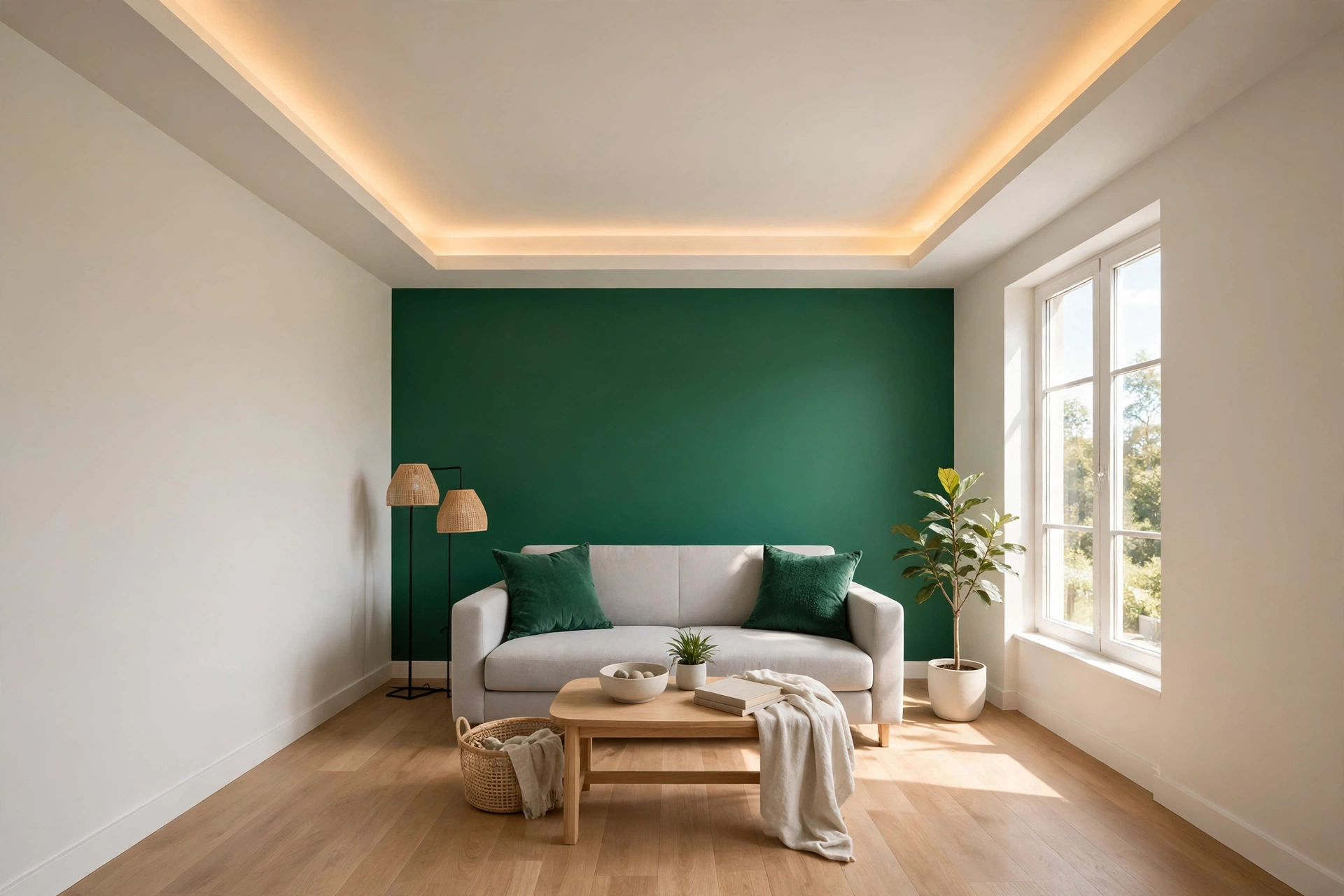
10 False Ceiling Designs for Small Rooms That Make Low Ceilings Look Taller
A false ceiling is a second ceiling hung a few inches below the real one. It hides wires, pipes and ugly beams, and it gives you somewhere to put proper lighting. In a small room it can do something furniture cannot: it can make the ceiling feel higher than it is. But it can also do the opposite. Pick the wrong design and a low room feels like a box.
Here is the short answer. The best false ceiling designs for small rooms are the slim ones: a narrow perimeter border with cove lighting, a flat single-layer gypsum ceiling, or a shallow tray. They frame the room without eating its height. The numbers below are real. HomeGuide’s 2026 cost guide puts a flat drywall ceiling at $2 to $4 per square foot installed, a tray at $3 to $7, a drop ceiling at $4 to $20, and a coffered ceiling at $10 to $40. For a 10 by 12 ft room (120 sq ft, about 11 sq m), that works out to $240 to $480 for flat drywall and $1,200 to $4,800 for coffered. All prices in this post are as of October 2026.
One more number before we start. A standard US ceiling is 8 ft (96 in, 244 cm). Take 4 in (10 cm) off for a false ceiling and you are standing under 7 ft 8 in (234 cm). That is the math every design in this post has to survive.
What Is a False Ceiling, Exactly?
A false ceiling, also called a dropped ceiling or suspended ceiling in the US, is a secondary ceiling fixed below the structural ceiling. In the UK it is usually called a suspended ceiling, and the boards are plasterboard. In India the same thing is usually built from POP (Plaster of Paris) or gypsum board. In the US the closest everyday equivalent is a drywall ceiling hung on metal channels, or a grid-and-tile drop ceiling in a basement.
The materials matter more than the names. Gypsum board, sold as drywall in the US, comes in factory-made sheets, so it goes up fast and finishes smooth. POP is plaster mixed and shaped on site, so it can be moulded into curves and custom patterns a board cannot do. Wood, PVC panels and stretch membranes fill the gaps. Every design below uses one of these, and the verdict at the end of each one tells you who it actually suits.
The 3 Rules Before You Pick a Design
First, measure your ceiling height. Most pros want at least 8.5 to 9 ft (259 to 274 cm) before a false ceiling goes in, and that rule shows up in nearly every guide I read. If your ceiling is 8 ft, you can still do it, but only with a slim design that drops 2 to 4 in (5 to 10 cm) at most.
Second, decide what the ceiling has to do. Hide wires? Add light? Zone a living room from a dining corner? A design that only looks pretty is a bad buy in a small room. Every square inch of drop has to earn its place.
Third, keep 70 to 80 percent of the ceiling plain and light. That is the rule DesignCafe’s team gives, and it is the one I would actually follow. One feature, one accent, and the rest stays quiet. The room reads bigger when the ceiling is mostly calm.
Which False Ceiling Designs for Small Rooms Keep the Most Height?
These ten are ranked by how little height they steal, not by how fancy they look. They sit inside the wider set of ceiling designs for small rooms, but every one here is a false ceiling, not just a paint or trim trick. The slim ones come first for a reason.
1. Slim Perimeter Border With Cove Lighting
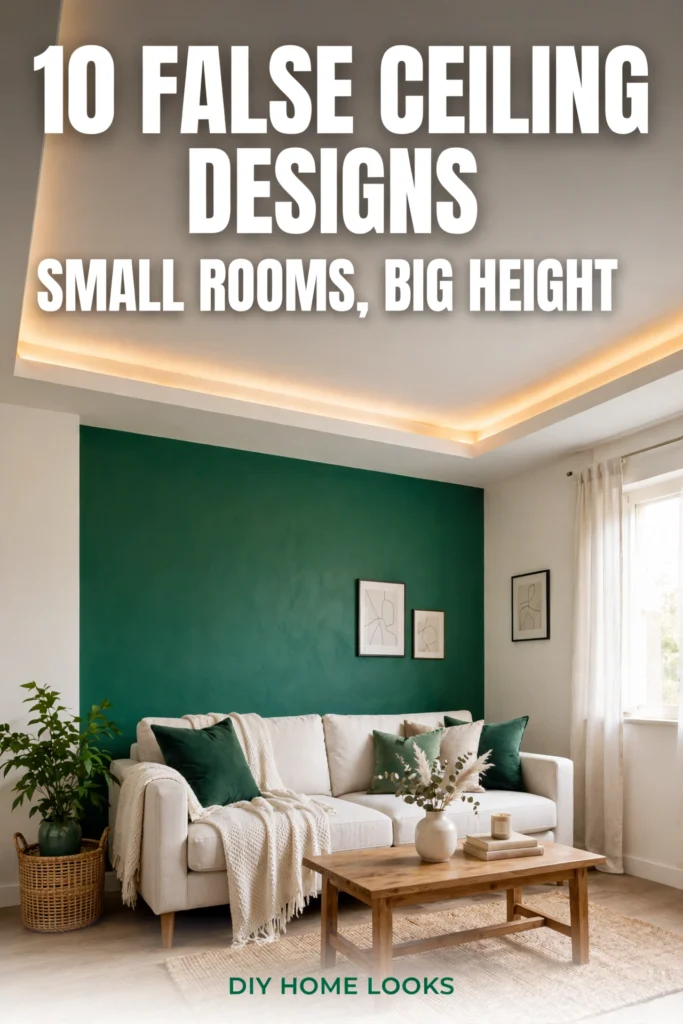
A narrow border, usually 12 to 18 in (30 to 46 cm) wide, runs around the edges of the ceiling. The centre stays at full height. Hidden LED strips sit inside the border and wash light down the walls, which makes the walls look taller and the ceiling look like it floats.
Best for: small living rooms and bedrooms with 8 ft ceilings. Main advantage: you get the finished, layered look without losing any height in the middle of the room. Watch out for: a border wider than 18 in starts to close the room in, and cheap LED strips flicker or shift colour over time, so buy dimmable 2700K strips from a brand you can name. Verdict: the best all-round false ceiling for a small room. If you pick one design from this list, pick this one.
2. Single-Layer Flat Gypsum Ceiling
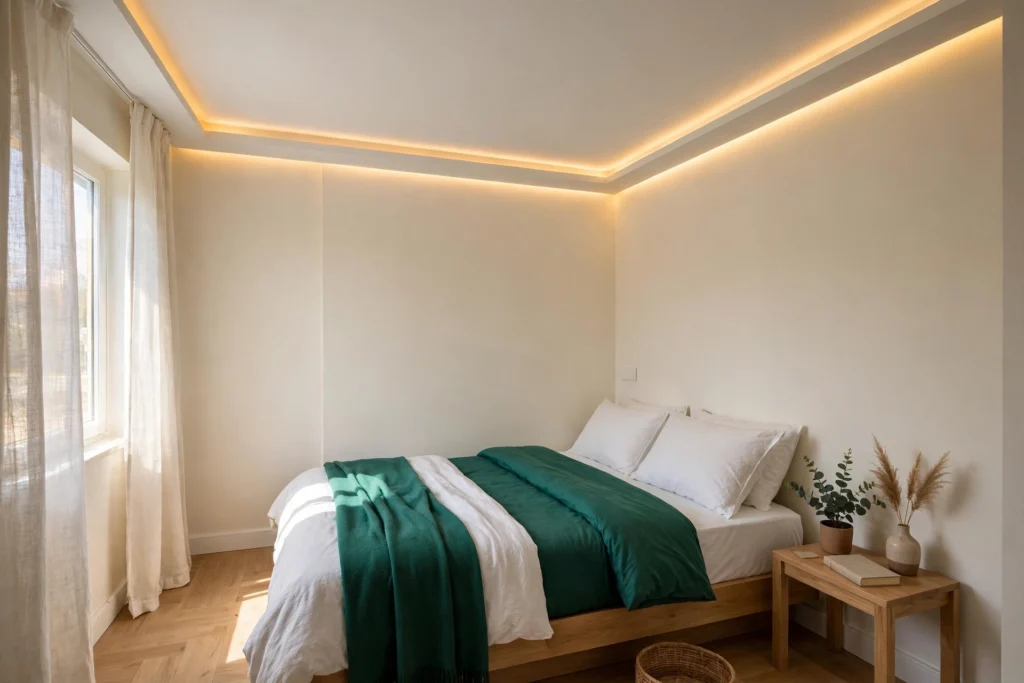
One flat layer of gypsum board (drywall) hung just below the slab. No steps, no curves, no drama. It hides every wire and beam and gives you a clean surface for recessed lights.
Best for: renters-turned-owners and anyone who wants the mess gone, not a feature. Main advantage: cheapest real false ceiling there is, $2 to $4 per sq ft installed, so $240 to $480 for a 10 by 12 ft room. Watch out for: a flat ceiling with no lighting plan looks exactly like the ceiling you already had, just lower. Plan the lights first, then the board. Verdict: the honest, invisible option. Boring in the best way.
3. Shallow Tray Ceiling
A recessed rectangle in the centre of the ceiling, usually 2 to 4 in (5 to 10 cm) deep, with LED strips tucked around its inner edge. The centre of the tray sits higher than the border, so the eye reads extra height where there is none.
Best for: small living rooms where the sofa sits under the tray. Main advantage: adds depth and a focal point for $3 to $7 per sq ft, or $360 to $840 for a 10 by 12 ft room. Watch out for: a tray deeper than 4 in on an 8 ft ceiling starts to feel like a lid. Keep it shallow and keep the tray colour the same white as the rest of the ceiling. Verdict: the prettiest way to fake height, as long as you keep it shallow.
4. Floating Central Panel
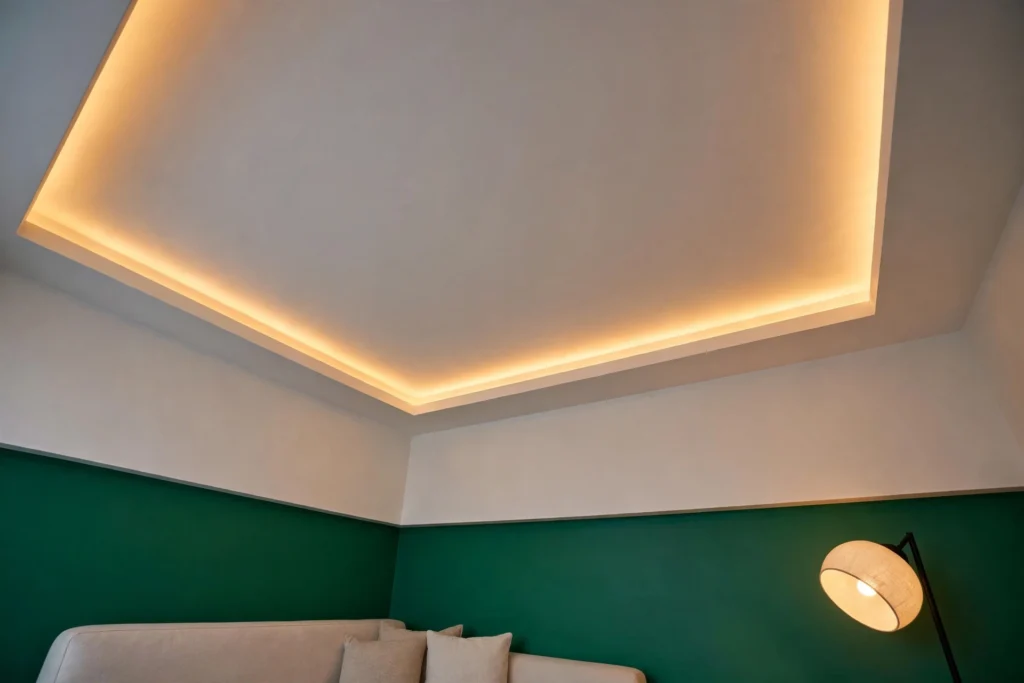
A single flat panel, gypsum or wood-look, hung in the centre of the ceiling with a slim gap all around it. Recessed lights or one pendant sit in the panel. The gap of plain ceiling around it tricks the eye into seeing more height.
Best for: bedrooms, above the bed, and dining corners in open-plan rooms. Main advantage: zones a space without a partition, and the panel can be as small as 4 by 6 ft (122 by 183 cm). Watch out for: a panel that covers more than half the ceiling stops floating and starts looming. Verdict: a smart zoning trick, and one of the few designs that works over a bed without feeling heavy.
5. POP Decorative Border
Plaster of Paris shaped on site into a border with curves, steps or a simple geometric pattern. POP is the material behind most of the fancy Indian false ceilings you see online, and it can do shapes gypsum board simply cannot.
Best for: homeowners who want a custom pattern and have a plasterer who actually knows POP. Main advantage: total design freedom, curves, circles, layered steps. Watch out for: POP is rarely sold as a standard US service, so there is no published US per-square-foot rate the way there is for drywall. Expect a per-job quote, a messier install, and a longer drying time. It also cracks more easily than board if the house moves. Verdict: beautiful if you have the right craftsperson, a headache if you do not. In the US, gypsum usually wins on practicality.
6. Wood Slat Accent Strip
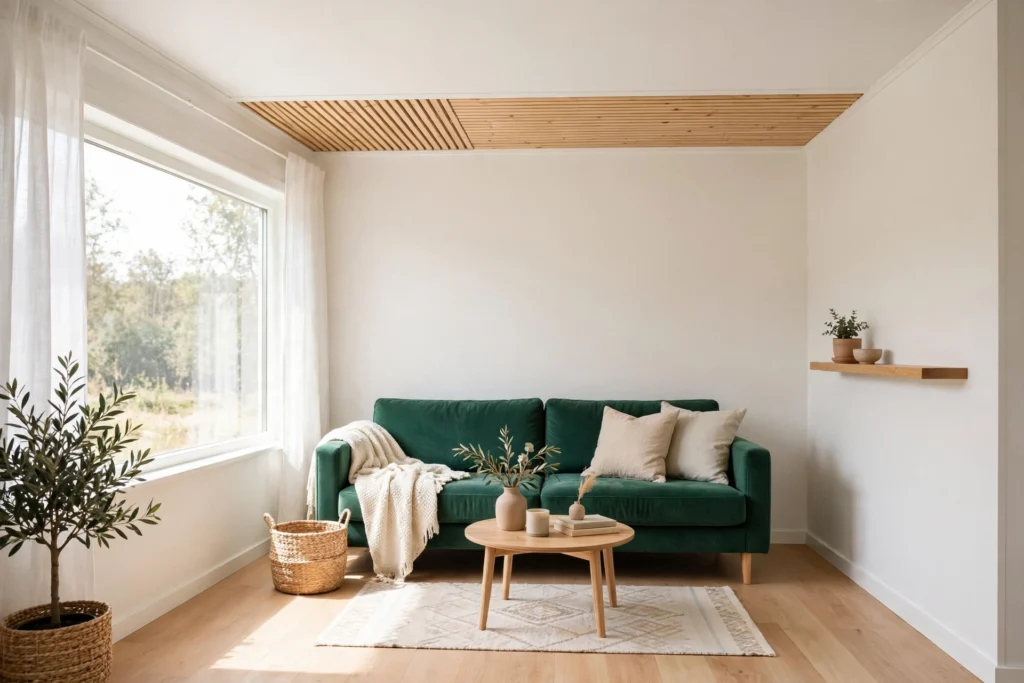
A narrow strip of wood slats, or wood-look panels, running in one direction across part of the ceiling. It adds warmth and texture, and lines running along the length of a room make the room feel longer.
Best for: bedrooms and living rooms that feel cold or flat. Main advantage: wood tongue-and-groove runs $4 to $10 per sq ft installed, and you only need a strip, not the whole ceiling, so a 3 by 10 ft strip (36 by 305 cm) costs roughly $120 to $300. Watch out for: covering the whole ceiling in wood makes a small room feel like a cabin, and heavy. Keep it to one strip, one direction, and keep the slats close to the ceiling colour if the room is dark. Verdict: the warmest accent on this list, used sparingly.
7. Shallow Coffered Ceiling
Recessed square or rectangular panels in a grid, usually 2 to 3 in (5 to 8 cm) deep. Real coffered ceilings are a luxury feature, but a shallow version with wide panels and thin beams can work in a small room.
Best for: living rooms with 9 ft ceilings or higher. Main advantage: the grid adds architecture and depth no flat ceiling can match. Watch out for: the price. At $10 to $40 per sq ft, a 10 by 12 ft room runs $1,200 to $4,800, the most expensive design here by far. On an 8 ft ceiling, even a shallow coffer reads as heavy. Verdict: lovely, but only if you have the height and the budget. On a standard 8 ft ceiling, skip it.
8. Drop Ceiling (Suspended Grid and Tiles)
A metal grid hung from the joists with acoustic tiles dropped in. This is the ceiling you know from offices and basements. It is the most practical design here and the least pretty.
Best for: basements, laundry rooms and any small room where you need access to pipes and wires above. Main advantage: tiles pop out for access, and the grid hides everything. Cost runs $4 to $20 per sq ft installed, or $480 to $2,400 for a 10 by 12 ft room, and a DIY install with basic tiles drops to about $3 to $5 per sq ft in materials. Watch out for: a drop ceiling loses at least 3 in (8 cm) of height, and cheap mineral-fibre tiles stain and sag. Pick vinyl-faced or PVC tiles if the room ever gets damp. Verdict: the workhorse. Not beautiful, but nothing else gives you this much access this cheaply.
9. Two-Tone Painted Band (No False Ceiling at All)
No boards, no grid, no drop. Paint a soft, lighter band around the edges of the ceiling and keep the centre a tone deeper, or paint the ceiling a pale colour from our ceiling colors guide and add a slim painted border. It mimics the effect of a tray or border for the price of a gallon of paint.
Best for: renters, and anyone with a ceiling under 8 ft. Main advantage: zero height lost, zero demolition, and a gallon of ceiling paint costs $35 to $45, which covers a 10 by 12 ft ceiling (120 sq ft) with paint left over. The right paint finish for a small room matters here, so a flat or matte sheen hides flaws best. Watch out for: paint cannot hide wires or beams, and a bad colour choice makes the ceiling look lower, not higher. Keep the band light. Verdict: the most underrated option on this list. If your ceiling is low, this beats a real false ceiling.
10. Backlit Stretch Panel
A PVC membrane stretched across a slim frame and lit from behind, so a section of the ceiling glows. It looks futuristic and it makes a dark room feel brighter.
Best for: a small lobby, a windowless bathroom corner, or one feature panel in a bedroom. Main advantage: the glow makes the ceiling feel like a skylight, and the membrane hides everything behind it. Watch out for: it is a specialist install with specialist pricing, and a full-room stretch ceiling in a small space looks like a gimmick. One panel, not a whole ceiling. Verdict: a single glowing panel is a talking point. A whole glowing ceiling is a mistake.
POP vs Gypsum: Which One Wins for a Small Room?
This is the question every guide dodges, so here is the straight answer. POP (Plaster of Paris) wins on design freedom. It is mixed and shaped on site, so curves, circles and layered steps are all possible. Gypsum wins on everything else. It comes in factory-made boards, so it goes up faster, finishes smoother, cracks less, and costs a known amount: $2 to $4 per sq ft installed for a flat drywall ceiling.
For false ceiling designs for small rooms, gypsum wins. The designs that work in small rooms are slim and simple, and simple is exactly what boards do best. POP earns its keep only when you want a custom shape a board cannot make, and you have a craftsperson you trust. If you are in the US, ask your contractor for gypsum first. If you are in the UK, the same board is plasterboard, and the same logic holds.
What a False Ceiling Costs in the US
These are HomeGuide’s 2026 installed costs per square foot, multiplied out for a real 10 by 12 ft room (120 sq ft), as of October 2026. Labour is most of the bill, so get three quotes and check what each one actually includes.
Flat drywall (gypsum): $2 to $4 per sq ft, $240 to $480 for the room. Shallow tray: $3 to $7 per sq ft, $360 to $840. Wood tongue and groove: $4 to $10 per sq ft, $480 to $1,200. Drop / suspended ceiling: $4 to $20 per sq ft, $480 to $2,400. Coffered: $10 to $40 per sq ft, $1,200 to $4,800.
Add $1 to $2 per sq ft if you want texture, and remember a drop ceiling costs you at least 3 in (8 cm) of height. A painted band, design 9 above, is the only option on this list under $100 all-in.
Renters: Ceiling Tricks Without a False Ceiling
A false ceiling is a permanent build, so renters cannot install one. That does not mean the ceiling has to stay boring. Our renter-friendly ceiling ideas cover the damage-free options in full, and the short version is this: paint is your best friend if your landlord allows it, and peel-and-stick ceiling tiles or a fabric canopy are the no-paint alternatives. A plug-in pendant hung from a ceiling hook and a strip of LED lights tucked behind a bookshelf both pull the eye upward without a single hole that matters. Keep every fix removable and photograph the ceiling on move-in day.
What to Skip
Multi-layer POP showpieces. The most overrated move in a small room is the three-layer POP centrepiece with a chandelier. It eats 6 in (15 cm) or more of height and turns a small room into a jewellery box. One layer, one feature, done.
Dark ceiling colours. A deep shade overhead brings the ceiling visually closer. Keep the ceiling white or near-white and put the bold colour on one wall instead.
A full-room coffered ceiling on 8 ft. Coffered needs height. On a standard 8 ft ceiling it reads as heavy, and at $10 to $40 per sq ft it is the priciest way to make a room feel smaller.
A grid of spotlights everywhere. Twelve downlights in a 10 by 12 ft room is clutter, not lighting. Plan three or four key spots, add one cove or indirect source, and stop.
Skipping the fan and vent check. Decide where the ceiling fan, the AC vent and the smoke alarm go before the boards go up. Moving them after costs more than the ceiling did.
The Short Version
If your ceiling is 8 ft, pick the slim perimeter border with cove lighting, or skip the build entirely and paint a two-tone band. That is the whole shortlist of false ceiling designs for small rooms that actually work on a low ceiling. If you have 9 ft or more, a shallow tray earns its keep. Gypsum beats POP for small rooms on speed, cost and crack resistance. And whatever you pick, keep most of the ceiling plain and light, because in a small room the ceiling works hardest when it gets out of the way.
Which false ceiling design is best for a small living room?
A slim perimeter tray with cove lighting. It leaves the centre height intact, frames the seating area, and the hidden LED light makes the walls look taller. Keep the border 12 to 18 in (30 to 46 cm) wide and the drop under 4 in (10 cm).
What is the minimum height required for a false ceiling?
Most pros want at least 8.5 to 9 ft (259 to 274 cm) before a false ceiling goes in. On a standard 8 ft (244 cm) ceiling you can still do a slim design, but only one that drops 2 to 4 in (5 to 10 cm). A drop ceiling needs at least 3 in (8 cm) for the grid alone.
Is POP better than gypsum for a bedroom ceiling?
POP is better for custom shapes and curves, because it is shaped on site. Gypsum is better for almost everything else: it installs faster, finishes smoother, cracks less, and costs a known $2 to $4 per sq ft. For a small bedroom, gypsum wins unless you specifically want a curved or moulded design.
Does a false ceiling make a room look smaller?
It can, if the design is wrong. Deep drops, dark colours and multi-layer patterns all make a small room feel lower. A slim, light-coloured design with hidden lighting does the opposite: it draws the eye up and makes the room feel taller. The rule is simple. If the ceiling is already low, keep the design slim or skip the build and use paint.