Under-Stairs Storage Ideas for Small Homes: 10 Ways to Use the Triangle
The space under your stairs is the biggest piece of storage most small homes already own and never use. Under stairs storage ideas work when you stop treating the void like a cupboard and start treating it like a triangle. I measured a typical staircase, 7 in (17.8 cm) rise and 11 in (27.9 cm) run, and worked out the clearance at every foot from the tall end. At the tall end you get about 80 in (203 cm) of headroom. Six feet back, you get 34 in (86 cm). Nine feet back, you get 11 in (28 cm). That one table decides everything in this post: what fits, where it goes, and what to skip.
What under stairs storage ideas actually work in a small home?
The short answer is: the ones that match the height where they sit. Tall things live at the tall end. Flat things live in the low wedge. Everything in between gets shelves, cubes, or a cart that rolls out. Here is the zone plan, computed from a typical 7 in rise and 11 in run staircase with 80 in (203 cm) of clearance at the tall end.
| Distance from the tall end | Clearance | What fits there |
|---|---|---|
| 0 to 2 ft (0 to 61 cm) | 65 to 80 in (165 to 203 cm) | Coats on hooks, tall shoe rack, vacuum standing up |
| 2 to 4 ft (61 to 122 cm) | 50 to 65 in (127 to 165 cm) | Cube storage, KALLAX unit, hanging rail |
| 4 to 6 ft (122 to 183 cm) | 34 to 50 in (86 to 127 cm) | Slim rolling cart, pull-out drawers, stacked bins |
| 6 to 9 ft (183 to 274 cm) | 11 to 34 in (28 to 86 cm) | Flat lidded boxes, shoes lying flat, seasonal storage |
Measure your own staircase before you buy anything, because two stairs are never the same. The table gives you the shape of the answer. Your tape measure gives you the real numbers. The whole-home organization guide we published earlier covers the rest of the house room by room, and this post is the missing piece for the stair void.
How do you measure the space under your stairs?
Do this before you spend a dollar. It takes fifteen minutes and it stops the most common mistake in this project, which is buying storage that is two inches too tall for the spot it was meant for.
What you need: a tape measure, a pencil, masking tape, and your phone camera.
- Find the tall end. Stand at the highest point under the stairs, usually where the staircase meets the wall or the door. Measure the floor-to-ceiling height there and write it down.
- Mark one-foot intervals. Put a strip of masking tape on the floor every 12 in (30 cm) from the tall end toward the low end, and number them.
- Measure the height at each mark. Hold the tape vertically from the floor to the underside of the stairs at each mark. Write each number on its tape strip.
- Measure the depth. Measure from the back wall to the front edge at the tall end, the middle, and the low end. Stair voids are rarely square.
- Check what is already there. Note the meter, the electrical panel, any pipes, and any damp patches. Photograph them. These decide what you cannot block.
- Check the door swing. If the void has a door, or you plan to add one, make sure it opens fully without hitting the stairs or the hallway wall.
- Write your three numbers on one card. Tall-end height, middle height, and total depth. Take the card to the store, or keep it open on your phone while you shop online.
The 10 under stairs storage ideas, ranked
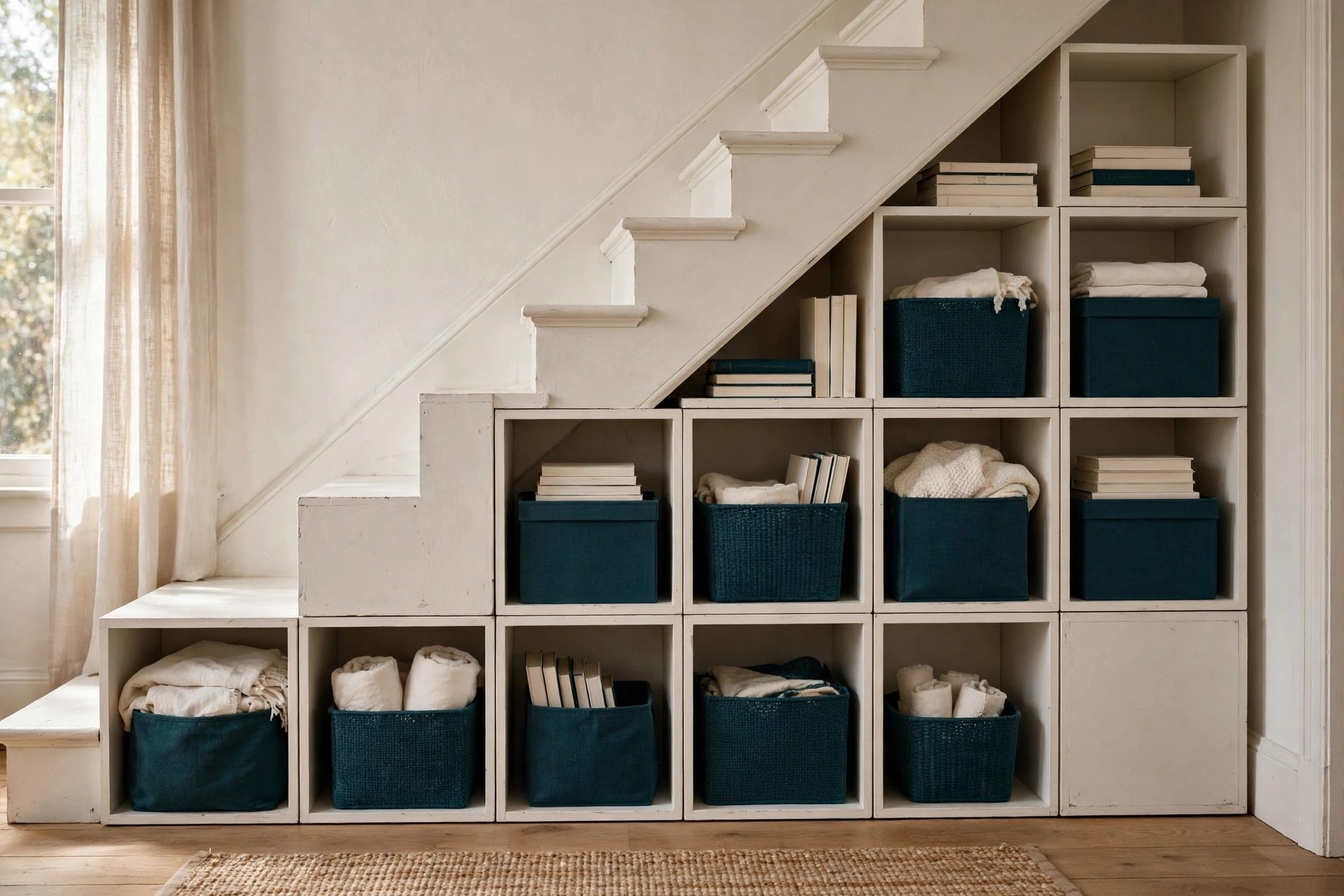
1. Stepped cube storage that follows the slope
Stack modular cubes in a staircase shape so the top of the unit follows the slope of the stairs. A 12-cube unit with 12 in (30 cm) cubes is the classic fit, and each cube holds about 4.5 kg (10 lb) according to the manufacturer rating.
Best for: books, baskets, and everyday clutter in the middle zone. Main advantage: no drilling, no carpenter, and you can reconfigure it when you move. Watch out for: the top row of cubes wastes space if the slope is steep, so start the stack one cube lower than you think. Verdict: the best first move for renters and the cheapest way to make the triangle look deliberate.
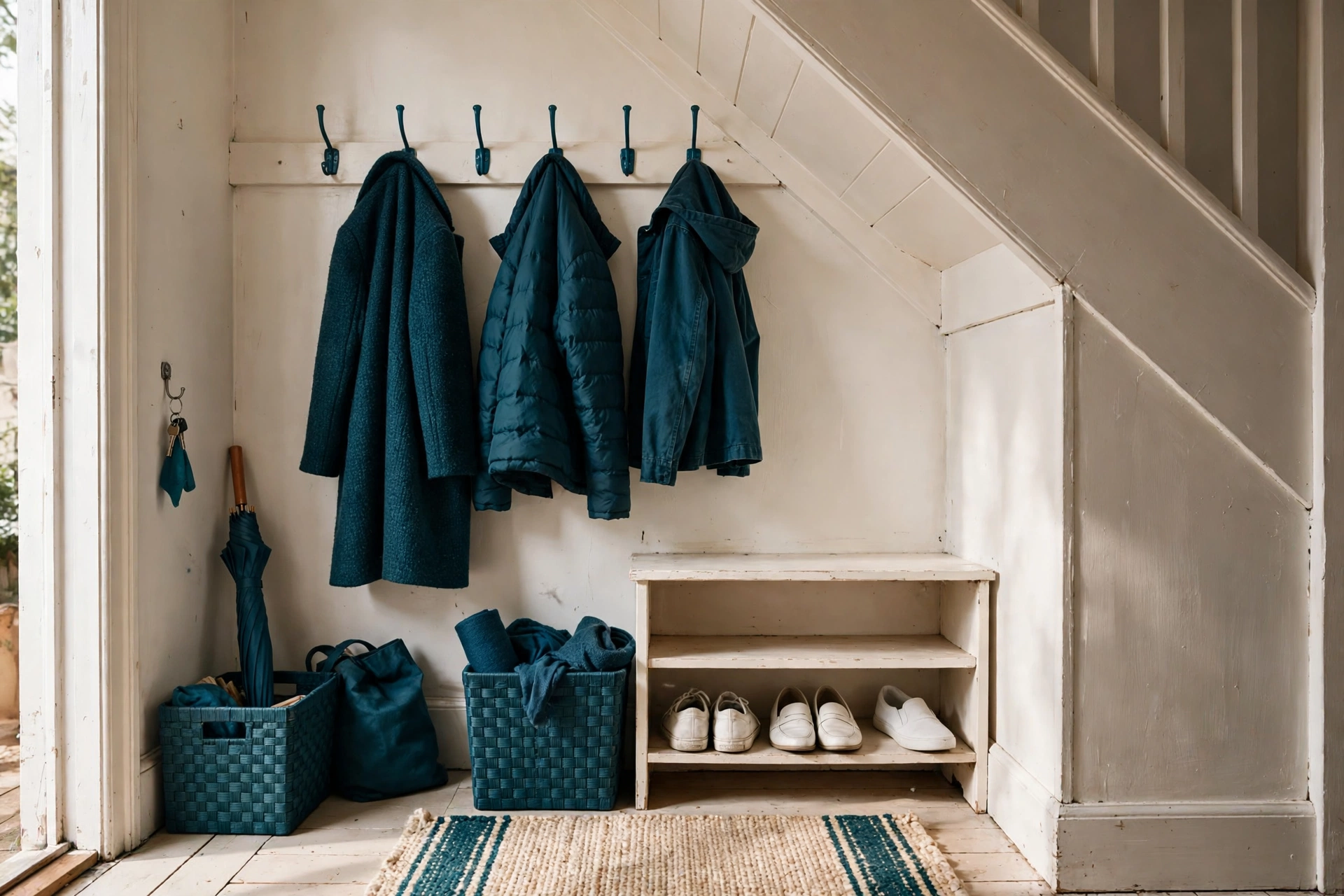
2. Tall-end shoe and coat zone
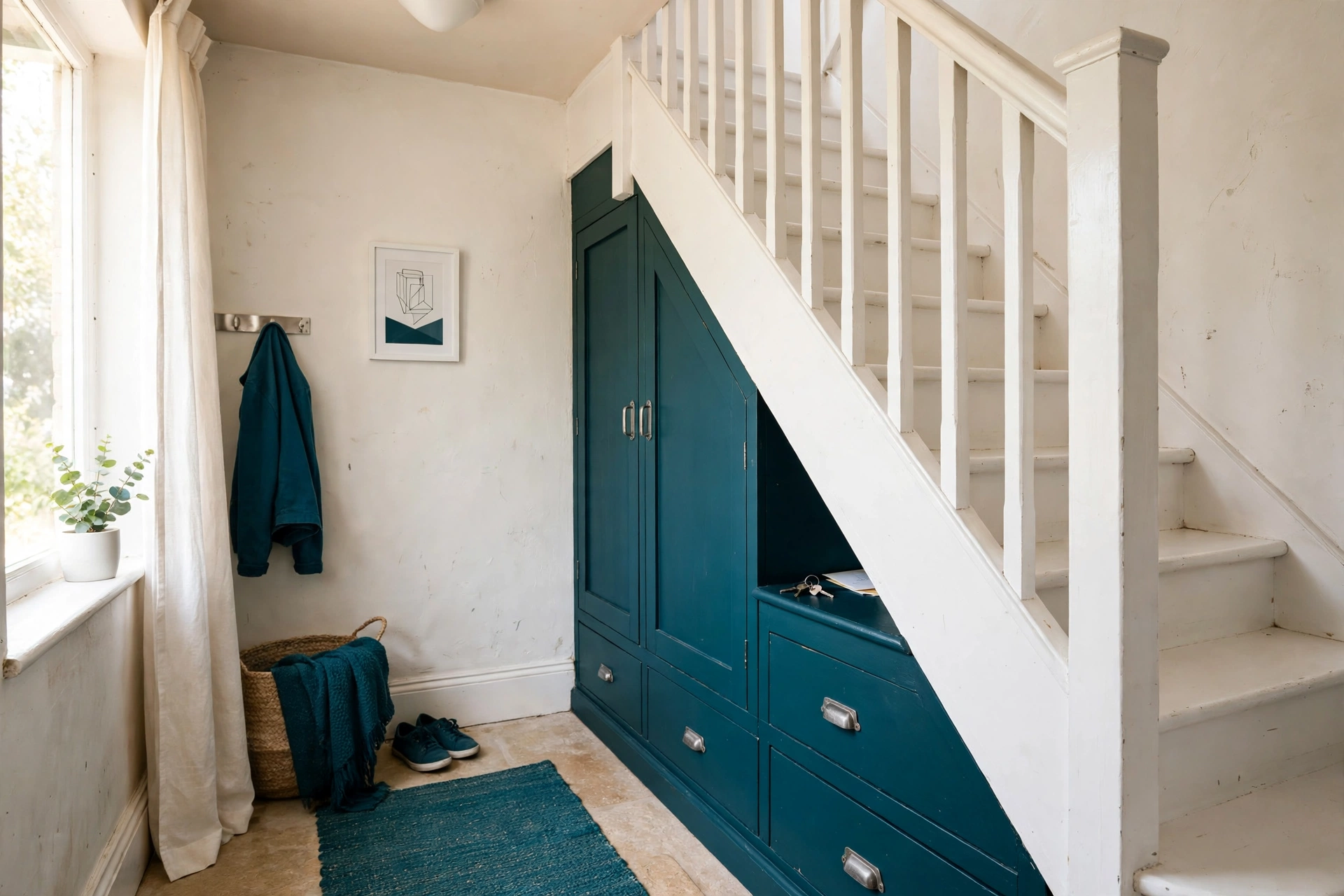
Use the tallest 2 ft (61 cm) of the void for the things you grab on the way out. A three-tier shoe rack, 21.3 in (54 cm) high, fits easily, and a row of hooks on the full-height side wall holds coats without eating floor space, with our coat closet organization guide covering the per-person coat budget if the whole household shares the zone. Our small entryway organization ideas post covers the rest of the hallway, and this zone is its natural partner.
Best for: households where shoes pile up by the front door. Main advantage: it puts the messiest daily items in the one spot with real headroom. Watch out for: wet shoes need air, so leave a gap behind the rack and never seal the zone behind a solid door. Verdict: the highest-value use of the tall end, and the first zone to build.
3. Slim rolling cart in the middle zone
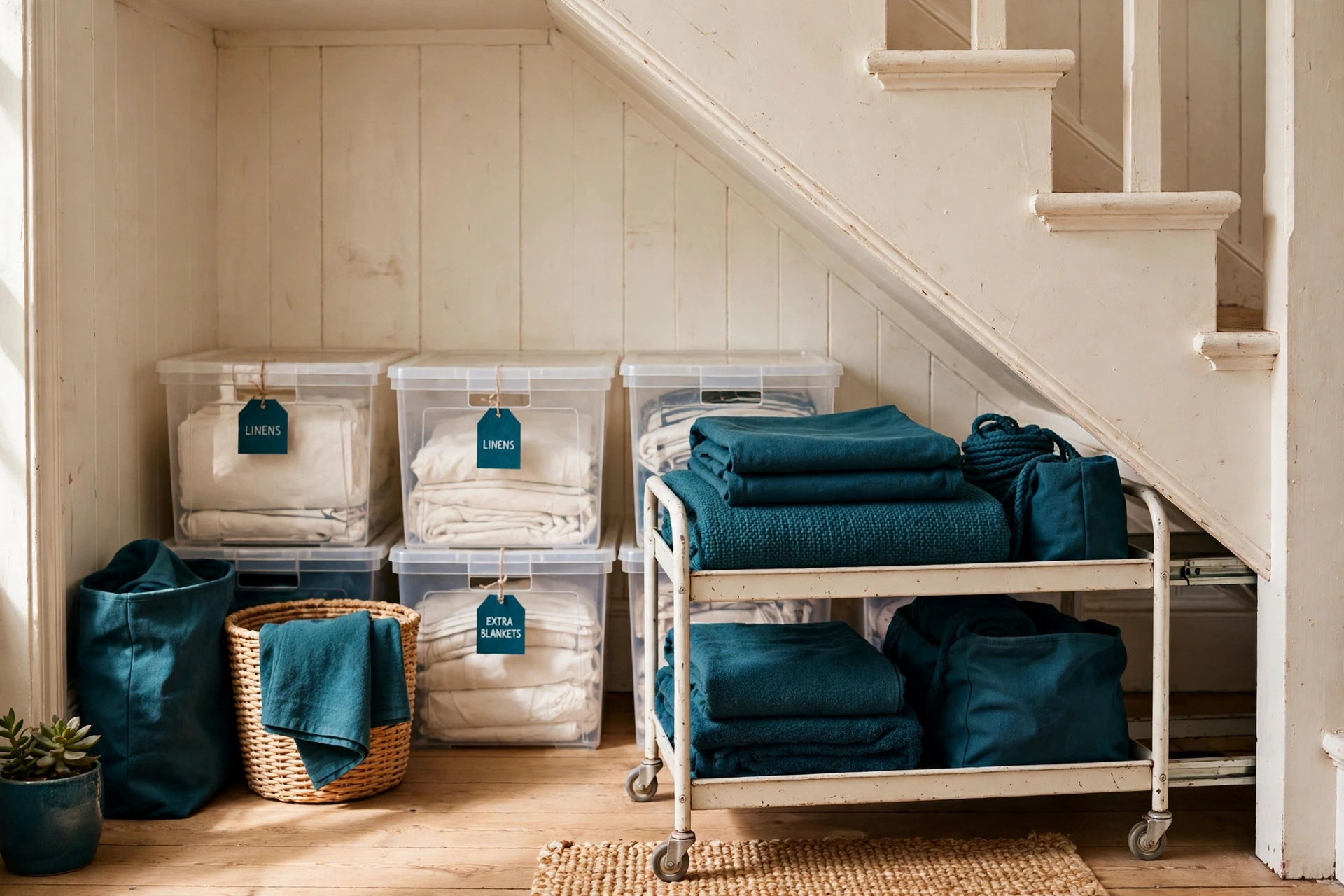
A slim three-tier cart, about 24 in (61 cm) high and 5 in (13 cm) wide, slides into the middle zone where fixed shelves would create a dead strip. Pull it out like a drawer, put it back when you are done.
Best for: cleaning supplies, pantry overflow, and craft bits. Main advantage: full access to the deep middle of the void without crawling. Watch out for: measure the cart against your height table, because a cart that is one inch too tall will jam under the slope. Verdict: the best ten-dollar-style fix for the awkward middle, and fully renter-safe.
4. Lidded boxes in the low wedge
The lowest 3 ft (91 cm) of the void is the worst everyday storage in the house and the best occasional storage. Clear lidded boxes, about 12 in (30 cm) high, stack two high here and hold Christmas decorations, suitcases, and out-of-season clothes.
Best for: anything you touch two or three times a year. Main advantage: clear boxes mean you can see what is inside without pulling the whole stack out. Watch out for: label every box on the side that faces out, not the top, or you will never find anything. Verdict: the only honest use of the low wedge, and the cheapest idea on this list.
5. Pull-out drawers on runners
If you own the home, drawers on full-extension ball-bearing runners solve the access problem completely. Angled drawer fronts follow the stair pitch, so the shallow end finally gets used instead of becoming a black hole.
Best for: owners who want the void to work like a real cupboard. Main advantage: you reach the back of a 3 ft (91 cm) deep void without emptying the front. Watch out for: this is joinery, not flat-pack, so get a quote before you fall in love with the idea. Verdict: the best storage per square foot, and the most expensive idea here by a long way.
6. Under-stairs pantry or larder
If the stairs sit near the kitchen, the void becomes a pantry. A narrow pull-out unit holds cans and dry goods, and the tall end takes a shelf for bulky items like the slow cooker. Our small pantry organization ideas post has the shelf-fit math for the rest of the kitchen, and the same zone logic applies here.
Best for: small kitchens with no pantry. Main advantage: it frees a whole kitchen cupboard. Watch out for: keep food away from any damp patch, and never store food against an outside wall that gets cold and condenses. Verdict: the smartest use of a kitchen-adjacent void, if yours is dry.
7. Full-height side-wall hooks and rails
The vertical wall under the highest part of the stairs is free storage that costs nothing in floor space. A rail with hooks holds bags, dog leads, umbrellas, and the ironing board. A pegboard on the same wall holds tools.
Best for: renters, because adhesive hooks and a leaning rail need no drilling. Main advantage: it uses a wall that would otherwise be blank. Watch out for: check the load rating on every hook and keep heavy items low, so nothing falls on anyone coming down the stairs. Verdict: the cheapest upgrade on this list, and the easiest to undo.
8. Cleaning cupboard
Give the vacuum, mop, bucket, and ironing board one home. The vacuum stands upright at the tall end, the mop hangs on the side wall, and the ironing board slides into the middle zone. Everything is in one place, and the hallway stops being the vacuum’s parking spot.
Best for: homes where cleaning gear currently lives behind three different doors. Main advantage: you stop tripping over the vacuum in the hallway. Watch out for: the vacuum needs about 45 in (114 cm) of height standing up, so check your table before you commit the tall end to shoes instead. Verdict: the most boring idea here and the one you will notice every single day.
9. Fold-down desk nook
A hinged desk surface, about 12 in (30 cm) deep, folds down from the side wall for laptop work and folds flat when you are done. A small shelf above it holds the charger and a notebook. This is a use for the void, not a second home office, so keep it simple.
Best for: quick admin jobs, homework, and paying bills. Main advantage: it turns dead space into a workspace without taking a room. Watch out for: you need a power outlet nearby, and you need light, so add a battery LED strip before you add the desk. Verdict: a good idea for a void near a window, a poor idea for a dark one.
10. Seasonal rotation store
Treat the whole void as the home for the off-season half of your life: Christmas decorations, suitcases, winter coats in summer, and summer gear in winter. One labeled box per season, one shelf per family member, and a swap day twice a year.
Best for: families with no loft, garage, or spare cupboard. Main advantage: it gets bulky seasonal stuff out of the closets you use every day. Watch out for: the swap only works if you actually do it, so put the two swap dates in your calendar now. Verdict: the best use of the deep end if you already have your daily storage sorted elsewhere.
What should you not store under the stairs?
Some things do not belong in a stair void, however tidy the boxes look.
Never block the meter or the electrical panel. You need clear access to them in an emergency, and an electrician needs room to work. Keep at least 3 ft (91 cm) of clear space in front of any panel, and never stack boxes against it.
Never store paint, solvents, or fuel. Stair voids are enclosed, often warm, and often near a heat source. Flammable liquids belong in a garage or an outside store, not under your stairs.
Never block an escape route. If the stairs are your way out in a fire, the void underneath them must not become a wall of boxes. Keep the hallway side clear and the door, if there is one, easy to open.
Watch for damp. Stair voids against outside walls can be the dampest spot in a small home. If you see mould or a damp patch, fix the damp first. Do not hide it behind storage, and do not store clothes, books, or paper there until it is dry.
Mind the structure. Never cut into a stringer, a load-bearing stud, or a support post to make room for a shelf. If you are not sure what holds the stairs up, ask a carpenter before you cut anything.
Under stairs storage ideas for renters vs owners
Renters and owners should not build the same thing. Renters need storage that leaves no trace. Owners can spend money on joinery that stays with the house.
Renters: stick to ideas 1, 2, 3, 4, and 7. Cubes, racks, carts, boxes, and hooks all come with you when you move, and none of them touch the walls in a way a landlord can object to. Check your lease before you stick anything to a painted surface, and photograph the void before you start so you can prove its condition at move-out. Deposit risk for the whole renter route: 1 out of 5.
Owners: ideas 5, 6, and 9 are yours. Fitted drawers, a pull-out pantry, and a fold-down desk add real value to a small home, and the cost makes sense when you will live with the result for years. Get two quotes for fitted work, and expect a fitted under-stairs unit to cost several hundred dollars at the low end. Deposit risk does not apply, but a bad fitted job is harder to undo than a bad flat-pack, so check the carpenter’s past work first.
What does under-stair storage cost?
Prices checked in November 2026. These are market prices for the products named, not a receipt for a project, and prices change, so check before you buy.
| Item | Price (Nov 2026) | Source |
|---|---|---|
| SONGMICS 12-cube organizer with fabric bins | $34.99 | Amazon US |
| Sterilite 30 qt latch box, each | $11.99 | Target |
| SPACELEAD slim 3-tier rolling cart | $23.99 | Amazon US |
| SONGMICS 3-tier shoe rack | $19.99 | Amazon US |
| Battery LED strip, 3 m | $11.99 | Amazon US |
Budget route, $55.96: shoe rack ($19.99) plus two latch boxes ($23.98) plus the LED strip ($11.99). That covers the tall end and the low wedge with light, and it is the honest minimum.
Full starter kit, $114.94: add the 12-cube organizer ($34.99) and the rolling cart ($23.99) to the budget route. That covers all four zones. The sums check out: 34.99 plus 23.98 is 58.97, plus 23.99 is 82.96, plus 19.99 is 102.95, plus 11.99 is 114.94.
Time estimate: measuring and planning, 30 minutes. Building the renter route, one afternoon, about 3 hours including assembly. The fitted route, one to two days of carpenter time plus drying time for paint.
Mistakes to avoid
Buying before measuring. This is the number one mistake, and it is also the most expensive one. A cube unit that is two inches too tall does not fit, and it does not shrink. Measure first, buy second.
Filling the low wedge with daily items. Anything you use every day will make you crawl. Daily items live at the tall end. The low wedge is for seasonal things only.
Sealing the void shut. A solid door with no ventilation traps damp and smell. Leave a gap, use a louvered door, or leave the void open with a curtain.
Forgetting the light. A stair void is dark even in daylight. A battery LED strip costs $11.99 and changes the space from a black hole into a cupboard you can actually use.
What to skip
Bespoke fitted drawers in a rental. You cannot take them with you, your landlord did not ask for them, and they cost more than everything else on this list combined.
Open shelving in the low wedge. Open shelves at ankle height collect dust and get kicked. Lidded boxes do the same job better and they stack.
A full under-stairs office. A fold-down desk for quick jobs is sensible. A permanent desk, chair, and monitor under a sloping ceiling is not. The headroom runs out, the light is poor, and you will stop using it within a month.
Sources
Stair dimensions in this post follow the International Residential Code: a riser no higher than 7 3/4 in (19.7 cm), a tread no shallower than 10 in (25.4 cm), and headroom of at least 6 ft 8 in (203 cm), per section R311.7.2. The code figures are explained in the stair code guide. Cube load limits and box sizes come from the measured under-stairs guide. Prices are market prices checked in November 2026 from Amazon US and Target, as listed in the cost table above.
What can I put under the stairs for storage?
Almost anything dry and non-flammable that fits the height where it sits. Shoes and coats at the tall end, cubes and shelves in the middle, flat lidded boxes in the low wedge. Keep food away from damp walls, keep the meter and electrical panel clear, and never store paint, solvents, or fuel under the stairs.
How do I make storage under my stairs?
Measure first. Mark one-foot intervals from the tall end, measure the height at each mark, and check the depth at three points. Then match storage to the heights: tall items at the tall end, flat boxes in the low wedge, and a rolling cart for the middle. Renters should use freestanding cubes, racks, and carts. Owners can add fitted drawers.
What should you not store under the stairs?
Do not store flammable liquids like paint or fuel, and do not store anything against the meter or the electrical panel. Avoid clothes, books, and paper if the void is damp, and never block the hallway side if the stairs are part of your escape route in a fire.
Can you put a closet under the stairs?
Yes, and it is one of the best uses of the space. A small closet needs about 24 in (61 cm) of depth for hangers and at least 65 in (165 cm) of height at the tall end for coats. If your void is shallower than that, use hooks and a shoe rack instead of a full closet, and keep the door ventilated.