Small Kitchen Wall Colors: 7 Paint Colors That Make a Tiny Kitchen Feel Bigger
The best small kitchen wall colors make a tiny kitchen feel bigger and hide cooking splatter at the same time, and the cheapest route costs about $94 for a whole galley kitchen. I did the math first, because no list I read had done it: an 8 by 10 foot galley kitchen (2.4 by 3.0 m) has about 220 square feet (20.4 sq m) of paintable wall once you subtract the cabinets, the backsplash, the door, and the window. At the standard 400 square feet per gallon, two coats need 1.1 gallons, so one gallon plus one quart does the job. Below are the 7 wall colors that actually work in a small kitchen, ranked by light, grease, and the cabinets they sit next to, with a paint-quantity table, a finish-by-zone table, and a cost table dated November 2026.
What small kitchen wall colors actually do in a tiny kitchen
Here is the direct answer: wall color changes how big a kitchen feels, not how big it is. Light bounces off pale walls and back into the room, so the walls seem to step back. Dark walls absorb that light, so the room reads smaller and closer. The number that decides this is LRV, light reflectance value, a 0 to 100 scale for how much light a paint reflects. Benjamin Moore publishes an LRV for every color, and the brightest white on this list, Chantilly Lace OC-65, sits at 90.04, which means it reflects about 90% of the light that hits it.
The same light rule drives our guide to wall colors that make small rooms feel bigger, and kitchens are where it matters most, because steam and grease punish the wrong choice. A kitchen also adds a second rule the bedroom posts never face: the walls get splashed. Grease from the stove, steam from the sink, and fingerprints on every corner mean the finish matters as much as the color. Pick the color by LRV and light direction, then pick the finish by zone, and a small kitchen stops fighting you.
Cabinets cover most of a small kitchen’s wall space, so the wall color only works if it sits close to the cabinets in tone. Our guide to kitchen cabinet colors shows which cabinet shades pair with each wall color below, so read the two together. The rule is simple: keep the wall and the cabinets within a step or two of each other in lightness, and the room reads as one calm surface instead of a patchwork.
How much paint does a small kitchen need?
Once you pick your small kitchen wall colors, the next question is how much paint to buy. Most people guess, and guessing wastes either a return trip or a half-used gallon. Measure the room once and the table below does the rest.
| Kitchen size | Gross wall area (8 ft / 2.4 m ceilings) | Paintable after deductions | Gallons for 2 coats | Buy |
|---|---|---|---|---|
| 8 x 10 ft galley (2.4 x 3.0 m) | 288 sq ft (26.8 sq m) | 220 sq ft (20.4 sq m) | 1.1 gal (4.2 L) | 1 gallon + 1 quart |
| 10 x 12 ft (3.0 x 3.7 m) | 352 sq ft (32.7 sq m) | 280 sq ft (26.0 sq m) | 1.4 gal (5.3 L) | 2 gallons |
The deductions are the part everyone skips. For the 8 by 10 galley: upper cabinets 8 ft by 2.5 ft (20 sq ft), backsplash 8 ft by 1.5 ft (12 sq ft), one door 3 by 7 ft (21 sq ft), one window 3 by 4 ft (12 sq ft). That is 65 sq ft you never paint, so 288 minus 65 leaves 223, rounded to 220. For the 10 by 12 kitchen: uppers 25, backsplash 15, door 21, window 12, which is 73 sq ft off 352, leaving 279, rounded to 280. Two coats at 400 sq ft per gallon gives 1.1 and 1.4 gallons. If you paint the ceiling the same color, add 80 sq ft (7.4 sq m) for the galley ceiling or 120 sq ft (11.1 sq m) for the larger kitchen, which is about 0.2 to 0.3 gallons per coat.
One honest warning: 400 sq ft per gallon is the manufacturer planning figure for smooth walls in one coat. Textured walls, dark-to-light changes, and thirsty drywall all drink more paint. Buy the quart, not just the gallon, and keep the receipt. An unopened can goes back. A half-finished wall does not wait.
What paint finish belongs on each kitchen wall?
Finish is the part of this decision most lists rush past, and it is the part you will notice every week. A kitchen wall gets wiped, steamed, and splashed, so the sheen has to survive cleaning without showing every wipe mark.
| Zone | Finish | Why |
|---|---|---|
| Stove wall | Semi-gloss | The most washable sheen, so grease splatter wipes off with a damp cloth |
| Sink wall | Satin | Handles steam and splashes, wipes clean, and glares less than semi-gloss |
| Dining nook and far walls | Eggshell | Low splash, softer look, hides small wall flaws better |
| Ceiling | Flat | Nothing gets wiped up there, and flat hides flaws best |
| Trim and doors | Semi-gloss | Takes knocks and daily touching without marking |
The rule behind the table: the closer a wall sits to water, heat, or hands, the shinier the finish should be. Flat or matte paint has no place on a wall that gets splashed, because it marks when you scrub it and touch-ups show as dull patches. Satin is the safe default if you want one finish for the whole room, and semi-gloss is the right call behind the stove and sink, even though it shows bumps and patches more than satin does.
The 7 small kitchen wall colors, ranked
Each color below carries a grease-visibility note, because that is the question no shade list answers. Pure white shows every grease mark. Very dark colors show grease as a dull film and dust as a pale haze. Mid-tones hide splatter longest, which is why two of the seven picks below sit in the middle of the LRV scale instead of the top.
1. Warm white (White Dove family)
Best for: Kitchens with no window or one small window, where every bit of light has to come from bulbs.
Main advantage: A warm white with a soft yellow undertone bounces most of the light in the room without the cold, clinical feel of a stark white. It sits in the low to mid 80s on the LRV scale, so it reads bright but not blinding.
Watch out for: Warm white shows grease near the stove faster than any mid-tone on this list, so keep the stove wall in semi-gloss and wipe it weekly, or the warm white will yellow near the cooking zone.
Verdict: The safest pick for a dark kitchen, and the easiest to live with long term.
Grease visibility: High.
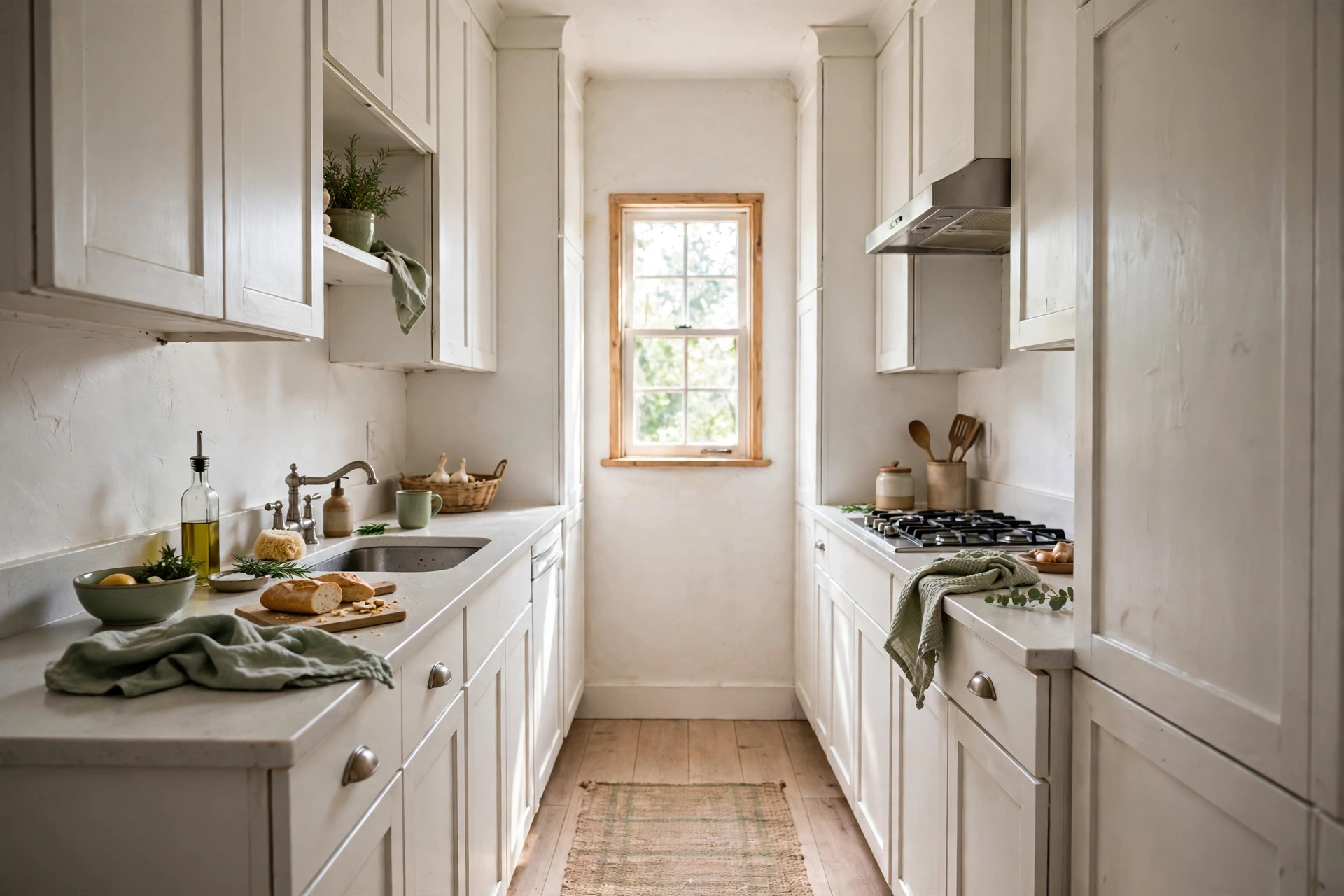
2. Clean bright white (Chantilly Lace OC-65)
Best for: Kitchens where maximum light is the whole point, low ceilings, and white cabinets you want to disappear into the walls.
Main advantage: At LRV 90.04, this is the brightest white Benjamin Moore makes, and both sources that list LRVs agree on the number. It reflects about 90% of the light that hits it, so a small kitchen with this on the walls feels as large as its footprint allows.
Watch out for: It is the most overrated small-kitchen choice on this list, and here is why: it shows every grease mark, every fingerprint, and every scuff, and it needs warm wood or brass nearby or the room feels like a lab. If your kitchen has cool stainless steel and no warm tones, this white will fight them.
Verdict: Use it when light is the problem. Skip it when grease is the problem.
Grease visibility: High.
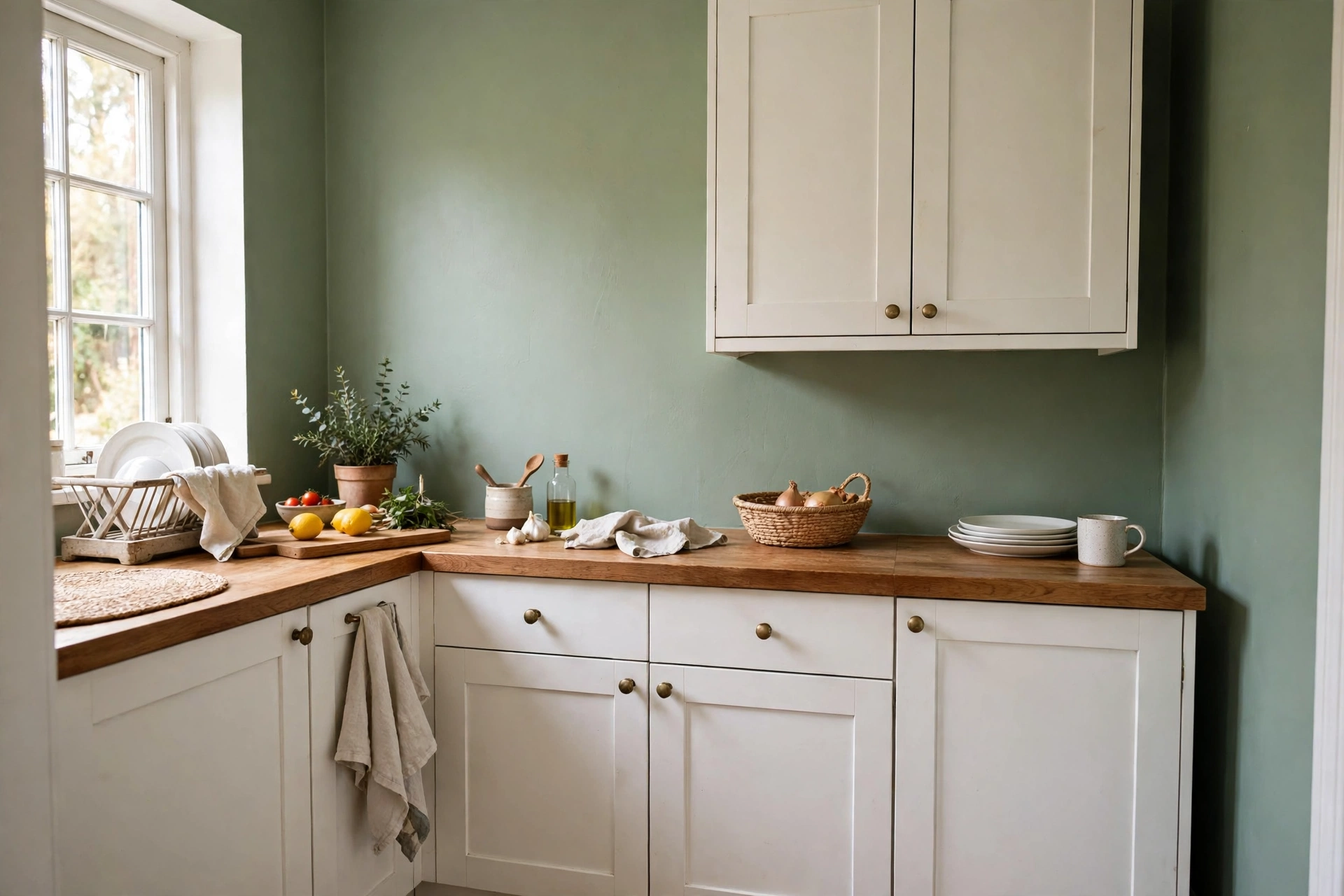
3. Soft sage green (Sea Salt SW 6204 family)
Best for: White cabinets, wood countertops, and kitchens that need color without losing light.
Main advantage: Sage behaves almost like a neutral, so it adds color without making the room feel smaller, and its mid-tone green hides cooking splatter better than any pale color on this list. Sea Salt sits in the mid 60s on the LRV scale, which is the lowest this list goes for a whole-room color, and it still clears the bar for a small kitchen. Greens are also the fastest-growing kitchen color family in 2026, with 86% of design pros naming green among the most popular kitchen colors in the NKBA 2026 report, behind neutrals at 96% and ahead of blues at 78%.
Watch out for: Sage shifts with the light. In a north-facing kitchen it can read gray and flat, so test a large sample on the wall and look at it at breakfast time, not just at noon.
Verdict: The best all-round small kitchen wall color on this list, and the most underrated. It hides the mess and keeps the light.
Grease visibility: Low.
4. Pale blue-gray (Palladian Blue family)
Best for: Sunny kitchens and dark cabinets, where a cool wall balances warm wood or a dark cabinet run.
Main advantage: A pale blue-gray feels fresh and clean, it suits white cabinets and stainless steel, and it is the best pick for a kitchen that gets strong afternoon sun, because the cool tone takes the edge off the glare. It also pairs well with dark lower cabinets, since the light wall keeps the room from closing in.
Watch out for: In a north-facing or windowless kitchen, pale blue-gray can read cold and dull. If your kitchen faces north, pick the butter yellow in color 6 instead.
Verdict: The best cool color for a small kitchen, but only when the sun does the warming for you.
Grease visibility: Medium.
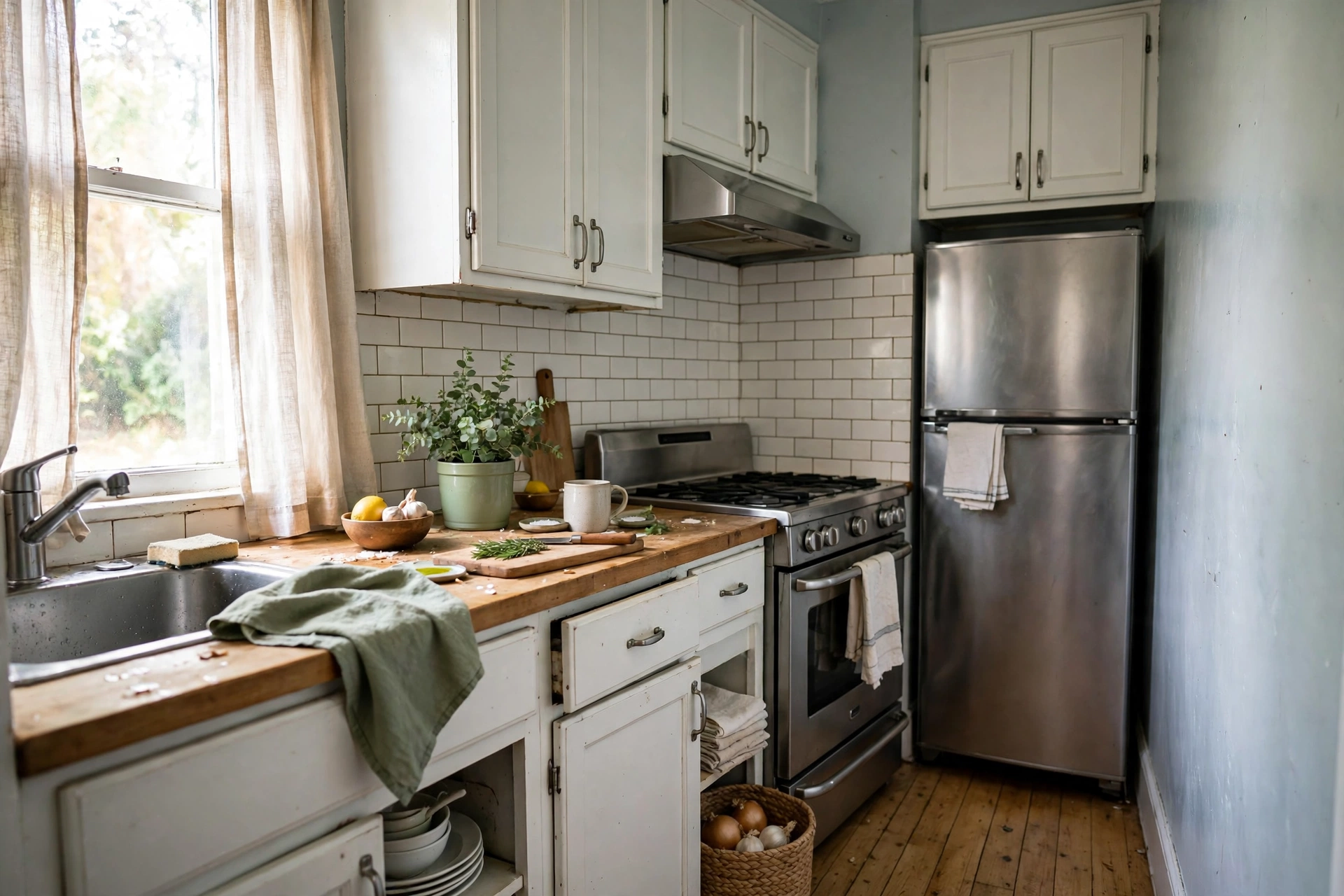
5. Warm greige (Agreeable Gray SW 7029 family)
Best for: Stainless steel appliances, gray countertops, and kitchens where the stove gets daily use.
Main advantage: Greige is the hardest-working color on this list. It hides grease splatter longer than any pale shade, it bridges warm wood and cool steel without fighting either, and Agreeable Gray sits at LRV 60, which is the deepest shade that still earns its place in a small kitchen. If you cook every day and wipe the walls once a week at most, this is your color.
Watch out for: Greige has undertones that shift by brand and by light, so a greige that looks warm in the store can read pink or purple on your wall. Test it next to your countertop, not next to the paint chip.
Verdict: The most practical pick for a real cooking kitchen. It trades a little brightness for a lot of forgiveness.
Grease visibility: Low.
6. Soft butter yellow
Best for: North-facing kitchens and windowless kitchens that need warmth more than they need brightness.
Main advantage: A pale butter yellow adds the warmth a north-facing kitchen never gets from the sun, and it does it without darkening the room the way a deep yellow would. If your kitchen faces north, the same warm logic in our paint colors for north-facing rooms applies here, only stronger, because a kitchen adds steam to the cold light.
Watch out for: Yellow is the easiest color to overdo. Keep it pale, keep it on the walls only, and do not pair it with yellow-toned wood cabinets, or the whole room turns one flat honey color.
Verdict: The best fix for a cold, north-facing kitchen, and the only warm color on this list that works in low light.
Grease visibility: Medium.
7. Deep green accent wall only (Evergreen Fog SW 9130)
Best for: One wall in a kitchen over 100 sq ft, behind open shelves or a dining nook, never the whole room.
Main advantage: A deep muted green on a single wall gives a small kitchen a focal point and a sense of depth without the cost of new cabinets. It works best on the wall you face while cooking, so the color sits behind you, not in front of your eyes.
Watch out for: A full dark room is color drenching a small room taken too far for a kitchen, so save the deep green for one wall and keep the rest light. In a kitchen under 100 sq ft, even one dark wall can close the room in if it faces the window, so put the dark wall opposite the light, not across from it.
Verdict: The one bold move on this list, and only as an accent. The whole room in this color is a mistake in a small kitchen.
Grease visibility: Medium on the accent wall, and it shows dust as a pale film, so wipe it monthly.
What does it cost to paint a small kitchen?
Prices below are live-checked as of November 2026. Paint prices move by store and by sale, so the per-gallon figures come from PaintDeck’s October 2026 price check of all three brands, and the Benjamin Moore figure is the maker’s own site price from October 27, 2026.
| Item | Price | Source |
|---|---|---|
| Behr Premium Plus, 1 gallon | $29.98 | Home Depot listing, August 2026 |
| Benjamin Moore Regal Select, 1 gallon | $84.99 | benjaminmoore.com, October 27, 2026 |
| Sherwin-Williams Emerald, 1 gallon | $101 to $106 | PaintDeck, October 2026 list price; 30 to 40% off sales run several times a year |
| Zinsser Bulls Eye 1-2-3 primer, 2 quarts | $40.64 | Target, $20.32 per quart |
| ScotchBlue painter’s tape | $7.79 | Checked November 2026 |
| Wooster Shortcut brush | $7.05 | Checked November 2026 |
| Master Foam mini roller kit | $8.29 | Checked November 2026 |
Budget route, 8 by 10 ft galley, 2 coats: 1 gallon Behr Premium Plus $29.98 + primer $40.64 + tape $7.79 + brush $7.05 + roller kit $8.29 = $93.75.
Premium route, same kitchen: 1 gallon Benjamin Moore Regal Select $84.99 + primer $40.64 + tape $7.79 + brush $7.05 + roller kit $8.29 = $148.76.
The $55 gap between the two routes buys washability and coverage, not color. Regal Select covers 400 to 450 sq ft per gallon and scrubs without burnishing, while Premium Plus is the budget line that needs two honest coats. For a rental, the budget route is the right call, since you may be repainting it white at move-out anyway. For your own kitchen, the premium gallon earns its price the first time you wipe grease off the stove wall.
Time estimate: one weekend, about 6 to 8 hours of work across two days. Day one is prep, cleaning, taping, and primer. Day two is two coats with drying time between them. Do not rush the drying time. A second coat over a tacky first coat peels, and peeling costs more time than waiting.
How to paint small kitchen walls in a weekend
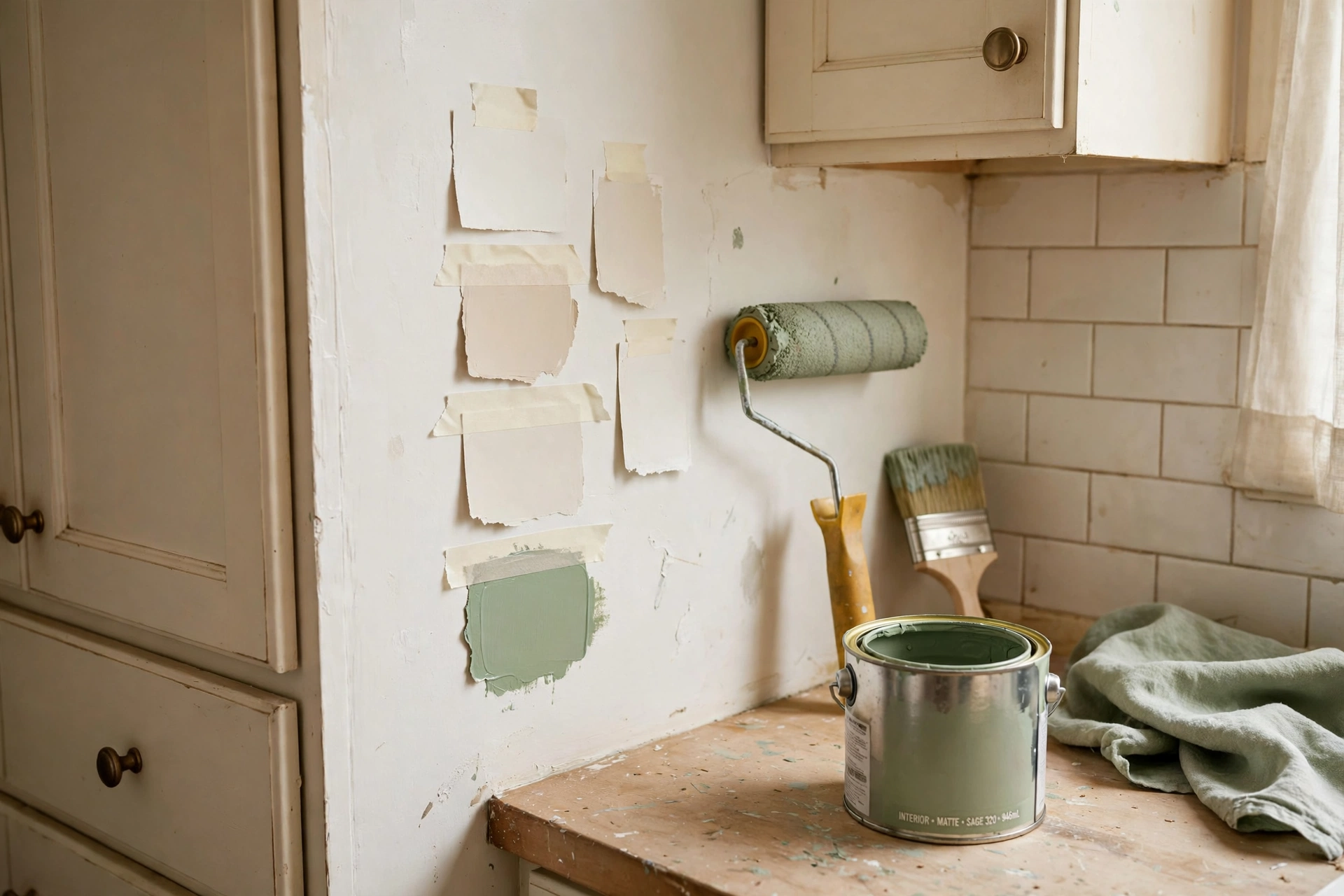
Materials list: 1 gallon + 1 quart of your chosen wall paint (see the quantity table above), 2 quarts Zinsser Bulls Eye 1-2-3 primer if you are going dark to light or covering stains, 1 roll ScotchBlue painter’s tape, 1 Wooster Shortcut brush, 1 Master Foam mini roller kit, 1 drop cloth, sugar soap or dish soap for degreasing, a step stool.
- Measure the walls and buy the paint using the quantity table above, then buy one extra quart if your walls are textured or the old color is dark.
- Clean the walls, especially near the stove. Grease stops paint from sticking, so wash the stove wall with sugar soap or hot soapy water and let it dry fully.
- Tape the trim, the backsplash edge, and the ceiling line, and lay the drop cloth over the counters and floor.
- Prime only where it is needed: dark-to-light changes, stains, grease marks that survived cleaning, and bare patches. A full primer coat on already-painted light walls wastes paint and time.
- Cut in the edges with the brush first, one wall at a time, so the rolled paint meets wet brushwork and leaves no lap marks.
- Roll the first coat, let it dry for the time on the can, then roll the second coat. Two thin coats beat one thick coat every time.
- Peel the tape while the second coat is still slightly tacky, touch up any bleed, and put the kitchen back together once the walls are dry to the touch.
Mistakes to avoid
Painting over grease. This is the number one cause of peeling kitchen paint. Wash the stove wall first, or the new paint will lift within weeks.
Choosing the color from the chip alone. A paint chip is two inches wide and lit by store lights. Paint a large sample on the wall and look at it in the morning, at noon, and under your kitchen bulbs before you buy the gallon.
Using flat paint near the stove. Flat paint marks when you scrub it, and kitchen walls get scrubbed. Keep flat paint on the ceiling and use satin or semi-gloss where splashes land.
Skipping the quantity math. One gallon looks like plenty until the second coat runs out halfway across the last wall. Measure once, buy the quart, and keep the receipt for the unopened can.
Painting the ceiling the same dark color as the walls. A dark ceiling lowers the room visually. Keep the ceiling white or a lighter tint of the wall color, even when the walls go bold.
Forgetting the backsplash line. Tape the top edge of the backsplash before you start, or you will spend an hour scraping paint off tile grout.
What to skip
A dark color on all four walls. In a kitchen under 100 sq ft, a full dark room feels like a cupboard, not a design choice. One accent wall is the limit.
Trendy colors with no sample test. The 2026 trend colors are gorgeous in photos and wrong in half the kitchens they land in, because trend photos are shot in big, bright rooms. Your kitchen is small. Test first.
Cheap paint for the stove wall. The budget gallon is fine for the far walls, but the stove wall earns the washable premium paint. One gallon of the good stuff for the cooking zone and budget paint elsewhere is a smarter split than premium paint everywhere.
Painting the cabinets the same day. Cabinets need a different paint, a different prep, and a different weekend. Do the walls first, live with them for a week, then decide if the cabinets still need paint.
Skipping the landlord conversation. If you rent, read the next section before you open the can.
A note for renters
Renters can use small kitchen wall colors too, but the rules are different. Check your lease first: many leases allow painting with written permission and a promise to repaint to the original color at move-out, while some ban it outright. Ask your landlord in writing, keep the reply, and keep the original paint color name and brand on file so the reversal is a one-weekend job, not a deposit fight. Light colors are the safest renter bet, because one primer coat plus two coats of white returns the wall to its original state. A deep green accent wall needs the same primer plus two white coats to disappear, which is more work and more deposit risk. Deposit risk: light colors 1/5, mid-tones 2/5, one dark accent wall 3/5. Photograph the walls before you paint and after you repaint, and keep the receipts for the paint and primer as proof of the reversal.
Sources: LRV figures from Benjamin Moore’s published values as listed by Lily Ann’s small-kitchen paint guide (checked October 16, 2026) and Home Sentiment’s small-kitchen list; NKBA 2026 kitchen color statistics via Lily Ann and Home Sentiment; paint prices from PaintDeck’s October 2026 brand comparison, Benjamin Moore’s own site price from October 27, 2026, and a Home Depot listing from August 2026; primer price from Target; tape, brush, and roller prices checked November 2026. All prices are US retail before tax and vary by store and sale.
Frequently asked questions
What color makes a small kitchen look bigger?
Light, high-LRV colors make a small kitchen look bigger, because they bounce light around the room instead of absorbing it. Warm white works best in a north-facing kitchen, pale blue-gray works best in a sunny one, and the brightest option is Chantilly Lace at LRV 90.04. No paint adds square feet, but a high-LRV wall makes the room read larger than it is.
What type of paint finish is best for a kitchen?
Satin is the best default finish for kitchen walls, because it wipes clean, resists steam and splashes, and does not glare. Use semi-gloss behind the stove and sink, where splashes land hardest, and eggshell on low-splash walls like a dining nook. Never use flat or matte paint where splashes land, because it marks when you scrub it.
How much paint do I need for a small kitchen?
An 8 by 10 foot galley kitchen needs about 1.1 gallons for two coats, so buy 1 gallon plus 1 quart. A 10 by 12 foot kitchen needs about 1.4 gallons, so buy 2 gallons. Both figures use the standard 400 sq ft per gallon coverage and subtract the cabinets, backsplash, door, and window. Add 0.2 to 0.3 gallons per coat if you paint the ceiling the same color.
Can I paint my rental kitchen walls?
It depends on your lease. Many leases allow painting with written landlord permission and a promise to repaint to the original color at move-out. Ask in writing, keep the reply, and choose a light color, because light colors reverse with one primer coat plus two coats of white. A dark accent wall costs more time and more deposit risk to reverse.
Written by Wasim. Last updated November 2026.