Best Cordless Drill for Small Apartments: 5 Picks That Fit a Closet Shelf
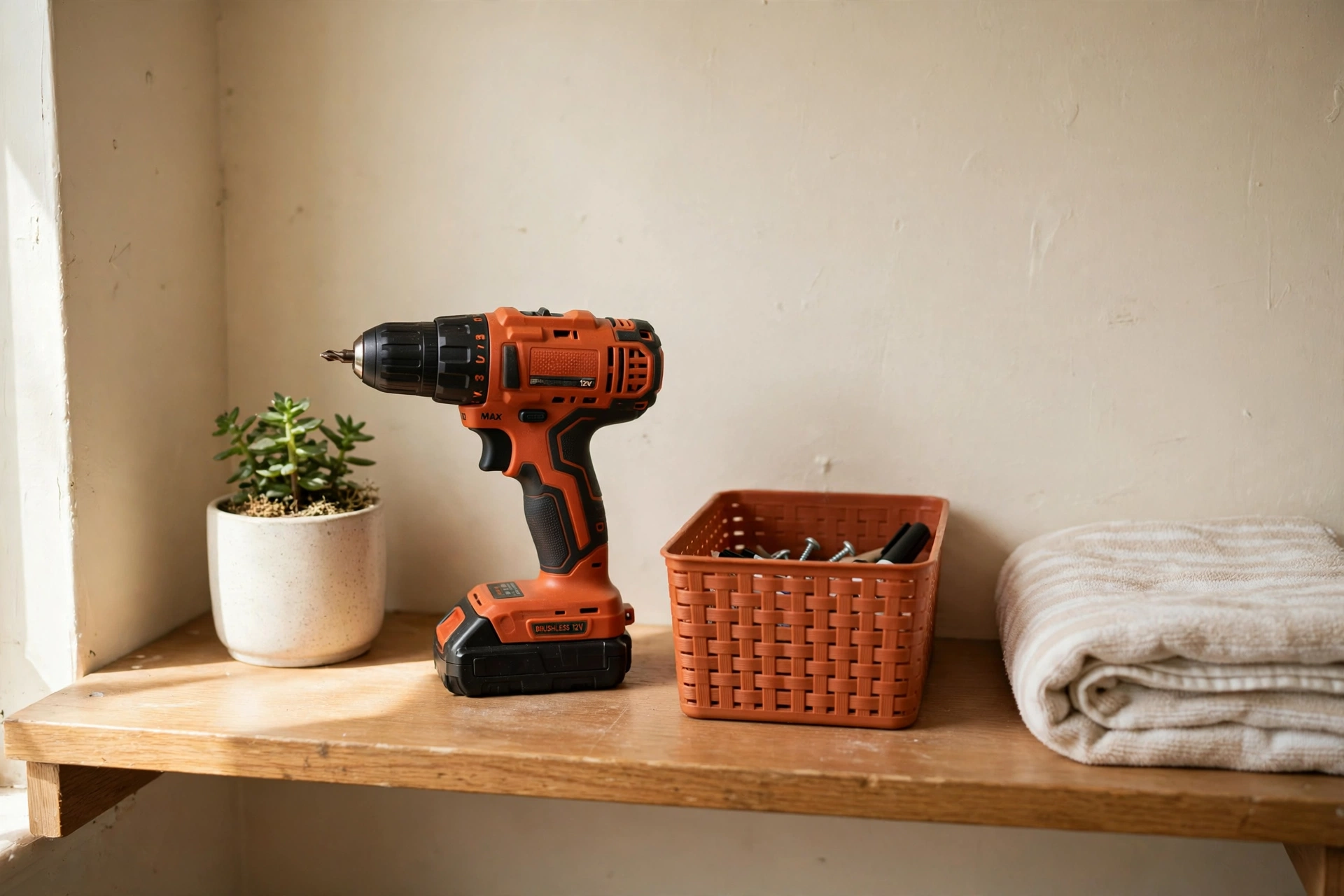
The best cordless drill for small apartments is a compact 12V drill, not the big 18V pro kit your neighbor owns. It weighs about 2 pounds, it is under 7 inches long, and it slides onto a closet shelf next to the vacuum. I checked all five picks in this guide against a standard 12 inch closet shelf using the makers’ own published dimensions, and every one fits, but only one leaves real room to spare. Prices below are checked for November 2026, and every pick comes from a brand with a battery system you can grow into.
A drill is the first power tool most renters buy, and it is the one that unlocks everything else on this site. It hangs the shelves, builds the headboard, and mounts the curtain rods. Buy the wrong one and it sits in a box because it is too heavy, too loud, or too big to store. Buy the right one and you will reach for it every month.
What makes the best cordless drill for small apartments different?
Three things: size, weight, and the battery behind it. A small apartment drill must fit a closet shelf with its kit, weigh little enough to hold overhead with one hand, and run on a battery system that powers your next tool too. Torque barely matters here, because apartment jobs are pilot holes and screws, not framing.
Think about what the drill actually does in a small apartment. It assembles flat-pack furniture. It hangs floating shelves and curtain rods. It puts up a pegboard kitchen organizer and a diy headboard. It mounts a TV bracket and a row of hooks. None of those jobs needs a pro drill. All of them need a drill you can grab, use for ten minutes, and put away without a production.
The most overrated spec on the box is torque. The most underrated is the clutch. A good clutch stops the screw exactly when it is seated, so you do not strip the head or blow through drywall. Every pick below has an adjustable clutch, and that is not an accident.
Is a 12V drill enough for an apartment, or do you need 18V?
A 12V drill is enough for nearly every apartment job. It drives 2 inch screws into softwood, drills pilot holes, and assembles flat-pack furniture without strain. Step up to 18V only if you also drill into brick or drive long screws into hardwood every weekend. If your project list is furniture, shelves, curtain rods, and small repairs, 12V is not a compromise. It is the better tool.
The confusion starts with the numbers on the box. “18V” and “20V MAX” are the same class of tool. 20V MAX is the voltage measured with no load; the working voltage is 18V. So a DeWalt 20V MAX drill and an 18V Ryobi drill are playing in the same league, and the label tells you nothing about which is stronger.
Here is the honest comparison, from the voltage guide I used to check this section:
| 12V compact | 18V / 20V MAX | |
|---|---|---|
| Weight with battery | About 2 to 2.5 lb (0.9 to 1.1 kg) | About 3 to 3.5 lb (1.4 to 1.6 kg) compact, 4 lb or more for hammer drills |
| Torque claims on the box | Roughly 250 to 400 in-lbs | Roughly 400 to 700 in-lbs, premium models well over 1,000 |
| Chuck | 3/8 in on most | 1/2 in on most |
| Tool family | Smaller, focused on compact tools | Very broad, including saws and yard tools |
| Best for | Furniture, cabinets, hardware, tight spaces | Decks, framing, big bits, masonry, all-round use |
One more thing the table cannot show: a 12V battery is small. It charges fast, it stores in a drawer, and a spare costs less than a dinner out. An 18V battery is a brick by comparison. In a closet with no spare inch, that matters.
Which is the best cordless drill for small apartments? The 5 picks
Five drills, one per job. Three are 12V compacts and two are budget friendly 18V and 20V options, so you can see the trade in real numbers. Every price below was checked on November 12, 2026.
1. Bosch 12V Max PS31-2A, the top pick, $99
Best for: A first drill for a renter who wants one small tool that does everything.
Main advantage: Two batteries and a hard case in a kit that weighs 2.14 lb (0.97 kg) with a battery fitted. BestReviews calls this the best drill kit for apartment dwellers, and the reason is simple: the whole kit, drill plus two 2.0Ah batteries plus charger plus case, is only as big as it has to be. It is 7.0 in (17.8 cm) long, with a 3/8 in chuck, 265 in-lbs of torque, two speeds (0 to 350 and 0 to 1,300 RPM), and a 20+1 clutch. One battery charges while you use the other, so you never wait.
Watch out for: The 3/8 in chuck caps your bit size, so big hole saws are out. The motor is brushed, not brushless, so it is a touch less efficient than the DeWalt and Milwaukee below. And 265 in-lbs is the lowest torque in this guide, though it is still more than any apartment job needs.
Verdict: 4.5 out of 5. This is the best cordless drill for small apartments for a first-time buyer. It is the cheapest way to own a real brand-name drill with two batteries, and the case keeps the whole kit in one grab.
2. DeWalt 12V MAX Xtreme DCD701F2, $159
Best for: Tight spaces and overhead work, like drilling inside cabinets.
Main advantage: It is the shortest drill here at 5.97 in (15.2 cm) from front to back, and the lightest in the hand at 1.9 lb (0.86 kg) bare and 2.4 lb (1.09 kg) with the battery. The brushless motor runs cooler and longer than a brushed one, and the 16 clutch settings give you finer control than any other pick. The kit includes two 2.0Ah batteries, a multi-voltage charger, and a soft bag. DeWalt’s own product page lists the 5.97 inch length and the 250 UWO power rating.
Watch out for: It is the priciest 12V here at $159 on Amazon (Lowe’s lists it at $169). DeWalt rates power in UWO, not torque, so you cannot compare its number directly with the others. And the soft bag is handy but it is not a hard case, so the kit flops around a little on a shelf.
Verdict: Buy this if you drill inside cabinets a lot or you hold a drill overhead often. The half inch it saves over the Bosch is the difference between fitting and not fitting between two studs.
3. Milwaukee M12 Fuel 2503-22, $169.69
Best for: The buyer who wants one drill for years and never wants to think about drills again.
Main advantage: This is the strongest 12V here by a clear margin: 350 in-lbs of torque, a 1/2 in all-metal chuck, and a brushless motor that spins to 1,700 RPM. It is 6.6 in (16.8 cm) long and 2.3 lb (1.04 kg) bare, 2.8 lb (1.27 kg) with a battery, and the kit includes two batteries, a charger, and a hard case. The M12 system behind it runs more than 125 tools, from lights to fans to a small vacuum.
Watch out for: It is the most expensive pick at $169.69. The 2.0Ah batteries are small, so runtime is short on bigger jobs, and a spare battery costs real money. The 1/2 in chuck is nice to have, but in an apartment you may never use a bit that big.
Verdict: The strongest small drill in this guide. Buy it if you want the last small drill you will buy for a decade, and you are happy to pay for that.
4. Ryobi ONE+ 18V PCL206K1, $79
Best for: The buyer who wants a whole tool system, not just a drill.
Main advantage: The price and the platform. At $79 this is the cheapest 18V here, and it is rated at 515 in-lbs with a 1/2 in ratcheting chuck, a 24-position clutch, and two speeds up to 1,750 RPM. It is 7.3 in (18.5 cm) long and about 2.5 lb (1.13 kg) tool only. The real win is the ONE+ system: the battery you buy today powers more than 200 Ryobi tools, so your next purchase can be a bare tool at half the price.
Watch out for: It is the heaviest pick here once the battery is on, about 3.6 lb (1.63 kg), and the motor is brushed. The kit (PCL206K1) includes one battery and a charger, so check the box carefully: the PCL206B sold on its own is tool only, with no battery and no charger, and that is the most common buying mistake with this model.
Verdict: The best value in this guide if you plan to add a Ryobi saw, vacuum, or fan later. As a drill alone it is bigger than the 12V picks, but as a system starter it is unbeatable.
5. Black+Decker 20V MAX LDX120C, $49
Best for: The lightest possible budget, for pictures, flat-pack, and curtain rods.
Main advantage: The price. At about $49 it is the cheapest real drill from a real brand, and it nails the basics: a 3/8 in chuck, an 11-position clutch, an LED work light, and a lithium battery that holds a charge for 18 months on the shelf. It weighs 3.3 lb (1.5 kg) with the battery and it is honest about what it is.
Watch out for: It is the weakest and the longest drill here: 115 in-lbs of torque, a single speed of 650 RPM, and a body about 9.4 in (23.9 cm) long. There is no slow gear for delicate screws, and there is no case, just a box. The “20V MAX” badge is marketing; the working voltage is 18V, same as the Ryobi.
Verdict: The cheapest way to own a real drill. Fine for pictures, flat-pack, and curtain rods, and nothing heavier. If you think you will hang shelves, spend the extra $30 on the Bosch instead.
Will it fit your closet shelf? The closet test
A standard closet shelf is 12 in (30.5 cm) deep. A drill needs its own length plus about 2 in (5 cm) of clearance so you can grab it without knocking everything else off. Here is the math for all five, computed from the makers’ published dimensions:
| Pick | Tool length | Shelf depth needed (length + 2 in) | Fits a 12 in shelf? | Kit storage |
|---|---|---|---|---|
| DeWalt DCD701F2 | 5.97 in (15.2 cm) | 7.97 in (20.2 cm) | Yes, with 4 in to spare | Soft bag, folds flat |
| Milwaukee M12 Fuel 2503-22 | 6.6 in (16.8 cm) | 8.6 in (21.8 cm) | Yes, with 3.4 in to spare | Hard case |
| Bosch PS31-2A | 7.0 in (17.8 cm) | 9.0 in (22.9 cm) | Yes, with 3 in to spare | Hard case |
| Ryobi PCL206 | 7.3 in (18.5 cm) | 9.3 in (23.6 cm) | Yes, with 2.7 in to spare | Tool bag |
| Black+Decker LDX120C | 9.4 in (23.9 cm) | 11.4 in (29 cm) | Yes, barely, 0.6 in to spare | No case, just a box |
Every pick fits, but the Black+Decker is the warning: it eats nearly the whole shelf depth, and with no case you still need somewhere for the charger and the battery. Standing upright, every drill here is about 7 to 8.6 in (17.8 to 21.8 cm) tall, so all five fit under a 12 in shelf gap too.
Measure your own shelf before you order. Shelf depth minus 2 in is your maximum tool length. If the hard case does not fit, store the drill on the shelf and the case on top of the closet. The drill is the part you reach for; the case is just a box.
The battery system matters more than the torque number
Here is the part the roundups skip. The torque number on the box is stall torque, the twisting force at the moment the motor stops. It is not the torque you get while actually driving a screw. Independent testers such as Project Farm measure working torque well below the box claim, and the gap is biggest on the cheapest drills. DeWalt does not even publish a torque number for the DCD701F2. It publishes 250 UWO, a power figure you cannot compare with anyone else’s torque number. So do not rank drills by the torque number. It is the least comparable number on the box.
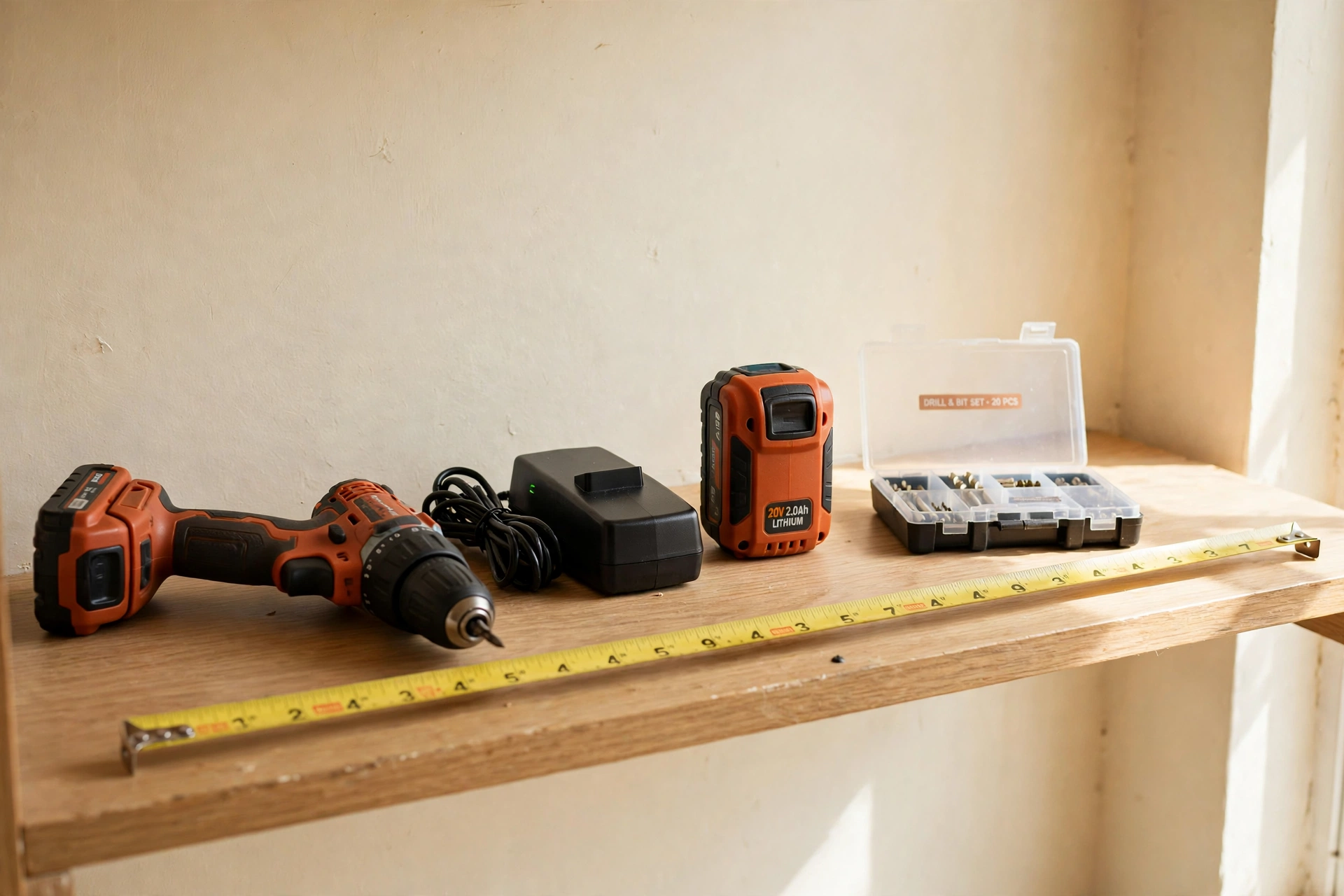
Rank them by the battery system instead, because the battery is what you will live with. Every future tool runs on it, and switching systems later means buying new batteries for everything. The systems behind these five picks:
- Bosch 12V Max: compact tools only, small and light, good for a renter who wants a drill, a light, and maybe a small saw.
- DeWalt 12V MAX: a small system with the same idea, plus DeWalt’s huge 20V MAX range if you ever step up.
- Milwaukee M12: more than 125 tools, the deepest compact system here, from heated jackets to a wet-dry vacuum.
- Ryobi ONE+: more than 200 tools, the biggest system here and the cheapest bare tools.
- Black+Decker 20V MAX: a small system, fine for a drill and a trimmer, but not a platform you grow into.
The rule is simple: pick the system first and the drill second. If you already own a battery from any of these brands, buy the drill that fits it and skip the kit. And set the clutch low for drywall screws and high for wood. A drill without a clutch, or a clutch left on drill mode, strips screw heads and blows through drywall. Every pick here has a real clutch, which is one more reason to skip the off-brand kits below.
Renter rules: how to drill without losing your deposit
A drill is a renter’s best friend and a deposit’s worst enemy, and the difference is five minutes of checking before you pull the trigger.
Check the lease first. Most leases allow small picture holes and forbid anything structural. Anything bigger than a picture hook, a TV bracket, a shelf into a stud, deserves a written yes from the landlord. Keep the permission email. It is your deposit insurance.
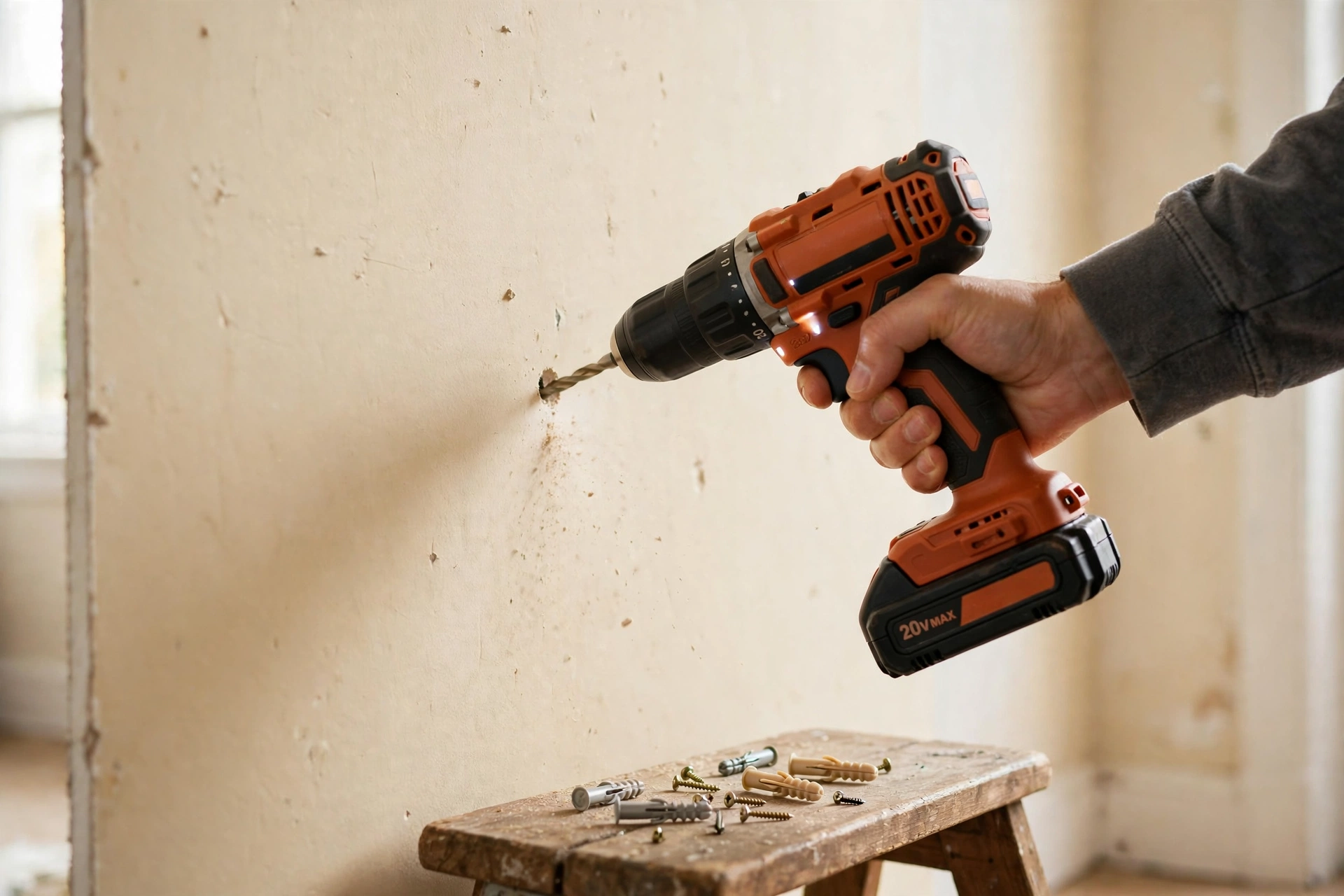
Always drill a pilot hole in drywall. Pick a bit slightly smaller than the screw, drill first, then drive the screw. The pilot hole stops the paper face tearing and keeps the screw from wandering. It takes ten seconds and it is the single best habit in this guide.
Use the right anchor for the weight. A bare screw in drywall holds almost nothing. Plastic expansion anchors suit light pictures. Self-drilling threaded anchors suit shelves and curtain rods. Toggle bolts suit a TV or anything heavy. Bob Vila’s anchor guide lists the types with prices, and a 100-piece anchor kit costs about $12.
Deposit risk by job:
- Picture hooks and small frames: risk 1 out of 5. Tiny holes, easy to fill.
- Curtain rod brackets: risk 2 out of 5. Four small holes, all fillable.
- Floating shelf into studs: risk 2 out of 5. Strong and safe, but find the stud first.
- Shelf on anchors only, no stud: risk 3 out of 5. Fine if the anchors are rated for the weight, risky if they are not.
- TV bracket: risk 4 out of 5. Get written permission first, and if you want the no-drill route, read how to hang a TV in a rental without drilling instead.
Mind the noise and the wires. A drill is loud for seconds, not minutes, so keep drilling to daytime hours and your neighbors will not mind. DeWalt is the only maker here that publishes a noise figure: 65 dB(A) sound pressure for the DCD701. Before you drill, check for wires and pipes with a stud finder that has AC detection, and never drill straight above an outlet or below a light switch without checking.
Move-out repair takes ten minutes. Fill each hole with spackle, let it dry, sand it flat, and touch it up with the landlord’s paint if you have it. Keep a small repair kit with your drill: spackle, a putty knife, sandpaper, and a brush. A wall with filled holes is a wall that costs you nothing.
What to skip
Off-brand Amazon kits. The roundups are full of names you have never heard: FADAKWALT, AVID POWER, DEKOPRO, and a dozen more. They are cheap, and they work for a month. Then the drill dies, the battery has no replacement, and there is no warranty you can actually use. A $30 drill you throw away costs more than a $79 Ryobi you keep for ten years.
Pro 18V and 20V kits. The Milwaukee M18 and the DeWalt 20V MAX Atomic are great tools and the wrong apartment purchase. They are heavier, bigger, and their kit cases eat a whole shelf. Buy them when you own a house with a garage, not a studio with one closet.
A hammer drill as your first drill. You will not drill masonry in a rental. If you ever need one hole in brick for a balcony mount, borrow a hammer drill or hire it for the afternoon. Do not pay for a feature you will use once.
An impact driver as your only tool. An impact driver drives screws fast, but it cannot drill clean pilot holes, and pilot holes are half of apartment work. Buy the drill first. Add the impact driver later, on the same battery, when you have a deck or a fence to build.
Mistakes to avoid
Buying the biggest torque number. Torque is the least comparable number on the box, and apartment jobs need the least torque of any room in the house. Buy for size, weight, and battery system instead.
Skipping the pilot hole. Every stripped screw head and every torn patch of drywall starts here. Drill the pilot hole. It takes ten seconds.
Driving screws on drill mode. Drill mode bypasses the clutch, so the drill keeps turning after the screw is seated. Use a low clutch setting for drywall and a medium one for wood.
Drilling without checking for wires. A stud finder with AC detection costs less than one electrician visit. Use it every time, especially above outlets and below switches.
Storing the battery dead for months. Lithium batteries hold a charge well, but a dead battery stored for a year may not wake up. Top up the battery every few months, even if you have not used the drill.
Buying a bare tool by mistake. Check the box before you pay. A kit includes the battery and the charger. A bare tool does not. The Ryobi PCL206B is tool only; the PCL206K1 is the kit. That one letter is a $40 mistake.
What a first drill kit costs in November 2026
A drill alone is not a kit. You also need bits and anchors, or the drill cannot do its first job. Here are the three honest routes, with prices checked on November 12, 2026:
| Route | Drill | Bits + anchors | Total |
|---|---|---|---|
| Budget route, Black+Decker LDX120C | $49.00 | $26.96 | $75.96 |
| Top-pick route, Bosch PS31-2A | $99.00 | $26.96 | $125.96 |
| Premium route, Milwaukee M12 Fuel 2503-22 | $169.69 | $26.96 | $196.65 |
The bits and anchors line is the same on every route: a Ryobi 70-piece impact driving set at $14.97 from Home Depot, plus a 100-piece drywall anchor kit at $11.99, for $26.96 together. That set covers every apartment job in this guide, from flat-pack screws to shelf anchors.
Time to buy is about 15 minutes: measure your shelf, pick your system, order the kit. Your first project, one shelf with two brackets, takes about 30 minutes including the pilot holes. One note on timing: prices move with sales, and holiday sales are about two weeks out, so check the price again before you buy. The drill you want in November is often $20 cheaper by the end of the month.
Pick the system first and the drill second, and the best cordless drill for small apartments is the one that fits your shelf, your hand, and your next project. For most renters that is the Bosch at $99. For the buyer who wants a whole workshop in one battery, it is the Ryobi at $79. Either way, buy the small drill. Your closet will thank you.
Sources: DeWalt DCD701F2 product page (dewalt.com) for the 5.97 inch length and 250 UWO rating; The Honest Reviewers’ 12V vs 18V guide for the voltage decision and torque claim bands; BestReviews’ cordless drill guide for the Bosch apartment dweller pick; Can Buy One’s budget drill guide (October 28, 2026) for the Ryobi $79 and Black+Decker under $50 prices; Northern Tool for the Milwaukee $169.69 price; Bob Vila’s drywall anchor guide for anchor types and prices. Prices checked November 12, 2026.

Is a 12V drill enough for an apartment?
Yes. A 12V drill handles pilot holes, flat-pack screws, curtain rods, shelf brackets, and cabinet hardware without strain. It struggles only with large hole saws, long screws in hardwood, and masonry. If those three jobs are not on your list, 12V is enough, and it is lighter and easier to store than any 18V drill.
Do I need an 18V drill, or is a compact 12V enough for a renter?
A compact 12V is enough for a renter. An 18V drill earns its weight only if you also do deck or framing work, which renters rarely do. If you want one drill for everything, including future house projects, the Ryobi 18V in this guide is the compromise pick: it is an 18V drill at a 12V price, with the biggest battery system behind it.
What size drill do I need for home use?
A 3/8 in chuck covers most apartment bits, from small pilot bits to standard spade bits. A 1/2 in chuck matters only if you use large spade bits or hole saws. Voltage matters more than chuck size for a first drill: pick 12V for light indoor work and small hands, and 18V only if your jobs are bigger or you want the wider tool system.
How much should I spend on a cordless drill for an apartment?
A good single drill kit costs $40 to $130, and a drill plus impact driver combo kit costs $90 to $180. The sweet spot for a renter is $79 to $99, the Ryobi or the Bosch in this guide, plus about $27 for a bit set and drywall anchors. You do not need a pro-tier drill at $150 and up for a bare tool plus separate batteries to hang a shelf.