DIY Crate Storage Bench: A Weekend Build for a Small Entryway
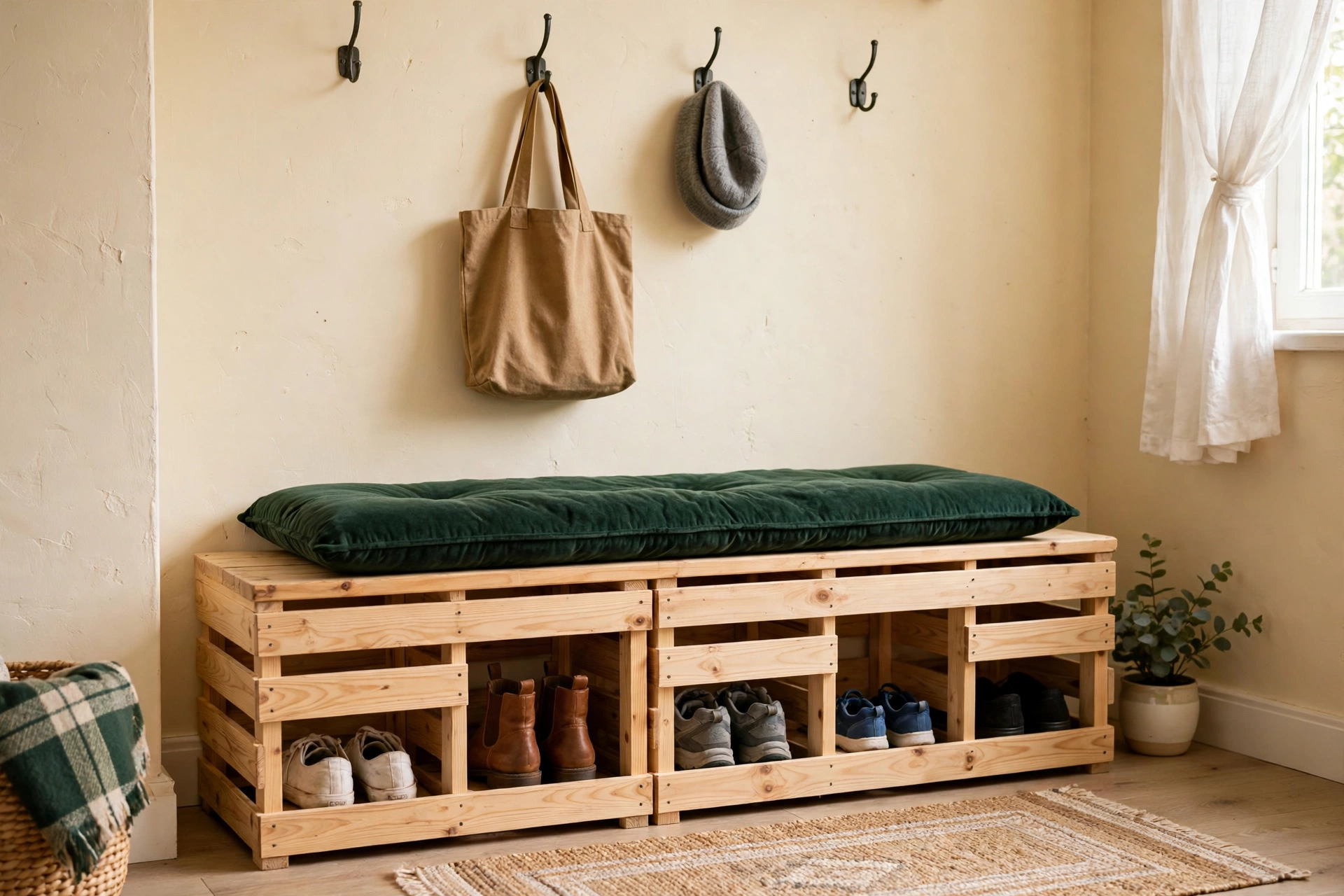
A diy crate storage bench is the cheapest real seat you can build for a small entryway. Two wooden crates, one pine board, and a Saturday afternoon give you a place to sit while you put your shoes on, plus two open cubbies that swallow the shoes by the door. Here is the part most build guides skip: the numbers. Two Target large crates (17.9 in / 45.5 cm each) make a 35.8 in (91 cm) bench that is 12.79 in (32.5 cm) deep, so in a 36 in (91 cm) hallway it leaves 23.2 in (59 cm) of walkway. And the seat sits lower than you think, about 12 in (30 cm) with a cushion, unless you add legs. This guide does the math first, then the build, so the bench fits your hall and your knees.
Will a diy crate storage bench fit your entryway?
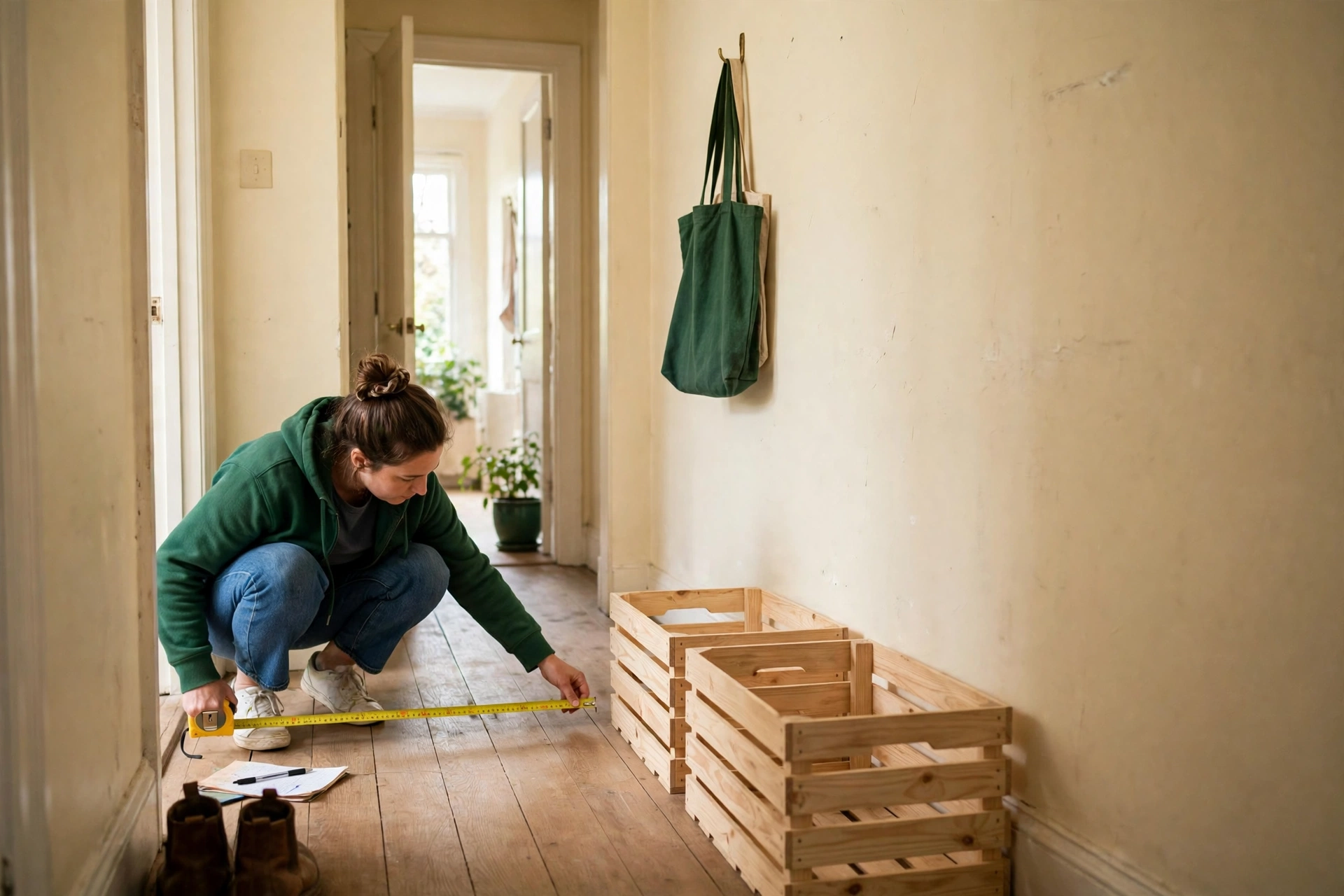
Measure before you buy anything. You need three numbers: the wall length where the bench will live, the hallway width, and the height of the shoes that will go in the cubbies. A two-crate bench is 35.8 in (91 cm) long, which suits most entry walls. A three-crate bench runs 53.7 in (136 cm), so it needs a longer wall or a wide foyer. The depth is fixed at 12.79 in (32.5 cm) with the crates named in the cost table below, and that depth decides whether the bench works or turns your hallway into an obstacle course.
Walkway left after the bench goes in:
| Hallway width | Walkway left | Verdict |
|---|---|---|
| 30 in (76 cm) | 17.2 in (44 cm) | Too tight, skip the bench or use one crate only. |
| 36 in (91 cm) | 23.2 in (59 cm) | Tight but workable, one person at a time. |
| 42 in (107 cm) | 29.2 in (74 cm) | Comfortable, the sweet spot. |
| 48 in (122 cm) | 35.2 in (89 cm) | Roomy, add a basket beside the bench. |
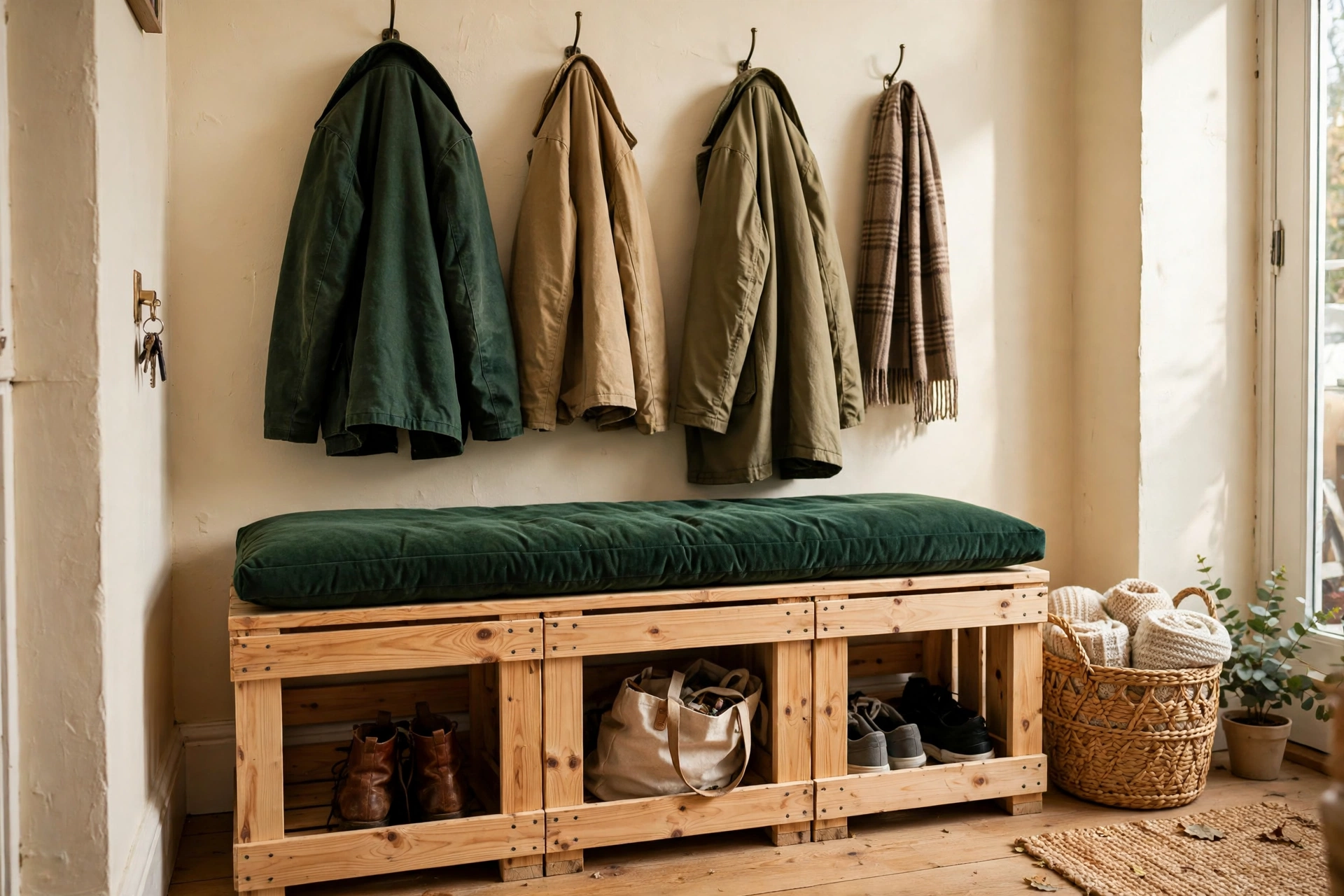
Under 24 in (61 cm) of clear walkway feels cramped every single day, so a 36 in hall is the honest minimum for this build. If your hall is narrower, the bench still works as a single crate with a board on top, 17.9 in (45.5 cm) long, tucked against the wall. The rest of your small entryway organization still matters, and the bench is only one piece of it. Hooks above the bench belong at 60 to 66 in (152 to 168 cm) from the floor, high enough for coats but low enough to reach.
Which crates actually work for a bench?
Not every crate can hold a person. The three types you will find in stores behave very differently, and picking the wrong one is the most common way this build fails.
Craft crates (Target, Michaels). Best for: the standard build in this guide. Main advantage: cheap, light, and a known size. The Target Mondo Llama large crate measures 17.9 x 12.79 x 9.6 in (45.5 x 32.5 x 24.4 cm) and weighs 5.4 lb (2.4 kg), so two of them plus a board are easy to carry home in one trip. Watch out for: craft crates carry no published furniture load rating, so treat the bench as one seated adult at a time and test it before daily use. Verdict: the right pick for most readers.
Heavy-duty wooden crates (lumber yards, farm stores). Best for: a bench that gets daily hard use or holds heavier sitters. Main advantage: thicker slats, often 10 to 12 mm, and sturdier joints. Watch out for: they cost more, weigh more, and sizes vary, so measure the actual crates before you cut the board. Verdict: worth it if the bench will serve a busy family entry.
Milk crates (plastic). Best for: a dorm room, a garage, or a kids’ playroom. Main advantage: nearly free and very strong in compression. Watch out for: the standard milk crate is 13 x 13 x 11 in (33 x 33 x 28 cm), so the bench ends up short and deep, and the plastic grid look reads as temporary in a front hall. Verdict: skip it for the entryway. A milk-crate bench belongs anywhere except the first thing guests see.
How high should your crate bench sit?
Here is the honest math nobody prints. A standard seat height is 17 to 19 in (43 to 48 cm). A plain two-crate build does not get close. The crate is 9.6 in (24.4 cm) tall, the pine board adds 0.75 in (1.9 cm), so the bare seat is 10.35 in (26.3 cm). Add a 2 in (5 cm) cushion and you are at 12.35 in (31.4 cm). That is fine for pulling on shoes, and it is too low for comfortable sitting, especially for taller people or anyone with sore knees.
For comparison, these entryway bench measurements show how the 17 to 19 in standard applies across different bench styles.
The height fix ladder:
| Fix | Seat height with a 2 in cushion | Best for |
|---|---|---|
| Nothing, cushion only | 12.35 in (31.4 cm) | A shoe bench for kids, or a very low hall. |
| 2 in (5 cm) locking casters | 14.35 in (36.5 cm) | A bench you want to roll out for cleaning. |
| 4 in (10 cm) short legs | 16.35 in (41.5 cm) | The closest to standard height, my pick. |
| Legs plus a thicker 3 in cushion | 17.35 in (44 cm) | Right inside the 17 to 19 in standard. |
The legs are the best fix because they also lift the crates off a damp entry floor. Cut four short legs from a 2×2, 4 in (10 cm) long, and screw them to a bottom board the same size as the seat board. Casters are the runner-up: they add height and let you roll the bench out to sweep, but buy the kind with brakes, because a bench that rolls when you sit down is a fall waiting to happen. And if you are choosing between a bench and a soft seat, our storage ottoman vs bench comparison lays out when each one wins.
What does a diy crate storage bench cost?
Prices checked live in November 2026. The table shows what each part costs at a real store, not a round-number guess. The bare build lands at $63, and the version with casters and stain stays under $88, while similar ready-made entry benches start around $300.
| Item | Cost |
|---|---|
| Wooden crates x2, Target Mondo Llama large, 17.9 x 12.79 x 9.6 in | $30.00 ($15.00 each) |
| Pine board, 1×12, 8 ft, cut to 36 in for the seat | $14.00 |
| Wood screws, 1.25 in box, about 50 count, you will use around 20 | $7.00 |
| Wood glue, 4 oz, for the crate joints and the board | $6.00 |
| Sandpaper pack, 120 and 220 grit, for every edge someone will touch | $6.00 |
| Locking casters, 2 in, set of 4, optional, only if you want it to roll | $9.99 |
| Stain or paint, 1 quart, optional, one coat is enough | $15.00 |
| Bare build total (crates, board, screws, glue, sandpaper) | $63.00 |
| With casters (bare build plus casters) | $72.99 |
| With casters and stain (the full finished version) | $87.99 |
If you already own screws, glue, and sandpaper, the out-of-pocket cost drops to $44 for crates and a board. And if you want the whole hall done on the same budget, our entryway makeover ideas under $100 show where the remaining dollars go furthest. Time estimate: about 3 hours including drying time, or one relaxed Saturday afternoon.
How to build a diy crate storage bench in 7 steps
Materials list: 2 large wooden crates (17.9 x 12.79 x 9.6 in), 1 pine board 1×12 x 8 ft, wood screws 1.25 in, wood glue, sandpaper 120 and 220 grit, optional: 4 locking casters or 4 short legs, optional: stain or paint, optional: 2 in foam cushion with fabric. Tools: drill, tape measure, pencil, clamps, saw (or have the store cut the board). For a second take on the same kind of build, see this step-by-step crate bench guide.
- Step 1. Measure the wall and the hallway. Confirm the 35.8 in bench length fits the wall with a few inches to spare, and check the walkway table above. Mark the bench spot with tape on the floor.
- Step 2. Sand every crate. Run 120-grit paper over all edges and surfaces, then 220-grit for a smooth finish. Craft crates arrive rough, and splinters on a bench people touch daily are the fastest way to hate the build.
- Step 3. Stand the crates side by side, openings facing front. Line them up flush on a flat floor. Clamp them tight so the faces sit level with each other.
- Step 4. Join the crates. Drive at least 4 screws through the inside slats where the crates meet, two near the front and two near the back. This screw pattern stops the crates shifting under load, and it is the step that turns two boxes into furniture. Add a thin bead of wood glue along the joint first for extra hold.
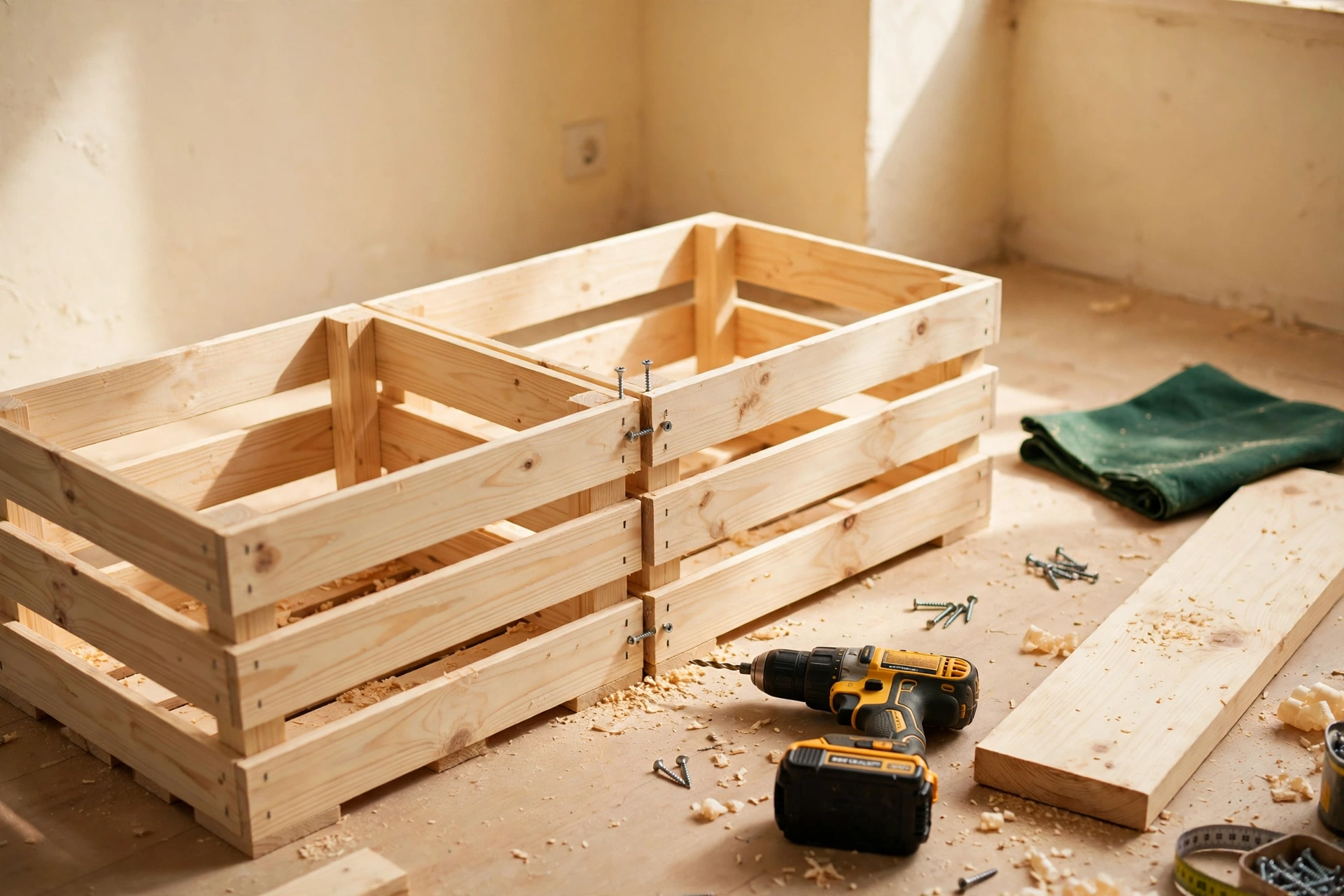
- Step 5. Cut and fit the seat board. Cut the 1×12 board to 36 in (91 cm). A 1×12 board is actually 11.25 in (28.6 cm) wide, a little narrower than the 12.79 in crate depth, so center it with a small reveal front and back, or sit it flush at the front with the extra depth at the back against the wall.
- Step 6. Attach the board and the legs or casters. Spread glue on the top rims of the crates, set the board in place, then drive screws up from inside the crates into the underside of the board. If you are adding legs, screw them to a bottom board first, then screw that board to the crate bottoms. If you are adding casters, screw one into each corner of the bottom board and lock the brakes before the first sit test.
- Step 7. Finish and test. Wipe off excess glue before it cures, then stain or paint and let it dry fully. Sit on it, shift your weight side to side, and check for wobble. If it rocks, loosen one caster or leg, shim it with a thin piece of cardboard, and retighten. Only add the cushion once the bench sits flat and still.
The renter version: no drilling, no damage
Renters can build this bench too, with one change: join the crates without screws. Heavy-duty zip ties through the slats, pulled tight at four points per joint, hold the crates together well enough for a shoe bench, and a ratchet strap around the whole pair adds real rigidity. The board then rests on top with a strip of museum putty or non-slip shelf liner underneath so it cannot slide. Nothing is fixed to the wall or the floor, so the whole bench comes apart in minutes when you move out.
Check your lease first, the same as with any furniture project. Most leases say nothing about freestanding furniture, and this build needs no permission because it touches no wall, no floor, and no fixture. The deposit risk is low, about 1 out of 5, and the only real risk is scuffing the floor, which felt pads under the legs or casters prevent. If your lease does restrict furniture assembly or you share walls with a strict landlord, the no-drill version above keeps you safe. A diy crate storage bench that comes apart cleanly is the most renter-friendly seat you can build, and the same no-drill thinking hides a litter box too: a diy hidden litter box cabinet turns a thrifted cabinet into furniture with a secret.
Mistakes to avoid
Skipping the join. Loose crates tip. A stack that is not screwed, bolted, or strapped together will shift the first time someone sits on the edge. Join them properly or do not build it.
Using crates of different sizes. Mixed crates make a wavy seat and a bench that rocks. Buy the crates together, check the sizes match, and dry-fit them before you glue anything.
Forgetting the brakes. Unbraked casters turn a bench into a skateboard. If you fit casters, every one of them needs a locking brake, and the brakes stay on whenever someone sits down.
Sanding too little. One quick pass is not enough. Run your hand over every edge after sanding. If you can feel a splinter, so can everyone who sits down.
Putting heavy things up high. The cubbies hold shoes, bags, and hats. Do not store a toolbox or a stack of books in a crate cubby, because the weight pulls the joint apart over time.
What to skip
Milk crates in the front hall. They work, they are cheap, and they look temporary. Save them for the garage.
A second row of crates for height. Stacking crates two high gives a 20 in seat, which is too tall, and a top-heavy bench that tips. Legs are the better height fix.
Fancy hardware. Decorative corner brackets and iron straps add cost and nothing else. Screws and glue do the structural work.
A cushion before the sit test. Buy the cushion after the bench is built and tested, so you know the real seat height and the real board size. A cushion ordered early is usually the wrong thickness.
How high should a DIY crate bench be?
A standard seat height is 17 to 19 in (43 to 48 cm). A plain two-crate build seats at about 12 in (31 cm) with a cushion, so add 4 in (10 cm) legs to reach about 16 in (41 cm), or legs plus a thicker cushion to land inside the standard range. For a shoe bench that you only sit on for a minute, the lower height is fine.
Are wooden crates strong enough for a bench?
Heavy-duty wooden crates are, and craft crates work if you join them properly and keep it to one seated adult at a time. The keys are 4 screws per joint, a solid board on top that spreads the load, and a sit test before daily use. Craft crates carry no published load rating, so do not treat the bench like a rated chair. If the bench will serve a busy family entry every day, buy the heavier crates.
How many crates do I need for a bench?
Two crates make a 35.8 in (91 cm) bench, which fits most entry walls and holds about 4 pairs of shoes, two per cubby. Three crates make a 53.7 in (136 cm) bench for a wide foyer and hold about 6 pairs. One crate with a board on top works as a mini bench for a hallway under 36 in wide. For the shoe side of the cubbies, our shoe storage ideas for small entryways cover how many pairs should live by the door in the first place.
Can you build a crate bench without drilling?
Yes. Join the crates with heavy-duty zip ties at four points per joint, add a ratchet strap around the pair, and set the seat board on non-slip shelf liner instead of screwing it down. The bench comes apart in minutes when you move. The trade-off is strength: the no-drill version suits one person sitting briefly to put shoes on, not daily heavy use.
How this was made: keyword research and prices were checked live in November 2026, the fit and seat-height math was computed from the crates’ published dimensions, and the build steps follow published crate-bench guides, linked above.