Shoe Storage Ideas for Small Entryways: 10 Fixes That Keep the Door Clear
The short answer
Shoe storage ideas for small entryways work best when you stop buying storage and start counting pairs first. Keep 4 to 6 pairs at the door, route the rest to the closet or under the bed, and pick storage by depth, not by looks. The numbers decide everything here. A slim cabinet only 7 1/8 in deep leaves about 29 in of clear walkway in a 36 in hallway, while a 12 in deep rack leaves 24 in, and that 5 in gap is the difference between turning around with a bag and shuffling sideways. A 10-tier narrow rack takes just 1.4 sq ft of floor and holds 20 to 24 pairs. The starter kit for the whole system costs $46.95 with prices checked in November 2026. Everything below is renter friendly unless the idea says otherwise, and every idea carries a deposit-risk rating so you know what your landlord could charge you for.
How much does shoe storage cost?
Prices checked in November 2026 from retailer listings. These shoe storage ideas for small entryways stay cheap because the starter kit needs only three buys, and the cabinet is the one upgrade worth paying for later.
| Item | What it does | Price (Nov 2026) |
|---|---|---|
| Amazon Basics 24-pocket over-the-door organizer | 12 pairs of shoes on zero floor space | $9.87 |
| SUPENUIN heavy-duty rubber boot tray, 16 x 27.5 in | Catches water and mud from daily pairs | $17.09 |
| WEXCISE 10-tier narrow shoe rack, 17.1 x 11.8 in | 20 to 24 pairs in 1.4 sq ft of floor | $19.99 |
| Starter kit total | Door pairs, wet boots, and overflow in one buy | $46.95 |
| IKEA TRONES shoe cabinet, 2-pack (optional upgrade) | Slim wall cabinet, 7 1/8 in deep, 4 to 8 pairs | $39.99 |
| Full setup total | Starter kit plus the cabinet | $86.94 |
A solid-wood entryway bench costs far more, about $162 for a 48 in bench checked in October 2026, so treat a bench as furniture, not as shoe storage. Plan on one Saturday afternoon to set the whole system up, about 2 to 3 hours, and a 2-minute reset every evening when you come home. That reset is the whole secret. A system you cannot tidy in 2 minutes is a system you will stop using.
Measure your hallway first
Before you buy anything, measure three numbers. First, the hallway width. Most small entryways run 36 to 42 in wide, about 91 to 107 cm. Second, the door swing. A front door that opens inward eats up to 36 in of floor when it swings, and nothing tall can live in that arc. Third, your longest shoe. An adult sneaker runs 11 to 12 in long, about 28 to 30 cm, so any shelf under 12 in deep needs shoes set at an angle or toe to heel, or the toes stick out past the edge.
Now do the walkway math. Take the hallway width and subtract the storage depth. A 36 in hallway minus a TRONES at 7 1/8 in leaves about 29 in clear, which is enough to turn around with a bag and a coat on. The same hallway minus a 12 in deep rack leaves 24 in, which is passable but tight, and minus a 15 in deep bench leaves 21 in, which is a squeeze. If your hallway is under 36 in wide, wall-mounted storage is the only honest option, because anything that stands on the floor steals the walkway. Write the three numbers on your phone before you shop. Every idea below names the depth it needs, so you can check it against your hallway in seconds.
10 shoe storage ideas for small entryways
1. Start with the daily-pairs rule
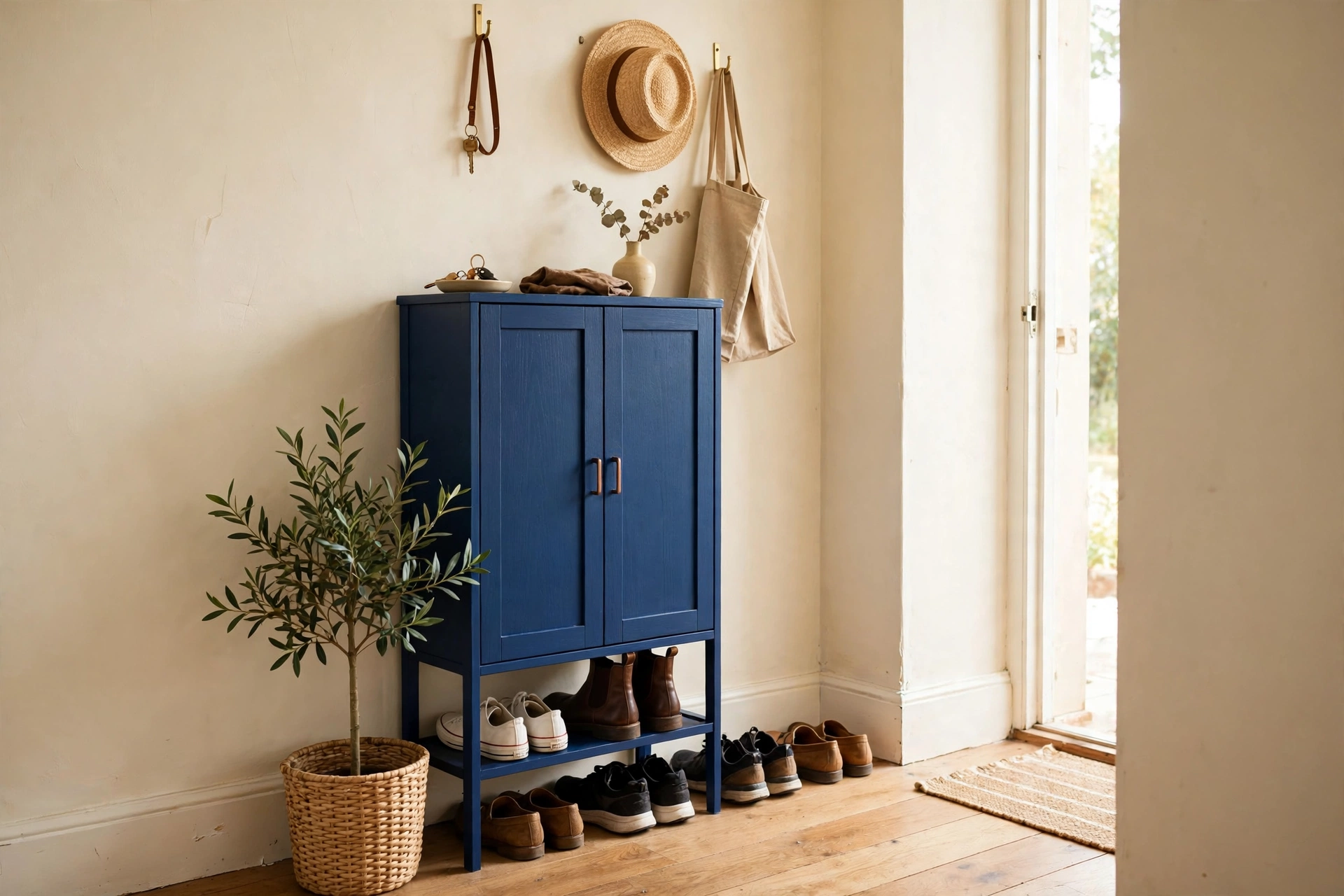
Count the pairs that live at the door right now. Then cut that number to 4 to 6 pairs per person, and move everything else away. One person needs 4 pairs at most: everyday shoes, a second everyday pair, one smart pair, and one pair of boots or trainers. Two people need 8 pairs at the door, which is exactly what one TRONES 2-pack holds, 4 to 8 pairs depending on shoe size, or one 10-tier rack shelf zone. The rule works because shoes multiply silently. A pair you wore twice this month does not need to live by the door. It needs a home in the closet.
Best for: Every small entryway, no matter what you buy next. Main advantage: It costs nothing and it halves the pile before you spend a dollar. Watch out for: Kids break the rule fast, so give each child one cubby and let the cubby be the limit. Verdict: Do this first. Every other idea on this list plugs into it. Deposit risk: 1/5. Nothing touches the wall.
2. Mount a slim flip-down shoe cabinet
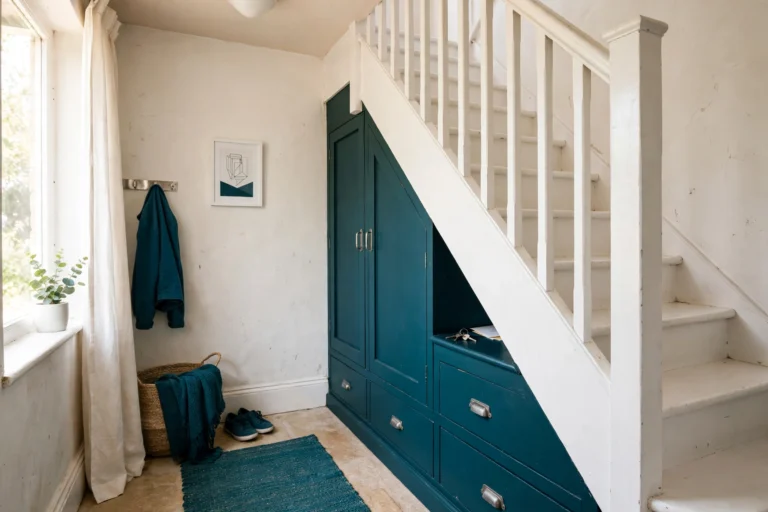
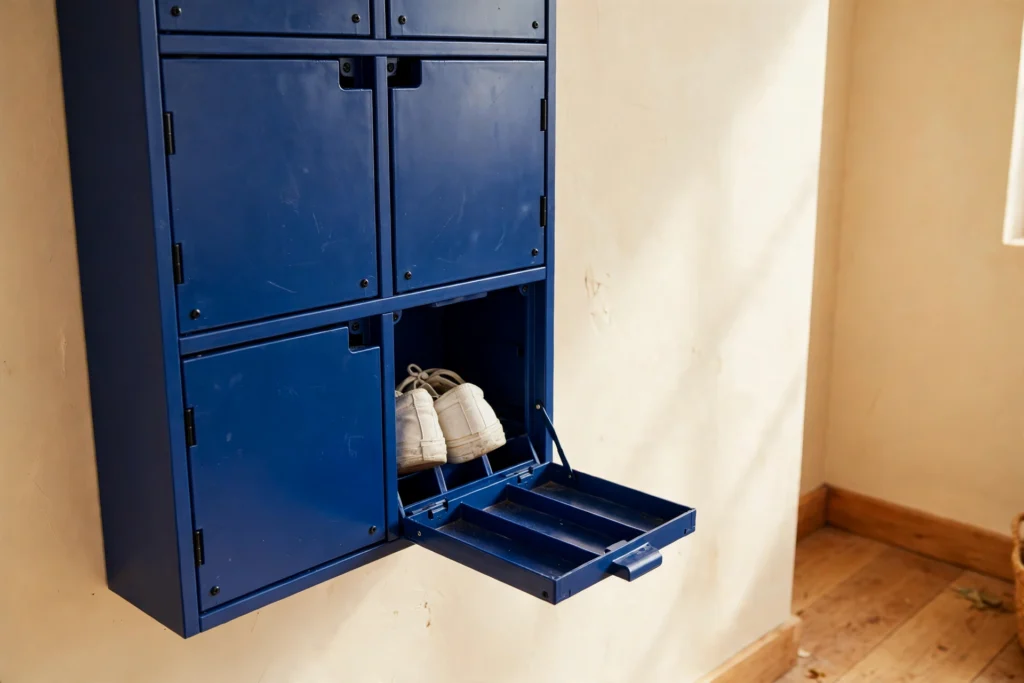
A slim cabinet is the tidiest way to hide shoes in a narrow hallway. The IKEA TRONES measures 20 1/2 in wide by 15 3/8 in tall, and only 7 1/8 in deep, about 18 cm, so it sits almost flush against the wall. Each unit holds 2 to 4 pairs depending on shoe size, and a 2-pack costs $39.99, so two units stacked hold 4 to 8 pairs in a strip of wall about 20 in wide. Taller flip-down cabinets run about 24 cm deep, roughly 9 1/2 in, and hold 12 to 18 pairs across three or four compartments, but they need wall screws and an anti-tip kit, so check the lease section below first. Mount the cabinet at a height where the top doubles as a key and mail shelf, and leave 2 in of clearance above it so the flip doors open fully.
Best for: Narrow hallways under 40 in wide where a rack would block the walkway. Main advantage: Shoes disappear behind a door, and the wall does the work the floor cannot. Watch out for: Tall boots do not fit flip-down compartments. Boots need flat shelves or the boot tray in Idea 4. Verdict: The best-looking option, and the only one that truly hides the pile. Deposit risk: 3/5. Wall screws need filling at move-out.
3. Sit down on a bench with cubbies
A bench does two jobs at once, a seat for putting shoes on and storage underneath, and a diy crate storage bench does both for about $63 in materials. The right seat height is 17 to 19 in, about 43 to 48 cm, which is the height of a dining chair, so sitting down and standing up feels natural. Open cubbies under the seat hold 6 to 12 pairs depending on bench width, and a 40 to 48 in wide bench fits a short hallway without dominating the wall. A lift-top bench hides more, but open cubbies are faster, and speed is what keeps the system alive on a tired evening. Put the bench against the longest wall, never opposite the front door, or it blocks the door swing.
Best for: Entryways with at least 15 in of depth to spare and no space for a separate chair. Main advantage: One piece of furniture replaces a rack and a chair. Watch out for: Benches are the priciest option here, about $162 for a solid-wood 48 in bench, so buy one only if you will sit on it daily. Verdict: Worth it when the bench earns its floor space twice over. Deposit risk: 1/5. It stands on the floor.
4. Put a boot tray under the daily pairs, with hooks above
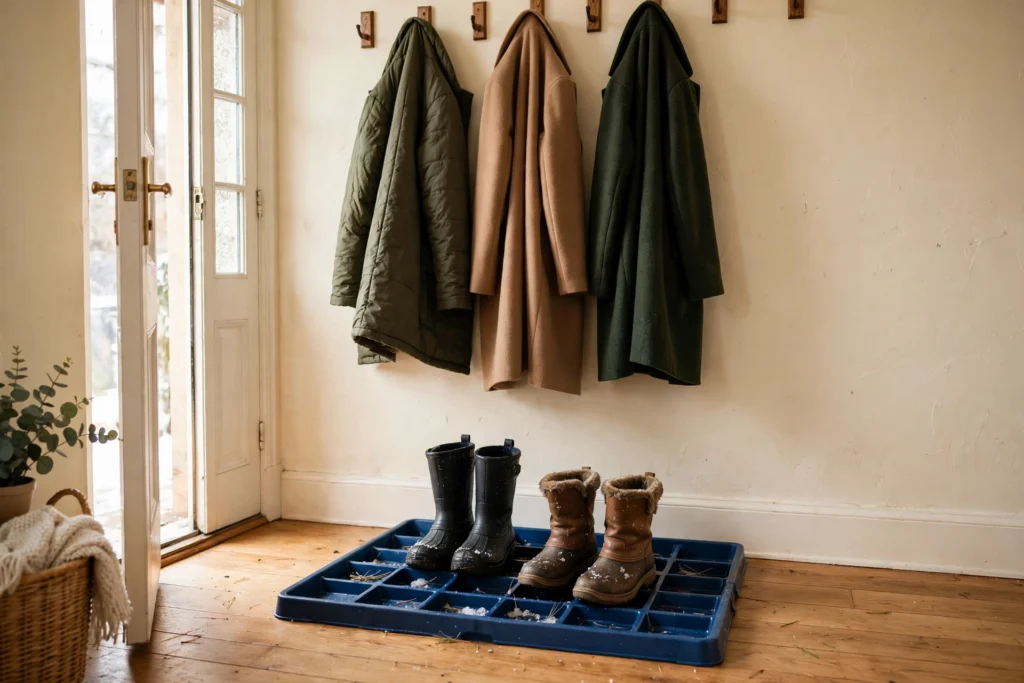
This is the cheapest honest setup, and the most underrated one. A rubber boot tray with a raised lip catches water, mud, and salt before they reach the floor. A 16 by 27.5 in tray covers 3.1 sq ft and holds 2 to 3 pairs of adult boots side by side, and it costs $17.09. Above it, two or three wall hooks hold the coats and bags that usually end up on the shoe pile. The whole setup needs zero furniture and zero floor space beyond the tray itself. In winter it is the only setup that actually works, because wet boots left on a bare floor stain it, and wet boots stuffed into a closed cabinet grow mildew.
Best for: Renters, tiny entryways with no furniture, and anyone entering a wet winter. Main advantage: Under $20, no screws if you use adhesive hooks, and it protects the floor. Watch out for: Adhesive hooks hold light coats, not a heavy winter coat plus a bag. Use screw-in hooks for heavy loads, or keep the heavy coat in the closet. Verdict: Start here if your budget is under $25. Deposit risk: 1/5. A tray and adhesive hooks leave nothing behind.
5. Hang an over-the-door shoe organizer
An over-the-door organizer holds the most pairs per square foot of any idea on this list, and it uses zero floor space. A 24-pocket organizer holds 12 pairs of shoes, or 24 pairs of sandals and flats, and costs $9.87. Each pocket is about 4 to 5 in wide, so it suits flats, sandals, flip-flops, and slim sneakers best. Hang it on the back of the entryway closet door, the bedroom door, or even the front door if your lease allows it. Clear pockets beat fabric ones, because you can see every pair at a glance instead of digging through 24 pouches. Keep boots out of it. Boots are too heavy and too tall for pockets, and they stretch the fabric until it sags.
Best for: Flats, sandals, and kids shoes, and any home with a spare door. Main advantage: 12 pairs for under $10, with no floor space at all. Watch out for: The hooks can mark the top of the door, so stick a felt pad behind each hook. Verdict: The best capacity per dollar on this list. Deposit risk: 1/5. The hooks lift off at move-out.
6. Go tall with a narrow 10-tier rack
When the hallway is narrow but the wall is tall, go up instead of out. A 10-tier narrow rack measures 17.1 by 11.8 in at the base, which is 1.4 sq ft of floor, and it holds 20 to 24 pairs across ten tiers. That is about 15 pairs per sq ft, the densest storage in this post. It costs $19.99, needs no tools, and folds flat when you move. The catch is balance. A tall rack loaded with boots on top will tip, so put the heaviest pairs on the bottom two tiers and the lightest pairs up top. If you have kids or a dog that bumps into things, anchor it to the wall with a furniture strap, which is one small screw.
Best for: Big shoe collections in a hallway with no wall space for a cabinet. Main advantage: The most pairs per square foot, at the lowest price. Watch out for: It looks like a shoe tower, not furniture. A dust cover helps, but it slows you down every morning. Verdict: The capacity winner, if you can live with the look. Deposit risk: 1/5. Free-standing, unless you add the anchor strap.
7. Float narrow shelves along the wall
Two or three rows of narrow floating shelves turn shoes into a display instead of a pile. Mount them 8 to 10 in deep, low on the wall, and space them 12 to 14 in apart vertically so sneakers fit without squashing. A 36 in shelf holds 3 pairs side by side, so three shelves hold 9 pairs in a strip of wall that otherwise holds nothing. This works best for the pairs you actually like looking at, clean sneakers, smart shoes, and the boots you wear most. It works worst for muddy trainers, so keep those on the boot tray. Our DIY floating shelves guide walks through studs, anchors, and weight limits, and the same rules apply here, just lower on the wall.
Best for: Design-minded renters who want the entryway to look intentional. Main advantage: Zero floor space, and the shoes become decor. Watch out for: Shelves need screws into studs or proper anchors, and each shelf holds only 3 pairs, so this is a display, not bulk storage. Verdict: Lovely for the daily pairs, useless as the only storage. Deposit risk: 3/5. Screws need filling at move-out.
8. Slide baskets under a console or bench
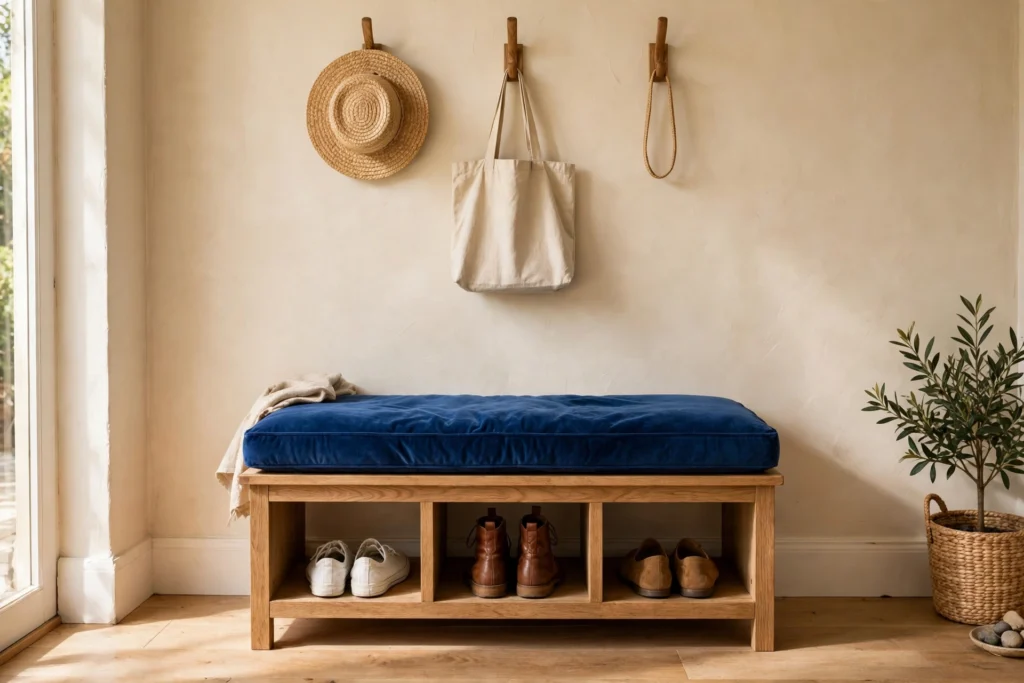
When you cannot add furniture, add a basket. A large woven basket under a console table, or two flat baskets under a bench, holds the daily pairs out of sight for the price of a basket. One basket holds 3 to 4 pairs, so two baskets cover a two-person household. The trick is the one-basket rule. When the basket is full, no more pairs live at the door. The rest go to the closet. Baskets also solve the kids problem, because a child can toss shoes into a basket faster than they can line them up on a rack, and a basket hides the mess even when the toss was sloppy. Choose a basket with handles, so you can lift the whole thing out to sweep underneath it.
Best for: Homes that already have a console or bench, and families with kids. Main advantage: The cheapest hidden storage, and the easiest habit to keep. Watch out for: Baskets trap dust and damp. Air them out weekly, and never put wet boots in a closed basket. Verdict: The simplest fix that actually sticks. Deposit risk: 1/5.
9. Route the overflow to the closet door and under the bed
The entryway should hold the daily pairs only. Everything else needs a second home, or it creeps back to the door. Hang a second over-the-door organizer on the closet door for off-season flats and sandals, 12 more pairs for another $9.87. Slide flat under-bed bins under the bed for winter boots in summer and sandals in winter, which is the same under-bed storage system our under-bed guide covers, and it costs nothing extra if you already own the bins. The rule is simple. If a pair has not been worn in two weeks, it leaves the entryway. If it has not been worn in a season, it leaves the closet for the under-bed bin. A home for every pair, and a pair in every home, is the only system that survives a whole year.
Best for: Anyone with more than 8 pairs, which is most of us. Main advantage: It doubles your storage without buying a single new piece of furniture. Watch out for: Out of sight turns into out of mind. Rotate the bins every season, or you will buy a second pair of the shoes you already own. Verdict: The overflow system is the real post. The entryway ideas are just the front door. Deposit risk: 1/5.
10. Run a winter boot protocol
Winter is when entryway shoe storage fails, because boots are big, wet, and heavy, and they arrive in pairs of two or three per person. Give boots their own protocol. First, the tray. Every wet boot lands on the tray, never on the floor and never in a closed cabinet. Second, the dry rule. Boots dry on the tray for a full day before they go back into a cabinet or a bin, because damp boots in a sealed space grow mildew in a week. Third, the boot count. Two pairs of winter boots per person is enough, one everyday pair and one snow pair. The rest stay in the closet until the weather turns. Fourth, the salt check. Wipe road salt off the tray and the boot soles weekly, or the salt eats the tray and stains the floor around it. Our coat closet system pairs with this protocol, because the boots live by the door and the coats live in the closet, and neither one invades the other’s space.
Best for: Anyone in the US, Europe, or anywhere winter means slush. Main advantage: It protects the floor, which is what your deposit is really about. Watch out for: A tray that is too small is worse than no tray, because boots spill over the edge and the water goes everywhere anyway. Measure the tray against your biggest boots before you buy. Verdict: The most useful section in this post from November to February. Deposit risk: 1/5.
How to set up your entryway shoe system in one afternoon
You need: a tape measure, the starter kit or the pieces you already own, a pencil, and a level if you are mounting anything.
- Count the pairs at the door and pick the 4 to 6 per person that stay. Box the rest for the closet and under the bed.
- Measure the hallway width, the door swing, and your longest shoe. Write the three numbers down.
- Subtract your storage depth from the hallway width. If the clear walkway is under 24 in, pick a slimmer option.
- Put the boot tray by the door first. It is the foundation, and everything else arranges around it.
- Mount or place the main storage, cabinet, rack, or bench, on the longest wall, clear of the door swing.
- Hang the over-the-door organizer on the closet door and load the off-season pairs.
- Walk the route. Open the front door fully, carry a bag in, and sit down to put your shoes on. If anything catches or blocks you, move it now, not next month.
Mistakes to avoid
Buying storage before counting pairs. A cabinet that holds 8 pairs cannot fix a 20-pair pile. Count first, then buy the size the count demands.
Choosing depth by looks. A 15 in deep bench in a 36 in hallway leaves a 21 in walkway, and you will hate it every single day. Depth is a number, not a style choice.
Storing wet shoes in a closed cabinet. Damp shoes in a sealed space grow mildew in about a week. Dry them on the tray first, then store them.
Filling every shelf on day one. Leave one shelf or one cubby empty on purpose. It is the landing spot for the next pair, and without it the pile starts on the floor.
Forgetting the door swing. Anything tall inside the arc of the front door gets hit every time someone comes home. Measure the swing before you place anything.
Hiding the daily pairs. If the shoes you wear every morning are behind a door, inside a box, or under a lid, you will stop putting them away. Daily pairs stay visible and grabbable.
What to skip
The giant shoe cabinet for a 6-pair household. A cabinet that holds 24 pairs in a home with 6 pairs is a wall of empty shelves. Buy the size you need, not the size that looks impressive.
Stackable clear shoe boxes at the door. They look great in a closet, but at the entryway they are a daily chore, open the box, take the shoes out, put the box back. A rack or a tray is faster.
The shoe carousel. It spins, it wobbles, and it holds fewer pairs than a plain rack in the same footprint. Fun for a closet, pointless by the door.
Heated shoe dryers as storage. They dry boots well, but they are not storage, and they eat an outlet and a shelf. Use the tray for storage and dry boots on it.
Matching sets bought before measuring. A bench plus a cabinet plus a rack from the same range looks tidy in a photo and blocks the hallway in real life. Measure first, then buy one piece at a time.
Renter check: read the lease before you drill
Most of these ideas need no permission at all. Racks, benches, trays, baskets, and over-the-door organizers touch nothing permanent, so they carry a deposit risk of 1 out of 5. The two ideas that need a lease check are the wall-mounted cabinet and the floating shelves, both rated 3 out of 5, because they need screws. Check three things in your lease before you drill. First, whether small holes are allowed, and how many. Second, whether you must fill and paint them at move-out, and what paint the landlord expects. Third, whether an anti-tip kit counts as a fixture you must leave behind. If the lease is silent, ask in writing and keep the answer. A cabinet held by two screws is easy to fill. A cabinet that rips out of drywall because it was never anchored is a repair bill. If you cannot drill at all, the tray plus hooks setup in Idea 4 and the tall rack in Idea 6 give you the same storage with zero holes. And if you want the full picture on deposits, our tiny entryway organization guide covers the whole room, not just the shoes.
How do you store shoes in a small entryway?
Use a slim shoe cabinet, shallow shelving, baskets beneath a bench, or a dedicated section of an entryway closet. Keep only the pairs you wear regularly near the entrance, and move seasonal or occasional footwear to the closet or under the bed.
How many pairs of shoes should you keep by the door?
Keep 4 to 6 pairs per person at the door. That covers everyday shoes, a second pair, one smart pair, and one pair of boots or trainers. A two-person household needs 8 pairs at the door, which is exactly what one TRONES 2-pack or one 10-tier rack zone holds. The rest belong in the closet or under the bed.
What is the best shoe storage for a narrow hallway?
A slim flip-down cabinet about 7 in deep, like the IKEA TRONES, is the best fit for a hallway under 40 in wide, because it leaves about 29 in of clear walkway in a 36 in hallway. A tall narrow rack is the best budget option, holding 20 to 24 pairs in just 1.4 sq ft of floor.
Can you store wet boots in a closed shoe cabinet?
No. Wet boots need to dry on a boot tray for a full day before they go into a closed cabinet or a bin. Damp shoes in a sealed space can grow mildew in about a week, and the smell gets into the cabinet itself. Use the tray for wet boots and the cabinet for dry ones.
Sources
Nest Sorted, “Shoe Storage Ideas For Small Spaces: 15 Smart Ways” (nestsorted.com), measurements, comparison table, sneaker-length rule. Real Home Habits, “10 Shoe Storage Ideas for Small Spaces” (realhomehabits.com), location-based grouping, boot tray and bench guidance. The House Chapter, “23 Entryway Storage Ideas That Keep Clutter Under Control” (thehousechapter.com), slim cabinet depth guidance, daily versus long-term storage distinction. IKEA TRONES dimensions and price from IKEA US listings and 2026 coverage (Hunker, House Digest). Boot tray, rack, and organizer prices from Amazon listings and Koupon deal roundups, October and November 2026.