DIY Hidden Litter Box Cabinet: 7 Ways to Hide the Box in a Small Apartment
The short answer
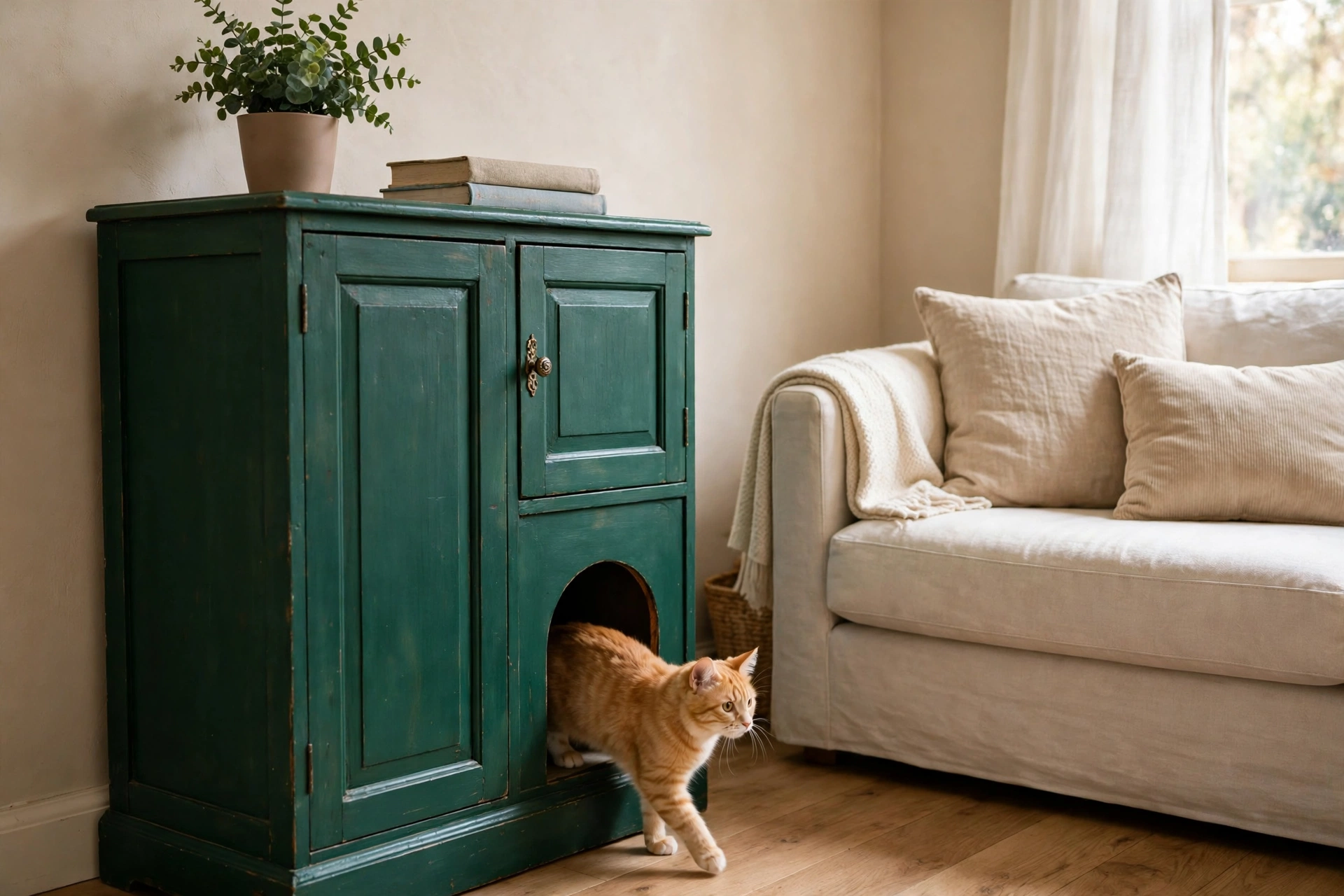
A diy hidden litter box cabinet is a thrifted cabinet with a cat-sized entrance cut into one side and a litter pan hidden inside, so the box looks like ordinary furniture. The whole project costs about $121.85 with prices checked in November 2026, and it takes one weekend afternoon. Here is the part most guides skip: the numbers. A standard litter pan measures 19 by 15 in (48 by 38 cm). A 30 in (76 cm) cabinet holds it with 9.5 in (24 cm) to spare, and even a 24 in (61 cm) cabinet works, with 3.5 in (9 cm) to spare. Measure the pan first, then buy the cabinet. That order is the difference between a cabinet that hides the box and a cabinet the box will not fit inside.
Measure first: the fit table that decides everything
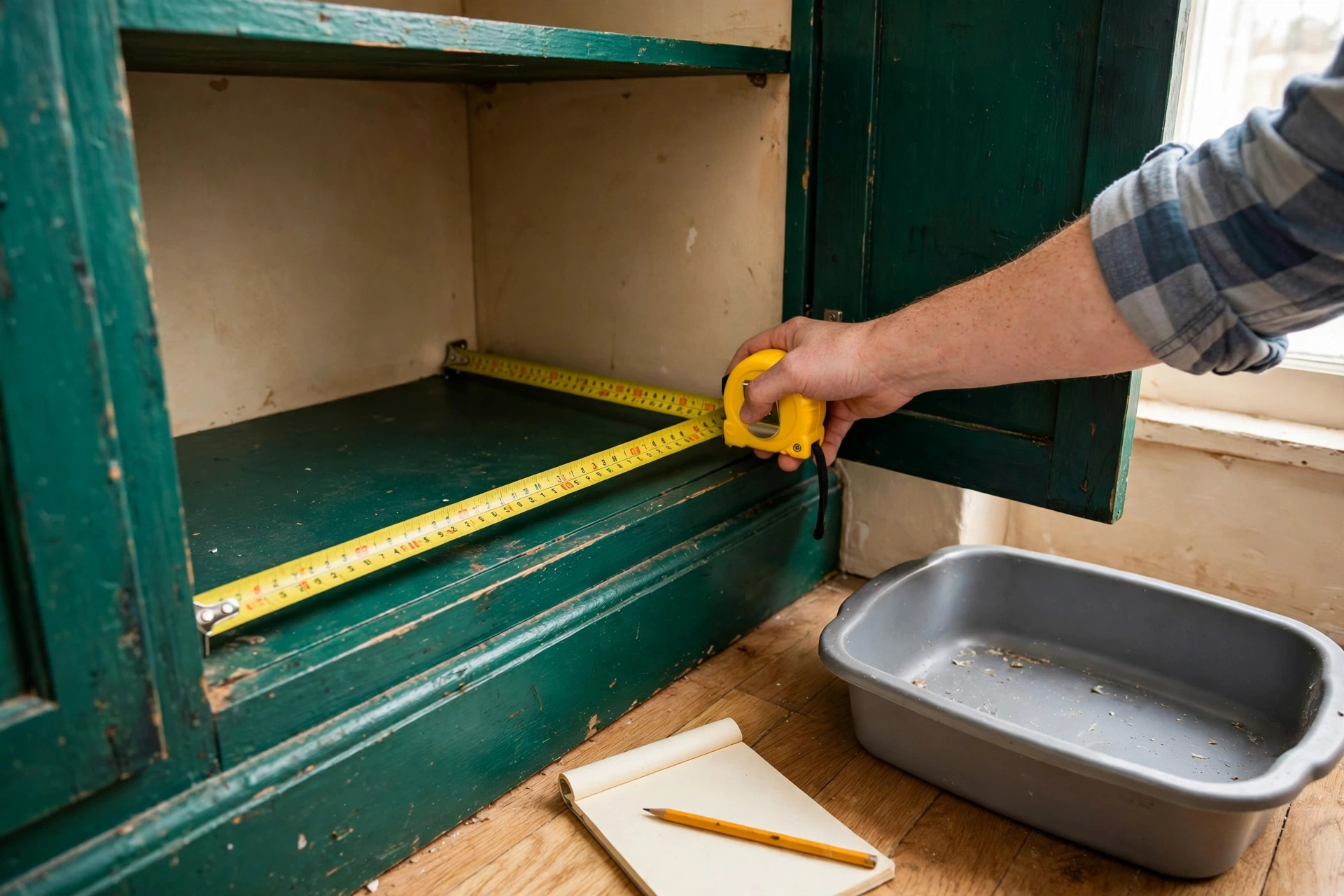
Three numbers decide whether a cabinet works: the pan, the cabinet interior, and the entrance. Get them in the right order and the rest of the build is easy. Get them wrong and you own a cabinet with a pan sitting beside it.
A standard litter pan, the Arm and Hammer Large Sifting model, measures 19 by 15 by 8 in (48 by 38 by 20 cm). That is the size most cats use. A big cat needs more. The rule from the Neakasa size guide is simple: a litter box must be at least 1.5 times the cat’s length, nose to tail base. An 18 in (46 cm) cat needs a 27 in (69 cm) box, so the standard 19 in pan is too short for that cat. The Petmate Giant pan, 25.5 by 19 in (65 by 48 cm) and $25 to $30, is the big-cat pick, and it only fits a 30 in cabinet.
Cabinet interiors are smaller than the outside numbers. A 30 in wide base cabinet loses about 3/4 in (1.9 cm) per side to the carcass, so the interior is about 28.5 in (72 cm) wide and 22.5 in (57 cm) deep. A 24 in cabinet gives about 22.5 in (57 cm) of interior width. Interior height runs about 33 in (84 cm) once the top and base are counted.
| Cabinet | Interior (approx.) | Standard 19 x 15 in pan | Big-cat 25.5 x 19 in pan |
|---|---|---|---|
| 30 in base cabinet (76 cm) | 28.5 x 22.5 in (72 x 57 cm) | Fits, 9.5 in (24 cm) spare width | Fits, 3 in (8 cm) spare width |
| 24 in cabinet (61 cm) | 22.5 x 22.5 in (57 x 57 cm) | Fits, 3.5 in (9 cm) spare width | Does not fit, pan is too long |
| 18 in nightstand (46 cm) | 16.5 x 16.5 in (42 x 42 cm) | Does not fit, pan is too wide | Does not fit |
Headroom matters as much as floor space. The pan is 8 in (20 cm) tall and the cabinet interior is about 33 in (84 cm) tall, so the cat gets about 25 in (64 cm) of clear height to turn around and squat. That is plenty. What fails is width, not height, so measure the pan against the interior width and stop guessing from the outside label.
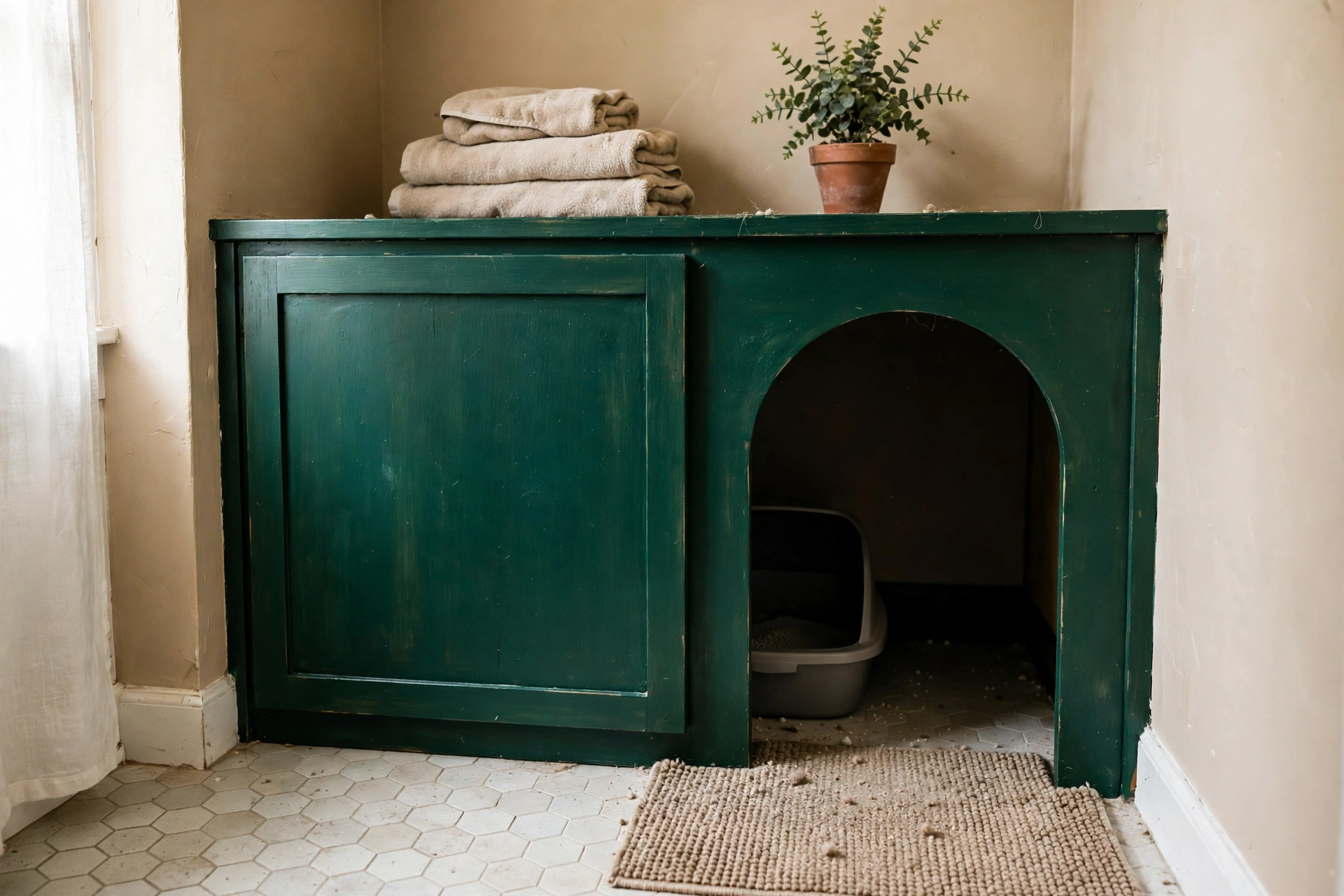
The entrance is the third number. Build guides that name a size agree on 8 to 10 in (20 to 25 cm) wide, with 9 in (23 cm) right for most adult cats. Cut yours 10 in wide and 12 in tall (25 by 30 cm), arched at the top, and almost any cat walks through without ducking. A hole under 8 in is the classic rejection mistake: the cat looks at it, decides it is a trap, and uses your rug instead. Keep the entrance on the side that faces the room, not the wall, so the cat can see out while it goes in.
1. The thrifted cabinet (the main build)
This is the build the rest of the guide prices out, and it is the diy hidden litter box cabinet most readers should start with.
Best for: the cheapest real build, and the one this guide prices out. Main advantage: a solid-wood cabinet from Facebook Marketplace, a Habitat for Humanity ReStore, or a thrift store costs $25 to $100, and it already has doors, a top, and a finished look, and the same sourcing rules apply in any diy thrift furniture flip for small spaces. Watch out for: thrifted pieces vary, so measure the interior before you pay, and skip anything with a swollen base or a musty smell that will not air out. Verdict: the best first build in this guide. A used cabinet plus a weekend is how you hide a litter box for about $122 instead of $400 to $1,100 for a commercial enclosure. Deposit-Risk: 1/5. It is freestanding furniture. Nothing is fixed to the walls.
What you need
A thrifted solid-wood cabinet at least 24 in wide, a litter pan, a jigsaw with wood blades, a drill with a 1/2 in spade bit, a pencil, a tape measure, sandpaper, a quart of primer, a quart of paint, carbon filter pads, and a litter mat. Borrow the jigsaw if you can. If you must buy one, the Hammerhead 4.8-Amp runs about $27 on Amazon, checked November 2, 2026.
The 7 steps
- Measure the pan against the cabinet interior. Set the pan inside the empty cabinet and check the table above. You want at least 2 in (5 cm) of spare width so the pan slides in and out for cleaning. If it is tight, pick a smaller pan or a wider cabinet now, not after the paint dries.
- Mark the entrance. On the side panel, draw a 10 in wide by 12 in tall arch (25 by 30 cm), with the bottom of the opening 2 in (5 cm) above the cabinet floor so litter stays inside. Mark the corners for the drill.
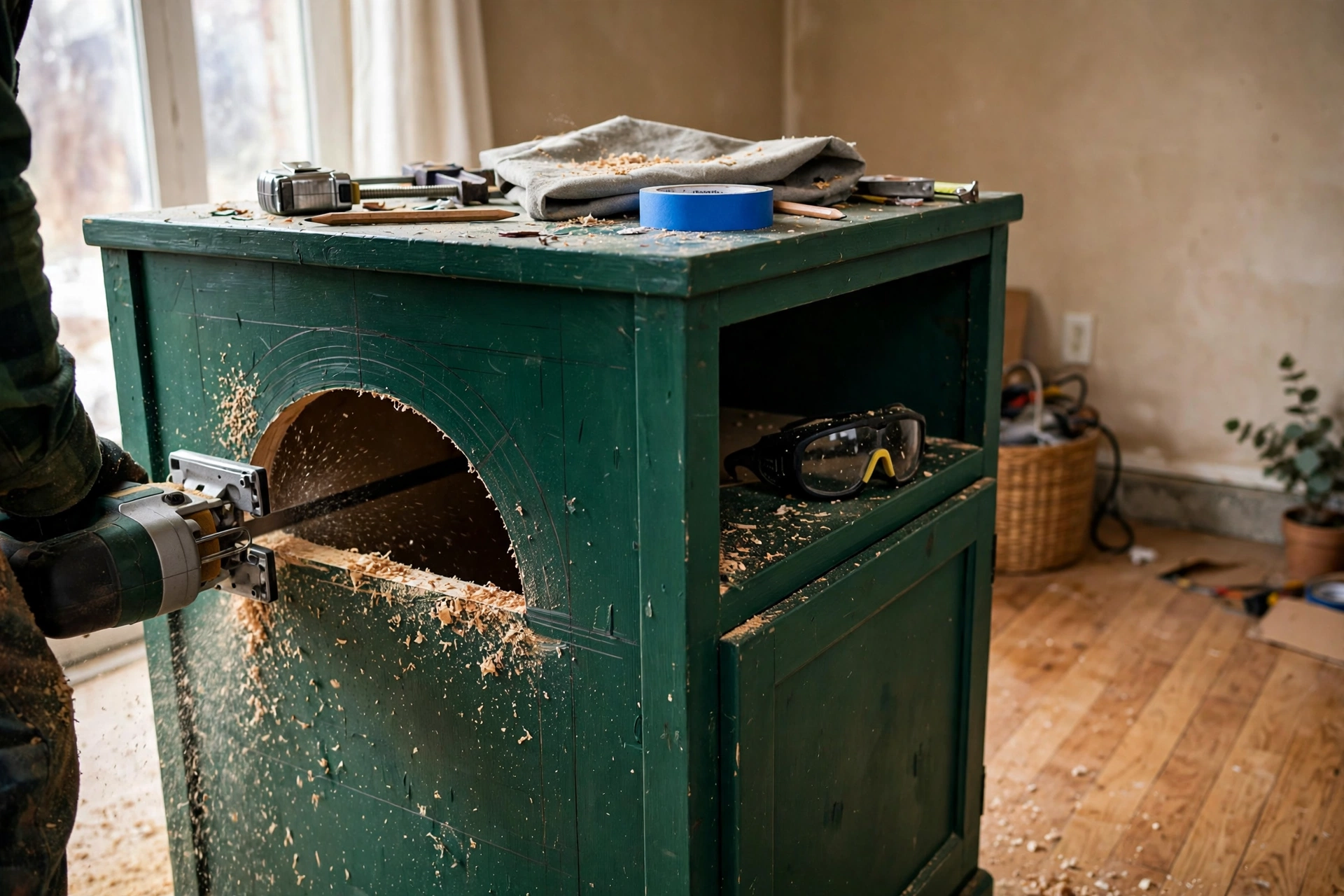
- Drill starter holes, then cut. Drill a hole at each corner of the outline with the spade bit, then cut along the lines with the jigsaw. Go slow through laminate or MDF so the edges do not chip. Sand the cut edges smooth so no splinter catches the cat.
- Drill the ventilation holes. Drill 6 to 8 holes, 1/2 in (1.3 cm) each, high on the back panel. Eight holes give 1.57 sq in (10 sq cm) of open area, which is enough for air to move without turning the cabinet into a sieve. Stick a carbon filter pad behind them on the inside.
- Seal the inside. Line the cabinet floor with peel-and-stick tiles or a cut-to-size waterproof mat. If the cabinet is raw wood or old laminate, prime the interior with a shellac-based primer, which seals odor into the wood instead of letting it soak in.
- Paint the outside. Two thin coats of interior eggshell paint, with drying time between them. A quart covers about 100 sq ft (9 sq m), so one quart is more than enough for a single cabinet, and the leftover covers the next project.
- Set it up and let the cat approve it. Put the pan inside, add litter, set the mat in front of the entrance, and leave the cabinet doors open for a day so the cat finds it on its own terms. Close the doors once the cat uses it twice. If the cat refuses, widen the entrance before you blame the cat.
2. A stock base cabinet
Best for: readers who want a new cabinet with known dimensions instead of a thrift-store hunt. Main advantage: a 30 in (76 cm) stock base cabinet is a standard size, so the fit table above applies exactly, and the interior is deep enough for the big-cat pan too. Watch out for: a new stock cabinet costs more than a thrifted one, and the flat-pack versions are often particleboard, which swells if litter or water sits on it. Verdict: the reliable pick if you cannot find a good thrifted piece. Buy solid wood or plywood, not particleboard, for a wet job like this. Deposit-Risk: 1/5. Freestanding, no wall fixings needed.
3. A dresser with a missing drawer
Best for: a bedroom or a hallway where a low dresser already lives. Main advantage: remove one bottom drawer and the opening is already there, so you cut nothing structural. The remaining drawers hold litter, bags, and the scoop. Watch out for: dressers are often only 16 to 18 in (41 to 46 cm) deep, and the standard 19 in pan will not fit. The same measure-first habit behind our DIY window seat with storage build applies here: measure the drawer cavity, not the dresser front. Verdict: great when the measurements work, and the storage above the pan is genuinely useful. Check the depth first or skip it. Deposit-Risk: 1/5. Freestanding furniture, nothing attached.
4. A nightstand
Best for: a single cat in a small bedroom, where the box needs to disappear completely. Main advantage: a nightstand is the smallest piece that can hide a pan, and it doubles as the bedside table. Watch out for: most nightstands are too narrow for the standard pan, as the fit table shows. Only wide nightstands, 24 in or more, work, and the pan will fill the whole interior. Verdict: the tightest fit in this guide. Lovely when it works, but measure twice, because a nightstand that is 2 in too narrow is a nightstand you cannot use. Deposit-Risk: 1/5. Nothing is fixed to the wall.
5. A storage bench
Best for: entryways and living rooms where the box needs to look like seating. Main advantage: a bench hides the pan, gives you a seat, and the lid lifts for easy scooping. The shape is close to our diy crate storage bench build, which uses the same thrifted-materials logic for a different job. Watch out for: benches are low, so headroom is the constraint. A bench interior under 14 in (36 cm) tall is too cramped for most cats to turn around in. Verdict: the most multi-purpose option here, and the best-looking one in a living room. Confirm the interior height before you cut. Deposit-Risk: 1/5. It sits on the floor and moves with you.
6. An IKEA-style hack
Best for: readers who want a clean, modern look and a parts list they can order in one trip. Main advantage: flat-pack units like the BESTA frame come in known sizes, and the cat-entrance hack is well documented. The Refined Feline DIY litter box cover guide shows the same pattern on several IKEA frames. Watch out for: most flat-pack furniture is particleboard with a thin laminate skin, so the cut edges need sealing and the base needs a waterproof liner, or the first spill swells the board. Verdict: the prettiest route, and the most fragile one. Seal every cut edge and never skip the liner. Deposit-Risk: 1/5. Freestanding, no drilling into walls.
7. The curtain-table version (the renter build)
Best for: renters who cannot cut into furniture they do not own, and anyone who wants the box hidden tonight. Main advantage: zero cutting, zero tools, zero damage. Put the pan under a sturdy side table, hang fabric panels from a tension rod or hook-and-loop tape around the base, and leave one side open as the entrance. Watch out for: fabric traps odor faster than wood, so wash the panels weekly, and the setup looks softer and less finished than a cabinet. Verdict: the most underrated option in this guide for renters. It is the only build here with literally nothing to reverse at move-out, and it costs less than the cabinet route because there is no cabinet to buy. Deposit-Risk: 1/5. Nothing is attached to anything.
Where to put it in a small apartment
The room matters as much as the build. A cabinet in the wrong room gets ignored by the cat and resented by the humans.
| Spot | Why it works | Watch the number |
|---|---|---|
| Bathroom | The exhaust fan helps with odor, and tile floors forgive spills | Needs a cabinet 24 in (61 cm) wide minimum; check the door swing clears it |
| Living room corner | The cat can reach it day and night, and the cabinet looks like furniture | Keep it away from the food bowls; cats will not use a box next to their dinner |
| Bedroom | Quiet, private, and the cat is already there at night | Nightstand builds only work at 24 in wide or more |
| Hallway or under the stairs | Dead space becomes useful, and the box is out of the main rooms | The hallway must keep at least 24 in (61 cm) of clear walkway |
| Inside a closet | The most hidden option of all | Needs a vent gap at the door or the closet becomes a sealed box |
The bathroom wins on ventilation, and the living room wins on access. If you can only pick one, pick the bathroom, and put the cabinet near the exhaust fan, not behind the door. This Old House’s hidden litter box guide makes the same point about bathroom placement, and the exhaust fan is the reason. If the cabinet under the sink is free, the under-sink storage ideas in our earlier guide show what else that space can hold, though a litter pan needs the full depth, so check it against the fit table first. A budget living room makeover under $100 can absorb the cabinet as a side table without anyone knowing what is inside, which is the whole point of hiding the box in the first place.
Ventilation and odor: the part most guides skip
A sealed cabinet is a smelly cabinet. Every guide in the top results says “add ventilation” and then stops, so here is the actual math. Eight 1/2 in holes give 1.57 sq in (10 sq cm) of open area. That is the minimum that moves air. Put them high on the back panel, where warm air rises, and stick a carbon filter pad behind them on the inside. A 10-pack of cut-to-size carbon filter pads costs $8.99 on Amazon, checked November 5, 2026, and one pad lasts about a month.
Three habits do more than any filter. Scoop daily, because a sealed box concentrates odor faster than an open pan. Change the litter on schedule, not when it smells. And never rely on scented litter or air freshener inside a closed cabinet, because the cat breathes that air at nose level and may refuse the box entirely. The carbon filter plus daily scooping is the system. The spray can is not.
A note on materials, because this is where builds fail quietly. Particleboard and MDF swell when they stay damp, and a litter cabinet is damp by definition. Solid wood or plywood survives. If your thrifted cabinet is laminate over particleboard, seal every cut edge with primer and line the floor, or the base will swell within months. The guides that skip this step are the ones whose comment sections are full of swollen cabinets.
What does a diy hidden litter box cabinet cost in November 2026?
Prices below were checked in live search results in November 2026. The cabinet price is a planning figure inside the $25 to $100 band that single used cabinets sell for on Facebook Marketplace and at Habitat ReStores. No affiliate links are used anywhere on this site.
| Item | Price checked Nov 2026 |
|---|---|
| Thrifted solid-wood cabinet, single (Marketplace / ReStore) | $50.00 |
| Litter pan, Arm and Hammer Large Sifting 19 x 15 in (48 x 38 cm) | $24.99 |
| Carbon filter pads, 10-pack | $8.99 |
| Jigsaw blades, Bosch 10-piece set | $9.87 |
| Primer, Zinsser Bulls Eye 1-2-3 quart | ~$13.00 |
| Paint, interior eggshell quart | ~$15.00 |
| Total build | $121.85 |
| If you already own the jigsaw and the paint | $83.98 |
| If you also need a jigsaw (Hammerhead 4.8-Amp, Nov 2, 2026) | $148.85 |
The sums check out: 50.00 plus 24.99 plus 8.99 plus 9.87 plus 13.00 plus 15.00 is 121.85. The tools-and-paint version is 50.00 plus 24.99 plus 8.99, which is 83.98. Add the $27 jigsaw and you get 148.85. A commercial litter box enclosure runs $400 to $1,100, so even the full $148.85 version is less than half the cheapest commercial option, and the thrifted cabinet is the reason why. One weekend afternoon of work is the honest time estimate: about 3 to 4 hours of cutting, priming, and painting, plus drying time between coats.
Mistakes to avoid
Buying the cabinet before measuring the pan. The most common failure in this whole category is a cabinet the pan will not fit inside. Measure the pan, then the interior, then pay.
Cutting the entrance too small. Under 8 in (20 cm) wide and many cats will refuse it. Cut 10 in (25 cm) wide and stop worrying about it.
Skipping ventilation. A sealed box smells worse than an open pan, and the cat knows it first. Drill the holes before you paint, not after.
Using particleboard without sealing it. Litter dust and the odd spill will swell an unsealed particleboard base within months. Solid wood, plywood, or a sealed and lined base only.
Putting the box next to the food bowls. Cats keep eating and toileting separate. A cabinet beside the food station gets ignored, and the cat finds a corner you like less.
Painting with the cat in the room. Primer and paint fumes in a small apartment are rough on a cat’s nose and lungs. Paint in a ventilated room and let it cure a full day before the cat moves in.
What to skip
Commercial enclosures at $400 and up. They are handsome, but this build does the same job for about $122, and the thrifted cabinet looks just as much like furniture.
Sealed boxes with no ventilation holes. Some ready-made covers have no airflow at all. They are odor traps with a door, not a solution.
Tiny decorative cabinets. If the interior will not hold a 19 in pan with room to spare, it is a decoration, not a litter box cabinet. The fit table above is the test.
Scented litter inside a closed cabinet. The smell concentrates at cat nose level. Unscented litter plus a carbon filter is the combination that actually works.
Automatic litter boxes inside a DIY cabinet. They need power, clearance, and their own ventilation, and most are too tall for a standard cabinet interior. Keep the powered box out in the open and hide only the manual pan.
A note for renters
Every build in this guide except the stock cabinet is renter-safe in the same way: the cabinet is freestanding furniture, so nothing is drilled into a wall, nothing is stuck to a floor, and nothing needs reversing at move-out. The one exception to watch is wall anchoring. Some build guides tell you to secure a tall cabinet to the wall studs, and that is good safety advice for a tall, top-heavy piece, but it means screws in the wall. In a rental, use adhesive anti-tip pads or a low, wide cabinet that cannot tip instead, and check your lease before you put any screw into a wall. The curtain-table version needs no tools at all, so it is the safest pick for a strict lease, and the whole cabinet moves with you when the lease ends. That is the honest summary of a diy hidden litter box cabinet for renters: the furniture is yours, the walls stay untouched, and the deposit is safe.
Frequently asked questions
Do cats use a hidden litter box?
Most do, if the entrance is big enough and the box is ventilated. Cut the opening 10 in (25 cm) wide and 12 in (30 cm) tall, drill the ventilation holes, and leave the doors open for the first day so the cat finds it on its own. If the cat refuses, widen the entrance first. A hole under 8 in (20 cm) is the usual reason a cat rejects a hidden box.
How big should a litter box cabinet be?
At least 24 in (61 cm) wide for a standard 19 by 15 in (48 by 38 cm) pan, and 30 in (76 cm) wide for a big-cat pan at 25.5 in (65 cm) long. Interior height should leave about 25 in (64 cm) of clear space above the pan so the cat can turn around. Measure the pan against the cabinet interior, not the outside label.
How do you ventilate a litter box cabinet?
Drill 6 to 8 holes, 1/2 in (1.3 cm) each, high on the back panel, and stick a carbon filter pad behind them inside the cabinet. Eight holes give 1.57 sq in (10 sq cm) of open area. Scoop daily, because a closed cabinet concentrates odor faster than an open pan, and replace the filter pad about once a month.
Will my cat use a litter box inside a cabinet?
Usually yes, if the setup respects the cat. Cats like privacy, which is why cabinets work, but they dislike dark, airless boxes and entrances they have to squeeze through. A 10 in entrance, real ventilation, unscented litter, and a day with the doors open while the cat investigates will win over most cats. Keep the old open pan beside the cabinet for a week as a backup, then remove it once the cat uses the cabinet twice.
How this was made
This guide was built from live search results and published product listings checked in November 2026, not from products we bought or tested. Every dimension, weight rule, and price comes from a listing or a published guide, and the sums in the cost table were checked by hand. The fit table and the ventilation math are our own calculations from those published numbers.
Sources
Fit and size rules: the Neakasa large-breed litter box guide (the 1.5 times cat length rule; Petmate Giant pan 25.5 by 19 in, $25 to $30) and the Cats.com Arm and Hammer Large Sifting Litter Pan review (19 by 15 by 8 in, $24.99). Build method: the Cat Loves Best thrifted-cabinet guide, the Alibaba DIY litter cabinet guide (30 in stock cabinet, 8 to 10 in entrance, 6 to 8 ventilation holes with carbon filter, under $250 build vs $400 to $1,100 commercial), and the This Old House hidden litter box guide. Prices: Amazon listings as surfaced in live search results, November 2026 (Hammerhead jigsaw about $27, Black and Decker about $38, Bosch blade set $9.87, carbon filter 10-pack $8.99). Used-cabinet price band: Living Space Guide and OrganizerTone second-hand cabinet guides, November 2026 (single cabinets under $100).