12 Entryway Makeover Ideas Under $100 That Make a Tiny Hallway Feel Designed
Your entryway is the first thing you see when you walk in and the last thing you see when you leave — and in a small apartment, it’s usually about 20 square feet of beige wall, a pile of shoes, and a door that won’t stay open. It doesn’t have to be a renovation project to fix it. Mine was a 3-foot-wide hallway with scuffed paint and one sad overhead light, and for under $100 it went from “please don’t look in here” to the corner guests actually compliment.
The trick with a budget entryway makeover is spending where your eye lands first: the wall you face when the door opens, the floor under your feet, and the light above your head. Here are the twelve upgrades that earned their place in my $100 budget, with the real costs I paid.
1. Paint One Accent Wall for $25–35
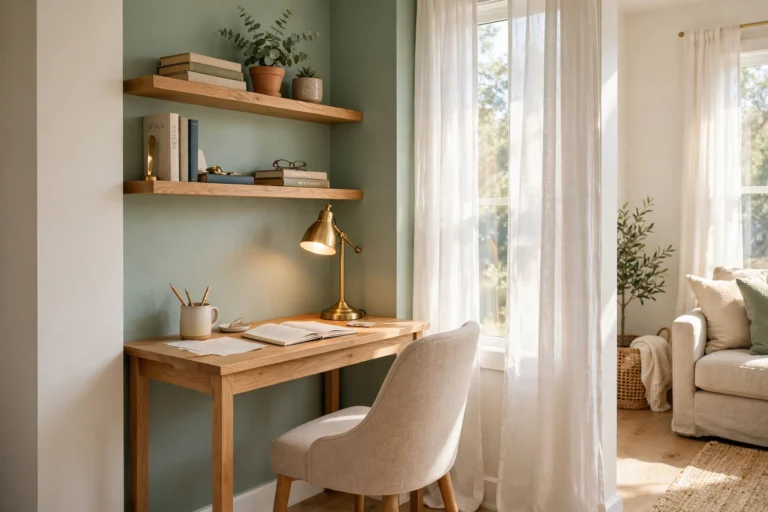
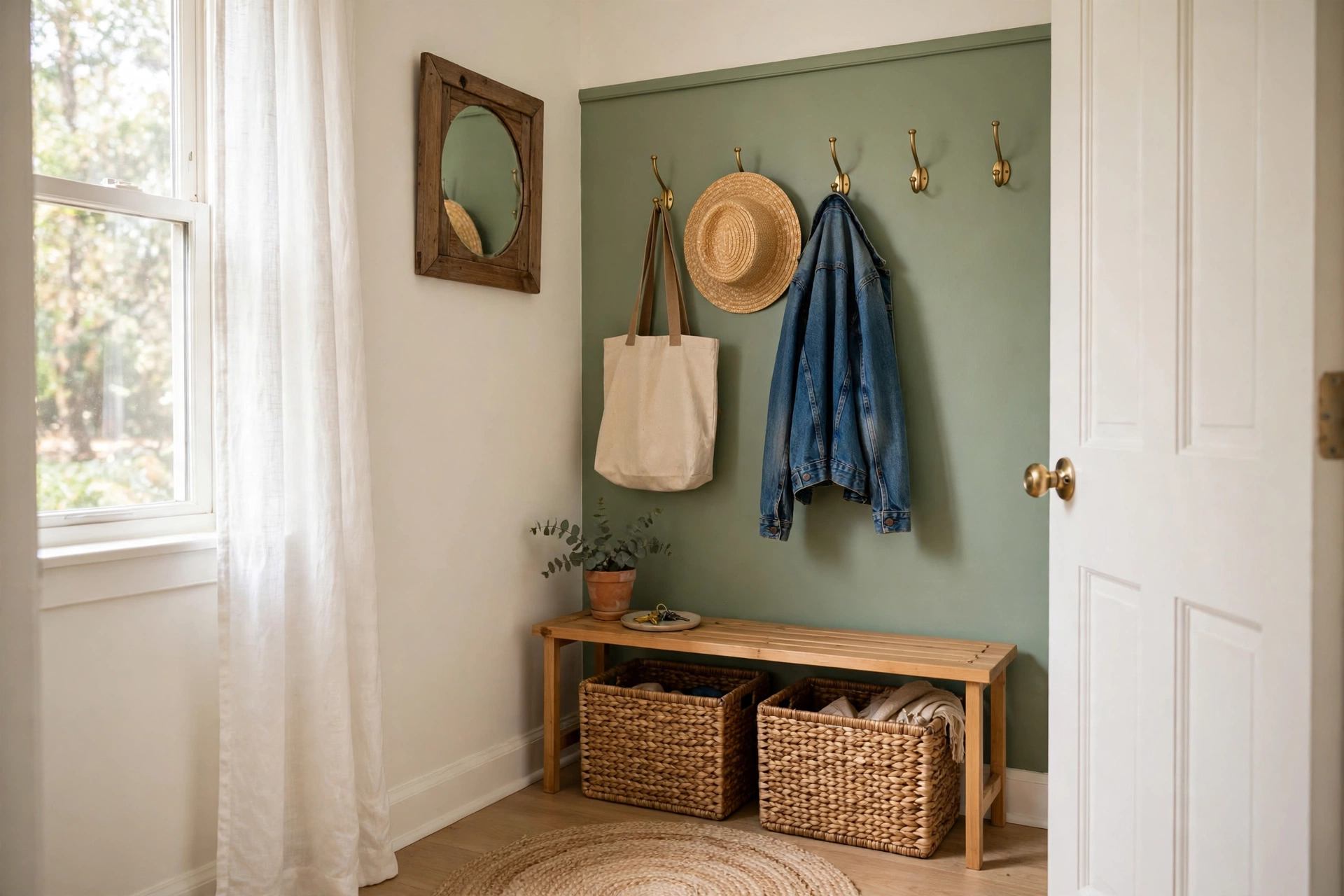
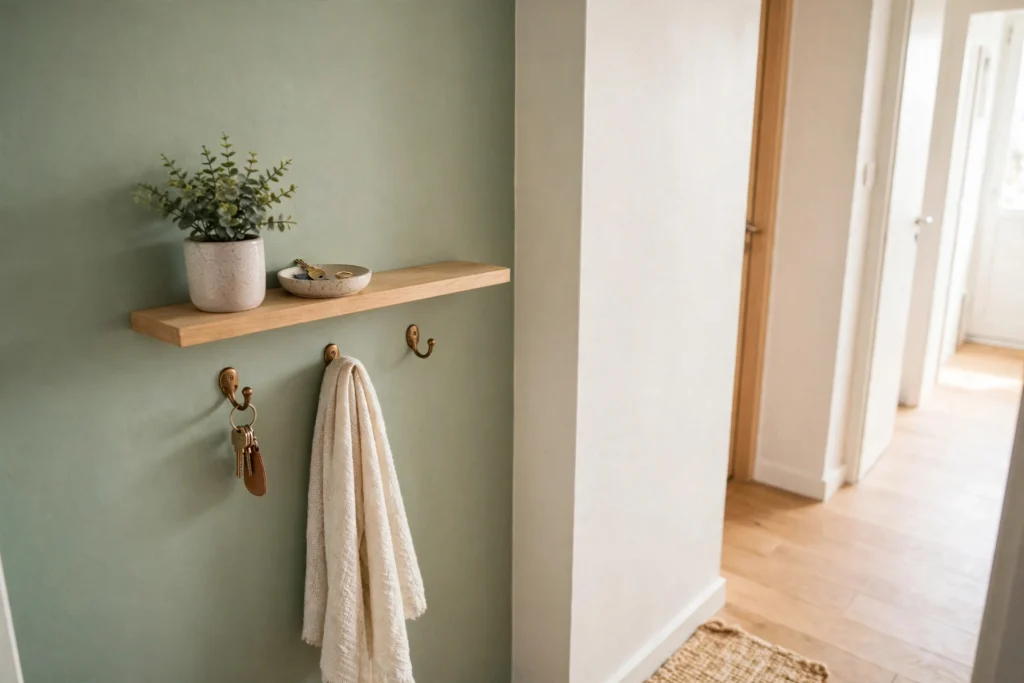
Paint is the single cheapest transformation in home design, and in an entryway you need barely a quart. I painted the wall facing the front door soft sage green — a $28 quart of eggshell plus a $6 mini roller set. The whole job took an afternoon, including the tape.
The color choice matters more than the brand. Deep or mid-tone greens, warm terracotta, and navy all make a small hallway feel intentional instead of leftover. If you’re deciding between shades, these paint colors for small rooms were my starting point — entryways follow the same rules as any small space.
2. Swap the Overhead Light for a Plug-In Sconce ($30–60)
Rental entryways come with one harsh ceiling light that makes everyone look tired. A plug-in wall sconce with a brass or black arm costs $30–60, mounts with two small screws (or heavy-duty adhesive hooks if you can’t drill), and the cord tucks behind a $5 cord cover painted to match the wall.
Warm light changes everything about a hallway. Go for a 2700K bulb — it’s the “golden hour” temperature that flatters faces and paint alike. This one swap made my sage wall look like a design choice instead of a paint sample.
3. Build a Hook Rail From a Scrap Board ($15–20)
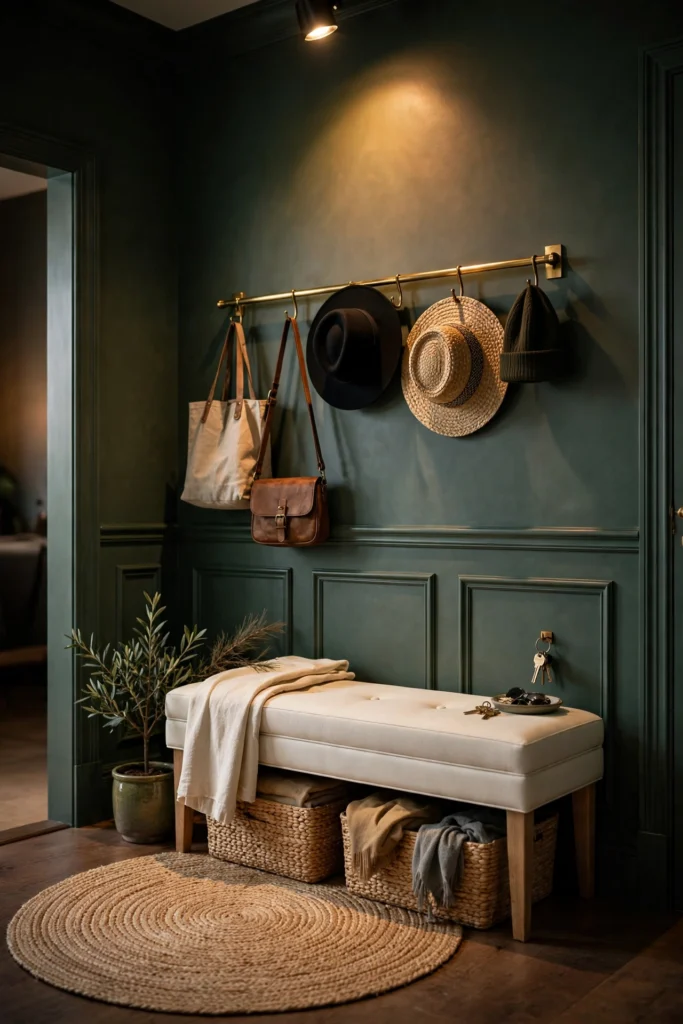
Five brass or matte-black hooks on a 3-foot (90 cm) stained pine board give you a landing zone for bags, jackets, and keys. The board cost me $8 at the lumber aisle, hooks were $2 each, and a half-pint of walnut stain finished it. Total: $18 and a Saturday morning.
Mount it at 60–66 inches (152–168 cm) from the floor so coats hang clear of the bench below. If your lease bans drilling, the same rail hangs on two heavy-duty adhesive strips rated for the weight — just one of the damage-free wall treatments that hold up surprisingly well.
4. Add a Slim Bench With Hidden Storage ($40–70)
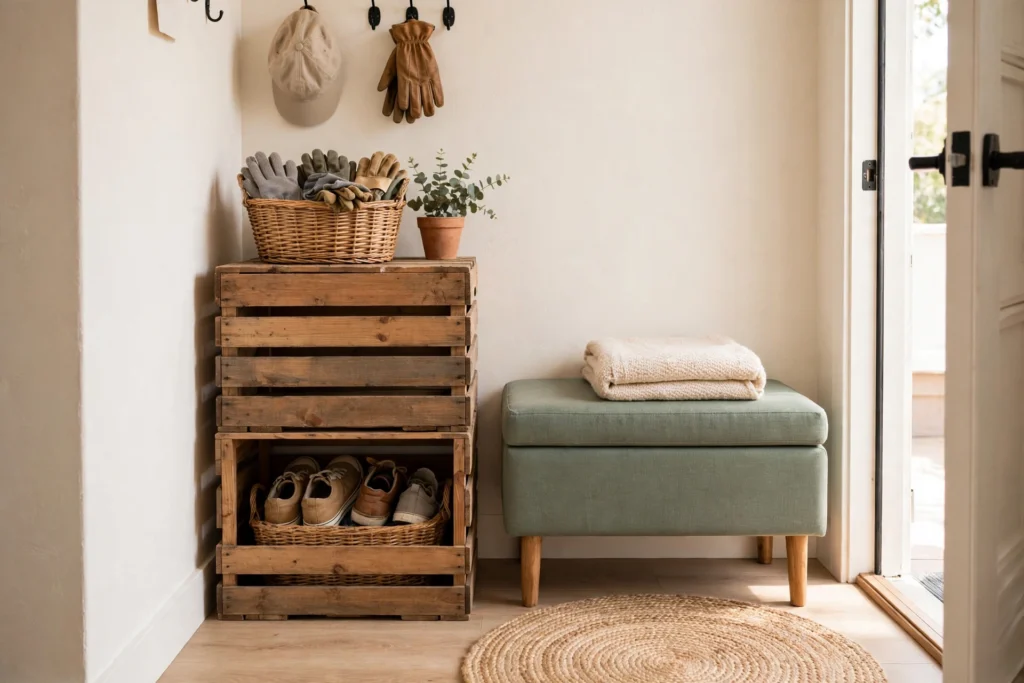
A 36-inch (91 cm) storage bench is the entryway’s hardest worker: seating for putting on shoes, a lid that hides gloves and reusable bags, and a top surface for the mail tray. I found mine at a thrift store for $25, sanded it, and painted it warm white with the leftover sage for the inside lid.
New, these run $40–70 at discount stores — still inside the budget if you pick it as your one “big” purchase. Measure your hallway first: you want at least 24 inches (61 cm) of walkway left in front of it.
5. Lay a Washable Runner or Round Rug ($20–35)
A rug does two jobs in an entryway: it marks the zone and it catches the dirt. A 2×6-foot (61×183 cm) washable runner costs $20–35, and the washable part matters — this rug will see every shoe you own. I went with a small round jute rug because my hallway was too narrow for a runner, and the texture warms up the whole corner.
Patterned rugs hide wear better than solids, and a rug that’s slightly smaller than you think reads better than one that crowds the door swing.
6. Hang a Thrifted Mirror to Double the Light ($10–25)
A mirror opposite or beside the door bounces daylight and the new sconce around the whole space — the oldest small-space trick there is, and it works. Thrift stores always have oval and arched mirrors for $10–25; mine was $14 with a wooden frame I painted brass with a $4 metallic spray paint.
Hang it so it reflects something worth seeing: the painted accent wall, a plant, the rug. A mirror that reflects a blank wall just doubles the blankness.
7. Mount Floating Shelves for the Vertical Space ($15–25)
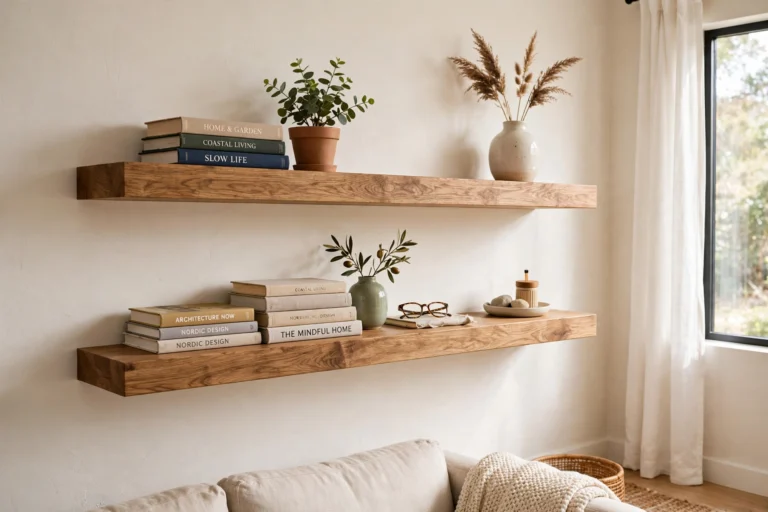
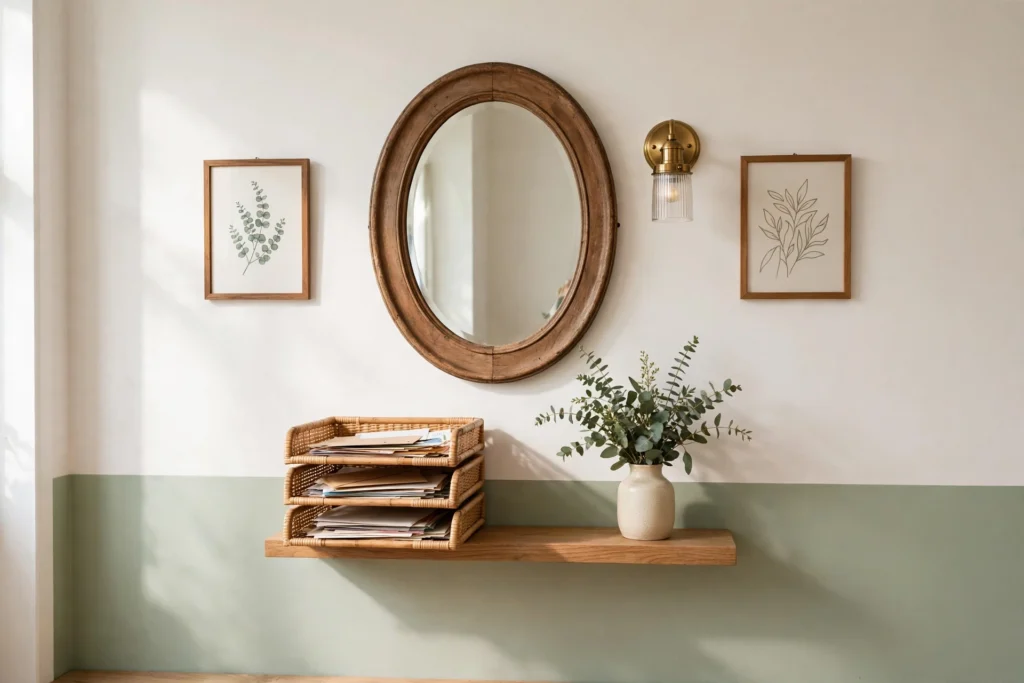
Entryway walls are usually bare above hook height, and that’s wasted storage. Two 24-inch (61 cm) floating shelves above the bench hold a small plant, a candle, and the sunglasses basket — decor plus function for about $20. Pre-finished shelf boards from the home store come with hidden brackets in the box.
Keep the styling loose: one plant, one stack of two books, one catch-all bowl. Shelves that look “styled” rather than “stored” are what separate a makeover from a cleanup.
8. Create a Mail and Key Command Center ($10–15)
The entryway makeover fails if paper piles colonize the bench within a week. A wall-mounted file sorter or two small trays ($10–15) with labeled slots — action, to-file, outgoing — ends the mail drift. Add a small ceramic dish on the shelf for keys and you’re done.
This is the part of the makeover nobody photographs but everybody feels. Five minutes of sorting when you walk in beats a Sunday avalanche.
9. Upgrade the Doormat and Door Hardware ($15–30)
The doormat is the entryway’s handshake. A coir mat with a simple pattern costs $12–18 and instantly looks more considered than the flattened freebie from move-in day. While you’re at it, swapping the interior door handle for a $15 matte-black lever takes ten minutes with a screwdriver and makes the whole door look newer.
These are the smallest spends on this list and two of the most visible. Guests notice the doormat before they notice the paint.
10. Style a Thrifted Frame Gallery ($10–20)
Three to five small frames — thrifted for $1–3 each — with free printable art or your own photos turn a blank wall into a gallery. I sprayed mismatched frames the same warm white so they read as a set, total cost $11.
Keep the arrangement tight: 2–3 inches (5–8 cm) between frames, and the center of the grouping at about 57 inches (145 cm) eye level. A tight cluster reads as one deliberate piece; frames scattered across the wall read as clutter.
11. Add a Plant That Survives Neglect ($10–18)
One plant makes an entryway feel alive. Snake plants and pothos survive low light and forgotten waterings — a 6-inch (15 cm) pot costs $10–18 including a simple ceramic planter. Hang the pothos from a hook if floor space is tight; trailing leaves soften the hard lines of hooks and shelves.
If you travel a lot, go faux. A good faux pothos is $12 and nobody has ever once looked closely enough to tell.
12. Finish With a 15-Minute Weekly Reset (Free)
Here’s the honest part: a $100 makeover only looks like $100 if it stays tidy. Once a week, everything in the entryway gets a 15-minute reset — shoes back on the rack, mail sorted, bench lid closed, rug shaken out. It’s the same whole-home organization approach shrunk down to one hallway, and it’s free.
Pair it with the tiny entryway setup principles — every item gets a home, and the homes stay small — and the entryway stops being the room that embarrasses you when the doorbell rings.
The $100 Budget Breakdown
Here’s how the money actually split on my hallway, so you can plan yours:
- Accent wall paint + roller: $34
- Plug-in sconce + cord cover: $42
- Hook rail (board + hooks + stain): $18
- Thrifted bench + paint: $25
- Round jute rug: $24
- Thrifted mirror + brass spray paint: $18
- Two floating shelves: $20
- Mail sorter + key dish: $13
- Doormat + door handle: $30
- Gallery frames + prints: $11
- Pothos + planter: $14
You don’t do all twelve. Pick the five or six that fit your hallway and your budget lands under $100 easily. My actual spend was the paint ($34), hook rail ($18), rug ($24), and mirror ($18) — $94 total — and the hallway looks completely different. Start with paint, light, and hooks; add the rest as budget allows.
Can you really makeover an entryway for under $100?
Yes — if you spend on surfaces, not furniture. Paint, hooks, a rug, and lighting transform how the space feels for under $100, while a new console table alone would blow the budget. Thrift the bench and mirror, DIY the hook rail, and the math works.
What should every small entryway have?
Four things: a place for shoes, hooks for bags and coats, a spot for keys and mail, and a mirror or light source. Everything else — the gallery wall, the plant, the styling — is the layer that makes it feel designed rather than just functional.
How do you makeover a rental entryway without drilling?
Use heavy-duty adhesive hooks and strips for the hook rail and shelves, a plug-in sconce instead of hardwired lighting, peel-and-stick paint alternatives like removable wallpaper on the accent wall, and freestanding pieces (bench, rug, mirror leaned on the wall) for everything else.
What color makes a small entryway look bigger?
Light, warm neutrals — warm white, soft cream — reflect the most light and visually expand a narrow hall. But a deep accent color on one wall (sage green, navy, terracotta) can make the space feel more designed without shrinking it, as long as the other walls stay light.