What Size Furniture Fits a Tiny Bedroom? Max Sizes That Actually Leave Room to Walk
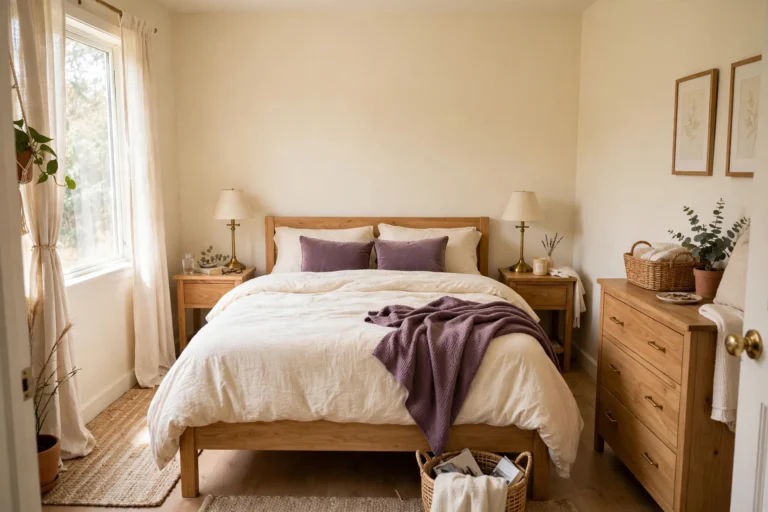
Tiny bedroom furniture sizes are the whole game in a room under 80 sq ft (7.4 sq m). Take the classic 8 by 9 ft (2.4 by 2.7 m, 72 sq ft) bedroom: a twin bed plus a 36 in (91 cm) dresser plus a wall shelf leaves 33 in (84 cm) at the foot of the bed and a full walkway. Swap in a queen and the same room fails, because the 30 in (76 cm) door swing wipes out the 28 in (71 cm) left at the foot. That one comparison is the original check behind this post: every max size below is tested against the same 8 by 9 ft room, so you can hold a tape measure to your own walls and get a yes or no before you buy anything.
What counts as tiny, and the 3 numbers that rule it
For this guide, tiny means 80 sq ft or less. That covers the box rooms in older apartments and small houses: 8 by 9 ft (72 sq ft), 8 by 10 ft (80 sq ft), and 7 by 11 ft (77 sq ft). If your room is bigger, our small bedroom layout ideas cover the general plans, including the 10 by 10 ft queen-bed math. This post is only for the band where every inch has to be argued for, and it pairs with our tiny bedroom layout ideas, which show where each piece goes once you know its size.
Three numbers rule every size below. First, you need at least 24 in (61 cm) of clear space on any side of the bed you walk past; 30 in (76 cm) feels comfortable. Second, leave about 36 in (91 cm) in front of a dresser so its drawers can open and you can stand in front of them. Third, a standard interior door swings through about a 30 in (76 cm) arc, and that arc has to stay clear of furniture. Most tiny bedroom mistakes are not about taste. They are about one of these three numbers being ignored at the shop.
What tiny bedroom furniture sizes actually fit an 80 sq ft room?
The table is the short answer. The piece-by-piece verdicts underneath explain the trade behind each number, so you can break a rule knowingly instead of by accident.
| Piece | Max size for an 8 by 9 ft room | Why this is the ceiling |
|---|---|---|
| Bed | Twin 38 by 75 in (97 by 191 cm); full 54 by 75 in (137 by 191 cm) only in a corner | Queen 60 by 80 in leaves 28 in at the foot, less than the 30 in door swing |
| Dresser | 36 in wide by 18 in deep (91 by 46 cm) | 36 in fits the 58 in of free wall beside a corner twin, with room to spare |
| Nightstand | 18 in wide (46 cm), or a wall-mounted shelf instead | A floor nightstand wider than 18 in eats the only walkway |
| Wardrobe | 36 in wide (91 cm), shallow depth | Wider than 36 in steals the free wall the dresser needs |
| Desk | 42 in wide by 20 in deep (107 by 51 cm) | Deeper than 20 in turns the chair zone into a tripping hazard |
| Rug | 5 by 8 ft (1.5 by 2.4 m) | An 8 by 10 ft rug is 120 in long, 12 in longer than the whole room |
Bed: twin is the honest default, full is the corner exception
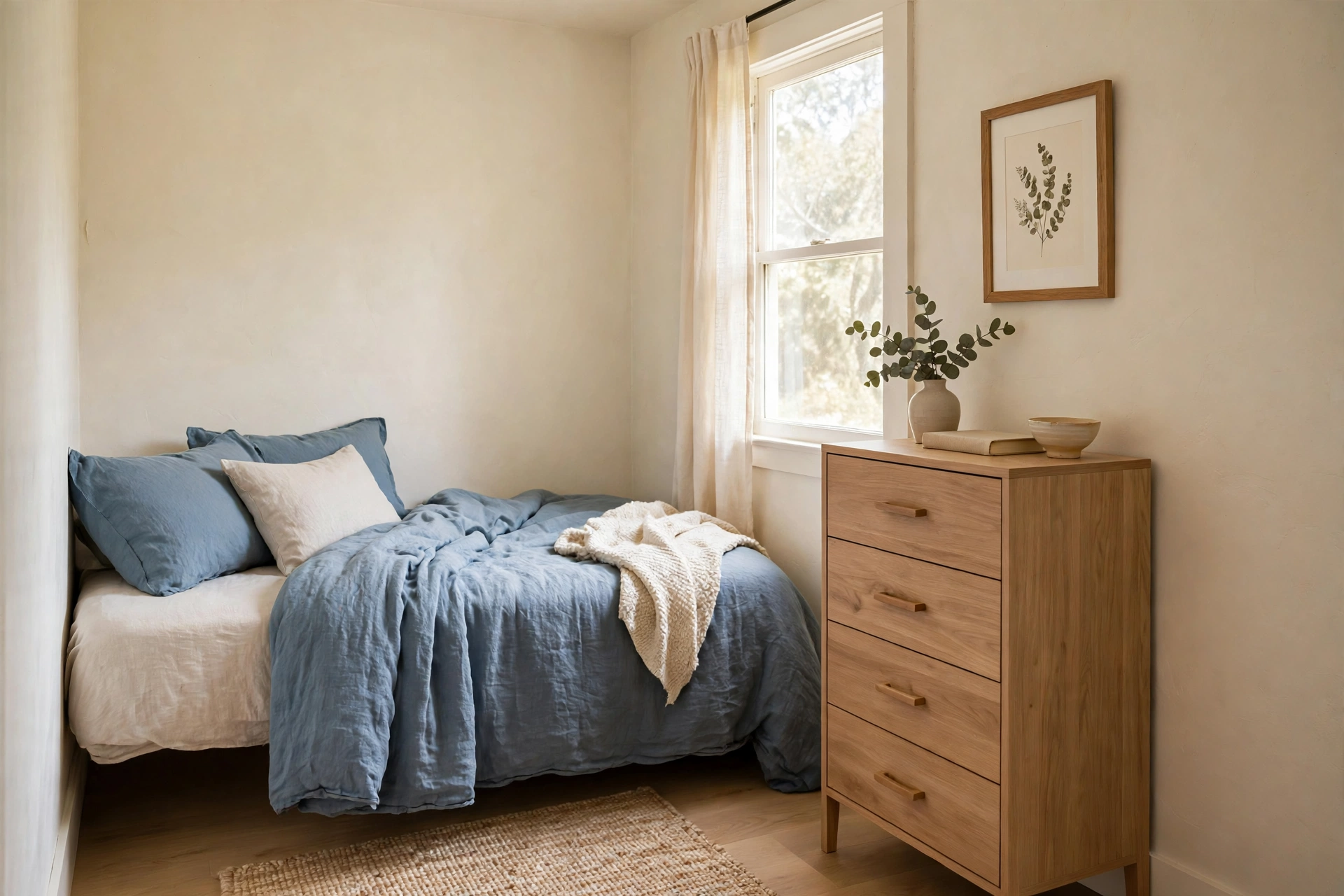
Max size: twin 38 by 75 in (97 by 191 cm). A full 54 by 75 in (137 by 191 cm) fits only pushed into a corner.
Best for: one sleeper, kids rooms, guest rooms, and any room that also has to hold a dresser.
Watch out for: a twin XL is 38 by 80 in, and those extra 5 in matter. In an 8 by 9 ft room a twin XL leaves 28 in (71 cm) at the foot, and the 30 in door swing wipes that out, exactly like a queen. Tall sleepers should check the door swing before choosing the longer bed.
Verdict: buy the twin unless you have measured the corner-full layout and accepted one nightstand, not two. Standard mattress sizes are the starting point, but always check the frame size too, because a bulky frame can add 3 to 6 in beyond the mattress on each side.
Dresser: 36 in wide, 18 in deep, no deeper
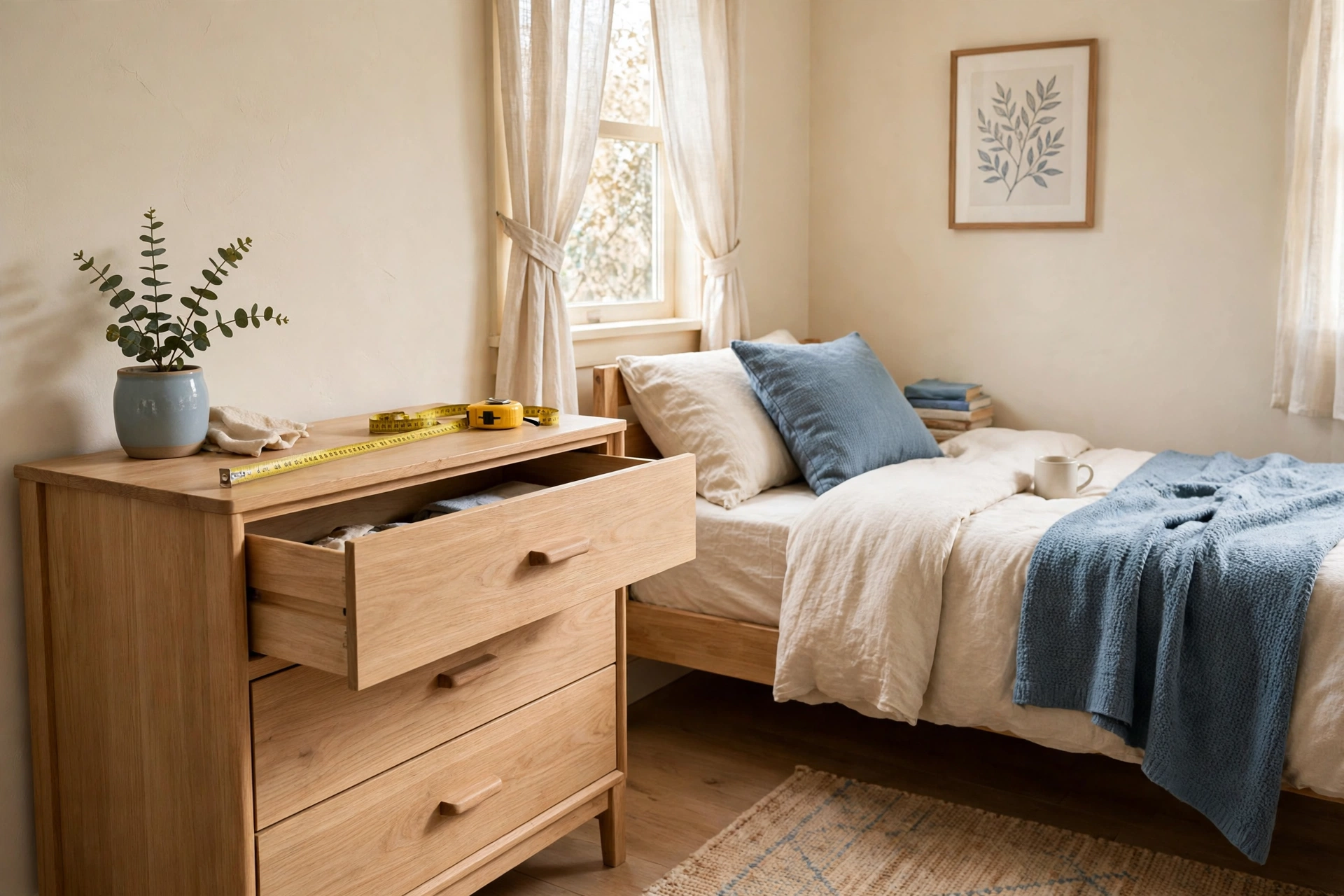
Max size: 36 in wide by 18 in deep (91 by 46 cm).
Best for: the 58 in (147 cm) of free wall left beside a corner twin bed, where a 36 in dresser fits with 22 in (56 cm) to spare.
Watch out for: depth hurts more than width here. A dresser that is 22 in deep instead of 18 in steals 4 in from your only walkway, every single day, and its drawers still need their 36 in of opening space in front. Our small bedroom organization ideas show how a slim dresser earns its place by holding a full drawer set without blocking the walkway.
Verdict: go tall and slim before you go wide. A tall chest that stays inside 36 in wide and 18 in deep beats a wide low dresser that eats the wall.
Nightstand: 18 in wide, or no floor nightstand at all
Max size: 18 in wide (46 cm) for a floor nightstand, with its top roughly level with the mattress top so you can reach it from bed.
Best for: one side of the bed only. In this band, one nightstand is a complete set.
Watch out for: a pair of standard 24 in (61 cm) nightstands is 48 in of furniture in a room with only 58 in of free wall. That leaves nothing for the dresser, which is why the matching set is the most overrated buy in this niche.
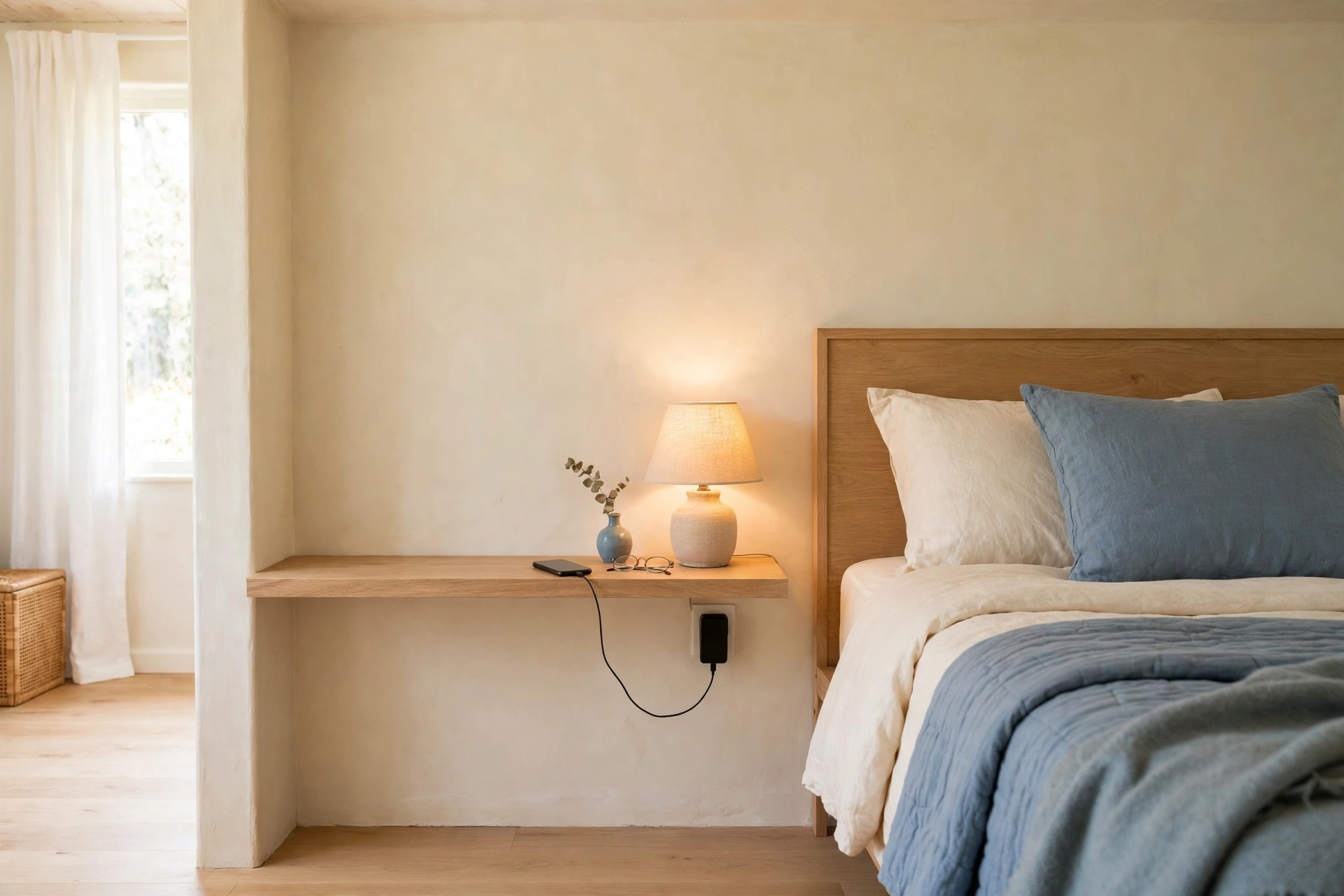
Verdict: the underrated move is a wall-mounted shelf nightstand. It holds a lamp, a phone, and a book, it costs less floor than any cabinet, and renters can often fit it with removable hardware within its rated weight. Keep the floor nightstand only if you truly need a drawer beside the bed.
Wardrobe: 36 in wide, shallow, and mind the door arc
Max size: 36 in wide (91 cm). Shallow wardrobe frames at about 35 cm (about 14 in) deep exist and are the right call here.
Best for: a windowless wall, so the wardrobe never blocks natural light, which is the one thing that makes 72 sq ft feel bigger.
Watch out for: a swing-door wardrobe needs its own door width clear in front of it, on top of the walkway. A sliding-door wardrobe skips that arc and is usually the better tiny-room choice. Never put a tall wardrobe in front of the window, and never let its door arc land on the dresser drawers.
Verdict: if the wardrobe you want is wider than 36 in, it is not a tiny-bedroom wardrobe. Split the storage instead: a 36 in wardrobe plus under-bed storage beats one giant box that blocks the room.
Desk: 42 in wide, 20 in deep, chair tucked fully under
Max size: 42 in wide by 20 in deep (107 by 51 cm), with a chair that tucks fully underneath.
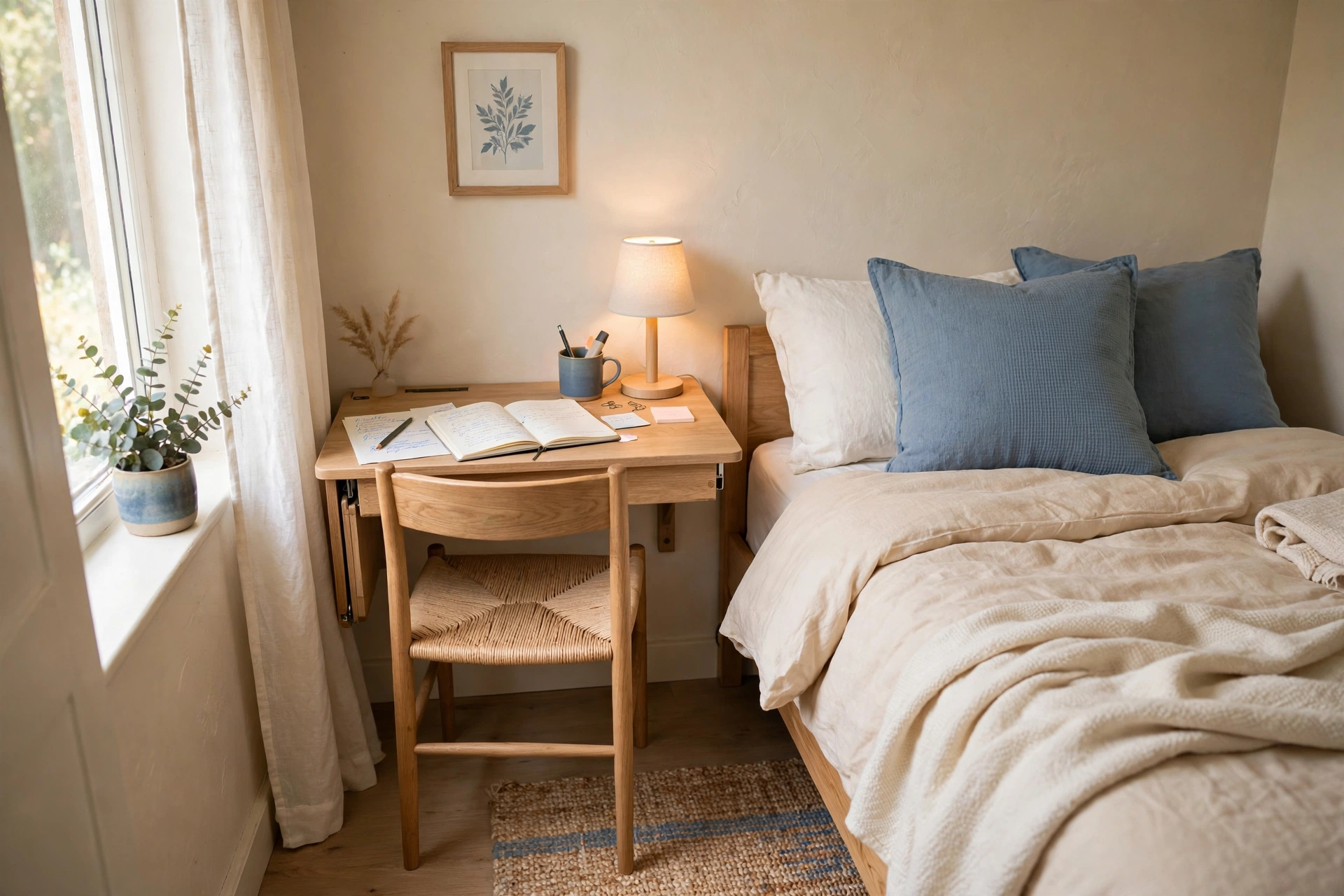
Best for: students and remote workers whose bedroom is also their office, especially with a folding wall desk that folds away at night.
Watch out for: a desk deeper than 20 in pushes the chair into the walkway, and a chair left sticking out becomes a shin-level hazard after dark. Our studio apartment layout ideas cover the full one-room zoning system for rooms where the desk also has to share space with a living zone.
Verdict: a folding wall desk beats a full desk in this band, because it gives you a work surface without permanently renting 42 by 20 in of floor.
Rug: 5 by 8 ft, and nothing bigger
Max size: 5 by 8 ft (1.5 by 2.4 m), placed under the lower two-thirds of the bed or in the open zone, with its front edge where your feet land when you get up.
Best for: anchoring the open zone in a room that otherwise feels like a corridor between furniture.
Watch out for: an 8 by 10 ft rug does not just look big here, it literally does not fit. It is 120 in long in a room 108 in long, and 96 in wide against a 96 in wall, so there is no margin on any side.
Verdict: one 5 by 8 ft rug, or no rug at all. A rug that fits badly is worse than a bare floor, because it curls, bunches, and shrinks the walkway it was meant to soften.
The frame trap: measure the bed you buy, not the mattress you read about
Mattress sizes are standard: twin 38 by 75 in, full 54 by 75 in, queen 60 by 80 in, king 76 by 80 in. Bed frames are not. A thick headboard, wide side rails, or a padded platform frame can add 3 to 6 in beyond the mattress, and in a 72 sq ft room that extra width is the difference between a walkway and a squeeze. Before you order, get the finished frame dimensions from the seller, add them to your wall measurement, and re-run the free-wall math: wall length minus frame width equals the wall you have left for everything else. If that number goes negative, the bed does not fit, no matter how good it looked in the shop photo. Bed sizes compared side by side in a good bed size guide will still show mattress numbers first, so treat the frame number as the real one.
The three-arc check: door swing, drawers, wardrobe doors
Sizes alone do not make a room work. Arcs do. Tape these three arcs on your floor with painter’s tape before you buy anything: the door swing (about 30 in), the dresser drawer pull (about 36 in in front of the dresser), and the wardrobe door arc (its full door width, unless it slides). If any arc lands on another piece of furniture, one of the two loses. Move the dresser to a wall where its drawer zone overlaps the walkway, not the bed. Move the wardrobe to a wall where its door arc overlaps empty floor, not the dresser. Keep the door swing zone empty, even if it looks like wasted space, because it is the only route in and out of the room. This check takes about 30 minutes with a tape measure and a roll of painter’s tape, and it catches more bad buys than any amount of browsing.
What tiny bedroom furniture sizes cost
Prices below are typical retail ranges as of November 2026, not a single store’s quote and not personal purchases. The mattress is extra, because mattress prices vary too much to price honestly in one line.
| Item | Typical range | Notes |
|---|---|---|
| Twin platform bed frame | $80 to $190 | Basic metal frames sit near $80; storage-headboard models near $190 |
| Slim dresser, 36 in wide | $100 to $180 | Keep depth at 18 in (46 cm) or less so drawers clear the walkway |
| Wall-mounted shelf nightstand | $25 to $60 | Replaces a floor nightstand; renters should use removable hardware only within its rated weight |
| Folding wall desk | $60 to $140 | For rooms where a full desk would block the walkway |
| 5 by 8 ft rug | $40 to $120 | Anchor the open zone, not the whole room |
| Sleep-only kit total | $245 to $550 | Frame, dresser, shelf nightstand, rug. Mattress extra |
| Work-from-bedroom kit total | $305 to $690 | Sleep-only kit plus the folding wall desk. Mattress extra |
A quick opinion, since this niche is full of soft advice: stop shopping by collection name. A matching bedroom set is sized for a showroom, not for 72 sq ft, and its wide nightstands are usually the first thing that breaks the plan. Shop by the three numbers in the table, piece by piece, and let the room decide what matches.
Measure in this order
Shop to these tiny bedroom furniture sizes, not to a photo. Work through the steps in order, because each one depends on the last.
- Measure the room wall to wall at floor level, where furniture actually sits, and write down the length and width in inches and cm.
- Measure the door swing. Open the door fully and mark the arc it sweeps on the floor.
- Measure every piece you already own, frame dimensions included, not mattress dimensions alone.
- Work out the free wall: wall length minus bed frame width. That number is your dresser budget.
- Tape the bed outline on the floor with painter’s tape, then tape the dresser drawer zone and the wardrobe door arc.
- Buy the bed first, then the dresser, then everything else. Never reverse that order, because the bed is the piece nothing else can move around.
You will need a tape measure, a roll of painter’s tape, and a pen and paper. That is the whole toolkit, and it saves more money than any sale.
Mistakes to avoid
Buying the mattress size instead of the frame size. The frame is what has to fit through the door and against the wall.
Forgetting the door swing. A 30 in arc of floor you cannot use is the number most people skip, and it is the one that kills queen beds and twin XL beds in this band.
Centering the bed on the wall. Symmetry looks good in photos and wastes a whole side of the room. In a tiny bedroom, the corner is your friend, because it hands you a full free wall for storage.
Choosing furniture by looks instead of depth. A dresser 4 in too deep steals 4 in from your only walkway, every day, for years.
Blocking the window or the closet door. Light and access are not decoration. A wardrobe in front of either one makes the room feel smaller and work worse.
What to skip
A queen or king bed in this band. The math in the table does not change because you want it to.
Two floor nightstands. One wall shelf does the job and keeps the floor clear.
A dresser deeper than 18 in. Depth is the silent room-eater, and no amount of width makes up for it.
An 8 by 10 ft rug. It is longer than the room. Buy the 5 by 8 ft rug or skip the rug.
A foot-of-bed bench or an armchair. Both eat the foot clearance and the walkway that the whole plan depends on.
A note for renters
Check your lease before you mount a wall shelf, swap a swing door for a sliding one, or anchor any wardrobe to the wall. Most leases allow freestanding furniture and removable hooks, but wall-mounted shelves, door changes, and wall anchors usually need written permission, and the deposit risk is real if you drill first and ask later. The good news is that almost everything in this guide works with zero drilling: a corner twin, a freestanding slim dresser, a sliding wardrobe, and a folding desk held by removable hardware within its rated weight. If your landlord says no to anchors, skip the wall shelf and use a slim floor nightstand no wider than 18 in, and keep the receipt for the removable hardware so you can reverse the whole setup on moving day.
How much space do you need around a bed in a small bedroom?
Plan at least 24 in (61 cm) on any side you walk past, and 30 in (76 cm) where you walk often. Leave about 36 in (91 cm) in front of a dresser so its drawers can open and you can stand comfortably.
Can a queen bed fit in a tiny bedroom?
No, not in an 8 by 9 ft room. A queen is 60 by 80 in, leaving 28 in at the foot, and a standard 30 in door swing needs more than that. A full bed fits only in the corner, and a twin fits anywhere in this band.
What size nightstand fits a tiny bedroom?
An 18 in (46 cm) wide nightstand at most, with its top roughly level with the mattress top, or a wall-mounted shelf instead. Skip the matching pair: two standard nightstands eat the free wall the dresser needs.
What furniture should you skip in a tiny bedroom?
Skip queen and king beds in this band, two floor nightstands, dressers deeper than 18 in, 8 by 10 ft rugs, foot-of-bed benches, and armchairs. In a tiny bedroom, fewer right-sized pieces beat a crowd of standard ones.
Start with the bed, then the dresser, and let tiny bedroom furniture sizes decide the rest. Measure the frame, tape the arcs, and buy only what leaves you a walkway, because a bedroom you cannot walk through is not a bedroom, it is storage with a mattress in it.
How this was made: the room math in this post was computed from standard mattress sizes and the 24 in minimum clearance rule, then checked against the 8 by 9 ft worked example; prices are typical retail ranges as of November 2026, not personal purchases or product tests.