How to Hang a TV in a Rental Without Drilling: 7 Options That Actually Work
Yes, you can hang a TV in a rental without drilling a single hole. The safest option for most renters is a freestanding floor stand. It holds the TV at eye level, it moves with you when you move, and it leaves the walls untouched. This guide covers how to hang a tv in a rental without drilling with seven options, compared by weight limit, cost, and deposit risk. Here is the short version. A 55-inch TV weighs about 35 lb (16 kg). Only floor stands and tension poles rated above 75 lb clear it with a real safety margin. Adhesive strips top out at 20 lb, so they are not a TV mount at all. Pick the method that fits your TV first, then worry about how it looks, and keep the same no-damage rule as our damage-free upgrades for every room.
Measure first: two numbers decide everything
Before you buy anything, find two numbers. First, your TV’s weight. It is printed on the label on the back of the TV and in the manual. Second, your TV’s VESA pattern. That is the spacing of the four mounting holes on the back, written like 200×200 mm or 400×400 mm. Every mount lists the VESA patterns it fits. If the pattern does not match, the mount does not fit, no matter what the box says about screen size.
Then check where the TV will sit. Sit on your sofa and look straight ahead. The center of the screen should sit at about your seated eye level, roughly 42 in (107 cm) from the floor. Too high and your neck hurts by the second episode. For distance, use the 1.5 to 2.5 times rule. Multiply your screen size by 1.5 for the closest seat and by 2.5 for the farthest. A 55-inch TV wants 6.9 to 11.5 ft (2.1 to 3.5 m) of viewing distance. Most small living rooms only just fit that, which is why a floor stand you can slide beats a mount you cannot move. If you are still planning the room, a no-drill living room layout built around the TV wall saves you from buying the wrong stand twice.
The weight budget: what each method can actually hold
This is the table no other guide prints, and it is the whole decision. A mount is only safe if its rating beats your TV’s weight by at least 20 percent. A 35 lb TV needs a mount rated for 42 lb or more. Here are typical TV weights against each method’s real limit.
| TV size | Typical weight | Floor stand | Tension pole | No-stud nail mount | Adhesive strips |
|---|---|---|---|---|---|
| 32 in (81 cm) | 10 to 12 lb (4.5 to 5.5 kg) | Yes | Yes | Yes | On paper only |
| 43 in (109 cm) | 18 to 22 lb (8 to 10 kg) | Yes | Yes | Yes | No, over the limit |
| 55 in (140 cm) | 30 to 40 lb (14 to 18 kg) | Yes | Yes | Yes | No |
| 65 in (165 cm) | 45 to 55 lb (20 to 25 kg) | Yes, check rating | Yes, 75 lb limit | Yes, 100 to 150 lb limit | No |
| 75 in (191 cm) | 60 to 75 lb (27 to 34 kg) | Check rating first | At the 75 lb limit | Yes, 150 lb limit | No |
Learning how to hang a tv in a rental without drilling starts with this check, not with a shopping list. Weigh the TV, multiply by 1.2, and only then pick a method whose rating clears the number. If the rating is missing from the listing, treat that as a no.
How to hang a TV in a rental without drilling: the 7 options
1. Freestanding floor stand, the best option for most renters
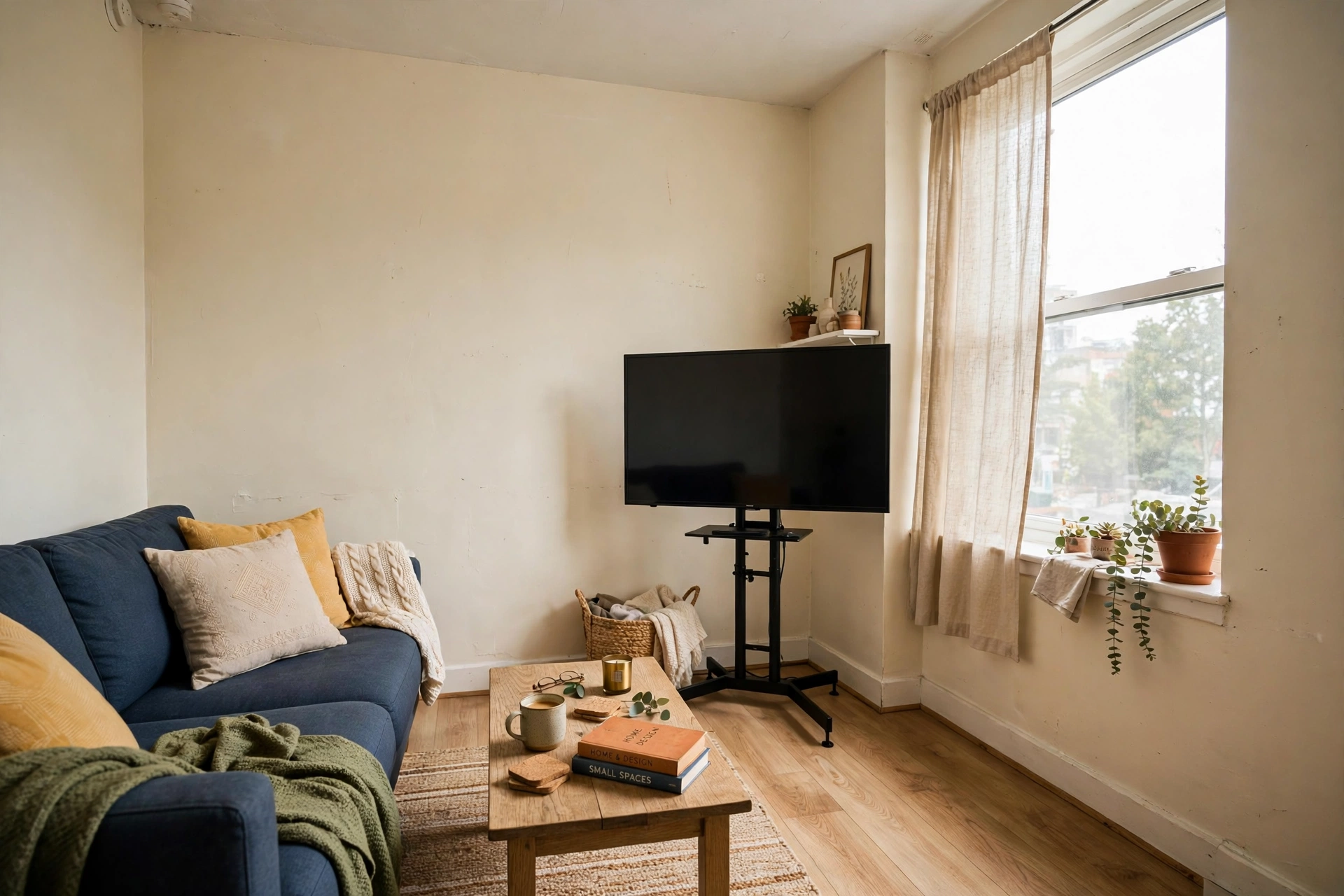
Best for: any TV from 32 to 65 in, and any renter who wants zero wall contact. Main advantage: it holds the TV at eye level, it moves room to room, and it takes nothing from the wall. Most stands list a 32 to 65 in size range and cost about $68 for a standard height-adjustable model. Watch out for: cheap stands wobble, and a tall TV on a narrow base can tip. Always fit the anti-tip strap that comes in the box, and lock the wheels if it rolls. This matters more than it sounds. The US Consumer Product Safety Commission’s Anchor It! campaign found that 47 percent of tip-over deaths from 2013 to July 2023 involved a TV. Verdict: the default choice. Deposit risk: 1 out of 5.
2. Pillar TV stand on a console
Best for: renters who already own a low console or TV unit. Main advantage: a short pillar stand bolts to the back of the console and lifts the TV above it, so the TV looks wall-mounted while the furniture takes the weight. It also hides the cables behind the pillar. Watch out for: the console has to be heavy and stable. A light flat-pack unit will tip forward with a 55-inch TV on a pillar. Put the heaviest gear on the lowest shelf. Verdict: great if the console is solid, pointless if it is not. Deposit risk: 1 out of 5.
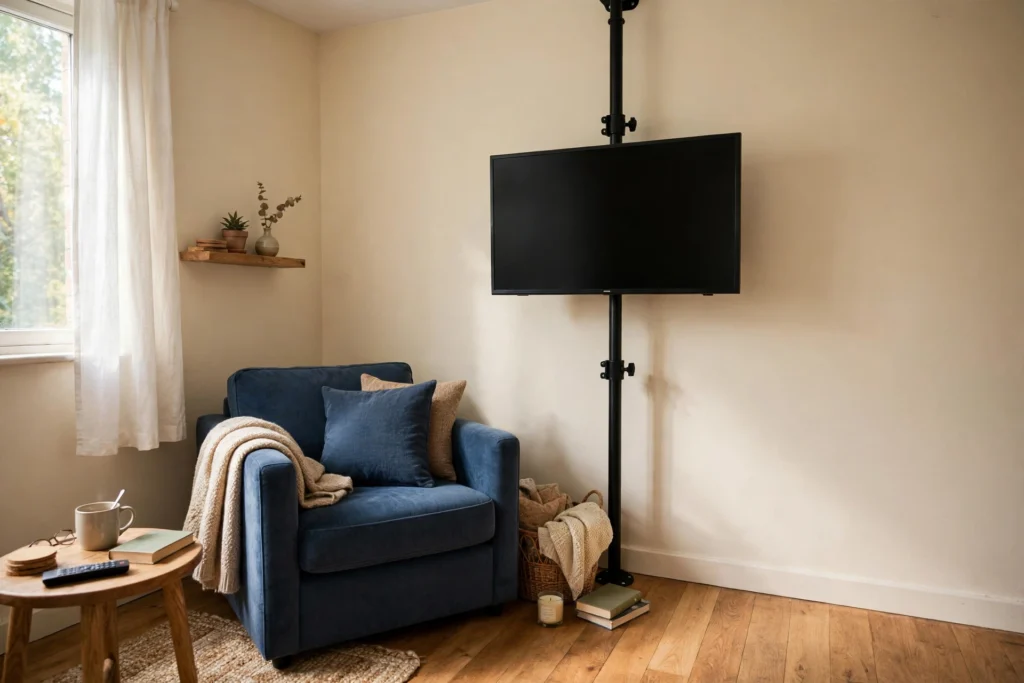
3. Tension pole mount, floor to ceiling
Best for: corners and tight walls where a stand would eat the walkway. Main advantage: a telescoping pole presses between floor and ceiling, and the TV hangs from it at eye level. Brands like VIVO and Echogear rate their poles up to 75 lb, which covers most TVs under 70 in. Watch out for: never use one on a false ceiling. The pole needs a solid ceiling to press against, and a plasterboard or drop ceiling will crack or bow. It can also leave rubber marks on the ceiling and floor, so check both surfaces when you move out. Verdict: the best true wall-free mount, if your ceiling is solid. Deposit risk: 2 out of 5.
4. No-stud nail mount, the honest middle ground
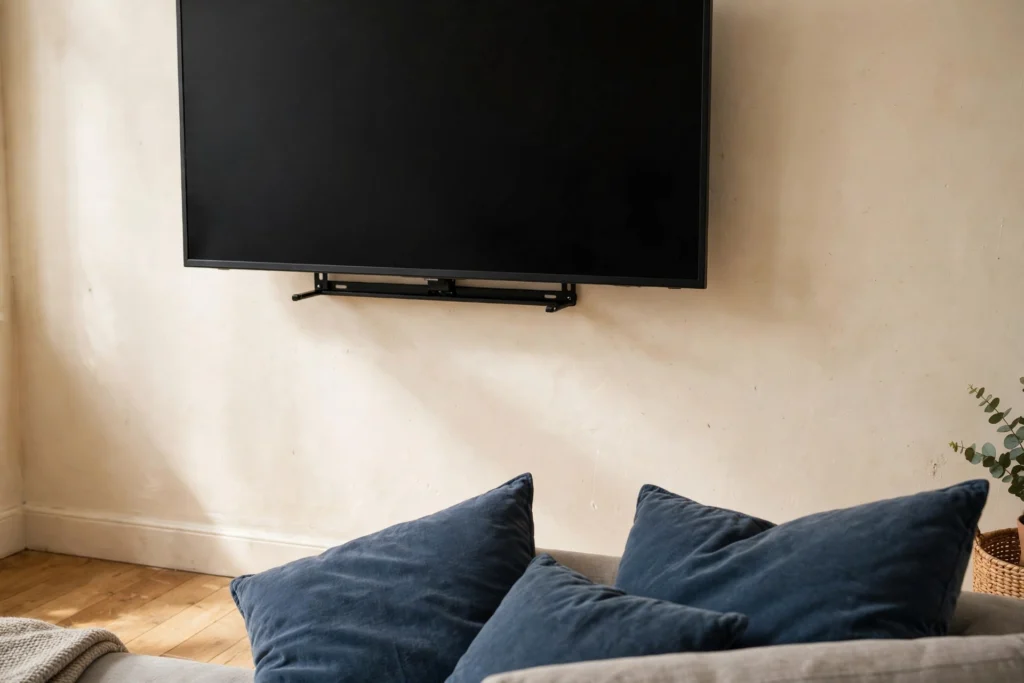
Best for: renters whose lease allows small nail holes but bans drilling. Main advantage: mounts like HangSmart hold screens up to 100 in and 150 lb on small pin nails driven in at an angle, with no stud finder and no drill. A cheaper fixed bar version costs about $30 and holds 20 to 57 in TVs up to 100 lb. Watch out for: this is not zero damage. Pin nails leave tiny holes, and on plaster walls they can crack the surface. You will need spackle at move-out. The mount is also fixed, so you cannot tilt or swivel the TV. Verdict: the strongest wall option that is not drilling, but call it what it is. Tiny holes, not no holes. Deposit risk: 3 out of 5.
5. Leaning frame, the gravity option
Best for: renters who want the wall-mounted look with nothing fixed to anything. Main advantage: a weighted frame leans against the wall and the TV hangs from it. No holes, no adhesive, no ceiling pressure. It moves in one piece. Watch out for: it needs floor space for the base, about 12 to 18 in (30 to 46 cm) deep, and it can scuff the skirting board where it rests. It also suits flat walls only. A wavy plaster wall leaves it rocking. Verdict: simple and safe, if you can spare the floor depth. Deposit risk: 1 out of 5.
6. Clamp-on mount for a mantel or shelf
Best for: rooms with a solid mantel, thick shelf, or sturdy cabinet top. Main advantage: a clamp grips an edge 0.5 to 2.5 in (1.3 to 6.4 cm) thick and the TV hangs from it. Nothing is fixed to the wall at all. Watch out for: the shelf has to be genuinely solid. A hollow floating shelf will bend or pull off the wall under a TV’s weight. Check the clamp’s rating and keep the 20 percent margin. Verdict: clever where it fits, useless where it does not. Deposit risk: 2 out of 5.
7. Adhesive strips and tape, the one to skip
Best for: nothing bigger than a small picture frame. Main advantage: none for a TV. Command Large strips hold 16 lb with four pairs, and the X-Large version holds 20 lb. That covers a 32-inch TV on paper and nothing bigger. Watch out for: adhesive is rated for frames, not screens. Heat, humidity, textured walls, and old paint all weaken the bond, and a TV that falls takes the wall with it. Removal can peel paint, which is a deposit deduction, not a saving. One renter guide puts it plainly: adhesive is not made to carry a TV. Verdict: do not hang a TV on adhesive. Use the strips for cable clips instead, which is what they are good at. Deposit risk: 4 out of 5.
What it costs (as of November 2026)
Prices below are live-checked US listings from November 2026. Items marked “check listing” had no stable US price I could verify, so no number is invented here.
| Route | What you buy | Cost |
|---|---|---|
| Floor stand route (recommended) | Height-adjustable floor stand, ~$68 + Command Large strips 14-pair pack for cable clips, $11.37 | $79.37 |
| Budget route | Swivel tabletop TV base, ~$33 + Command Large strips 14-pair pack, $11.37 | $44.37 |
| Rolling stand route | Heavy-duty rolling TV stand, ~$110 + Command strips, $11.37 | $121.37 |
| No-stud nail mount route | No-stud mount, ~$30 + Command strips, $11.37 | $41.37 |
| Tension pole route | Tension pole TV mount + Command strips, $11.37 | Pole: check listing |
| Cable hiding only | Adhesive cable trunking kit | Check listing |
Time estimate: a floor stand takes 30 to 45 minutes to build and set up. A no-stud mount takes about 20 minutes. Add 15 minutes for cable hiding. If you are furnishing the whole room on a budget, these renter-friendly living room upgrades pair with the TV setup and keep the same no-damage rule.
How to set up a floor stand in 7 steps
You need: a floor stand rated above your TV’s weight, a screwdriver, a spirit level, a tape measure, Command strips or adhesive cable clips, and a second person for the lift. Never lift a 55-inch TV alone.
- Weigh the TV and check the VESA pattern on the back label.
- Measure the viewing distance and mark the screen center at about 42 in (107 cm) from the floor.
- Check the stand’s rating beats your TV’s weight by 20 percent.
- Build the stand on the floor, away from the wall, and level the base.
- Bolt the VESA plate to the back of the TV while it lies face-down on a soft blanket.
- Lift the TV onto the stand with a second person and lock the plate in place.
- Fit the anti-tip strap, run the cables, and push the stand firmly. If it rocks, re-level it before you switch the TV on.
Hide the cables without drilling
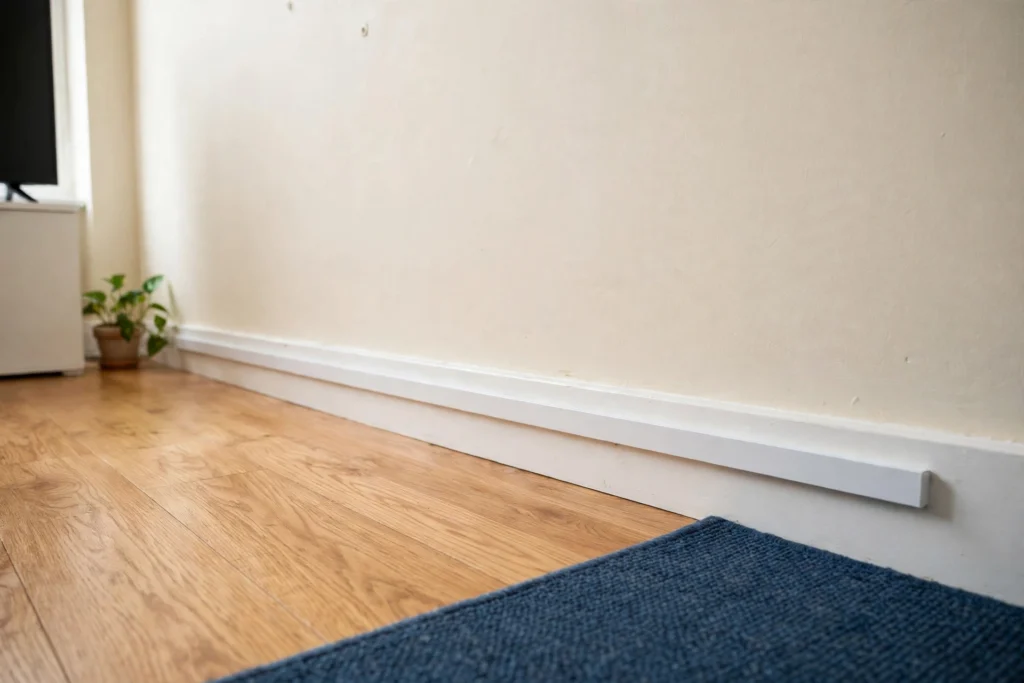
Loose cables ruin the wall-mounted look and trip everyone in a small room. Run them down the back of the stand with adhesive cable clips, then along the skirting board inside an adhesive cable trunking strip. The trunking peels off at move-out with a hair dryer and a slow pull. Never run cables inside the wall. That is a lease violation in most rentals and a fire risk you do not want to own. Keep the power brick where air can reach it, never inside a closed trunking run with no ventilation.
Mistakes to avoid
- Buying the mount before weighing the TV. Size is not weight. Two 55-inch TVs can differ by 10 lb.
- Trusting adhesive for a real TV. The strips are rated for frames, and a falling TV costs more than any mount.
- Using a tension pole on a false ceiling. It will crack the boards and the repair is yours.
- Skipping the anti-tip strap on a freestanding stand, especially with kids or pets in the home.
- Mounting the TV too high. If your neck tilts up to watch, the center is above eye level.
- Drilling “just two small holes” without asking. Small holes are still holes, and the lease decides, not you.
What to skip
- Adhesive TV mounts of any brand, for any TV over 20 lb.
- Suction-cup mounts. They fail on textured paint and in humid rooms.
- “No-drill” kits that turn out to be nails in a fancy box, unless you have accepted the tiny holes and the spackle job.
- Oversized stands that eat 18 in of walkway in a room that only has 30 in to spare.
- Rolling stands with no wheel locks. A TV that rolls is a TV that falls.
Renter caveat: check the lease before you buy anything
Read your lease first. Look for the words holes, alterations, decorating, or fixtures. If the lease bans holes, a no-stud nail mount is still a hole, and only the truly zero-hole options above are safe. If the lease is unclear, ask your landlord in writing. Name the wall, the method, and who patches what when you leave, and keep the reply with your lease. Photograph the wall before you start so you can prove what was already there. At move-out, fill pin holes with spackle, sand them flat, and touch up the paint. Then run through a move-out cleaning checklist room by room so the TV wall is not the thing that costs you the deposit. Most renters who lose deposit money on a TV lose it on the removal, not the install, so plan the removal on the day you buy the mount.
How this was made: prices were checked against live US listings in November 2026, weight limits come from manufacturer listings, and no product was tested in our home.
Can I mount a TV in my apartment without drilling?
Yes. The cleanest way to hang a tv in a rental without drilling is a freestanding floor stand. It holds most TVs from 32 to 65 in, needs no wall contact at all, and moves with you. A tension pole mount is the other true zero-hole option, as long as your ceiling is solid.
Can a landlord say no to a TV mount?
Yes, if the lease does not allow holes or alterations. Ask in writing before you buy anything. Name the wall, the hardware, and who patches the holes at move-out. Keep the landlord’s reply with your lease. A floor stand or tension pole needs no permission because nothing is fixed to the property.
Will mounting a TV damage my apartment walls?
A true zero-hole method leaves no damage. A no-stud nail mount leaves tiny pin holes that spackle fixes. Adhesive is the risky one. It can peel paint on removal, which is the most common deposit deduction from TV mounting. Photograph the wall before you start so you can show what was already there.
Can adhesive strips hold a TV?
No, not safely. Command Large strips hold 16 lb with four pairs and the X-Large version holds 20 lb. That is a picture-frame rating, not a TV rating. Heat, humidity, and textured walls weaken the bond further. Use adhesive strips for cable clips, and pick a stand or a pole for the TV itself.