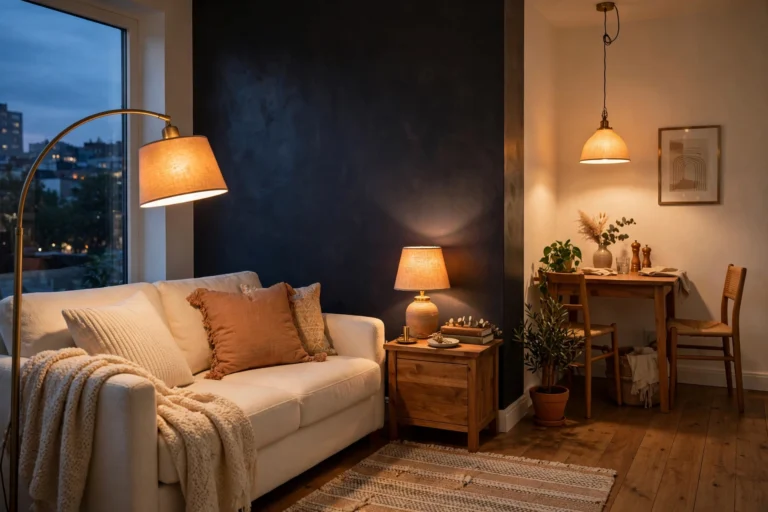

Renter Friendly No Drill Living Room Layouts: 4 Plans That Leave No Holes
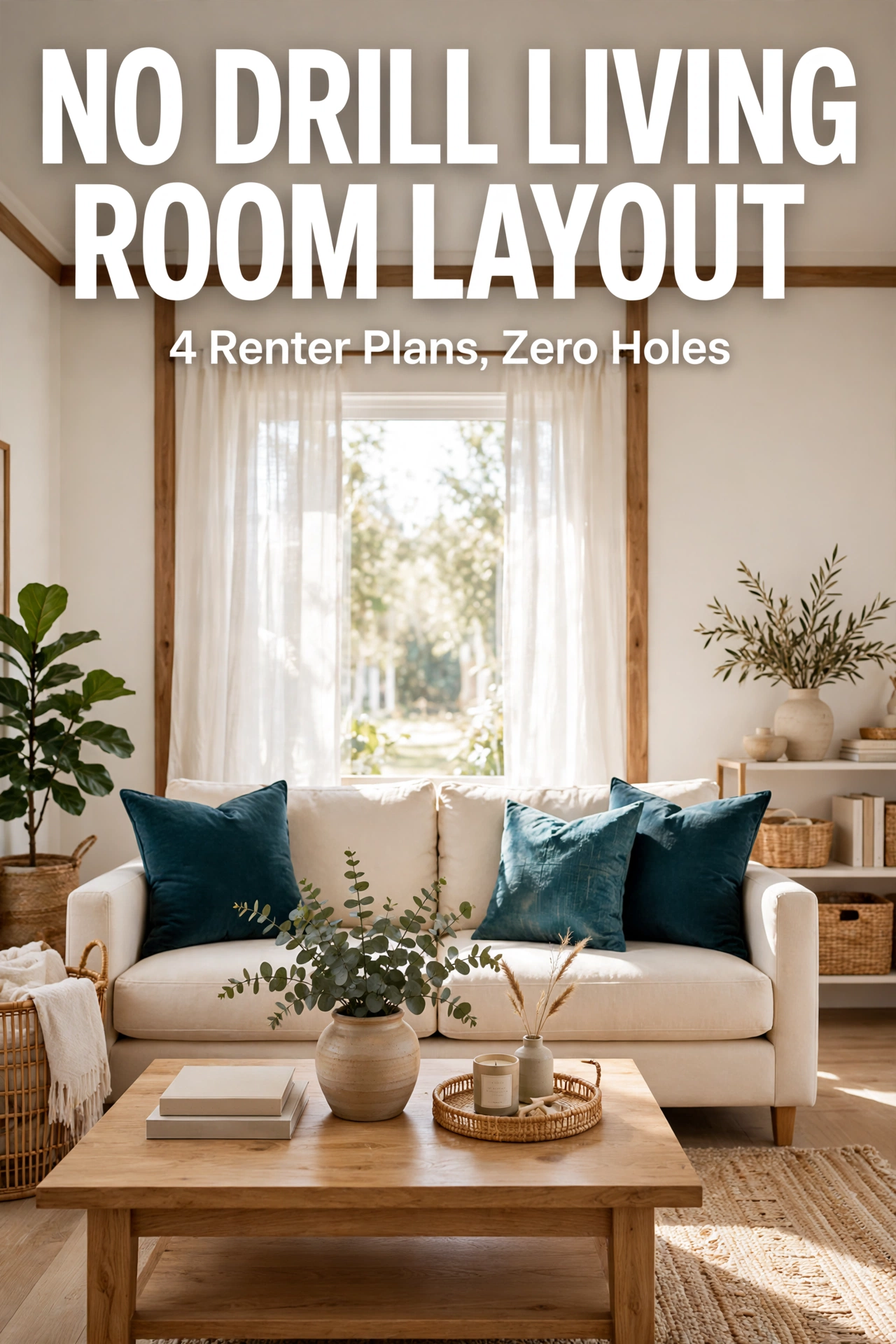
Direct answer: A no drill living room layout works when the furniture does the dividing, the rug does the anchoring, and the walls stay untouched. In a Small 10×12 ft room, an 84 in (213 cm) sofa plus an 18 in (46 cm) side table equals 102 in on a 120 in (305 cm) wall, leaving 18 in (46 cm) spare. In that same room, a 12 ft (3.7 m) depth minus a 36 in (91 cm) deep sofa leaves about 9 ft (2.7 m) of TV viewing distance. And the adhesive budget is fixed by the manufacturer: 4 pairs of XL strips hold 20 lb (9.1 kg) for a frame up to 24×36 in (61×91 cm), so a print under 20 lb hangs, and a TV never does. This guide gives you one no drill plan for each size band, a toolkit with deposit risk ratings, and a weekend setup order that leaves nothing to argue about at move out.
Which no drill living room layout works in each size band?
Direct answer: Tiny rooms get a loveseat and a leaning mirror, Small rooms get a full sofa against one wall, Compact rooms get a floated sofa with a console behind it, and Modest rooms get two zones divided by furniture instead of walls. The rule never changes: nothing gets screwed into a wall, and anything heavy stands on the floor.
| Size band | Room example | Main seat | TV solution | Rug |
|---|---|---|---|---|
| Tiny, up to 80 sq ft | 8×10 ft (2.4×3.0 m) | 60 in (152 cm) loveseat | Small TV on a low stand | 5×7 ft (1.5×2.1 m) |
| Small, 80 to 120 sq ft | 10×12 ft (3.0×3.7 m) | 84 in (213 cm) sofa | TV on a console stand | 8×10 ft (2.4×3.0 m) |
| Compact, 120 to 180 sq ft | 12×14 ft (3.7×4.3 m) | Floated 84 in sofa plus console | TV on a media console | 8×10 ft (2.4×3.0 m) |
| Modest, 180 to 250 sq ft | 14×16 ft (4.3×4.9 m) | Sofa plus two chairs, two zones | TV on a wide console | 9×12 ft (2.7×3.7 m) |
If your room sits between bands, use the smaller band’s plan. A plan with breathing room always looks better than a plan that is stuffed to the walls. The living room layout mistakes guide shows what goes wrong when a room is overfilled, and it is worth a quick read before you buy anything.
Plan A: Tiny, up to 80 sq ft, the loveseat and leaning mirror plan
Direct answer: In a Tiny living room, put a loveseat on the long wall, lean a mirror beside it, and let a 5×7 ft rug define the whole seating zone.
Take an 8×10 ft (2.4×3.0 m) room. A 60 in (152 cm) loveseat plus a 16 in (41 cm) side table equals 76 in on a 96 in (244 cm) wall, with 20 in (51 cm) spare. That spare strip is where a floor lamp or a plant lives, not a third seat. The rug math works too: a 5×7 ft rug on a 96 in wide wall leaves 36 in total, or 18 in (46 cm) of bare floor on each side, which is enough to keep the room from looking carpeted wall to wall.
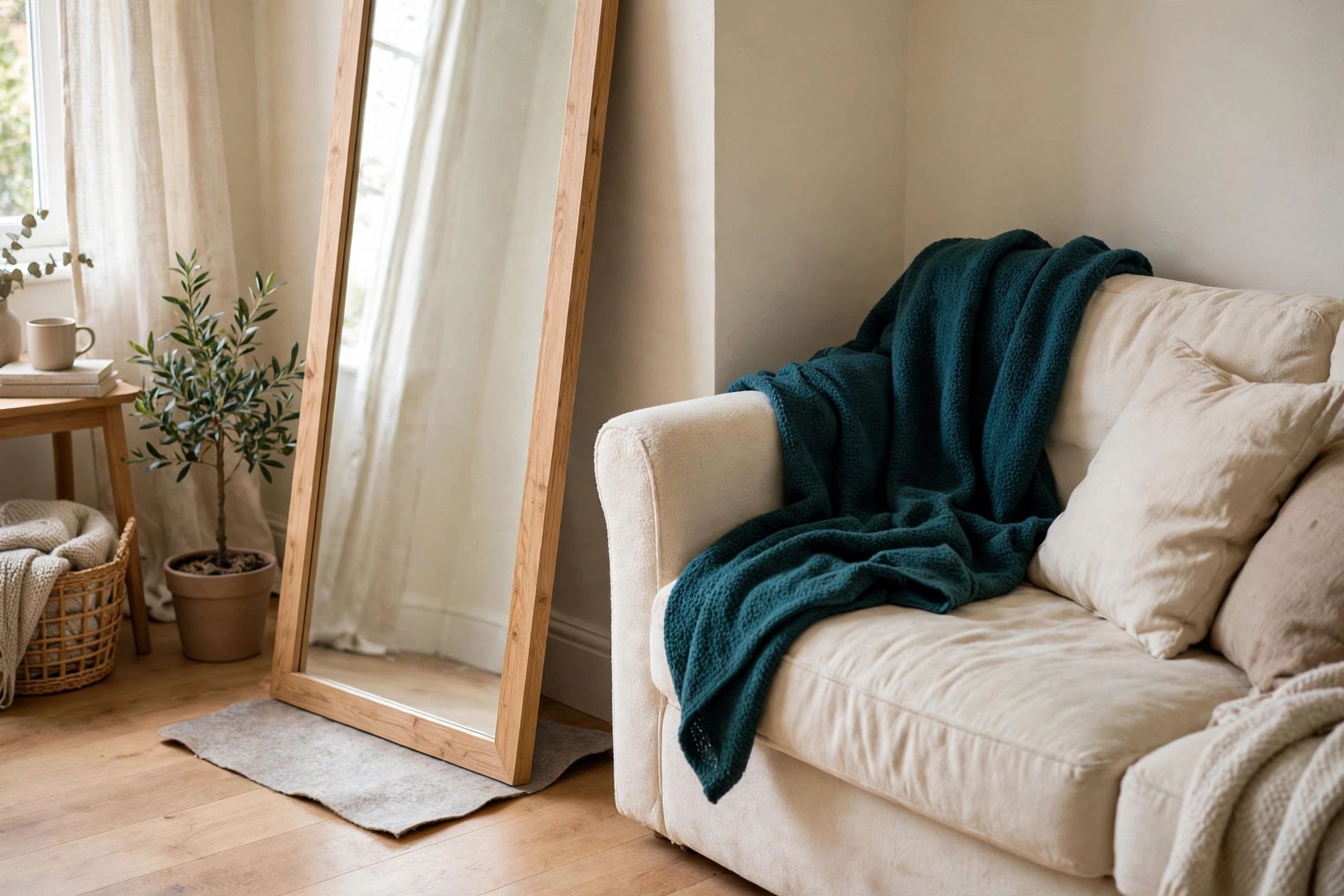
The mirror does the decorating here. Lean a full length mirror against the wall beside the loveseat, on a felt pad so the frame edge cannot mark the floor. It bounces light, it makes the room look deeper, and it needs zero fixings. Hang nothing above the sofa in this band. There is no wall space to spare, and a leaning frame on the side table does the same job.
Best for: one or two people, a studio corner that doubles as a living room, a first rental. Watch out for: a full sofa in this band. It eats the walkway and leaves no place for a side table. Verdict: the only plan in this guide where a loveseat beats a sofa outright. The tiny living room layout ideas guide works the same band with more plan variants.
Plan B: Small, 80 to 120 sq ft, the sofa wall plan
Direct answer: In a Small living room, center an 84 in sofa on the long wall, put the TV on a stand opposite, and anchor both with an 8×10 ft rug.
Take a 10×12 ft (3.0×3.7 m) room. The wall math from the intro passes cleanly: 84 in plus 18 in equals 102 in on a 120 in wall, with 18 in spare. The rug subtraction passes too: an 8×10 ft rug on a 120 in wide wall leaves 24 in total, or 12 in (30 cm) of bare floor on each side, and on the 144 in (366 cm) length it leaves 24 in total, or 12 in at each end. That frame of bare floor is what makes the rug look placed, not dropped.
The TV rule matters most in this band. A TV is too heavy and too valuable to trust to adhesive, and no strip manufacturer rates strips for a TV. Put the TV on a low console stand with its feet fully on the floor, and run the cable behind the stand, not along the wall. Viewing distance works out at about 9 ft, which suits a 55 in screen without anyone craning.
Best for: couples, small families, anyone whose living room is also the TV room. Watch out for: pushing the sofa against the TV wall to gain floor space. It wrecks the viewing distance and blocks the walkway behind you. Verdict: the most useful plan in this guide, and the one most renters should start from. The small living room layout ideas guide covers the same band with more seating variants.
Plan C: Compact, 120 to 180 sq ft, the floated sofa and console plan
Direct answer: In a Compact living room, float the sofa with its back to the room, put a narrow console behind it, and let the console act as the wall you are not allowed to build.
Take a 12×14 ft (3.7×4.3 m) room. Float an 84 in sofa about 36 in (91 cm) off the back wall, leaving a walkway behind it, and slide a console table 12 in (30 cm) deep behind the sofa back. The console gives you a lamp spot, a book stack, and a place for the remote, all without touching the wall. Add a plug in or battery sconce on the console instead of a wall light: a battery sconce pair costs about $17 as of November 2026, it sticks on with its own adhesive mount or stands on the console, and it moves with you.

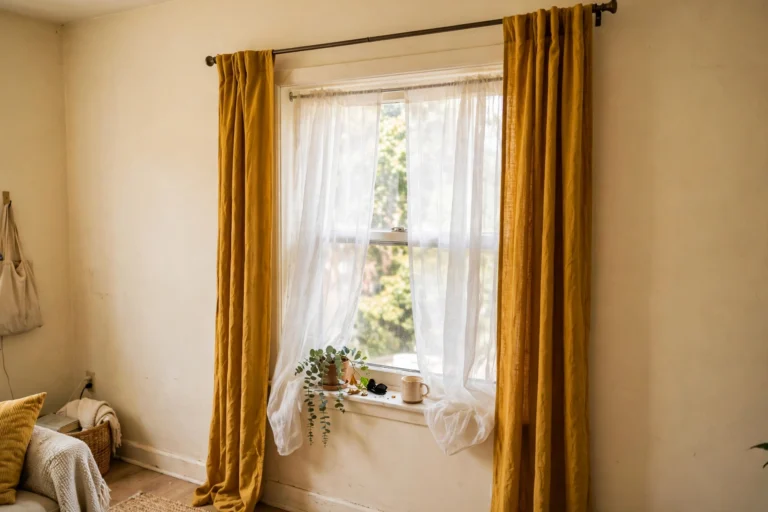
Curtains in this band go on a tension rod inside the window frame, which is the kind of small decision a no drill living room layout depends on: pressure, not holes. A rod rated for the window width holds lightweight curtains with pressure alone, and it leaves zero marks. If the window is wider than the rod rating, use two narrower panels on one rod rather than forcing a long rod to bow.
Best for: renters who want a reading corner or a work corner behind the sofa, open plan rooms that need a boundary. Watch out for: a tall open shelf as a divider. It looks like a wall, but an unanchored tall shelf can tip, and fixing it to the wall breaks the no drill rule. Use a low, broad console instead. Verdict: the plan that makes a Compact room feel designed rather than furnished. The medium living room layout ideas guide covers this band in more depth.

Plan D: Modest, 180 to 250 sq ft, the two zone plan
Direct answer: In a Modest living room, split the room into two zones with furniture: a seating zone on a 9×12 ft rug, and a second zone for dining or work behind the sofa console.
Take a 14×16 ft (4.3×4.9 m) room. The seating zone takes the sofa, two chairs, and a coffee table on a 9×12 ft rug. The rug subtraction is generous here: on a 168 in (427 cm) wall, a 108 in wide rug leaves 60 in total, or 30 in (76 cm) of bare floor on each side. Behind the sofa, the console marks the boundary, and a second rug or a different lamp tone marks the second zone. Nothing is built, nothing is screwed in, and the whole split can be undone in an afternoon.
This is also the band where a leaning mirror earns its keep twice over. One large leaning mirror in the seating zone reflects the window light, and because it stands on the floor, it moves to the next rental with no patching. The 14×16 living room layout ideas guide shows exactly how that rug anchors a 224 sq ft room, and its two zone split is the drilled free cousin of this plan.
Best for: sharers, families, anyone whose living room must also be a dining room or a work corner. Watch out for: filling the second zone with a full dining set plus a desk. Pick one second use, not two. Verdict: the plan for renters who refuse to live in one big undifferentiated room. The no drill bedroom layout guide uses the same band logic for bedrooms, if you want the matching set.
The no drill toolkit: what holds, what leans, what stands
Direct answer: Hang only what the manufacturer rates for strips, lean anything tall or heavy, and stand everything else on furniture. Guessing is how paint comes off.
| Tool | Holds or does | Deposit risk 1 low to 5 high |
|---|---|---|
| XL adhesive strips, 4 pairs | Frame up to 20 lb, max 24×36 in | 1, if removed by pulling the tab straight down |
| Adhesive hooks | Keys, light frames, cables | 1, if weight limit respected |
| Tension rod | Lightweight curtains inside a window frame | 1, pressure only |
| Leaning mirror or art | Any size that stands safely on the floor | 1, felt pad under the frame edge |
| Battery or plug in sconce | Light without wiring | 1, adhesive mount or console placement |
| Narrow console table | Lamp, books, TV stand duty | 1, freestanding |
| Peel and stick wallpaper | Accent wall only after a 48 hour test patch | 3, removal depends on paint and finish |
The adhesive budget, worked out: 4 pairs of XL strips hold 20 lb. A framed print under 20 lb hangs. A mirror over 20 lb leans. A TV stands on a console, always. If a frame is close to the limit, weigh it on a bathroom scale before you hang it. That one minute saves a fallen frame and a paint repair.
Materials list and 7 step weekend setup
Direct answer: You need a tape measure, a roll of painter’s tape, the toolkit above, and one free weekend afternoon. The tape on the floor matters more than any single purchase.
Materials: tape measure, painter’s tape, XL adhesive strips (4 pairs), adhesive hooks, tension rod rated for your window width, leaning mirror with felt pads, 8×10 ft or 9×12 ft rug to suit your band, battery sconce pair, narrow console table if your plan uses one, floor lamp.
- Measure the room wall by wall, and write down the sofa wall length and the room depth. Check the sofa math before you buy anything.
- Tape the rug outline on the floor with painter’s tape, and walk around it. If the walkway feels tight, drop one rug size.
- Place the sofa first, then the rug, then the TV stand. Big pieces set the plan, small pieces fill it.
- Set the console behind the sofa if your plan uses one, and put the lamp and sconce on it.
- Hang only the frames that pass the adhesive budget, on clean, fully cured paint, and wait one hour before hanging.
- Fit the tension rod curtains, lean the mirror on its felt pad, and place the plants last.
- Photograph every wall and corner, and keep the photos with your move in pictures. They are your deposit evidence.
Time estimate: about 3 to 4 hours for a Small room, up to a full afternoon for a Modest two zone plan. No drying time, no drilling, no landlord visit needed for the work itself.
Renter caveat: check the lease before you stick anything
Direct answer: Read the lease for three things before you start: whether adhesive products are named, whether small holes are allowed (irrelevant here, but it tells you how strict the landlord is), and what counts as damage at move out.
If the lease bans adhesive products outright, skip strips and wallpaper and lean everything instead. If it is silent, test every adhesive on a hidden patch for 48 hours first, and keep the packaging with the weight limits. If you are unsure, ask in writing. A short message works: “Hi, I plan to use removable adhesive strips rated to 20 lb and a tension rod inside the window frame, with no drilling or holes. Is that OK?” A written yes beats a verbal yes at move out.
Removal order, in reverse: take down curtains and rods first, then lift leaning pieces off the floor, then pull strip tabs slowly straight down along the wall, never outward, then roll up the rug last so the floor is clear for the final photos. If a tab snaps, heat it gently with a hairdryer on low and peel slowly, and stop if paint starts to lift.
Cost breakdown, as of November 2026
Direct answer: A no drill living room layout starter kit costs about $176 to $273, and adding a narrow console takes it to about $281 to $378. These are checked market prices, not a receipt for a single shop.
| Item | Checked price, November 2026 |
|---|---|
| XL adhesive strips, 4 pairs | $7 to $13 |
| Tension rod | $13 to $20 |
| Leaning mirror | $52.99 |
| 8×10 ft rug | $86 to $170 |
| Battery sconce pair | $17 |
| Starter kit total | $176 to $273 |
| Narrow console table, 36 in (optional) | $104.99 |
| With console | $281 to $378 |
Prices were checked in November 2026 from manufacturer and retailer listings. The mirror price is a Walmart listing as of November 1, 2026, and the console price is a Target listing checked November 3, 2026. Prices move, so check again before you buy, and buy the rug last: it is the biggest cost and the easiest to get wrong.
Mistakes to avoid
Direct answer: The expensive mistakes are all weight and placement mistakes, not taste mistakes.
Do not hang a TV on strips, ever. Do not hang a frame over a sofa if the manufacturer warns against hanging over beds and seating, and never hang anything heavy above where someone sits. Do not stick strips on fresh paint: wait until the paint is fully cured, or the strip will take the paint with it. Do not use a tension rod wider than its rating, or it will bow and drop the curtains. Do not skip the felt pad under a leaning mirror, or the frame edge will mark the floor. And do not block a heater or a vent with a floated sofa: leave the clearance the heater maker states.
What to skip
Direct answer: Skip the things that look renter friendly but cost deposit money later.
Skip peel and stick wallpaper on textured walls or on paint you did not apply yourself, unless a 48 hour test patch peels clean. Skip tall unanchored shelving as a room divider, since it needs a wall fixing to be safe. Skip adhesive hooks for anything near their stated limit: if it is close, lean it or stand it instead. Skip a rug pad that is not grippy on hard floors, or the rug will creep every day. And skip buying the console before you measure the sofa wall: a console longer than the sofa looks wrong, and a console deeper than 12 in eats the walkway behind a floated sofa.
How do I arrange a living room without drilling any holes?
Use furniture for structure, a rug for the zone, and adhesive or leaning pieces for the walls. Place the sofa first, anchor it with a rug, stand the TV on a console, lean the mirror, and hang only light frames on strips rated for their weight. Nothing in that order needs a drill.
Can I hang a TV without drilling in a rental?
No, not on adhesive strips. No strip maker rates strips for a TV, and a falling TV is a safety and deposit disaster. Use a freestanding TV stand or a media console with its feet fully on the floor, and keep the viewing distance at about 9 ft in a 12 ft deep room by placing the sofa correctly.
Will adhesive strips damage my rental paint?
Not if you use and remove them correctly. Clean the wall first, respect the printed weight limit, wait the stated time before hanging, and remove by pulling the tab slowly straight down along the wall, never outward. Test a hidden patch first on fresh, textured, or unknown paint.
How do I hang curtains without drilling?
Use a spring tension rod inside the window frame for lightweight curtains, or a twist to fit rod for wider windows. Both grip with pressure alone and leave zero marks. For a high and wide look without drilling, use adhesive hooks rated for the rod weight, and check the rating before you hang heavy fabric.
This no drill living room layout guide was written from manufacturer load limits, computed room math, and checked November 2026 prices, not from a test in a rented home. The sofa wall sums, rug subtractions, TV viewing distance, adhesive budget, and cost totals were re-added by hand before publishing. If a price has moved since November 2026, the method and the math still hold: measure first, respect the weight limit, and lean or stand anything that does not pass it.