Best Over-the-Door Organizers for Small Spaces: 7 Types Worth It (and 2 to Skip)
If your shelves are full and your floor space is gone, the back of a door is the storage you already own. The best over-the-door organizers turn that dead surface into a pantry shelf, a shoe rack, a towel bar, or a whole extra closet — with no drilling, no screws in the wall, and nothing to patch when you move out. The trick is picking the right type for the room, because a fabric pocket organizer that is perfect in a bedroom will sag under a pantry full of cans, and a wire rack built for cans looks wrong in a bathroom.
Before You Buy: Measure the Door First
Every over-the-door organizer hangs from hooks that slide over the top of the door, so the door itself decides what works. Most interior doors are 1.25 to 1.75 inches (3.2 to 4.4 cm) thick, and most organizers are built for exactly that range. If your door is thicker, check the hook depth first, or the door will not close properly. Check the clearance on both sides too: a pantry rack loaded with cans needs about 4 to 5 inches (10 to 13 cm) of depth behind the door. And be honest about weight — hollow-core doors, the light doors in most apartments, can flex under 30 pounds (14 kg) or more, so keep heavy loads on solid doors.
1. Fabric Pocket Organizers: Best for Bedrooms and Closets
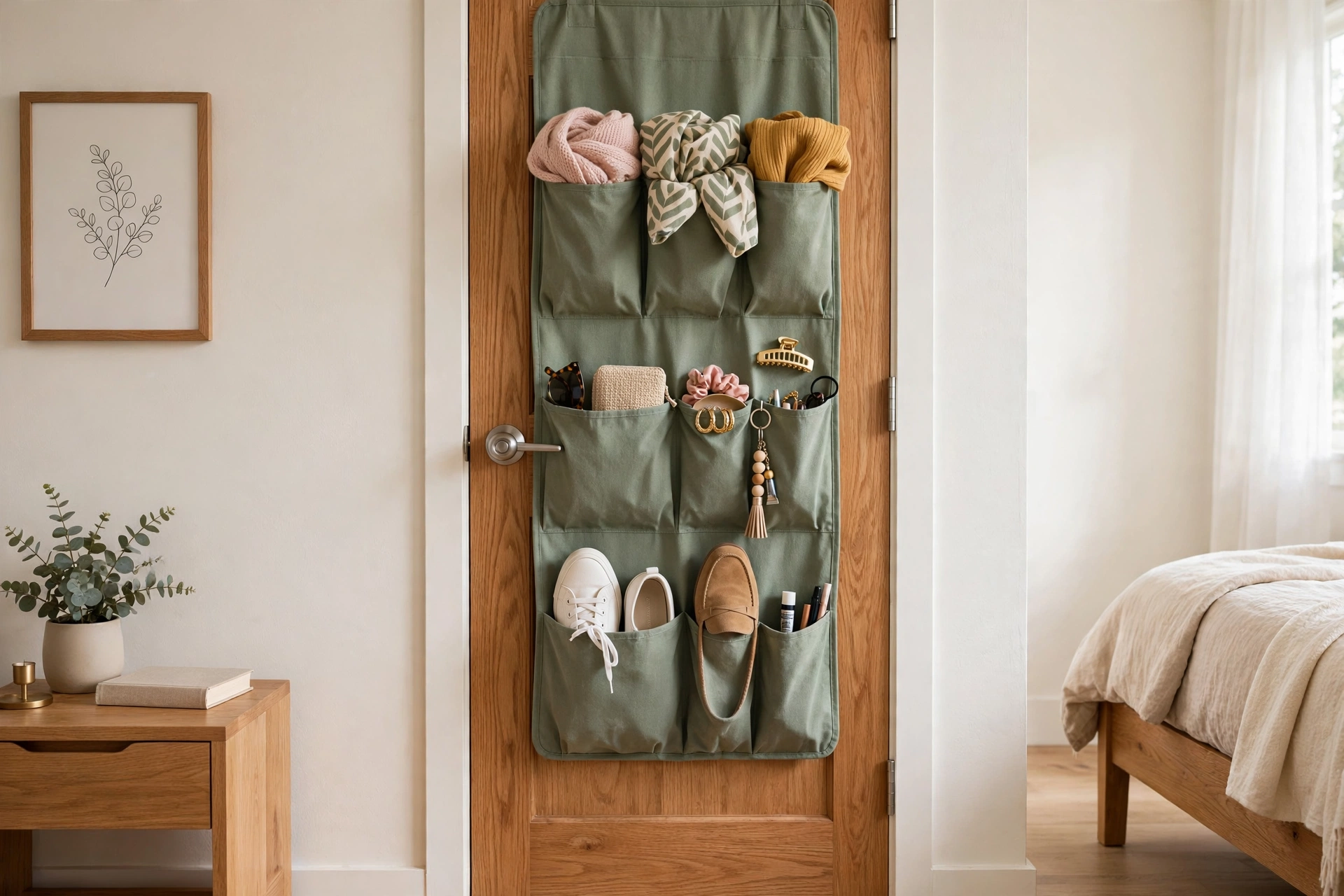
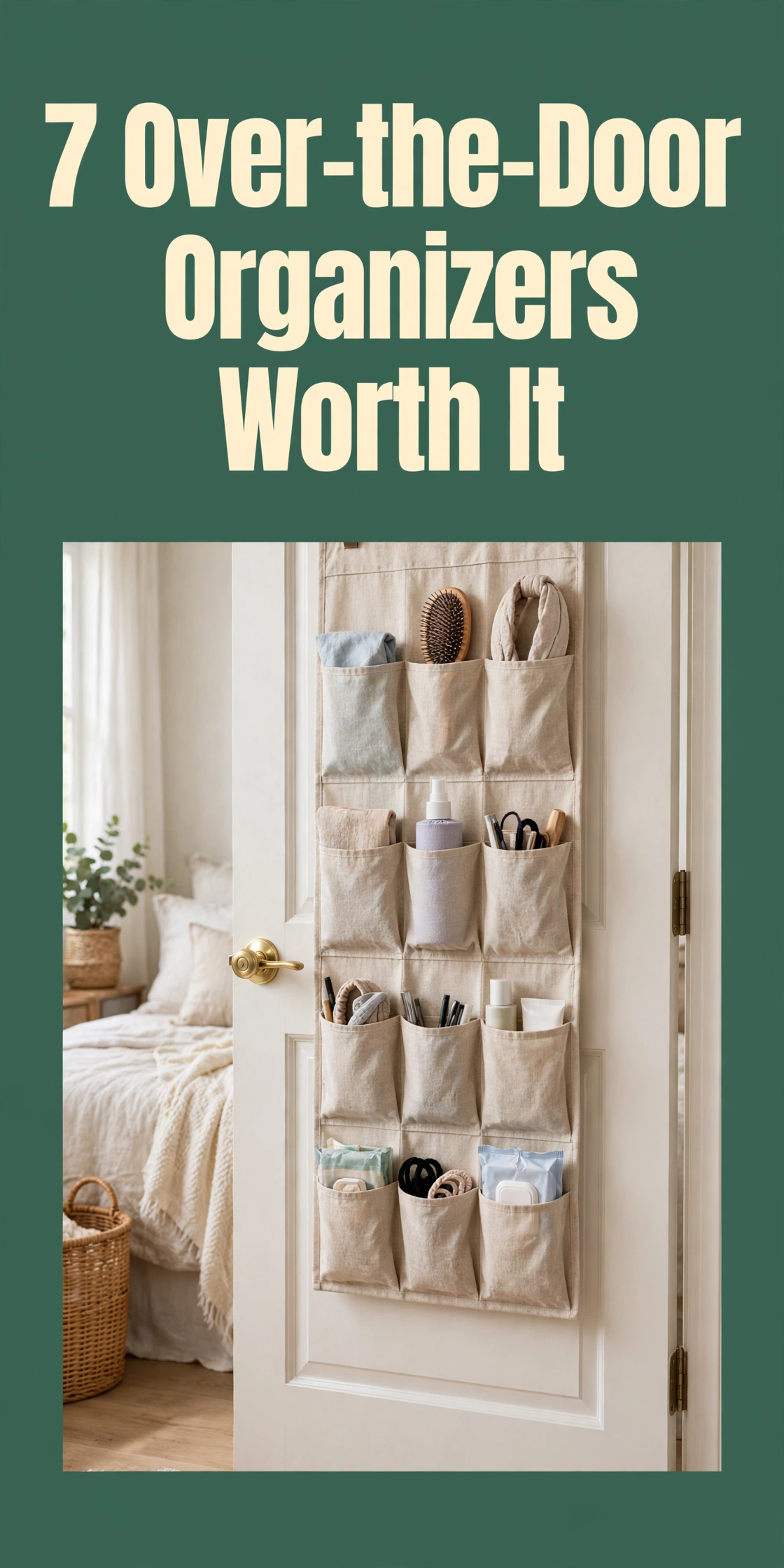
The classic fabric pocket organizer is a long sheet of pockets that hangs from two or three hooks. Clear pockets let you see everything at a glance; fabric pockets look tidier and hide clutter. Either way, this is the best over-the-door organizer for small, light things: scarves, belts, sunglasses, chargers, hair tools, and craft supplies. Most run $8 to $20, and the limit is weight — a pocket full of shoes stretches the fabric and pulls the whole sheet forward. Keep the heaviest items in the lowest pockets. The same logic that makes organizing a kitchen with no pantry work — using doors, walls, and gaps instead of new cabinets — applies here: the door is just another wall you already have.
2. Wire Basket Pantry Racks: Best for Kitchens
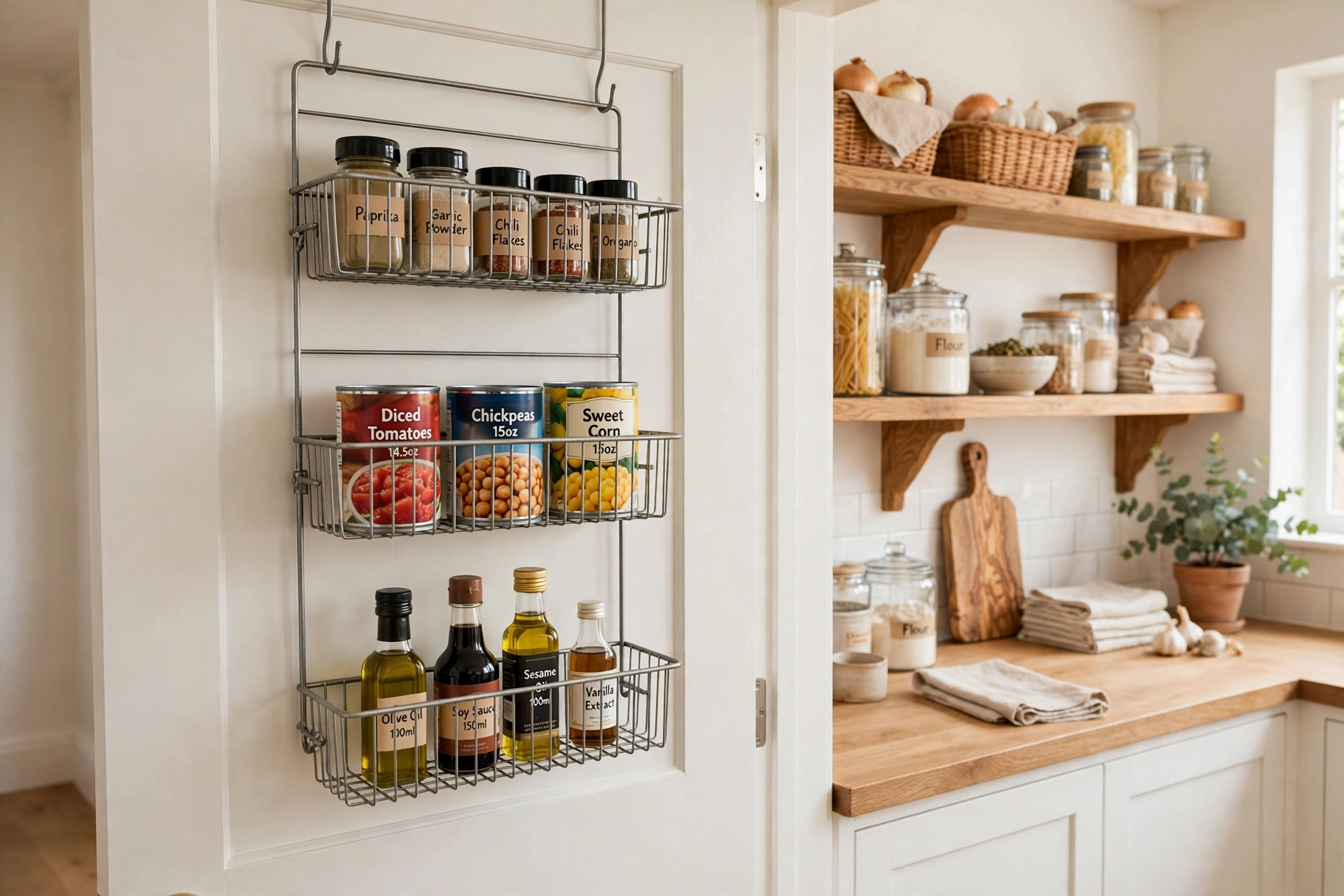
If you need a pantry and do not have one, a wire basket rack is the single most useful over-the-door organizer you can buy. Rows of open wire baskets hold cans, spice jars, and bottles where you can see and grab them. Good racks hold 40 to 60 pounds (18 to 27 kg) in total, with 10 to 15 pounds (4.5 to 7 kg) per basket, and the baskets adjust up and down so tall bottles fit. Look for thick wire, not thin wire that bows under a row of cans, and for a middle strap or pad that stops the rack from swinging. A rack that only hooks at the top will bounce every time the door closes; one anchored in the middle stays quiet.
3. Hook Racks With Baskets: Best for Bathrooms and Entryways
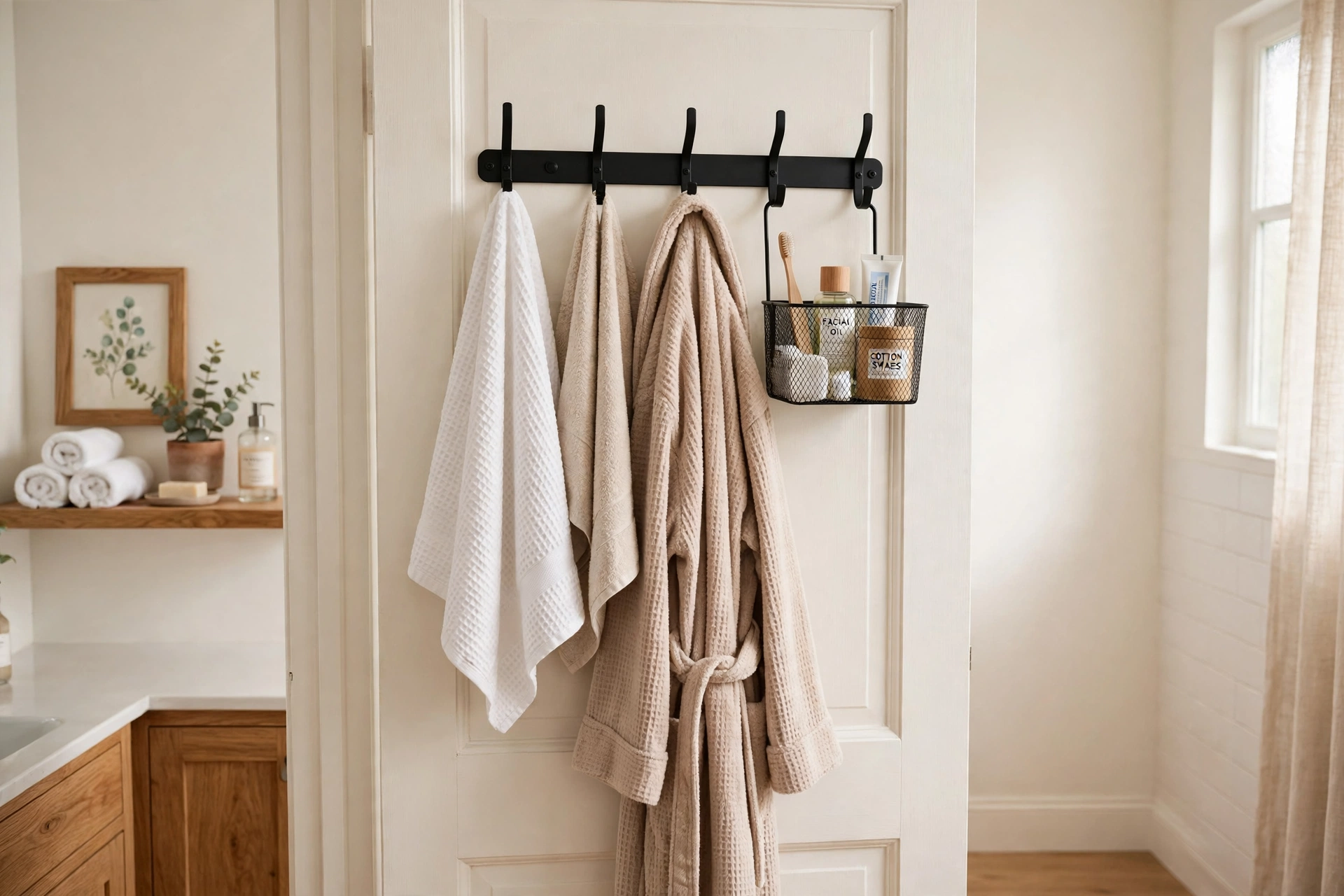
A hook rack is the simplest over-the-door organizer: a bar of hooks, sometimes with one or two mesh baskets attached. In a bathroom it holds towels, a bathrobe, and a basket of toiletries. In an entryway it holds coats, bags, and keys. Buy metal, not plastic, if the rack will hold wet towels or heavy coats — metal hooks hold 5 to 7 pounds (2 to 3 kg) each without bending, while plastic hooks creep and snap over time. Count the hooks honestly, and pick hooks with a rubber or foam pad: they protect the door’s finish and stop the rack from rattling.
4. Over-the-Door Shoe Organizers: Best for Small Bedrooms
Shoe organizers are fabric pocket organizers with deeper, shoe-sized pockets — usually 24 pockets on a single door. They are the fastest way to get shoes off the floor in a small bedroom, and they work on closet doors, bedroom doors, and the back of a bathroom door for slippers. The limit is the same as any fabric organizer: weight and swing. Keep one pair per pocket, keep heavy boots on the floor, and put the organizer on a door you do not slam. Pairing a shoe organizer with the ideas in our small closet organization guide gives you two wins at once: shoes off the floor and shelves free for everything else.
5. Over-Cabinet-Door Baskets: Best for Kitchens and Bathrooms
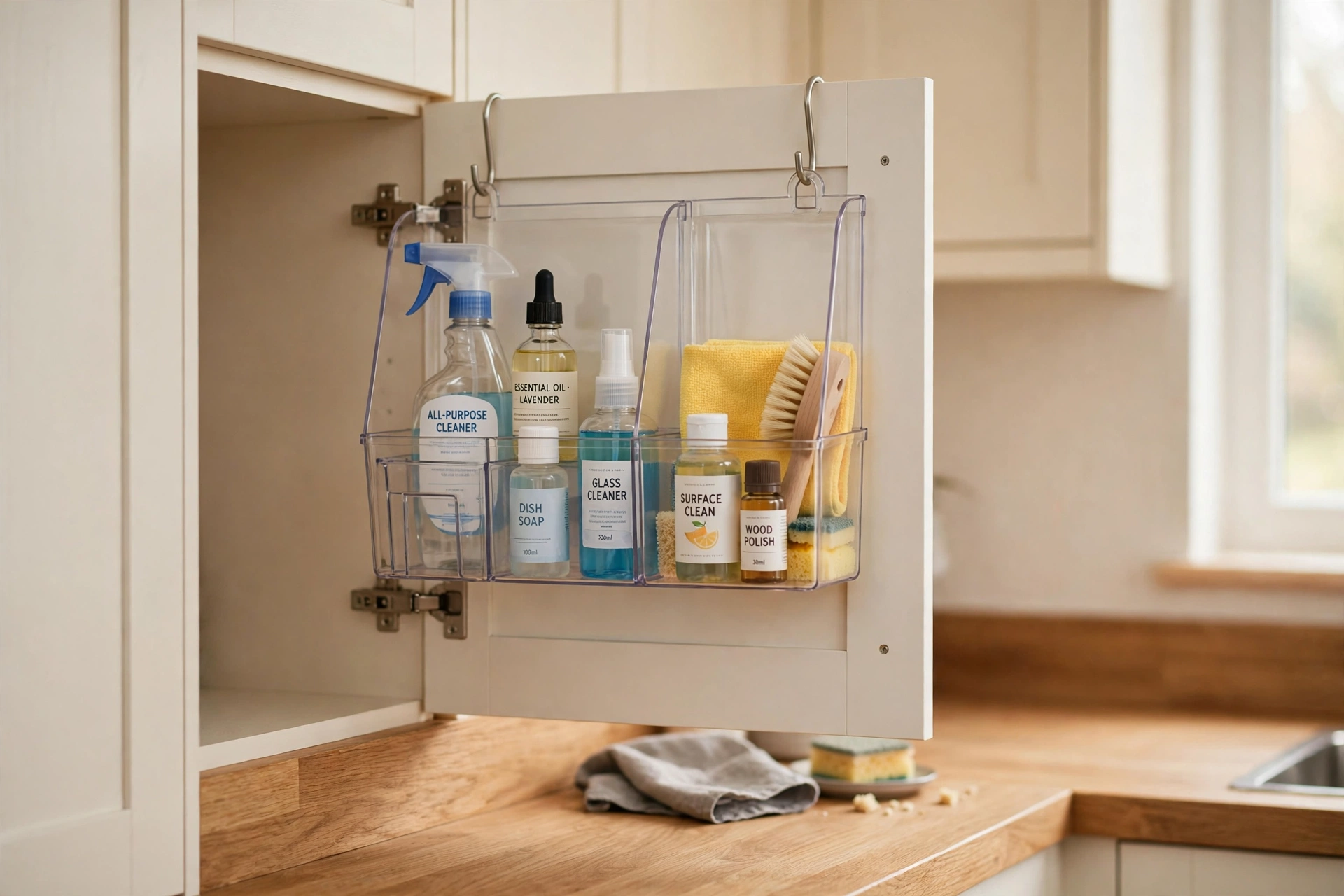
Over-cabinet-door baskets are the small cousins of pantry racks: a single clear or wire basket that hooks over a cabinet door, inside or out. Inside a kitchen cabinet door, one holds cleaning sprays, sponges, and trash bags right where you use them. Inside a bathroom cabinet door, one holds hair tools or medicine bottles. These are cheap — usually $5 to $12 each — and the easiest organizer to install badly, because a basket that is too deep will stop the cabinet door from closing. Measure the inside depth first, and leave at least half an inch (1.3 cm) of clearance.
6. Over-the-Door Towel Racks and Bathroom Caddies: Best for Small Bathrooms
A towel rack that hangs over the door gives a small bathroom something it almost never has: a place for two full-size towels that does not need a wall stud. The bar style holds towels flat so they dry properly; the caddy style adds baskets for shampoo and soap. In a bathroom with no linen closet, this one piece can replace a whole shelf unit. Check two things first: the finish — bathroom doors get steamed daily, so stainless steel or powder-coated metal outlasts plain chrome — and the swing, since a towel rack adds 3 to 4 inches (8 to 10 cm) of depth to the door and must clear the toilet tank and vanity.
7. Hanging Shelf and Cubby Organizers: Best for Closets and Kids’ Rooms
The last type hangs from a single wide hook and drops down in fabric shelves — three to six cubbies that turn the back of a door into a mini bookcase. It works for folded clothes in a closet, toys in a kids’ room, and handbags in a bedroom. It is also the type most people buy for the wrong room: cubbies are open, so anything small falls out, and anything heavy pulls the whole unit forward. Use it for light, bulky things only — folded T-shirts, handbags, stuffed animals — and skip it for books or cans. Once the door holds the overflow, the stackable bins we compared for closets and pantries can hold what is left, and the whole room stays organized instead of just one door.
The 2 Types to Skip
First, skip ultra-cheap thin-wire racks. If the wire flexes when you press it with a thumb, it will bow under a row of cans within a month, swing, scrape the door, and dump its contents. Spend $5 more for thicker wire — it is the difference between an organizer that lasts a year and one that lasts five. Second, skip any organizer wider than your door or deeper than your clearance. An organizer that blocks the door from closing is not storage, it is an obstacle, and one that needs screws into a hollow-core door defeats the whole point of a no-drill solution. Measure first, buy second.
Quick Picks by Room
- Bedroom or closet: fabric pocket organizer or shoe organizer for light items; hook rack for coats and bags.
- Kitchen or pantry: wire basket rack for cans and spices; over-cabinet baskets for cleaning supplies.
- Bathroom: towel rack or hook rack with a basket; over-cabinet basket inside the vanity door.
- Laundry closet: hanging shelf organizer for light supplies; hook rack for a lint roller.
- Kids’ room: fabric pocket organizer for toys; hanging shelf organizer for stuffed animals.
Whichever type you pick, load it once, live with it for a week, and then adjust: move the baskets, swap the pockets, and move anything that swings or sags to a lower, sturdier spot. That one week of adjusting is what turns a good organizer into a system — the same habit that makes our room-by-room whole-home organization system work, one door and one room at a time.
Will an over-the-door organizer damage my door?
Not if it fits. Hooks made for your door thickness, with foam or rubber pads, leave no marks on most doors. Damage happens when a rack is too narrow for a thick door and the metal digs in, or when a very heavy rack hangs on a hollow-core door for months. Check the fit, use the pads, and keep heavy loads on solid doors.
What size over-the-door organizer fits a standard door?
Most organizers fit doors 1.25 to 1.75 inches (3.2 to 4.4 cm) thick and up to about 17 inches (43 cm) wide. Measure your door’s thickness and the clearance behind it before ordering, and make sure the organizer is narrower than the door itself so it does not catch the frame.
How much weight can an over-the-door organizer hold?
Fabric pocket organizers hold about 20 to 30 pounds (9 to 14 kg) in total, wire pantry racks hold 40 to 60 pounds (18 to 27 kg), and individual metal hooks hold 5 to 7 pounds (2 to 3 kg) each. Hollow-core doors should carry less than solid doors — when in doubt, load light and move heavy items to a shelf.
Can I use an over-the-door organizer on a hollow-core or bifold closet door?
Hollow-core doors work fine for light organizers — fabric pockets, shoe organizers, and hook racks with light loads. Bifold doors are a poor fit: they fold in the middle, so a hanging organizer swings, catches, and can pull the door off its track. For bifold closets, use the back of a bedroom door or a freestanding rack instead.