DIY Thrift Furniture Flip for Small Spaces: 7 Flips That Fit (and What to Skip)
A diy thrift furniture flip for small spaces works when you test the fit before you buy, not after you paint. The test has three parts. The piece must pass a 30 in (76 cm) apartment door and the hallway turn. It must leave a 24 in (61 cm) walkway clear in the room. And one person must be able to carry it up the stairs. This guide runs that test on 7 flips, prices a nightstand flip two ways with prices checked in November 2026, and shows the no-sand chalk paint route that suits an apartment. The big dresser is the most overrated flip for a small apartment. The nightstand is the most underrated. Start with the nightstand, and you can finish in one afternoon.
The Small-Space Flip Test: Does a DIY Thrift Furniture Flip for Small Spaces Fit Your Door?
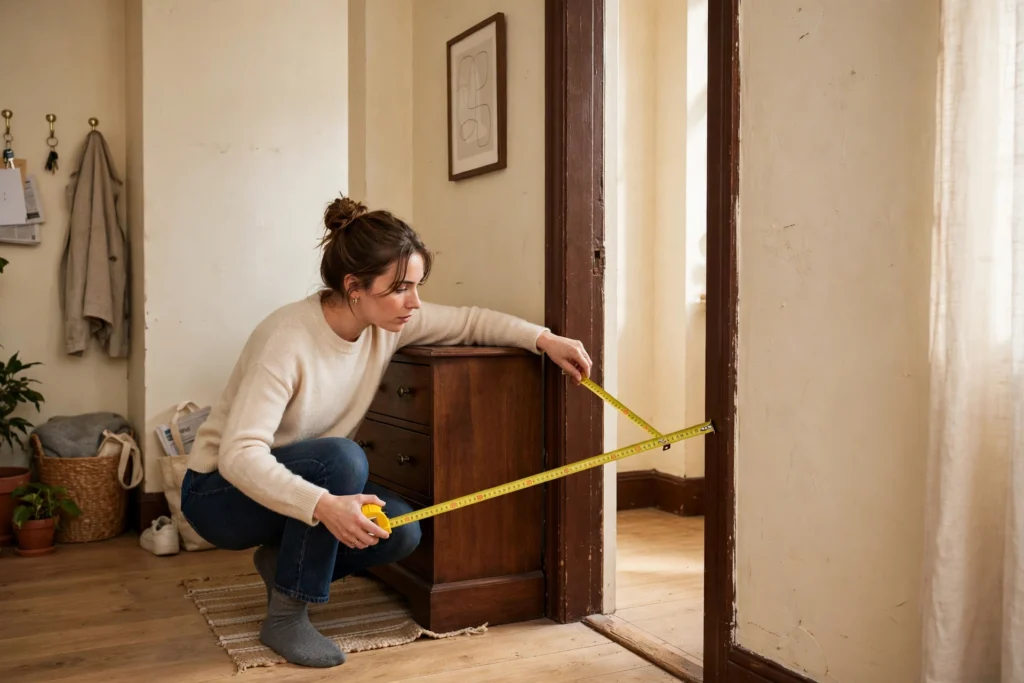
Measure three things before you pay: the narrowest door and hallway turn on the way in, the walkway the room can spare, and whether you can lift one end alone. A piece that fails any one of the three is a bad buy at any price, even if the wood is solid and the paint is cheap. The table below turns those three checks into numbers you can use in the store.
| Piece | Footprint | Through a 30 in (76 cm) door? | Walkway math in a 10×12 ft (3×3.7 m) bedroom |
|---|---|---|---|
| Nightstand | 18×16 in (46×41 cm), 2 sq ft | Yes, 12 in (30 cm) to spare | Sits beside a 60 in (152 cm) bed, 14 in (36 cm) of depth budget left |
| Round side table | 18 in (46 cm) round, about 1.8 sq ft | Yes, easily | Needs no wall run, parks in a corner |
| Small dresser | 30 to 36 in wide x 18 in deep (76 to 91 x 46 cm), 3.8 to 4.5 sq ft | Yes, carried on its side, since 18 in is less than 30 in | Needs 30 to 36 in of clear wall |
| Big dresser | 60 in wide x 18 in deep (152×46 cm), 7.5 sq ft | Only on its side, and only if the hallway turn clears 60 in diagonally | Eats half of a 10 ft wall, and leaves no room for a bed and a walkway |
| Wooden chair | About 18×18 in (46×46 cm) | Yes | Tucks under a desk or table when not in use |
| Bar cart | About 24×16 in (61×41 cm) | Yes, and it rolls | Parks in a 24 in gap between furniture |
Here is the walkway math. A 10 ft wall is 120 in (305 cm). A 60 in bed takes half of it. A 30 in walkway takes another quarter. That leaves 30 in of depth budget for furniture along that wall. A nightstand at 16 in deep fits with 14 in to spare. A dresser at 18 in deep fits with 12 in to spare. A big 60 in dresser fails on width, not depth: it needs 60 in of clear wall, and a 10 ft wall with a bed on it does not have 60 in to give. Measure the wall, not just the piece.
The carry test is simple. Lift one end of the piece in the store and walk it 10 ft (3 m). If you cannot do that alone, do not buy it alone. Bring a friend, borrow a dolly, or pick a smaller piece. A flip you cannot get into your apartment is not a bargain. It is a storage problem.
How to Tell Solid Wood From Veneer in 60 Seconds
Look at the grain, check an edge, open a drawer, and lift one end. Solid wood has grain that runs over the edge and around a corner. Veneer has a printed or sliced grain pattern that repeats, and it stops dead at the edge. Open a drawer and look at the sides: solid dovetail joints or thick solid sides mean real wood, while thin stapled sides mean a cheap build. Lift one end: solid wood is heavy for its size, and particleboard is heavy in a dead, flat way with no grain to show for it. If the edge is chipped and you can see a crumbly brown core, that is particleboard under a thin skin. Walk away from swollen particleboard every time. It will not sand flat, it will not hold a screw, and paint will not save it.
Thrift Store Furniture Flip Ideas: 7 Flips That Fit a Small Apartment
Every flip below passed the same diy thrift furniture flip for small spaces test: through a 30 in door, inside the walkway budget, and light enough for one person to carry. The list is short on purpose. A small apartment rewards a few good pieces, not a house full of projects.
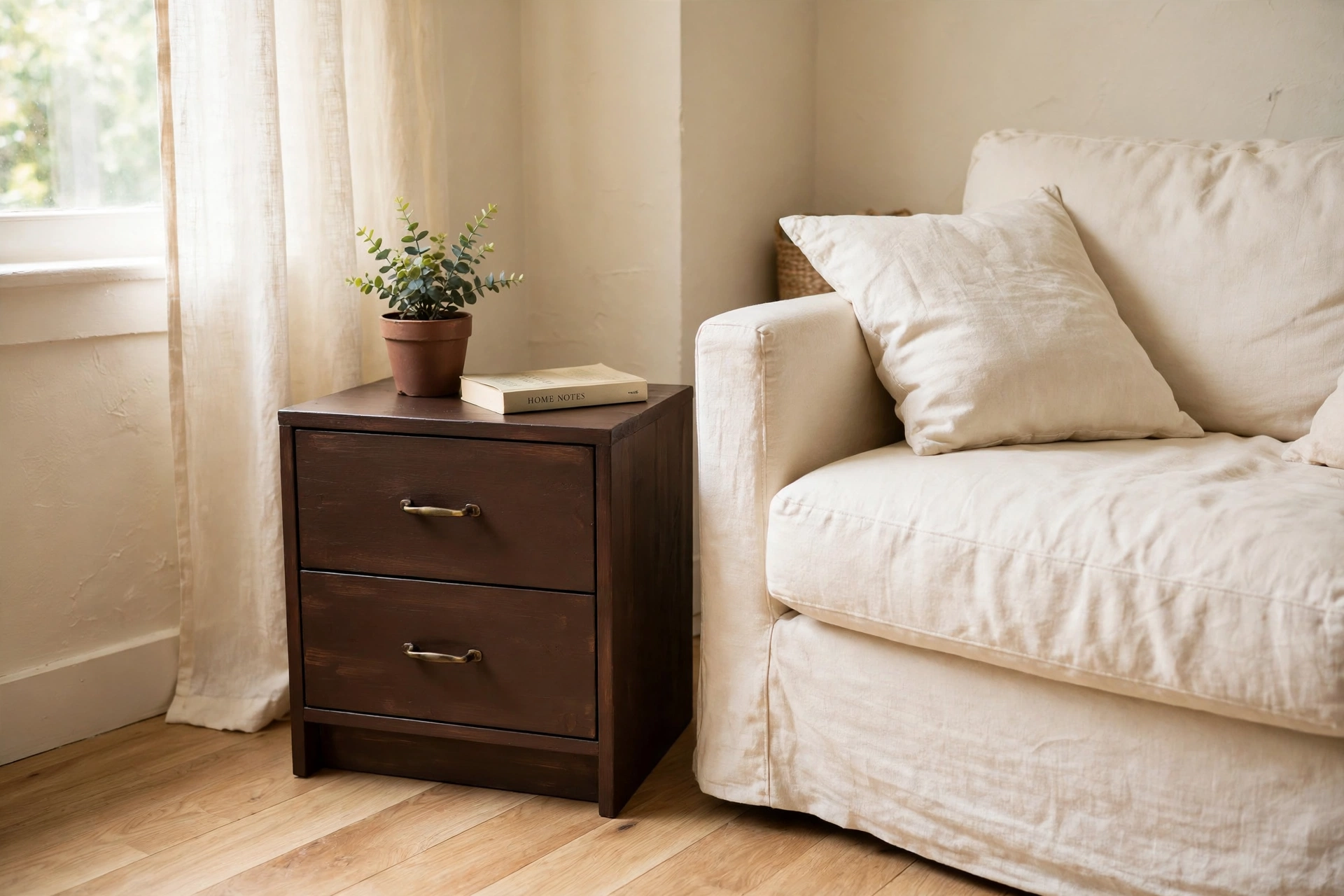
1. The nightstand. Best for: Bedrooms with no storage and no surface for a lamp and a book. Main advantage: One afternoon, one quart of paint, and a piece that fits through every door in the building. Watch out for: Wobbly legs and missing drawer runners. Rock it in the store before you pay. Verdict: The most underrated flip in this guide, and the one to start with.
2. The round side table. Best for: Living room corners and the gap beside a sofa. Main advantage: A round top has no corners to catch your hip in a narrow room, and a wobble is easy to fix with a felt pad. Watch out for: Three-legged tables tip more easily than four-legged ones. Verdict: The easiest win after the nightstand, and the cheapest to paint.
3. The wooden dining chair. Best for: A desk chair, extra seating, or a plant stand in a bright corner. Main advantage: Chairs are the cheapest solid wood in any thrift store, and paint changes them completely. Watch out for: Loose joints. Sit on it, twist it gently, and re-glue anything that moves before you paint. Verdict: Buy the chair with good bones and ignore the ugly finish.
4. The small bookshelf. Best for: Renters, because a low shelf moves with you and holds books, plants, and baskets. Main advantage: No wall fixing needed, and a low shelf doubles as a room divider in a studio. Watch out for: Tall narrow shelves tip. Keep it under 36 in (91 cm) tall or anchor it. Verdict: A solid pick, as long as you keep it low and wide.
5. The bar cart. Best for: Kitchen storage, bathroom storage, or a coffee station that rolls out of the way. Main advantage: Wheels mean the footprint is flexible, and two shelves hold more than they look like they should. Watch out for: Rusty casters and wobbly frames. Spin every wheel in the store. Verdict: The best flip for a home with no spare floor space at all.
6. The small bench. Best for: An entryway seat, the foot of a bed, or a hallway that needs a landing spot. Main advantage: A bench gives you a seat and storage in one piece, and it slides under a window. Watch out for: Check the weight it can hold, and skip benches with a cracked frame. Verdict: A good second project once the nightstand is done.
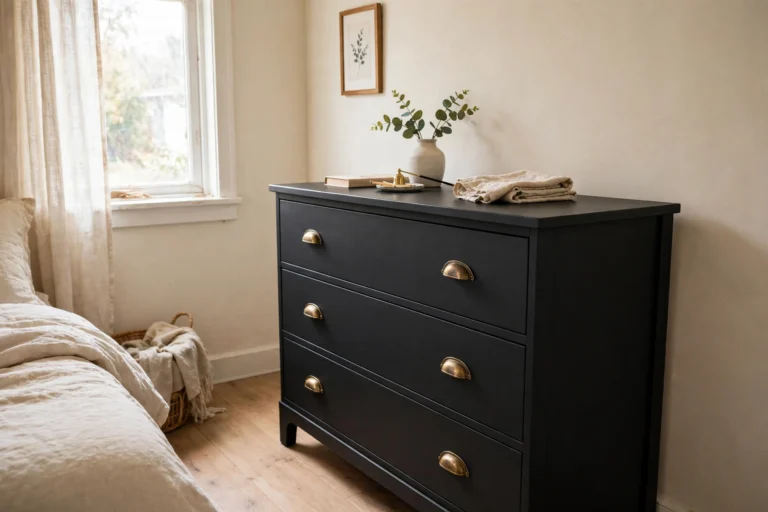
7. The small dresser, 30 to 36 in wide. Best for: Bedroom storage when a nightstand is not enough. Main advantage: Real drawers in a size a small room can hold, with a top that works as a changing table or a TV stand. Watch out for: This is the size limit. A 60 in dresser is the most overrated flip for a small apartment: it eats the room, it eats the weekend, and it may not clear the hallway turn. Verdict: Buy the 30 to 36 in dresser. Leave the big one in the store.
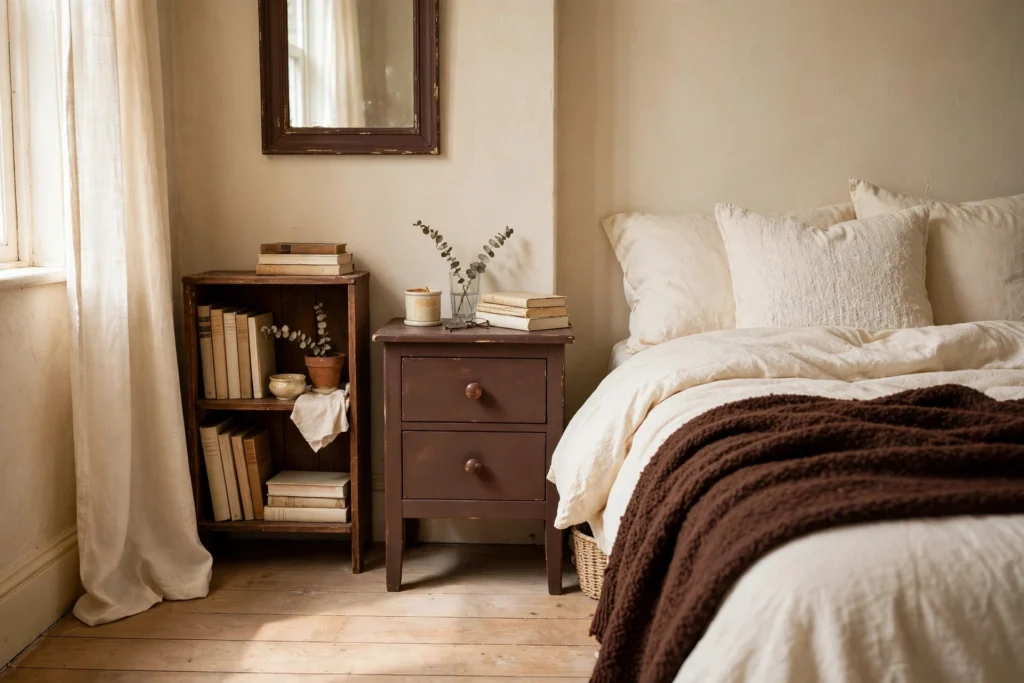
How Much Does It Cost to Flip Thrift Furniture?
One nightstand, two routes, prices checked in November 2026. Both routes use the same thrifted nightstand, so the only difference is the paint system. A quart of paint covers about 150 sq ft (14 sq m), so a nightstand uses a small share of the can, and the rest can go to small projects that use half a can of leftover paint.
| Item | Route A: chalk paint, no sand | Route B: latex plus primer |
|---|---|---|
| Thrift nightstand | $10 to $30 | $10 to $30 |
| Rust-Oleum Chalked quart | $22.48 | Not used |
| Annie Sloan Clear Wax | About $25 | Not used |
| Zinsser Bulls Eye 1-2-3 primer quart | Not used | $17.99 |
| BEHR Premium Plus latex quart | Not used | $18.48 |
| Minwax Polycrylic topcoat | Not used | $15 to $20 |
| Sandpaper 120/220 pack | About $8 | About $8 |
| 2 in angled brush | $6 to $14 | $6 to $14 |
| Foam roller set | About $5 | About $5 |
| New knobs or pulls, 2 at $3 to $8 each | Not included | $6 to $16 |
| Total | $76.48 to $104.48 | $86.47 to $129.47 |
The sums check out. Route A: $10 plus $22.48 plus $25 plus $8 plus $6 plus $5 is $76.48, and $30 plus $22.48 plus $25 plus $8 plus $14 plus $5 is $104.48. Route B: $10 plus $17.99 plus $18.48 plus $15 plus $8 plus $6 plus $5 plus $6 is $86.47, and $30 plus $17.99 plus $18.48 plus $20 plus $8 plus $14 plus $5 plus $16 is $129.47. The latex quart is BEHR Premium Plus at $18.48, checked at Home Depot in November 2026. Route A is the simpler buy: fewer cans, no primer, and a finish that suits a first flip. Route B costs more at the low end but gives a tougher finish on pieces that take hard daily use. Time for either route is one afternoon of work plus drying time between coats.
Chalk Paint vs Latex: Which Paint Wins for a No-Sand Flip?
Chalk paint wins for an apartment flip, and latex wins for a piece that takes hard daily use. Chalk paint grips a clean surface with no sanding on most pieces, dries matte, and hides brush marks well. Rust-Oleum Chalked costs $22.48 a quart, while Annie Sloan Chalk Paint runs $40 to $45 a quart, and both cover about 150 sq ft per quart. Latex needs a bonding primer first: Zinsser Bulls Eye 1-2-3 primer at $17.99 a quart bonds to glossy surfaces without sanding, dries to touch in 30 minutes, and takes a recoat in 1 hour. The same brush-and-roll method in our guide to painting kitchen cabinets for under $200 works for furniture too, with smaller coats and a lighter touch.
One rule applies to both routes: sealant is not optional. Chalk paint without wax or a clear topcoat will mark, stain, and wear through on any surface you touch daily. Wax costs about $25, and a clear topcoat runs $15 to $20 for Minwax Polycrylic. The Rust-Oleum Chalked Matte Clear Topcoat 2-pack is $36.99 on Amazon if you want the matching system. On cure time, treat chalk paint gently for 48 hours and give it about 30 days to fully cure, which is the guidance in the no-sand painting guides. Do not put a heavy lamp or a stack of books on a fresh top for the first two days.
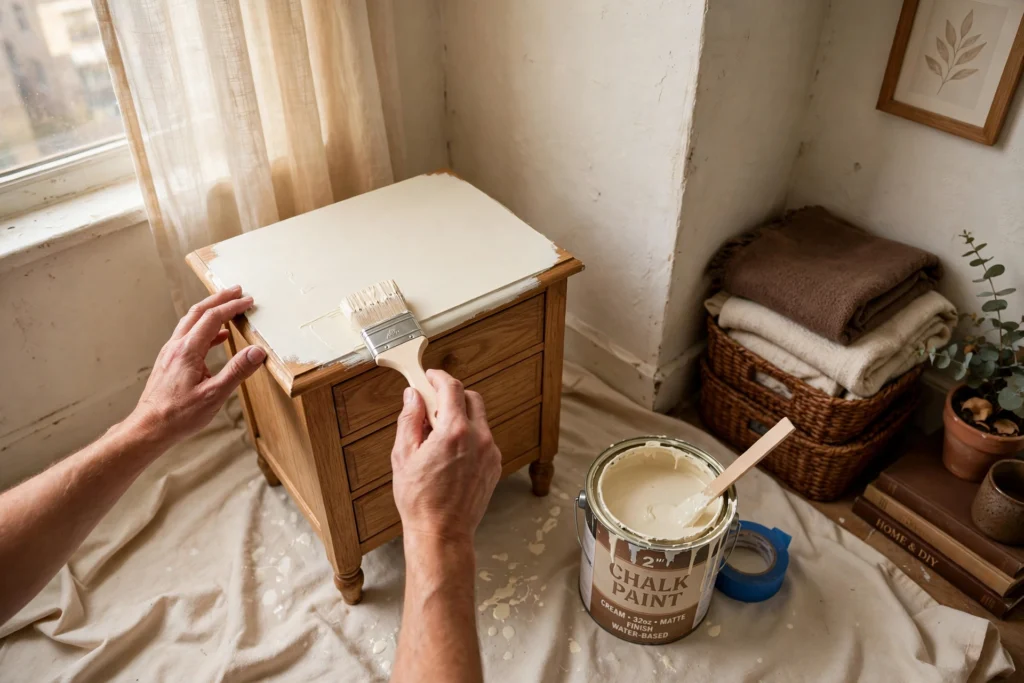
How to Flip Thrift Store Furniture in 7 Steps
These are the steps to follow in order. Step 1 comes first for a reason: it is the safety check, and it decides whether you sand at all.
- Check for lead paint first. If the piece was painted before 1978, treat it as if it could contain lead. The EPA reports that 87% of homes built before 1940 and 24% of homes built from 1960 to 1978 have some lead-based paint. Test before you sand anything, and never dry-sand old paint. The EPA recognizes LeadCheck and D-Lead kits for use by trained professionals.
- Measure the door, the hallway turn, and the room before you buy. A tape measure in the store beats a return trip with a piece that does not fit.
- Clean the piece with soap and water, then let it dry fully. Paint will not grip a greasy or dusty surface, and chalk paint is no exception.
- Scuff glossy spots lightly with 120-grit sandpaper and wipe off the dust. On the chalk paint route, this light scuff is the only sanding you need.
- Prime only where the paint needs grip, or use chalk paint straight on a clean surface. Primer is the latex route. Chalk paint skips it.
- Paint two thin coats, and let each coat dry before the next one. Thin coats dry flat. Thick coats drip, crack, and stay tacky.
- Seal it with wax or a clear topcoat, fit new knobs, and let it cure before heavy use. New knobs at $3 to $8 each are the cheapest upgrade in this guide, and they change the whole look.
How to Flip Furniture in an Apartment Without a Garage
A diy thrift furniture flip for small spaces in an apartment works when the workspace fits on a kitchen table and the tools fit in one bag. Lay a drop cloth on the table, paint with a brush and a small foam roller, and keep the piece near a window for airflow. Skip the power sander. Hand sanding with 120-grit paper makes almost no dust and no noise, which matters when the neighbors share a wall. Keep noisy work to daytime hours, and never sand old paint indoors. If your building has a balcony, check the rules before you paint there: some buildings ban painting on balconies, and wind will carry dust and paint smell to the neighbors. Dry the piece in the bathtub on a drop cloth overnight if floor space is tight, and keep pets and kids out of the room until the paint is dry to touch.
Mistakes to Avoid When You Flip Thrift Furniture
The most common mistakes are easy to name, and they are all avoidable. Do not skip the lead check on a pre-1978 piece. Do not skip the sealant, or the first coffee ring will mark the top forever. Do not paint in a cold or damp room, or the paint will stay tacky for days. Do not lay on thick coats to save time, because thick coats are the reason paint peels. Do not buy before you measure, and do not ignore a wobble in the store, because a wobble at home is a repair job, not a paint job. And do not sand old paint dry. If the piece is old and painted, test it first, then decide how to strip it safely.
What Furniture to Avoid Flipping
Some pieces are bad buys at any price, and the store is full of them. Skip big hutches, wardrobes, and 60 in dressers that will not clear a 30 in door or a hallway turn. Skip swollen particleboard, peeling veneer over a large area, and any piece with a strong smoke smell that will not air out. Skip drawers with missing runners or cracked sides, because new hardware will not fix a broken drawer box. Skip upholstered pieces unless you know how to check them for pests and stains, since a thrifted chair can carry more than a bad color. A companion build shows the other side of this rule: a thrifted cabinet can even become a hidden litter box cabinet when the piece is solid and the size is right, so judge the piece in front of you, not the category it came from.
Is Flipping Thrift Furniture Profitable?
It can pay, but the honest answer depends on whether you keep the piece or sell it. Keep-first math is simple: a nightstand flip costs $76 to $104 in materials, and you get a solid-wood piece that fits your room and your door. Sell-first math is tighter. The most honest range in the guides is $25 to $150 of profit per item, and that is before fees, unsold pieces, and your time. Casual earnings of $100 to $500 a month are claimed by several flipping guides, and that is a realistic ceiling for a steady side project, not a starting point. The $130,000 a year figure you will see in course ads is a course-selling claim, not a beginner outcome. Treat it as marketing, not math. If you flip to furnish your own home, every piece that fits is a win. If you flip to sell, count your hours, price the piece before you paint it, and sell locally, where there is no shipping to eat the profit.
What Should Renters Check Before Flipping Furniture?
Check the lease first, even though a flip is just furniture. Most leases say nothing about painting a nightstand, but some ban sanding, spray paint, or strong fumes indoors. Do the messy work outside or on a drop cloth, keep paint off the floors and the walls, and keep the receipt for the paint in case the landlord asks. A freestanding flipped piece carries almost no deposit risk, because nothing is fixed to the walls and it moves with you. The only real risk is damage to the rental while you work, so protect the floor, ventilate the room, and reverse nothing, because there is nothing to reverse. The piece leaves with you.
Sources
Lead paint testing and safety: US Environmental Protection Agency, frequent questions about testing lead-based paint, https://www.epa.gov/lead/frequent-questions-about-testing-lead-based-paint
Chalk paint costs and coverage: Angi, painting furniture with chalk paint, https://www.angi.com/articles/painting-furniture-chalk-paint.htm?entry_point_id=33797117++Plantation+shutters+cost
Prices in this guide were live-checked on Amazon and Home Depot in November 2026, and the fit math was computed from standard furniture dimensions. The Zinsser primer drying times come from the Zinsser product data sheet. Profit ranges come from the flipping guides named in the text.
How this was made: prices were live-checked on Amazon and Home Depot in November 2026, fit math was computed from standard furniture dimensions, and no piece in this guide was bought or tested by us.
By Wasim
Do I have to sand thrift store furniture before painting?
Not always. Chalk paint grips a clean surface with no sanding on most pieces, and a light scuff with 120-grit paper is enough for glossy spots. Latex paint needs a bonding primer like Zinsser Bulls Eye 1-2-3, which bonds to glossy surfaces without sanding. Always test for lead first on a piece painted before 1978, and never dry-sand old paint.
How do I flip furniture if I live in an apartment?
Work on a kitchen table with a drop cloth, use a brush and a small foam roller, and pick the no-sand chalk paint route so there is almost no dust and no power-tool noise. A diy thrift furniture flip for small spaces in an apartment also means measuring the door and the hallway turn before you buy, since a piece that does not fit through a 30 in door is a piece you cannot use. Dry it in the bathtub on a drop cloth if floor space is tight.
What is the cheapest paint that still looks good?
Rust-Oleum Chalked at $22.48 a quart is the cheapest good-looking route in this guide, and it covers about 150 sq ft per quart. Annie Sloan Chalk Paint at $40 to $45 a quart costs nearly twice as much for a similar finish. Either way, budget for sealant: wax at about $25 or Minwax Polycrylic at $15 to $20. Skipping the sealant is the false economy that ruins a cheap paint job.
What second-hand furniture is worth buying?
Solid-wood nightstands, small side tables, wooden chairs, small dressers under 36 in wide, and bar carts. Look for grain that runs over the edge, dovetail or solid drawer sides, and a frame that does not wobble. Skip swollen particleboard, peeling veneer, strong smoke smells, and any piece too big for your door. A simple ladder build like our DIY blanket ladder shows the same rule in a different form: small, solid, and sized for the room beats big and cheap every time.