Budget Living Room Makeover Under $100: 10 Ideas That Make a Tiny Living Room Feel Designed
Can you actually makeover a small living room for under $100? Yes. But let me be straight with you first, because this is where most $100 makeover posts lose me: $100 won’t buy you a new sofa. It won’t turn a 12-by-14-foot box into a magazine spread. What it buys — and this is the part nobody says plainly enough — is the feeling of a new room. Paint changes the light. Curtains change the proportions. Warm bulbs change the mood. And moving the furniture you already own? Costs nothing. Zero.
I’ve done this exact makeover twice. The first time was my own place, and I made every mistake in the book — bought the accessories before the paint, hung the curtains at window height, the whole thing. The second time, my friend’s place, I did it in the right order. That version cost $94: paint $28, curtains $22, warm bulbs $10, a thrifted mirror $12, a throw $12, and one plant $10. Everything below is priced as of October 2026, and every idea works in a rental. No drilling. No renovation. No deposit risk.
10 Budget Living Room Makeover Ideas Under $100
1. Paint one accent wall (~$25–$30)
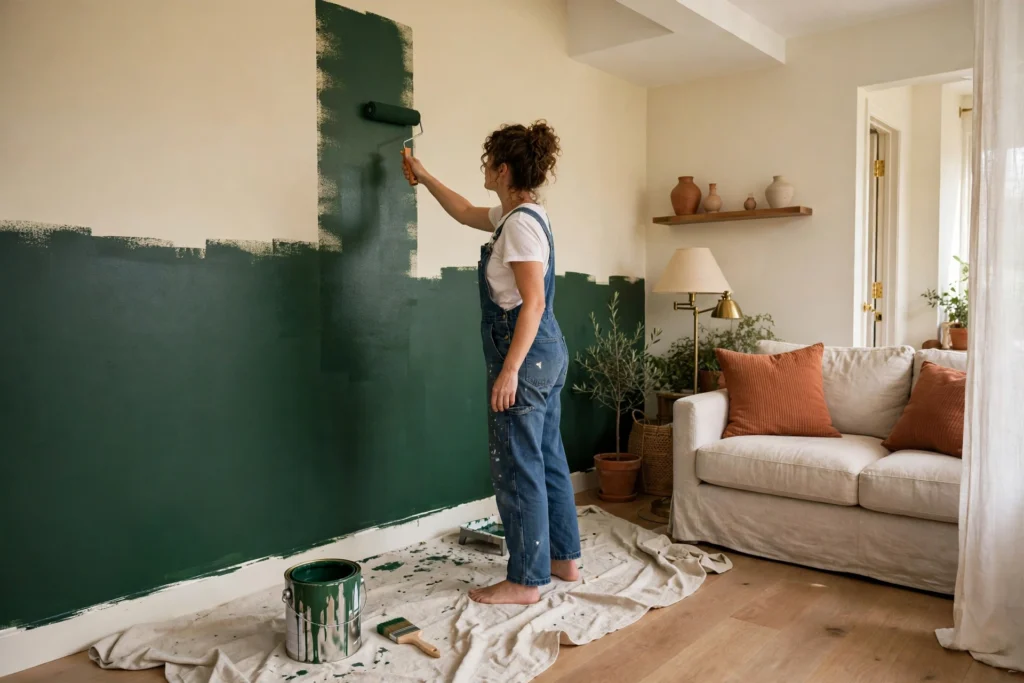
Paint is still the best dollar you’ll spend in a room. Full stop. One wall is all a small living room needs — a gallon of decent interior paint runs about $25–$30, and it’ll cover one accent wall twice over with some left for touch-ups.
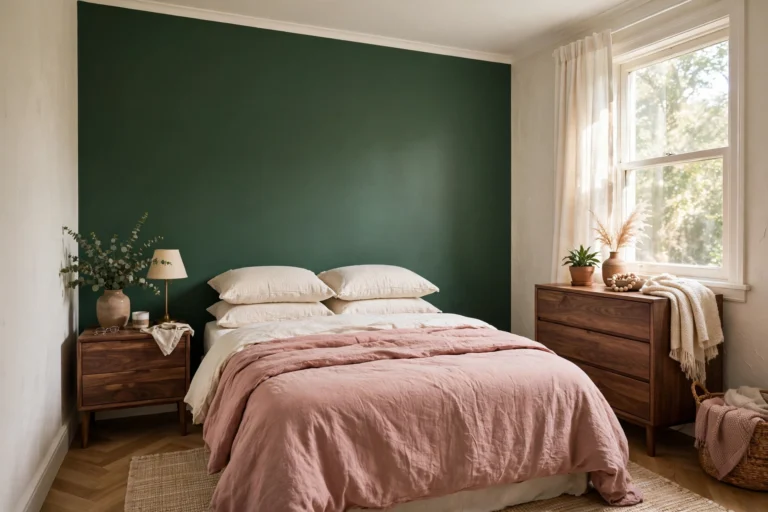
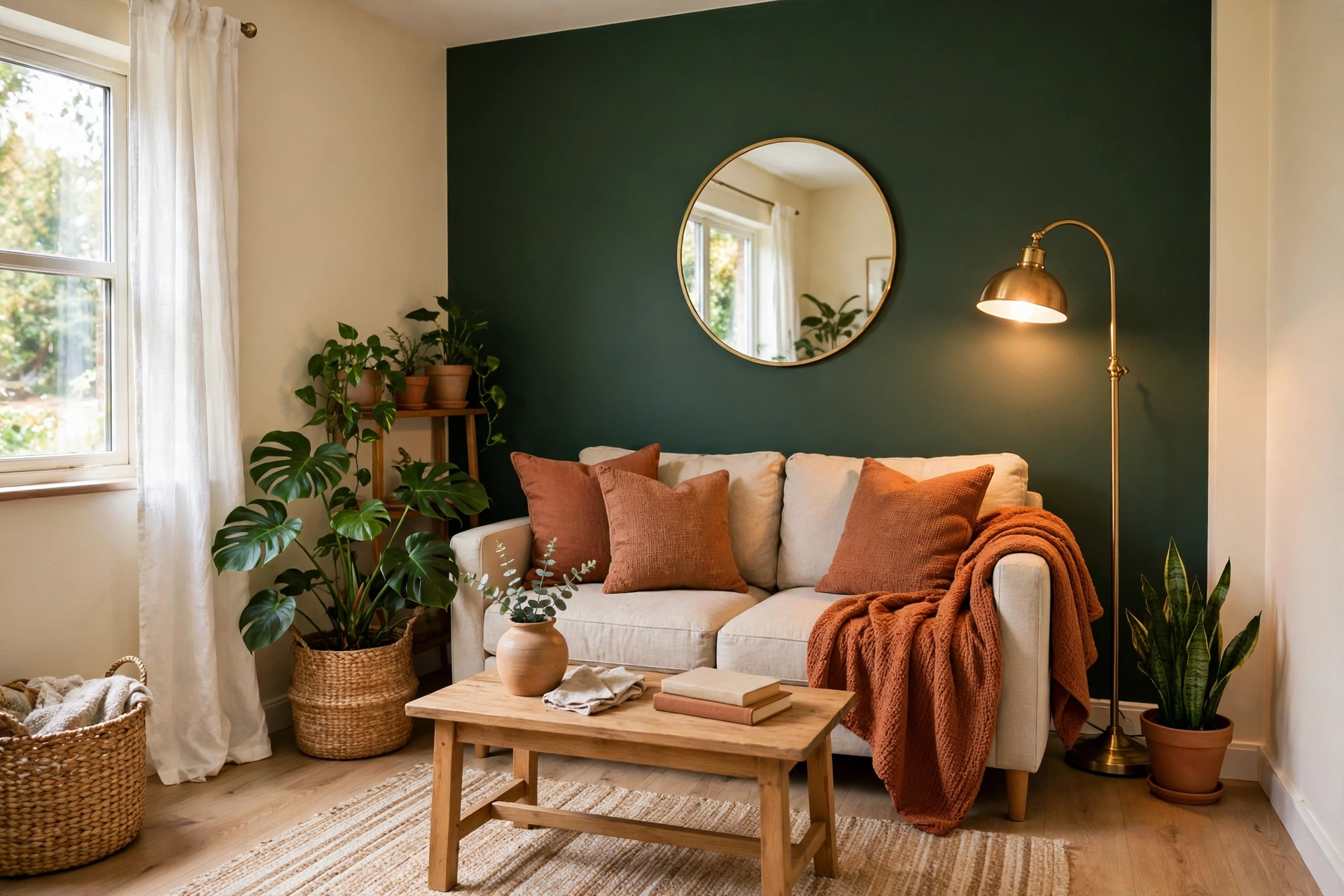
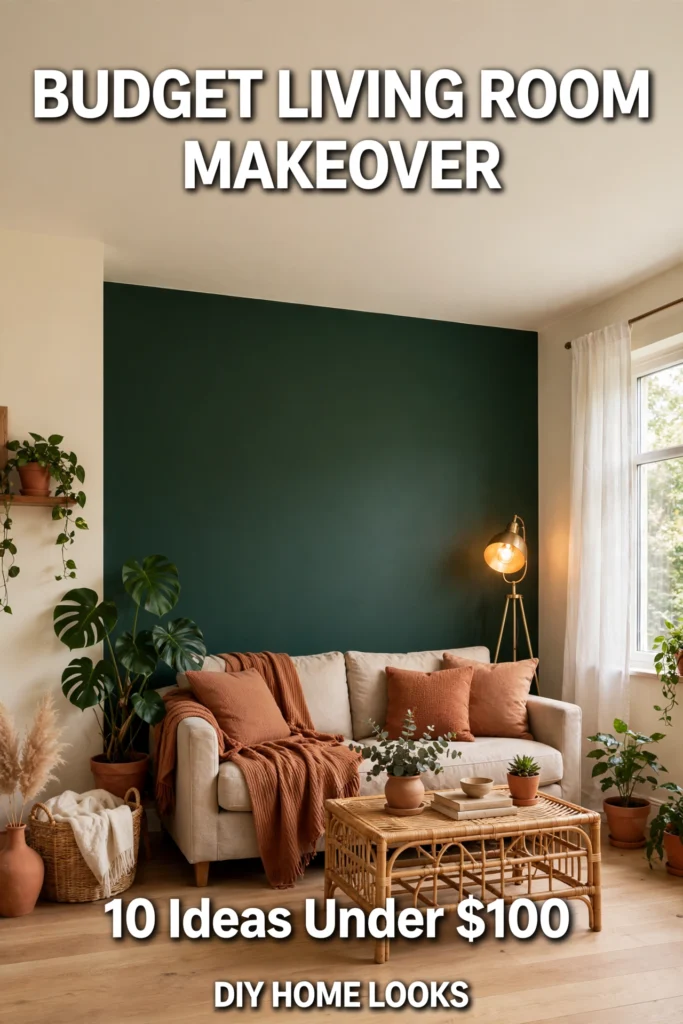
Now, the color. Deep forest green sounds dark, I know. I thought the same thing. But on one wall behind the sofa it doesn’t shrink the room — it adds depth, like the wall recedes a little. Warm terracotta does the same job if green isn’t your thing. Either way, test a sample first. Paint a 2-by-2-foot (61-by-61 cm) square, live with it for two days, and look at it in the morning and again in the evening before you commit. Colors shift more than you’d expect. Especially in a north-facing room — ask me how I know. And if you rent, skip the paint and jump to idea 7. Peel-and-stick gives you the same one-wall drama with zero deposit risk.
2. Rearrange the furniture (free)
Before you spend a cent, spend twenty minutes moving things around. Seriously. Pull the sofa 6 to 8 inches (15 to 20 cm) off the wall — that little gap makes a small room breathe in a way I can’t quite explain but you can feel the second you walk in. Angle the armchair slightly toward the sofa instead of lining everything up against the walls like a waiting room. If the TV is the problem, try the sofa facing the window for a day. See if the room feels bigger with the light coming in behind you.
The small living room layout ideas we rounded up cover the full set — floating, L-shaped, conversation-first — but here’s the principle in one line: furniture that floats a little reads as intentional. Furniture shoved flat against every wall reads as stuck. Free, fast, and honestly the idea most people skip because it feels too easy. Don’t skip it. It’s the one I skipped the first time, and my room paid for it.
3. Hang curtains high and wide (~$20–$25)
This is the trick that makes people ask if you got a bigger window. You didn’t. You just hung the rod right.
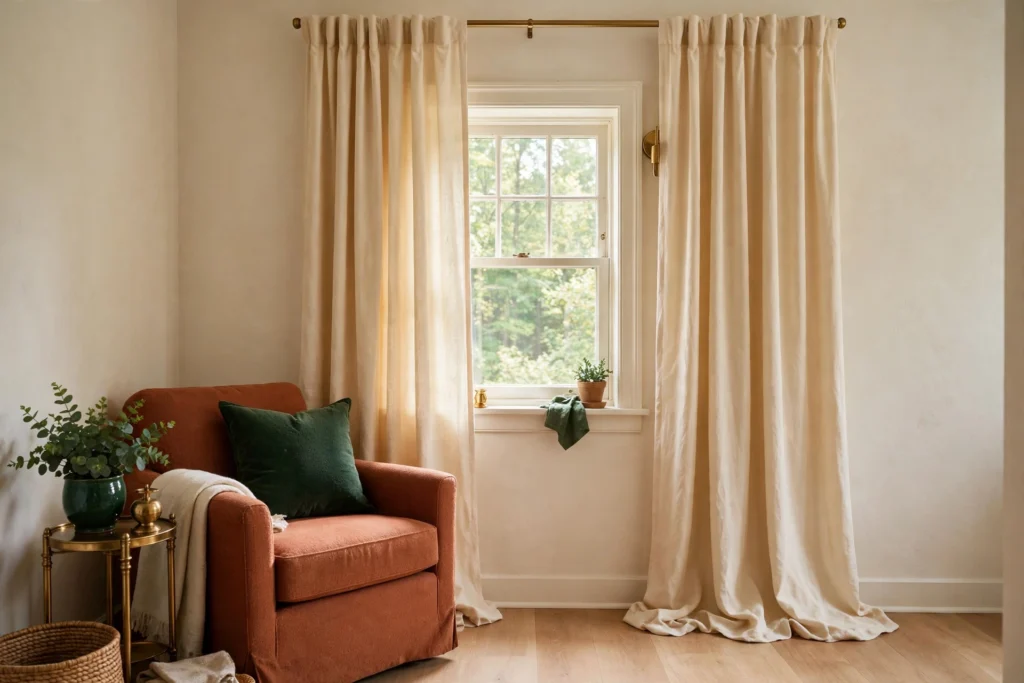
Mount it 4 to 6 inches (10 to 15 cm) above the window frame — all the way to the ceiling if the gap is small — and extend it 6 to 12 inches (15 to 30 cm) past the frame on each side. The curtains then cover wall, not glass, when they’re open. So the window reads as a full-width opening and the wall reads as taller. Floor-length panels work best in a small room; that long vertical line pulls the eye up.
A pair of budget panels in warm cream or soft linen-look runs about $20–$25, and the budget curtains we picked for small rooms have the exact sizes and fabrics that hold up in a small space. Get the rod position right and a $22 pair looks like a $200 one. Get it wrong — rod at frame height, panels too short — and no fabric on earth will save it. I learned that one the expensive way. Well. The $22 way.
4. Warm up the light (~$8–$12)
If your living room still has the cool-white bulbs the last tenant left behind, this is your cheapest win. Swap them for 2700K warm-white LEDs — about $8–$12 for a multi-pack — and the whole room softens. Instantly. Cool light makes a small room feel like an office. Warm light makes it feel like a living room. Same furniture. Same walls. Completely different mood. I still don’t fully understand why the difference is that dramatic. It just is.
Then add a second light source, if you only have one. A thrifted table lamp. A plug-in floor lamp. Even a $5 string of warm fairy lights in a dark corner. Two light sources at different heights beat one bright ceiling light every single time — and if you want to go further without touching a wire, the renter-friendly lighting ideas that need no electrician cover plug-in sconces and rechargeable lamps too. Want the numbers behind the 2700K advice? This budget small living room guide backs it up — lighting is the highest-return change you can make on a tight budget.
5. Thrift a big mirror (~$10–$15)
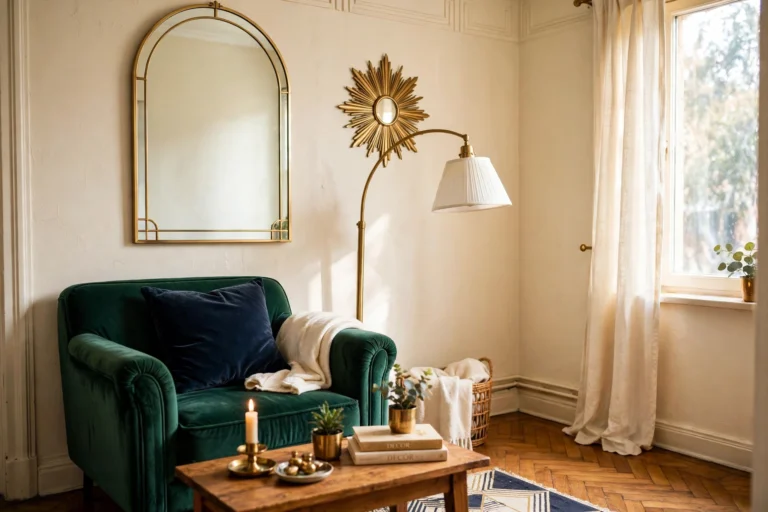
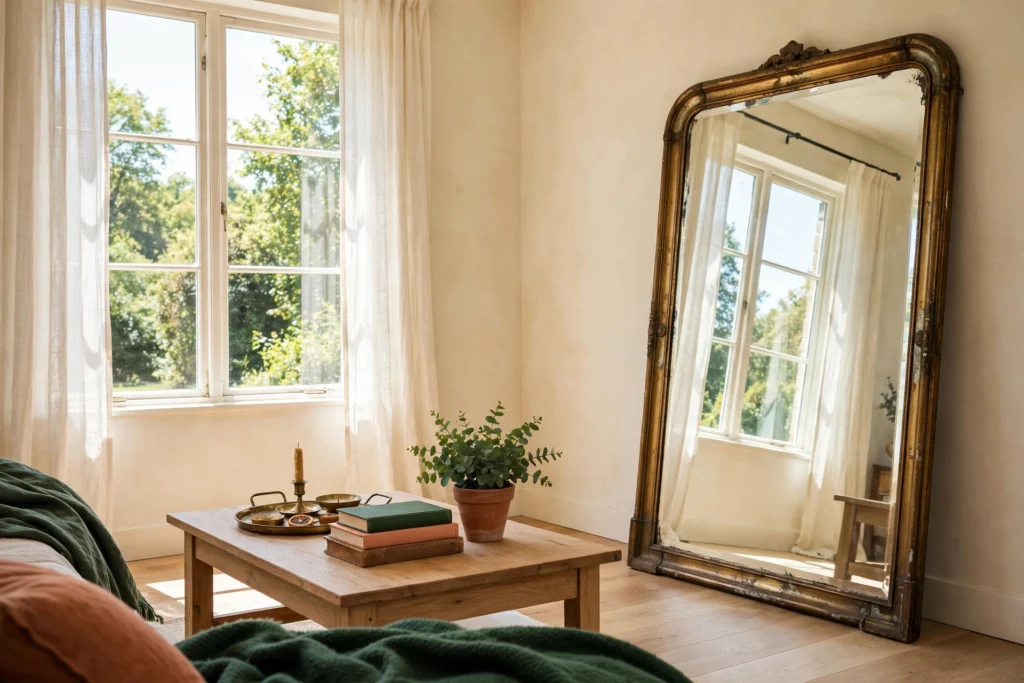
A large mirror across from the window is the oldest small-room trick there is. Oldest because it works. It does two jobs at once: bounces daylight deeper into the room, and doubles the visual width of the wall. Thrift stores and Facebook Marketplace are full of big framed mirrors for $10–$15. People get rid of them constantly because they’re awkward to move. Their problem, your gain.
Measure before you buy, though. A mirror that’s too small looks like an afterthought — you want one at least 24 inches (61 cm) wide, ideally 30 inches (76 cm) or more. Lean it against the wall, or hang it with two picture hooks. No fancy mounting system needed. And check the frame before you fall for the mirror: a brass or wood frame you can live with beats a perfect mirror in a frame you hate. You can always paint the frame later for $0, if you’ve got paint left over from idea 1. Which you will.
6. Layer thrifted textiles (~$10–$15)
Two throw pillows and a throw blanket. Thrifted, or from a budget bin. About $10–$15 for the lot. The rule that keeps it from looking like a jumble sale? Two colors plus one neutral. In this room that’s terracotta and deep green against warm cream — same palette as the paint and the curtains, so everything ties together instead of competing with each other.
Drape the throw over one sofa arm. Not folded in a perfect square on the back — over the arm, a little messy, like someone actually lives there. Pillows go at the ends of the sofa, not lined up in the middle like soldiers. And don’t buy six pillows when two good ones will do. In a small room, restraint reads as design. Excess reads as clutter. If the pillows you find are the wrong color, a $5 dye pack or a cover swap fixes that for less than buying new. Ask me about the mustard-yellow pillows I almost bought. Actually, don’t. They’re a sore subject.
7. Peel-and-stick wallpaper on one wall (~$20–$25)
This is the renter’s version of idea 1, and honestly? It’s the one I’d pick even if I owned the place. No drying time. No cleanup. Peel it off on moving day and the wall underneath is exactly how you found it. Two rolls of peel-and-stick wallpaper cover one accent wall in a small living room, about $20–$25 total as of October 2026.
Go subtle. A grasscloth texture, or a quiet geometric. Loud prints fight with everything else in a small room, and you’ll be sick of them by month two — I give it eight weeks, tops. Apply it top-down, one strip at a time, smooth as you go. A credit card works as a smoother if you don’t own one. Strip goes on crooked? Peel it back, redo it. That’s the whole point of the stuff. One patterned wall, behind the sofa or the TV wall. Not every wall. One patterned wall is a feature. Four patterned walls is a headache, and your landlord will agree with me.
8. Style the coffee table with what you own ($0–$5)
You don’t need to buy styling. Open a cupboard. I’m serious — go look. A stack of two or three books, a tray or a shallow bowl, and one small plant. Three things, different heights, and suddenly the coffee table looks styled instead of just… used. The books can be anything with a decent cover. Nobody’s reading the spines. The tray corrals the remote and the coasters, so the table reads as tidy even when it isn’t. Which, let’s be honest, is most of the time.
If you genuinely own nothing that works — nothing — a thrifted tray is about $3–$5, and that’s the only money this idea should cost. The mistake to avoid is buying a whole set of matching “decor objects.” A small room with five new matching objects looks like a showroom. And a showroom is the opposite of a home. Your living room should look lived in. Just… intentionally lived in.
9. Add one real plant and one faux (~$10–$15)
Plants are the fastest way to make a room feel alive. You only need two. One real — a snake plant or pothos, about $8–$10 in a basic pot, both nearly impossible to kill (and I have tested that claim thoroughly) — and one good faux one for the spot with no light, about $5. Real plant goes where the light is. Faux one goes on the shelf or in the dark corner where a real plant would slowly give up and you’d feel guilty about it.
Don’t scatter five tiny plants around the room. One decent-sized plant in a corner, one on the coffee table or shelf. That’s enough. In a small living room, one plant that looks healthy beats a jungle that looks neglected, and the green picks up the accent wall beautifully. It ties the whole palette together without you having to think about it.
10. Declutter and edit down (free)
Last. And honestly the one that makes the other nine work.
Take everything out of the room that doesn’t earn its place. Not into another room — out of the house. Into a bag. To donate, or to bin. A small living room with eight well-chosen pieces always looks more intentional than one with twenty random bargains, and no amount of paint or curtains fixes a room that’s overstuffed. I know, because I tried. Twice. The paint was lovely. The room was still a mess.
Work with the whole-home organization system if you want a method for it — one room, one pass, keep what you use and love, let the rest go. Then live with the room for a week before you buy anything else. You’ll be surprised how often the “missing” thing turns out to be something you already own, just sitting in the wrong place. It was in my case, anyway. Twice.
The $94 Starter Combo
If you do nothing else, do these six, in this order: paint one wall ($28), hang the curtains high and wide ($22), swap in warm bulbs ($10), thrift the mirror ($12), add the throw ($12), buy the plant ($10). That’s $94. One weekend. A room that looks like someone designed it. The remaining $6 buys the coffee. You’ll have earned it — and yes, I counted the coffee in the budget. Priorities.
One honest note on the math, because I don’t want to oversell this: the budget assumes you already own the sofa, the coffee table, and the basics. An honest breakdown of what $100 actually does to a living room makes the same point — $100 transforms how a room feels, not the furniture in it. Paint, light, curtains, rearranging what you already own — those change the energy of a space in ways that are immediately obvious. New furniture is a different budget entirely. Pretending otherwise is how $100 makeovers disappoint people, and I’d rather you be pleasantly surprised than let down.
And one thing to skip: the tiny rug. If your rug budget is under $30, skip the rug entirely this round. A rug that’s too small fragments the room and makes it feel more cramped, not less — the opposite of what you want. A 5-by-7-foot (152-by-213 cm) rug is the right range for most small living rooms, and a decent one costs more than this whole makeover. Save for it. Buy it once. Let the rest of the room carry the makeover until then.
Can you really makeover a living room for under $100?
Yes — if you mean changing how the room feels, not replacing the furniture. Paint, curtains, warm bulbs, a thrifted mirror, textiles, and rearranging what you already own transform a small living room for about $94 as of October 2026. What $100 won’t do is buy a new sofa, a quality rug, or new furniture — those are separate budgets, and any makeover that pretends otherwise is selling you something.
What’s the single best first buy if I only have $50?
Paint. Always paint. One gallon of a deep accent color for about $28 changes how the light works, how the furniture looks, and how the whole room feels — and it leaves you $22 for curtains or warm bulbs. Everything else in this post builds on the paint. Skip the paint and you’re just moving the same problem around the room.
What size rug works in a small living room?
Bigger than you think: a 5-by-7-foot (152-by-213 cm) or 6-by-9-foot (183-by-274 cm) rug is the right range for most small living rooms, with at least the front legs of the sofa resting on it. Anything under 4-by-6 feet (122-by-183 cm) visually fragments the space and makes it feel more cramped. If a proper rug doesn’t fit this round’s budget, skip it and save — a too-small rug is worse than no rug.
How do I make a small living room look bigger without buying furniture?
Declutter first, then pull the furniture 6 to 8 inches (15 to 20 cm) off the walls, hang floor-length curtains 4 to 6 inches (10 to 15 cm) above the window frame, and put a large mirror across from the window to bounce the light. Paint the ceiling the same shade as the walls, or one tone lighter. Those five moves cost almost nothing and change the perceived size of the room more than any purchase will.