12 Accent Wall Ideas for Small Bedrooms That Add Depth
An accent wall works in a small bedroom when you pick the right wall first and the right treatment second. The wall behind the bed wins in most rooms, but not in every room, and the wrong wall makes the room feel smaller instead of deeper. These 12 accent wall ideas for small bedrooms cover paint, wallpaper, limewash, wood slats, and four options that need no paint at all, with a cost table checked in November 2026. Here is the number most guides skip: one quart of paint covers 100 to 125 square feet, and a 10 by 8 foot wall needs 160 square feet across two coats, so one quart is not enough for a full wall. You need a gallon, or two quarts. That one calculation saves the most common accent wall mistake, running out of paint halfway through the second coat.
How do you pick accent wall ideas for small bedrooms that actually work?
Start with the layout, not the color. Stand in the doorway with the bed in place and look at which wall your eyes land on first. That wall is your accent wall in most rooms. Then check the layout table below, because five common bedroom shapes each change the answer.
| Your bedroom layout | Accent this wall | Why it works, and what to watch |
|---|---|---|
| Bed centered on a clear wall | The bed wall | The classic. It frames the headboard and reads as intentional from the doorway. |
| Bed off center, uneven gaps each side | The bed wall, but frame the bed, not the whole wall | A full-wall treatment makes uneven margins look worse. A painted arch or block aligned to the bed hides the offset. |
| Bed pushed into a corner | The bed wall, ending at the corner | Stop the treatment in the corner. Running it around onto the side wall looks like a mistake. |
| Window behind the headboard | Skip paint here | Wallpaper gets chopped by the window and slats need an awkward stop around the sill. Use full-length curtains in your accent color instead, or a half-height paint line that meets the sill. |
| Bed on the long wall, door opposite | The wall opposite the door, or the bed wall | Pick the view from the doorway. If you rarely see the bed wall while using the room, the door-facing wall carries the room better. |
| No headboard at all | The bed wall, with a painted arch or block | The paint becomes the headboard. It costs less than any headboard you can buy. |
Two rules sit behind the table. First, never accent a wall broken up by doors or windows. The openings chop the color field and the design looks accidental. Second, extend the color at least 6 inches (15 cm) wider than the bed on each side, so the bed sits inside the color instead of poking out of it.
How much paint does one accent wall need?
Paint brands list coverage at 400 to 500 square feet per gallon, which means one quart covers 100 to 125 square feet. A single coat is not a finished wall, though. Deep colors almost always need two coats, so double the wall area before you buy.
| Wall size | Area | Two coats | What to buy |
|---|---|---|---|
| 8 ft by 8 ft (2.4 by 2.4 m) | 64 sq ft | 128 sq ft | 1 gallon, or 2 quarts |
| 10 ft by 8 ft (3.0 by 2.4 m) | 80 sq ft | 160 sq ft | 1 gallon |
| 12 ft by 8 ft (3.7 by 2.4 m) | 96 sq ft | 192 sq ft | 1 gallon |
| 12 ft by 9 ft (3.7 by 2.7 m) | 108 sq ft | 216 sq ft | 1 gallon |
A quart only covers a painted arch, a block, or a single coat. Buy the gallon for any full wall, and buy it in one batch so the color matches. If you are going dark over light, add a quart of primer or a tinted primer, about $15 to $25, because dark paint over a pale wall shows every thin spot.
The 12 best accent wall ideas for small bedrooms
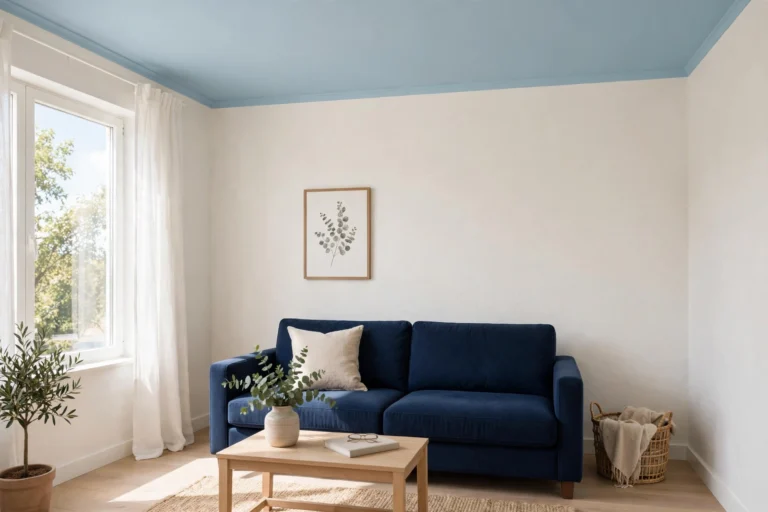
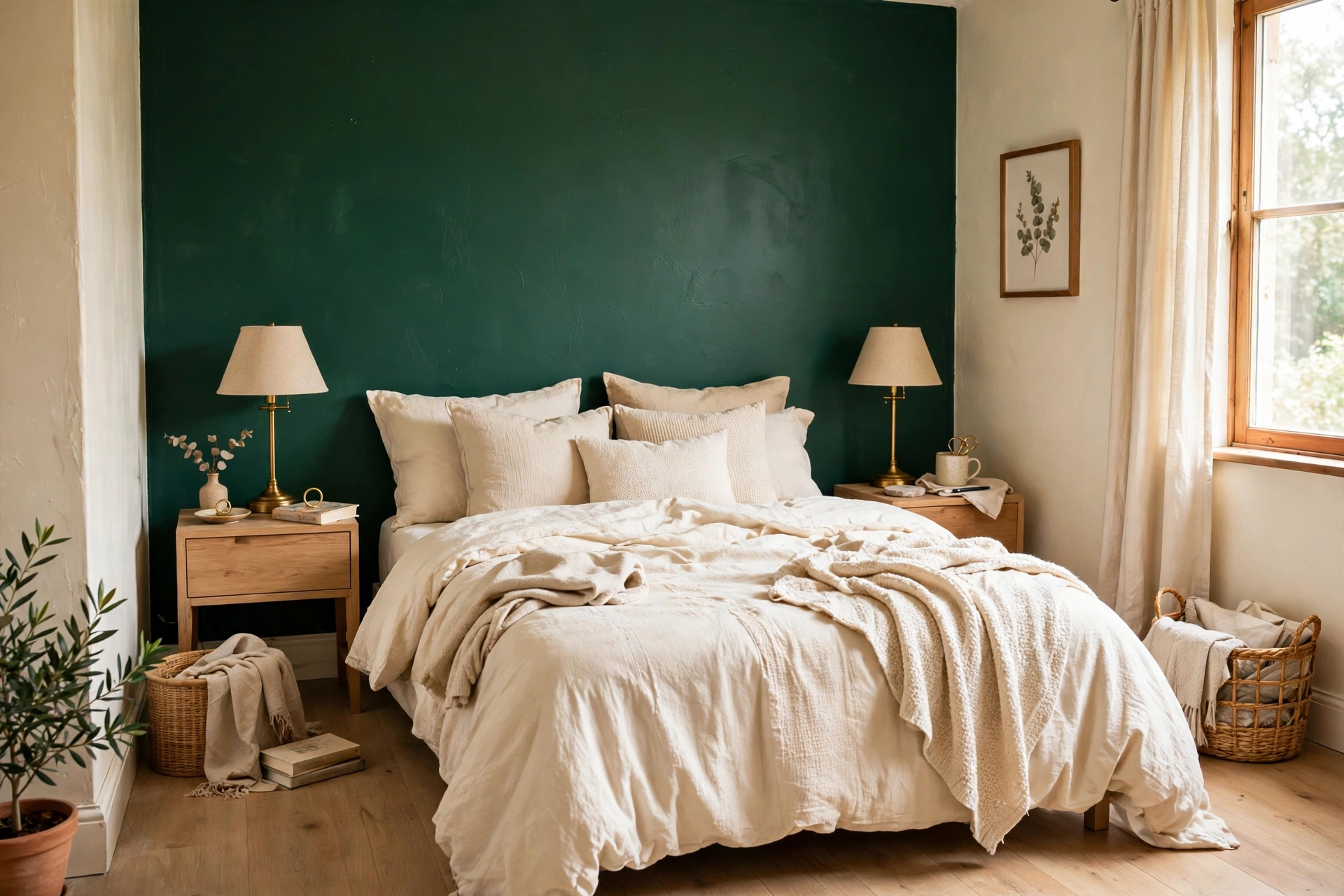
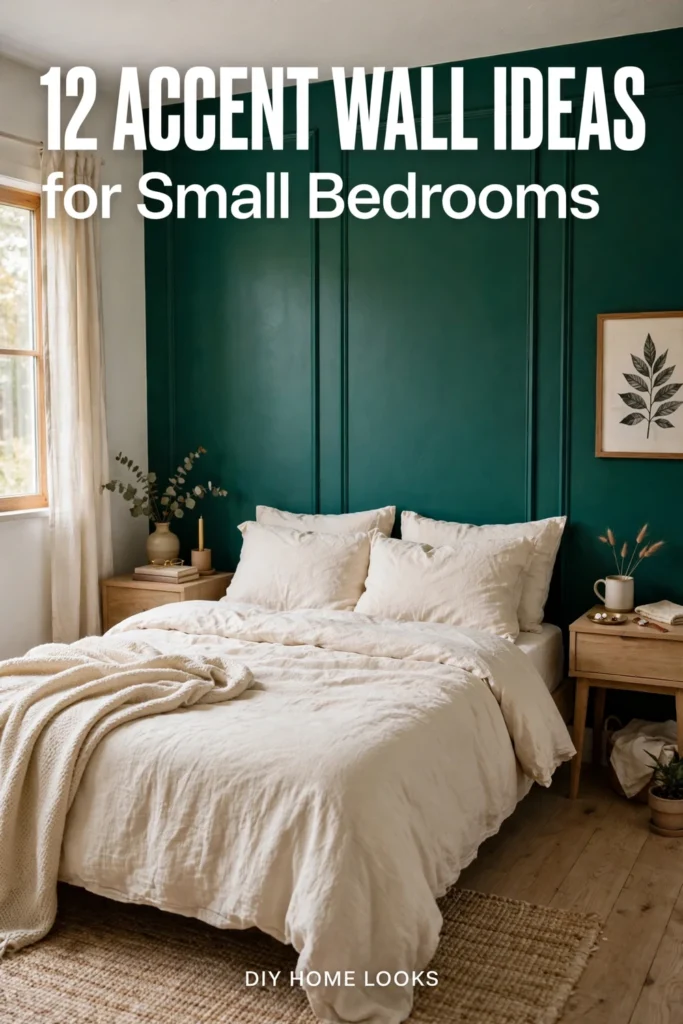
1. A deep painted bed wall. Navy, forest green, or charcoal behind the bed, with the other three walls pale. Best for: bedrooms with decent daylight and a simple headboard. Main advantage: the dark wall reads as farther away, so the room gains depth instead of losing it. Watch out for: a dark wall plus dark furniture plus a dark headboard turns heavy after dark. Keep bedding light. Verdict: the highest-impact idea for the lowest cost. Renter-Friendliness: 2/5 (paint needs permission and a repaint at move-out).
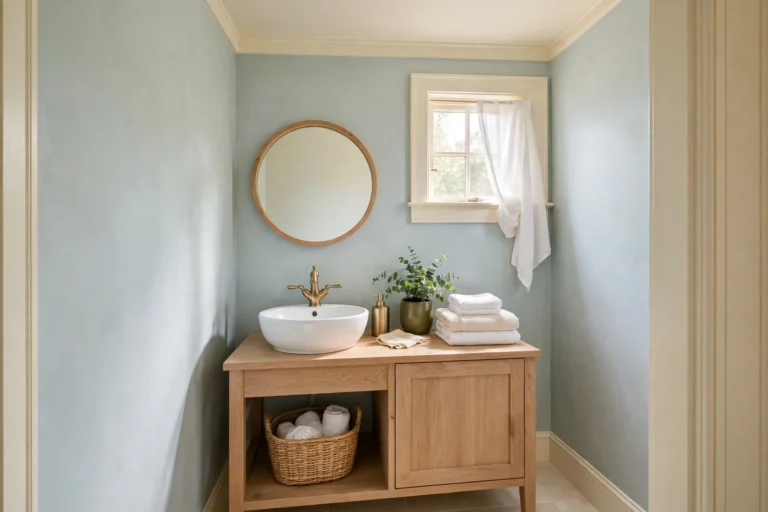
2. A low-contrast painted bed wall. One step deeper than the other walls, in the same color family and undertone. Warm greige against soft off-white, or dusty blue against pale blue-gray. Best for: small, dark, or north-facing bedrooms where a deep wall would feel heavy. Main advantage: it reads as a design decision, not a color shock, and it never fights the bedding. Watch out for: the step must be visible. Two shades that are too close just look like a painting mistake. Verdict: the safest painted accent wall you can do. Renter-Friendliness: 2/5.
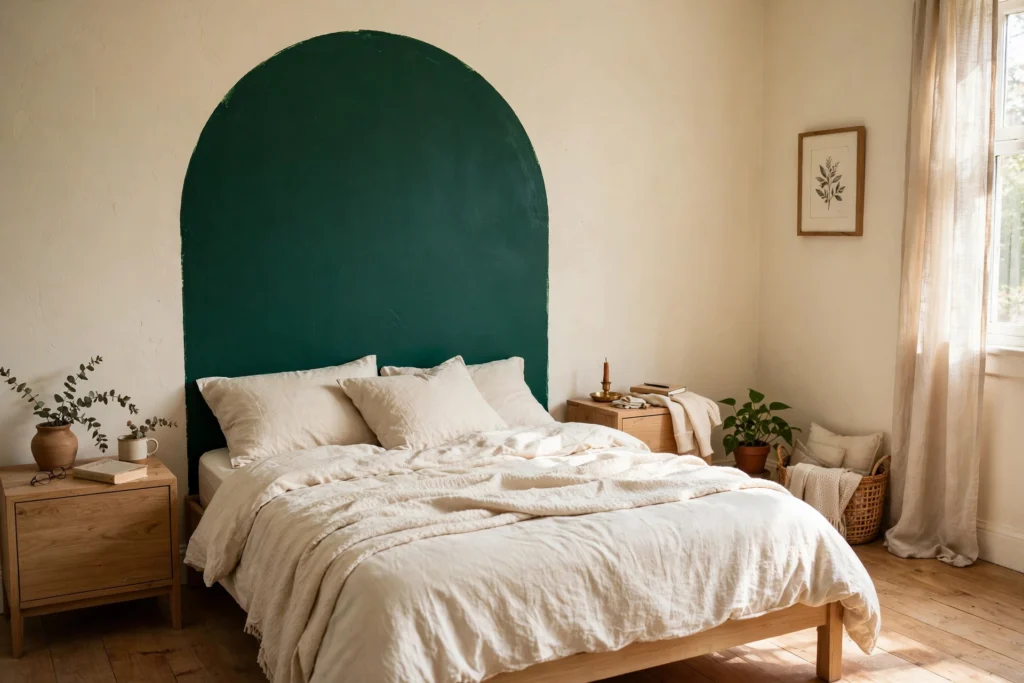
3. A painted arch or headboard-shaped block. A rectangle, rounded-top rectangle, or arch painted behind the bed, sized to read as an oversized headboard. Best for: rooms with no headboard, off-center beds, and renters who can paint one small area. Main advantage: it frames the bed without covering a whole wall, and it uses one quart of paint. Watch out for: measure the bed first. An arch narrower than the bed looks like a halo that missed. Verdict: the smartest small-room trick in this list. Renter-Friendliness: 3/5.
4. A half-height painted band. The lower part of the wall takes a deeper color, the upper part stays the room’s main color, and one horizontal line divides them. Best for: low ceilings, because the light upper wall keeps the height, and for walls that take scuffs near the floor. Main advantage: it grounds the furniture and hides marks. Watch out for: never split the wall exactly in half. A 50/50 split draws a horizon line across the room and makes the ceiling feel lower. Verdict: a strong second project after a full accent wall. Our half-painted wall ideas cover the exact line heights by ceiling height. Renter-Friendliness: 2/5.
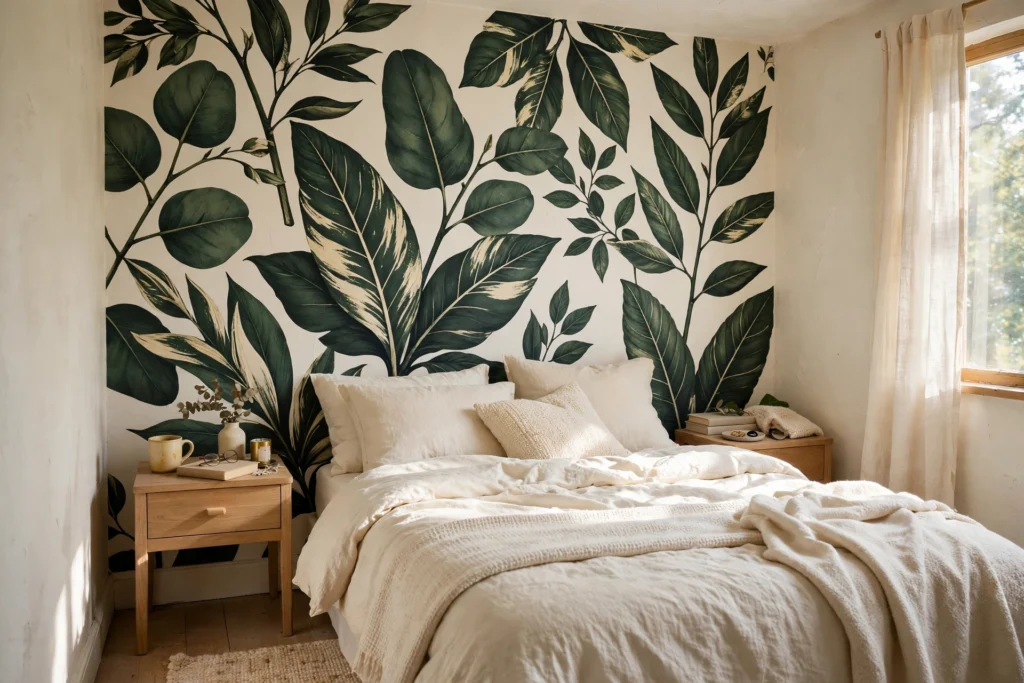
5. Peel-and-stick wallpaper, large-scale print. One wall of removable wallpaper behind the bed, in a large botanical, geometric, or mural print. Best for: renters and anyone who wants pattern without paste. Main advantage: a large-scale print makes the wall feel bigger, while a small busy print makes a small room feel cluttered. Watch out for: pattern matching eats paper. Order one extra roll for a patterned print. Test a sample square on your wall for 24 hours first, because textured or freshly painted walls can fight the adhesive. Verdict: the best renter accent wall, full stop. Our guide to peel-and-stick wallpaper that comes off clean covers brands and removal. Renter-Friendliness: 5/5.
6. Vertical stripes, painted or papered. Strong vertical lines that pull the eye up and make a low ceiling feel taller. Best for: bedrooms with 8 foot ceilings and plain furniture. Main advantage: stripes are the most forgiving pattern to hang, because there is no motif to match, only straight edges. Watch out for: stripes narrower than 4 inches (10 cm) can buzz visually in a small room. Keep them 6 to 12 inches (15 to 30 cm) wide. Verdict: the best ceiling-height trick that costs almost nothing. Renter-Friendliness: 4/5 as peel-and-stick, 2/5 as paint.
7. A limewash wall. A chalky, cloudy plaster effect with natural color variation, in warm clay, mushroom, or dusty rose. Best for: bedrooms that need texture more than color. Main advantage: the finish moves with the light, so the wall never looks flat, and it hides small wall flaws. Watch out for: limewash needs a block brush, two coats, and a primer on standard latex walls. It is not a one-coat Saturday job. Verdict: the most grown-up texture in this list, and the priciest paint option. Renter-Friendliness: 1/5 (specialty finish, hard to reverse).
8. A wood slat wall. Slim vertical timber battens running floor to ceiling behind the bed, in natural oak or walnut. Best for: bedrooms that feel cold or echoey, because the wood adds warmth and the felt-backed panels absorb sound. Main advantage: the vertical lines lift the ceiling visually, and the wall becomes the headboard. Watch out for: acoustic panels are the most expensive idea here, about $10 to $22 per square foot. Measure the wall and count panels before you fall in love. Our wall paneling ideas for small rooms cover the cheaper board-and-batten and picture-frame routes. Verdict: beautiful, but budget it honestly before you start. Renter-Friendliness: 1/5 (screwed or glued, not reversible).
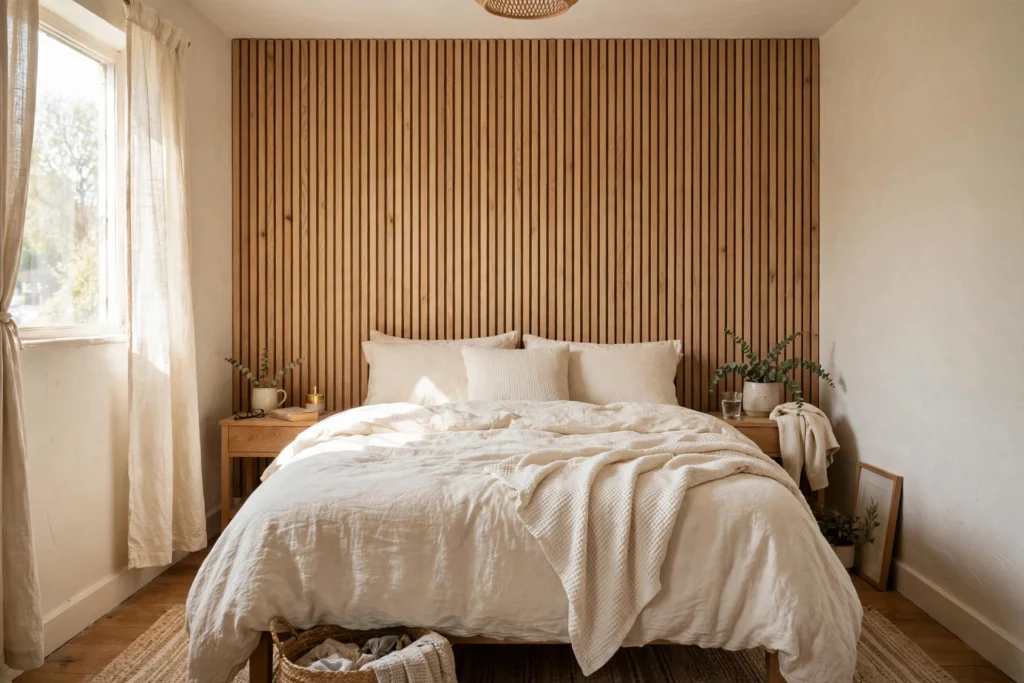
9. Fabric panels or a tapestry, hung with no drilling. A large textile panel or woven tapestry on the bed wall, hung from a tension rod or adhesive hooks. Best for: renters, dorm rooms, and anyone who changes their mind twice a year. Main advantage: zero wall damage, and fabric softens echo in a bare room. Watch out for: a small tapestry looks like a poster. Go big, at least as wide as the bed, or it reads as an afterthought. Verdict: the cheapest zero-risk accent wall. Renter-Friendliness: 5/5.
10. A gallery wall as the accent. A tight grid of framed prints and photos covering the bed wall, in matching frames. Best for: bedrooms where the art matters more than the paint. Main advantage: you can build it one frame at a time, and it doubles as storage for the art you already own. Watch out for: mixed frame colors and random spacing look messy fast. Pick one frame color and one spacing, 2 to 3 inches (5 to 8 cm) between frames, and stick to it. Verdict: the most personal accent wall, and the easiest to change. Renter-Friendliness: 4/5 with picture-hanging strips.
11. Mirrored panels. Tall, narrow mirror panels or mirror tiles covering part of the bed wall, or one large leaning mirror framed by paint. Best for: dark bedrooms that need light more than color. Main advantage: mirrors bounce the window light across the room, and a small room gains a second light source. Watch out for: a mirror facing the bed bothers some sleepers, and cheap mirror tiles show every seam. Keep mirrors to the side wall or above the headboard line. Verdict: a light trick first, a style choice second. Renter-Friendliness: 3/5 (leaning mirrors need no holes; glued tiles do).
12. A removable arch decal or mural panel. A peel-and-stick arch decal or a single mural panel sized to the bed wall, applied like a giant sticker and peeled off at move-out. Best for: renters who want the painted-arch look with zero paint. Main advantage: it takes twenty minutes, costs less than a roll of wallpaper, and leaves nothing behind. Watch out for: a decal smaller than the bed looks lost. Size it at least as wide as the bed plus 6 inches (15 cm) each side. Verdict: the lowest-commitment accent wall that still looks deliberate. Renter-Friendliness: 5/5.
What does an accent wall cost in a small bedroom?
Prices below are for one wall, 10 by 8 feet (3.0 by 2.4 m, 80 square feet), checked in November 2026. Time estimates are for a first-timer working alone.
| Treatment | Materials | Cost, as of November 2026 | Time |
|---|---|---|---|
| Painted wall, two coats | 1 gallon mid-premium paint plus roller, tape, tray | $85 to $115 | One weekend |
| Painted arch or block | 1 quart paint plus tape and a small roller | $40 to $60 | One afternoon |
| Peel-and-stick wallpaper | 3 to 4 rolls Tempaper at about $30 a roll, or 2 rolls WallPops at $39.99 | $80 to $120 | One afternoon |
| Limewash | 1 gallon Portola Lime Wash at $84 plus a block brush at $18 to $30 | $102 to $114 | One weekend |
| Wood slat acoustic panels | 6 panels at $179 each (15.5 sq ft per panel) | $1,074 | One day, plus help |
| Fabric panel or tapestry | One large textile plus a tension rod or hooks | $30 to $60 | Under an hour |
The cheapest real accent wall is a painted arch at $40 to $60. The most expensive by far is acoustic slats, which is why they deserve their own line in the budget before you buy a single panel. Paint stays the value winner: one gallon of Benjamin Moore Regal Select runs $69 to $85, and Aura runs $95 to $109, with a quart of Regal Select listed at $33.99 on the brand’s own store. A gallon covers the wall with paint to spare, while a quart does not cover two coats, which is exactly why the quantity table above matters.
What paint colors work best on a small bedroom accent wall?
Pick by light reflectance value, or LRV, the number that says how much light a color bounces back. A useful rule of thumb from paint writers is a 40 to 60 point LRV gap between the accent wall and the other walls. Smaller than that and the accent reads as a mistake. The LRVs below are the manufacturers’ published numbers.
| Color | LRV | Best for |
|---|---|---|
| Benjamin Moore Hale Navy HC-154 | 6.3 | Classic deep bed wall in a bright room |
| Sherwin-Williams Naval SW 6244 | 4 | Moody, dramatic bed wall |
| Sherwin-Williams Iron Ore SW 7069 | 6 | Soft charcoal, less blue than navy |
| Benjamin Moore Santa Barbara Green 2037-60 | 68 | Light accent in rooms under 120 sq ft |
| Sherwin-Williams Rainwashed SW 6211 | 59 | Soft blue-green, calm in low light |
| Benjamin Moore White Dove OC-17 | 85.4 | The other three walls, not the accent |
Two things to check before you commit. First, test a large sample board behind the headboard and live with it for a day, because a color that glows in the store can turn flat in your light. Second, check the best wall colors for small rooms for how your room’s direction changes the color. A north-facing room needs warm colors to fight its cool gray light, and the same deep green that glows in a south-facing room can look muddy in a north-facing one. Benjamin Moore’s own coverage figure, 400 to 500 square feet per gallon, is the source for the quantity math above.
How to paint an accent wall in a weekend
This is the process for ideas 1 to 4. It takes one weekend, with most of the time spent waiting for paint to dry.
Materials: 1 gallon of accent paint, primer if going dark over light, a 9 inch roller and tray, a 2 inch angled brush, painter’s tape, a drop cloth, a tape measure, a pencil, and a spirit level.
Steps:
- Clear the wall. Move the bed and nightstands at least 3 feet (91 cm) out, and take down anything hanging on the accent wall.
- Clean the wall with a damp cloth and let it dry. Dust kills adhesion, and paint shows every speck.
- Tape the edges. Run painter’s tape along the ceiling, the side walls, the baseboard, and around outlets. Press the tape edge down firmly with a putty knife.
- Cut in the edges with the angled brush, about 2 to 3 inches (5 to 8 cm) wide, along every taped edge.
- Roll the wall in a W pattern, working in sections about 3 feet (91 cm) wide. Keep a wet edge so roller marks do not dry into stripes.
- Let the first coat dry fully, usually 2 to 4 hours, then roll the second coat the same way. Deep colors need the second coat. Do not judge the color until it dries.
- Pull the tape off while the second coat is still slightly tacky, pulling at a 45 degree angle away from the painted edge. Let the wall cure 24 hours before pushing furniture back against it.
If you rent, read this first. Check the lease before you open a paint can. Most leases allow painting with written permission, and many require repainting to the original color at move-out, which means budgeting a gallon of the original white as well as your accent color. Peel-and-stick options, fabric panels, and decals need no permission in most leases, but photograph the wall before you apply anything, keep the product packaging, and test removal on a hidden spot first. The deposit you keep is worth more than any wall.
Mistakes to avoid
Painting the wrong wall. The wall with the window or the door is the most common wrong pick. It chops the color and the room looks unfinished. Use the layout table at the top and pick the wall you see from the doorway.
Buying one quart for a full wall. A quart covers 100 to 125 square feet. Two coats on an 80 square foot wall need 160. Buy the gallon.
Going dark in a dark room. A deep accent wall needs daylight or strong lamps to work. In a dim bedroom, pick a low-contrast wall or a light accent with an LRV above 55 instead.
Letting the headboard fight the wall. A busy patterned headboard plus a busy patterned wall is two focal points arguing. If the headboard is loud, keep the wall quiet, and the other way around.
Skipping the sample. A 2 inch paint chip lies. A large sample board behind the headboard tells the truth, and it costs less than a gallon of the wrong color.
Forgetting the ceiling line. A wobbly top edge shows from across the room. Tape it, or paint the ceiling line with a steady hand and a good brush, and check it from the doorway, not just up close.
What to skip
Accent walls on all four walls. That is not an accent wall, it is a painted room, and a small bedroom painted dark on every side feels smaller. One wall carries the idea. The other three stay quiet.
Tiny decals scattered across the wall. A dozen small stickers read as clutter, not design. One large decal or none at all.
High-gloss paint on a bumpy wall. Gloss shows every dent, patch, and seam. Use eggshell or satin on bedroom walls, and save gloss for trim.
Faux brick wallpaper in a room with real texture problems. Cheap brick prints look flat up close, and the pattern repeat shows on a wide wall. If you want brick, spend on a good print or skip it for a painted treatment.
Slat panels on a wall shorter than 8 feet. The vertical lines need height to work. On a low wall they crowd the ceiling line and the room feels shorter, not taller.
Sources: paint prices and coverage checked November 13, 2026 from Benjamin Moore’s store and published coverage figures, Sherwin-Williams and Clare Paint prices as reported in November 2026 guides, Tempaper and WallPops roll prices from a 12-brand peel-and-stick test, Portola Lime Wash prices from the brand’s own store, and WoodUpp Akupanel prices from an October 2026 retailer snapshot. LRV numbers are the manufacturers’ published values. The which-wall table, paint quantity table, and cost table were computed for this post from those published figures.
Which wall should be the accent wall in a small bedroom?
The wall behind the bed, in most rooms. It frames the bed, it is the first wall you see from the doorway, and you do not face it while falling asleep, so even a bold color never overstimulates. Avoid walls broken up by doors or windows, and if the bed sits off center or in a corner, frame the bed with an arch or block instead of painting the whole wall.
Does a dark accent wall make a small bedroom feel smaller?
No, not when the other three walls stay pale and the bedding stays light. A dark wall reads as farther away, which adds depth. It only shrinks the room when the furniture and headboard are dark too, or when the room has almost no daylight. In a dim room, pick a low-contrast wall or a light accent with an LRV above 55 instead.
How much does an accent wall cost in a small bedroom?
For one 10 by 8 foot wall, a painted wall costs $85 to $115, a painted arch $40 to $60, peel-and-stick wallpaper $80 to $120, and limewash $102 to $114, all checked in November 2026. Wood slat acoustic panels are the outlier at about $1,074 for six panels. Renters can do a fabric panel or a removable decal for $30 to $60 with no paint at all.
Can renters do an accent wall without losing their deposit?
Yes. Peel-and-stick wallpaper, fabric panels, and removable decals come off cleanly when the wall underneath is properly painted and cured, and they need no landlord permission in most leases. Test a sample square for 24 hours first, peel slowly at a 45 degree angle at move-out, and photograph the wall before you apply anything. Painted accent walls need written permission and a repaint to the original color, so budget that second gallon before you start.