
Best Budget Curtain Rods for Small Rooms: 7 Picks Under $40
The best budget curtain rods for small rooms are short, slim, and honest about weight. The right rod for a 36-inch window costs $15 to $20, not $60, and the most common mistake is buying a long, thick rod meant for a picture window and then wondering why the room feels crowded. This guide compares seven rods that all cost under $40, with the exact rod length your window needs, a simple way to check whether your curtains are too heavy for the rod, and one capacity conflict the listings do not agree on. Prices are as of November 2026.
How do you pick the best budget curtain rods for small rooms?
Four numbers decide it, and style comes after them. Get these four right and almost any rod under $40 will work.
Span first. Measure the window frame, outside edge to outside edge. Then add 8 to 12 inches total, which is 4 to 6 inches past the frame on each side. That extension is what lets the panels stack on the wall instead of covering the glass, and it is the single biggest difference between a window that looks bigger and one that looks smaller. A rod that only just covers the frame wastes light and makes the room feel boxed in.
Diameter second. For small rooms, 5/8 inch is the sweet spot for sheers and light cotton, and 1 inch is the safe choice for linen or blackout panels. A 1.5-inch rod looks oversized on a small window and costs more for strength you will never use. The 1-inch rod is also the most overrated default in this niche. It is fine, but it is not automatically better, and on a narrow window a slim 5/8-inch rod looks lighter and more deliberate.
Weight limit third. Every rod has one, but not every listing prints it. Add up the weight of both panels before you buy, and compare that total to the rod’s rated capacity. The method is in the section below, and it takes two minutes with a kitchen scale.
Mount type fourth. Drill-in brackets hold the most weight and suit owned homes. Tension rods hold less but need no holes at all, which is what makes them the renter’s best friend. If your lease bans drilling, the mount type is decided for you before you even look at prices.
What size curtain rod do I need for a small window?
Use the formula, not the guess. Rod length equals window width plus 8 to 12 inches. The 8-inch end suits tight walls where a bookcase or corner limits you. The 12-inch end suits windows with clear wall on both sides, because the panels clear the glass fully and the window reads wider than it is. Hang the rod 4 to 6 inches above the frame, which lifts the eye and makes the ceiling feel taller.
Here is the table worked out for the window sizes small rooms actually have. Every number below is window width plus 8 inches, then plus 12 inches, so you can check it yourself.
| Window width | Rod at 4 in per side | Rod at 6 in per side | Adjustable rod to buy |
|---|---|---|---|
| 24 in (61 cm) | 32 in (81 cm) | 36 in (91 cm) | 28 to 48 in |
| 36 in (91 cm) | 44 in (112 cm) | 48 in (122 cm) | 28 to 48 in |
| 48 in (122 cm) | 56 in (142 cm) | 60 in (152 cm) | 48 to 84 in |
| 60 in (152 cm) | 68 in (173 cm) | 72 in (183 cm) | 48 to 84 in |
| 72 in (183 cm) | 80 in (203 cm) | 84 in (213 cm) | 66 to 120 in |
| 96 in (244 cm) | 104 in (264 cm) | 108 in (274 cm) | 66 to 120 in |
Two things to notice. First, most small-room windows land in the 28-to-48-inch or 48-to-84-inch adjustable ranges, which is why every pick below lives in those two ranges except the wide-window rod. Second, buy the range, not the exact length. An adjustable rod that covers 28 to 48 inches handles every window in the first two rows, and it still fits if you move to a different apartment with a different window.
One more rule from the measuring guides: panels should total about twice the width of the rod when laid flat, so they fall in soft folds when closed. Two panels that each match the window width will look flat and stretched. For a 48-inch window on a 60-inch rod, that means two panels of roughly 48 to 60 inches flat width each, not two 24-inch panels.
How much weight can a budget curtain rod actually hold?
Less than the marketing suggests, and the listings do not always agree with each other. Here is the honest picture.
The weigh-it method. Put one curtain panel on a kitchen scale and note the weight. Double it for the pair. Add about half a pound for rings or clips if you use them. That total is the number that matters, and it is the number to compare against the rod’s rated capacity. A pair of sheer voile panels usually lands around 1 to 2 pounds total. A pair of cotton or linen panels usually lands around 3 to 6 pounds. A pair of lined blackout panels can reach 8 to 12 pounds, which is where cheap rods start to sag.
The capacity conflict you should know about. The same Amazon Basics spring tension rod, 36 to 54 inches, is listed at 7 pounds in one respected roundup and at 20 pounds in another. Both cite the product. The 7-pound figure is the safe planning number, because a tension rod’s grip depends on the wall surface and how far it is extended. A rod stretched near its maximum holds far less than the same rod at its shortest setting. Plan on 7 pounds for any spring tension rod under $20, and treat anything above that as a bonus, not a promise.
Diameter is a rough guide, not a guarantee. A 1-inch steel rod in the 28-to-48-inch range typically carries a pair of normal panels with room to spare, while a 5/8-inch rod in the same range suits sheers and light cotton. But wall fixings matter as much as the rod. A strong rod on a weak drywall anchor still fails, so use the anchors that come in the box and add proper wall plugs if your walls are plaster or hollow drywall.
The span rule. The longer the span, the lower the real capacity. A rod rated for 22 pounds at 72 inches will not hold 22 pounds at 144 inches without a center bracket. Any rod stretched past about 72 inches needs its center support fitted, or expect a visible sag in the middle within weeks.
The 7 best budget curtain rods for small rooms
Every pick below costs under $40 as of November 2026, and every one is sized for the windows small rooms actually have. Prices move, so treat them as checked on the day, not as permanent.
1. Amazon Basics 1-Inch Adjustable Rod, 36 to 72 Inches, $19.54
Best for: the standard small bedroom or living room window, and the best budget pick overall.
Main advantage: it is the cheapest honest 1-inch rod from a major brand, it adjusts across the two most common small-window sizes, and it ships with brackets and screws in the box. The nickel finish suits most rooms without drawing attention to itself.
Watch out for: Amazon Basics publishes no weight limit for this rod, so there is no official number to plan against. As a guide, a comparable 1-inch telescoping rod from Ivilon is rated at 22 pounds, which means a pair of normal cotton or linen panels is comfortably inside it, while heavy lined velvet is not. The round finials are plain, which is fine on a budget rod but will not win a style contest.
Verdict: the default buy if you own the place or your lease allows small holes. It does the job, it costs less than a takeaway dinner for two, and it fits the windows most small rooms have.
Renter-Friendliness: 3 out of 5. Drill-in brackets leave small holes to fill at move-out.
2. Amazon Basics Wrap-Around Blackout Rod, 48 to 88 Inches, $22.99
Best for: bedrooms where light leaks around the edges of the curtain, and the cheapest blackout upgrade that exists.
Main advantage: the curved ends return the rod to the wall, so the panels wrap around the window and block the side gaps where morning light sneaks in. Rated at 16 pounds, which covers a pair of blackout panels on a standard window. At $22.99 it costs less than a single blackout panel from most brands.
Watch out for: the 5/8-inch diameter is the honest limit of this design, so it suits one medium panel per side and it is not the right rod for two heavy layers. The 88-inch maximum means it does not suit wide picture windows. Pair it with the renter-friendly blackout solutions in our blackout guide if you need the room properly dark without drilling.
Verdict: buy this one if light is the problem. It solves the actual complaint, which is light at the edges, instead of just holding fabric up.
Renter-Friendliness: 3 out of 5. Drill-in, same small-hole caveat as pick 1.
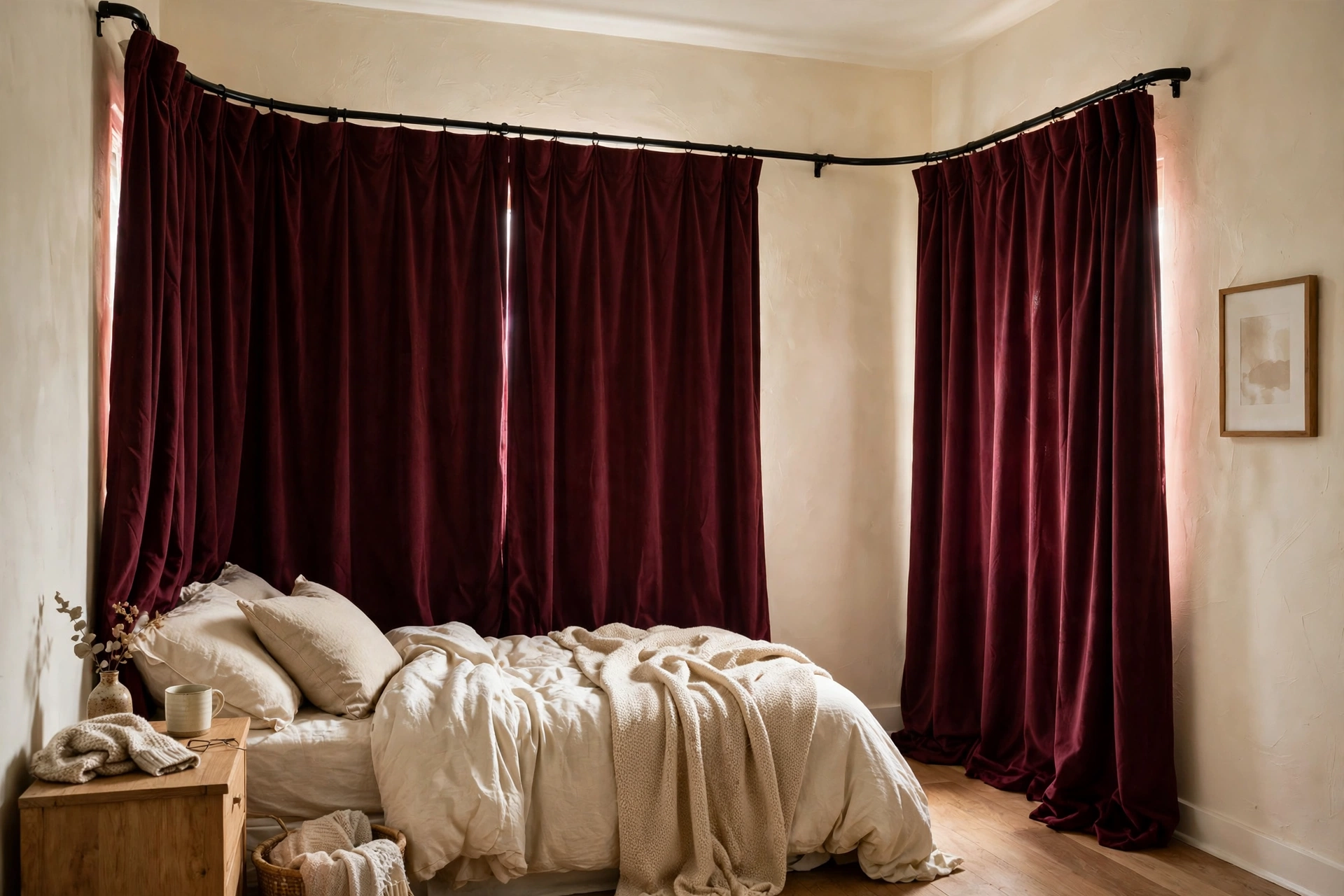
3. Room Essentials Heavy-Duty Tension Rod, 48 to 84 Inches, $15.00
Best for: renters who need a rod in ten minutes with zero holes, and the cheapest pick in this guide.
Main advantage: fifteen dollars at Target, no tools, no brackets, no holes. It spans the most common small-room window range, and the gloss white finish disappears against white trim. It is the rod to buy when the lease says no drilling and the budget says as little as possible.
Watch out for: Target publishes no weight limit for it, so plan on sheers and light cotton only, and test it with your actual panels before you trust it overnight. Tension rods lose grip near their maximum extension, so this one is at its best on windows under about 60 inches.
Verdict: the best no-drill budget buy. Fifteen dollars, zero damage, and it comes down in seconds at move-out.
Renter-Friendliness: 5 out of 5. Nothing is drilled, screwed, or stuck to the wall.
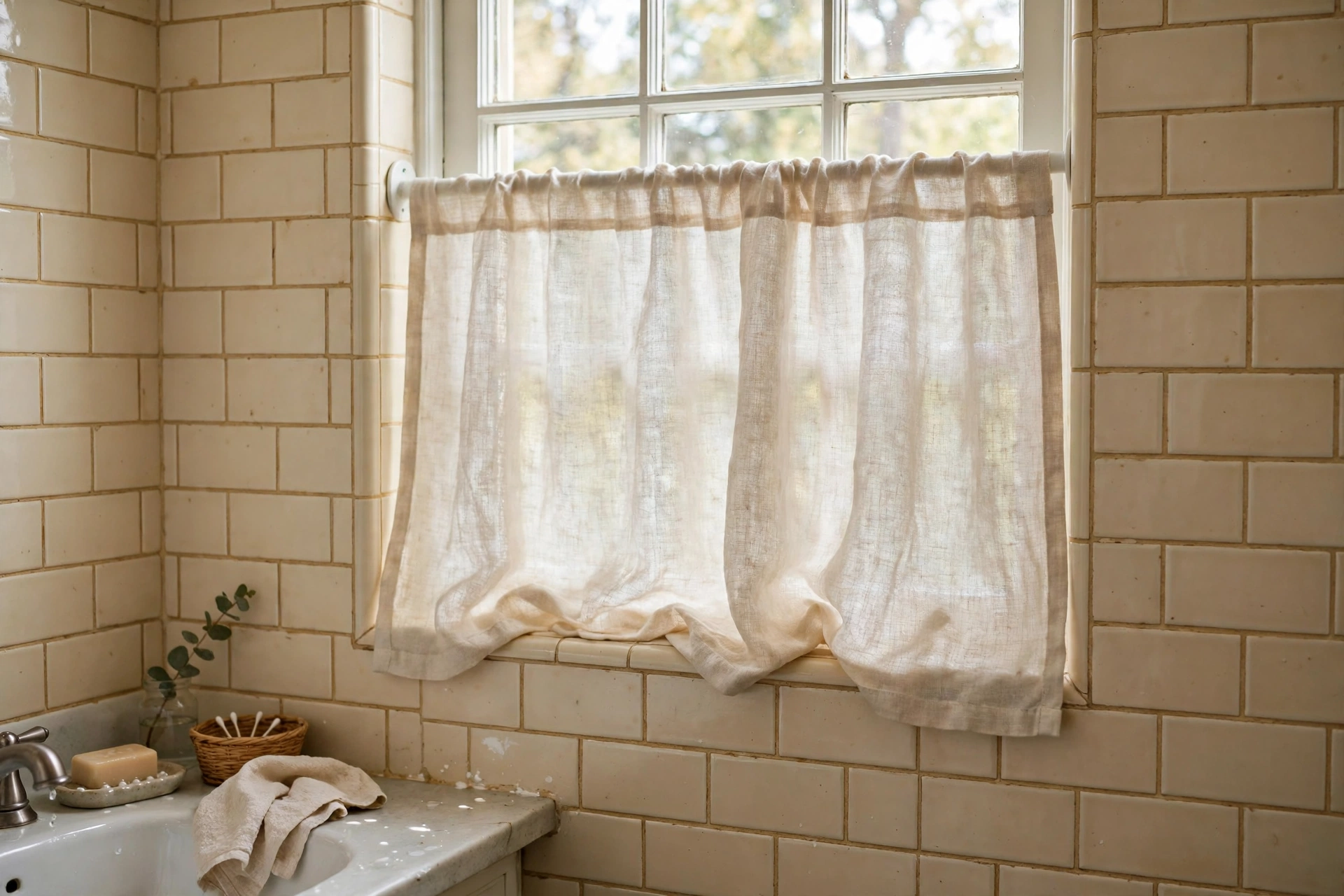
4. Zenna Home Adjustable Curtain Tension Rod, 48 to 84 Inches, $39.19
Best for: renters who want a tension rod that actually looks like a finished curtain rod.
Main advantage: this is the tension rod for people who hate how tension rods look. Decorative round finials, a proper rod profile, and a manufacturer-stated maximum of 20 pounds, which is the highest honest capacity in this guide for a no-drill rod. It covers the same 48-to-84-inch range as pick 3, but it reads as a deliberate design choice rather than a temporary fix.
Watch out for: at $39.19 it is the most expensive pick here, and it is still a tension rod, so heavy lined panels at full extension will test it. The bronze finish suits warm rooms and can clash with cool gray walls, so check it against your palette first. If you want the full no-drill method, including how to hang curtains without drilling on different surfaces, our no-drill guide covers the brackets and hooks that pair with it.
Verdict: the premium no-drill pick. It costs more than twice pick 3, but it is the only tension rod here that looks like it belongs in a styled room.
Renter-Friendliness: 5 out of 5. No holes, and the finials hide the fact that it is a tension rod at all.
5. Amazon Basics 1-Inch Adjustable Rod, 72 to 144 Inches, $29.45
Best for: the one wide window in a small apartment, usually the living room slider or the big bedroom window.
Main advantage: it is the only rod here that reaches 144 inches while staying under $30, and the 1-inch diameter keeps it rigid across the span. At $29.45 it undercuts most wide rods by ten dollars or more.
Watch out for: past about 72 inches, fit the center bracket or expect a sag in the middle. The black finish is the safest choice in this size, and the rod looks best with panels that stack fully off the glass, which needs the full 6 inches of extension per side. Measure twice, because a rod this long cannot be returned to a short window.
Verdict: buy it only for a genuinely wide window. On a 36-inch window it is the wrong tool, but on a 96-inch window it is the cheapest right tool.
Renter-Friendliness: 3 out of 5. Drill-in, and the center bracket adds a third hole to fill later.
6. Amazon Basics 1-Inch Double Rod, 36 to 72 Inches, $33.74
Best for: layering sheers behind blackout panels on one window, which is the best way to get privacy and darkness from a single window.
Main advantage: two rods on one bracket set, so sheers stay up during the day and blackout panels close at night, with no second installation. The list price of $33.74 buys both layers for less than two separate single rods. The square finials look more deliberate than the round ones on pick 1.
Watch out for: two layers means twice the weight on the same brackets, so weigh both pairs together before you commit. The front rod carries the heavier panels, and the gap between the rods needs about 3 inches of clearance from the wall, so it suits windows with clear wall space rather than tight corners.
Verdict: the best layering buy under $40. If your small room needs both daylight privacy and real darkness, this is the one-rod answer.
Renter-Friendliness: 3 out of 5. Drill-in, and the heavier load means the fixings deserve extra care.

7. Amazon Basics Spring Tension Rod, 36 to 54 Inches, $19.88
Best for: tiny windows, kitchen windows, closet openings, and bathroom windows where a normal rod is overkill.
Main advantage: it is the smallest serious rod in this guide, and the 36-to-54-inch range covers the windows that the bigger rods cannot shrink down to. Rated 4.6 stars across more than 5,900 ratings, which is the strongest social proof of any pick here. It also works as a closet rod or a shower curtain rod in a pinch, so it keeps earning its keep after a move.
Watch out for: this is the rod with the capacity conflict. One roundup lists it at 7 pounds, another at 20 pounds. Plan on 7 pounds, which still covers sheers and light cotton on a short span, and do not hang lined blackout panels from it. The classic finial design is functional rather than decorative, so it suits utility rooms more than a styled living room.
Verdict: the tiny-window specialist. For any opening under 54 inches where drilling is off the table, this is the rod that fits.
Renter-Friendliness: 5 out of 5. No holes, and it moves to the next apartment in a suitcase.
How far should a curtain rod extend past the window?
Four to six inches past the frame on each side, for most rooms. That is the rule every measuring guide in our research agrees on, and it is the rule the table above is built from. Four inches is the minimum that lets the panels clear the glass. Six inches is the better choice when the wall allows it, because the panels stack fully on the wall and the window reads wider than it is.
Height matters just as much. Hang the rod 4 to 6 inches above the frame, never sitting on the trim. A rod on the trim makes the window look short. A rod hung high makes the ceiling feel taller, which is the oldest small-room trick in the book and it costs nothing.
If the window sits tight against a corner or a bookcase, take what the wall gives you and keep at least 2 inches clear of the nearest obstruction. An even gap on both sides matters more than hitting the full 6 inches on one side and zero on the other. And when you pick the curtain color, the curtain and wall color pairings in our color guide will keep the rod and the panels working with the room instead of against it.
What does one window cost?
All prices below are as of November 2026, from the Amazon and Target listings checked for this guide. Every rod in this guide ships with its brackets and screws, so the rod price is the whole hardware cost for a drill-in install. No extra fixings are priced in, because the box already includes them.
| Route | What you buy | One-window total |
|---|---|---|
| Budget route | Amazon Basics 1-in rod, 36 to 72 in | $19.54 |
| No-drill route | Room Essentials tension rod, 48 to 84 in | $15.00 |
| Blackout route | Amazon Basics wrap-around rod, 48 to 88 in | $22.99 |
| Layered route | Amazon Basics double rod, 36 to 72 in | $33.74 |
| Finished no-drill route | Zenna Home tension rod, 48 to 84 in | $39.19 |
A small apartment usually has three windows that need rods. Three windows on the budget route come to 3 times $19.54, which is $58.62. Three windows on the no-drill route come to 3 times $15.00, which is $45.00. That is the whole project for most renters: under $60, one afternoon, and nothing to undo at move-out except filling a few small holes if you drilled. Once the rods are up, the panels are the next decision, and our budget curtains for small rooms guide pairs seven cheap panels with exactly these rods.
Mistakes to avoid
Buying the rod before measuring the window. It sounds obvious, and it is still the most common error. Measure the frame, add 8 to 12 inches, and then buy the range that covers the result. A rod bought on a guess is a rod that gets returned.
Trusting the highest capacity number you can find. When two sources disagree by 13 pounds on the same rod, the lower number is the plan. A curtain that falls at 2 a.m. is not a bargain at any price.
Skipping the center bracket on a long span. Any rod past 72 inches sags without one. The bracket is in the box for a reason, and a sagging rod makes even expensive curtains look cheap.
Hanging the rod on the trim. It saves four inches of wall and costs the whole room its proportions. Four to six inches above the frame, every time.
Forgetting the panel weight. The rod is only half the system. Weigh both panels together before you buy, and if the total is anywhere near the rod’s limit, step up a diameter or shorten the span.
What to skip
Oversized 1.5-inch rods in a small room. They cost more, they look heavy on a narrow window, and no normal curtain panel needs that much steel. Save them for rooms with 10-foot ceilings and lined drapes.
Rods longer than 120 inches for a small apartment. If your window is not actually that wide, a 120-inch rod is just a long lever waiting to sag. Buy the range your window needs, not the biggest range in the store.
Plastic brackets on a drill-in rod. They crack, they creep, and they fail at the worst moment. Every pick in this guide uses metal brackets, and that is not a coincidence.
Decorative rods with no published capacity. If the listing will not tell you what it holds, it is telling you something. Buy the rod that prints its number.
A note for renters
Check the lease before you drill, even for two small bracket holes. Most leases allow small picture-hook holes but treat curtain brackets as a gray area, and the deposit risk is real if the holes are left unfilled or the plaster crumbles. Tension rods avoid the question entirely, which is why three of the seven picks above need no holes at all. If you do drill, fill the holes with spackle at move-out and keep the original brackets in a labeled bag, so the next tenant inherits a working setup and you keep the deposit.
Sources
- WhoIsMcAfee, “12 Best Curtain Rods (October 2026) Tested Picks”, diameter and weight-capacity comparison table used for the wrap-around, Ivilon, Time Forest, GXOACKJ, and H.VERSAILTEX capacities: WhoIsMcAfee best curtain rods
- Homer DIY, “10 Best Tension Curtain Rods”, Zenna Home tension rod range, 20-pound capacity, and the competing capacity figure for the Amazon Basics tension rod: Homer DIY tension curtain rods
How this was made
This guide was written from live search results and retailer listings checked in November 2026. Rod lengths in the table are computed from the 4-to-6-inches-per-side rule published by the measuring guides cited above. Prices are the listed prices found on Amazon and Target on the day of checking, and the totals are simple arithmetic on those prices. No product was sent to us and no rod was installed for this guide.
What size curtain rod do I need?
Measure the window frame from outside edge to outside edge, then add 8 to 12 inches total, which is 4 to 6 inches past the frame on each side. Then buy the adjustable range that covers the result. For a 36-inch window that means a 44-to-48-inch rod, so a 28-to-48-inch adjustable rod is the right buy.
How far should a curtain rod extend past the window?
Four to six inches past the frame on each side is the standard. Four inches is the minimum that lets the panels clear the glass when open. Six inches is better when the wall allows it, because the window reads wider and more light comes in.
How much weight can a tension rod hold?
It depends on the rod and the span, and listings disagree. The Amazon Basics 36-to-54-inch tension rod is listed at 7 pounds in one roundup and 20 pounds in another. Plan on 7 pounds for a budget tension rod, which covers sheers and light cotton, and use a drill-in rod for lined blackout panels.
Can you hang curtains without drilling in a rental?
Yes. A tension rod needs no holes at all and comes down in seconds, and adhesive or clamp brackets cover windows where a tension rod does not fit. Three of the seven picks in this guide are no-drill, and all three score 5 out of 5 for renter-friendliness.