Narrow Hallway Storage Ideas: 10 Fixes That Fit a Tight Hall (and Keep the Walkway Clear)
A narrow hallway fails for one reason: the storage is deeper than the hall can spare. A hall that is 48 inches wide with a 15 inch deep cabinet leaves 33 inches to walk through, and that is the difference between a hallway and a tunnel. Narrow hallway storage ideas that actually work start from one number, the clear walkway, and this post gives you the table to check it, the shoe capacity per cabinet depth, and a starter kit that costs $96.99 at prices checked in November 2026. Ten fixes follow, all measured against a 36 inch clear walkway, and eight of them need no drilling at all.
Narrow hallway storage ideas start with the walkway budget
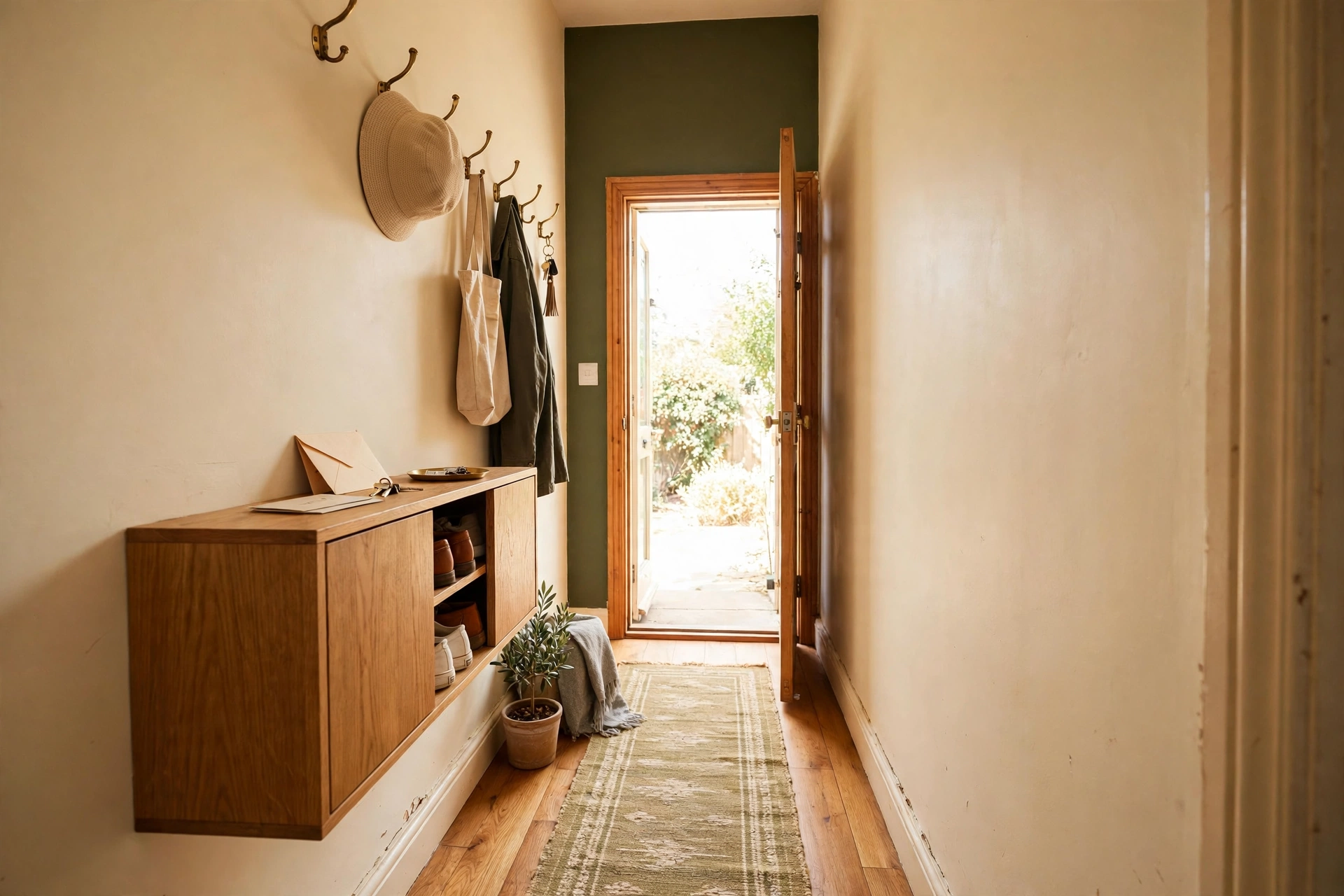
Measure the narrowest part of the hallway, not the widest wall. The pinch point is usually where the front door swings in, where the radiator sticks out, or where the skirting boards narrow the gap, and that number is the one your furniture has to respect. Our small hallway layouts guide sorts the floor plan first, and this post sorts what lives on it, but both start from the same measurement.
The rule is simple subtraction: hallway width minus furniture depth equals clear walkway. Aim for 36 inches (91 cm) of clear walkway, which is the yardstick the US Access Board sets for accessible routes in public buildings, narrowing to 32 inches only at short points such as doorways. That rule covers public buildings, not private homes, but 36 inches is a practical target, and 30 inches (76 cm) is the workable minimum. Below 30 inches you start turning sideways with bags, and the hall feels like an obstacle course instead of a room.
| Hallway width | Deepest piece keeping 36 in (91 cm) clear | Deepest piece keeping 30 in (76 cm) clear | What fits |
|---|---|---|---|
| 40 in (102 cm) | 4 in (10 cm) | 10 in (25 cm) | Nothing on the floor. Wall hooks and over-door storage only. |
| 44 in (112 cm) | 8 in (20 cm) | 14 in (36 cm) | A 9.4 in flip cabinet leaves 34.6 in, under the 36 in target but over the 30 in minimum. |
| 48 in (122 cm) | 12 in (30 cm) | 18 in (46 cm) | A slim flip cabinet at 9.4 in leaves 38.6 in clear. |
| 54 in (137 cm) | 18 in (46 cm) | 24 in (61 cm) | A flip cabinet or a slim bench at 14 in, which leaves 40 in clear. |
| 60 in (152 cm) | 24 in (61 cm) | 30 in (76 cm) | A bench and a cabinet on the same wall, one after the other. |
| 66 in (168 cm) | 30 in (76 cm) | 36 in (91 cm) | A 15.7 in door-and-shelf cabinet leaves about 50 in clear. |
| 72 in (183 cm) | 36 in (91 cm) | 42 in (107 cm) | Almost anything slim fits. Still keep furniture to one side only. |
Before you buy anything, mark the depth on the floor with masking tape and walk past it for a day. A 9.4 inch cabinet looks slim on a product page and feels very different when you carry a laundry basket past it. Note the door swing too: a front door that opens inward rules out a bench directly behind it, and a radiator rules out anything that blocks the heat. Keep furniture to one side only. Two slim pieces facing each other make a tunnel, not a hallway.
How many shoes does a slim cabinet actually hold?
The trick that makes slim cabinets possible is the angle. Every narrow hallway storage ideas plan needs the shoe number before the shopping list, because the cabinet depth decides the pair count, and the pair count decides whether one cabinet is enough. A men’s size 10 shoe is about 320 mm (12.6 in) long lying flat, which is why a flat shelf needs about 320 mm of depth. Stored on its edge in a flip drawer, the same shoe needs about 170 mm (6.7 in), and that is why the best narrow hallway cabinets are only 9.4 inches deep. The table below uses real product specs, and the pair counts are best-case figures: chunky trainers, high-tops, and large men’s shoes take more room and cut the count.
| Cabinet type | Depth | Height | Pairs it holds |
|---|---|---|---|
| Slim flip-drawer cabinet, 2 drawers | 9.4 in (24 cm) | 29.5 in (75 cm) | About 12 |
| Slim flip-drawer cabinet, 3 drawers | 9.4 in (24 cm) | 42 in (107 cm) | 12 to 18 |
| Tall flip-drawer cabinet, 4 drawers | 9.4 in (24 cm) | 61 in (155 cm) | Up to 28 |
| HOMCOM 4-flip cabinet, 80 cm wide | 9.4 in (24 cm) | 51.6 in (131 cm) | Up to 20 |
| VASAGLE CUSTOS, 2 flip + open compartment | 9.4 in (24 cm) | 40 in (102 cm) | 11 to 16 |
| Door-and-shelf cabinet, flat shelves | 15.7 in (40 cm) | Varies | 16 to 24 |
| Shoe bench with cubbies | 12 to 14 in (30 to 36 cm) | 18 in (46 cm) | 6 to 12 |
Go taller rather than wider when the hall is tight. A 61 inch tall cabinet holds up to 28 pairs on the same 9.4 inch footprint as the 12-pair version, and it costs you nothing in walkway. The catch is stability: a cabinet that is 61 inches tall and 9.4 inches deep is more than six times taller than it is deep, so anchor it. The US Consumer Product Safety Commission estimates that emergency departments treated an average of 17,800 tip-over injuries a year from 2020 to 2022, with 44 percent of victims under 18, and tall shallow furniture is exactly the kind that tips.
Narrow hallway storage ideas: the 10 fixes
1. Measure the pinch point, then mark the walkway with tape. This is the fix most narrow hallway storage ideas lists skip, and it is the one that saves the most money. Measure the narrowest width, the door swing, the radiator, and the light switch, then tape the cabinet depth on the floor and live with it for a day. If you brush it with every pass, the depth is wrong, not you. Best for: every hallway, because it costs nothing and prevents the one expensive mistake. Main advantage: you buy once, and the piece fits the first time. Watch out for: measuring the widest wall and assuming the rest matches. It never does. Verdict: ten minutes with a tape measure beats a return label. Deposit-Risk: 1/5.
2. Put in a slim flip-drawer shoe cabinet. This is the anchor piece, because shoes are the biggest source of hallway clutter and the cabinet solves them in 9.4 inches of depth. A two-drawer unit holds about 12 pairs, a three-drawer about 12 to 18, and the flip doors need almost no clearance in front, unlike swing doors. Wall-mount it 12 to 16 inches off the floor and everyday shoes slide underneath. Best for: any hall 44 inches or wider, because the cabinet keeps 36 inches of walkway clear. Main advantage: the most pairs per inch of depth you can buy. Watch out for: boots. Tall boots need 16 to 20 inches of compartment height, so check the drawer height before you order. Verdict: the first purchase, and the one the rest of the hall is built around. Deposit-Risk: 1/5 freestanding, 2/5 if you screw the anti-tip kit into the wall.
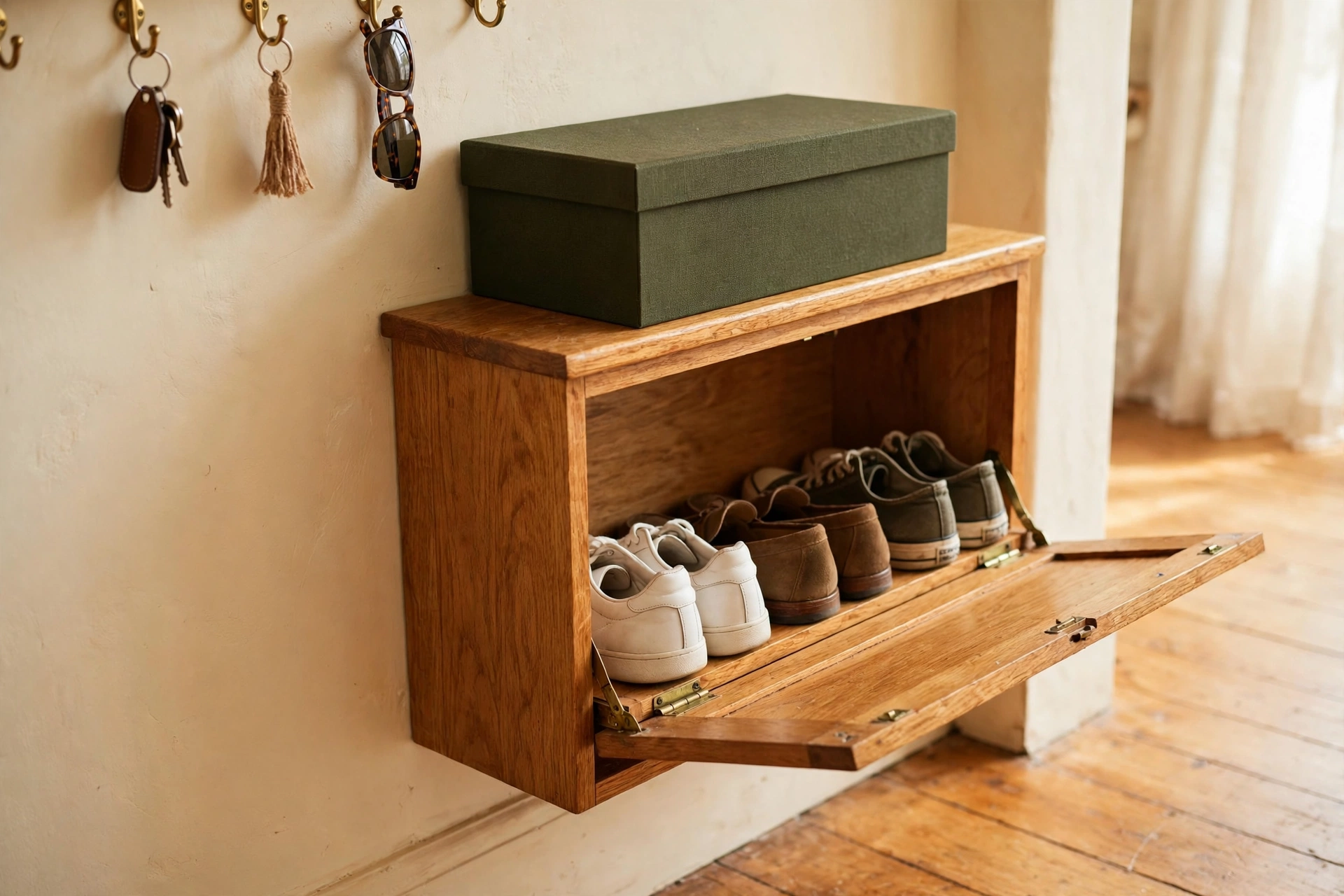
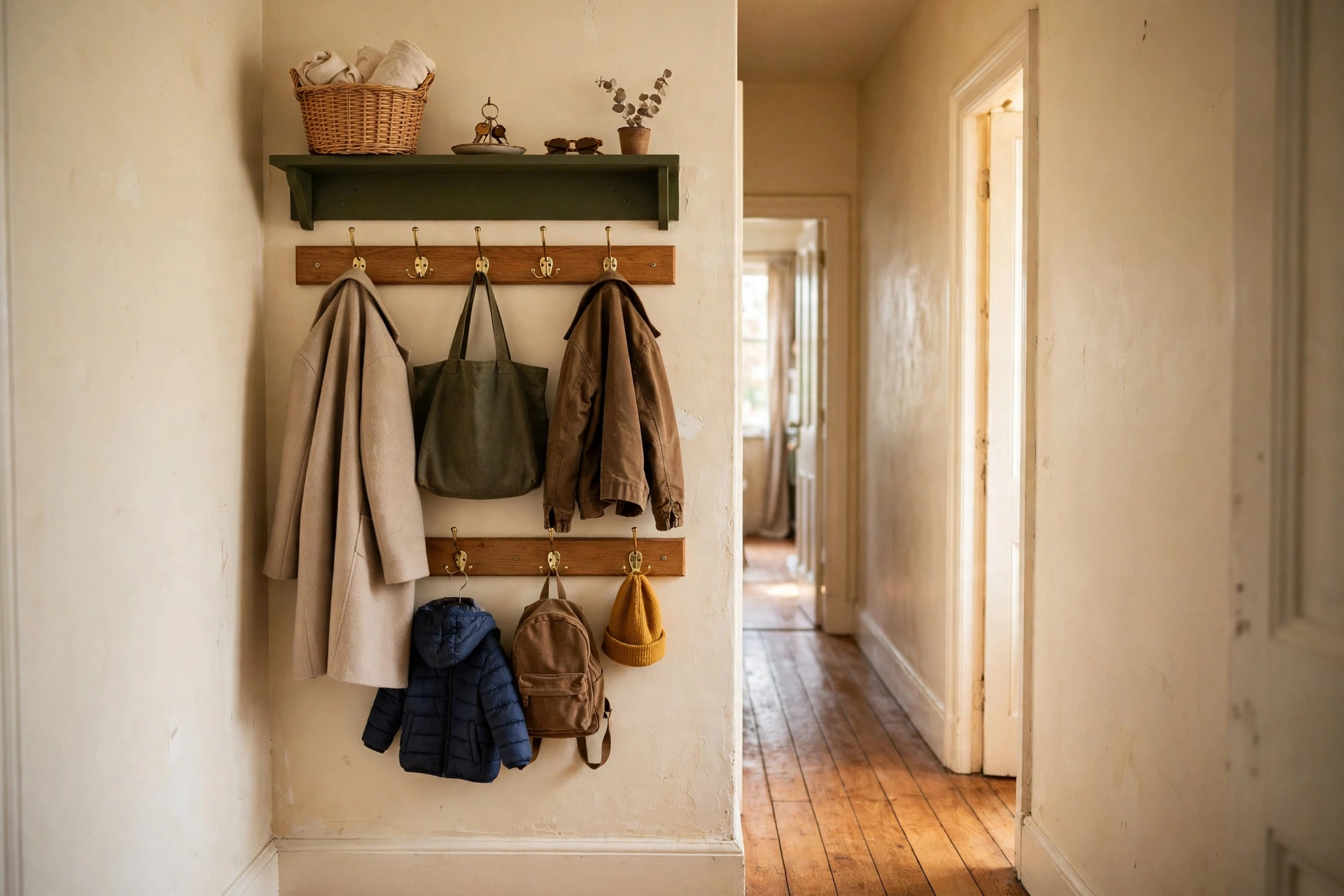
3. Hang two rows of wall hooks, adults high and kids low. Hooks are the hardest-working storage in a narrow hallway because they use vertical space that would otherwise be wasted, and they cost you zero floor. Fit the adult rail at about 67 inches (170 cm) and a second, lower row at about 43 inches (110 cm) so children hang their own coats without help. Use double hooks so a coat and a bag share one spot without tangling. Best for: households where coats land on the floor the moment the door closes. Main advantage: five or six hooks on a 24 to 36 inch rail swallow more than a coat stand ever will. Watch out for: hanging the rail above a bench that sticks out further than the coats. Coats should dangle over the bench, not into the walkway. Verdict: the cheapest fix per use in the whole list. Deposit-Risk: 2/5 with screws, 1/5 with heavy-duty adhesive hooks within their weight rating.
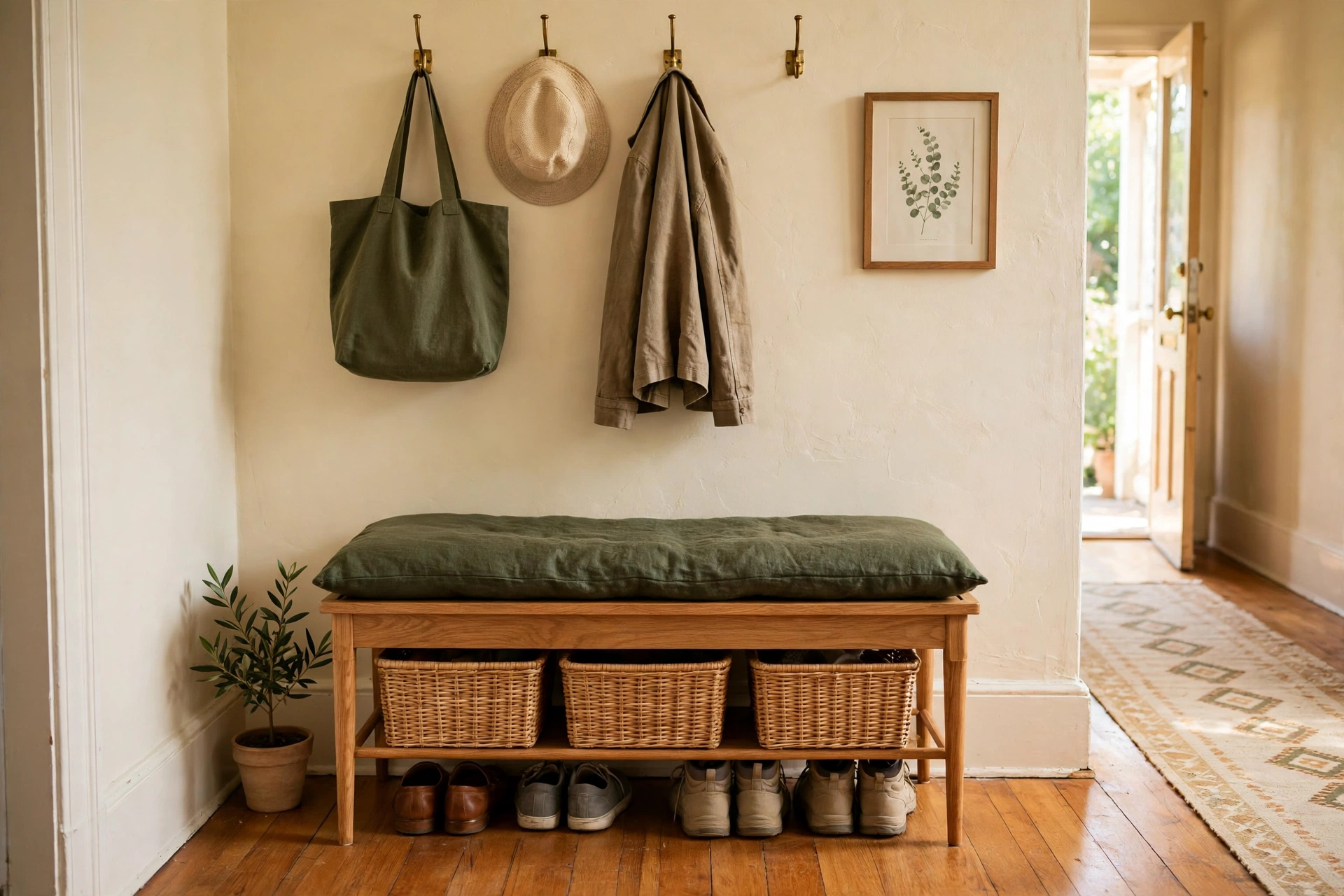
4. Add a slim bench with lift-up storage. A bench that is 12 to 14 inches deep and 18 inches high gives you somewhere to sit while you tie shoes, and the lift-up lid hides gloves, hats, and reusable bags. Open cubbies underneath keep everyday shoes visible and drying, which matters for damp shoes. The same bench logic works in a tiny entryway, where the seat earns its footprint the same way. Best for: halls 54 inches or wider, where the bench still leaves 40 inches of walkway. Main advantage: a seat, a shoe rack, and a glove box in one footprint. Watch out for: a bench deeper than 16 inches in a hall under 54 inches wide. It turns the walkway into a squeeze. Verdict: worth it when the width allows, and the first thing to cut when it does not. Deposit-Risk: 1/5.
5. Hang an over-door organizer on the nearest interior door. The back of a door is free vertical space, and a 20-pocket organizer turns it into shoes, gloves, hats, keys, sunglasses, and the small items that otherwise migrate to the stairs. It hangs from hooks over the door with no drilling and installs in five minutes. Best for: halls under 44 inches wide, where no floor furniture fits at all. Main advantage: 20 extra compartments in zero floor space. Watch out for: the door still closing fully. Load the organizer, then close the door and check, because a door that will not shut gets the organizer moved to the floor within a week. Verdict: the fastest win in the room. Deposit-Risk: 1/5.
6. Fit a shallow shelf above the hooks. A shelf 6 inches deep (15 cm), fixed above the coat rail, holds a lidded basket of hats and scarves plus a small tray for keys and post. It is deep enough for a basket and shallow enough that you will not catch your shoulder on it. Keep it to one short shelf, not a run of them, or the wall starts closing in. Best for: the daily small stuff that has no other home. Main advantage: the landing zone for keys and post, at eye level where you actually use it. Watch out for: loading it with books or heavy decor. A shallow shelf on plasterboard is for paper and keys, not a book collection. Verdict: the fix that stops the key hunt every morning. Deposit-Risk: 2/5.
7. Give each person one basket. Baskets are the quiet heroes of hallway storage. A lidded basket reads as intentional decor, an open pile reads as chaos, even when both hold exactly the same things. Give each household member one lined, washable basket, tucked under the bench or on a low shelf, for hats, gloves, dog leads, and returns. Three or four matching baskets look tidier than one big box, and each one has a name on it. Best for: families, where the hall collects one pile per person. Main advantage: the clutter has a boundary, and the boundary is visible. Watch out for: baskets deeper than 8 inches on the floor. They creep into the walkway. Verdict: the habit fix that makes the furniture fixes stick. Deposit-Risk: 1/5.
8. Slide a slim rolling trolley into the dead gap. Narrow halls are full of dead zones: the gap beside the radiator, the space behind the door, the strip between the cabinet and the wall. A slim rolling trolley about 6 inches wide turns that gap into cleaning supplies, shoe care, or the dog leads, and it rolls out when you need it. Best for: halls with an awkward gap no furniture fits. Main advantage: storage in space that was already wasted. Watch out for: a trolley that blocks the radiator. Leave ventilation gaps, and never cover a radiator fully. Verdict: the fix for the gap you thought was unusable. Deposit-Risk: 1/5.
9. Lay a runner that fits, and a boot tray by the door. A runner protects the floor, absorbs grit, and visually lengthens a narrow space, but only if it is the right size. Leave 2 to 3 inches of floor visible on each side, run it for about two-thirds of the hallway, and stop 18 to 24 inches short of the front door so the door and the mat have room to work. Always use an anti-slip gripper pad underneath, especially on tile or varnished boards. A shallow boot tray beside it catches wet shoes and rinses clean. Best for: halls with hard floors and wet weather. Main advantage: the floor stays clean and the hall looks longer. Watch out for: a runner that spans wall to wall. It makes the hall look narrower, not wider. Verdict: the finishing touch that also does real work. Deposit-Risk: 1/5.
10. Send the overflow out of the hallway. A hallway is not a warehouse. Keep only the shoes in current rotation by the door, the coats for this season, and the bags in daily use. Everything else lives elsewhere: off-season shoes go under the bed, where the same measure-first rule applies, and the overflow bags and household storage go in the under-stairs cupboard if you have one. Rotate with the seasons, one pair in for every pair out. Best for: every hallway, because the hall can only hold what the household actually uses this week. Main advantage: the hall stays at the size you planned, instead of growing a pile every month. Watch out for: the “just for now” pile on the stairs. It becomes permanent in a week. Verdict: the rule that protects all nine other fixes. Deposit-Risk: 1/5.
The 10-minute hallway audit
Materials: tape measure, masking tape, pencil, slim flip-drawer shoe cabinet, wall hook rail, Command strips or screws with wall plugs, slim bench, two or three baskets, over-door organizer, boot tray, anti-tip kit, labels and a marker.
- Measure the narrowest point of the hallway, the door swing, and the radiator, and write the numbers down.
- Mark the cabinet depth on the floor with masking tape and walk past it for a day.
- List what must live in the hall: two coats per person, one pair of shoes in use, keys, lead, reusable bag. Everything else is overflow.
- Pick the cabinet depth from the walkway table above, then order the cabinet to match.
- Hang the hook rail at 67 inches for adults and 43 inches for children, above the bench or the baskets.
- Place the bench and the baskets on one side only, then hang the over-door organizer and close the door to check it.
- Anchor tall cabinets to the wall, lay the runner and the boot tray, and run a 10-minute reset every Sunday.
Active work: about 2 hours for one person, including the flat-pack cabinet assembly. Do the measuring on day one and the buying after, not before: the people who buy first and measure second are the ones with a cabinet that does not fit and a receipt they cannot return.
How much does the whole setup cost?
Prices checked in November 2026. No affiliate links. The starter kit covers the three highest-return fixes in the list above: the cabinet, the door organizer, and the hooks.
| Item | Price, as of November 2026 |
|---|---|
| FUFU&GAGA slim shoe cabinet, 2 flip drawers, 22.4 x 9.4 x 29.5 in | $68.00 |
| UVIAHOMI over-door shoe organizer, 20 pockets | $17.00 |
| Command Large Utility Hooks, 7-hook 12-strip pack | $11.99 |
| Starter kit total | $96.99 |
| Budget route: HOMIDEC 8-tier shoe rack cabinet | $49.99, kit total $78.98 |
| Budget route: over-door organizer and Command hooks only | $28.99, included above |
| Optional add-ons: slim bench with storage, typically $60 to $100; woven baskets, typically $12 to $20 each; boot tray, typically $10 to $15 |
The budget route swaps the flip-drawer cabinet for an 8-tier open rack and keeps the organizer and the hooks, and it does the same job for $78.98. That is the whole point of narrow hallway storage ideas: buy the depth your hall can spare, not the furniture you wish it could hold. Everything in the kit lasts for years: the cabinet anchors to the next wall, the organizer hangs on the next door, and the hooks peel off cleanly. The most expensive item, the cabinet, is the one you will use every single day.
Mistakes to avoid
Buying furniture before measuring the pinch point. The most common hallway mistake is buying a 15.7 inch deep cabinet for a 44 inch hall and discovering the walkway is 28 inches. Measure the narrowest point, check the table, then buy.
Filling both walls. Symmetry sounds tidy, but two slim pieces facing each other make a tunnel. Keep furniture to one side only and let the other wall stay clear.
Storing the whole wardrobe by the door. A hallway holds the shoes in rotation and the coats for this season. If you keep 40 pairs by the door, half of them live on the floor, and the floor is not storage.
Skipping the anchor on a tall cabinet. A 61 inch cabinet that is 9.4 inches deep tips forward when a drawer opens with shoes in it. Fit the anti-tip kit that comes in the box.
Blocking the radiator or the door swing. Storage that blocks heat or stops a door opening gets hated within a week, and then it gets moved to the floor, which is where the clutter started.
What to skip
A deep coat cupboard in a narrow hall. A standard 24 inch deep wardrobe eats half a 48 inch hallway. Hooks and a slim cabinet do the same job in 9.4 inches.
A full hall tree in a hall under 54 inches wide. Hall trees with benches run 13 to 16 inches deep and 72 inches tall, and they need width you do not have. Take the bench and the hooks separately instead.
Matching storage sets. A matching set of pretty boxes costs twice the baskets and holds the same things. Buy the cheap baskets and spend the difference on the cabinet.
Open shoe racks with no back. Open racks let shoes slide off the back against the wall and collect dust. A closed flip cabinet or a rack with a back panel keeps the pile contained.
A second shoe cabinet before the first one is full. One tall cabinet holds up to 28 pairs. If it is not full, you do not need a second one, you need the overflow rule in fix 10.
A note for renters
Check the lease before you drill anything, because the lease, not this guide, decides what is allowed on your walls. Most leases allow small picture hooks and adhesive strips, and many allow a hook rail with screws if you fill the holes at move-out, but a tall cabinet anchored with screws is a deposit question, so ask in writing and keep the answer. Eight of the ten fixes need no drilling at all: the cabinet stands on the floor, the organizer hangs over a door, the baskets sit under a bench, and Command hooks peel off cleanly when the strips are removed with the pull tab. Photograph the walls on move-in day so a mark that was already there is not charged to you later, and keep receipts for everything you install. Everything in this guide reverses in under an hour on move-out day, and that reversibility is the point: the hallway should look untouched when you hand the key back.
Sources
Walkway figures come from the hallway guides reviewed for this post, which put the clear-walkway target at 36 inches with a 30 inch workable minimum, and the 36 inch yardstick comes from the US Access Board guidance cited in the FUFU&GAGA shoe cabinet buying guide (https://ca.fufugaga.com/blogs/news/shoe-cabinet-buying-guide), which also carries the CPSC tip-over figures (17,800 injuries a year, 44 percent under 18). Shoe dimensions and the 170 mm angle rule come from Sometimes Storage (https://sometimes-storage.com/storage-ideas/clothing/shoe/), and the 24 cm depth standard and pair counts come from the CompactHome narrow shoe rack comparison (https://www.compacthome.co.uk/storage/best-shoe-racks-for-narrow-hallways/). Cabinet prices come from the product listings checked in November 2026, including the FUFU&GAGA slim cabinet at $68.00, the HOMIDEC 8-tier rack at $49.99, and the Command hook pack at $11.99. All prices are as of November 2026 and will move with sales.
How this was made: the walkway-budget and shoe-capacity tables were computed from standard hallway widths and verified product specs, the prices were checked live in November 2026, and the safety figures were checked against the CPSC data cited in the buying guide above.
What is the best storage for a narrow hallway?
The best storage for a narrow hallway is shallow, vertical, or wall-mounted. A slim flip-drawer shoe cabinet about 9.4 inches deep, a wall hook rail at two heights, and an over-door organizer cover shoes, coats, and small items without taking floor space. Keep at least 30 inches of clear walkway, and aim for 36 inches where the hall allows it.
How deep should a shoe rack be for a narrow hallway?
Around 9 to 10 inches is the sweet spot for a genuinely narrow hallway, because flip drawers hold shoes at an angle instead of flat. A standard open shoe shelf needs about 12.6 inches, since a shoe lies front to back, while a flip-drawer cabinet gets away with 9.4 inches. Anything approaching 16 inches deep belongs in a wider hall, not a narrow one.
How do I store shoes in a narrow hallway?
Use a slim flip-drawer cabinet, which holds shoes at an angle so the unit is only about 9.4 inches deep instead of the 12.6 inches a flat shelf needs. Add a bench if there is room, because somewhere to sit is what makes people actually use shoe storage rather than leaving shoes on the floor. Keep only the pairs in current rotation by the door and move the rest under the bed.
How can I make a narrow hallway look wider?
Keep the furniture to one side only, keep the floor at least 80 percent clear, and hang a mirror opposite the door or at the end of the hall to bounce light around. Light, warm neutrals on the walls help, and a runner that leaves 2 to 3 inches of floor visible on each side visually lengthens the space instead of narrowing it.