Off-Season Clothes Storage for Small Apartments: 10 Fixes for the Twice-a-Year Swap
Every small apartment has the same hidden problem. Half the wardrobe is out of season, and it sits in the closet anyway, crowding the clothes you actually wear. The fix is a twice-a-year swap: move the off-season half out of the closet and into storage, and bring the current season back in. The best off-season clothes storage for small apartments follows that system, and the numbers behind it are smaller than most people expect. One person’s whole winter half measures about 3.9 cubic feet folded, and it packs down to about 2.5 cubic feet. That fits under one bed with room to spare, and the starter kit below costs $47.97 at prices checked in November 2026. Ten fixes follow, and they work in both directions, winter out in spring and summer out in fall.
What does off-season clothes storage for small apartments actually look like?
Two zones, and nothing else. The closet holds only the current season. Everything off-season lives in one labelled spot, under the bed, on a top shelf, or inside a suitcase, until the swap comes round again. That is the whole system. It works because it halves the clothes competing for the closet rail, which is the real win. A fashion blog put the same point plainly: storing the out-of-season half away can roughly halve the space the everyday wardrobe demands. The swap takes about 90 minutes of active work, plus laundry time, and it repeats every six months. Pick two dates tied to your local weather, not the calendar, and treat them as fixed. November is the moment in most of the US and Europe, when winter goes in and summer comes out.
How much space does your off-season half really take?
Less than you think, and that is why people buy the wrong containers. Measure the pile before you buy anything. The table below uses folded sizes you can check with a tape measure, for a typical one-person winter half. Your counts will differ, and that is fine. The method is the point.
| Item | Folded size | Volume each | In a typical half | Total |
|---|---|---|---|---|
| Chunky sweater | 12 x 10 x 3 in (30 x 25 x 8 cm) | 0.21 cu ft | 8 | 1.67 cu ft |
| Heavy coat | 16 x 12 x 4 in (41 x 30 x 10 cm) | 0.44 cu ft | 2 | 0.89 cu ft |
| Thermal / base layer | 10 x 8 x 1.5 in (25 x 20 x 4 cm) | 0.07 cu ft | 4 | 0.28 cu ft |
| Scarf, hat and glove set | about 0.1 cu ft each | 0.10 cu ft | 2 | 0.20 cu ft |
| Winter boots, per pair | 12 x 10 x 6 in (30 x 25 x 15 cm) | 0.42 cu ft | 2 | 0.83 cu ft |
| Whole winter half | 3.87 cu ft |
Vacuum-seal the soft stack, the sweaters and thermals, and it shrinks by about 60 to 70 percent, from 1.95 cubic feet to about 0.6. Coats and boots stay uncompressed, because they should. Packed total: about 2.5 cubic feet. Two IKEA SKUBB cases, each 65 x 53 x 19 cm (25 5/8 x 20 7/8 x 7 1/2 in) and 2.32 cubic feet, hold 4.6 cubic feet between them, which covers the whole 3.9 cubic foot half without any vacuum bags at all. And the space under a queen bed, 60 x 80 in (152 x 203 cm) at 7 in (18 cm) of clearance, is 19.4 cubic feet. The packed half uses about 13 percent of it. That is the whole job of off-season clothes storage for small apartments: move a small, known volume to a spot you already own.
The 10 fixes for the twice-a-year swap
1. Sort before you pack anything. Empty the closet onto the bed and make three piles: keep for this season, store for next season, donate. Anything unworn for a full year goes in the donate pile, not the store pile. Best for: everyone, because storing clothes you will never wear wastes the scarcest thing in a small apartment, which is space. Main advantage: the pile you pack is smaller than the pile you started with, so everything after this step is easier. Watch out for: the “maybe” pile. If it is not a clear keep or a clear store, it is a donate. Verdict: the only step you cannot skip. Deposit-Risk: 1/5.
2. Wash and dry everything before it goes away. This is the step people skip, and it is the most important one. Body oils, sweat and food spots are invisible on a dark sweater, but they attract insects and set into stains over months. Wash or dry-clean by the care label, then let everything dry completely. Damp clothes in a sealed bag grow mildew, and you will smell it in six months. Best for: wool, silk and cashmere, which moth larvae target first. Main advantage: clean fabric is the single best moth protection there is, better than any repellent. Watch out for: dry-cleaned coats need a day of airing before packing, because cleaning solvents leave residues that can mark fabric in storage. Verdict: non-negotiable. Deposit-Risk: 1/5.
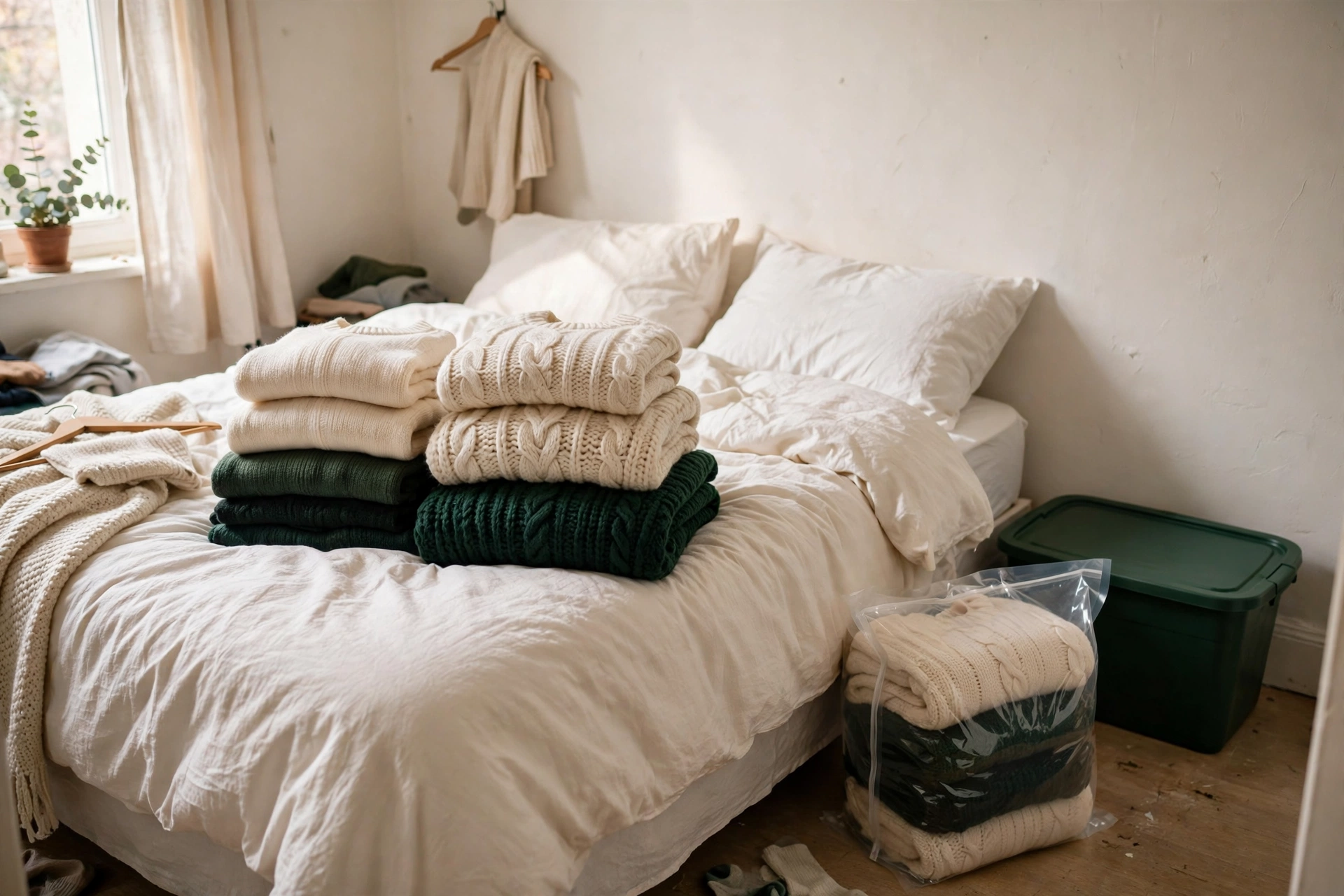
3. Vacuum-seal the soft stack only. Fleece, synthetic padded jackets for one season, cotton and everyday acrylic sweaters, thermals, scarves and gloves compress well. Fold flat, fill to the marked line, and seal. A jumbo bag, 100 x 76 cm (39 x 30 in), swallows the whole eight-sweater stack from the table above. Best for: bulky soft items that eat closet space. Main advantage: 50 to 80 percent less volume, and a sealed bag keeps out dust, moths and damp. Watch out for: overfilling. A bag packed past its line will not seal, and the seal is the whole point. Verdict: the best tool in the kit, used on the right fabrics. Deposit-Risk: 1/5.
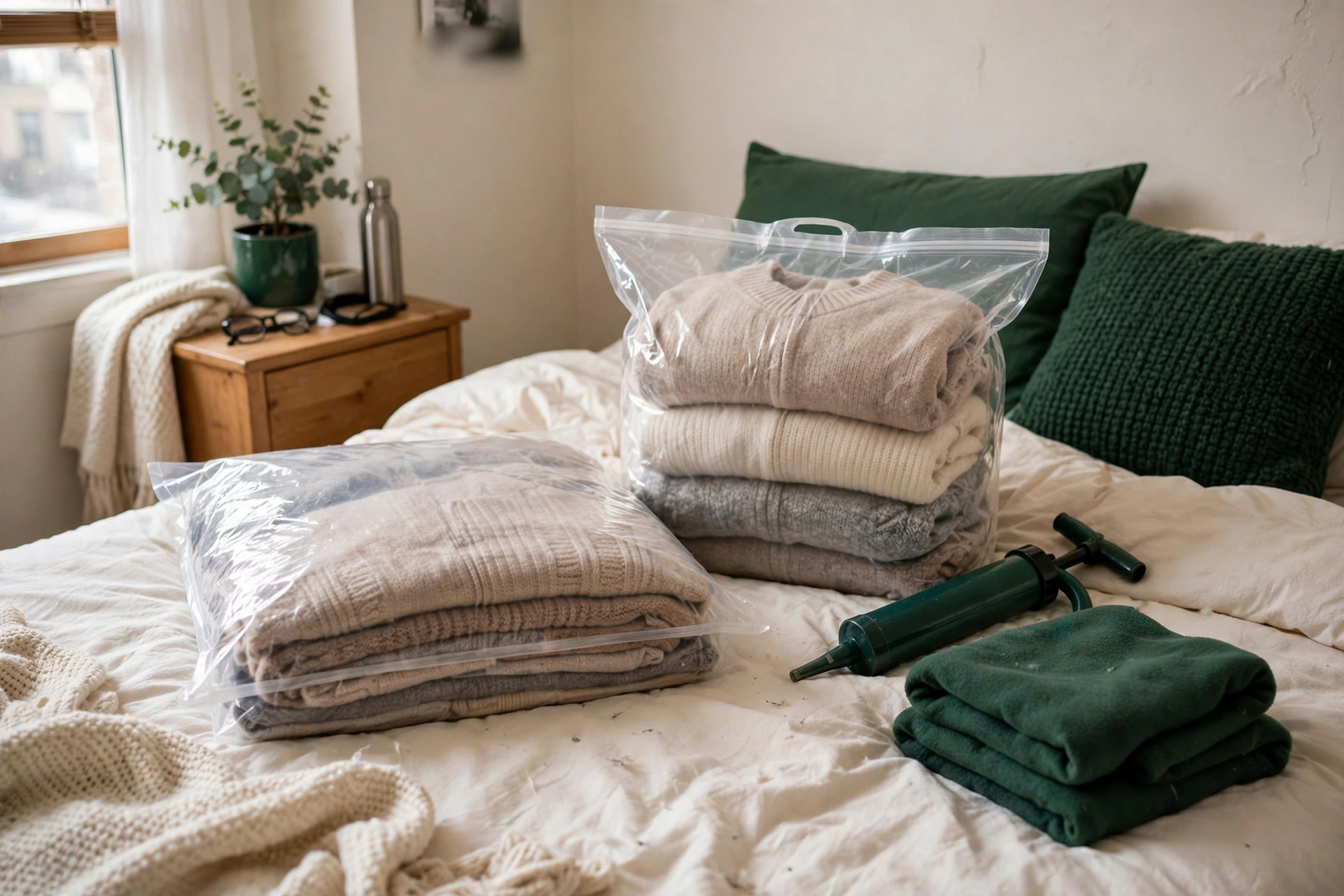
4. Never vacuum-seal these four things. Leather needs airflow and can crack when compressed. Fine knits, cashmere and loose weaves stretch and distort. Structured coats lose their shape. Down loses loft when crushed for months, and a flat down jacket is a cold down jacket. Pack those in breathable cotton bags or lidded bins instead. Best for: anyone with one good coat or one good sweater worth protecting. Main advantage: the expensive pieces come back in the same shape they went away in. Watch out for: the temptation to vacuum the coat “just this once”. Six months of compression is not “just once”. Verdict: the rule that saves the wardrobe. Deposit-Risk: 1/5.
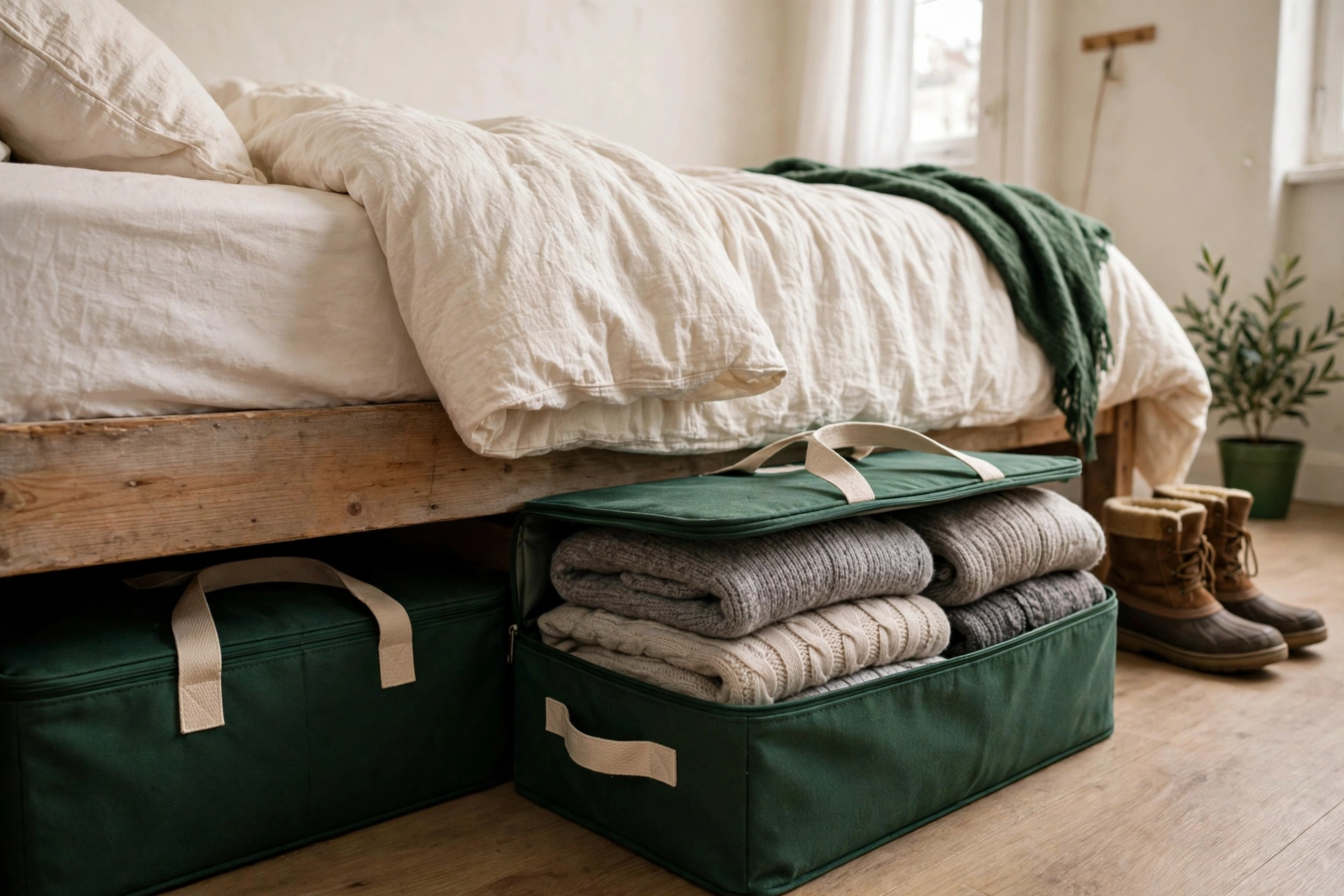
5. Put the packed half under the bed. Most bed frames allow 6 to 8 in (15 to 20 cm) of clearance, and low under-bed bags rise to about 6 in (15 cm). Measure your clearance first, then buy the container to match. Flat vacuum bags and low lidded bins slide under most frames, and a handle on the end means you can pull the whole thing out without crawling. Our guide to under-bed bins maps the space in detail, including wheeled options for heavy loads. Best for: the bulky soft stack and boots. Main advantage: the biggest hidden volume in the bedroom, and it costs no floor space. Watch out for: a bed with less than 6 in (15 cm) of clearance. Measure before you buy, or the bin will not fit and you will own a bin with nowhere to go. Verdict: the default home for the off-season half. Deposit-Risk: 1/5.
6. Use the closet top shelf for the light stuff. The high shelf that is awkward for daily use suits a labelled accessory bin, hats, gloves and the summer sandals, needed only once or twice a year. Keep heavy bins at a safe lifting height, and never stack a heavy box above shoulder height. The top shelf is also where towels live in many homes, and our towel storage guide shows how to fit 2 to 3 bath towels per person on one shelf section, so the two systems share the shelf without fighting over it. Best for: light items you touch twice a year. Main advantage: it turns dead space into the off-season zone. Watch out for: weight. A full bin of boots on a high shelf is a falling hazard and a back injury. Verdict: best for accessories, never for boots. Deposit-Risk: 1/5.
7. Pack the suitcase with the soft stuff. An empty suitcase is a ready-made storage box with a handle, and our guide to where to store suitcases in a small apartment shows where to put it. Fill it with scarves, thermals and fleece, and slide it under the bed or stand it in a corner. It holds about the same volume as one under-bed bin, and it is free, because you already own it. Best for: renters and anyone with one big case and no spare bins. Main advantage: zero cost, and the case is easy to pull out when travel season comes. Watch out for: hard-shell cases trap damp the same way sealed bags do, so everything inside must be fully dry. Verdict: the best free container in the flat. Deposit-Risk: 1/5.
8. Hang coats in breathable bags, never plastic. Coats keep their shape on wide hangers inside cotton garment bags, in the closet or on a spare rail. Thin plastic dry-cleaning bags trap moisture and belong in the bin, not on the coat. Boots get stuffed with newspaper or acid-free tissue so they hold their shape, then sit in a lidded bin. The coat closet is the natural home for the coats that stay out through the shoulder season, and our coat closet guide covers the per-person coat budget that decides how many actually fit. Best for: the two heavy coats and the good boots. Main advantage: the pieces come back wearable, not creased and damp. Watch out for: cramming. Coats packed tight in a garment bag crease just as badly as coats folded in a bin. Verdict: hang the coats, bin the boots. Deposit-Risk: 1/5.
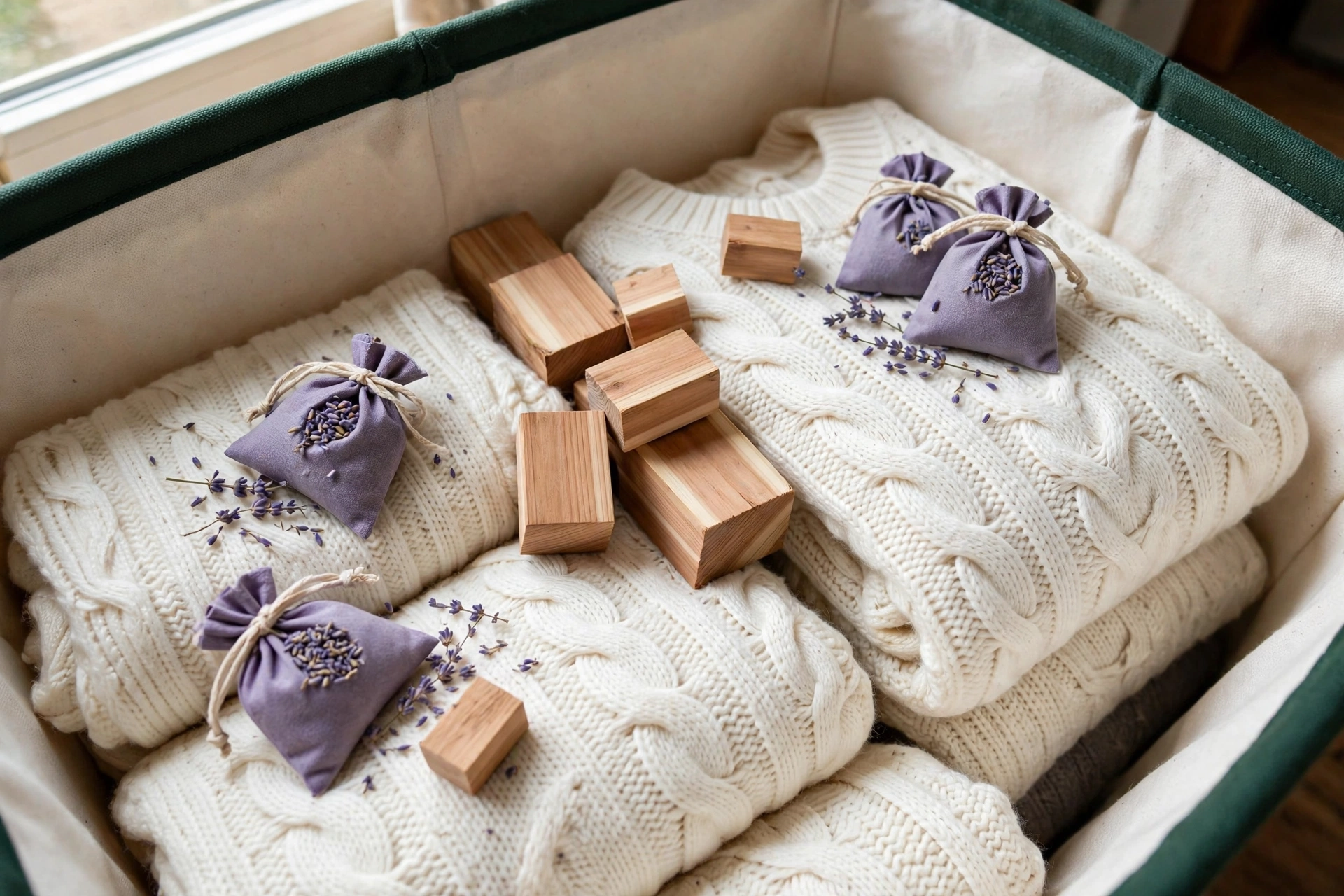
9. Add cedar and lavender the honest way. Cedar blocks, balls and sachets do not kill moths. They make the environment less inviting, so adult moths are less likely to lay eggs there. That matters, because it is the larvae that eat clothes, not the adult moths. Use about 1 to 2 cedar blocks per square foot of closet space, or one ball per drawer, and re-sand the surface every 3 to 6 months to refresh the scent. Lavender sachets work the same way. If you already have larvae, webbing or holes, cedar will not fix it. Clean the area and wash everything first. Best for: wool, cashmere and silk in closed containers. Main advantage: no chemical smell, safe for every fabric, and cheap. Watch out for: believing the label. Cedar is a repellent, not a killer, and old cedar with no scent left repels nothing. Verdict: worth it as prevention, useless as a cure. Deposit-Risk: 1/5.
10. Label every container and keep one inventory note. Write the category and size on each bag, bin and suitcase, for example “sweaters, medium” or “gloves and hats”. Keep one short note on your phone or taped inside the closet door: what went where, and the swap date. Next season you will know exactly what is inside without opening anything, and you will have a record of how long it has been since you last reviewed it. Best for: anyone who has ever opened four bins looking for one scarf. Main advantage: the swap takes minutes instead of an hour, because nothing is a mystery box. Watch out for: labels that fall off. Masking tape and a marker beat a sticky label that peels off in a damp closet. Verdict: the cheapest fix on this list, and the one that saves the most time. Deposit-Risk: 1/5.
Where does off-season clothes storage for small apartments actually live?
Pick the spot by the item, not by what is free. Heavy things go low, light things go high, and anything you might need mid-season stays reachable.
| Spot | What fits there | Clearance needed | Access |
|---|---|---|---|
| Under the bed | Vacuum bags, low bins, boots, suitcase | 6 to 8 in (15 to 20 cm) | Easy, twice a year |
| Closet top shelf | Accessory bin, hats, gloves, sandals | Shelf depth 12 in (30 cm) or more | Needs a step stool |
| Inside a suitcase | Scarves, thermals, fleece | One case, about 1.7 sq ft of floor | Easy, has a handle |
| Linen closet top shelf | Light overflow, spare bedding | Shared with towels, see our linen closet guide | Easy, if the shelf is free |
| Ottoman bed / storage ottoman | Whole soft stack in one lift | Bed or ottoman with storage | Easiest of all |
The linen closet deserves a mention here because its top shelf is the most overlooked overflow spot in a small flat. Our linen closet guide covers the shelf-depth rules that decide what fits there, and the same rolled-towel math applies to rolled thermals.
How do you keep moths out of stored clothes?
Start with the science, because most moth advice gets it backwards. Adult clothes moths do not eat clothes. They lay eggs on unwashed protein fibres, wool, silk, fur and cashmere, and the larvae do the chewing, quietly, for months, in a dark closed container. That is why the clean-first rule matters more than any repellent. A gentle wash removes the sweat, salts and oils that attract the adults in the first place. Then store cool, dry and dark, away from direct light, at about 45 to 55 percent humidity if you can manage it. A silica gel pack in each bin helps. Cedar and lavender make the container less inviting, and they are worth using, but they are the second line of defence, not the first. The first line is clean, dry clothes in a dry container. For the science behind this, the Phys.org explainer on storing winter clothes over summer lays out the larvae cycle and the storage conditions in plain language.
What is the keep-out kit?
The weather never flips on one day. There are always two or three weeks when it is cold in the morning and warm by lunch, and that is when the swap falls apart. Keep one small kit out of storage until the weather settles: one mid-weight jacket, one sweater, one scarf, and one pair of closed shoes. It lives on a hook by the door, not in the closet, so the closet stays clean. When you have not touched the kit for two weeks, pack it away with the rest. The same kit works in reverse in spring, when the summer clothes come back and the winter coat still earns its place for one more cold snap. The swap runs both ways, and the summer direction needs the same care: linen and swimwear go in breathable bags, not vacuum bags, because linen creases hard and swimwear elastic hates compression.
The swap-day checklist
Materials: vacuum storage bags (6-pack), under-bed bags or bins (2), cedar blocks or sachets, labels and a marker, laundry detergent, breathable garment bags for coats.
- Pull everything out of the closet and sort into keep, store and donate. Donate anything unworn for a full year.
- Wash or dry-clean the store pile by the care labels, then dry everything completely. Air dry-cleaned coats for a day.
- Measure the clearance under the bed and the depth of the top shelf, then choose the containers to match.
- Pack by fabric. Vacuum-seal the soft stack. Hang coats in breathable bags. Bin the boots with tissue inside.
- Add cedar or lavender to every container, label each one with its contents and size, and write the swap date on your inventory note.
- Slide everything into its spot, put the keep-out kit by the door, and set a reminder for the next swap in six months.
Active work: about 90 minutes for one person, plus laundry time. Two people with a full wardrobe should allow two hours.
How much does the whole swap cost?
Prices checked in November 2026. No affiliate links. The starter kit covers one person’s whole winter half.
| Item | Price, as of November 2026 |
|---|---|
| Amazon Basics vacuum storage bags, 6-pack (2 Jumbo, 2 Large, 2 Medium) | $20.00 (was $22.00) |
| Amazon Basics under-bed storage bags, 2-pack | $11.00 (was $13.00) |
| HOUNDSBAY cedar and lavender sachets, 20-pack | $16.97 (was $24.98) |
| Starter kit total | $47.97 |
| Budget swap: cedar balls 30-pack instead of sachets | $12.98, kit total $43.98 |
| Optional extra: IKEA SKUBB storage case, 35 x 12 x 6 in (89 x 30 x 15 cm) | $12.99, kit total $60.96 |
Labels and a marker cost a few dollars if you do not already own them. Everything in the kit lasts for years: the bags reseal, the bins stack, and the cedar re-sands. The swap itself costs nothing after the first one.
Mistakes to avoid
- Packing anything damp. Mildew starts in days and you will not smell it until the next swap. If it is not bone dry, it does not go in.
- Vacuum-sealing the good coat. Six months of compression flattens down, crushes structured shoulders and sets creases that steam will not lift. Hang it.
- Storing clothes in the attic, garage or basement. Temperature swings and damp ruin fabric faster than any moth. Keep the off-season half inside the flat, in a cool, dry, dark spot.
- Forgetting the boots. Boots stuffed with nothing collapse, and collapsed boots crease at the ankle for good. Tissue or newspaper costs nothing.
- Skipping the inventory note. Six months is long enough to forget what is in which bag. The note is the difference between a ten-minute swap and an hour of opening bins.
What to skip
- Mothballs. They work, but the chemical smell takes weeks to air out of wool, and cedar plus clean fabric does the same job without it.
- A second wardrobe. A whole extra rail for off-season clothes is the most expensive way to store them, and it eats the floor space the swap is meant to save.
- Specialist “seasonal storage” boxes at triple the price. A plain lidded bin and a vacuum bag do the same job. Spend the difference on the cedar.
- Hanging heavy knits. A heavy sweater on a hanger stretches at the shoulders over six months. Fold knits flat, always.
A note for renters
Everything in this guide is deposit-safe. Nothing here needs a drill, a screw or an adhesive hook. The storage lives under the bed, on a shelf and inside a suitcase you already own, so the flat looks exactly as it did on move-in day. Two things to check in the lease first. Some buildings ban storing personal items in shared basement or attic rooms, and those rooms are damp anyway, so keep the off-season half inside your flat. And if the flat came furnished, do not vacuum-seal the landlord’s spare bedding without asking, because compressed landlord bedding is a deposit argument waiting to happen. Take a photo of the empty shelves and the under-bed space before you start, the same way you would for any room, so you have proof of the condition you left behind.
FAQ
How do I store off-season clothes in a small apartment?
Move the off-season half out of the closet and into one labelled spot, under the bed, on a top shelf, or inside a suitcase. Wash and dry everything first, vacuum-seal only the soft bulky items, hang coats in breathable bags, add cedar, and label every container. The whole winter half packs to about 2.5 cubic feet, which fits under one bed.
Can you vacuum seal wool sweaters?
Everyday wool and acrylic sweaters, yes, for one season of about four to six months. Fine cashmere, loose weaves and hand-knits, no, because compression stretches and distorts them. Leather, structured coats and down should never be vacuum-sealed either. When in doubt, fold it in a breathable bag instead.
How often should you rotate seasonal clothes?
Twice a year works for most climates, timed to when the weather actually shifts where you live rather than a fixed calendar date. In most of the US and Europe that means November, when winter goes in, and April or May, when summer comes back. Keep a small keep-out kit by the door for the two or three transition weeks.
Do cedar blocks really keep moths away?
Cedar repels adult moths, which makes them less likely to lay eggs on your clothes, but it does not kill moths, larvae or eggs. Use about 1 to 2 blocks per square foot of closet space, or one ball per drawer, and re-sand the surface every 3 to 6 months to refresh the scent. Clean clothes and dry storage matter more than any repellent.
How this was made
This post was written from a live search of the top results for off-season clothes storage for small apartments, with the capacity math worked out from standard folded garment dimensions and the prices checked at Amazon in November 2026. No products were tested and no closet was measured by hand for this post; the measurements are standard sizes you can check with a tape measure in your own bedroom.
Sources
Off-season storage system and vacuum-bag fabric rules: Cozy Cubby, “How to Store Winter Clothes in a Small Apartment” (cozycubby.top). Two-zone swap system and swap schedule: Real Home Habits, “How to Swap Seasonal Clothes Without Cluttering Your Closet” (realhomehabits.com). Moth science, larvae cycle and storage conditions: Phys.org, “Putting away your winter clothes? Science explains how to keep them safe over summer” (phys.org). Vacuum-bag compression range and hybrid approach: Dream Deal Shop, “Are Vacuum Storage Bags Worth It for Seasonal Clothes?” (dreamdealshop.com). Cedar dosage and re-sanding: Woodworking Advisor, “How Much Cedar to Repel Moths?” (woodworkingadvisor.com). Cedar plank specifications: Dr. Killigan’s, “Cedar Planks (10 Pack)” (drkilligans.com). Prices: Amazon US listings and Men’s Journal, November 2026; IKEA SKUBB price via Apartment Therapy, November 2025.