Small Kids Closet Organization Ideas: 10 Fixes That Fit a Tiny Closet
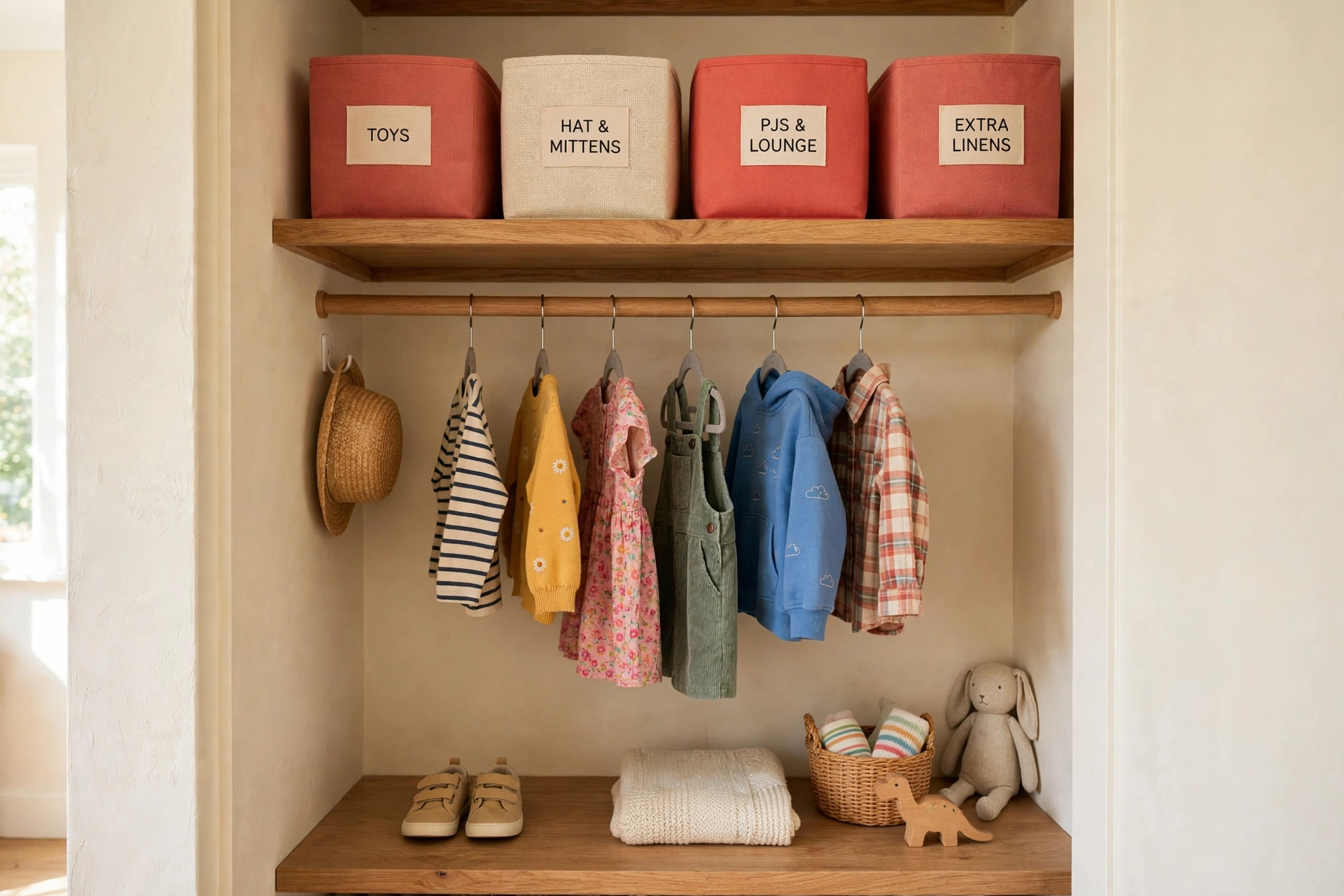
A small kids closet works when everything sits at your child’s height, not yours. The best small kids closet organization ideas come down to three moves: hang a second rod low enough for little hands, catch everything else in labeled bins, and keep only this season’s clothes inside. The whole setup takes about 2 hours, costs around $85 at mid-range prices as of November 2026, and needs no drilling at all.
Here is the short version. Most kids closets ship with one rod hung at adult height, around 66 to 68 inches (168 to 173 cm). Your child cannot reach a single thing on it, so you do all the dressing and all the putting away. Lower the rod to your child’s shoulder height and the closet starts running itself. I have seen this one change do more than any bin or basket ever will, because it turns the closet from your job into their job.
Small Kids Closet Organization Ideas by Age: Set Heights by Reach, Not by Guess
A closet that works for a two-year-old will frustrate a ten-year-old, and a setup built for a ten-year-old is useless to a toddler. The fix is simple: measure your child’s shoulder height, then set the daily-use rod about 2 inches (5 cm) below it. Shoulder height is the honest number here, because that is where a child can lift a hanger on and off a rod without stretching or climbing.
Here is the zone table, computed from average child heights. Treat these as starting points, then measure your own child and adjust.
| Age band | Average height | Shoulder height | Daily rod height | Hook height | Bins live at |
|---|---|---|---|---|---|
| Ages 2 to 4 | 34 to 40 in (86 to 102 cm) | 28 to 32 in (71 to 81 cm) | 28 to 32 in (71 to 81 cm) | 24 to 30 in (61 to 76 cm) | Floor to 24 in (61 cm) |
| Ages 5 to 7 | 42 to 48 in (107 to 122 cm) | 34 to 38 in (86 to 97 cm) | 36 to 40 in (91 to 102 cm) | 30 to 36 in (76 to 91 cm) | Floor to 36 in (91 cm) |
| Ages 8 to 12 | 50 to 58 in (127 to 147 cm) | 41 to 47 in (104 to 119 cm) | 44 to 48 in (112 to 122 cm) | 36 to 42 in (91 to 107 cm) | Floor to 48 in (122 cm) |
Everything above the daily rod is adult-only storage: off-season clothes, dressy outfits, keepsakes. That split matters more than any product. When the top shelf holds only things your child never needs alone, the daily zone stays calm.
Best for: any age, any closet size. Main advantage: one measurement replaces all the guessing. Watch out for: kids grow fast, so re-measure every 6 months and raise the rod in 6 to 8 inch (15 to 20 cm) steps. Verdict: do this before you buy anything else.
The 10 Fixes
Fix 1. Hang a Second Rod at Your Child’s Shoulder Height
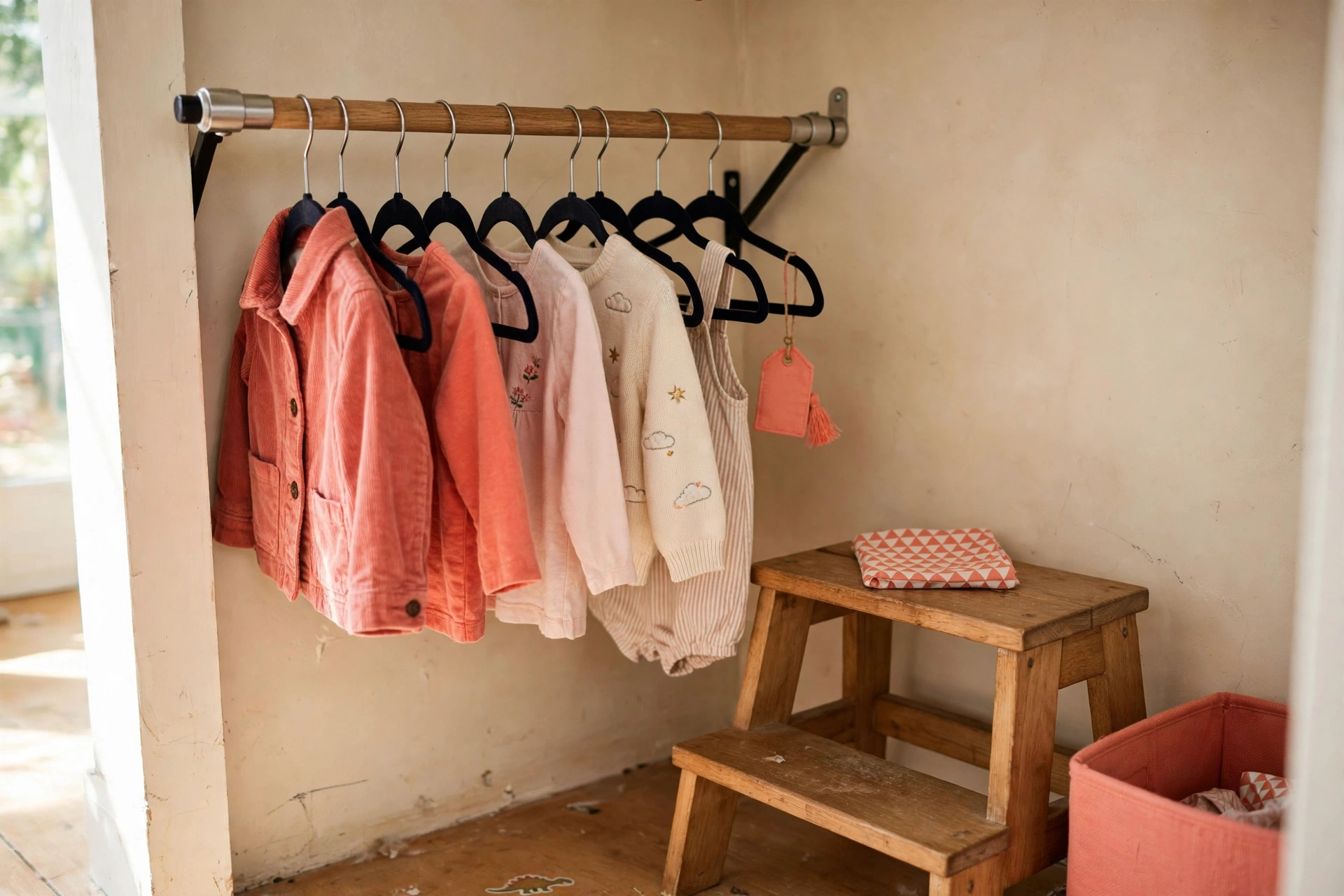
If you do exactly one thing from this entire list, do this one. A hook-on closet doubler rod hangs from the existing rod and drops a second bar to whatever height you set. No tools, no drilling, no landlord drama. You hang it, lower it to your child’s shoulder height, and suddenly the closet belongs to them.
Put the everyday stuff on the low rod: school outfits, play clothes, the ten to fifteen pieces they actually wear on repeat. Keep the low rod short and sweet. Ten to fifteen pieces is plenty, and it is also the whole point. A rod crammed with forty shirts teaches nothing except how to shove.
Best for: ages 2 to 10, renters, any reach-in closet. Main advantage: your child can dress themselves and put clothes away alone. Watch out for: a rod hung too low sags under weight, so keep it to everyday clothes and move heavy coats to the upper rod. Verdict: the single highest-impact fix in this post. Deposit risk: 1 out of 5. A hook-on rod leaves no marks at all.
Fix 2. Split a Shared Closet Straight Down the Middle
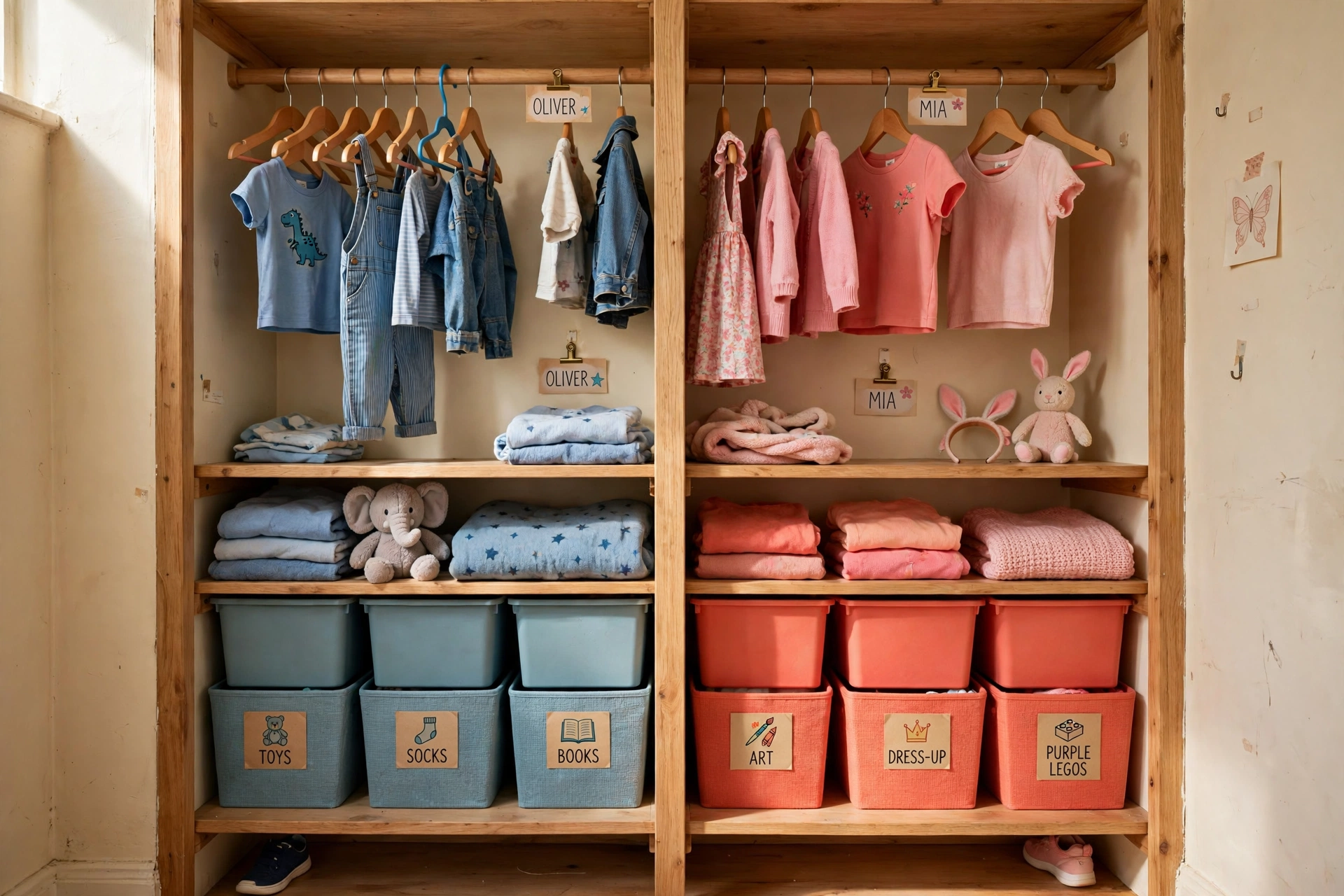
Two kids, one closet, zero peace. The fix is simpler than a second dresser. Give each child their own vertical column and treat the center line like a tiny border wall. With double rods in place, each kid gets a full column: a low rod for everyday clothes and a share of the upper space for extras.
Left side belongs to one kid, right side to the other. Each side gets its own bins on the shelf above, its own color of hanger, and its own little name tag on the rod. When everything is mixed together, every cleanup turns into a sorting argument about whose stained tee is whose. When the closet is split, each kid owns their mess and their reset.
Put a strip of washi tape or a small bookend on the shelf to mark the center line. A visible divider stops the slow creep of one kid’s stuff into the other’s territory. And do not give one kid the good side with the light and the other the dark corner. Resentment over closet real estate is real, and it will surface at bedtime.
Best for: siblings sharing one closet. Main advantage: ends the daily “that is my shirt” argument. Watch out for: uneven splits breed resentment, so measure the halves and keep them equal. Verdict: the only shared-closet system that survives a full school week. Deposit risk: 1 out of 5.
Fix 3. Trade Every Bulky Hanger for Slim Velvet Ones
A slim velvet hanger is about as thick as two quarters stacked, and you can fit roughly three times as many on the same rod as bulky plastic hangers. The math is plain. A standard 36 inch (91 cm) rod holds about 15 outfits on bulky hangers and about 40 to 50 on slim ones, because kid clothes are small and light.
| Closet rod width | Bulky hangers (about) | Slim velvet hangers (about) |
|---|---|---|
| 24 in (61 cm) | 10 outfits | 25 to 30 outfits |
| 30 in (76 cm) | 12 outfits | 30 to 40 outfits |
| 36 in (91 cm) | 15 outfits | 40 to 50 outfits |
| 48 in (122 cm) | 20 outfits | 55 to 65 outfits |
The velvet coating matters too. Kid clothes are slippery little things, and plain plastic hangers drop them on the floor. Velvet grips, so shirts stay put and your child is not fishing outfits off the closet floor every morning. Buy one color per child in a shared closet and the sorting does itself.
Best for: every kids closet, especially narrow ones. Main advantage: triples hanging capacity for about $15. Watch out for: cheap velvet hangers snap under heavy coats, so keep coats on sturdier hangers on the upper rod. Verdict: the cheapest capacity upgrade that exists. Deposit risk: 1 out of 5.
Fix 4. Use Picture Labels, Not Word Labels
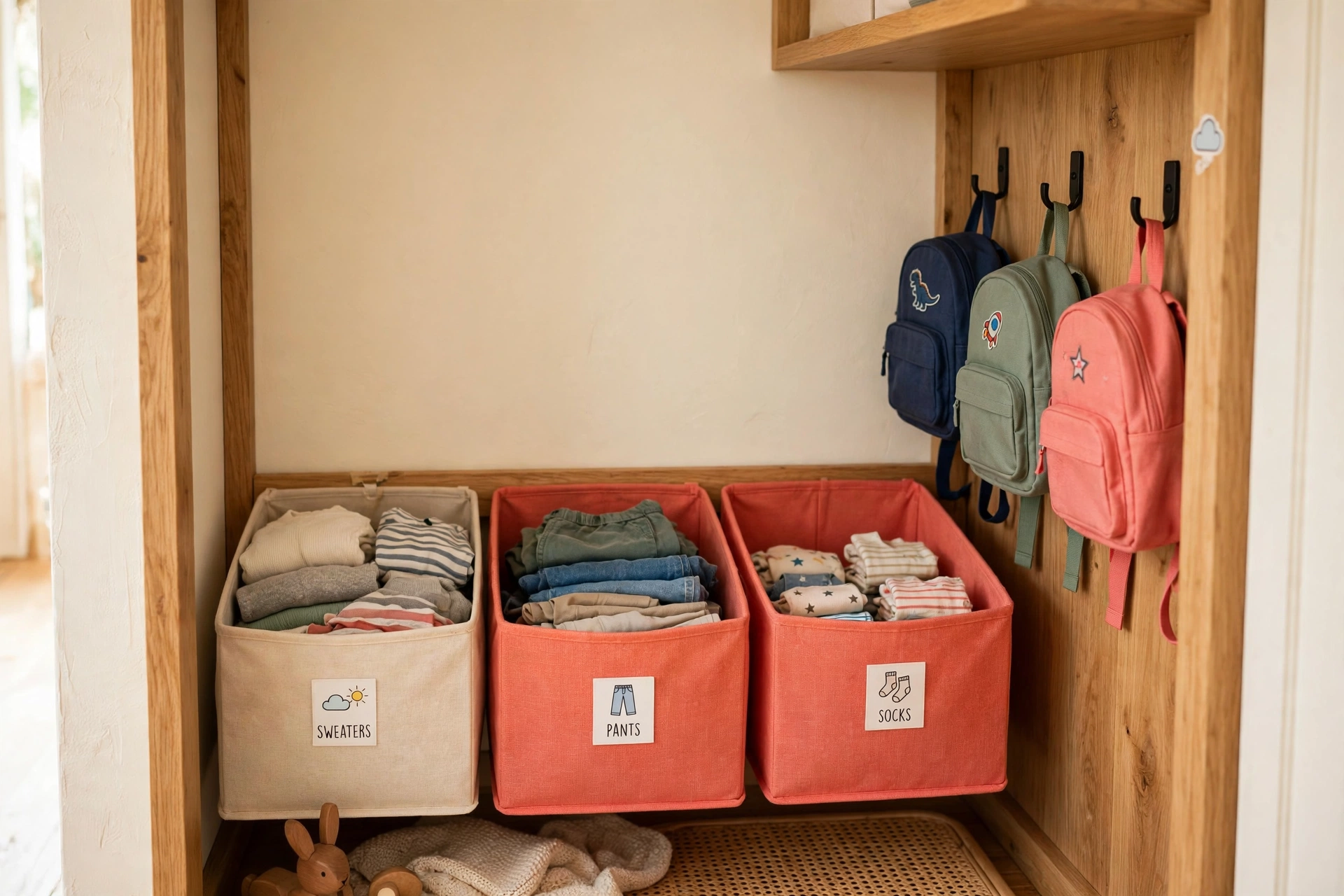
A three-year-old cannot read “socks,” but they can read a photo of socks. That is the whole idea. Put a picture on every bin: a photo of folded shirts on the shirt bin, a photo of socks on the sock bin, a drawing of a dinosaur on the toy bin. The label tells a pre-reader exactly where things go, and cleanup becomes a matching game instead of a chore.
Print the photos at home or cut them from old catalogs. Tape them to the front of each bin at your child’s eye level, not yours. If a bin’s label sits above their eye line, it may as well not exist. For older kids, switch to word labels with a small picture beside them, and let them pick the pictures. A label they chose is a label they will actually use.
Best for: ages 2 to 6, and any child who is still learning to read. Main advantage: kids put things away without being asked, because the bin tells them where it goes. Watch out for: labels fall off fabric bins, so use clear packing tape over the whole label, edge to edge. Verdict: the fix that makes all the other fixes stick. Deposit risk: 1 out of 5.
Fix 5. Hang a Fabric Shelf for Everything You Fold
Folded tees, jeans, leggings, and sweaters do best on a hanging fabric shelf that hooks right onto the closet rod. It turns dead air into six neat cubbies, and it costs about $14. Look for one that is 12 to 15 inches (30 to 38 cm) wide so it does not block the rest of the rod.
Fold everything so it stands upright in the cubby, file style, instead of stacking flat. A flat stack hides everything below the top item. A file fold shows it all, and your child can pull one shirt without toppling five others. One cubby per category: tees, pants, pajamas, underwear, socks, and one spare for whatever the week brings.
Best for: folded clothes in closets with no built-in shelves. Main advantage: adds six shelves with zero tools. Watch out for: fabric shelves sag when overloaded, so keep heavy jeans on the bottom cubby and light tees up top. Verdict: the best use of the air between the rod and the shelf. Deposit risk: 1 out of 5.
Fix 6. Turn the Back of the Door into a Storage Wall
An over-the-door organizer with clear pockets holds socks, tights, hair clips, hats, and small toys, and it costs about $15 to $25. It uses space that is usually wasted, and clear pockets mean your child can see everything at a glance instead of digging through a drawer.
Check the door clearance first. The organizer must be thin enough that the door still closes and latches. If the door sticks, move the organizer to the inside of the bedroom door instead, or switch to a flat pocket version. And keep the pockets at kid height: the bottom two rows are the ones that get used every day.
Best for: socks, accessories, and small items that vanish in drawers. Main advantage: a whole extra storage wall for $20. Watch out for: overloading the door can strain hinges over time, so keep it to light items only. Verdict: the easiest square footage you will ever add. Deposit risk: 1 out of 5. It hooks over the door, nothing is screwed in.
Fix 7. Put Hooks at Kid Height for Backpacks and Jackets
Mount a hook rail at the heights in the age table above, and give every child their own hook. Backpacks, jackets, and pajamas live on hooks, not on the floor, and a hook at the right height is one your child will actually use. A hook at adult height is just decoration.
One hook per child, plus one spare for the jacket of the day. Add a small bin below the hooks for sports gear or scarves. Use adhesive hooks if you rent, and check the weight rating before you trust one with a loaded backpack. A school bag full of books can weigh 10 to 15 pounds (4.5 to 7 kg), which is more than the cheapest adhesive hooks hold.
Best for: the morning rush, backpacks, and jackets. Main advantage: the floor stays clear and the backpack always has a home. Watch out for: adhesive hooks fail on textured walls, so test one hook for a week before you load them all. Verdict: small fix, big daily payoff. Deposit risk: 1 out of 5 with adhesive hooks, 3 out of 5 with screwed hooks.
Fix 8. Keep One Open Floor Basket for Shoes
Shoes can take over a closet floor in a week. Give them one open basket or a low cubby per child and set a hard limit: four to five pairs each. The pairs they wear most live in the basket. Everything else goes to the entryway or the top shelf.
Open beats lidded for young children. A lid is one more step between your child and putting their shoes away, and that one step is usually enough to stop them trying. A shallow boot tray under the basket catches wet shoes in winter and keeps the closet floor dry.
Best for: shoes, boots, and sports gear. Main advantage: a visible limit stops the shoe pile from growing. Watch out for: outgrown shoes sneak back in, so check the basket every month and pull the pairs that no longer fit. Verdict: the simplest floor plan that works. Deposit risk: 1 out of 5.
Fix 9. Run a Seasonal Swap Shelf and an Outgrown Bin
A small closet cannot hold four seasons of clothes, so do not ask it to. Keep one shelf as the swap shelf: off-season clothes live there in labeled bins, and the daily zone holds only this season. When the weather turns, swap the bins. The whole job takes about 30 minutes, twice a year.
Keep one bin on that shelf for outgrown clothes. The moment something is too small, it goes straight in the bin. No pile on the floor, no “maybe it still fits” drawer. Use the 3-3-3 rule when you purge: keep three everyday outfits, three play or school outfits, and three special-occasion pieces per season, per child. Everything past that is clutter wearing a hanger.
Best for: growing kids, seasonal climates, hand-me-down chains. Main advantage: the daily closet never holds more than one season. Watch out for: the outgrown bin fills fast with a toddler, so empty it into storage or donation every month or two. Verdict: the system that keeps the closet working all year. Deposit risk: 1 out of 5.
Fix 10. Buy Hardware That Grows With Your Child
An adjustable rod that rises in 6 to 8 inch (15 to 20 cm) steps is the last rod you will buy for that closet. Start at shoulder height, raise it one step every 6 months or so, and the closet grows with your child instead of fighting them. The same goes for adjustable shelving: move the levels as your child gets taller and their clothes get bulkier.
This is the overrated versus underrated call in this niche. Matching boutique closet systems are overrated: they cost hundreds, they are sized for adults, and your child outgrows the layout in a year. A $20 adjustable rod and a set of bins are underrated, because they bend to the child instead of asking the child to bend to them. Spend the money you save on better hangers and more bins.
Best for: parents who want to set the closet up once. Main advantage: no rebuild every growth spurt. Watch out for: cheap adjustable rods slip under load, so test the lock with a full rod of clothes before you trust it. Verdict: the only “buy once” advice in this post that is actually true. Deposit risk: 1 out of 5 for hook-on adjustable rods.
Materials List and 7-Step Setup
What you need: an adjustable closet doubler rod, a 30-pack of slim velvet hangers, a 6-shelf hanging fabric organizer, an over-the-door organizer, 4 small fabric bins, a hook rail or adhesive hooks, picture labels, and a tape measure. Plan about 2 hours for the setup and 10 minutes a week to keep it neat.
- Measure your child and the closet. Measure shoulder height, then measure the rod width and the closet depth. Write the numbers down. Our general closet organization guide starts the same way: measure first, buy second.
- Empty the closet completely and purge with the 3-3-3 rule. Three everyday outfits, three play outfits, three special pieces per season. Everything else leaves: outgrown bin, donation bag, or storage.
- Set the rod height. Hang the doubler rod at shoulder height minus 2 inches (5 cm). Test it with your child standing there, reaching for a hanger.
- Swap the hangers. Move everyday clothes onto slim velvet hangers, one color per child in a shared closet. Coats and heavy items stay on the upper rod.
- Zone the shelves and floor. Hanging fabric shelf for folded clothes, bins on the shelf above, open basket on the floor for shoes. Daily items live below your child’s reach line. Adult-only items live above it.
- Label everything with pictures. Photo labels on every bin, at your child’s eye level. Name tags on the rod for each child’s column.
- Finish the door and the hooks. Over-the-door organizer on the back of the door, hook rail at the right height, then a 10-minute reset every Sunday to keep it honest.
What the Full Setup Costs
Prices live-checked November 2026. These are mid-range picks, not the cheapest and not the priciest, and the total is the point: these small kids closet organization ideas add up to less than one boutique organizer.
| Item | Price (as of November 2026) |
|---|---|
| Adjustable closet doubler rod kit | $20.00 |
| Slim velvet hangers, 30-pack | $15.00 |
| Over-the-door organizer | $20.00 |
| Hanging fabric shelf organizer, 6-shelf | $14.00 |
| Small fabric bins, set of 4 | $16.00 |
| Total | $85.00 |
The sum checks out: $20.00 + $15.00 + $20.00 + $14.00 + $16.00 = $85.00. Expect about 2 hours to set it all up, and about 10 minutes a week to keep it neat. That weekly reset is the real cost of the system, and it is the part most guides skip.
Mistakes to Avoid
Hanging the rod at adult height. If your child cannot reach it, you own the closet forever. Measure shoulder height and set the rod there.
Using lidded bins for toddlers. A lid is a barrier. Open bins at knee height get used. Lidded bins get ignored, and the clothes end up on the floor anyway.
Keeping every outfit they own in the closet. A closet holding four seasons is a closet holding nothing findable. The 3-3-3 rule is the limit. The rest lives on the swap shelf or in storage.
Forgetting the outgrown bin. Without one, too-small clothes drift back onto the rod and crowd out the clothes that fit. One bin, emptied monthly, solves it.
Putting daily items on the top shelf. The top shelf is adult-only storage. Anything your child needs every day lives below their reach line, or it may as well not exist.
What to Skip
Matching boutique closet systems. Hundreds of dollars for a layout your child outgrows in a year. A $20 adjustable rod does the same job and bends with them.
Tiny hangers that do not fit real clothes. Mini hangers look cute and hold nothing. Standard slim velvet hangers fit toddler clothes fine and still work when the child is ten.
A shoe organizer that eats rod space. Hanging shoe cubbies steal the hanging rod your clothes need. Shoes belong in a floor basket, not on the rod.
A second dresser “just in case.” If the closet system works, the dresser is a duplicate. Save the floor space and spend the money on better hangers and more bins instead.
A Note for Renters
These small kids closet organization ideas are renter-safe by design. Hook-on doubler rods, adhesive hooks, over-the-door organizers, and freestanding bins leave no holes and no marks, so the deposit risk is 1 out of 5 across the board. Before you start, check your lease for two things: whether adhesive hooks are allowed on painted walls, and whether you need permission to add a tension rod. Most leases say nothing about either, but a two-minute check beats a deposit argument later. When you move out, the whole system comes down in about 20 minutes and the closet looks exactly as it did before. Our renter-friendly closet organization ideas post covers the same no-holes approach for adult closets, and the rules are identical here.
Sources
Prices and measurements behind these small kids closet organization ideas were checked in November 2026 against the kids closet guides at Sprinkle Pop Print and Organizables, plus the age-band guidance at Tots N Trends by Morgan. Rod heights in the age table are computed from average child heights, not copied from any single guide, so measure your own child before you
drill or buy. The 3-3-3 rule and the 10 to 15 piece low-rod limit come from those same guides. For the wider room view, our small kids room layout ideas post covers how the closet fits into the
whole bedroom, and our renter-friendly kids room ideas post covers the no-drill version of the same room.
How do I organize a small kids closet?
Add a second, lower rod at your child’s shoulder height and use a hanging shelf organizer for folded items. Put an over-the-door organizer on the back of the door for socks and accessories. Keep only this season’s clothes on the daily rod, move off-season clothes to labeled bins on the top shelf, and label every bin with a picture your child can read.
How high should a closet rod be for kids?
Set the daily rod about 2 inches (5 cm) below your child’s shoulder height. That works out to roughly 28 to 32 inches (71 to 81 cm) for ages 2 to 4, 36 to 40 inches (91 to 102 cm) for ages 5 to 7, and 44 to 48 inches (112 to 122 cm) for ages 8 to 12. Re-measure every 6 months and raise the rod in 6 to 8 inch (15 to 20 cm) steps as your child grows.
How do I organize a closet shared by two kids?
Give each child their own vertical column: split the closet down the middle with a visible center line, give each side its own low rod, its own bins, and its own hanger color. Put a name tag on the rod for each child and keep the halves equal in width, so neither kid gets the better side.
How many clothes should a child keep in their closet?
About ten to fifteen everyday pieces on the low rod is plenty, plus three everyday outfits, three play outfits, and three special-occasion pieces per season under the 3-3-3 rule. Everything past that is clutter. Outgrown and off-season clothes belong in labeled bins on the top shelf, not on the daily rod.