Tiny Living Room Furniture Sizes: The Max Dimensions That Fit an 80 Sq Ft Room
Most tiny living room advice tells you to buy small furniture and stops there. That is not enough, because small is a feeling and a room is a measurement. The direct answer for tiny living room furniture sizes is this: in an 8 by 10 ft (2.4 by 3.0 m) room, cap the loveseat at 60 in (152 cm) long, the second seat at 30 in (76 cm) wide, the coffee table at 18 in (46 cm) deep, the TV console at 48 in (122 cm) long, and the rug at 5 by 8 ft (1.5 by 2.4 m). The original check behind every number below is a depth budget you can redo on your own floor. The room is 96 in deep. Subtract a 35 in (89 cm) loveseat, a 14 in (36 cm) gap, and an 18 in coffee table, and 29 in (74 cm) is left for the TV zone. A 16 in (41 cm) deep console fits there with 13 in (33 cm) to spare. Nothing in this post is a guess dressed up as a rule. Every maximum comes from that budget, or from a clearance figure designers publish again and again.
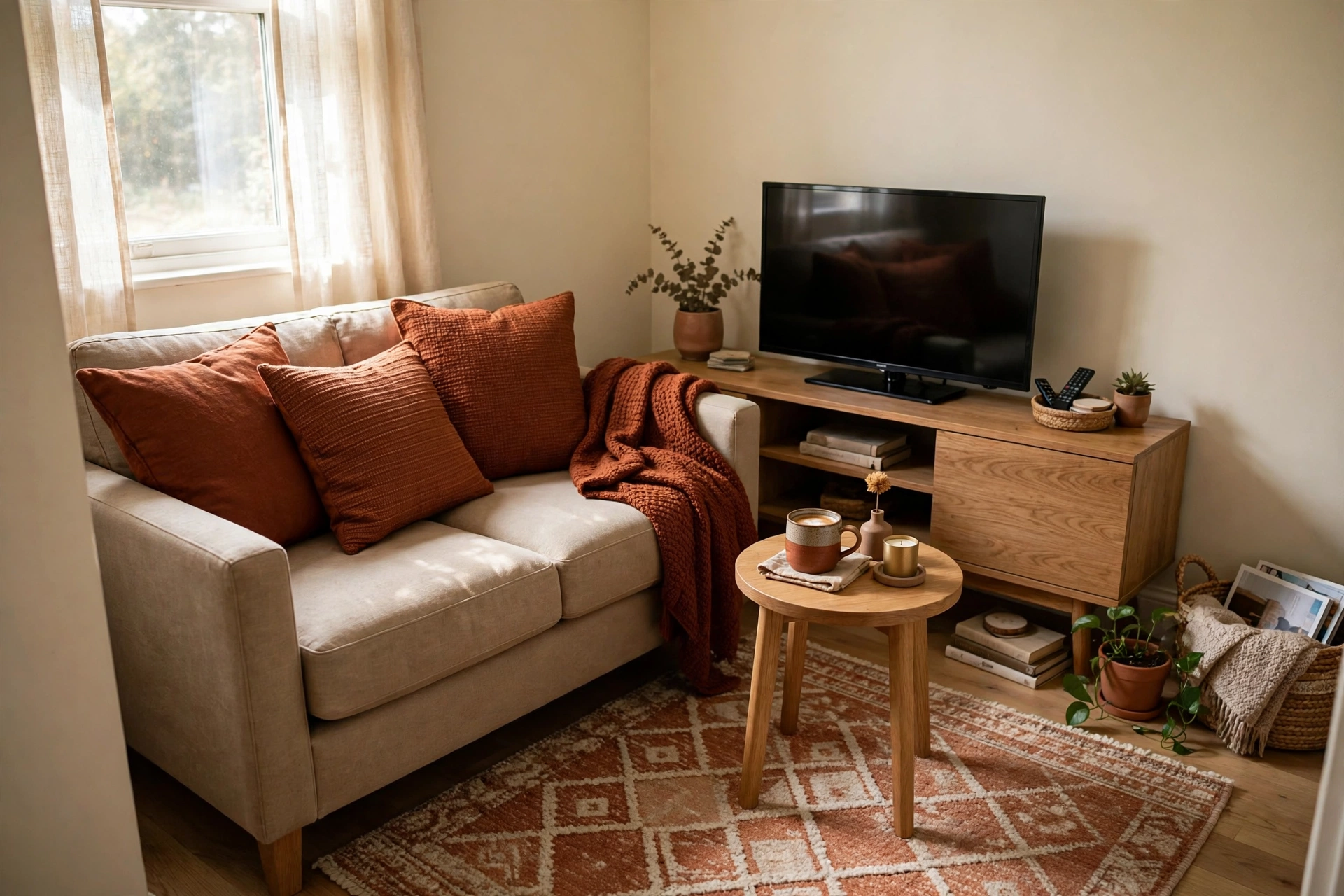
What tiny living room furniture sizes work in an 8 by 10 room?
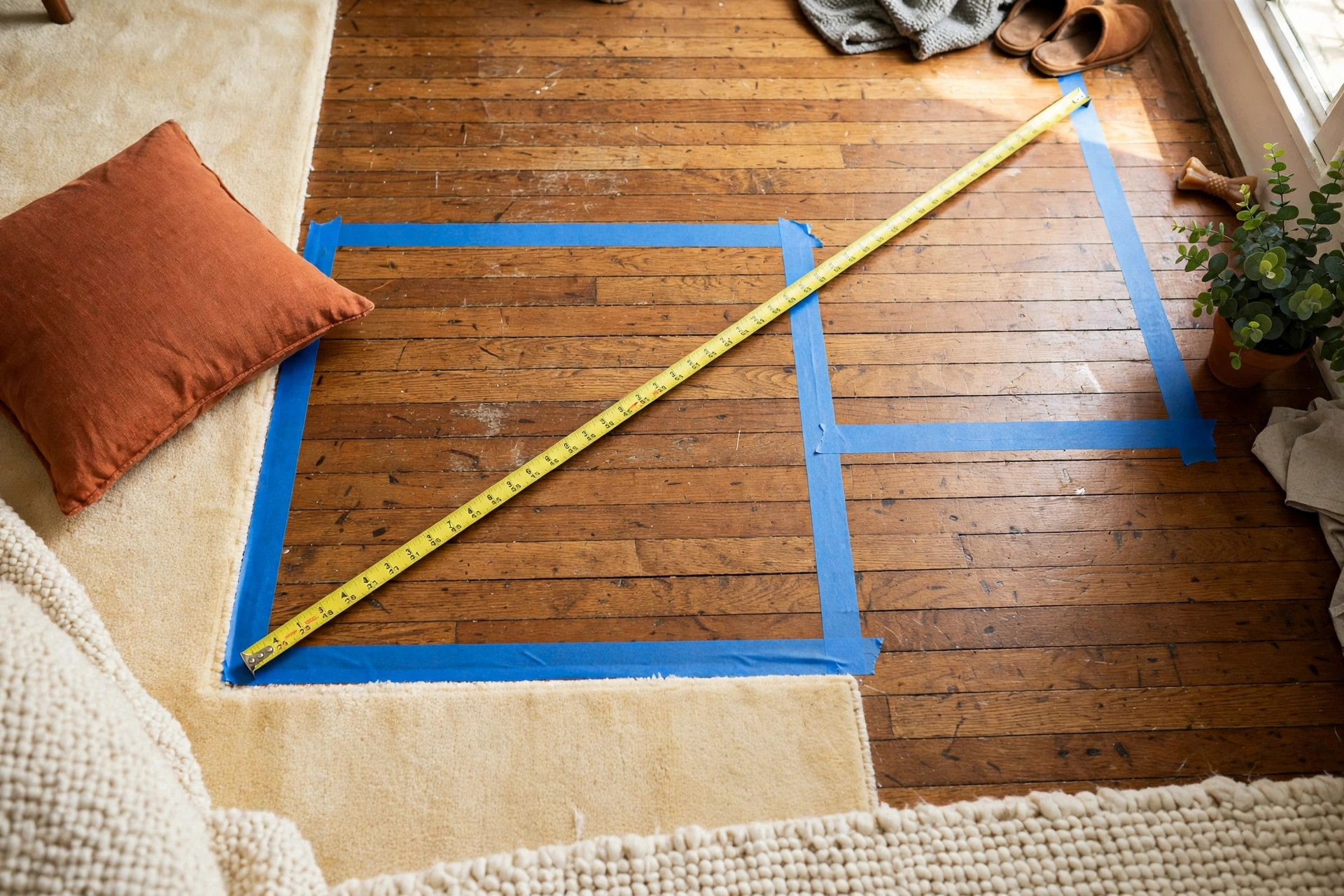
Start with the room, not the catalog. Measure wall to wall, then mark every door swing, radiator, outlet, and window that furniture cannot block. A standard interior door needs its full swing arc, about 30 in (76 cm), kept clear, and in an 80 sq ft room that arc can eat a whole corner. Tape every footprint on the floor before you buy anything, including the walkways. Walk through carrying something, open the doors, pull a chair out. Tape is free and it finds the problems a product photo hides.
Here is the whole set at a glance, for the 8 by 10 ft room this post is built around. Each maximum is explained piece by piece below, with the verdict for each one.
| Piece | Maximum size | Why this is the cap |
|---|---|---|
| Loveseat | 60 in long x 35 in deep (152 x 89 cm) | Leaves room on a 120 in wall for a side table and a lamp |
| Second seat | 30 in wide x 32 in deep (76 x 81 cm) | One armchair, or one armless chair at 26 in wide, and no more |
| Coffee table | 36 in long x 18 in deep (91 x 46 cm), or round at 24 in (61 cm) | Keeps the 14 in gap to the seat and the walkway to the TV wall |
| Side table | 16 in across (41 cm) | Fits beside the loveseat without stealing the side path |
| TV console | 48 in long x 16 in deep (122 x 41 cm) | Fits the 29 in TV zone left by the depth budget, with room to spare |
| Rug | 5 by 8 ft (1.5 by 2.4 m) | Covers the seating zone without running under the console or buckling at a door |
| TV | 32 to 43 in screen | At about 1.5 times the screen diagonal, a 43 in screen wants roughly 5.5 ft (1.7 m) of viewing distance, which is what this room gives |
| Bookshelf | 30 in wide x 12 in deep (76 x 30 cm) | Anything deeper turns a wall into a corridor |
The clearance figures here are the widely published designer guidelines, not building code, and they are worth memorizing. Keep 30 to 36 in (76 to 91 cm) for a main walkway, never less than 24 in (61 cm) for a side path. Leave 14 to 18 in (36 to 46 cm) between a seat and a coffee table. Put the front legs of every seat on the rug. The generic small living room layout guide on this site covers bigger small rooms, and its spacing rules are the starting point this band sizes guide tightens. If a piece breaks one of those numbers, it does not fit, no matter how good it looks online. The plans that use these sizes in a full room are covered by the tiny living room layout ideas on this site, and this sizes guide is the companion that decides each piece before a plan is drawn.
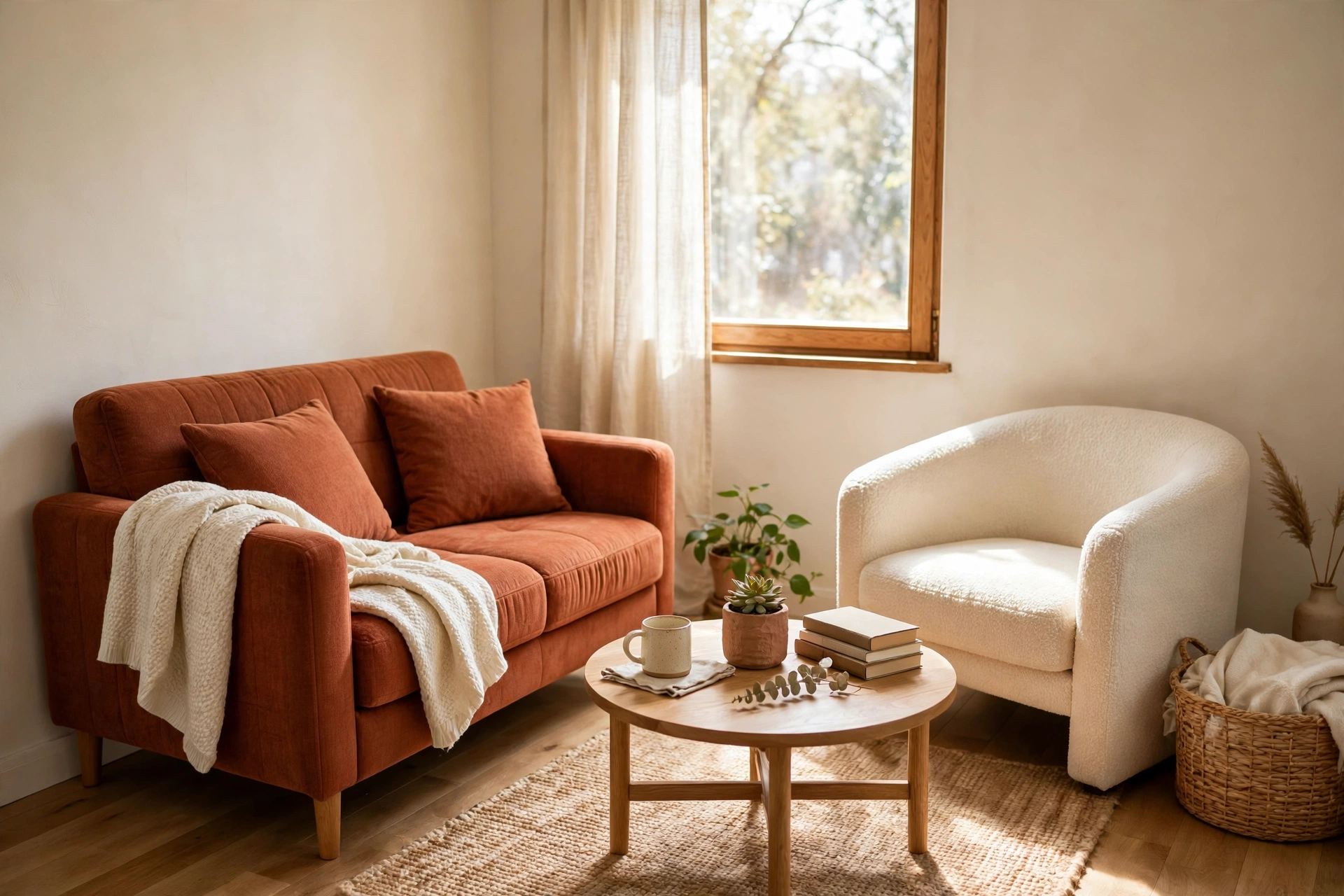
The loveseat: 60 in long, 35 in deep, no exceptions worth making
Best for: couples, TV watchers, and any room with one long free wall. Main advantage: two people sit properly without the piece eating the whole wall. Watch out for: width alone. A loveseat listed at 60 in wide can still be 40 in deep, and that extra depth comes straight out of your walkway. Check depth first, then width, then seat width inside the arms. A pair of wide rolled arms can steal 12 in of sitting room from a piece that measures fine on the outside. Verdict: 48 to 60 in long, 35 in deep at most, slim arms, raised legs if you can get them. Legs you can see under make a small room feel less stuffed, and they let a robot vacuum or a dust mop get underneath.
This is also where most people go wrong, and it is an opinion worth stating plainly. The standard 84 in (213 cm) three-seat sofa is overrated for rooms this size, not because it is a bad sofa but because it belongs in a bigger room. On a 120 in wall it leaves almost nothing at either end, and it pushes the coffee table and the walkway into a fight they both lose. A 60 in loveseat on the same wall leaves room for a side table and a lamp, which is the difference between a room and a furniture warehouse. A sofa size guide for small living rooms makes the same point in general terms, and the band numbers here tighten it to one exact room.
The second seat: one chair, chosen by width and depth together
Best for: guests, readers, and rooms where the loveseat alone leaves a dead corner. Main advantage: a second seat turns the room from a TV spot into a place two people can actually talk. Watch out for: the second full armchair. Two wide armchairs close the seating into a box and block the side path. Verdict: one chair, 30 in wide at most, 32 in deep at most. An armless chair at 26 in (66 cm) wide is even better in a corner, because it angles without blocking the path behind it.
Measure the chair the same way you measured the loveseat: overall width, overall depth, and seat width inside the arms. A chair that is 30 in wide overall with thick arms may only give you 20 in of seat, which is a stool with pretensions. Sit in it if you can, or at least check the seat dimensions on the listing, not just the headline size. If you rent and cannot drill, the same chair logic applies twice over, since a chair you can move beats a layout you cannot change.
Tables: the coffee table is the piece that quietly breaks rooms
Best for: a coffee table at 36 by 18 in, or a round table at 24 in across, with a 16 in side table beside the loveseat. Main advantage: a table this size holds drinks and a book without becoming a wall. Watch out for: depth creep. A 22 in deep coffee table looks only slightly bigger than an 18 in one, and it quietly eats 4 in of the gap to the seat and the walkway behind it. Verdict: 18 in deep, no more, and round beats rectangular in a tight room because round has no corners to catch a hip in a 24 in side path.
Skip the matching three-piece suite entirely. A coffee table plus two end tables plus a console is a lot of furniture for 80 sq ft, and the end tables are the first thing to cut. One side table beside the loveseat does the lamp and the coffee. The other side can hold a floor lamp, which takes up almost no floor at all. That trade alone can save the side path.
The TV wall: console first, screen size second
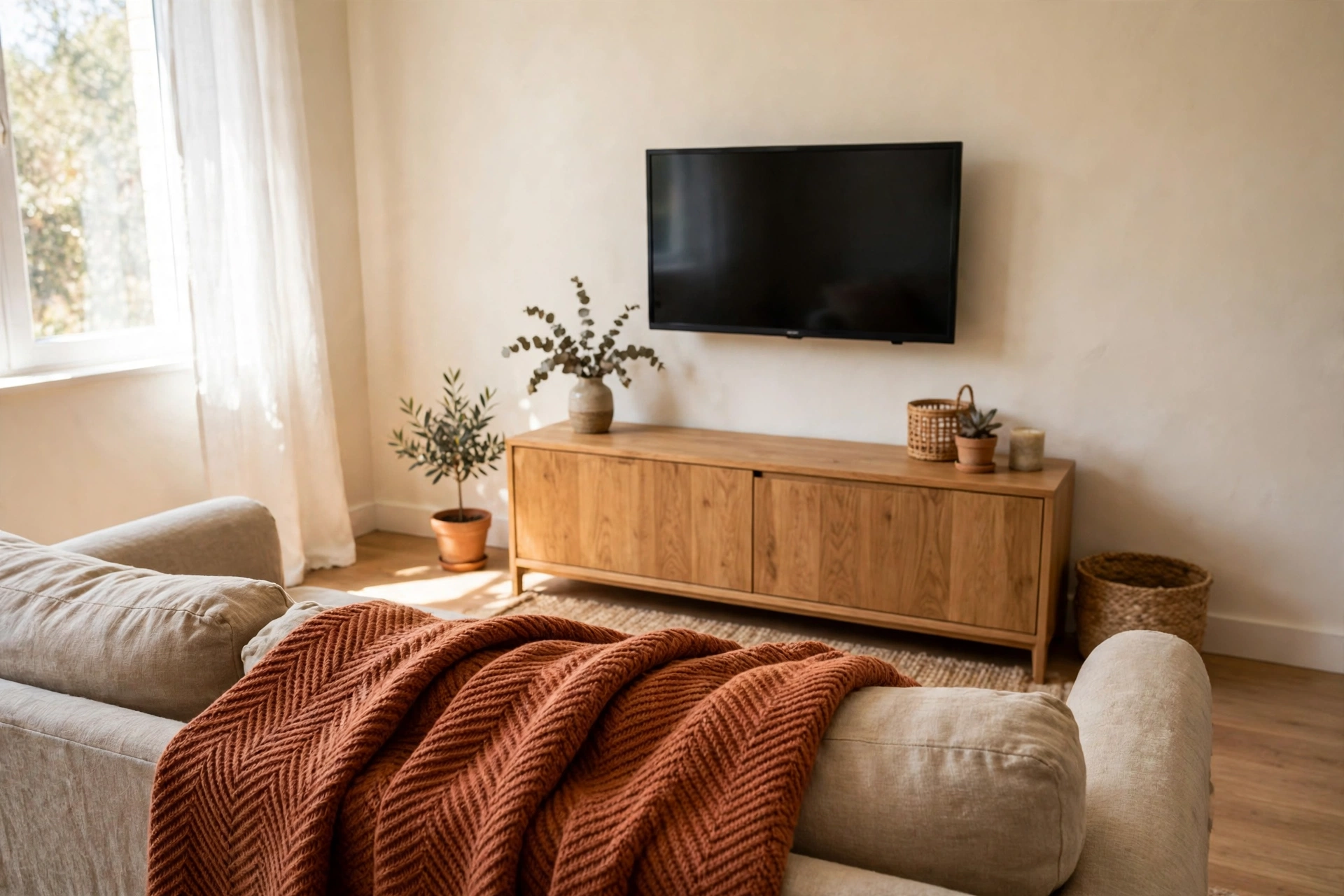
Best for: a console at 48 in long and 16 in deep, with a 32 to 43 in screen above it or wall-mounted over it. Main advantage: the console gives the TV a home without becoming the biggest piece in the room. Watch out for: buying the TV first. A 55 in screen in an 8 ft deep room is too big, not a treat, because the viewing distance math does not care how good the sale was. Verdict: console first, screen second, and mount the screen with its center near seated eye level, about 42 in (107 cm) from the floor.
Console height matters too, and it is the detail listings hide. A console taller than the seat backs turns the TV wall into a wardrobe, and a console deeper than 16 in eats the spare inches from the depth budget. Keep it low, keep it shallow, and keep its doors closed. Open shelving on a TV console in a tiny room reads as clutter from the seat, while closed doors read as a wall. If you rent and cannot drill for a mount, use the console version of this setup and skip the mount entirely, since a lost deposit costs more than any layout gains. A guide on how to choose a sofa for a small living room covers the same measure-first habit for seating, and it applies just as well to the TV wall.
The rug, the shelf, and the doorway trap
Best for: a 5 by 8 ft rug with the front legs of every seat on it, and a bookshelf no deeper than 12 in. Main advantage: the rug defines the seating zone, and a shallow shelf gives storage without narrowing the room. Watch out for: the 8 by 10 ft rug. It sounds generous and it is wrong here, because it runs under the console and buckles at the door, while a 5 by 8 ft rug fits the seating zone exactly. Verdict: 5 by 8 ft, low pile, front legs on, and no second rug layered under the first.
Then comes the trap no size table covers, and it is the most original warning in this post. Measure the smallest doorway, hallway turn, and stairwell the furniture must travel through, and compare it with the largest single box or module the piece ships as. A loveseat that fits the room perfectly can still fail to arrive there if it does not fit through the front door. Flat-pack and modular pieces solve this, and they are worth choosing on purpose in a small home, not as a compromise. Before you order, write down three numbers: the wall length, the doorway width, and the box size. If the box beats the doorway, pick a different piece, not a different room.
What tiny living room furniture sizes cost (as of November 2026)
Most of this post costs nothing, because it is measuring, not shopping. If you do need the pieces that make the sizes work, these are checked market prices from listings live in November 2026, not personal receipts. A compact loveseat of about 59 to 60 in runs $148 to $299 in checked listings. A small accent chair of about 30 in wide runs $110 to $125 in checked Target listings. A low TV console of about 43 to 48 in runs $90 to $155 in checked Target and Wayfair listings. A low-pile 5 by 8 ft rug runs $86 to $170 in checked listings. Everything else, the tape, the measuring, the moving, is time, not money.
| Item | Checked price, as of November 2026 | Notes |
|---|---|---|
| Compact loveseat, 59 to 60 in (150 to 152 cm) | $148 to $299 | Checked October and November 2026 listings; check depth, not just length |
| Small accent chair, about 30 in (76 cm) wide | $110 to $125 | Checked November 2026 Target listings |
| Low TV console, 43 to 48 in (109 to 122 cm) | $90 to $155 | Checked November 2026 Target and Wayfair listings |
| Low-pile 5 by 8 ft rug (1.5 by 2.4 m) | $86 to $170 | Checked Target and Wayfair listings |
| Total for the four bought pieces | $434 to $749 | Reuse a coffee table, side table, and TV you already own |
Time estimate: measuring and taping takes about an hour, checking doorway and box sizes takes half an hour more, and a full rearrange with the rug down takes half a day at most. If a piece needs delivery, add the delivery wait, not more work.
Set it up in an afternoon
Step 1
Measure the room wall to wall and note every door swing, outlet, and radiator.
Step 2
Measure the smallest doorway and hallway turn, and check the largest box each piece ships in.
Step 3
Tape the loveseat, chair, table, console, and walkway footprints on the floor.
Step 4
Walk every route carrying something, open every door, and pull every chair out.
Step 5
Place the rug first, front legs of every seat on it, then the seating, then the TV wall.
Step 6
Live with it for one evening and move only the piece that annoyed you.
Mistakes to avoid
The biggest mistake is buying by width alone. Width tells you if a piece fits the wall. Depth tells you if the room still works after it is in place, and depth is the number people skip. Second is the sectional. A small L sectional of 96 by 64 in (244 by 163 cm) is bigger than the whole seating zone of an 80 sq ft room, and it blocks the walkway on both sides. Third is two focal points. A fireplace and a TV on different walls force two orientations, and this room only has space for one. Fourth is the tall bookshelf beside the TV, which turns a wall into a corridor and makes the screen feel boxed in. Fifth is ordering before measuring the doorway, which is how a perfect loveseat ends up stuck in a hallway.
What to skip
Skip the matching three-piece suite, the oversized coffee table, the tall bookcase beside the TV, and the second rug layered under the first. Each one is fine in a bigger room and each one steals the same 30 in walkway this room cannot spare. Skip a TV bigger than 43 in for an 8 ft deep room, skip a recliner unless it is the only seat you own, and skip wall shelves above the TV if they force the screen above eye level. What looks sparse in a photo feels calm in a room this size, and calm is the whole point. Once the sizes are set, the storage side of the same room, baskets, consoles with doors, and wall shelves that do not eat floor space, is covered by the small living room organization ideas on this site, and the bedroom version of this band thinking is in the tiny bedroom furniture sizes guide.
FAQ
What size sofa fits a tiny living room?
For tiny living room furniture sizes, the seat rule is simple: a loveseat of 60 in (152 cm) or less, 35 in deep or less, and no sectional. In an 8 by 10 ft room a 60 in loveseat on the 120 in wall leaves room for a side table and a lamp, while a standard 84 in (213 cm) three-seat sofa leaves almost nothing and blocks the side path.
What size rug fits an 8 by 10 living room?
A 5 by 8 ft (1.5 by 2.4 m) rug, low pile, with the front legs of every seat on it. An 8 by 10 ft rug runs under the console and buckles at the door in a room this size, while the 5 by 8 ft rug fits the seating zone exactly.
What size TV fits a tiny living room?
A 32 to 43 in screen. At about 1.5 times the screen diagonal, a 43 in TV wants roughly 5.5 ft (1.7 m) of viewing distance, which is what you get once a 35 in deep loveseat is subtracted from an 8 ft room. Mount it with the center near seated eye level, about 42 in (107 cm) from the floor, or set it on a low console if you rent and cannot drill.
Can a sectional fit in a tiny living room?
No, not in an honest 80 sq ft room. A small L sectional of 96 by 64 in is bigger than the whole seating zone, and it blocks the walkway on both sides. Use a loveseat plus one movable chair instead, and keep a folding stool in a closet for a fourth guest.
How this was made: the size caps in this post were computed from standard furniture footprints and the published clearance guidelines cited in the text, with prices checked from retail listings live in November 2026. No piece was bought or tested for this post, and no personal purchase is claimed.