How to Hang Things on Drywall Without Drilling: 7 Renter-Safe Methods That Hold
Direct answer: If you want to learn how to hang things on drywall without drilling, start with the weight, not the hook. Weigh the piece, pick a method rated above that weight, and stick it to clean, smooth, fully cured paint. Most rental walls will hold posters, canvases, and medium framed prints this way. Anything past 20 lb needs a different plan. This guide gives you the weight budget, the steps, the costs as of November 2026, and a deposit rating for every method, so nothing falls down and nothing costs you at move-out.
First, is your wall really drywall?
Direct answer: Drywall feels hollow when you knock on it, and it sits over studs spaced 16 in (41 cm) or 24 in (61 cm) apart. It is a gypsum panel with a paper face, which is why it tears if you rip adhesive off it the wrong way. If the wall feels solid and cold, or sounds like a dull thud, it may be plaster, brick, concrete, or tile, and for tile, see our guide to hanging things on tile without drilling.
Check the paint too. Adhesive needs smooth, clean, indoor paint. Fresh paint needs about 7 days to cure before you stick anything to it. Textured paint, flaking paint, and wallpaper are weaker surfaces, and hang things on textured walls without drilling in the companion guide. When in doubt, test one strip in a hidden spot and leave it a full day before you trust it with a frame.
The weight budget: match the method to the pounds
Direct answer: The rule that makes how to hang things on drywall without drilling work is simple. The rating must beat the weight, with room to spare. Never treat a rating as a target. If a piece weighs 14 lb, a 16 lb set is the floor, not a comfortable margin.
Use a bathroom scale. Frame weights surprise people, because glass is the heavy part. A 24 by 16 in (61 by 41 cm) gallery canvas weighs about 2 lb, since it has no glass. The same size as a framed print behind glass weighs about 6 to 8 lb. A 36 by 24 in (91 by 61 cm) framed print with glass can pass 15 lb. Weigh the frame, the glass, and the hanging hardware together, then read the table.
| Item | Typical weight | Method that fits | Rating to use |
|---|---|---|---|
| Unframed poster or print | Under 1 lb | Poster strips or putty | About 1 lb per strip set |
| Small canvas or light frame | 1 to 3 lb | Small adhesive strips or a small hook | 3 lb set or higher |
| Medium framed print with glass | 6 to 8 lb | Medium or large picture strips | 12 to 16 lb set |
| Large framed print with glass | 15 to 16 lb | Four large picture strips | 16 lb set, checked twice |
| Tote bag, keys, light jacket | 1 to 5 lb | Adhesive hook | Hook rated above the load |
| Heavy mirror, TV, shelf | Over 20 lb | Stop, do not use adhesive | Stud, permission, or a leaning plan |
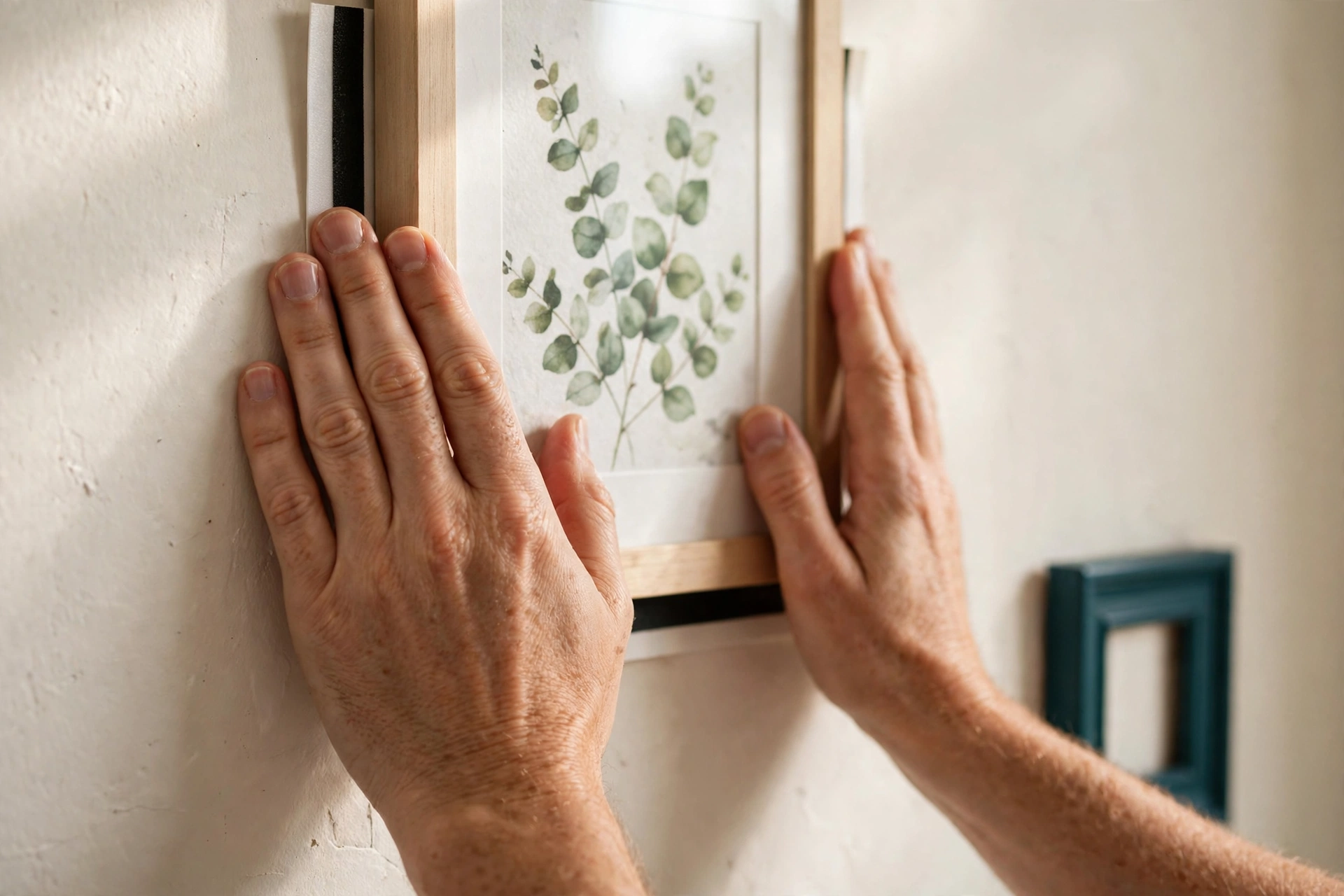
Method 1: Adhesive picture strips
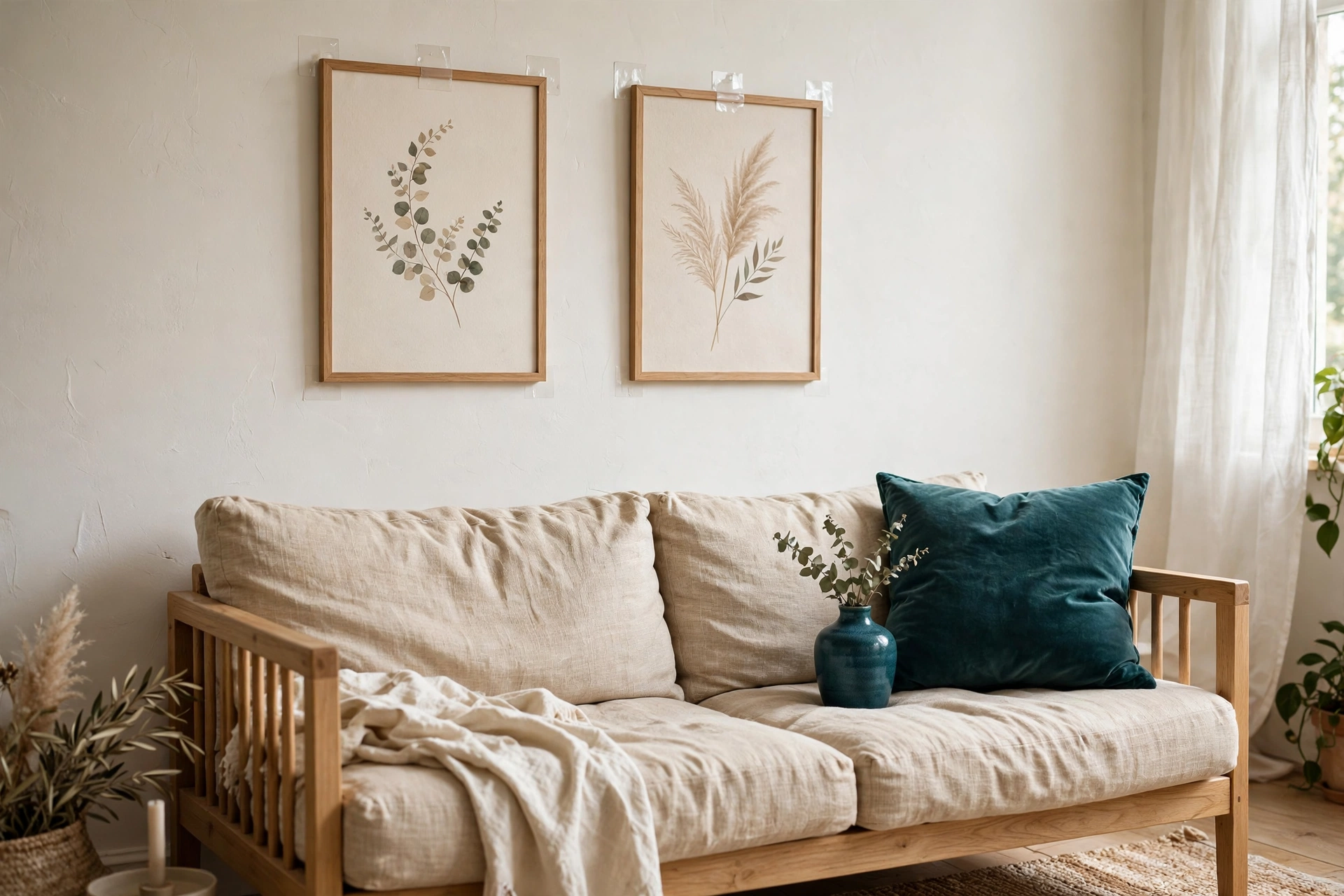
Direct answer: Picture strips are the best no-drill choice for framed art on smooth drywall. Two strips go on the wall and two on the frame, and they lock together like hook and loop fastener.
Best for: Framed prints and canvases up to 16 lb with four large strips, or up to 20 lb with an extra-large set. Main advantage: The frame sits flat against the wall, and removal stretches the strip down instead of tearing the paint. Watch out for: You must remove every old hanger from the back of the frame first, or the strips will not sit flat. Verdict: Use this for art first. It is the most reliable adhesive method on drywall.
Method 2: Adhesive hooks
Direct answer: Hooks suit things that hang from a loop, a strap, or a wire. Small hooks hold about 1 lb, medium wire hooks about 2 lb, and larger hooks about 5 to 8 lb, depending on the size you buy. Always read the pack, since sizes look alike.
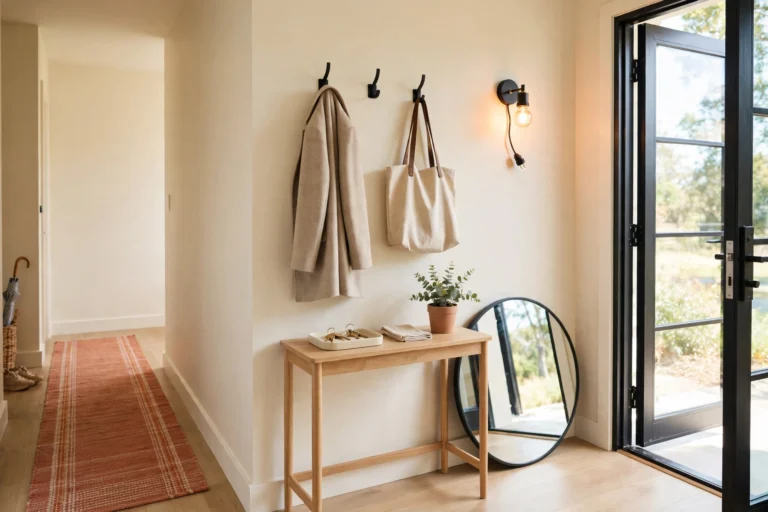
Best for: Bags, keys, hats, light wreaths, and cords. Main advantage: You can move them without tools, and refills are cheap. Watch out for: A swinging load pulls at an angle and fails sooner than a flat frame does. Keep the load still and centered. Verdict: Great for everyday hanging, poor for heavy or swinging items.

Method 3: Poster strips and putty
Direct answer: Poster strips and putty are for paper only. They hold about 1 lb, which is plenty for an unframed poster and nothing else.
Best for: Posters, kids art, and light paper prints. Main advantage: They are the cheapest and gentlest option on paint. Watch out for: Putty can stain thin paper over time, and it will not hold a frame. Verdict: Use it for paper, and never stretch it to a framed piece just because it feels sticky.
Method 4: Lean it against the wall
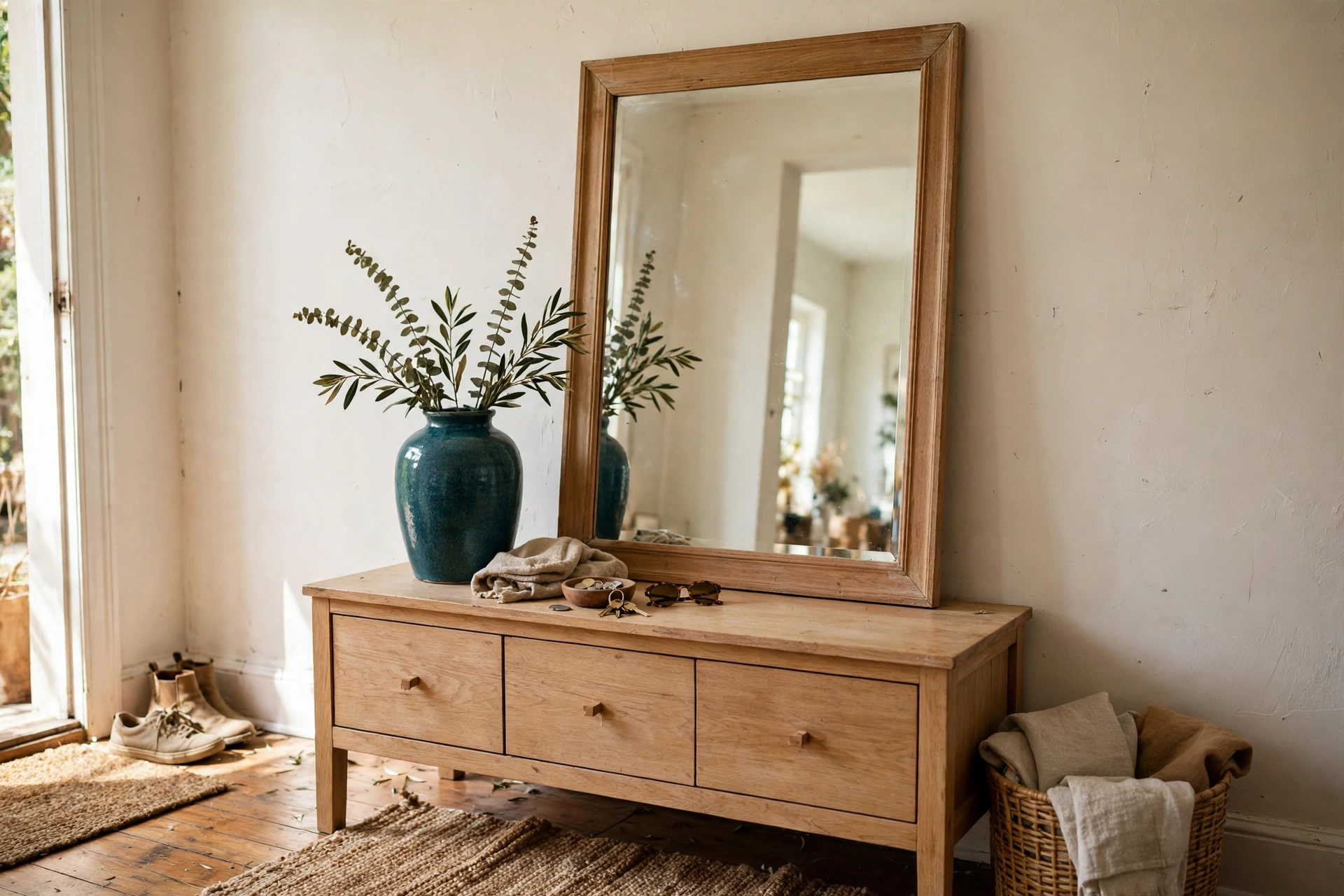
Direct answer: Leaning skips the wall altogether, which makes it the safest option for heavy art. A large mirror or framed piece rests on the floor or on a console, tilted slightly back to the wall.
Best for: Large mirrors and heavy frames over 20 lb. Main advantage: Zero wall damage and zero adhesive risk. Watch out for: It needs floor space, a stable base, and a spot where nobody will bump it. In a home with small children, anchor the top or pick a different wall. Verdict: If adhesive cannot safely hold it, leaning is the honest answer, not a bigger strip.
Method 5: Over-door hooks
Direct answer: Over-door hooks hang from the door itself, so the wall takes no load at all. They work for towels, robes, bags, and light coats.
Best for: Bathrooms, bedrooms, and entryways with a door that closes cleanly. Main advantage: No adhesive, no holes, and you can take them with you. Watch out for: If the door rubs, scrapes paint, or will not close, the hook is the wrong size for that door. Verdict: Use it for daily items, and check the door swing before you load it up.
How to hang things on drywall without drilling in 7 steps
Direct answer: Clean, press, wait, then hang. The waiting step is the one most people skip, and it is the one that keeps frames on the wall.
Materials list: Adhesive strips or hooks rated above your piece, rubbing alcohol and a cloth, a pencil, a small level or a phone level app, and a bathroom scale. Time estimate: about 20 to 30 minutes of work, plus 1 hour of curing before you load the strips.
- Weigh the piece on a bathroom scale, including glass and hardware.
- Pick a method rated above that weight, using the table above.
- Clean the wall spot with rubbing alcohol and let it dry fully.
- Press the wall-side strip or hook firmly for at least 30 seconds.
- Wait 1 hour before you hang anything, so the bond can set.
- Hang the piece, press it flat to the wall, and check it with a level.
- Recheck it the next morning. If a corner has lifted, take it down and start over with a fresh set.
For a full room plan that uses these methods without drilling, see our no drill bedroom layout ideas. For the removal steps that protect drywall paper at move-out, see our guide to removing adhesive hooks without damage.
Cost breakdown as of November 2026
Direct answer: A starter kit for one room costs about $14.47 at Target prices checked in November 2026. Add a refill pack if you plan to rehang things during the year.
| Item | Target price, November 2026 | What it covers |
|---|---|---|
| Command medium picture hanging strips, 6 count | $6.39 | Frames up to about 12 lb |
| Command medium wire toggle hooks, 2 pack | $3.29 | Bags, keys, and light items up to 2 lb each |
| Command small poster strips, 24 count | $4.79 | Posters and paper prints |
| Starter kit total | $14.47 | One room, mixed hanging |
| Command refill strips, 16 pack (optional) | $3.29 | Rehangs through the year |
| With refills | $17.76 | Starter kit plus refills |
These are checked market prices, not personal receipts. Prices vary by store and by pack size, so check the rating on the pack you actually buy. The rating matters more than the brand name on the front.
Mistakes to avoid
Direct answer: Most failures come from rushing the prep, not from weak adhesive. Slow down for five minutes and the strips do their job.
- Sticking strips to dusty, damp, or freshly painted walls. Clean first, and wait 7 days after painting.
- Loading the frame right away. Give the bond 1 hour to cure.
- Using one strip pair for a frame that needs four. Spread the load across the full width of the frame.
- Hanging above a bed or a sofa with a heavy glass frame on a borderline rating. Move it, lean it, or pick a lighter frame.
- Pulling a strip outward at removal. Stretch it straight down, slowly, as our removal guide shows.
- Ignoring heat. Adhesive softens in high heat, and ratings drop above about 105 degrees Fahrenheit (41 degrees Celsius), so skip adhesive above a radiator or in a sun-baked spot.
What to skip
Direct answer: Skip anything that promises a heavy hold with no rating on the pack. Skip permanent foam tape, which is not the same as removable strips and can tear paint on removal. Skip suction cups on painted drywall, since they need a smooth, non-porous surface like glass or tile to grip. Skip press-in pin hooks if your lease bans holes of any kind, even tiny ones, and skip a heavy mirror on strips entirely. A mirror that needs a stud does not become safe because the pack looks strong.
Lease check before you stick anything
Direct answer: Read the lease clause on walls, adhesive, and alterations before you hang a full gallery. Most leases allow removable adhesive, but some ban it on fresh paint or limit what you can hang, and the lease wins over the pack instructions.
| Method | Deposit risk | Why |
|---|---|---|
| Picture strips, removed correctly | Low | Clean removal if stretched down slowly |
| Adhesive hooks, removed correctly | Low | Small contact area, same removal rule |
| Poster putty | Very low | Gentle, but check for stains on thin paper |
| Leaning art | None | No wall contact at all |
| Over-door hooks | Low | Risk is door rub, not wall damage |
If the item is heavy, valuable, or above a bed, ask first. Our guide to ask your landlord for permission in writing gives you an email that gets a yes more often than a vague request does. For the full move-in and move-out picture, read our lease and deposit guide for renters.

How much weight can adhesive strips hold on drywall?
Small sets hold a few pounds, medium sets hold about 12 lb, four large strips hold up to 16 lb, and extra-large sets hold up to 20 lb on clean, smooth, painted drywall. Always use the rating on your pack, and stay below it.
Will adhesive strips damage drywall or paint?
They should not, if the paint is fully cured and you stretch the strip straight down at removal. Damage usually comes from fresh paint, textured surfaces, or pulling the strip outward instead of down.
How long should I wait before hanging a picture on strips?
Wait 1 hour after pressing the strips on before you hang the frame. Wait 7 days after painting a wall before you stick anything to it at all.
What should I do if a strip breaks during removal?
Stop, do not pry at the frame. Work a thin piece of dental floss behind the strip, warm it gently with a hair dryer on low, and follow the step-by-step rescue in our adhesive removal guide.
The bottom line
If the piece is light, the wall is smooth and cured, and the rating beats the weight, adhesive hanging on drywall is a sound renter choice. If any one of those three fails, change the plan, not the rating. That is the whole discipline behind how to hang things on drywall without drilling: weigh it, rate it, cure it, and check it the next day. Done that way, your walls stay clean, your frames stay up, and your deposit stays yours.
By Wasim. How this was made: this guide was written from published manufacturer ratings and Target prices checked in November 2026, plus the top-ranking guides for this query. No product was presented as personally tested, and no weight rating was invented. Images are bright real-home style illustrations, not photos of a real project.
Sources: EngineerFix guide to hanging pictures on drywall without holes (https://engineerfix.com/how-to-hang-pictures-on-drywall-without-holes/) and the Renter Edit guide to renter-friendly wall hooks (https://renteredit.com/en/renter-friendly-wall-hooks-guide/).