How to Hang Things on Tile Without Drilling: 7 Renter-Safe Methods That Hold
Direct answer: If you want to hang things on tile without drilling, start with two checks, not the hook. First, is your tile smooth and glazed, and can the whole strip sit on one flat tile without crossing a grout line? Second, does the rating beat the loaded weight? A shower caddy holding about 6 lb of bottles, hung on two 5 lb bath strips, puts 3 lb on each strip, which is inside the rating. That load-per-strip math, plus the one-tile placement rule, is what keeps things on the wall. This guide gives you the method for each tile type, the steps, the costs as of November 2026, and a deposit rating for every method, so nothing falls down and nothing costs you at move-out.
First, is your tile the right kind for adhesive?
Direct answer: Smooth, glazed tile is the best surface adhesive can meet. It is flat, non-porous, and gives a strip full contact. Matte tile, textured tile, and natural stone with pits are weaker surfaces, because the strip cannot touch the whole area. Suction cups are even pickier: they only seal on smooth glazed tile or glass.
Find the grout lines before you buy anything. 3M’s own instructions for its bath hooks say to avoid applying adhesive over grout lines. A strip that crosses a grout line touches less tile, and the gap becomes the weak point. The rule is simple: every strip sits on one flat tile, edge to edge, with no grout under it. If your tiles are small, say 4 in (10 cm) squares, a long strip may not fit on one tile. Then pick a smaller hook or a different spot, not a strip that bridges two tiles.
Check the zone too. Inside a shower, or anywhere the wall gets splashed daily, you need the water-resistant bath version of the product, not the standard dry-room version. Most bathroom failures I see in reader questions come down to this one swap: a standard strip in a wet zone, slowly giving up over weeks. Use bath strips in wet zones, standard strips in dry zones, and never mix them up.
The weight budget: match the method to the pounds
Direct answer: The rating must beat the weight, with room to spare, and that is the rule that makes hang things on tile without drilling work in practice. Never treat a rating as a target. If a piece weighs close to the rating, step up a size or add a second strip set.
Use a bathroom scale for anything you are unsure about. A wet bath towel weighs about 2 to 3 lb. A full shower caddy with shampoo, conditioner, and body wash lands around 5 to 7 lb. A small framed print with glass is about 4 to 6 lb. Weigh the item loaded, the way it will actually hang, then read the table. Manufacturer ratings used here are printed ratings, not test claims: Command bath hooks hold 3 to 5 lb depending on size, Command large bath strips hold 5 lb, and VELCRO bath fasteners hold up to 10 lb at 1 lb per square inch.
| Item | Loaded weight | Method that fits | Rating to use |
|---|---|---|---|
| Hand towel, loofah, razor | Under 2 lb | Bath hook or suction hook | 3 lb bath hook or higher |
| Bath towel, robe | 2 to 4 lb | Large bath hook | 4 to 5 lb hook |
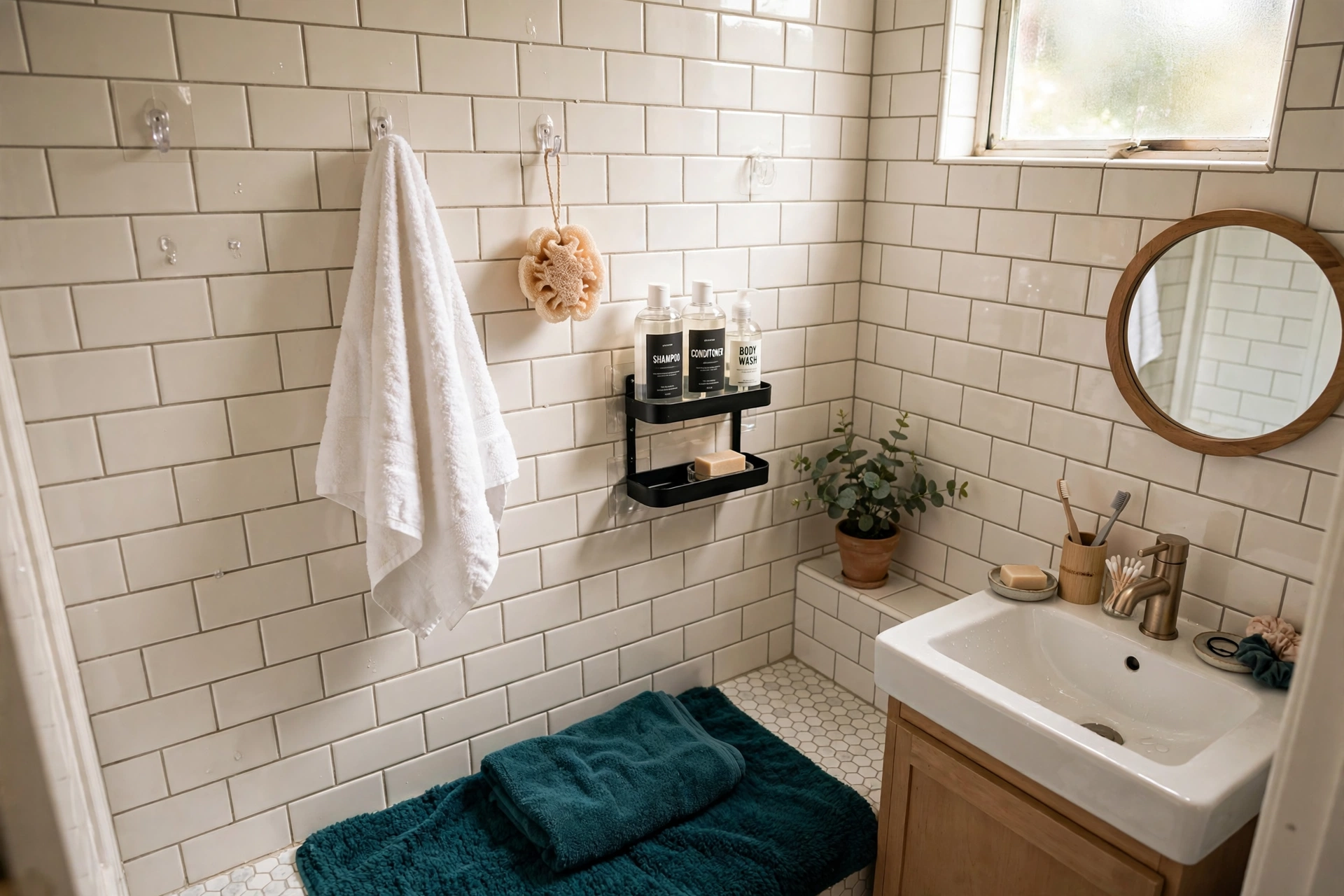
| Shower caddy, full | 5 to 7 lb | Adhesive caddy on two strips | Two 5 lb strips, 3 to 4 lb per strip |
| Small mirror or framed print | 4 to 6 lb | Bath fastener strips | 10 lb fastener set |
| Towel bar, loaded | 5 to 8 lb | Adhesive towel bar, two mounts | Two 5 lb mounts or higher |
| Heavy mirror, shelf, TV | Over 20 lb | Stop, do not use adhesive | Freestanding or leaning plan |
Method 1: Water-resistant bath strips and hooks
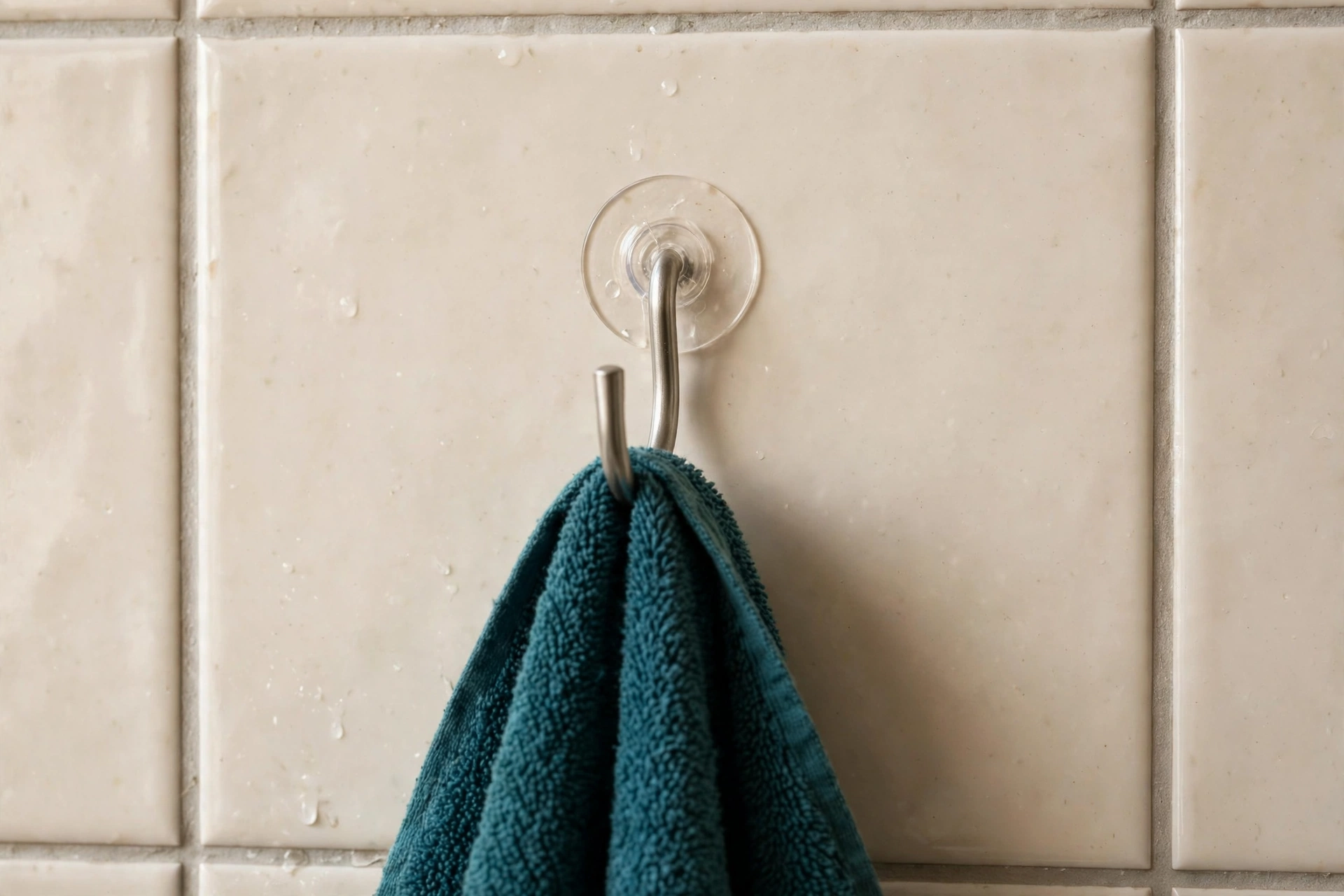
Direct answer: Bath strips and hooks are the best no-drill choice for tiled bathroom walls. They use a water-resistant adhesive made for hot, wet, humid air, and 3M says they hold better than suction cups in those conditions.
Best for: Towels, robes, loofahs, and shower accessories on glazed tile. Main advantage: They remove cleanly, with no holes, marks, or sticky residue, when you stretch the tab down slowly at move-out. Watch out for: Standard strips look identical to bath strips on the shelf. Check the pack for the words water-resistant before you buy. Verdict: Use this first for anything in a bathroom. Deposit risk: low, 1 out of 5.
Method 2: Suction cups
Direct answer: Suction cups work only where they can seal, which means smooth glazed tile or glass, with no grout line under the cup and no texture at all.
Best for: Very light items like a toothbrush holder, a soap dish, or a squeegee. Main advantage: They move in seconds and cost almost nothing. Watch out for: They lose grip slowly as air leaks in, and they fail without warning. Keep them off anything breakable, and re-press them every few days. Verdict: Fine for light, cheap items. Do not trust them with a mirror or a full caddy. Deposit risk: low, 1 out of 5, since they leave nothing behind.
Method 3: Bath fastener strips for flat items
Direct answer: Hook and loop bath fastener strips suit flat items that need to sit flush against the tile, like a small mirror or a light framed print. One side sticks to the item, the other to the tile, and they press together.
Best for: Flat mirrors, small frames, and light decor on smooth tile. Main advantage: The item sits flat, and you can pull it off the wall to clean behind it, then press it back. Watch out for: The rating is 1 lb per square inch, up to 10 lb total, so a small pair of strips holds far less than the headline number. Size the strips to the weight, not the frame. Verdict: Great for flat, light pieces. Poor for anything that hangs from a single point. Deposit risk: low, 1 out of 5.
Method 4: Adhesive shower caddy and basket
Direct answer: An adhesive caddy is the right answer for a shower with no shelf, as long as you count the loaded weight, not the empty weight.
Best for: Shampoo, conditioner, and body wash in a shower with smooth tile. Main advantage: Two strips share the load, and a basket keeps bottles off the tub edge. Watch out for: Bottles get heavy fast. A full-size shampoo bottle alone is about 1.5 lb. Load the caddy, weigh it if you can, and divide by the number of strips. If each strip carries more than about 70 percent of its rating, drop a bottle or add a second caddy. Verdict: Use it, but respect the loaded weight. Deposit risk: low, 1 out of 5.

Method 5: Adhesive towel bar and ring
Direct answer: An adhesive towel bar works when both mounts sit on flat tile, not on grout, and the bar is short enough that both mounts land on solid tile.
Best for: Hand towels and washcloths beside a sink or tub. Main advantage: It looks built in, and it frees the towel from the door. Watch out for: A long bar whose mounts land on grout lines will peel from one side first, then twist. Measure the mount spacing against your tile layout before you buy. Verdict: Good for hand towels. For a heavy wet bath towel, a large bath hook holds better than a long bar. Deposit risk: low, 1 out of 5.
Method 6: Adhesive shelf on a kitchen backsplash
Direct answer: The same bath and kitchen strips work on a dry kitchen backsplash, where steam and splashes are lighter than a shower but still present.
Best for: A small spice shelf, a paper towel holder, or a utensil rail on smooth backsplash tile. Main advantage: It adds storage without drilling into tile you do not own. Watch out for: Heat matters. Do not mount strips right above a stove or kettle, since heat softens adhesive. Keep the shelf clear of the hottest zone. Verdict: A solid dry-zone use. Keep loads light and heat away. Deposit risk: low, 1 out of 5.

Method 7: For heavy items, skip the wall
Direct answer: Anything over about 20 lb does not belong on adhesive, and tile makes that limit stricter, not looser. A heavy mirror or a shelf full of jars needs a different plan.
Best for: Heavy mirrors, large art, and loaded shelves. Main advantage: Zero wall damage and zero fall risk. A leaning mirror, a freestanding shelf unit, or a tension-pole caddy that grips floor to ceiling all skip the tile entirely. Watch out for: A leaning mirror needs a stable base and a spot where nobody will bump it. Verdict: If adhesive cannot safely hold it, a freestanding plan is the honest answer, not a bigger strip. For the drywall version of this decision, see our guide to hanging things on drywall without drilling.
How to hang things on tile without drilling in 7 steps
Direct answer: Clean, place on one tile, press, wait, then load. The waiting step is the one most people skip, and it is the one that keeps caddies on the wall.
Materials list: Water-resistant bath strips or hooks rated above your loaded item, rubbing alcohol and a cloth, a pencil, a small level or a phone level app, and a bathroom scale. Time estimate: about 15 to 20 minutes of work, plus 1 hour of curing before you load the strips. Heavy strips reach full strength after about 24 hours.
- Weigh the item loaded, the way it will actually hang.
- Pick a bath-rated method rated above that weight, using the table above.
- Pick a spot where every strip sits on one flat tile, with no grout line under it.
- Clean that tile with rubbing alcohol, not household cleaner, and let it dry fully.
- Press the strip firmly for at least 30 seconds, covering the whole strip.
- Wait 1 hour before you hang anything, and a full day before a heavy caddy.
- Recheck it the next morning. If an edge has lifted, take it down and start over with a fresh strip.
For the removal steps that protect tile and grout at move-out, see our guide to removing adhesive hooks without damage. For the wider bathroom plan, see our renter friendly bathroom upgrades.
Cost breakdown as of November 2026
Direct answer: A starter kit for one bathroom costs about $28.27 at Target prices checked in November 2026. Add a refill strip pack if you plan to rehang things during the year.
| Item | Price checked November 2026 | Notes |
|---|---|---|
| Command Bath 2-pack medium hooks | $5.49 | 3 lb each, water-resistant strips included |
| Command large bath hook | $6.49 | 5 lb, for bath towels and robes |
| Command shower caddy | $11.29 | Water-resistant strips, two-strip mount |
| Rubbing alcohol and cloth | About $5.00 | Skip household cleaners, they leave residue |
| Starter total | $28.27 | One bathroom, hooks plus caddy |
Prices are checked market prices, not personal receipts, and they vary by store and region. A suction basket upgrade, like the OXO Stronghold suction basket at $21.99, swaps in for the adhesive caddy if your tile is perfectly smooth and you want a movable option.
What to skip
Direct answer: Skip anything that asks adhesive to do a job it was never rated for. Standard dry-room strips in a shower, suction cups on textured tile, and strips stretched across grout lines are the three skips that cause most falls.
Also skip hanging over a bed, over a tub edge where a fall could break glass, and above anything valuable. The rating assumes a still, centered load. A swinging towel, a tugged caddy, or a child pulling a towel bar all load the strip at an angle, and angled loads fail sooner.
Mistakes to avoid
Direct answer: The mistakes are small, and they all happen before the item goes up, which is why hang things on tile without drilling fails most often at the prep stage, not on the wall. Cleaning with a household spray instead of rubbing alcohol leaves a film that weakens the bond. Loading the strip before the hour is up is the same as using a weaker strip. Reusing a stretched strip is not possible, since the adhesive is spent once pulled.
The other mistake is placement. People center the hook on the wall and ignore the grout grid, then wonder why one side peels. Center the hook on the tile, not on the wall. If the tile layout will not allow it, move the hook a few inches, since tile grids repeat every few inches anyway.
Renter caveat: check the lease first
Direct answer: Before you stick anything up, check your lease for its rules on wall attachments, even damage-free ones. Most leases allow adhesive hooks, but some require written permission for anything mounted in a bathroom, and a few ban adhesives on stone or specialty tile.
Photograph the tile before you mount anything, so you have a move-out record. Keep the rating and the pack, since a landlord dispute goes better when you can show the product was rated for the load and removed per its instructions. For the full lease and deposit picture, see our lease and deposit guide for renters. Deposit risk for the methods in this guide is low, 1 out of 5, as long as you use bath-rated strips, keep them off grout, and remove them by stretching the tab slowly down the wall.

Frequently asked questions
Can you use Command strips on tile in the shower?
Yes, but only the water-resistant bath version. Standard Command strips are made for dry rooms, and constant steam and splashes weaken them over time. Bath strips are tested for hot, wet, humid conditions, and 3M says they hold better than suction cups in a shower. Clean the tile with rubbing alcohol, keep every strip off the grout lines, and wait an hour before loading.
Do adhesive hooks work on textured tile?
Poorly, and often not at all. Adhesive needs full contact, and texture leaves gaps under the strip. The same goes for suction cups, which cannot seal on texture. On textured or matte tile, use a freestanding shelf, a tension-pole caddy, or an over-door hook instead of fighting the surface.
How much weight can suction cups hold on tile?
Only light items, and only on smooth glazed tile. A suction hook suits a toothbrush holder, a soap dish, or a squeegee, not a mirror or a full caddy. They lose grip slowly as air leaks in, so re-press them every few days and never trust them above anything breakable.
How do you remove adhesive from tile without damage?
Remove the hook from its base first, then hold the base steady with one hand while you stretch the strip tab slowly straight down the wall, at least 12 in (30 cm), until it releases. Never rip a strip sideways or pull it toward you, since that can chip grout or pull paint from a painted edge. Any light residue wipes off glazed tile with warm water and a soft cloth. Our full removal guide covers the step-by-step version.
How this was made: this guide was researched from manufacturer ratings and live-checked November 2026 prices, written in our own words, and checked against the top-ranking guides for the gaps they leave, including the grout-line rule and the wet-zone split. No product was tested by us, and no personal purchase is claimed.
Author: Wasim
Sources: Command brand (3M) bath strips and hooks product information.