
How to Hang a Mirror Without Drilling: 6 Renter-Safe Methods That Hold
Direct answer: To learn how to hang a mirror without drilling, start with its weight, not with the hardware aisle. A mirror is glass, so it is heavier than a framed print of the same size, and that single fact rules out half the shortcuts people try. Small mirrors up to about 12 lb (5.4 kg) can go up on adhesive picture strips if the wall is smooth and the strips are rated for at least twice the mirror’s weight. A medium mirror needs that same doubling rule plus a frame the strips can actually grip. A heavy or full-length mirror should not hang on adhesive at all. Lean it, stand it, or hang it over a door instead. The original planning rule in this guide is the size-to-weight check below: a 24 by 36 in (61 by 91 cm) mirror in quarter inch glass weighs about 20 lb (9 kg) of glass alone, before the frame, so it already breaks the usual strip-only plan.
A falling mirror is not like a falling poster. It breaks, it cuts, and it can take paint and plaster with it. So this guide is stricter than the usual just use strips advice. Every method below carries a deposit risk rating from 1 to 5, where 1 means almost no risk to your deposit and 5 means you will probably pay for a repair. Read the weight section first, then pick the method that fits your mirror, not the one that looks easiest in the store.
How to hang a mirror without drilling starts with weight
Direct answer: Weigh it loaded, frame and backing included, on a bathroom scale, and if you cannot weigh it, estimate it from its size. Glass in the common quarter inch (6 mm) thickness weighs about 3.3 lb per square foot (16 kg per square metre). Multiply the mirror’s area by that number, then add 2 to 5 lb (0.9 to 2.3 kg) for a light frame, or more for a thick wood frame.
| Mirror size | Glass area | Glass weight, estimated | With a light frame, about | Method that fits |
|---|---|---|---|---|
| 12 by 18 in (30 by 46 cm) | 1.5 sq ft | About 5 lb (2.3 kg) | 6 to 7 lb (2.7 to 3.2 kg) | Adhesive strips or hooks |
| 18 by 24 in (46 by 61 cm) | 3 sq ft | About 10 lb (4.5 kg) | 12 to 13 lb (5.4 to 5.9 kg) | Adhesive strips, doubled rating |
| 24 by 36 in (61 by 91 cm) | 6 sq ft | About 20 lb (9 kg) | 22 to 25 lb (10 to 11.3 kg) | Lean it, or a stand, not strips alone |
| Full length, 20 by 60 in (51 by 152 cm) | 8.3 sq ft | About 27 lb (12.2 kg) | 30 lb or more (13.6 kg) | Lean it, over-door hooks, or a stand |
That table is the reason this guide disagrees with a lot of quick advice online. A 24 by 36 in mirror is the largest size the maker of Command strips lists for its picture strips, and its large strip set is rated at 16 lb. The mirror alone, before the frame, already weighs more than that rating. The honest answer for that size is not buy more strips and hope. It is change methods.
The doubling rule: whatever your mirror weighs, your hardware’s total printed rating should be at least twice that weight. A 12 lb mirror needs at least 24 lb of rated strips, which means two 16 lb strip sets spread across the frame, not one. Ratings assume a clean, smooth, fully cured surface, and rental walls are rarely perfect, so the second half of the rating is your safety margin. If the doubled rating cannot be reached with strips that fit on the frame, pick a method that does not rely on adhesive at all.
Which wall surface are you hanging on?
Direct answer: Smooth painted drywall and smooth tile are the only surfaces where adhesive strips earn their printed rating. Textured walls, fresh paint, wallpaper, and damp bathroom walls all cut that rating, sometimes to zero.
| Surface | Adhesive plan | Better method if adhesive fails |
|---|---|---|
| Smooth painted drywall, paint cured over 7 days | Strips at the doubled rating | Lean or stand for heavy mirrors |
| Smooth tile | Strips or suction for light mirrors only, and check the grout lines | Lean, or a stand, for anything heavy |
| Light orange peel texture | Light frames only, at half the printed rating | Lean or stand |
| Heavy texture, knockdown, or popcorn | No adhesive load at all | Lean, stand, or over-door |
| Fresh paint, wallpaper, or brick | No adhesive load | Lean, stand, or over-door |
If your wall is smooth drywall, the companion guide to hanging things on drywall without drilling covers the full rating method in detail. For tile, the companion guide to hanging things on tile without drilling covers grout lines and steam. For textured walls, the companion guide to hanging things on textured walls without drilling explains why the adhesive budget drops to zero on heavy texture. This mirror guide builds on those three, and it does not repeat their surface tables.
Method 1: Lean it against the wall
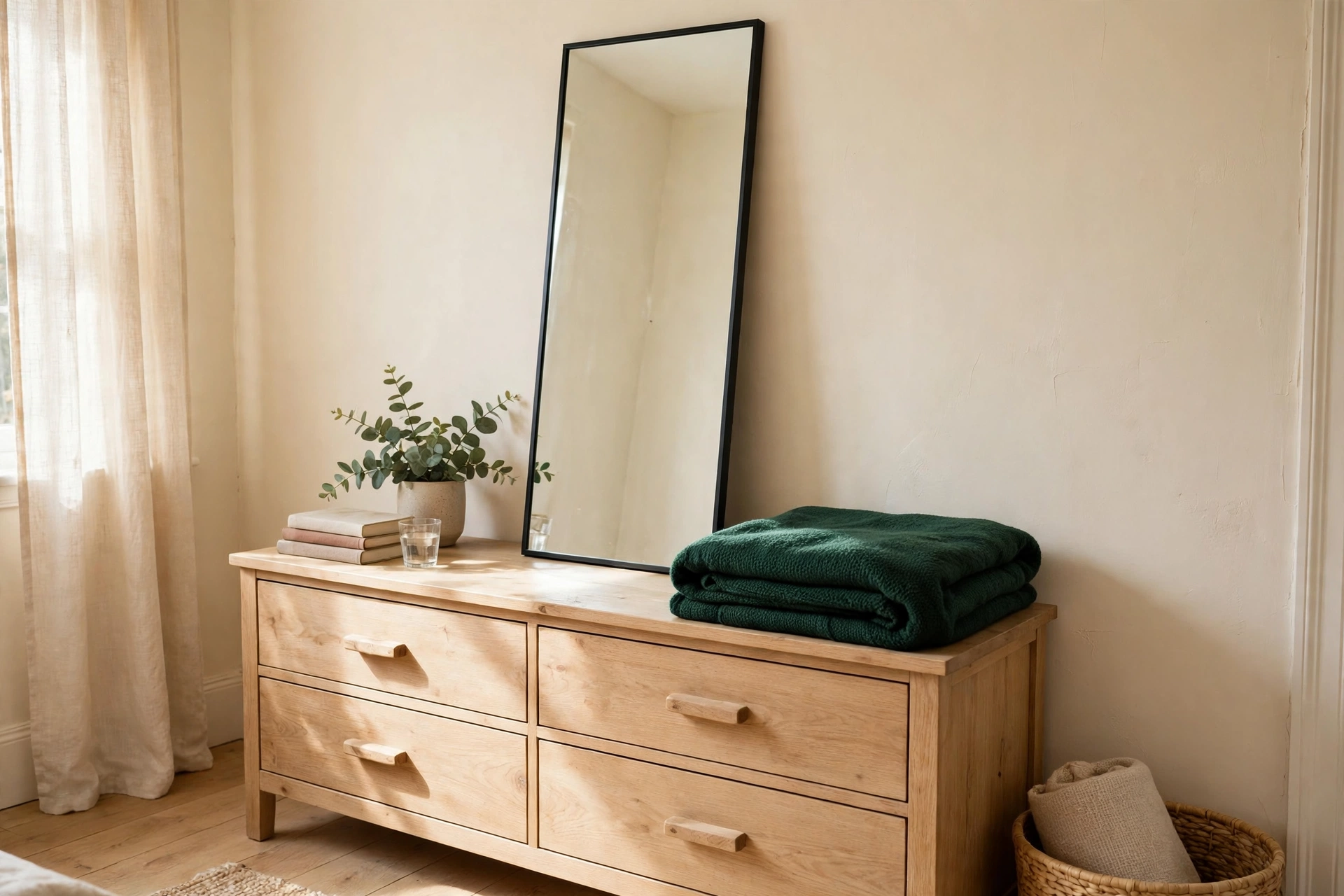
Direct answer: Leaning is the best answer for any mirror over about 15 lb (6.8 kg), and it is the only answer this guide fully trusts for a full-length mirror. The mirror’s weight goes to the floor, and the wall only steadies it.
Best for: Full-length mirrors, heavy framed mirrors, and any mirror you want to move later. Main advantage: Zero adhesive, zero holes, and zero wall load, so the wall cannot fail under it. Watch out for: A leaning mirror still needs a secure foot. Keep it on a stable floor, angle the top slightly back toward the wall, and keep it out of door swing paths. In a home with small children or pets, put a small adhesive bumper or a furniture anchor behind the top edge so a bump cannot tip it forward. Verdict: Underrated, and the safest heavy-mirror method in a rental. Deposit risk: 1 out of 5.
Method 2: Adhesive picture strips for small and medium mirrors
Direct answer: Adhesive picture strips work for mirrors up to about 12 lb (5.4 kg) on smooth, cured, painted walls, provided the total rating is at least twice the mirror’s weight and the frame gives the strips a flat area to grip.
Best for: Small vanity mirrors and medium framed mirrors on smooth drywall. Main advantage: They remove cleanly with the stretch-release tab when the tab is pulled slowly straight down, and they leave no holes. That doubling rule is the whole method for how to hang a mirror without drilling on strips, and skipping it is how light mirrors end up on the floor. Watch out for: Strips grip the frame, not the glass, so a frameless mirror with a thin edge has nowhere safe to stick. Never use strips on fresh paint under 7 days old, on wallpaper, on heavy texture, or above a bed or a sofa where a fall could hurt someone. Verdict: The right tool for light mirrors, and a trap for heavy ones. Deposit risk: 2 out of 5 on a smooth wall, 4 out of 5 on texture or fresh paint.
Method 3: Adhesive hooks and wire for small round mirrors
Direct answer: A pair of adhesive hooks with a short wire across the mirror’s back works well for small round or light mirrors, because the weight hangs straight down instead of pulling the adhesive away from the wall.
Best for: Small round mirrors, light decorative mirrors, and mirrors with a built-in hanging wire. Main advantage: Two hooks share the load, and the mirror can be lifted off for cleaning without disturbing the adhesive. Watch out for: Hooks fail by peeling from the top edge, so keep the load close to the wall and never hang a bag or a towel from the same hook. Check the hook’s rating, then apply the doubling rule to the pair combined. Verdict: A neat, low-risk method for light mirrors. Deposit risk: 2 out of 5.
Method 4: Over-the-door hooks for full-length mirrors
Direct answer: Over-the-door hooks let a full-length mirror hang from a door, not from a wall, so the wall never carries the weight and no holes are made anywhere.
Best for: Full-length mirrors in bedrooms and dorm rooms with a solid interior door. Main advantage: The door carries the weight, the mirror can be moved in seconds, and move-out means lifting it off. Watch out for: Check the door first. A hollow-core door can flex under a heavy mirror, and a door that slams will swing the mirror into the frame. Use hooks with a felt or rubber pad where they touch the door, and keep the mirror off doors that children swing hard. Verdict: The simplest full-length solution, and the one most renters overlook. Deposit risk: 1 out of 5, or 2 out of 5 if the hooks scuff an unprotected door edge.

Method 5: A freestanding stand or easel
Direct answer: A freestanding mirror stand, a display easel, or a standing jewelry mirror needs no wall at all, which makes it the safest choice when the wall surface is unknown or the lease is strict.
Best for: Renters with textured, damaged, or freshly painted walls, and anyone who rearranges often. Main advantage: The mirror moves with you, room to room and home to home, and the deposit is never involved. Watch out for: A stand still needs a stable base. Keep it away from high-traffic paths, and use the anti-tip strap if the stand ships with one, especially in a home with children. Verdict: Costs more than a pack of strips, and buys the most peace of mind. Deposit risk: 1 out of 5.
Method 6: Hooks on a picture rail or molding you already have
Direct answer: If your rental already has a picture rail, a chair rail, or a sturdy molding, hang the mirror from that with rail hooks and wire, and make no new holes of any kind.
Best for: Older rentals and period apartments where a rail is already part of the room. Main advantage: Rails were built to carry pictures, the load spreads along the rail, and removal leaves the room exactly as you found it. Watch out for: Never screw a new rail into the wall to create this method, because that defeats the whole point. Check that the rail itself is firmly fixed before trusting it with a mirror. Verdict: The most elegant solution, when the room already offers it. Deposit risk: 1 out of 5.
Materials and steps for the adhesive strip method
Direct answer: For a small or medium mirror on strips, learning how to hang a mirror without drilling takes about 30 minutes plus a full day of curing before the mirror carries its full load, and rushing the cure is the most common reason strips fail.
Materials list: Bathroom scale, rubbing alcohol and a lint-free cloth, a pencil, a small level, adhesive picture strips rated for at least twice the mirror’s weight, and small felt bumper pads for the bottom corners of the frame.
For a small or medium mirror on strips, the job takes about 30 minutes plus a full day of curing before the mirror carries its full load.
Weigh the mirror and double the rating
Weigh the mirror loaded, frame and backing included, and double the number. That doubled number is the rating your strips must reach in total.
Check and clean the wall
Check the wall. It must be smooth, dry, and painted at least 7 days ago. Clean it with rubbing alcohol and let it dry fully.
Clean the back of the frame
Clean the back of the frame the same way, and remove any paper labels or dust where the strips will sit.
Press the strip pairs onto the frame
Press the strip pairs onto the frame, two across the top and at least one pair lower down for a medium mirror, and press each firmly for 30 seconds.
Mark the wall and press the mirror to it
Mark the wall lightly with a pencil, hold the mirror level, and press it to the wall. Press each strip area firmly for 30 seconds, then step back and check the level.
Leave the mirror untouched to cure
Leave the mirror untouched for a full hour at minimum, and a full day before you trust it completely. Do not hang anything from it during the cure.
Check it after a day
Check it after a day by pressing the bottom edge gently toward the wall. If it moves, take it down, clean both surfaces again, and add another strip set, or switch to leaning it.

How much does it cost?
Direct answer: A strip-only hang for a small mirror costs about $15 to $25 in total, while a no-wall solution for a heavy mirror costs more up front and nothing at move-out. Prices below were checked from major US retail listings in November 2026, and they vary by store and pack size, so treat them as a planning range, not a quote.
| Item | Typical price, as of November 2026 | Notes |
|---|---|---|
| Large picture hanging strips, 14-pair pack | About $12 to $13 | Four pairs rated at 16 lb; buy the doubled rating, not one pack by habit |
| Rubbing alcohol and lint-free cloths | About $3 to $5 | Already at home for most people |
| Small level and pencil | About $8 to $12 | A phone level app works for a small mirror, but a real level is steadier |
| Over-the-door hooks, pair | About $8 to $15 | Check the door thickness before buying |
| Freestanding mirror stand or easel | About $25 to $60 | The no-wall answer for a heavy mirror |
| Total for a strip hang, small mirror | About $15 to $25 | Strips plus cleaning supplies |
| Total for a no-wall hang, heavy mirror | About $25 to $60 | Hooks or a stand, and no wall repair later |
The whole job takes 30 minutes of work plus a day of curing for strips, or about 10 minutes for leaning, over-door, or stand methods. Budget an extra day at move-out for strip removal, done slowly with the stretch-release tabs, and a wipe of any dust behind the mirror.
Mistakes to avoid
Direct answer: Most mirror failures come from skipping the weighing step, trusting a rating on the wrong surface, or loading the strips before they cure.
- Hanging a mirror you never weighed, and discovering its weight only when the strips give way.
- Using one strip set because the packet says 16 lb, when the mirror weighs 14 lb and the doubling rule calls for 28 lb of rating.
- Sticking strips to dusty, greasy, damp, or freshly painted walls, where the adhesive bonds to the dirt, not the wall.
- Loading the mirror an hour after hanging, or hanging a towel from it, before the adhesive has fully cured.
- Hanging a heavy mirror above a bed, a sofa, or a changing table, where a fall could injure someone, not just damage the wall.
- Pressing strips onto a frameless glass edge, where there is no frame area for the adhesive to grip safely.
What to skip
Direct answer: Skip anything that trades a clean move-out for a stronger hold today, because a rental mirror needs both.
- Permanent mounting tape and mirror mastic. Both hold well, and both will take paint, plaster, or mirror silvering with them at removal. They are not renter tools.
- Suction cups on painted drywall or wallpaper. Suction needs smooth, non-porous tile or glass, and it fails slowly on paint.
- Pinhole picture hangers sold as no drill. They still puncture the drywall, so they are not zero-damage, whatever the packaging implies.
- A single nail or screw just for safety alongside strips. One hole is still a hole, and it still shows up on a move-out inspection.
- Hanging a mirror on a wall you have not checked for texture, damp, or fresh paint. If the surface is wrong, change methods, not the wall.
Renter caveat: check the lease first
Direct answer: Before you hang anything, check your lease for its wall and decoration clauses, and get written permission if the lease limits even adhesive products. Some leases ban all wall fixings, some allow adhesive only, and some require the walls to be returned in their original condition, which is a stricter test than no holes.
Photograph the wall before you hang the mirror, keep the strip packaging with its rating, and photograph the wall again after removal. That pair of photos is your best evidence at move-out, and it costs nothing. For the full move-out picture, the companion lease and deposit guide for renters covers what counts as wear and tear and what counts as damage. If your landlord has already said no to adhesive products, lean the mirror or use a stand, and do not test the boundary with a heavy piece of glass.

Frequently asked questions
Can Command strips hold a mirror?
Yes, for a small mirror on a smooth, cured, painted wall, when the total strip rating is at least twice the mirror’s weight. The maker of Command strips lists its large picture strips at 16 lb for a frame up to 24 by 36 in (61 by 91 cm), and its 20 lb strips for heavier frames, so check the packet rating, not the brand name. A heavy or full-length mirror is past the honest limit for strips, and leaning or standing it is the safer answer.
How heavy a mirror can you hang without drilling?
Without drilling, a small mirror up to about 12 lb (5.4 kg) can hang on adhesive strips under the doubling rule, and any weight above that should go to a method that does not load the wall: leaning, over-door hooks, a stand, or an existing picture rail. There is no adhesive-only answer for a 30 lb mirror in a rental that also protects the deposit, because the rating, the frame area, and the wall surface all run out at about the same point.
How do you hang a full-length mirror without drilling?
Lean it against the wall with its weight on the floor, hang it from over-the-door hooks, or put it on a freestanding stand. All three avoid the wall entirely, which is why they work for a full-length mirror when strips do not. Leaned mirrors need a secure foot and a slight backward angle, over-door mirrors need a solid door with padded hooks, and stands need a stable base away from traffic paths.
Will adhesive strips damage walls when you remove a mirror?
On cured, smooth paint, strips removed slowly with the stretch-release tab usually leave no damage, but on fresh paint, wallpaper, or heavy texture they can lift paint or paper. Pull the tab slowly straight down, never outward, and never rush it with a heavy mirror still attached. Take the mirror down first, then remove each strip on its own. If paint does lift, photograph it, note it for move-out, and repair it the same way the companion adhesive removal guide describes.
How this was made: this guide was written from manufacturer ratings for picture hanging strips, a computed glass-weight estimate from the standard weight of quarter inch glass, and the weight and surface rules used across this site’s no-drill hanging series. No mirror was hung for this article, and no weight limit here comes from a test that did not happen.