12 Renter-Friendly Closet Organization Ideas That Leave Zero Holes
Intro
The best renter friendly closet organization changes how the closet works without changing the closet itself. No holes, no screws, no paint to match at move out. Every piece either hangs, stands, slides, or sticks on and peels off clean.
Here is the math behind this guide, worked out from standard closet sizes and published product specs. A standard reach-in closet is about 60 inches (152 cm) wide with one rod. That is 60 inches of hanging space. If half that rod holds short items like shirts, a second tension rod below that half adds 30 inches (76 cm) of hanging space, taking the closet to 90 inches total. At roughly 1 inch per slim hanger, that is about 25 to 30 extra shirts, gained with zero drilling.
The pattern is consistent: renters buy the wrong thing first. A drilled closet system looks great on move in day, but you cannot take it with you, and your landlord keeps the upgrade. The most underrated storage in a rental closet is the door itself. It is free space most renters walk past every day. The most overrated buy is any system that needs a drill in a home you do not own.
What can renters actually change in a closet?
Start with the lease, not the shopping cart. Read the line about walls, hanging things, and alterations. Some leases allow small nail holes. Some allow nothing at all. A few allow shelves if you restore the wall at move out. If the wording is unclear, ask in writing and keep the answer.
Photograph the closet on move in day: walls, rod, shelf, door, and floor. Those photos are your proof if a deposit dispute comes up later. Then set one rule for the whole project: nothing goes on a wall unless you already know how it comes off. That single rule prevents most deposit deductions.
How much extra hanging space can renter friendly closet organization really add?
More than most renters expect, because the waste is vertical, not horizontal. A single rod with only shirts on it leaves about 30 inches (76 cm) of empty air below the hems. That air is a whole second row of storage.
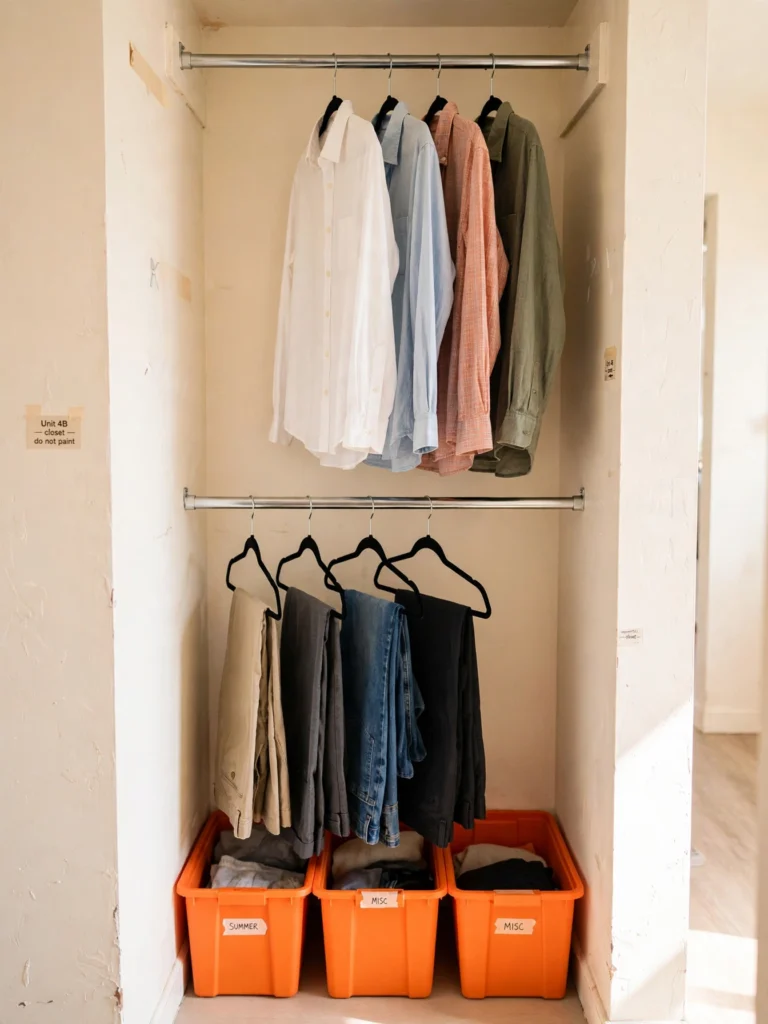
The fix is simple. Hang a tension rod below the short-item half of the main rod, about 30 inches (76 cm) above the floor, so shirts and pants hang without touching the floor. Keep long coats and dresses on the single-rod half, where they need the full drop. Check one measurement first: most reach-in closets are about 24 inches (61 cm) deep, and hangers need that full depth to sit straight. A recent zone by zone guide to small closet organization without built-ins reaches the same conclusion: work zone by zone, rod, shelf, floor, and door, instead of buying one big system. If your closet is shallower, measure before buying anything wide.
12 renter friendly closet organization ideas that leave zero holes
1. Switch to slim hangers first
Direct answer: Slim velvet hangers are the cheapest space gain in any closet, because each one is thinner than a plastic hanger and grips fabric so clothes stop sliding off. Swap the whole rod at once, or the mixed hangers will look messy and snag each other.
A 60 inch (152 cm) rod holds noticeably more slim hangers than bulky ones, and the closet instantly looks calmer. Keep the old hangers in a bag for move out day, so you leave nothing behind. Best for: every rental closet, no exceptions. Watch out for: heavy coats, which can bend slim hooks over time, so keep those on the sturdier original hangers. Deposit risk: 1/5.
2. Add a double hang tension rod
Direct answer: A tension rod hung below the short-item half of the main rod doubles that section overnight, with no tools and no marks if the ends are padded. Twist it tight, then test it with a few hangers before loading it fully.
This is where the 30 extra inches from the intro come from. Keep the load light: shirts, blouses, and pants, never heavy winter coats. A sagging tension rod is almost always an overloaded one. Best for: closets full of shirts and pants with dead air below them. Watch out for: smooth painted walls, where a bare rod end can slip or leave a ring mark, so use rubber end caps. Deposit risk: 1/5.
3. Hang a shelf organizer from the rod
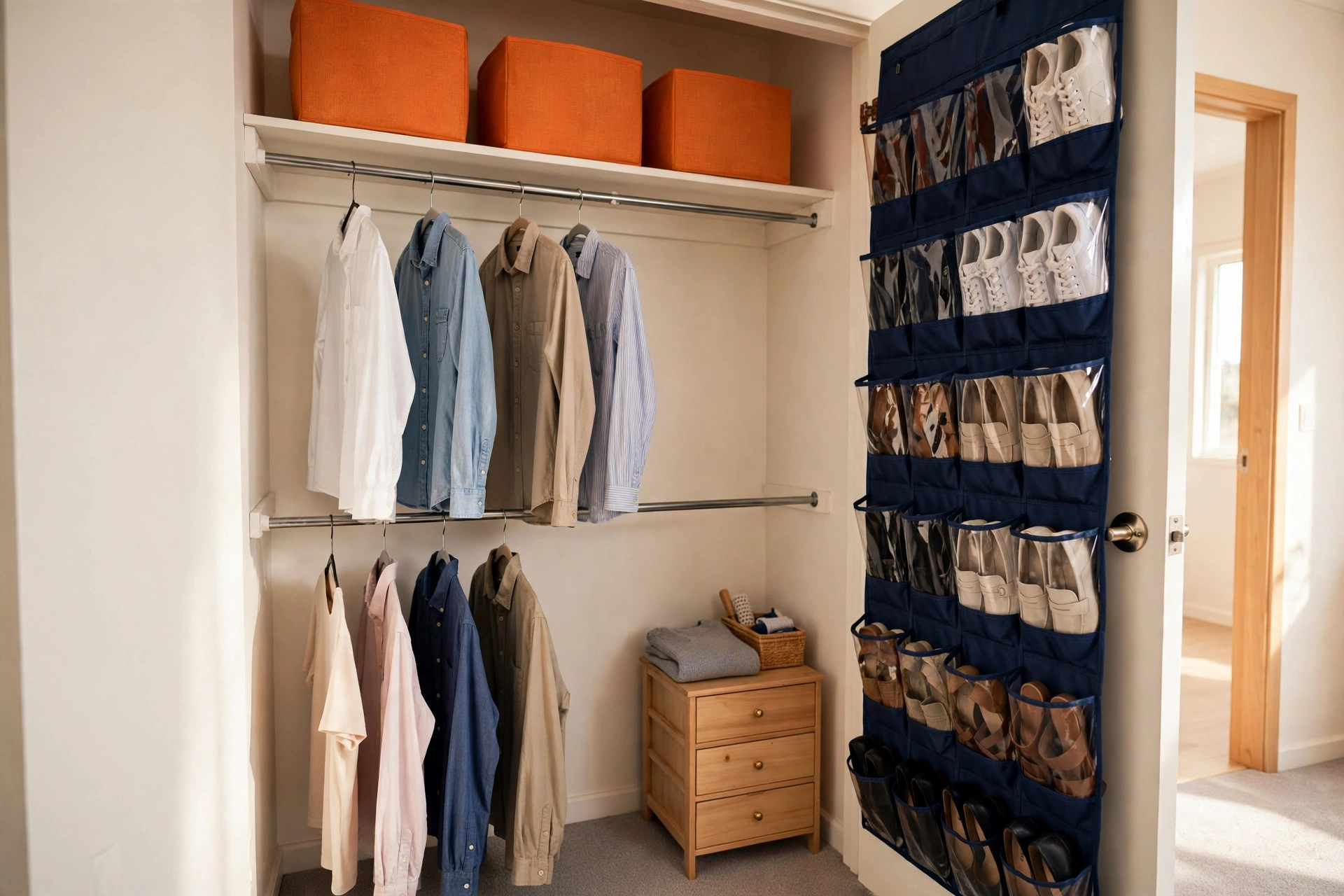
Direct answer: A hanging fabric shelf unit turns one rod into five or six cubbies for folded clothes, bags, and accessories, using space that was just air. It hangs from the rod itself, so the walls never get touched.
Fold sweaters and jeans into the cubbies instead of stacking them on the top shelf, where piles topple. Put daily items at eye level and seasonal items at the top. Best for: closets with no built-in shelves at all. Watch out for: overstuffing the bottom cubby, which pulls the whole unit sideways. Deposit risk: 1/5.
4. Slip shelf dividers over the top shelf
Direct answer: Shelf dividers clip over the existing top shelf and stop folded stacks from sliding into each other. They cost little, install in seconds, and come off just as fast.
One divider between jeans and sweaters is often enough to end the avalanche. Use them to give each category its own bay, and label the bay if you share the closet. These small closet organization ideas use the same zone logic for a whole closet, and it works just as well on a single shelf. Best for: deep top shelves where stacks collapse. Watch out for: shelves thinner than the divider grip, so check the fit before buying a pack. Deposit risk: 1/5.
5. Stand a freestanding drawer unit on the floor
Direct answer: A small freestanding drawer tower or cube unit on the closet floor holds socks, underwear, and accessories without a single screw. When you move, it walks out with you and works in the next closet too.
Measure the floor space first: width, depth, and the height up to the hanging clothes, so drawers still open under the hems. Put a felt pad under the feet if the unit slides on hard floors. Best for: renters who move often and want storage that moves with them. Watch out for: tall units in a play area or a child’s room, which can tip if climbed. Deposit risk: 1/5.

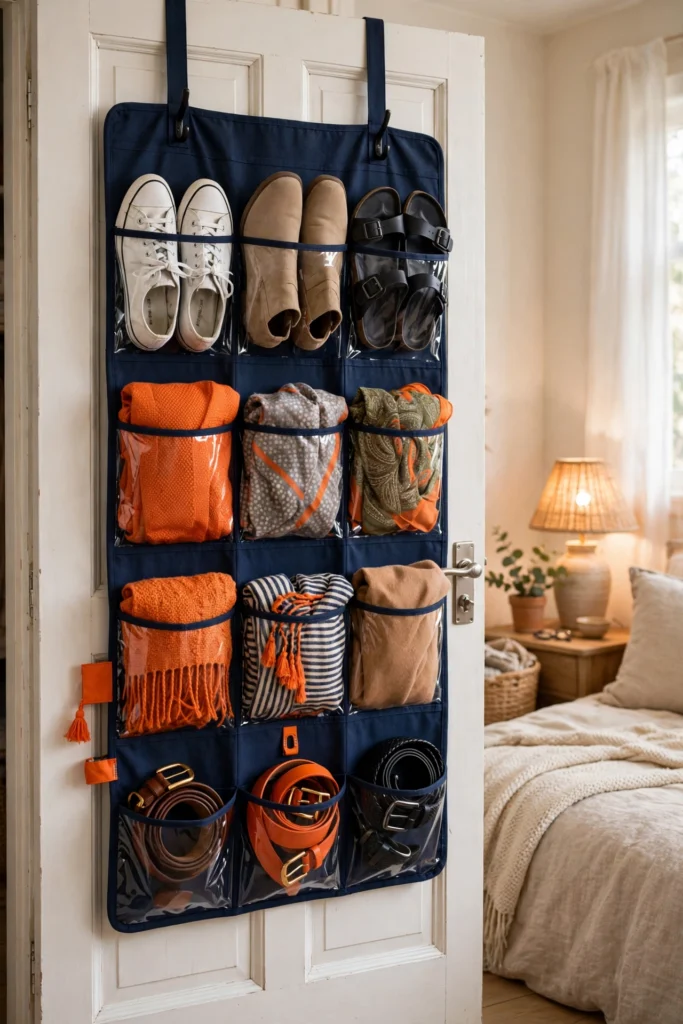
6. Use the door with an over door organizer
Direct answer: An over door organizer turns the back of the closet door into shoe, scarf, belt, and accessory storage, using space that was completely wasted. It hooks over the top of the door, so there is nothing to drill and nothing to stick.
Check two measurements before buying: the door thickness and the gap above the door, so the door still closes fully. Clear pockets make finding things fast, while fabric pockets hide clutter better. For the full comparison of door organizer types, the best over the door organizers guide breaks down which style suits shoes, accessories, and small spaces. Best for: shoe collections and accessory chaos. Watch out for: a door that rubs the frame once the organizer is loaded, which scuffs paint over time. Deposit risk: 1/5.
7. Give shoes a floor plan, not a pile
Direct answer: Shoes eat closet floors because they have no assigned spot. A low open rack, a row of bins, or one bin per person gives every pair a home and keeps the floor walkable.
Put daily shoes at the front and occasion shoes at the back or on the top shelf. One pair out per person per day is a good house rule: the pair you wore goes back before a new pair comes out. Best for: shared closets and big shoe collections. Watch out for: tall shoe towers that block the hanging clothes above them. Deposit risk: 1/5.
8. Hang accessories on adhesive hooks, matched to weight
Direct answer: Adhesive hooks hold bags, belts, and hats cleanly, but only if the hook rating matches the weight. Light items get small hooks. Bags get large hooks, spaced apart so straps do not tangle.
Published specs from 3M, checked October 2026, say large Command picture strips hold up to 15 pounds (7 kg) with four pairs, for frames up to 24 by 36 inches (61 by 91 cm). The same weight-first rule applies to hooks: check the package rating, wait the full hour after sticking before hanging anything, and pull the tab slowly straight down to remove. These damage-free guide for every room ideas use the same rule across the whole home. Best for: bags, belts, hats, and robes. Watch out for: heavy bags on a single small hook, which will fail and take paint with it. Deposit risk: 2/5.
9. Light the closet with a battery motion light
Direct answer: A battery motion light stuck to the closet ceiling or top shelf makes a dark rental closet usable, with no wiring and no electrician. It turns on when the door opens and off when you leave.
Dark closets hide clothes you already own, so you buy duplicates. Light fixes that for a few dollars. Use the magnetic or adhesive mount that comes in the box, and keep the light off painted walls where adhesive could lift weak paint. Best for: closets with no built-in light, which is most rentals. Watch out for: lights mounted where hanging clothes brush them, which can knock them down. Deposit risk: 1/5.
10. Shrink the seasonal pile with vacuum bags
Direct answer: Vacuum bags flatten bulky winter coats and spare bedding to a fraction of their size, freeing the top shelf for daily items. Seal the bag, vacuum the air out, and store it flat on the top shelf or under the bed.
Only bag clean, fully dry items, or trapped dampness will smell later. Keep one bag per season, labeled on the outside, so you are not opening five bags to find one coat. Best for: small closets in climates with real winters. Watch out for: delicate fabrics and leather, which can crease or crack under compression. Deposit risk: 1/5.
11. Label every bin, even if you live alone
Direct answer: A label turns a bin from a junk box into a destination. One word per bin, like gym, winter, or cables, is enough, and it stops the slow slide back into chaos.
Use the same bins in the same color family so the closet reads as one system, not a pile of leftovers. Put daily bins low, keepsake bins high, and nothing unlabeled on the floor. If your landlord ever allows a fitted system, the best reach in closet systems guide covers which ones actually fit a 4 to 6 foot closet, but labels work with any system, fitted or not. Best for: anyone whose closet drifts back to mess within a month. Watch out for: labels that peel in humidity, so use proper bin labels or a label maker. Deposit risk: 1/5.
12. Split a shared closet down the middle, in writing
Direct answer: A shared closet works when the split is visible and agreed: one side each, one door hook each, and one bin each, with a clear line at the middle. Write it down together, even as a joke, so it sticks.
Hang a small tension rod or a fabric divider at the midpoint if the rod is shared, and give each person their own over door hooks on their side. The most common shared closet fight is not about space, it is about one person’s pile spreading into the other’s half. A visible line prevents it. Best for: couples and roommates sharing one reach-in closet. Watch out for: one partner owning twice the clothes, in which case the split should follow the wardrobe, not the wall. Deposit risk: 1/5.
What should renters skip in a closet?
Skip any drilled closet system unless your landlord approves it in writing. Skip foam tape, which is the one adhesive most likely to pull paint off with it. Skip heavy wall shelves on adhesive, since they exceed strip ratings and fail suddenly. Skip overloading a tension rod with coats, and skip storing heavy boxes on a high shelf above hanging clothes, where a falling box can bend the rod. Skip the cloffice conversion in a rental closet unless you genuinely need a desk more than storage, because a desk in a closet is hard to undo cleanly and leaves you with nowhere to hang clothes.
How do you undo it all on move-out day?
Work in reverse, and leave the closet cleaner than you found it. Pull adhesive tabs slowly straight down along the wall, never outward. Twist tension rods loose and wipe any ring marks with a damp cloth. Fold hanging organizers flat and pack them for the next home. Patch any tiny marks, wipe the shelf and floor, and photograph the empty closet next to your move in photos.
Keep the original rod and shelf exactly as they were. If you swapped hangers, put the originals back. If a tension rod left a faint ceiling mark, a magic eraser style sponge usually lifts it, but test a hidden spot first on delicate paint. This is the part of renter friendly closet organization that actually protects your deposit: removal done slowly beats removal done in a panic the night before the keys go back.
The short version
Start with the lease. Photograph everything. Swap to slim hangers, double hang the short items, use the door, and store low in labeled bins that move with you. Skip drilled systems and foam tape. Undo it all slowly on move out day. That is the whole system, and it fits a 60 inch closet just as well as a walk-in.
How this was made
Written from live search results and published product specs checked in October 2026, with hanging math computed from standard closet dimensions. No hands-on testing is claimed.

How do I organize a closet in a rental without damaging it?
Use pieces that hang, stand, or slide rather than screw in: slim hangers, tension rods, hanging shelf organizers, shelf dividers, freestanding drawer units, and over door organizers. Check your lease first, photograph the closet on move in day, and test every adhesive on a hidden patch.
Can I use Command strips in a closet?
Yes, for light items, if you match the strip rating to the weight. Published 3M specs, checked October 2026, rate large picture strips at up to 15 pounds (7 kg) with four pairs. Wait one hour after sticking before hanging anything, and pull the tab slowly straight down to remove it cleanly.
How do I organize a closet with no shelves?
Hang a fabric shelf organizer from the rod for folded clothes, add a tension rod below the short items for a second hanging row, and stand a freestanding drawer unit on the floor for small items. The rod, the door, and the floor give you three storage zones without building a single shelf.
How do I organize a shared rental closet without fights?
Split it visibly: one side each, one door hook each, and one labeled bin each, with the split following the size of each wardrobe rather than a strict half. Put daily items at each person’s eye level and seasonal items on the shared top shelf.