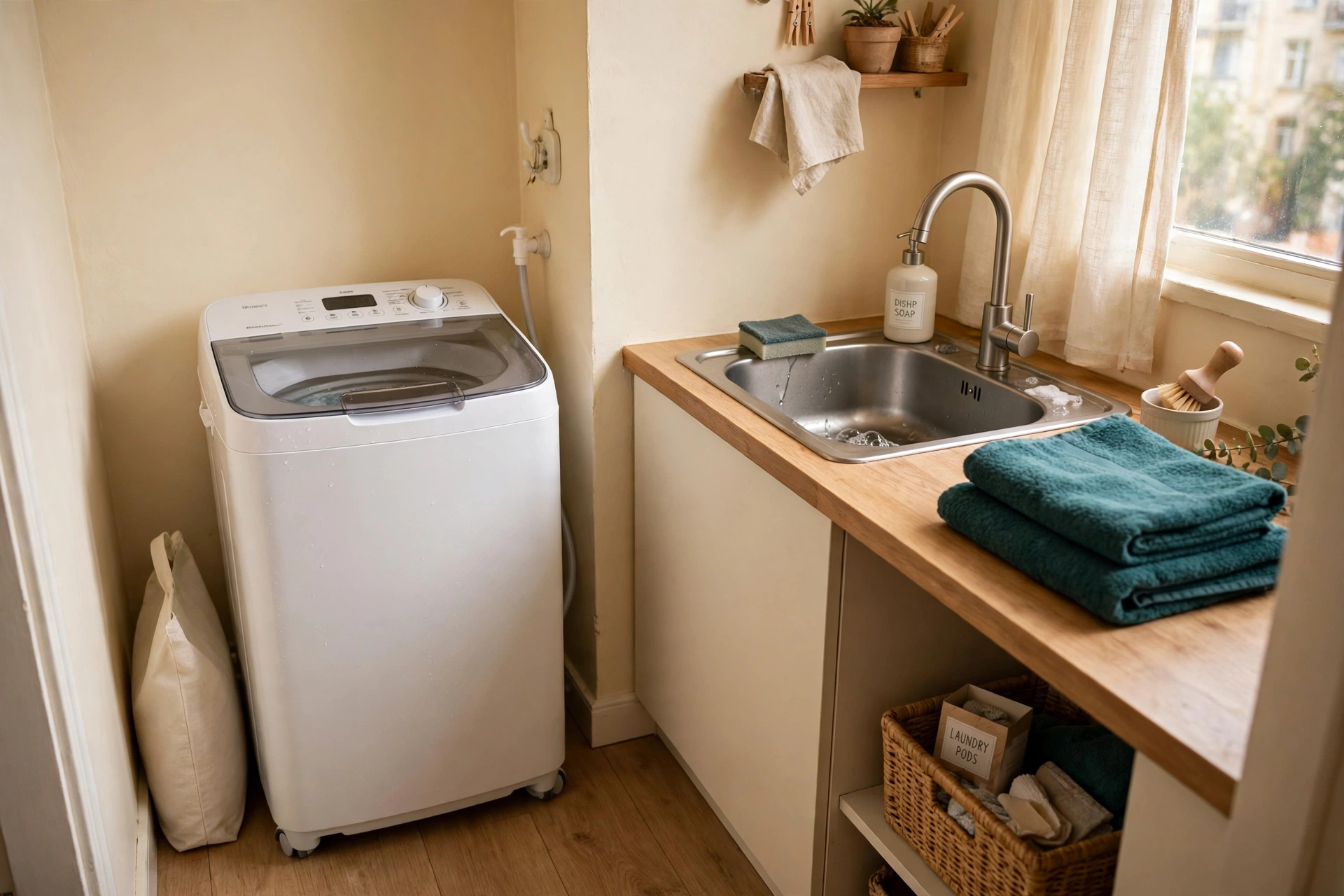
Best Mini Washing Machine for Small Apartments: 7 Picks That Actually Fit a Renter’s Life
The best mini washing machine for small apartments is the one that fits your faucet and your drain first, and your laundry pile second. That sounds backwards. It is not. A machine that cannot hook up to your tap or drain into your sink is a very expensive laundry basket.
Here is the math that decides it. A 0.9 cu ft machine holds about 6.6 lb per load, which is roughly 2 pairs of jeans plus a few tops. One person doing 3 loads a week saves about $3.70 per load against a laundromat wash, which adds up to about $575 a year. The top pick here costs $276.99, so it pays for itself in about 6 months. This guide shows you how to pick the right one, what it costs to run, and how to dry everything without a dryer.
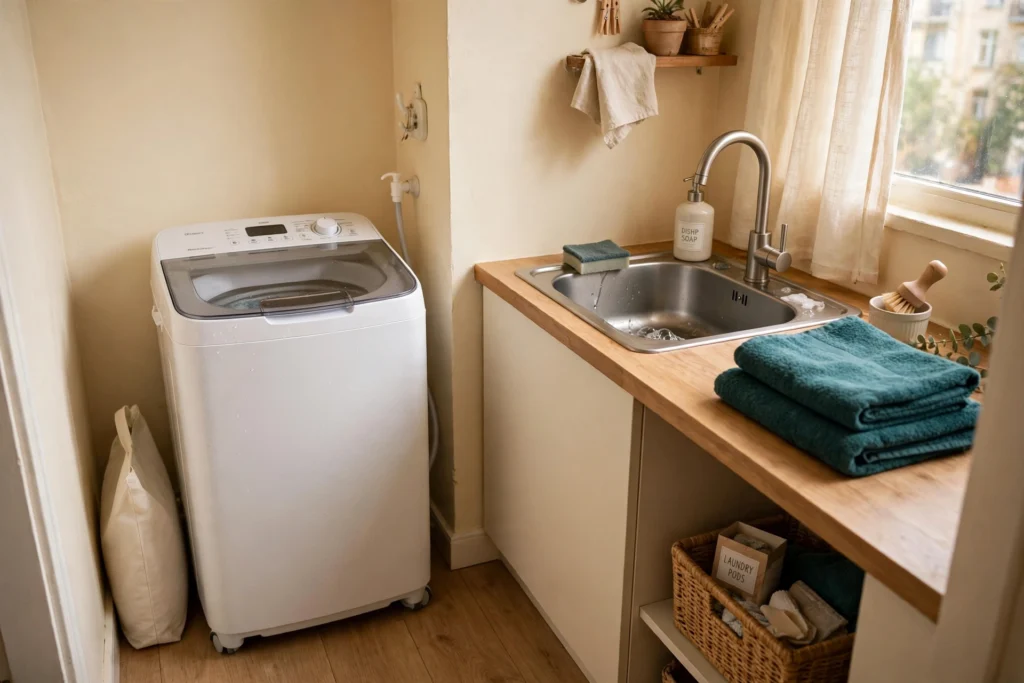
What Is the Best Mini Washing Machine for Small Apartments?
A mini washing machine is a small, portable washer that runs on a standard 120V outlet and hooks up to a regular faucet. It is not a smaller version of a full-size washer. It is a different kind of machine, built for a different job.
Most portable washers fall into three types. A fully automatic portable washer fills, washes, rinses, and spins on its own once you connect the faucet hose and the drain hose. A twin tub has two separate tubs, one for washing and one for spinning, and you move the clothes between them by hand. A manual washer has no motor at all. You crank it by hand.
None of them dry clothes. That is the fact most listings bury. The spin cycle pulls out a lot of water, but the clothes still come out damp. You still need a drying rack or a line. I cover the drying plan later in this guide, because a washer without a drying plan is only half a solution.
A mini washer also is not a replacement for a laundromat on bedding day. A 0.9 cu ft drum will not take a queen comforter. It will take your everyday clothes, your towels, and your sheets. Keep the laundromat for the big stuff and let the little machine handle the weekly routine.
How Much Laundry Can a Mini Washing Machine Wash?
Capacity is where most buyers guess wrong. They look at the photo, not the numbers. The photo lies. The numbers do not.
Manufacturers list capacity two ways, in cubic feet and in pounds. A 0.9 cu ft drum holds about 6.6 lb of laundry. That is the figure BLACK+DECKER publishes for the BPWM09W, and it gives us a simple rule. One cubic foot of portable washer drum holds roughly 7 lb of laundry. Use that rule to compare any two machines, even when one lists only cubic feet and the other lists only pounds.
| Machine size | Load weight | What fits | Loads per week, 1 person | Loads per week, 2 people |
|---|---|---|---|---|
| 0.9 cu ft | About 6.6 lb | 2 pairs of jeans plus tops and underwear | 2 to 3 | 4 to 5 |
| 1.34 cu ft | About 10 lb | 3 pairs of jeans plus a full set of tops | 2 | 3 to 4 |
| 1.7 cu ft | About 11 lb | 4 pairs of jeans plus towels | 1 to 2 | 2 to 3 |
| Twin tub, 11 lb wash tub | 11 lb wash, 6.6 lb spin | A big wash load, spun in two batches | 2 | 3 |
| Manual, 5 lb | 5 lb | A few tops and underwear | 3 to 4 | 6 to 8 |
One person makes about 10 to 15 lb of laundry a week. Two people make about 20 to 25 lb. A small family makes about 30 to 40 lb. Divide your weekly pile by the load weight and you get your real load count. If the answer is more than 5 loads a week, step up a size. Running a tiny machine 6 times a week gets old fast.
My take: buy the size for your real week, not your lightest week. A 0.9 cu ft machine is perfect for one person. Two people sharing a flat should start at 1.34 cu ft or bigger. The extra $70 or so buys back hours of your week.
Will a Portable Washer Work With Your Faucet and Drain?
Read this section before you spend a dollar. The faucet check and the drain check decide everything, and they take five minutes.
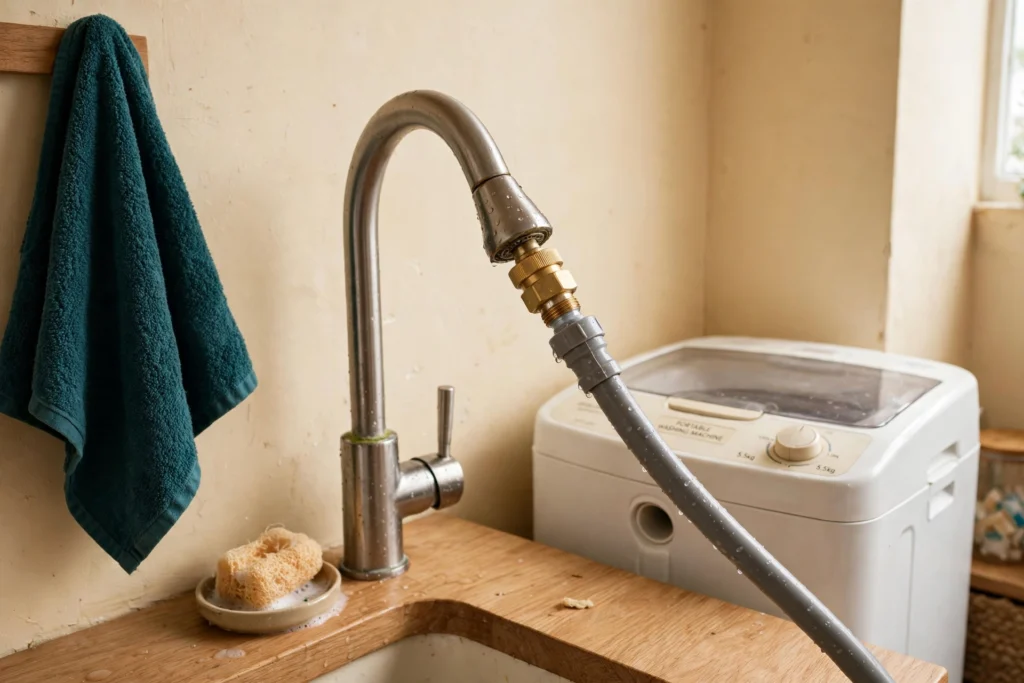
First, the faucet. A portable washer connects to your tap with a quick-connect adapter. The adapter fits two standard thread sizes: a 55/64 inch female thread or a 15/16 inch male thread. Most kitchen faucets have one of these under the aerator, the little mesh cap at the end of the spout. Unscrew the aerator and look at the threads. If they match, you are set.
Pull-out faucets usually do not work. The adapter cannot grip them, and the water pressure can push back into the faucet. If your kitchen has a pull-out faucet, try the bathroom faucet instead. It often has a standard thread.
Second, the water. Most small fully automatic portables use cold water only. That is fine for everyday clothes with a good cold-water detergent. The bigger BLACK+DECKER BPWM16W takes hot and cold water, which is one reason it costs more.
Third, the drain. This is the check most people skip, and it is the most underrated step in this whole guide. There are two drain types, and they are not interchangeable.
| Drain type | How it works | Works with | Watch out for |
|---|---|---|---|
| Drain pump | The machine pushes water out through the hose | A kitchen or bathroom sink, even if the sink lip is higher than the machine | The hose must stay clipped or tied in place so it cannot slip out mid-cycle |
| Gravity drain | Water flows downhill out of the hose on its own | A bathtub, a shower pan, or a floor drain that sits lower than the machine | It will not drain into a sink that sits higher than the machine |
A gravity-drain machine bought for a kitchen sink is the classic expensive mistake. The water has nowhere to go, the tub fills up, and the machine looks broken when it is not. If your only drain option is a sink, buy a machine with a drain pump.
Also check the standpipe rule from the BLACK+DECKER manual. If you drain into a standpipe, it should be about 35 inches high, and the drain hose goes 1 to 2 inches past the hose flange into the pipe. Tie the hose to the inlet hose or the standpipe so it cannot jump out during the drain cycle. A hose that slips out mid-cycle can put gallons of water on your floor in a minute. That is a deposit risk, not a small mess.
One last check: power. These machines run on a standard 120V grounded outlet. Plug it straight into the wall, not into an extension cord, and keep the cord away from standing water.
The 7 Best Mini Washing Machines for Small Apartments
This is the shortlist I would hand a friend who asked for the best mini washing machine for small apartments. Seven picks, each with a clear job. Prices are live-checked as of November 2026, and every spec below comes from the manufacturer or the product listing. Where a figure is not published, I say so.
1. BLACK+DECKER BPWM09W, Best Overall
Price: $276.99 on Amazon, as of November 2026.
Best for: One person or a couple in a small apartment who want a set-it-and-forget-it machine.
Main advantage: The most complete small automatic washer you can buy. It holds 0.9 cu ft, about 6.6 lb per load, and runs 5 wash cycles with a 1,350 RPM spin. That spin speed matters. It pulls more water out of the clothes, so they dry faster on the rack. It has casters, so you can roll it to the sink and back into a closet. The quick-connect sink adapter and drain hose come in the box.
Watch out for: Cold water only, so no hot washes. The spin cycle runs up to about 78 dB, which is loud enough to hear through a thin wall. Run it during the day, not at midnight. At 48.4 lb, roll it instead of carrying it.
Verdict: The safest first pick. It does the most jobs with the fewest compromises. Rating 4.4 out of 5. Renter-Friendliness 5/5. Deposit-Risk Low.
Specs: 0.9 cu ft, 6.6 lb capacity, 5 cycles, 1,350 RPM spin, 17.7 x 18.1 x 31.5 inches (45 x 46 x 80 cm), 48.4 lb, wash about 64 dB, spin up to 78 dB.
2. COMFEE 0.9 Cu Ft Portable Washer, Best Value
Price: $259.00 on Amazon, as of November 2026.
Best for: Renters who want the BPWM09W experience for a little less money.
Main advantage: Same 0.9 cu ft drum, same 5 wash cycles, same LED display and child lock, plus a delay start timer the BLACK+DECKER does not have. It has a drain pump, so it drains into a sink without a fuss. Load it at night, set it to run in the morning, and wake up to clean clothes.
Watch out for: The 840 RPM spin is slower than the BPWM09W, so clothes come out wetter and need about 30 minutes more drying time. The load capacity in pounds is not stated on the listing, so I worked it out from the drum size at about 6 to 7 lb per load. The manufacturer does not publish a dB figure, so treat the 62 dB number in roundups as a listing claim, not a spec.
Verdict: The best value full-automatic pick. You give up some spin speed and save about $18 against the top pick. Renter-Friendliness 5/5. Deposit-Risk Low.
Specs: 0.9 cu ft, about 6 to 7 lb per load (computed from drum size), 5 cycles, 840 RPM spin, 18.1 x 17.7 x 31.5 inches (46 x 45 x 80 cm), delay start, child lock, drain pump. Noise: not published by the manufacturer.
3. Panda PAN6320W, Best Large Capacity
Price: About $246.49 on Amazon, as of November 2026.
Best for: Two people or a small family who need bigger loads without a bigger footprint.
Main advantage: This is the capacity step-up. It holds 1.34 cu ft, about 10 lb per load, with 10 wash programs and 5 water levels. A couple can do their week in 3 to 4 loads instead of 5. It has a built-in drain pump and a stainless steel tub, and it runs on about 310 watts, so it sips power.
Watch out for: It is heavier and harder to move than the 0.9 cu ft machines, at about 37 to 44 lb depending on the listing, and it stands 34 inches tall (86 cm). Measure your closet before you buy. Some buyer reviews mention leaks, so check the hose connections every month and keep a drip tray under it if your landlord is strict. The spin speed is not published by the manufacturer.
Verdict: The best pick if your laundry pile is bigger than one person’s. It costs less than the top pick and washes more per load. Renter-Friendliness 4/5. Deposit-Risk Low to Medium.
Specs: 1.34 cu ft, 10 lb capacity, 10 wash programs, 5 water levels, 20 x 19 x 34 inches (51 x 48 x 86 cm), about 310 watts, drain pump, stainless steel tub. Spin RPM: not published. Noise: not published.
4. Giantex Twin Tub 17.6 Lb, Best Budget
Price: About $135 (price check November 2026; Target lists the same 17.6 lb twin tub at $139.99).
Best for: Budget buyers and dorm rooms where the price matters more than convenience.
Main advantage: You get an 11 lb wash tub and a 6.6 lb spin tub for about half the price of a full-automatic machine. The two tubs can run at the same time, so you can wash the next load while the first one spins. It has a built-in drain pump and separate timer knobs for wash and spin, and it weighs only about 24.5 to 28 lb, so it is easy to move.
Watch out for: Twin tubs are manual work. You fill the tub yourself, you move wet clothes from the wash tub to the spin tub, and you drain it yourself. That is fine once. It gets old on load number four. The spin cycle is noticeably louder than a full-automatic machine, and no dB figure is published. My opinion is blunt here: the twin tub is the most overrated option for busy renters. It looks like a bargain and it is, but it charges you in time instead of money.
Verdict: The cheapest way to wash real loads at home. Buy it if your budget is tight and your schedule is not. Renter-Friendliness 3/5. Deposit-Risk Medium.
Specs: 17.6 lb total (11 lb wash tub, 6.6 lb spin tub), 22.5 x 14 x 25.5 inches (57 x 36 x 65 cm), about 24.5 to 28 lb, 240 watts wash power, drain pump. Spin RPM: not published. Noise: not published.
5. BLACK+DECKER BPWM16W, Best for Two People
Price: $348.99 on Amazon, as of November 2026.
Best for: Two people who want the biggest portable washer that still fits a small apartment.
Main advantage: This is the grown-up version of the top pick. It holds 1.7 cu ft, about 11 lb per load, with 6 cycles including a bulky cycle for towels and bedding. It takes hot and cold water, which the smaller BLACK+DECKER does not, and it has an LED display and a lint filter you clean once a month. Two people can do their week in 2 to 3 loads.
Watch out for: It is big for a portable. It measures 21.3 x 21.7 x 36.6 inches (54 x 55 x 93 cm) and weighs 70.5 lb. That is not a machine you roll into a closet every day. It needs a permanent corner. Some listings still call it 1.6 cu ft, but the current Amazon and Target listings say 1.7 cu ft and 11 lb, so I used the current figure. The spin speed and noise figures are not published by the manufacturer.
Verdict: The best pick for a couple who have a corner to spare. It costs the most, but it also replaces the most laundromat trips. Renter-Friendliness 4/5. Deposit-Risk Low to Medium.
Specs: 1.7 cu ft, 11 lb capacity, 6 cycles, 21.3 x 21.7 x 36.6 inches (54 x 55 x 93 cm), 70.5 lb, hot and cold water, LED display. Spin RPM: not published. Noise: not published.
6. SUPER DEAL Compact Mini Twin Tub, Best Ultra-Budget
Price: $115.99 on Amazon, as of November 2026.
Best for: Students and first apartments where every dollar counts.
Main advantage: The cheapest electric washer on this list by a clear margin, and it still washes and spins. It holds about 9.9 lb in the wash tub and spins at 1,300 RPM, which is a strong spin for this price. At about 22 lb, it is the lightest electric machine here, so you can carry it to a closet or a car without help.
Watch out for: It is a twin tub, so the same manual-work warning applies: you fill it, you move the clothes, you drain it. It uses a gravity drain, not a pump, so the drain hose outlet must sit lower than the machine. That means a bathtub or a floor drain, not a kitchen sink. The exact XPB30-1288SA listing price was not separately verifiable, so the $115.99 figure is the current Amazon price for the SUPER DEAL compact mini twin tub. Its dimensions are not published in the sources I checked.
Verdict: The lowest honest price for real washing. Buy it if the budget is the whole decision. Renter-Friendliness 3/5. Deposit-Risk Medium.
Specs: About 9.9 lb wash capacity, 1,300 RPM spin, about 22 lb, gravity drain. Dimensions: not published. Noise: not published.
7. Laundry Alternative WonderWash, Best Manual
Price: $69.95 on Amazon, as of November 2026.
Best for: Dorms, travel, and renters who want a backup washer with zero plumbing.
Main advantage: It needs no electricity and no faucet. You add water and detergent, close the lid, and turn the hand crank for 2 to 3 minutes. It holds about 5 lb per load and measures 12 x 12 x 16 inches (30 x 30 x 41 cm), so it sits on a countertop and stores in a closet. It uses far less water than an electric machine, and it makes no motor noise at all.
Watch out for: Five pounds is a small load, so a normal week takes 3 to 4 loads for one person and far more for two. Your arm is the motor. That is fine for a few items and tiring for a full week. It also has no spin cycle, so clothes come out wetter than from any electric machine and take longer to dry.
Verdict: The best no-power, no-plumbing option. It is a backup or a dorm solution, not a replacement for a real washer. Renter-Friendliness 5/5. Deposit-Risk Very Low.
Specs: About 5 lb capacity, 12 x 12 x 16 inches (30 x 30 x 41 cm), 5.5 lb, manual hand crank, no electricity, no spin cycle. Noise: none, it has no motor.
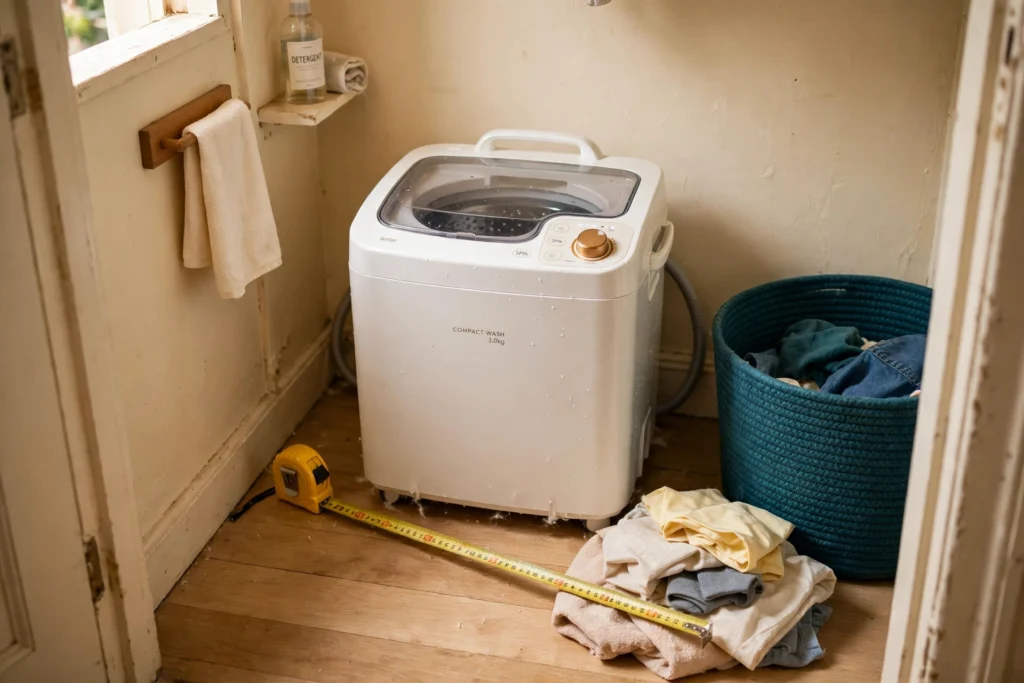
Where will it live when it is not running? Measure your storage spot before you buy, not after the box arrives.
| Pick | Floor space while running | Height | Storage fit |
|---|---|---|---|
| BLACK+DECKER BPWM09W | 17.7 x 18.1 in (2.2 sq ft) | 31.5 in (80 cm) | Rolls into a closet on its casters |
| COMFEE 0.9 cu ft | 18.1 x 17.7 in (2.2 sq ft) | 31.5 in (80 cm) | Rolls into a closet, same as the BPWM09W |
| Panda PAN6320W | 20 x 19 in (2.6 sq ft) | 34 in (86 cm) | Fits a laundry closet, too tall for most under-counter spots |
| Giantex Twin Tub | 22.5 x 14 in (2.2 sq ft) | 25.5 in (65 cm) | Short enough to slide under a counter or a desk |
| BLACK+DECKER BPWM16W | 21.3 x 21.7 in (3.2 sq ft) | 36.6 in (93 cm) | Needs a permanent corner, not a closet |
| SUPER DEAL Twin Tub | Not published | Not published | Light enough to carry to a closet, about 22 lb |
| WonderWash | 12 x 12 in (1 sq ft) | 16 in (41 cm) | Countertop or a closet shelf |
How Loud Is a Portable Washing Machine in a Thin-Walled Apartment?
Noise is the complaint that shows up most in buyer reviews, and it is the spec manufacturers hide most. Only one pick on this list has a published dB figure for both wash and spin. Here is the honest table.
| Pick | Wash noise | Spin noise | What it means |
|---|---|---|---|
| BLACK+DECKER BPWM09W | About 64 dB | Up to 78 dB | Normal talk is about 60 dB. The spin is as loud as a vacuum cleaner. |
| COMFEE 0.9 cu ft | About 62 dB (listing claim) | Not published | Likely the quietest electric pick, but the figure is not a manufacturer spec. |
| Panda PAN6320W | Not published | Not published | Buyer reviews call it quiet for its size, but there is no number to check. |
| Giantex Twin Tub | Not published | Not published | The spin tub is noticeably louder than full-automatic machines. |
| BLACK+DECKER BPWM16W | Not published | Not published | No figure published, so assume it is as loud as the smaller model. |
| SUPER DEAL Twin Tub | Not published | Not published | No figure published. |
| WonderWash | None | None | No motor, no noise. |
Three things keep the noise down. First, load the drum evenly. An unbalanced load thumps and walks across the floor. Second, run the machine on a hard floor, not on a rug that lets it rock. Third, run it during the day. A spin cycle at 78 dB at 11 pm is how you meet your neighbors for the wrong reason.
Vibration matters as much as noise. A machine that walks across the floor can pull its drain hose out of the sink, and that is a leak. If your machine vibrates, put a rubber anti-vibration mat under it. A basic mat costs about $10 to $15, and it is the cheapest deposit insurance you can buy.
What Does a Mini Washing Machine Cost to Run?
If you run the best mini washing machine for small apartments three times a week, the math below is your payback. The laundromat side uses typical 2026 US prices for a small-machine wash: $3.50 to $4.50 per load, and a dryer adds $1.50 to $4.00. A full laundromat visit runs $5.00 to $8.50 per load. The at-home side is a computed estimate, and I am showing the working so you can check it.
| Cost per load | Amount |
|---|---|
| Water, about 8 gallons | About $0.04 |
| Electricity, about 0.3 kWh | About $0.05 |
| Detergent | About $0.20 |
| Total at home | About $0.30 |
| Laundromat wash only | $3.50 to $4.50, midpoint $4.00 |
| You save per load | About $3.70 |
Water and electricity prices vary by city, so your exact figure will differ by a few cents. The shape of the math does not change. The machine is cheap to run. The laundromat is not.
Now the payback. This assumes 3 loads a week for one person, saving $3.70 per load against a laundromat wash.
| Pick | Price | Loads to break even | Weeks at 3 loads a week | Payback |
|---|---|---|---|---|
| WonderWash | $69.95 | 19 | About 6 | About 1.5 months |
| SUPER DEAL Twin Tub | $115.99 | 31 | About 11 | About 2.5 months |
| Giantex Twin Tub | $135.00 | 36 | About 12 | About 3 months |
| Panda PAN6320W | $246.49 | 67 | About 22 | About 5 months |
| COMFEE 0.9 cu ft | $259.00 | 70 | About 23 | About 5.5 months |
| BLACK+DECKER BPWM09W | $276.99 | 75 | About 25 | About 6 months |
| BLACK+DECKER BPWM16W | $348.99 | 94 | About 31 | About 7 months |
Two people doing 5 loads a week break even faster. The BPWM16W pays for itself in about 19 weeks at 5 loads a week, or about 4.5 months. The WonderWash math looks best on paper, but remember its loads are only 5 lb, so a real week takes more loads and more of your time. Payback is not the whole story. Your time is part of the price.
One more cost to count: the extras. Budget about $15 to $25 for a faucet adapter if your tap needs a different thread, about $10 to $15 for an anti-vibration mat, and about $20 to $30 for a decent drying rack if you do not own one. That is roughly $45 to $70 on top of the machine. It is still less than two months of laundromat visits.
How Do You Dry Clothes Without a Dryer?
No portable washer dries clothes. The spin cycle only buys you time. The drying plan is the other half of this purchase, and it needs as much thought as the washer.
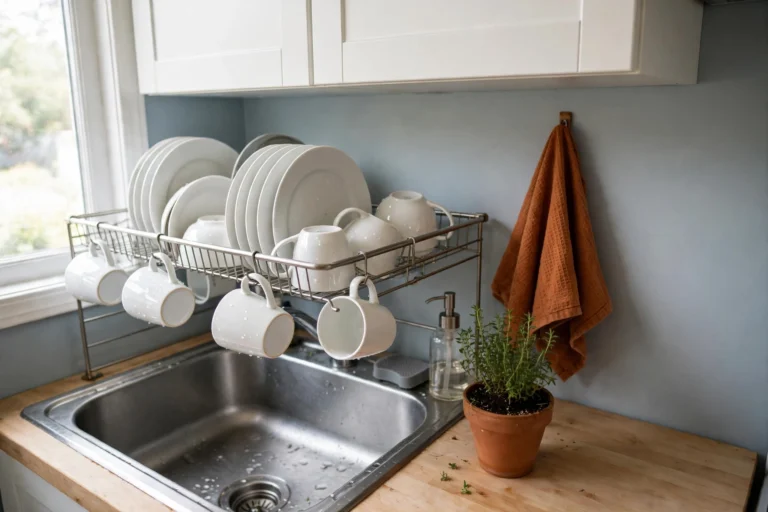
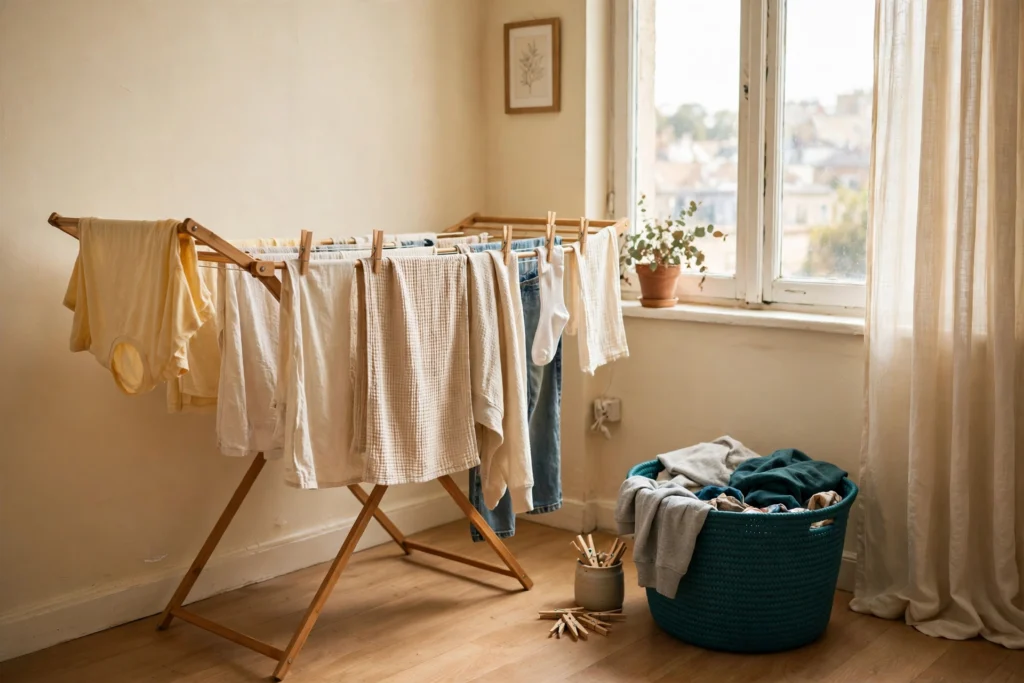
A folding drying rack is the simplest answer. A good one holds a full load, folds flat against a wall, and costs about $20 to $30. Put it near a window or a fan, and most clothes dry in 6 to 12 hours. Hang shirts on hangers from a shower rod or a door frame for faster drying and fewer wrinkles.
Drying indoors adds moisture to the air. In a small apartment that can show up fast as condensation on rental windows, especially in winter. Crack a window or run a fan while the rack is up, and do not dry loads in a closed bedroom overnight. If you want the full room setup, my small laundry room organization ideas show how to fit a washer, a rack, and supplies into a laundry closet without blocking the door.
Two rules keep the drying simple. First, spin twice. Run the spin cycle a second time before you hang anything. It takes 5 minutes and can cut drying time by an hour. Second, do not overload the rack. Clothes that touch each other stay damp. Space them out and the air does the work.
What Should Renters Check in the Lease Before Buying One?
This is the renter caveat, and it matters more than the brand you pick. A portable washer is not a permanent fixture, but some leases still restrict it. Check before you buy, not after the box arrives.
Read your lease for three things. First, any clause about washing machines, portable appliances, or water-using appliances. Second, any rule about connecting anything to the faucets. Third, any rule about water damage liability. If the lease is silent on all three, you are probably fine, but a quick message to your landlord costs nothing and creates a paper trail.
If you ask permission, keep it short. Say it is a portable machine, it connects to the faucet with an adapter, it needs no installation, and it drains into the sink or the bathtub. Offer to use a drip tray and to show the setup. Most landlords say yes to that. A landlord who says no usually worries about leaks, so the drip tray and the tied drain hose are your best answers.
Reversing it is simple. Unplug the machine, disconnect the faucet adapter, put the aerator back on the tap, and roll the washer into a closet. Nothing is drilled, nothing is plumbed, and nothing stays behind. Take a photo of the faucet before you connect anything, so you can prove it went back exactly as it was. That photo is worth more than any argument at move-out.
Deposit risk comes from two things only: water on the floor and vibration damage. Both are preventable. Tie the drain hose so it cannot slip out. Check the faucet adapter for drips in the first week. Put a mat under the machine. Do those three things and the risk stays low.
Mistakes to Avoid
Buying before checking the faucet. Unscrew the aerator and check the thread size first. A machine that cannot connect to your tap is a return, not a washer.
Buying a gravity-drain machine for a sink. If your only drain is a sink that sits higher than the machine, you need a drain pump. Gravity will not help you.
Overloading the drum. A stuffed drum does not clean well and it shakes more. Fill it to about three quarters full. If the lid will not close easily, take something out.
Using too much detergent. Portable washers use less water, so they need less detergent. A full cap made for a big machine leaves soap in the clothes. Use about half, and use a high-efficiency detergent if the manual asks for one.
Running the spin cycle at night. The spin is the loudest part. Run it during the day and keep the peace with your neighbors.
Skipping the first-week leak check. Check the faucet adapter and the drain hose after the first three loads. A slow drip you catch in week one is a wipe with a towel. A slow drip you catch in month three is a deposit dispute.
Drying loads in a closed room. Wet clothes in a sealed bedroom mean damp air and damp walls. Open a window or run a fan while the rack is up.
What to Skip
A second machine for delicates. One portable washer with a gentle cycle handles delicates fine. A separate mini washer for socks and underwear is clutter, not a system.
A portable dryer to match. Portable vented dryers exist, but they need a window vent, they use a lot of power, and they dry slowly. A $25 drying rack does the same job with no vent and no power bill. Skip the dryer unless your climate never dries anything indoors.
The biggest drum you can afford. Bigger is not better if you live alone. A 1.7 cu ft machine for one person means half-empty loads and a machine you cannot store. Match the drum to your week, not to your wish list.
Washer balls and scent beads as a fix. If your clothes smell after washing, the cause is usually too much detergent or a drum that needs cleaning. Run an empty hot cycle with vinegar once a month if your machine allows it, and use less soap. Gadgets do not fix a soap problem.
A machine with no drain pump and no bathtub. If you have no bathtub, no floor drain, and only a sink, a gravity-drain twin tub is the wrong buy. Pay the extra for a pump model or pick a different machine.
The Short Version
The best mini washing machine for small apartments for most renters is the BLACK+DECKER BPWM09W at $276.99. It is the most complete automatic machine in the small size, it spins at 1,350 RPM, and it pays for itself in about 6 months against laundromat prices.
If money is tight, the COMFEE at $259.00 does nearly the same job for less, and the Giantex twin tub at about $135 is the cheapest real washer here, as long as you accept the manual work. Two people should step up to the Panda PAN6320W at about $246.49 or the BLACK+DECKER BPWM16W at $348.99, because bigger loads mean fewer loads.
Whatever you buy, check the faucet first and the drain second. A machine that cannot hook up to your tap or drain into your sink is not a bargain at any price. And if you want the rest of the system, my whole-home organization system shows how laundry fits into a home that stays organized room by room, and the small fridge organization guide uses the same compact-appliance thinking for the kitchen. Buy the machine that fits your faucet, your drain, and your week, in that order.
Sources: BLACK+DECKER BPWM09W instruction manual (standpipe and drain hose guidance): https://www.manualshelf.com/manual/black-decker/bpwm09w/instructions-assembly-english-spanish-french/page-27.html ; 2026 US laundromat prices (wash $2.00 to $5.00, dry $1.50 to $4.00, total $4.00 to $8.00 per load; small front-load washers $3.00 to $4.50): https://dryandwashrent.com/blog/laundromat-costs-st-george.html and https://laundromatbyme.com/guides/how-much-does-a-laundromat-cost/ ; product prices and specs from Amazon listings and price trackers as listed above, checked November 15, 2026.
Can you use a portable washing machine in an apartment?
Yes, in most cases. A portable washer connects to a regular faucet with an adapter and drains into a sink or a bathtub, so it needs no installation and no plumbing changes. Check your lease first for any clause about washing machines or water-using appliances, and tell your landlord if the lease asks for permission. Use a drain pump model if your only drain is a sink, tie the drain hose so it cannot slip out, and put a mat under the machine to stop vibration. When you move out, disconnect the adapter, put the aerator back on the tap, and roll the machine away. Nothing stays behind.
Do portable washing machines need a special faucet hookup?
No, they use your existing faucet. The machine comes with a quick-connect adapter that fits a standard 55/64 inch female thread or a 15/16 inch male thread, which you find under the aerator at the end of most kitchen and bathroom taps. Unscrew the aerator, check the threads, and screw the adapter on. Pull-out faucets usually do not work with the adapter, so try the bathroom faucet if the kitchen tap is a pull-out. No plumber is needed, and no pipe is changed.
How much laundry can a mini washing machine wash?
A 0.9 cu ft machine washes about 6.6 lb per load, which is roughly 2 pairs of jeans plus a few tops. A 1.34 cu ft machine washes about 10 lb, and a 1.7 cu ft machine washes about 11 lb. One person makes about 10 to 15 lb of laundry a week, so a 0.9 cu ft machine means 2 to 3 loads a week. Two people make about 20 to 25 lb a week, so they should start at 1.34 cu ft or bigger. Twin tubs list separate wash and spin capacities, so check the wash tub number, not the combined total.
Do mini washing machines dry clothes?
No. No portable washer dries clothes. The spin cycle pulls out a lot of water, and a 1,350 RPM spin leaves clothes noticeably drier than an 840 RPM spin, but the clothes still come out damp. You need a drying rack, a clothesline, or hangers on a shower rod. Run the spin cycle twice to cut drying time, space clothes out on the rack so air can move between them, and open a window or run a fan while they dry. A folding rack costs about $20 to $30 and holds a full load.