Small Dining Room Organization Ideas: 10 Systems That Keep the Table Clear
The best small dining room organization ideas start with one rule: every item has one named home, and the furniture fits the wall first. In a real 10 by 12 ft room (305 by 366 cm), a 42 in (107 cm) round table plus 36 in (91 cm) of chair pull-out plus a 14 to 16 in (36 to 41 cm) slim buffet uses 92 to 94 in of the 120 in wall and leaves 26 to 28 in (66 to 71 cm) of spare walkway. That computed budget, a capacity table built from real product specs, and a cost table with prices checked in November 2026 are the spine of this post. Ten systems follow, and each one earns its place or it goes.
Here is my honest take up front. The most overrated move is buying a full-depth sideboard for a small room. It eats the walkway it was meant to save. The most underrated move is a storage bench plus rolled placemats in a basket. It costs little, damages nothing, and holds the whole linen set. Organization is not more furniture. It is fewer homes for things, each one named.
How Do Small Dining Room Organization Ideas Fit a 10×12 Ft Room?
They fit by math, not by luck. A 42 in round table needs 36 in behind each seated diner, and a slim buffet adds only 14 to 16 in of depth. Add the three numbers along one wall and you know whether the room still walks well. The table below runs that sum for a 10 by 12 ft room.
| Piece along the wall | Size | Running total |
|---|---|---|
| Round table | 42 in (107 cm) | 42 in |
| Chair pull-out behind diners | 36 in (91 cm) | 78 in |
| Slim buffet | 14 to 16 in (36 to 41 cm) | 92 to 94 in |
| Spare walkway left over | 26 to 28 in (66 to 71 cm) | 120 in wall |
| Same sum with a full-depth 18 in (46 cm) sideboard | 18 in (46 cm) | 96 in, spare 24 in (61 cm) |
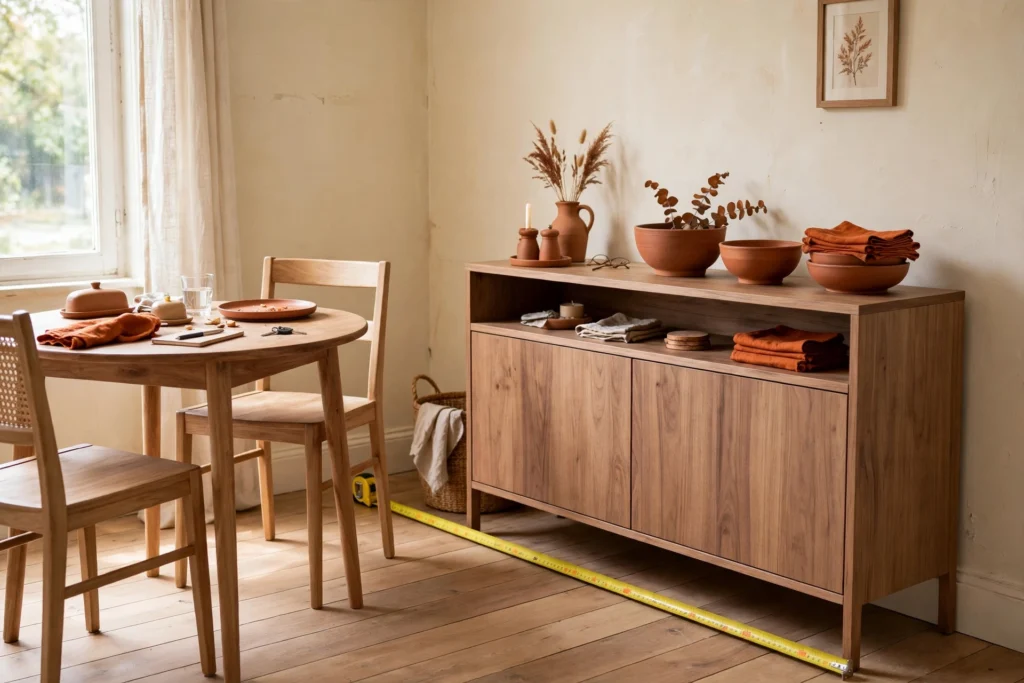
The 36 in pull-out comes from NKBA Guideline 8, which sets 36 in behind a seated diner where people walk past, and the same clearance math sits inside our small dining room layout guide, which covers door swing and table shape in full. The NKBA numbers are summarised in the NKBA Kitchen Planning Guidelines summary from CRD Design Build. A full-depth sideboard only costs 2 to 4 in more than a slim one, but in a small room those inches are the whole walkway. That is why slim wins.
What each system actually holds
| System | Real spec | What it holds |
|---|---|---|
| Homfa slim buffet | 55.1 by 15.1 by 31.9 in (140 by 38 by 81 cm), 3 drawers, 4 doors | Everyday linens in the drawers, serving dishes and board games behind the doors |
| BAYKA floating shelf | Rated 22 lb (10 kg) per shelf, set of 3 at 15.7 in (40 cm) | Plates, bowls, and glasses for daily use, kept off the table |
| Basket for placemats | Rolled 12 by 18 in (30 by 46 cm) placemats, upright | A full everyday set, each one pulling out without unfolding the rest |
| Linen drawer | 29.8 by 14.4 by 6.1 in (76 by 37 by 15 cm) drawer size | Folded tablecloths plus a flatware tray, laid flat |
| IKEA NORDEN gateleg table | Folds to 10 1/4 in (26 cm) deep, 6 drawers, seats 2 to 4 | Table leaves store in the table itself, so nothing needs a separate home |
What Does It Cost to Organize a Small Dining Room?
It costs less than most people expect, because the cheapest route skips the big furniture entirely. These small dining room organization ideas come in three tiers, and every price below was checked in November 2026. Pick the tier that matches the mess you actually have, not the room you wish you had.
| Route | What you get | Checked cost, as of November 2026 |
|---|---|---|
| Budget | BAYKA floating shelves $21.99, VASAGLE 17.5 in (44 cm) bar cart $39.99, Brightroom flatware organizer $12.00 | $73.98 |
| Mid | Homfa slim buffet $162.99, BAYKA shelves $21.99, VASAGLE 33.3 in (85 cm) bar cart $59.99, Brightroom organizer $12.00 | $256.97 |
| Full | Homfa buffet $162.99, Powell lift-top bench $265.99, BAYKA shelves $21.99, VASAGLE 33.3 in cart $59.99, Brightroom organizer $12.00 | $522.96 |
These are checked market prices, not personal receipts. Nothing here was bought or tested by us. The first setup takes about 2 to 3 hours, including the clear-out and the measuring. After that, the daily reset takes 5 minutes. A standalone table-leaf storage product was not found and priced, so that line stays TBC. The NORDEN table at $359.99 stores its leaves in-table, which solves the problem for that table.
The 10 Systems That Keep the Table Clear
The ten systems below turn small dining room organization ideas into named homes for every item in the room. Each idea carries a verdict, so you can skip the ones that do not match your room. Freestanding pieces need no wall fixings at all. Anything screwed to the wall gets a deposit-risk rating in the renter section below.
1. Slim sideboard, not a full-depth one
A slim buffet sits 14 to 16 in deep, so it holds serving dishes without stealing the walkway. The Homfa 55.1 in model costs $162.99, down from $279.99, and its 3 drawers take linens while the 4 doors take serving pieces. Budget alternates run $107.99 to $169.99 for similar narrow models.
Best for: rooms with one free wall. Main advantage: real closed storage that still leaves 26 to 28 in of walkway. Watch out for: anything deeper than 16 in. It pushes chairs into the table. Verdict: buy this first if you have the wall. It is the one big piece that earns its footprint.
2. Storage bench
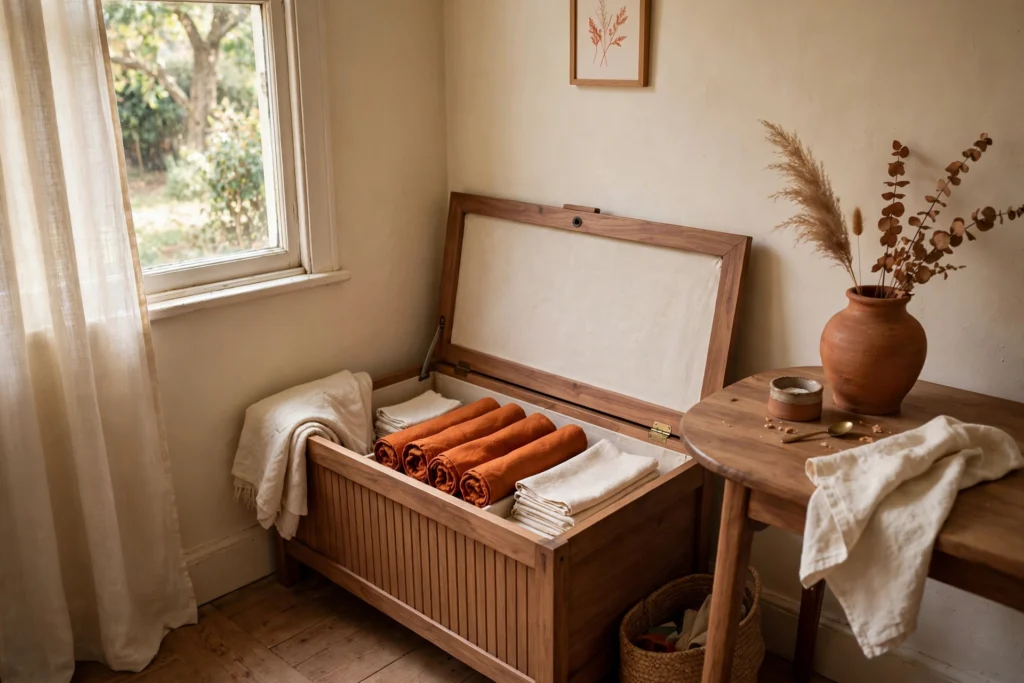
A lift-top bench hides linens, tablecloths, and board games under the seat, and it seats two people against the wall. The Powell 48 in (122 cm) bench costs $265.99, the Threshold bench $160.00, and the HomePop Malmo from $104.99. Pick the bench that matches your table height, not the prettiest one.
Best for: rooms where chairs crowd the table. Main advantage: seating plus storage in one footprint, with zero wall damage. Watch out for: a bench too deep to slide under the table. Measure first. Verdict: the most underrated piece in this post. Buy it before a second sideboard.
3. Rolling bar cart
A three-tier cart works as a mobile serving station, then rolls against the wall when dinner ends. The VASAGLE carts run $39.99 for the 17.5 in model, $49.99 for 25.4 in (65 cm), and $59.99 for 33.3 in. Renters already meet the bar cart in our renter friendly dining room ideas, where it works as a no-drill serving station that moves with you.
Best for: renters and open-plan rooms. Main advantage: it moves, so it never blocks a walkway for long. Watch out for: overloading the top tier. Keep heavy bottles low. Verdict: the cheapest real system here. Deposit-Risk 1 out of 5, since nothing is fixed to the wall.
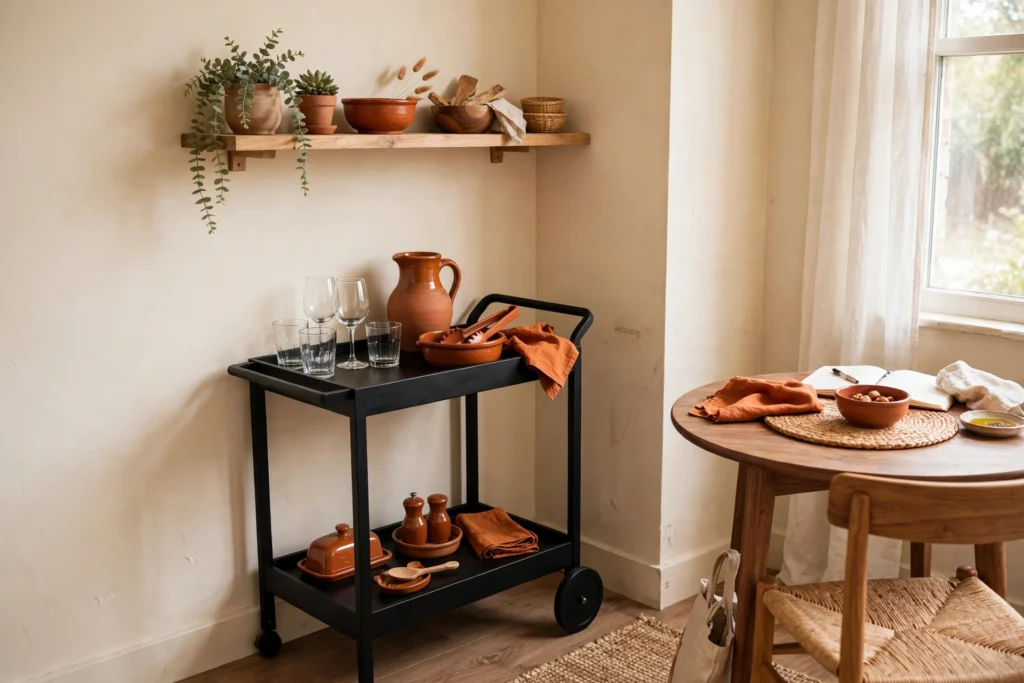
4. Floating shelves as a vertical buffet
Three short shelves above the sideboard hold daily plates and glasses where hands can reach them. The BAYKA set of 3 costs $21.99 and each shelf is rated 22 lb (10 kg). Amazon Basics sells a similar 3-pack for $22.03. Keep the everyday dishes here and the rarely used ones in the buffet.
Best for: rooms with no floor space left. Main advantage: it uses dead wall space above furniture you already own. Watch out for: open shelves collect dust and clutter fast. One row of plates, not three. Verdict: buy for daily dishes only. Deposit-Risk 2 with Command strips, 4 to 5 with screws.
5. Wall rail with hooks
A 24 to 36 in (61 to 91 cm) rail with hooks holds aprons, oven mitts, and the tablecloth clips that otherwise land on the table. Hang it at shoulder height beside the serving spot, not above the table where things drip. No price is listed here because no rail was price-checked this round.
Best for: cooks who serve from the dining room. Main advantage: small tools stay visible and off the table. Watch out for: rails fill up fast. Five hooks is a limit, not a starting point. Verdict: useful, but only after the shelves are up. Deposit-Risk 4 to 5 if screwed in.
6. Rolled placemats in a basket
Roll each placemat and stand it upright in a basket, and the whole everyday set fits in one small container. A basket costs about $6.42 from a 12-pack of Sterilite Ultra baskets at $76.99, and it slides under the sideboard or bench. The Yamazaki placemat stand at $50.00 and its magnetic organizer at $78.00 do the same job in steel.
Best for: anyone who eats at the table daily. Main advantage: each placemat pulls out alone, so setting the table takes seconds. Watch out for: the $78 organizer. It is a splurge, not a need. Verdict: the second most underrated move in this post. Start with the basket.
7. Linen drawer plan
Give tablecloths a shallow drawer or one shelf, folded loose, never crammed in a tight stack. A drawer 29.8 by 14.4 by 6.1 in holds folded cloths plus a flatware tray, and the Brightroom 5-compartment organizer at $12.00 keeps cutlery sorted inside it. Keep the everyday set within reach and the seasonal set in a rotation box.
Best for: hosts who change cloths with the season. Main advantage: cloths stay smooth and findable instead of wrinkled at the back of a cupboard. Watch out for: stuffing the drawer. If it does not close easily, something leaves. Verdict: a habit more than a purchase. The $12 organizer is the only thing to buy.
8. Table-leaf storage
Drop-leaf and gateleg tables fold down, but the leaves still need a home when the table is small. The IKEA NORDEN at $359.99 stores its leaves in the table itself, with 6 drawers and room for 2 to 4 diners. If your table has loose leaves, wrap each one in a cloth and stand it upright behind the sideboard, never flat under heavy boxes.
Best for: gateleg and drop-leaf owners. Main advantage: the leaves stay flat, dry, and scratch-free. Watch out for: leaning leaves against a damp wall. Verdict: if your table does not store its own leaves, the upright-behind-the-buffet spot is the fix. A standalone leaf-storage product price is TBC.
9. Drop zone by the door
Mail, keys, homework, and chargers land on the dining table because they have nowhere else to go. Put one basket by the door for mail and keys, and one homework caddy that clears in a single move. The table stays a table, and the clutter gets a home ten steps away.
Best for: families and anyone who works at the table. Main advantage: it removes the cause of the mess instead of tidying the result. Watch out for: a drop zone with no emptying rule. Clear it every Sunday or it becomes a second table. Verdict: the highest-impact free move in this post. Deposit-Risk 1 out of 5.
10. Seasonal rotation box
Candles, board games, holiday linens, and vases you use four times a year do not belong in daily storage. Put them in one labelled box on top of the buffet or in a closet, and swap the contents with the season. The dining room keeps only what this month uses.
Best for: small rooms that also host holidays. Main advantage: daily storage stays light because seasonal items leave the room. Watch out for: a box with no label. Unlabelled boxes never get opened again. Verdict: do this the same weekend you set up. It frees a whole shelf.
How Do You Organize a Small Dining Room in 7 Steps?
Follow these steps in order, and the room is done in one afternoon. The sequence matters, because buying storage before clearing the table just gives clutter a nicer box. Set aside 2 to 3 hours for the first run, then 5 minutes a day after that.
- Clear the table completely. Take everything off, including the centerpiece. Wipe the surface. This takes about 15 minutes, and it shows you what actually lives here.
- Sort into three piles. Stays, goes elsewhere, leaves the house. Be strict. If it has not been used at the table in a month, it goes elsewhere or leaves.
- Measure the wall and run the budget. Measure your wall, table, and pull-out space, then check the total against the 120 in example above. Do not buy a buffet until the numbers fit.
- Mark three zones. Table, serving spot, storage spot. Every item belongs to one zone, and zones do not mix. The serving spot sits beside the table, not on it.
- Give every item one named home. Placemats in the basket, cloths in the drawer, chargers in the caddy, serving dishes in the buffet. If an item has two homes, it has none.
- Mount storage renter-safe, no-drill first. Baskets and carts need nothing. Command strips come next. Screws are last, and only with the lease checked first.
- Set the 5-minute reset and run it tonight. Clear, wipe, return, set one place. The system only works if the reset happens daily, so start the habit the same day you finish.
What Is the 5-Minute Daily Reset?
The reset is a short evening habit that keeps the table clear between deep cleans. It takes 5 minutes, and it works because it has a fixed order: clear, wipe, return, set one place, check the floor. Run it every evening and the table never needs a big tidy again.
Minute one, clear everything off the table into its named home. Minute two, wipe the surface. Minute three, return the homework caddy and chargers to the drop zone. Minute four, set one place for tomorrow so the table looks ready. Minute five, check the floor and push chairs in. Done. If the table collects clutter again, the reset is not the problem. Something is missing a home, so find it one.
Renter-Safe Mounting: What Can You Hang Without Losing the Deposit?
Renters can organize a dining room without risking the deposit, as long as the mounting method matches the wall. The ladder below runs from safest to riskiest, and the deposit-risk rating tells you the stakes before you drill. Freestanding storage is always the safest choice in a rental.
| Method | Deposit-Risk (1 to 5) | What it holds |
|---|---|---|
| Baskets, carts, bench, sideboard | 1 | Everything freestanding, no fixings at all |
| Command strips | 2 | Light shelves and small rails, removed cleanly |
| Small nails or picture hooks | 3 | Light frames and small shelves, holes to fill |
| Screwed rails and shelves | 4 | Heavier shelves and rails, needs filling and paint touch-up |
| Drilled heavy shelving | 5 | Full shelf loads, most likely to cost deposit money |
Check your lease first. Ask for permission in writing before you drill anything, and keep the note. Photograph the walls before you mount anything, so you can prove the condition later. Keep the original hardware and fill every hole when you leave. Reversibility is the whole rule. If a fix cannot be undone in an afternoon, do not do it in a rental. The table itself is the easy part. If you want a table that fits a small rented room without a build, the DIY dining table guide shows simple builds sized for small spaces.
Mistakes to Avoid
These are the errors that undo good systems, and every one of them is avoidable. The common thread is buying or mounting before measuring, and storing things where they do not belong. Fix the order first, and the mistakes mostly disappear.
Buy furniture after measuring, not before. A chair 2 in too wide breaks the whole layout, and a sideboard 2 in too deep eats the walkway. Do not store everything on the table just because the table is big. The table has one job, and it is eating. Do not use one big basket for mixed items. Mixed baskets become junk drawers within a week, so give each category its own container. Do not wall-mount anything before checking the lease. A shelf is cheap, but a lost deposit is not. And do not buy the splurge organizer first. Fix the system with baskets and a cart, then spend on the nice version only if the cheap one proves the habit.
What to Skip
Skip anything that costs floor or wall space without earning it back. The full-depth sideboard is the classic case: it holds barely more than a slim one and takes the walkway with it. If a piece does not solve a named problem, leave it in the shop.
Skip the full-depth sideboard. It is the most overrated piece in this niche, and a slim 14 to 16 in model holds nearly as much. Skip the $78.00 Yamazaki placemat organizer unless rolled placemats in a basket already work for you and you want the steel version. Skip matching storage sets. Mixed pieces that fit your measurements beat a matching set that does not. Skip storing board games, candles, and holiday linens in daily storage. They belong in the rotation box. Skip a second sideboard before you own a storage bench. The bench seats people and stores linens, and the second sideboard only stores things.
Frequently Asked Questions
How do I keep my dining table clear every day?
Run a 5-minute reset every evening. Clear the table, wipe it, return the homework caddy and chargers to their named homes, and set one place for tomorrow. The table stays clear because everything on it has somewhere else to live.
What is the best storage for a small dining room?
A slim sideboard no deeper than 16 in (41 cm), plus a storage bench and one rolling cart. That trio holds linens, serving pieces, and daily clutter without eating the walkway. Skip the full-depth sideboard. It costs you the space it was meant to save.
How do I organize a dining room on a budget?
Start with the $73.98 budget route: floating shelves, a small rolling cart, and a drawer organizer, all prices checked in November 2026. Clear the table first, then add storage only for what is left. Buy the buffet last, not first.
Where should I store placemats and tablecloths?
Roll placemats upright in a basket so each one pulls out without unfolding the rest. Fold tablecloths loose on a shelf or in a shallow drawer, never crammed in a tight stack. Keep the everyday set within reach and the seasonal set in a rotation box.
Start with the reset tonight, because small dining room organization ideas only work when the table gets cleared every single day, and that takes five minutes, not a new sideboard. Pick one system from the list, give it a named home, and let the room prove the math.
By Wasim
How this was made: the fit and capacity tables were computed from real product specs and NKBA clearance numbers, prices were checked in November 2026, and no product was bought or tested by us.