DIY Dining Table for Small Spaces: 7 Builds That Fit Real Rooms
A diy dining table for small spaces works when the table is sized to the room first and the style second. Measure your floor patch, give every chair 36 inches (91 cm) of pull-out room, and pick one of the seven builds below. The cheapest honest build starts around $26 for a reclaimed top on hairpin legs, and the room-fit table in this post shows exactly which size fits your room before you cut anything.
That is the whole secret. Store-bought tables come in fixed sizes, and fixed sizes are why small dining rooms feel cramped. A table you build to your own measurements fits the gap you actually have, costs less than a shop table of the same size, and folds or shrinks away when dinner is over, and the walls around it matter just as much, which is why the best paint colors for small dining rooms with dark wood furniture are worth choosing before you buy a single can. In a studio, that matters twice as much, because the dining spot shares its floor with everything else, so start from studio apartment layout ideas and let the table fit the zone, not the other way round.
How do you size a diy dining table for small spaces?
Start with the floor, not the table. You need the table plus 36 inches (91 cm) of clear floor behind every chair that someone pulls out. Then allow 24 inches (61 cm) of elbow room per person along the table edge. A 48 inch (122 cm) side seats two people, because 48 divided by 24 is two. Get these two numbers right and the table stops fighting the room.
| Seats | Table size | Floor patch you need |
|---|---|---|
| 2 | 36 in round (91 cm) or 36 x 24 in (91 x 61 cm) | 9 ft (2.7 m) across |
| 4 | 42 in round (107 cm) or 48 x 30 in (122 x 76 cm) | 9.5 ft (2.9 m) across, or 10 x 8.5 ft (3 x 2.6 m) |
| 6 | 60 in round (152 cm) or 72 x 36 in (183 x 91 cm) | 11 ft (3.4 m) across, or 12 x 9 ft (3.7 x 2.7 m) |
Standard dining height is 30 inches (76 cm). Bench seats sit at 17 to 19 inches (43 to 48 cm). If your patch is smaller than the table for four, build for two and add a leaf or a bench, because a bench slides fully under the table and seats three people in the space of two chairs.
What does a diy dining table for small spaces cost?
Prices below were checked in November 2026. Sheet prices move with the lumber market, so check the current plywood grades and prices the week you buy. Small consumables are estimates, and the table says so.
| Build | Main cost, as of November 2026 | All-in range |
|---|---|---|
| 1. Round top on hairpin legs | Birch plywood top $60-76, hairpin legs $26 | $96-117 |
| 2. Drop-leaf wall table | Folding brackets $20, plywood top $40-55 | $65-85 |
| 3. Fold-down wall table | Folding brackets $20, smaller top $35-50 | $60-80 |
| 4. Farmhouse table with bench | Pine boards and legs, $40 for two seats, $85-89 for four | $40-89 |
| 5. Pedestal round table | Ready-made tulip table $154-200; a new steel base alone is $454+ | $154-200 ready-made |
| 6. Reclaimed pallet top | Reclaimed wood $0-30, hairpin legs $26 | $26-56 |
| 7. Extendable leaf table | Birch top $60-76, leaf hardware $20-30 | $80-106 |
Time estimate: a simple hairpin-leg table takes one afternoon, about 3 to 4 hours including sanding and one coat of finish. A drop-leaf or fold-down build takes a full weekend day, about 6 to 8 hours, because the wall fixing and the hinge alignment need care. Add a day of drying time between finish coats.
The 7 best diy dining table for small spaces builds
1. Round plywood top on hairpin legs
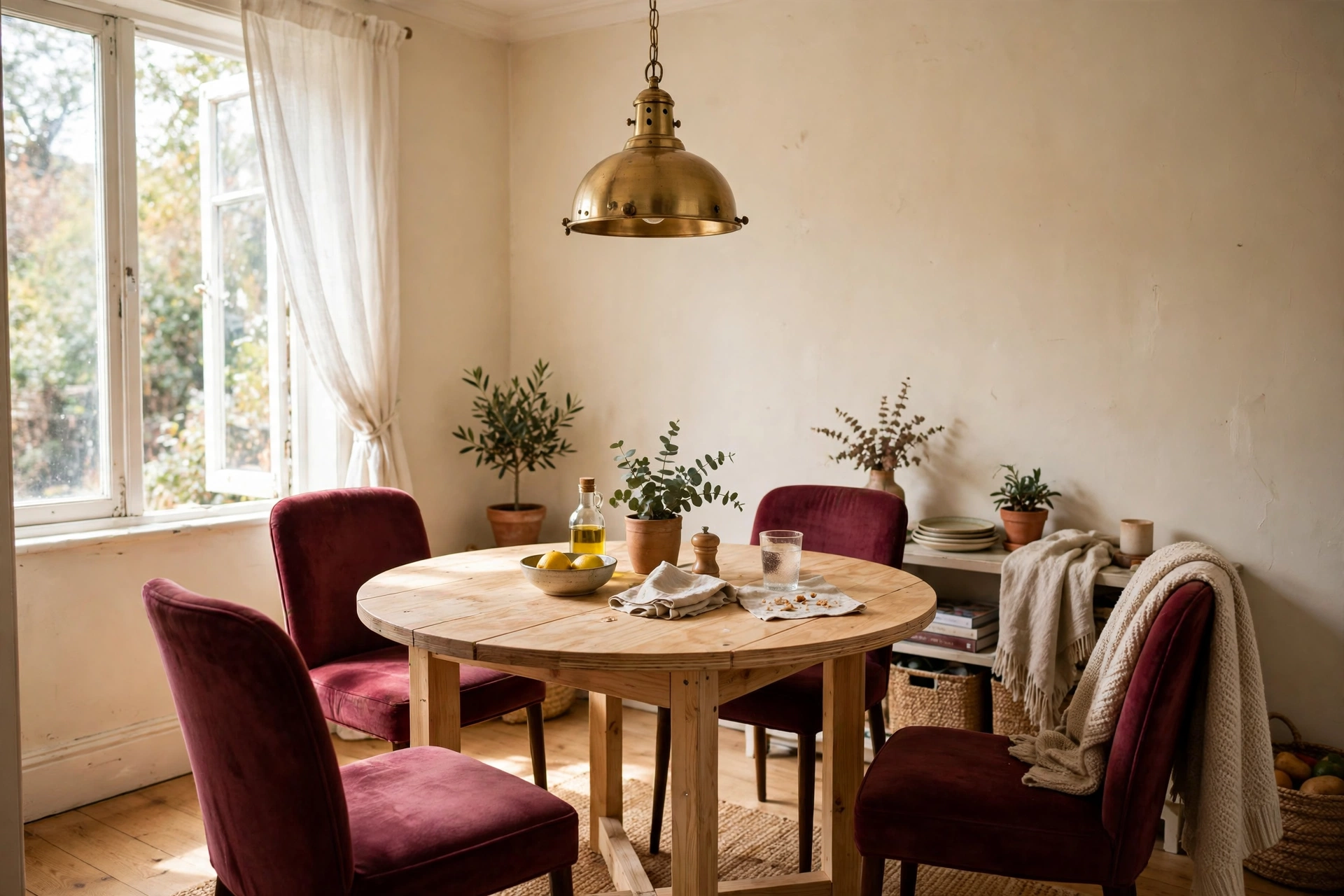
Cut a 36 or 42 inch (91 or 107 cm) circle from a sheet of birch plywood, screw on four 28 inch (71 cm) hairpin legs, and you are done. A round top has no corners to catch hips in a tight walkway, and four legs that bolt straight to the top make this the fastest build on this list.
Best for: first-time builders and square corners. Main advantage: one afternoon, no apron frame needed. Watch out for: a 3/4 inch (19 mm) plywood top can sag past 48 inches (122 cm) without an apron, so keep it small or add a support ring. Verdict: the best starter build. Renter-Friendliness: 5/5, nothing touches the wall.
2. Drop-leaf table against the wall
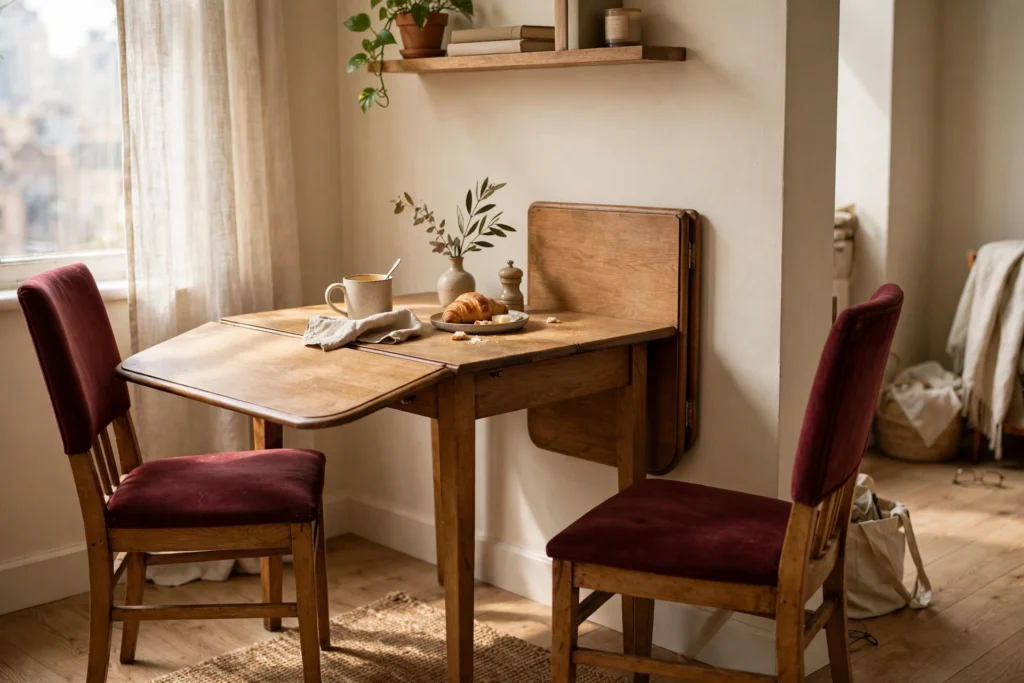
A fixed center section with one or two leaves that drop down on hinges. Up, it seats four. Down, it is a slim console about 12 inches (30 cm) deep that hugs the wall. Use heavy-duty folding brackets rated for the load, not cabinet hinges, because a leaf full of plates is heavier than it looks.
Best for: rooms that eat at the table once a day and need the floor back the rest of the time. Main advantage: the room changes size in ten seconds. Watch out for: the leaf must sit level with the center, so test the hinge position on scrap first. Verdict: the most useful build for tiny rooms. Renter-Friendliness: 4/5, it screws to the wall only if you fix the brackets there, and many renters can use a freestanding frame instead.
3. Fold-down wall table
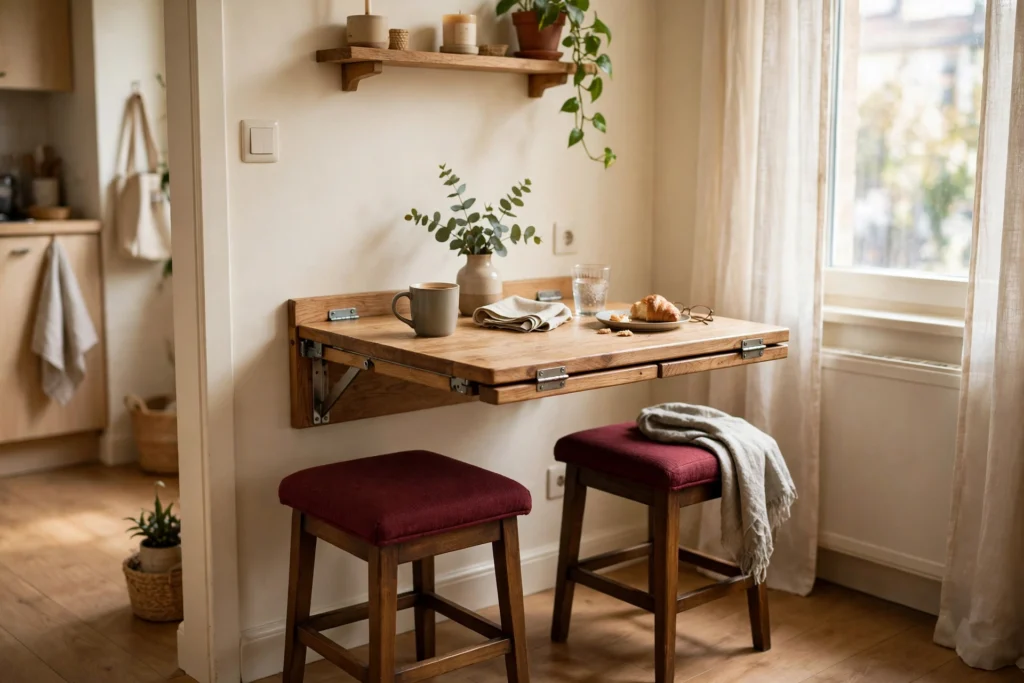
A top hinged to a wall cleat with folding brackets underneath. Fold it up for dinner, fold it flat after, and the whole dining room becomes floor space again. The brackets do the work, so buy the pair rated at 250 lb (113 kg), the same folding brackets we used for a wall-mounted desk, which costs about $20, and fix into studs, never into bare drywall.
Best for: studio apartments and one-wall dining spots. Main advantage: zero floor footprint when folded. Watch out for: this is the one build that must drill into the wall, so renters need written permission first. Verdict: brilliant for studios, a no-go without landlord permission. Renter-Friendliness: 2/5, wall fixing is the whole point.
4. Farmhouse table with a bench
A rectangular pine top on a simple apron frame, with a bench on the wall side instead of chairs. The bench is why this build earns its place: it seats three where two chairs fit, and it slides fully under the table when dinner ends. Put folding dining chairs that tuck away after dinner on the other side and the whole set disappears after the meal. A small two-person version costs about $40 in materials, and a four-person farmhouse build runs about $85-89.
Best for: families and narrow rooms. Main advantage: the most seats per square foot on this list. Watch out for: pine dents easily, so seal the top well if kids eat at it daily. Verdict: the best family build. Renter-Friendliness: 5/5, fully freestanding.
5. Pedestal round table
One center base instead of four legs, so chairs slide in from every side and nobody kicks a leg. This is my honest warning build. A new steel pedestal base alone lists at $454 and up, which is more than a whole ready-made tulip table at $154-200. Build this one only if you already own a base, or buy the ready-made table and refinish the top yourself.
Best for: round tables in square rooms where legroom matters most. Main advantage: the best legroom of any build here. Watch out for: a narrow base wobbles under a wide top, so the base should span at least half the top diameter. Verdict: overrated as a DIY build, underrated as a buy-and-refinish project. Renter-Friendliness: 5/5, freestanding.
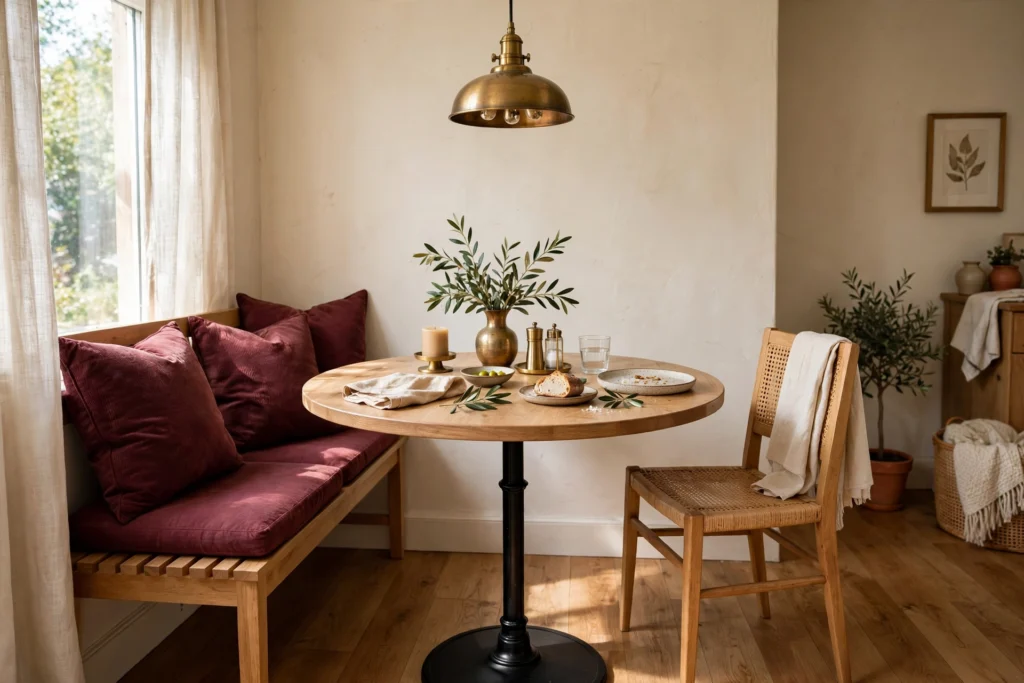
6. Reclaimed pallet or scaffold-board top
Take apart a pallet or a scaffold board, plane it flat, glue the boards into a top, and mount it on hairpin legs. The wood costs little or nothing, the character is free, and every top comes out different. Check each board for nails and stamps first, and skip any board marked MB, which means it was chemically treated.
Best for: tight budgets and rustic rooms. Main advantage: the cheapest top on this list. Watch out for: reclaimed boards are rarely flat, so budget an extra hour for planing and sanding. Verdict: the best budget build if you enjoy the prep work. Renter-Friendliness: 5/5, freestanding.
7. Extendable table with a hidden leaf
A rectangular top with a leaf that stores inside the table and pulls out for guests. It seats two on weekdays and six on Sundays, which is exactly what a small dining room needs. The leaf hardware is the only tricky part, so buy the slides as a kit and follow its measurements exactly instead of improvising.
Best for: people who host often but live small. Main advantage: two tables in one footprint. Watch out for: the leaf gap collects crumbs, so wipe the seam after every meal. Verdict: the best build for hosts. Renter-Friendliness: 5/5, freestanding.
Materials list and the 5-step build
This list covers Build 1, the round hairpin table. The other builds swap the legs or add brackets, but the steps stay the same. If you want a second walkthrough of the same order of work, this step-by-step build guide covers it well.
Materials: one 3/4 inch (19 mm) birch plywood sheet, four 28 inch (71 cm) hairpin legs with screws, wood glue, 120 and 220 grit sandpaper, wipe-on polyurethane, felt pads. Tools: jigsaw or circular saw, drill, tape measure, square, clamps.
- Measure your floor patch and mark the top size from the room-fit table above.
- Cut the top to size and sand the edges round, starting at 120 grit and finishing at 220.
- Mark the leg positions 2 inches (5 cm) in from the edge and pre-drill every screw hole.
- Screw the legs on, flip the table, and check for wobble on a flat floor.
- Seal the top with two coats of wipe-on polyurethane, letting each coat dry fully, then add felt pads.
What finish survives dinner?
A dining top needs a finish that wipes clean and shrugs off heat. Polyurethane is the safest pick for a first build: two or three coats, food-safe once fully cured, and easy to spot-repair. Hardwax oil looks warmer and feels nicer, but it needs re-oiling every year or so in a hard-use dining room. Paint looks great on a farmhouse build and hides pine dents, but use a satin or semi-gloss paint, because flat paint stains the first time someone spills curry. Whatever you pick, seal both sides of the top, because a top sealed on one side only can cup as it dries.
Mistakes to avoid
Do not skip the clearance math. A table that fits the room on paper but leaves 24 inches (61 cm) behind the chairs instead of 36 will make every meal a shuffle. Do not fix folding brackets into bare drywall: they pull out under load, and the repair costs more than the brackets saved. Do not build the top from construction-grade CDX plywood and expect a smooth finish, because its rough face will show through every coat. Do not forget the felt pads, because four steel legs on a hard floor will mark it in a week. And do not seal only the top face, as explained above, or the top can warp.
What to skip
Skip the expensive pedestal base as a DIY purchase, as Build 5 explains. Skip glass tops in small dining rooms: they show every fingerprint, they are heavy to move, and a chipped edge is a safety problem. Skip a table wider than 36 inches (91 cm) for a two-person household, because the extra width only collects clutter. And skip the cheapest folding brackets you can find online, because a bracket that folds under a plate of food is worse than no bracket at all.
Wasim
How this was made: I sized every build from the clearance rules in the linked guides, computed the room-fit and cost tables from live-checked November 2026 prices, and listed the prices I could not verify as estimates instead of guessing them.
What size dining table fits a small room?
Measure the floor patch first. Allow 36 inches (91 cm) behind every chair and 24 inches (61 cm) of elbow room per person. A 36 inch (91 cm) round table seats two in a 9 ft (2.7 m) patch, and a 42 inch (107 cm) round seats four in a 9.5 ft (2.9 m) patch.
What is the best shape dining table for a small space?
Round, in most small rooms. A round top has no corners to catch hips, seats four around a 42 inch (107 cm) top, and works in square rooms. A rectangle wins only in a long narrow room, or when you need to push one side against a wall.
How much clearance do you need around a dining table?
You need 36 inches (91 cm) of clear floor behind every chair that someone pulls out, and at least 30 inches (76 cm) behind a chair that slides under a bench. Less than that and people cannot stand up without hitting the wall.
Can you build a dining table for under $100?
Yes. A reclaimed top on hairpin legs costs about $26-56, a drop-leaf build runs about $65-85, and a small farmhouse table costs about $40 in materials. The builds that break $100 are the pedestal base and the large birch-top versions.