Best Blackout Curtains for Small Apartments: 7 Picks That Fit Real Windows (and Real Rods)
The best blackout curtains for small apartments are narrow 42 inch panels in a short 63 inch drop, bought after measuring the window, not before. Most small apartment windows are 24 to 48 inches wide (61 to 122 cm), and a standard 84 inch panel is too long and too wide for them. This guide fixes that with a computed fit table, a dated November 2026 price table for 7 picks from $13.89 to $35.99, and a renter-safe hanging plan. Measuring and hanging takes 30 to 45 minutes for two windows.
That is the short answer. The rest of this post earns it. Small windows punish the two mistakes every roundup makes: buying the standard size, and trusting the word blackout on the tag. The picks below are sized for real apartment windows, priced for one fixed size and color each, and rated for how safe they are for your deposit.
How do you measure blackout curtains for a small window?
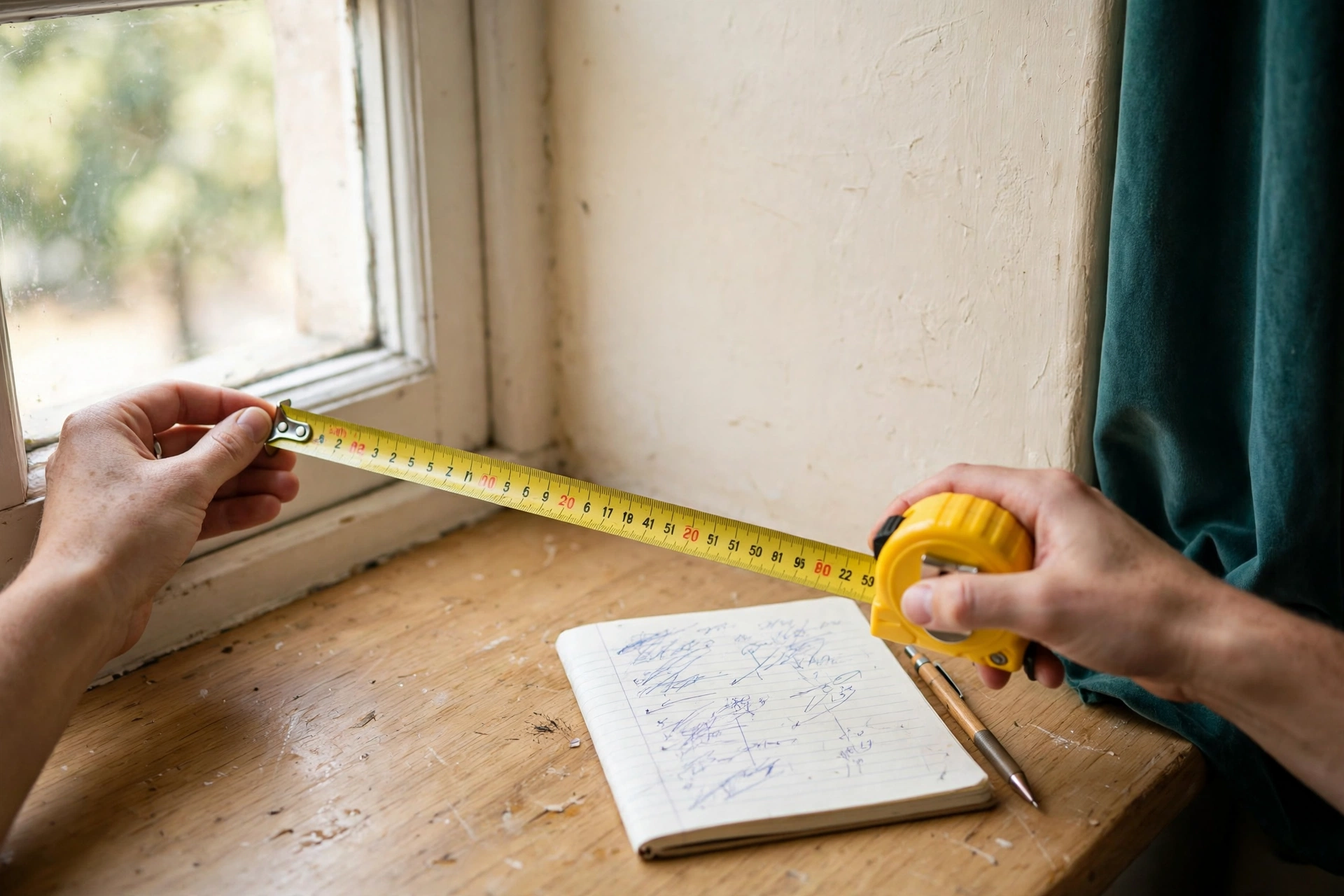
Measure the window width in three places, multiply by 1.5, and buy panels that total at least that much fabric. Then measure the drop from the rod to the sill or floor, and buy the next longer drop. Those two numbers decide everything else, including which picks on this list fit your window at all.
Width first. Curtains need fullness to fall in folds instead of hanging flat like a sheet. The rule is 1.5 times the window width, total across all panels. A pair of 42 inch panels gives you 84 inches of fabric. Divide 84 by 1.5 and you get 56 inches. That is why a pair of 42 inch panels covers windows up to about 56 inches wide (142 cm), and why the 42 inch panel is the small-apartment size.
| Window width | Panel width needed (1.5x) | What fits |
|---|---|---|
| 24 in (61 cm) | 36 in (91 cm) | One 42 in panel |
| 36 in (91 cm) | 54 in (137 cm) | Two 42 in panels (84 in total) |
| 48 in (122 cm) | 72 in (183 cm) | Two 42 in panels (84 in total) |
| 60 in (152 cm) | 90 in (229 cm) | Two 52 in panels (104 in total) |
| 72 in (183 cm) | 108 in (274 cm) | Three 42 in panels, or two 52 in panels plus a liner |
Check the math yourself. 24 times 1.5 is 36. 36 times 1.5 is 54. 48 times 1.5 is 72. 60 times 1.5 is 90. 72 times 1.5 is 108. Every row above follows the same rule, so you can run it for any window size in your apartment.
Drop second. Hang the rod 4 to 6 inches (10 to 15 cm) above the frame, then measure from the rod down to where you want the hem: the sill, or the floor. Small rooms have three short drops that the standard 84 inch panel overshoots.
| Drop | Length | Best for |
|---|---|---|
| 45 in (114 cm) | Short | Above a radiator, desk, or kitchen counter |
| 54 in (137 cm) | Short | Sill length on a tall small window |
| 63 in (160 cm) | Short | Sill length on a standard small window, the most useful short drop |
| 84 in (213 cm) | Standard | Floor length, only if the rod is high and the floor is clear |
Here is the mistake I see most: a 63 inch panel on a window where the rod sits high and the floor is the target. It stops mid-wall, leaks light at the bottom, and makes the wall look chopped in half. If the rod is high, buy the longer drop. If the window sits above furniture, buy the short drop and let the hem clear the furniture by 2 inches (5 cm).
Weight third, and this is the step most buyers skip. Weigh one panel on a kitchen scale and double it for the pair. A pair of lined blackout panels can reach 8 to 12 lb (3.6 to 5.4 kg). A standard spring tension rod holds about 7 lb if you plan honestly, and a heavy-duty tension rod holds up to 20 lb. Our guide to budget curtain rods rated for the weight works through the same check with real rod capacities, so run your numbers there before you order. A rod that holds for three days and drops at night is the classic small-apartment story, and it is always a weight problem, not a rod defect.
What is the difference between true blackout and room darkening?
True blackout blocks 85 to 100% of light through the fabric, depending on construction and color. Room darkening blocks roughly 60 to 80%, which is fine for a living room and not enough for sleep. The label will not tell you which one you are buying, so read the construction instead of the tag.
Blackout is not a regulated term. Any listing can print it. What matters is how the fabric is built, and there are only three constructions you will meet at this price.
| Construction | Light blocked through the fabric | Honest note |
|---|---|---|
| Triple-weave, dark color | 85 to 99% | Darker colors block more; the weave does the work |
| Triple-weave, light color | 85 to 90% | White and cream leak more at the folds |
| Black-liner (face fabric plus sewn black liner) | 100% claimed | The claim is the maker’s; the liner blocks the most light of any construction here |
| Room darkening weave | 60 to 80% | Takes a room to dusk, not to dark |
| Portable shade pressed to the glass | About 95% on the glass | Covers the glass, not the frame, so the edges still leak |
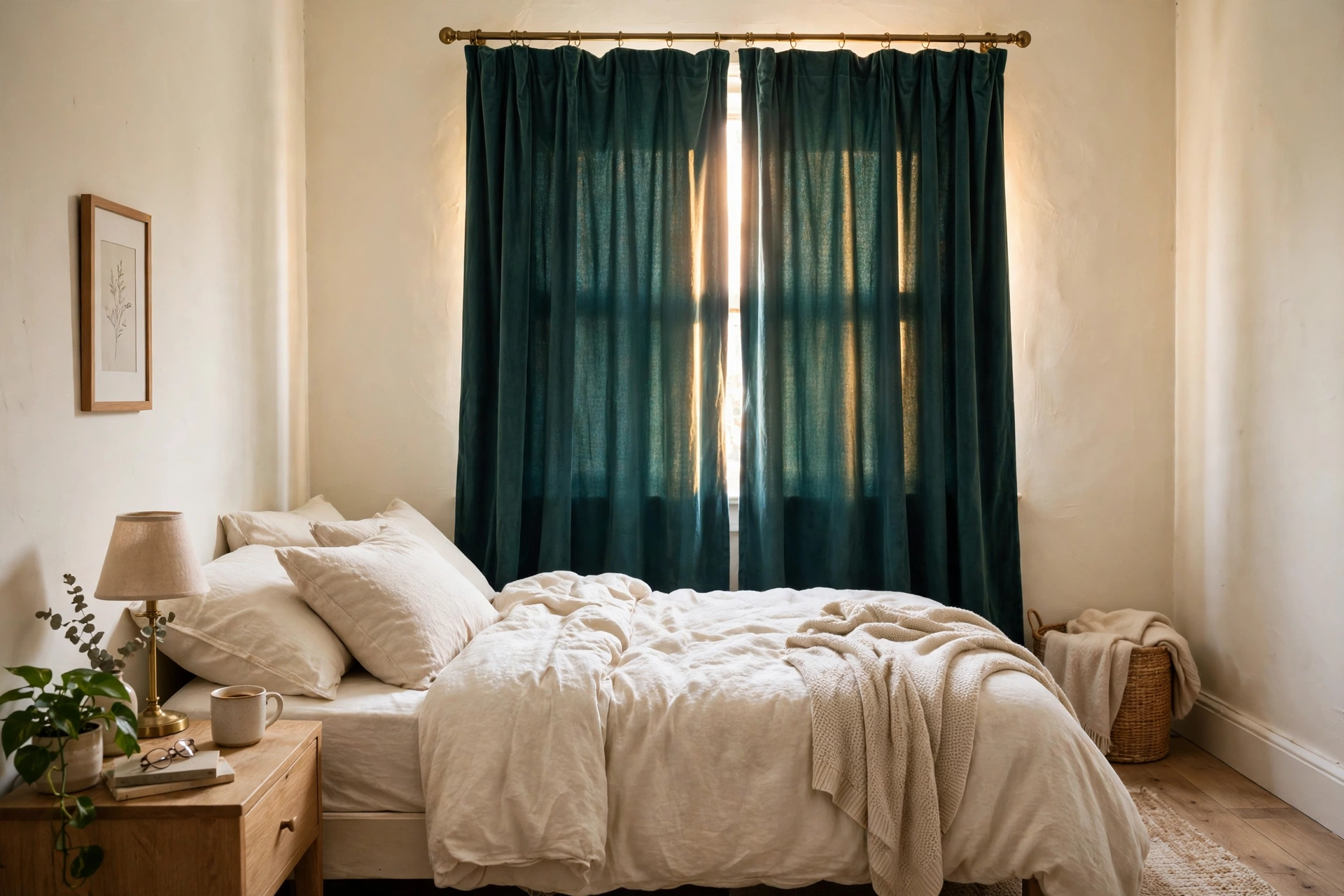
Now the caveat that no listing prints: no curtain is 100% blackout once it is hung. Light comes around the sides, over the top, and through the gaps between grommets. A grommet header holds the panel about an inch off the wall and leaves open scallops between the rings, so a row of bright arcs appears over the top no matter how good the cloth is. A back-tab or rod-pocket header sits closer to the wall and leaks less. A wraparound rod curves the panel back to the wall and kills the side glow. The fabric decides how much light passes through. The hanging decides how much light gets around. Both matter, and the second one is where most small apartments lose.
There is a real reason to care about the difference. A 2025 study of 5,006 adults in Poland found blackout curtains were the most common thing people did to cut nighttime light, used by 41.4% of respondents. That is a survey of what people actually do, not a lab test of what works, and it still tells you something useful: curtains are the first fix people reach for, so they had better be the right curtains. The study is linked in Sources.
Which are the best blackout curtains for small apartments?
These are the 7 picks that fit apartment windows, priced for one fixed size and color each, live-checked in November 2026. Every pick below carries a Best for, a Main advantage, a Watch out for, a Verdict, and Renter-Friendliness and Deposit-Risk ratings from 1 to 5. Prices are per pair of panels unless noted. Prices move by size and color.
1. NICETOWN Triple-Weave Blackout Curtains, 42×63 in, Biscotti Beige, $28.95 (TOP PICK)
Best for: The standard small bedroom window, and the best overall pick if you buy only one pair.
Main advantage: Triple-weave polyester with no coating to crack or peel, machine washable, and sold in more drops than most ranges at this price, from 45 to 108 inches. The 42 inch width is the small-window size, and the 63 inch drop is the sill length most small bedrooms need. Buyers rate these panels 4.6 out of 5 on average in a November 2, 2026 roundup of Amazon listings. The black full-blackout version of the same range weighs 4.96 lb per pair in the 52×84 size, so the 42×63 pair is lighter still and sits comfortably inside a normal rod’s capacity.
Watch out for: The price moves a lot by color. The Biscotti Beige 42×63 pair was $28.95 on Amazon on November 19, 2026, while the black pair showed about $20 in a November 2 roundup. Light colors block less light than dark ones, so pick a mid-tone or dark color for a bedroom. Grommets leak light over the top, so hang the rod high and wide.
Verdict: The default buy. It is the most reviewed blackout curtain on Amazon by a wide margin, it washes without damage, and it fits the windows this post is about.
Renter-Friendliness: 4/5. Deposit-Risk: 2/5. Grommets slide onto any rod, and the fabric itself touches nothing but the rod. The deposit risk is the rod, not the curtain.
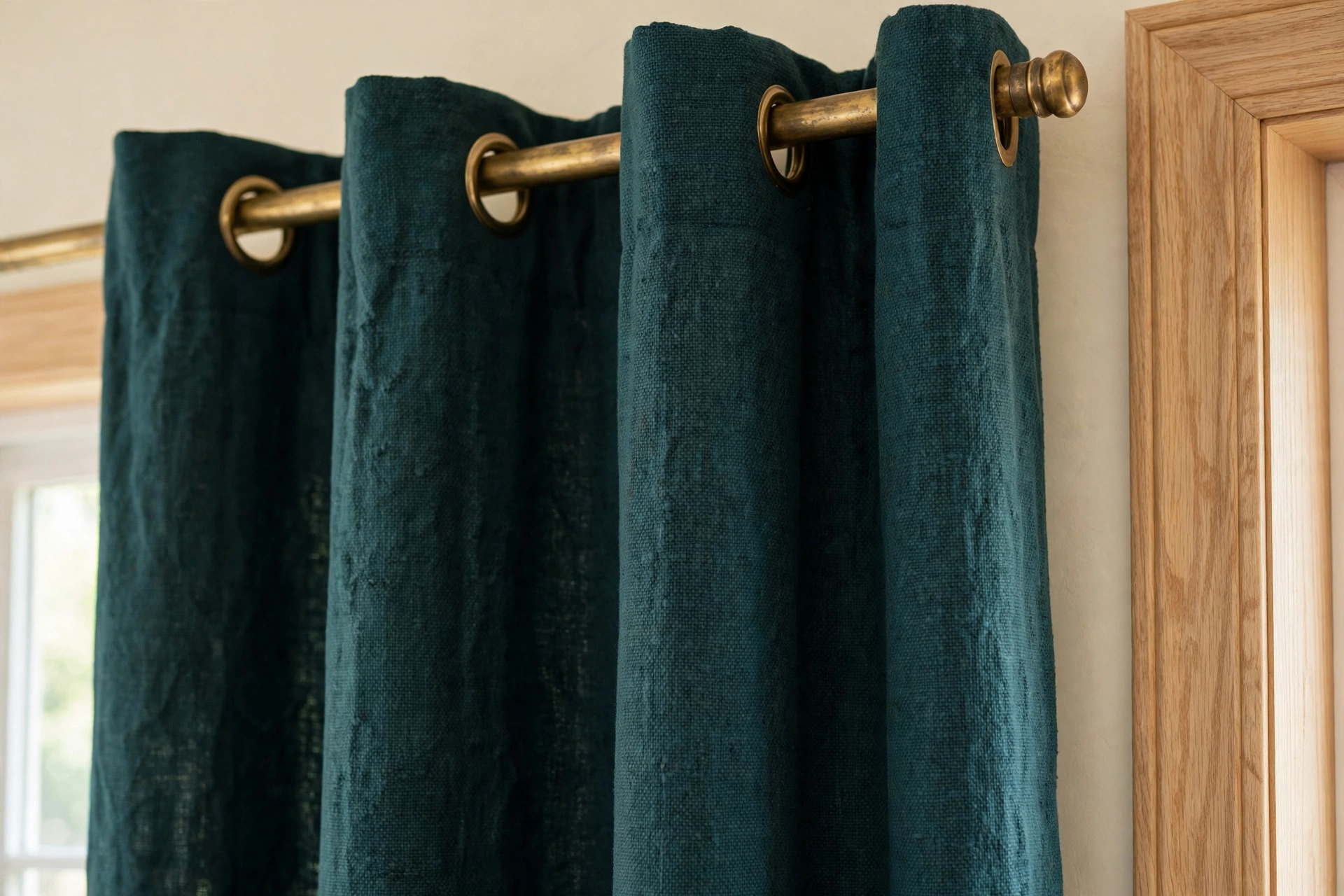
2. ChrisDowa Grommet Blackout Curtains, 42×63 in, Stone Blue, $27.99
Best for: Small windows where you want a color with some personality, and the closest rival to the top pick.
Main advantage: The same triple-weave construction as the top pick, in a Stone Blue that reads as a designed color rather than a blackout product. It was $27.99 on Amazon on November 18, 2026, and it is an Amazon best seller in window curtain panels. Buyers rate it 4.6 out of 5 on average in the same November 2, 2026 roundup. The 42×63 size is the narrow-window pick in the range.
Watch out for: ChrisDowa also sells a black-liner version of these panels, which is a different product with a separate liner sewn in. Do not confuse the two listings. The triple-weave version blocks 85 to 99% depending on color. The liner version claims full blackout and costs more. Check which one is in your cart before you pay.
Verdict: Buy this one if you like the color. On performance it ties the top pick, and the price is a dollar less in the size checked.
Renter-Friendliness: 4/5. Deposit-Risk: 2/5. Same grommet story as the top pick: safe fabric, rod-dependent risk.
3. BGment White Blackout Curtains, 52×84 in, Pure White, $35.99
Best for: A wide living room window where you want white curtains that still block light, and the pick that proves white is the hardest blackout color.
Main advantage: A 52 inch wide panel in an 84 inch drop, which is the size a 60 inch window needs at 1.5x fullness. It was $35.99 on Amazon as of November 18, 2026. BGment’s listings claim blackout and less heat and cold transfer, which is the maker’s say-so, and a November 2026 comparison rates the white panels 3.9 out of 5.
Watch out for: This is the honest warning of the list. White triple-weave blocks less light than dark triple-weave, and one November 2026 comparison puts white panels that still need a lining for blackout in the lower tier. If the room has to go properly dark, buy BGment’s black-liner version instead, or pair these with a liner. The 52 inch width also means more fabric weight on the rod, so check the rod capacity first.
Verdict: The right buy for a living room where looks matter and dusk is dark enough. The wrong buy for a bedroom where you sleep past sunrise.
Renter-Friendliness: 3/5. Deposit-Risk: 2/5. Wide panels need a sturdy rod, and a wide span needs a center bracket if the rod is long.
4. Yakamok 100% Blackout Curtains with Black Backing, 42×63 in, Burnt Orange, $28.99
Best for: A bedroom that has to go properly dark, and the best black-backing pick on this list.
Main advantage: A black backing layer behind the face fabric, which is the construction that blocks the most light short of a sewn liner. It was $28.99 at Walmart Business for the 42×63 Burnt Orange pair, crawled November 17, 2026. The black backing also helps in a room where the curtain faces the street, since the dark side takes the sun.
Watch out for: The black backing shows at the edges when the panel is open, so the room-side color matters less than you think and the edge look matters more. Burnt Orange is a strong color, so check it against the wall before you commit. The backing adds stiffness, so these panels stack wider than an unlined triple-weave when open.
Verdict: The darkness pick. If the top pick leaves too much morning light for you, this is the step up, not a second pair of the same thing.
Renter-Friendliness: 4/5. Deposit-Risk: 2/5. Grommet top, standard rod, no wall contact from the fabric.
5. LEMOMO Blackout Curtains, 52×84 in, Black, $13.89
Best for: The cheapest real blackout on this list, and the value pick for a wide window.
Main advantage: The price. The black 52×84 pair was $13.89 on Amazon as of November 13, 2026, which is about half the top pick for a larger panel. It is a triple-weave polyester with a smooth finish, it blocks 85 to 99% of light, and it carries over 49,000 Amazon reviews. The rod-pocket and back-tab header lets you hang it with or without rings, and the back-tab option sits closer to the wall than grommets, so it leaks less light over the top.
Watch out for: It is unlined, so it relies on the weave and the black color rather than a separate backing. The black version is the one to choose. The lighter colors will let more through, and that is not a small difference on this panel. It is a room-darkening set that leans blackout in black, rather than a true blackout set in every color.
Verdict: The budget winner. If you need 84 inch panels for a guest room or a rental and you do not need pitch darkness, this is the sensible buy.
Renter-Friendliness: 4/5. Deposit-Risk: 2/5. Light for its size, and the back-tab header is the renter-friendly choice.
6. Amazon Basics Portable Blackout Shade, 50×78 in, Black, 1-pack, $23.09
Best for: Renters who cannot hang a rod at all, and the only pick here that needs no rod, no brackets, and no holes.
Main advantage: It sticks straight to the glass with suction cups, so there is nothing to measure twice and nothing to drill. One 50 by 78 inch sheet covers a standard 36 by 48 inch window with overlap on every side, and Velcro tabs let you fold it down for smaller windows. It packs into a travel bag, so it moves with you. It was $23.09 in a November 14, 2026 price check, and our companion post on no-drill blackout methods for renters lists the same shade at the same price.
Watch out for: Amazon’s own listing calls it room darkening rather than full blackout, because it covers the glass but not the frame. Expect edge glow. Suction cups fail on textured glass, dirty glass, and in summer heat. The Amazon listing showed no featured offers on November 19, 2026, so check the listing before you buy, and do not pay a reseller markup for a $23 shade.
Verdict: The fastest real darkness a renter can buy with zero damage. Buy it for the window you cannot put a rod on, not as a replacement for curtains everywhere.
Renter-Friendliness: 5/5. Deposit-Risk: 1/5. Nothing touches paint or plaster. The only risk is a suction cup letting go on a hot afternoon.
7. Deconovo 100% Blackout Curtains with Black Liner, 42×63 in, $25.99
Best for: Shift workers and light sleepers who need the room genuinely dark, and the true-blackout pick of this list.
Main advantage: A decorative face fabric with a separate black liner sewn behind it, so the liner does the light blocking and the room-side color can be anything you like. That construction is the main thing you normally pay more than thirty dollars for. It was $25.99 for a pair as of November 18, 2026, and the same 42×63 listing showed $25.76 in an earlier crawl, so the figure is consistent. Drops run 63, 72, 84, and 96 inches, so the small-apartment 63 inch drop is in the range.
Watch out for: Two bonded layers make it bulky. It stacks wide when open, so it needs wall space beside the window and a rod with a center support on a wide span. Weigh the pair before you hang it, because a lined pair is the one most likely to test a light rod. The face fabric is the pretty part, the liner is the working part, and both need to survive the wash.
Verdict: The darkness winner. If dim is not good enough and the room genuinely has to go dark, this is the panel to buy, and the price is fair for a lined set.
Renter-Friendliness: 3/5. Deposit-Risk: 2/5. The fabric is safe, but the weight and the bulk demand a proper rod, and a falling lined panel is how rods get bent.
What do the best blackout curtains for small apartments cost?
All prices below were live-checked in November 2026, for one fixed size and color per pick. They are market prices, not personal receipts. Prices move by size and color, and Black Friday week runs November 19 to 30, so check the listing before you buy.
One window costs $23.09 to $51.94 depending on the route, and all seven picks together cost $184.89. The cheapest real blackout pair is the LEMOMO at $13.89, and the most expensive single pick is the BGment White at $35.99.
| Pick | Size and color (2 panels unless noted) | Price as of November 2026 |
|---|---|---|
| 1. NICETOWN triple-weave (TOP PICK) | 42×63 in, Biscotti Beige | $28.95 |
| 2. ChrisDowa grommet | 42×63 in, Stone Blue | $27.99 |
| 3. BGment White | 52×84 in, Pure White | $35.99 |
| 4. Yakamok black backing | 42×63 in, Burnt Orange | $28.99 |
| 5. LEMOMO | 52×84 in, Black | $13.89 |
| 6. Amazon Basics portable shade | 50×78 in, Black, 1-pack | $23.09 |
| 7. Deconovo black liner | 42×63 in, 2 panels | $25.99 |
| All 7 picks together | One of each | $184.89 |
The sums: 28.95 plus 27.99 is 56.94. Plus 35.99 is 92.93. Plus 28.99 is 121.92. Plus 13.89 is 135.81. Plus 23.09 is 158.90. Plus 25.99 is 184.89. That total is what all seven cost together, which nobody needs. What matters is the one-window route.
| One-window route | What you buy | Total as of November 2026 |
|---|---|---|
| No-drill shade only | Amazon Basics shade, 1-pack | $23.09 |
| Budget pair plus rod | LEMOMO 52×84 pair ($13.89) plus Room Essentials heavy-duty tension rod ($15.00) | $28.89 |
| Top pick plus wrap-around rod | NICETOWN 42×63 pair ($28.95) plus Amazon Basics wrap-around blackout rod ($22.99) | $51.94 |
| Two windows, budget route | Two budget routes | $57.78 |
| Two windows, top pick route | Two top pick routes | $103.88 |
Rod prices come from our own #199 rod guide, live-checked November 2026. The budget route is $13.89 plus $15.00, which is $28.89. The top pick route is $28.95 plus $22.99, which is $51.94. Two windows double each route: $57.78 and $103.88. Measuring and hanging takes 30 to 45 minutes for two windows, including the flashlight test at the end.
If your budget is tight, start with the LEMOMO pair and a tension rod for $28.89, and add the portable shade for the window you cannot put a rod on. If sleep is the problem, start with the Deconovo lined pair at $25.99 and a rod rated for its weight. Either way, buy the size from the fit table first and the brand second.
How do you hang blackout curtains in a rental without drilling?
Use a heavy-duty tension rod inside the window recess, or a suction shade on the glass. Both routes hang a real blackout panel with zero holes, and both come down clean at move-out. A deep recess takes a tension rod, a flush window takes a suction shade or adhesive brackets.
A standard tension rod holds about 7 lb if you plan honestly. A heavy-duty one holds up to 20 lb. A pair of lined blackout panels can reach 8 to 12 lb, so weigh the pair first and match it to the rod. The no-drill blackout methods we covered for renters work through the same weight budget with seven methods ranked by darkness, so start there if you have not picked a method yet. Tension rods lose grip near their maximum extension, so buy a rod whose range covers your window in its middle, not at its limit.
Adhesive brackets are the third route, and the one to treat with respect. Standard removable strips hold about 5 to 7.5 lb per pair, and heavy-duty mounts hold up to about 15 lb per bracket. The wall must be smooth and clean, or the bracket peels off with the panel. Patch-test one bracket first, and never stick adhesive to old paint you have not tested.
Renter caveat: check the lease first
Before you hang, stick, or tape anything to a window, read the window clause in your lease. Most leases ban drilling and anything that leaves marks, which is why every method above is no-drill. A few leases also ban window film and anything stuck to the glass, so check that line specifically if you pick the portable shade. Photograph every window before you install anything, keep the boxes and receipts, and plan the removal the day you move in, not the day you move out. Suction shades and tension rods come down in minutes. Adhesive brackets need a slow peel and a hair dryer on low heat. If a bracket takes paint with it, a small tube of spackle and a dab of matching paint costs under $5, which is far cheaper than a deposit deduction.
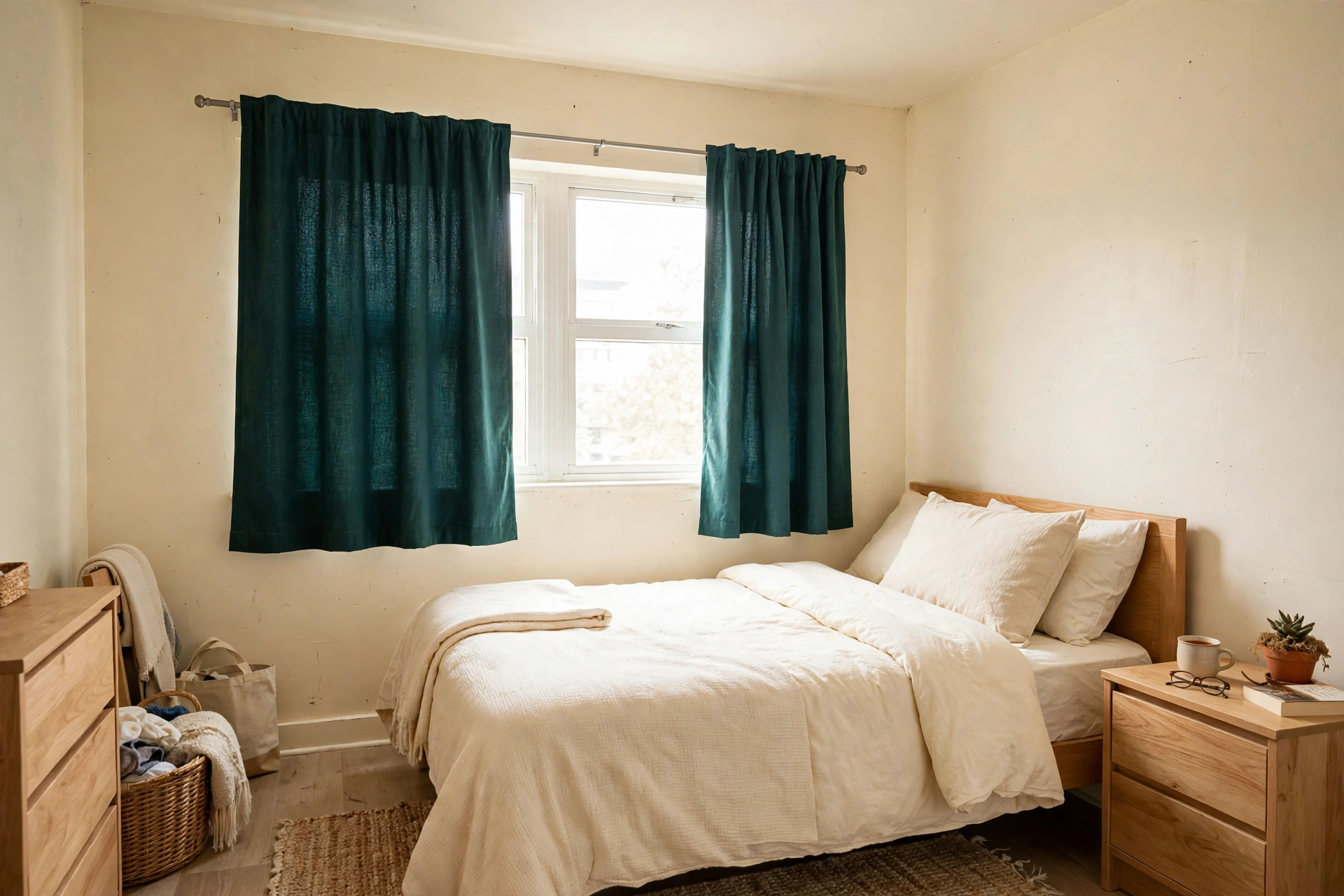
Do blackout curtains keep heat in and noise out?
They help with heat a little, and with noise only a little. Cornell Cooperative Extension found unsealed draperies cut window heat loss by only about 10%. The U.S. Department of Energy notes medium-colored draperies with a white plastic backing can cut summer heat gain by about a third. Those are the real figures for curtains hung like curtains.
That means a blackout panel is a draft buffer, not insulation. It traps a layer of air against the glass, which slows heat moving through the window, and it blocks summer sun before it heats the room. In a drafty apartment window in November, that is worth having, and it is worth about 10% of the window’s heat loss, not half your heating bill. Close the panels at night in winter, open them on sunny winter days to let the sun in, and close them on hot summer afternoons. That routine is free and it does more than the fabric alone.
Noise is the same story, only weaker. A heavy triple-weave panel muffles street noise a little, because mass absorbs sound, but no standard curtain carries a decibel rating, and no panel on this list was tested for noise in a lab. Treat noise claims as muffling, not blocking. If noise is the real problem, the fix is sealing the gaps around the window and the door, not a heavier curtain. Our soundproofing guide for rentals covers that properly, and it starts with the gaps, not the fabric.
How to measure and hang blackout curtains in a rental
This is the setup for one window on the tension-rod route, and it works for any panel on this list. It takes 30 to 45 minutes for two windows, including the flashlight test at the end. Follow the steps in order, and do not skip the weighing step, because the rod choice depends on it.
Materials list: heavy-duty tension rod ($10 to $15), one pair of blackout panels in the size from the fit table, painter’s tape, a tape measure, a pencil, hook-and-loop dots for the edges.
- Measure the window width in three places and use the smallest number.
- Multiply the width by 1.5 and pick panels that total at least that much fabric.
- Measure the drop from the rod to the sill or floor and pick the next longer drop.
- Weigh one panel on a kitchen scale and double it for the pair.
- Match the pair weight to a rod rated for at least that much, or switch to a no-drill shade.
- Hang the rod 4 to 6 inches above the frame and 4 to 6 inches past each side.
- Do the flashlight test at night and seal every leak you find.
If the rod slips after a day, the panels are too heavy for it. That is the rod telling you the truth, not a defect. Step down to a lighter panel or step up to adhesive brackets. If light still leaks at the sides after the flashlight test, add hook-and-loop dots along the panel edges and press them to the wall or trim at night. That one fix closes most of the gap that makes people say blackout curtains do not work.
Mistakes to avoid
Seven mistakes cause most blackout failures, and the first two cause the most: buying the standard 84 inch size for a small window, and trusting the word blackout on the tag. The rest are weight, hanging height, color choice, and skipping the night test.
Buying the standard 84 inch panel for a small window. It pools on the floor or lands on furniture, and it looks wrong every day. Buy the drop from the table above.
Buying one wide panel instead of two narrow ones. A single 52 inch panel on a 48 inch window has no fullness, so it hangs flat and leaks light at the folds. Two 42 inch panels gather properly.
Trusting the word blackout on the tag. Room darkening panels wear the same word. Read the construction: triple-weave or black liner means blackout, a thin single layer means room darkening whatever the tag says.
Buying white for a bedroom. White triple-weave blocks less light than dark triple-weave, and the difference shows at 5 a.m. Save white for the living room, or buy the black-liner version.
Skipping the weight check. A lined pair on a light tension rod falls at night. Weigh first, buy the rod second.
Hanging the rod on the trim. A rod screwed to the trim makes the window look short and leaves no room for the panels to stack off the glass. Hang it 4 to 6 inches above the frame.
Skipping the flashlight test. You cannot judge darkness at noon. Test at night with the lights off, or you will find the leak at sunrise.
What to skip
Five things are not worth buying for a small apartment window: coated panels that crack, cheap spring rods, a second layer of a failing method, screw-in track systems, and matching sets in the standard size. Each one costs money and solves nothing.
Foil or rubber-coated panels. The coating blocks light well on day one, then stiffens along the fold lines, cracks, and flakes. It also hates a hot wash. Buy triple-weave or a sewn liner instead.
The cheapest spring rod for a blackout panel. A $6 spring rod holds sheers, not a 12 lb lined pair. It will hold for three days and then come down at night.
A second layer of the same failing method. If one suction shade leaks at the edges, a second suction shade leaks at the same edges. Fix the edges with hook-and-loop dots instead.
Sealed track systems that need screws. They are the only route to true full darkness, and they cost several hundred dollars plus small screw holes in the window recess. That is a landlord conversation, not a renter fix.
Matching sets in every room. One pair per window, sized to that window, beats a matching set bought in the standard size. Small apartments have different windows in different rooms, and the curtains should show it.
Sources
Prices in this post were live-checked in November 2026: NICETOWN 42×63 Biscotti Beige $28.95 on Amazon, verified November 19, 2026 via BasketPrice; ChrisDowa 42×63 Stone Blue $27.99 on Amazon, verified November 18, 2026 via BasketPrice; BGment White 52×84 $35.99 on Amazon as of November 18, 2026 via Prepared States; Yakamok 42×63 Burnt Orange $28.99 at Walmart Business, crawled November 17, 2026; LEMOMO 52×84 Black $13.89 on Amazon as of November 13, 2026; Amazon Basics portable shade 50×78 $23.09, last verified November 14, 2026, with Amazon’s own listing showing no featured offers on November 19, 2026; Deconovo black-liner pair $25.99 as of November 18, 2026 via Drape and Dawn. Rod prices come from our own rod guide, post #199. Light-blocking figures come from manufacturer listings and independent roundups: triple-weave 85 to 99% depending on color, black-liner 100% claimed. The Sierpinski study is Sierpinski R, Jankowski M, Raciborski F, International Journal of Occupational Medicine and Environmental Health, 2025;38(5):559-571, surveyed 5,006 adults in Poland in December 2024, and found blackout curtains in the bedroom the most common intervention at 41.4%. Heat figures come from Cornell Cooperative Extension (unsealed draperies about 10% heat-loss reduction) and the U.S. Department of Energy (medium draperies with white backing about a third less summer heat gain). Prices change, so check the listing before you buy. Budget curtains for small rooms and the whole-home organization system are our own companion guides for the rest of the room.
Do blackout curtains work in apartments?
Yes, if you buy the right size and hang them high and wide. A triple-weave or black-liner panel in a dark color blocks 85 to 100% of light through the fabric, and a rod hung 4 to 6 inches above the frame with panels overlapping the wall on each side closes most of the edge gaps. They work least well when the panel is exactly as wide as the window, because light leaks around all four sides.
What are the best no-drill blackout options for renters?
A suction-cup portable shade on the glass, a heavy-duty tension rod with blackout panels inside the recess, or adhesive brackets with a wraparound rod. The shade needs no rod at all and comes down in seconds. The tension rod looks most like a real curtain. The adhesive brackets give the closest thing to a hotel blackout, and they carry the most deposit risk, so patch-test one bracket first.
Which blackout curtains for bedroom should you buy?
For a bedroom, the best blackout curtains for small apartments are a dark triple-weave pair in 42×63 for a standard small bedroom window, or a black-liner pair if the room has to go properly dark. The NICETOWN 42×63 pair is the top pick at $28.95, and the Deconovo black-liner pair is the darkness pick at $25.99. Pick the size from the fit table first, then the brand, and weigh the pair before you choose the rod.
How should renters compare blackout options?
Compare four things in this order: light blocked through the fabric, size fit for your window, weight against your rod, and deposit risk of the hanging method. A panel that blocks 99% of light but falls off a light rod is worse than a panel that blocks 90% and stays up. Check the lease for bans on film and anything stuck to glass before you buy a suction shade or adhesive brackets.
How this was made: this post was researched from live search results and retail listings in November 2026, with prices re-checked on November 19, 2026 and measurements computed from the 1.5x fullness rule. No product was tested in person, and no claim in this post comes from a test that did not happen.
By Wasim