Bike Storage Ideas for Small Apartments: 10 Ways to Park a Bike Without Losing Your Living Room
A bike in a small apartment is a space problem before it is a storage problem. It leans against the wall, blocks the hallway, and catches every bag that walks past. These bike storage ideas for small apartments start with three measurements, then match the bike to the one spot in your home that can actually hold it. No drilling required for most of them, and the cheapest fix that really works costs $42.75 as of November 2026.
The original number in this post is a fit table I computed from the bike’s own dimensions. A typical medium road bike is about 68 inches (173 cm) long end to end, and its handlebars are 38 to 80 cm (15 to 31 inches) wide, which is the measurement most people forget. Store it flat and it eats a whole wall. Store it upright on a gravity stand and two bikes fit in 22 by 14 inches (56 by 36 cm) of floor, about 2.1 square feet. That one switch is the whole post in miniature.
First, measure your bike. The three numbers decide everything.
Grab a tape measure before you buy anything. Three numbers decide which storage ideas can even work in your apartment, and guessing any of them is how people end up with a rack that does not fit.
Length. Measure end to end, tire to tire. A typical medium road bike runs about 68 inches (173 cm). A large mountain bike can push past 74 inches (188 cm). Write the number down.
Handlebar width. This is the sneaky one. Flatbike’s guide puts handlebars at 38 to 80 cm (15 to 31 inches) wide depending on the bike type, and the bars are usually the widest part of the whole bike. A drop-bar road bike is narrow. A flat-bar hybrid or mountain bike is wide. If the bars will not clear the gap, the rack will not work, no matter how good the rack is.
Weight. A road bike is often 20 to 25 pounds (9 to 11 kg). A hybrid runs 25 to 35 pounds (11 to 16 kg). An e-bike is usually 40 to 55 pounds (18 to 25 kg), and that matters because the most popular no-drill stand, the Delta Michelangelo, is rated for 40 pounds (18 kg) per bike. Weigh the bike on a bathroom scale (hold it, weigh yourself, subtract) if you are not sure.
The fit table: what your bike actually needs
| Storage method | Floor space needed | Wall width needed | Needs drilling? | Weight limit to check |
|---|---|---|---|---|
| Bike flat along a wall | 68 in x 15-31 in (173 x 38-80 cm) | Full bike length | No | None |
| Gravity stand, 2 bikes (Delta Michelangelo) | 22 x 14 in (56 x 36 cm) | 22 in (56 cm) | No | 40 lb (18 kg) per bike |
| Simple floor rack (RAD Cycle, 2 bikes) | About 24 x 24 in (61 x 61 cm) | None | No | Tire width up to 2.4 in (6 cm) |
| Vertical wall hook | Almost none | About 18 in (46 cm) | Yes, with permission | Mount rating, check the spec |
| Ceiling pulley hoist | None (overhead) | None | Yes, into a joist | Hoist rating, usually 50 lb (23 kg) |
| Tension-pole rack, 2 bikes | About 12 x 12 in (30 x 30 cm) | None | No | Often rated over 45 kg (99 lb) total |
| Behind the couch | Gap of 14-18 in (36-46 cm) | None | No | None, if bars turn sideways |
Now measure the spot, not just the bike. Tape the footprint on the floor with painter’s tape and walk past it for a day. If you keep clipping it with your shoulder, the spot is wrong, and no rack will fix a bad spot. Every one of these bike storage ideas for small apartments starts with the same three numbers, so measure first and shop second.
10 bike storage ideas for small apartments
1. Gravity stand (Delta Michelangelo style). Best for: renters with two bikes and one free wall.
Main advantage: It leans against the wall and holds two bikes upright on gravity alone, so there is no drilling, no screws, and nothing to patch at move-out.
Watch out for: It is 84 inches (213 cm) tall, so it needs a ceiling of at least 7 feet (213 cm), and each bike must weigh 40 pounds (18 kg) or less. Most e-bikes are too heavy for it.
Verdict: The best all-round no-drill answer for two regular bikes. Deposit risk: 1/5.
2. Tension-pole rack (floor-to-ceiling). Best for: two bikes in a corner with no free wall.
Main advantage: A spring or screw-jack pole clamps between floor and ceiling, and the arms cradle two bikes. Weight ratings often exceed 45 kg (99 lb) total, which covers many e-bikes.
Watch out for: It needs a solid ceiling, so skip it under a drop ceiling, and recheck the tension after a day because poles can settle.
Verdict: The strongest no-drill option for heavier bikes. Deposit risk: 1/5.
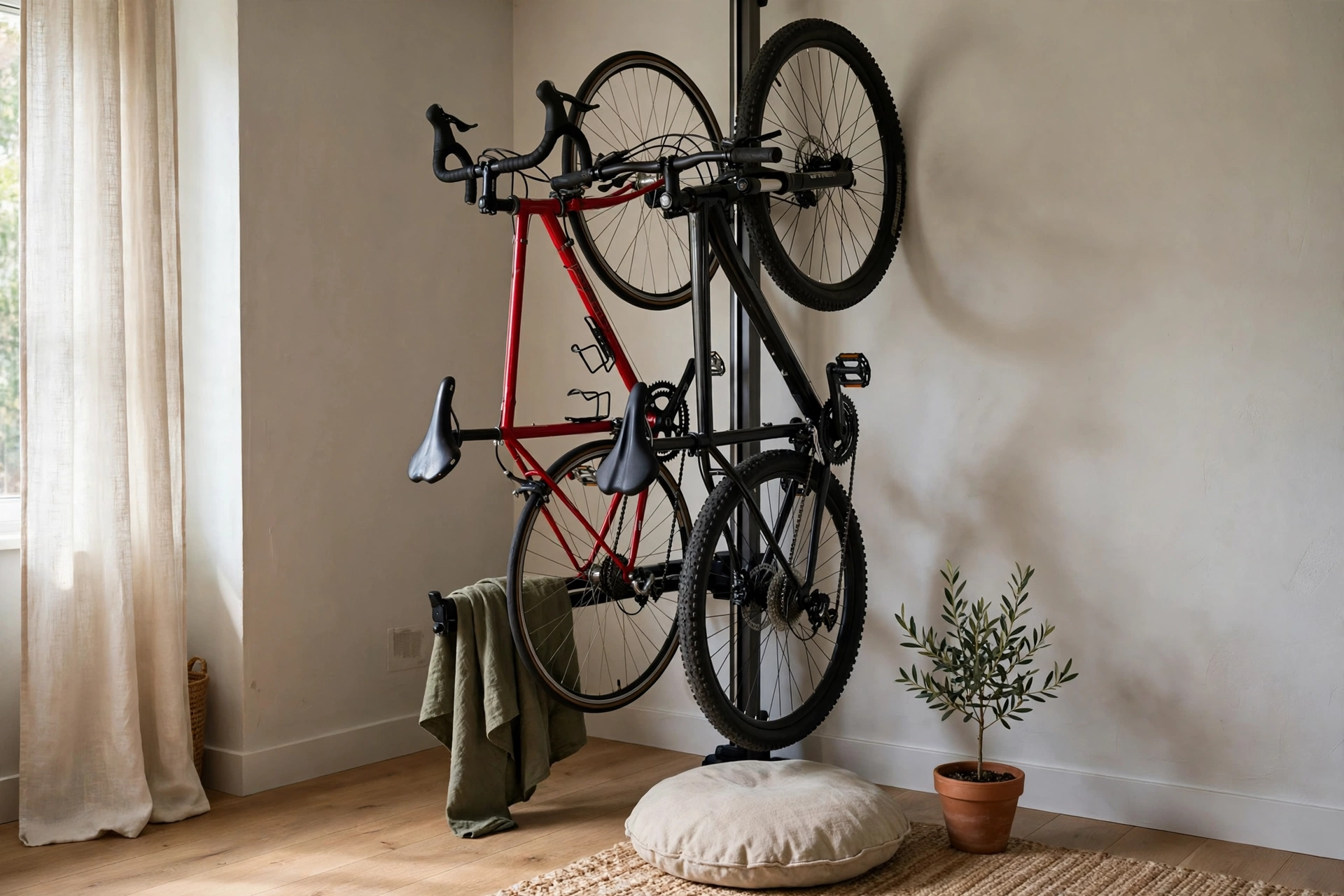
3. Simple floor rack (RAD Cycle style). Best for: the cheapest fix that actually works.
Main advantage: Two tire cradles hold the bikes upright for $42.75 as of November 2026, and you just roll the front wheel in. No assembly drama, no wall contact at all.
Watch out for: It fits tires up to 2.4 inches (6 cm) wide, so fat-tire bikes will not slot in, and it uses about 24 by 24 inches (61 by 61 cm) of floor.
Verdict: Start here if money is tight. Deposit risk: 1/5.
4. Vertical wall hook (with permission). Best for: the smallest possible footprint.
Main advantage: The bike hangs upright by its front wheel and uses about 18 inches (46 cm) of wall width, which is the least wall any method needs.
Watch out for: You drill into a stud, so ask the landlord first, and lifting a heavy bike up onto the hook every day gets old fast.
Verdict: Brilliant for a light bike you ride daily, if permission is in writing. Deposit risk: 3/5.
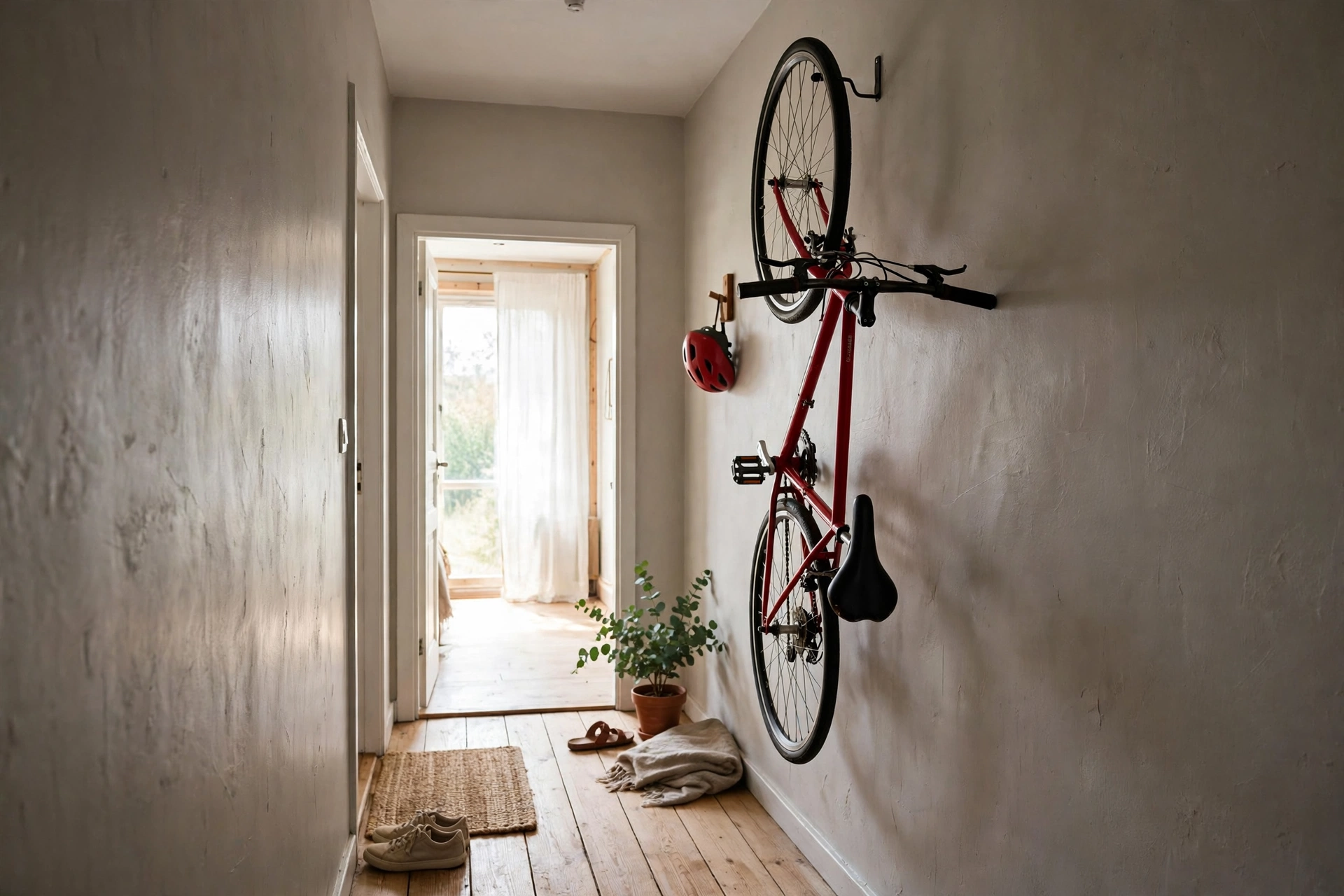
5. Ceiling pulley hoist (with permission). Best for: a bike you ride once a week or less.
Main advantage: The bike lives overhead, completely off the floor and off the walls, and the pulley does the lifting.
Watch out for: It must anchor into a ceiling joist, not just drywall, and you need enough ceiling height to clear your head underneath the hanging bike.
Verdict: The best use of dead air in the apartment, but only for occasional riders. Deposit risk: 3/5.
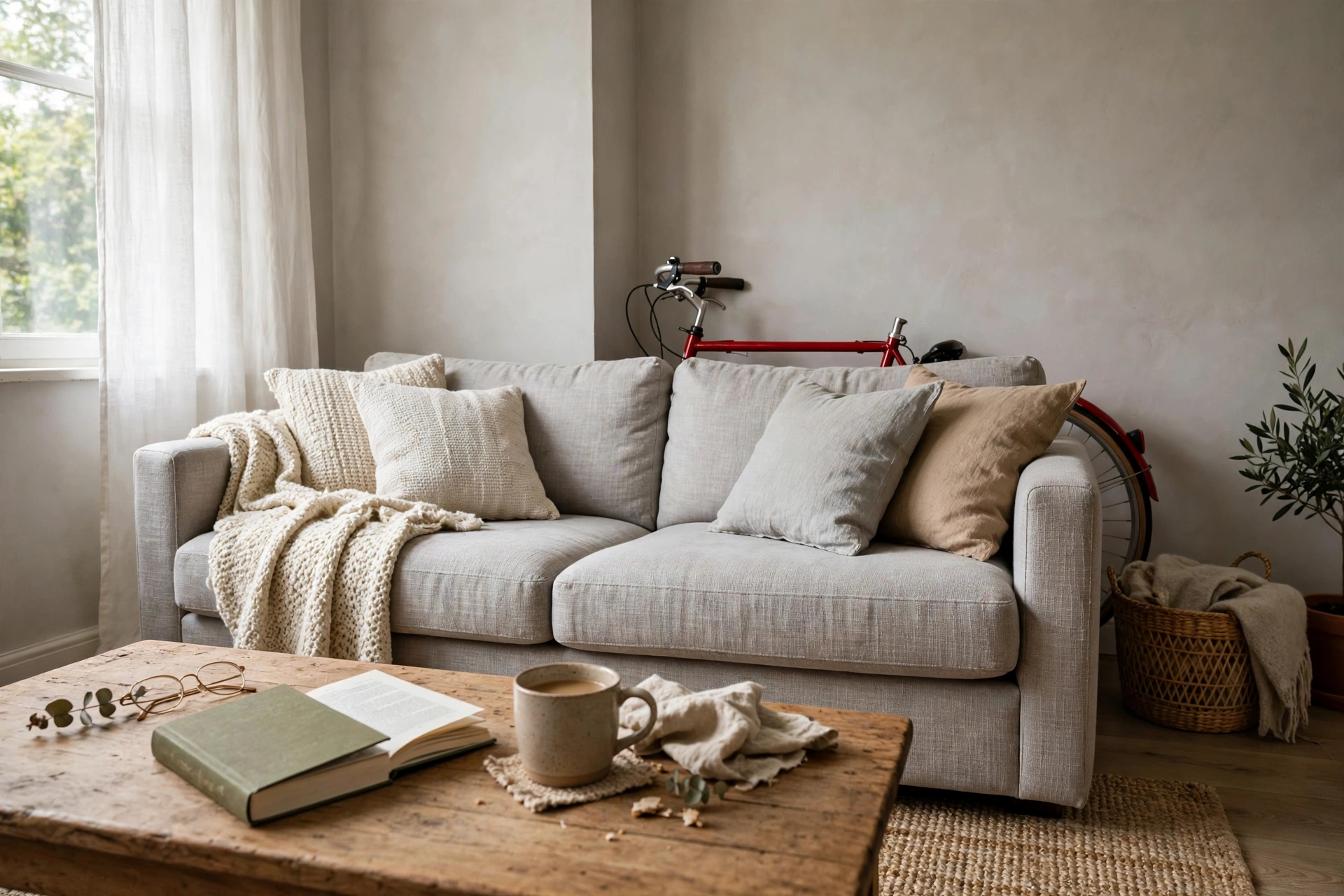
6. Behind the couch. Best for: studios where every wall is already taken.
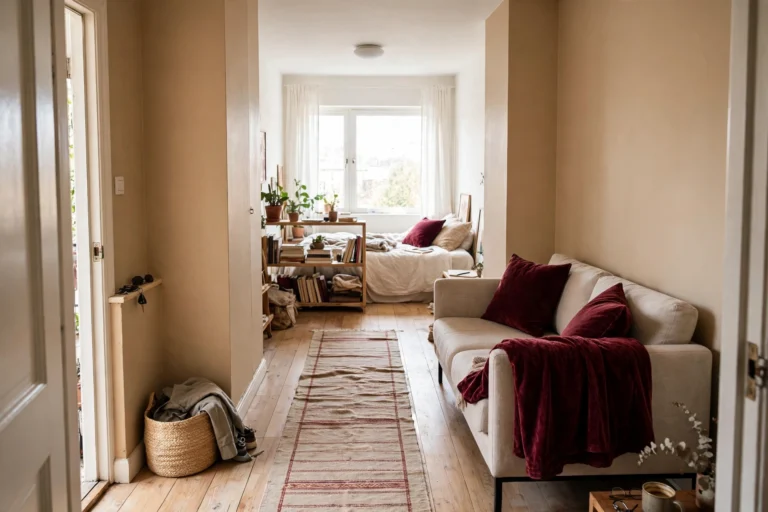
Main advantage: It costs nothing. Turn the bars sideways and the bike slides into the gap between the couch and the wall, out of sight and out of the walkway. This is the trick that makes a studio apartment layout work when the floor plan gives you no spare corner, and the same hide-it-in-plain-sight logic shows up in the best studio apartment layout ideas.
Watch out for: You need a 14 to 18 inch (36 to 46 cm) gap, and the bike will collect dust back there, so wipe the frame when you pull it out.
Verdict: Free, invisible, and surprisingly practical. Deposit risk: 1/5.
7. Coat closet conversion. Best for: renters with a closet they barely use for coats.
Main advantage: The bike stands upright inside the closet, the door closes, and the apartment looks bike-free. A rolling floor rack inside the closet keeps it tidy.
Watch out for: Measure the closet depth first. A 24 inch (61 cm) deep closet will not hold a bike with the bars straight, so turn the bars or remove a pedal.
Verdict: The tidiest hidden option, if your closet is deep enough. Pair it with the small coat closet organization plan for the coats that still need a home.
Deposit risk: 1/5.
8. Under the loft bed or under the desk. Best for: raised beds and tall desks.
Main advantage: The space under a loft bed is usually wasted air, and a bike slides in beside a dresser or storage bin. Under a tall standing desk it works the same way.
Watch out for: Check the clearance before you commit, and keep the chain side away from bedding and cables. A budget home office setup with a bike parked under the desk needs a floor mat, or the tires will mark the floor.
Verdict: Great for studios with a raised bed. Deposit risk: 1/5.
9. Entryway slim rack. Best for: daily riders who want grab-and-go access.
Main advantage: A slim upright rack by the front door holds the bike in under a foot of floor width, so you roll out in seconds. This is the one spot where a tiny entryway setup and a bike rack genuinely help each other, because the bike becomes part of the drop zone instead of an obstacle in it.
Watch out for: Keep the walkway clear and the door swing free, and put a mat under the tires to protect the floor.
Verdict: The most convenient daily setup, if your entryway has a spare foot. Deposit risk: 1/5.
10. Shrink the bike itself. Best for: any method above that is almost, but not quite, fitting.
Main advantage: Rotating the handlebars 90 degrees lines them up with the frame, and popping off a pedal takes minutes. Together they can cut the bike’s width by a third, which is often the difference between fitting and not fitting.
Watch out for: You will do it every time you park, so only choose this if you ride a few times a week, not daily.
Verdict: Not storage by itself, but the trick that makes every other idea fit. Deposit risk: 1/5.
What a no-drill setup costs (as of November 2026)
Prices checked live in November 2026 from retailer and guide listings. No affiliate links, and these are market prices, not a receipt for anything I bought.
| Setup | What you get | Price checked |
|---|---|---|
| Budget route, 1-2 bikes | RAD Cycle 2-bike floor rack | $42.75 |
| Gravity route, 2 bikes | Delta Cycle Michelangelo gravity stand | $79.99 (Dick’s Sporting Goods, in stock) |
| Single-bike floor stand | Feedback Sports RAKK | C$83 |
| Wall hook (with permission) | Basic vertical wall hook | $15-$50 |
| Ceiling hoist (with permission) | Pulley hoist system | $30-$200 |
A realistic starter kit for one bike is the RAD Cycle floor rack at $42.75 and nothing else. If you have two bikes and a free wall, the Michelangelo at $79.99 is the upgrade that earns its price, because it holds both bikes in 2.1 square feet of floor. Expect about 15 minutes to assemble either one. A wall hook or hoist adds an hour if you are drilling into a stud or joist for the first time.
How to set up no-drill bike storage in a weekend
Materials: tape measure, painter’s tape, the rack or stand you chose, a rubber floor mat (optional, for tire marks), a small bin for helmet, lights, and tools.
Steps:
- Measure the bike. Write down length, handlebar width, and weight.
- Measure the spot. Check floor footprint, wall width, and ceiling height against the fit table.
- Tape the footprint. Mark the rack’s footprint on the floor with painter’s tape and live with it for a day.
- Check the walkway. You need at least 24 inches (61 cm) of clear walking space past the parked bike.
- Assemble the rack. Follow the manufacturer’s instructions and check every bolt before loading a bike.
- Load the heaviest bike first. On a two-bike stand, the heavier bike goes on the lower arms.
- Test it for a week. If you clip it daily, move the spot, not the bike.
Mistakes to avoid
Buying before measuring. The bars are the widest part, and a rack that fits the wheels but not the bars is money wasted.
Hanging a full bike on adhesive hooks. Heavy-duty adhesive hooks hold 10 to 25 pounds per pair, and a bike weighs 20 to 35 pounds before you add a lock and lights. Adhesive is for helmets, not bikes.
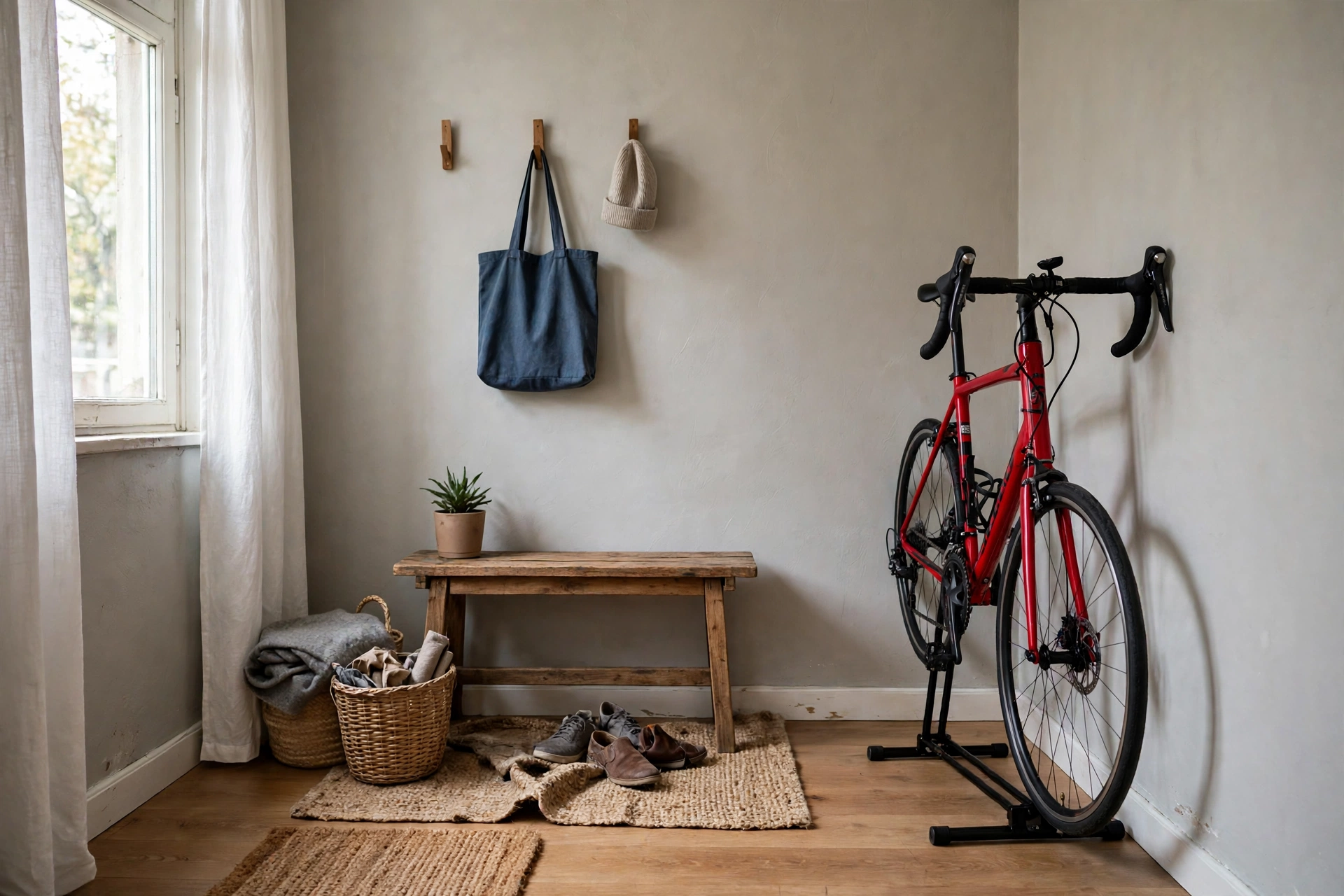
Forgetting the ceiling. The Michelangelo is 84 inches tall. In a 7 foot ceiling apartment it fits with nothing to spare, and in a shorter room it does not fit at all.
Blocking the exit. Building codes and leases both care about clear exits. A bike in front of the only door is a safety problem, not a storage solution.
Storing a dirty bike indoors. Wipe the tires and chain before it comes inside, or the hallway will tell the story within a week.
What to skip
A wall mount on drywall with no stud. Drywall anchors are not a plan for a 30 pound bike that gets lifted on and off daily. Find the stud or pick a freestanding option.
Balcony storage as a first choice. Balconies look like free space, but rain, sun, and temperature swings wear a bike out fast, many leases ban balcony bike storage, and a bike on a balcony is easier to steal. Treat it as a last resort, with a cover, and only if the lease allows it.
A ceiling hoist for a daily rider. Hoisting a bike overhead twice a day is a workout you did not sign up for, and you will stop doing it within a month.
The cheapest no-name stand. A wobbly stand that tips over onto your bike, your wall, or your foot is not a bargain. Check the weight rating against your actual bike before you buy.
Renter caveat: check the lease before you drill
Freestanding stands, tension poles, and floor racks are furniture, not fixtures, and most leases treat them that way, which is why their deposit risk is 1 out of 5. Most bike storage ideas for small apartments are renter-safe for exactly this reason: a stand is furniture, a wall mount is a fixture. Anything that puts a hole in a wall or ceiling is different. Read the lease for the alterations clause, ask the landlord in writing before you drill, and keep the permission with your lease papers. Photograph the wall before you mount anything and again when you remove it, so a deposit dispute has evidence on both sides. If the lease is silent, ask anyway, because a five-minute question is cheaper than a patch-and-paint charge at move-out.
Can you store a bike in a small apartment without drilling?
Yes. A gravity stand, a tension-pole rack, or a simple floor rack all hold a bike with no holes in the wall. A gravity stand holds two bikes in 22 by 14 inches of floor, and a floor rack costs $42.75 as of November 2026. That is the whole point of bike storage ideas for small apartments: the bike lives inside, but the walls stay untouched.
Where is the best place to store a bike in an apartment?
The best place is the spot closest to the front door that does not block a walkway. An entryway corner or a coat closet wins for daily riders because the bike is easy to grab. A living room corner works for occasional riders, and a ceiling hoist suits a bike you only ride on weekends.
Can I keep my bike on my apartment balcony?
You can, but it is the weakest option. Rain and sun wear out the chain, tires, and brakes, many leases ban it, and a bike on a balcony is easier to steal. If the lease allows it and it is your only choice, use a waterproof cover, lock the bike to the railing or a fixed point, and bring it inside for winter.
How much space does a bike take up in an apartment?
A typical medium road bike is about 68 inches (173 cm) long with handlebars 15 to 31 inches (38 to 80 cm) wide. Parked flat it needs a full wall. Stored upright on a gravity stand, two bikes fit in 22 by 14 inches (56 by 36 cm) of floor, about 2.1 square feet, which is why vertical storage is the first move in a small apartment.
How this was made: I checked the top search results for this keyword, measured the fit math from real bike and rack dimensions, and checked rack prices live in November 2026. No products were tested and no purchases were made.
Sources: Flatbike’s guide to storing a bike in a small space (handlebar widths 38-80 cm) and Apartment Notes’ 10 ways to store a bike in an apartment (decision guide and method comparison). Prices from Dick’s Sporting Goods, REI, and ShopAbunda listings seen in November 2026.