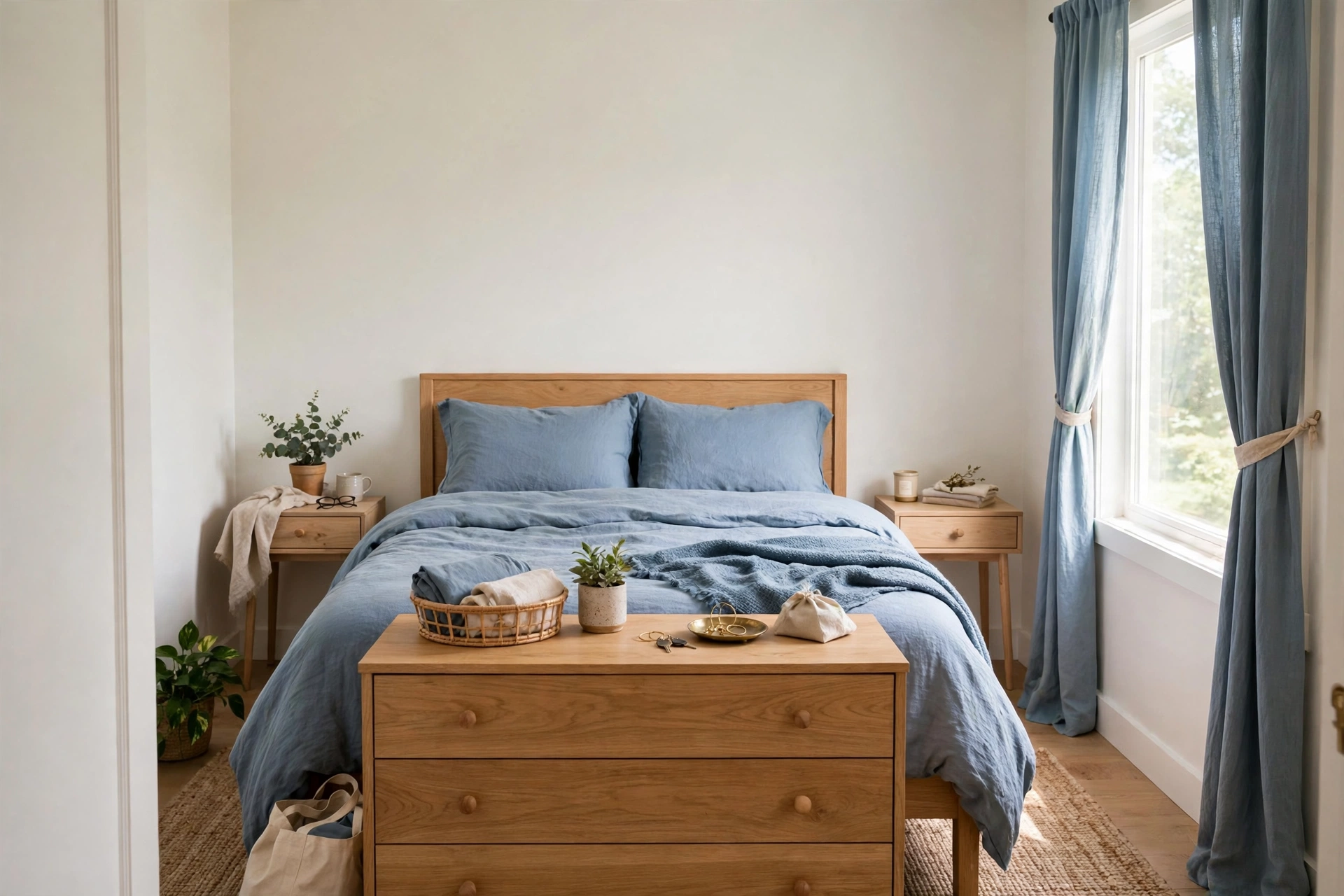
What Size Furniture Fits a Small Bedroom? Max Sizes for 80 to 120 Sq Ft Rooms
If you are shopping by small bedroom furniture sizes, here is the short answer: in a Small band bedroom of 80 to 120 sq ft, a queen bed is the largest bed that still leaves a real walkway, a dresser may be no wider than 48 inches (122 cm), nightstands top out at 22 inches (56 cm) wide, and a wardrobe stays at 48 inches (122 cm) wide or under. The original element in this guide is a worked 10 by 12 ft room (3.0 by 3.7 m, 120 sq ft) where every piece is tested on frame numbers, not mattress numbers: a queen frame of 64 by 84 inches (163 by 213 cm) leaves 28 inches (71 cm) on each side and 60 inches (152 cm) at the foot, while a king frame leaves only 19 inches (48 cm) per side and fails. Measure the frame, tape the footprint, and buy only what passes all three clearance arcs in this guide.
What small bedroom furniture sizes fit a 10 by 12 room?
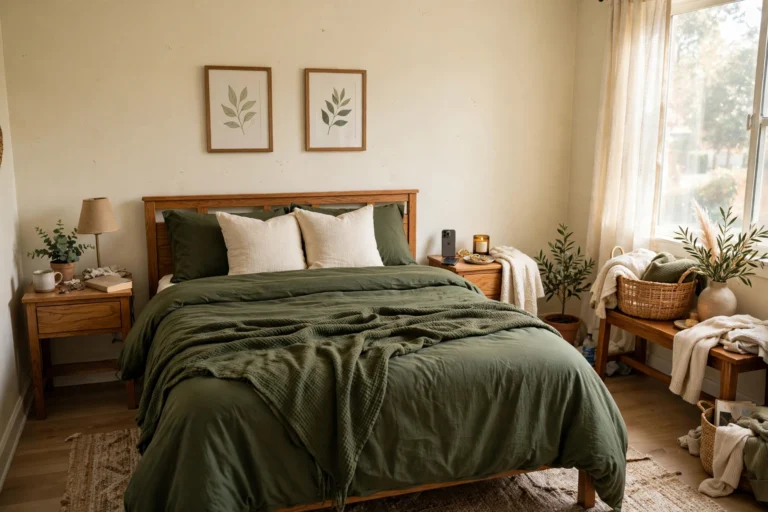
Start with the room, not the furniture. A 10 by 12 ft room gives you two walls of 120 inches (305 cm) and two walls of 144 inches (366 cm). The bed takes the 10 ft wall. The math that decides everything else is simple subtraction, and it only works if you use frame sizes. A queen mattress is 60 by 80 inches (152 by 203 cm), but its frame is typically 64 by 84 inches (163 by 213 cm). That extra 4 inches (10 cm) on each side is where most small bedroom plans quietly break.
On the 120 inch wall, a centered queen frame leaves 120 minus 64, which is 56 inches (142 cm), or 28 inches (71 cm) per side. That passes the widely used 24 inch (61 cm) minimum walkway with a little margin, but it falls just short of the comfortable 30 inch (76 cm) standard. So a queen works in this band, but it works tightly. Anything wider than the queen frame eats that margin first, and the nightstands go next.
At the foot, the room gives you 144 minus 84, which is 60 inches (152 cm). A dresser at the foot needs its depth plus standing room: 18 inches (46 cm) of depth plus 36 inches (91 cm) to stand and open drawers, which is 54 inches (137 cm) in total. It fits the 60 inch foot space with 6 inches (15 cm) to spare. Keep that 6 inch figure in mind, because it is the whole story of this band: things fit, but only just, and only if you respect every cap below. If your room is smaller than this band, the tiny bedroom layout ideas for rooms under 80 sq ft use tighter caps, so do not borrow numbers across bands.
What small bedroom furniture sizes are the caps for each piece?
These small bedroom furniture sizes are caps, not targets. If a piece is smaller than the cap, it only helps. If it is larger, it fails the room, no matter how good it looks in the store.
Table, max size for the Small band: Queen bed frame, 64 by 84 inches (163 by 213 cm), leaves 28 inches (71 cm) per side on a 10 ft wall. Full bed frame, 58 by 80 inches (147 by 203 cm), leaves 31 inches (79 cm) per side, the comfortable choice. Twin bed frame, 43 by 80 inches (109 by 203 cm), leaves about 38 inches (98 cm) per side, room for a desk. King bed frame, does not fit as a walk-around bed, leaves 19 inches (48 cm) per side, below the 24 inch minimum. Dresser, 48 by 18 inches (122 by 46 cm), 47.2 inch models fit with under 1 inch to spare. Tall chest, 36 by 18 inches (91 by 46 cm), same storage, narrower wall, taller profile. Wardrobe, 48 inches wide (122 cm), 24 inches deep (61 cm), keeps a 36 inch (91 cm) clear zone in front. Nightstand, 22 by 16 inches (56 by 41 cm), fits the 28 inch queen side gap with room for bedding. Rug under a queen, 8 by 10 ft (2.4 by 3.0 m), wider than the 64 inch frame on both sides. Desk, only if it replaces the dresser, 48 by 24 inches (122 by 61 cm), uses the same wall budget, never both pieces.
Which bed size is right for a Small band bedroom?
Best for: most couples in this band, a queen frame is the right ceiling.
Main advantage: a queen sleeps two properly and still leaves 28 inches (71 cm) per side on a 10 ft wall.
Watch out for: the frame, not the mattress. A bulky headboard or a frame with wide side rails can add 2 inches (5 cm) and cut each side gap to 27 inches (69 cm) or less. Read the technical sheet for the exact model, because frames vary.
Verdict: buy the queen only if your taped footprint still leaves at least 24 inches (61 cm) on both sides. If it does not, drop to a full.
A full frame at 58 by 80 inches (147 by 203 cm) is, in my experience, the underrated pick for this band. It leaves 31 inches (79 cm) per side, which is genuinely comfortable, and it frees enough wall for two real nightstands instead of one shelf and one apology. If one person sleeps in the room, a full is hard to beat.
A twin frame at 43 by 80 inches (109 by 203 cm) is the choice when the room must also hold a desk or a large wardrobe. It leaves about 38 inches (98 cm) per side, which is enough for a small desk on one side and a chest on the other. For a guest room or a child’s room in this band, a twin keeps the room feeling like a room instead of a bed with walls.
A king frame fails this band on plain subtraction. A king mattress is 76 by 80 inches (193 by 203 cm) and its frame runs about 82 by 85 inches (208 by 216 cm). On a 120 inch wall that leaves 38 inches (97 cm) in total, or 19 inches (48 cm) per side. That is below the 24 inch (61 cm) minimum, so you shuffle sideways past the bed and wardrobe doors cannot open fully. The overrated move in small bedrooms is buying the biggest bed that physically fits through the door. Fit is not the same as livable, and a king in this band proves it. If you already own a king, the honest fix is a larger room, not narrower nightstands. Our tiny bedroom furniture sizes guide covers rooms under 80 sq ft, where even a queen is usually the wrong call.
Dresser or chest: which one earns the wall?
Best for: a wide dresser suits a room with a free 48 inch (122 cm) wall and no foot-of-bed squeeze.
Main advantage: six shallow drawers are easier to live with than five deep ones, and the top doubles as a landing spot.
Watch out for: depth matters as much as width. A dresser deeper than 18 inches (46 cm) steals standing room inch for inch, and a 60 inch (152 cm) wide dresser, the standard six-drawer size in many stores, simply does not fit this band.
Verdict: cap the dresser at 48 by 18 inches (122 by 46 cm). The 47.2 inch (120 cm) wide six-drawer models checked for this guide, at 15.7 inches (40 cm) deep, fit the cap with under 1 inch (2.5 cm) to spare on width. Measure yours, because a “standard dresser” label hides a 12 inch width range.
A tall chest is the better pick when the free wall is under 48 inches (122 cm) or when the dresser must sit at the foot of the bed. Cap it at 36 by 18 inches (91 by 46 cm) and let height do the work: chests commonly run 48 to 54 inches (122 to 137 cm) tall, which holds as much as a low dresser without eating floor. The trade is reach: top drawers suit out-of-season clothes, not daily shirts. Put daily clothes in the middle drawers and stop pretending the top drawer is convenient.
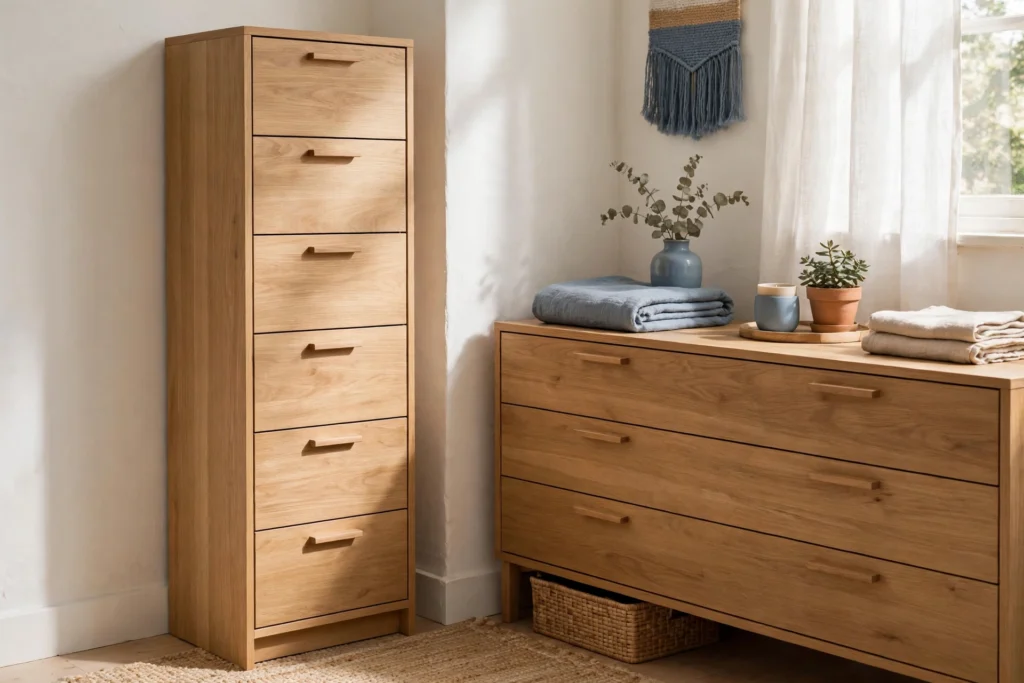
Wardrobe doors: sliding wins in this band
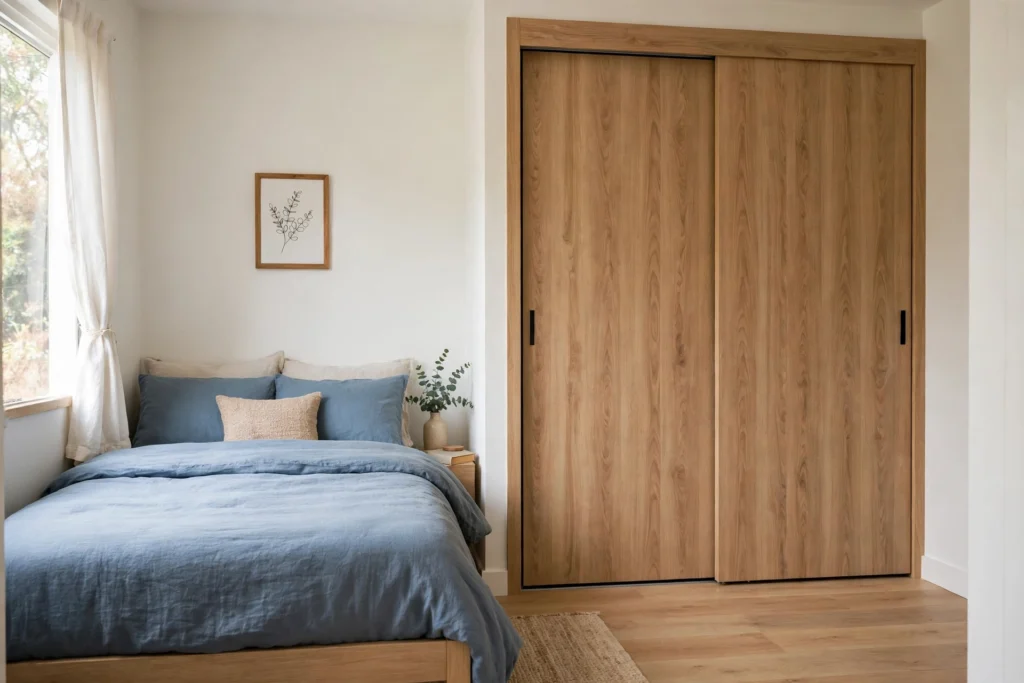
Best for: sliding wardrobe doors suit any Small band bedroom, because they add no swing arc to the floor plan.
Main advantage: a 48 inch (122 cm) wide wardrobe with sliding doors needs only its 24 inch (61 cm) depth plus the 36 inch (91 cm) clear zone in front, which is 60 inches (152 cm) of room depth in total.
Watch out for: hinged doors each swing about 24 inches (61 cm) into the room. If that swing crosses the bed’s side gap or the dresser drawer pull, one of the three will lose every time you open it.
Verdict: choose sliding doors, or a freestanding wardrobe no wider than 48 inches (122 cm) with doors that open onto a wall, never onto the walkway.
Depth deserves the same attention as width. Standard wardrobes run about 24 inches (61 cm) deep, which is what hangers need. Shallow wardrobes at 20 inches (51 cm) or less crush jacket shoulders and waste the wall anyway, so do not trade depth for a few inches of floor. If your room has a built-in closet, spend the wardrobe budget on better interior fittings instead of a second freestanding unit.
Nightstands and rugs: small pieces, strict caps
Best for: slim nightstands suit queen beds in this band, and a wall shelf suits the side where even a slim table will not fit.
Main advantage: a 22 inch (56 cm) wide nightstand fits the 28 inch (71 cm) queen side gap with about 6 inches (15 cm) left for bedding and a lamp cord.
Watch out for: height. The nightstand top should sit at or just below the top of the mattress, typically 24 to 28 inches (61 to 71 cm) high. A tall nightstand beside a low platform bed looks wrong and reaches awkwardly in the dark.
Verdict: cap nightstands at 22 by 16 inches (56 by 41 cm). If your queen side gap measures under 24 inches (61 cm) after taping, use a wall-mounted shelf on that side instead of forcing a table in.
Rugs follow one rule: the rug must be wider than the bed frame. An 8 by 10 ft rug (2.4 by 3.0 m) is 96 inches (244 cm) wide, so it extends 16 inches (41 cm) beyond each side of a 64 inch queen frame, and it fits a 10 by 12 ft room with about 12 inches (30 cm) of bare floor on each side. A 5 by 8 ft rug (1.5 by 2.4 m) is only 60 inches (152 cm) wide, which is narrower than the queen frame itself, so the bed overhangs the rug on both sides and the rug looks like a mat that missed. Save the 5 by 8 ft size for a twin bed, where it extends about 8 inches (20 cm) per side, and accept it as marginal for a full bed at only 1 inch (2.5 cm) per side.
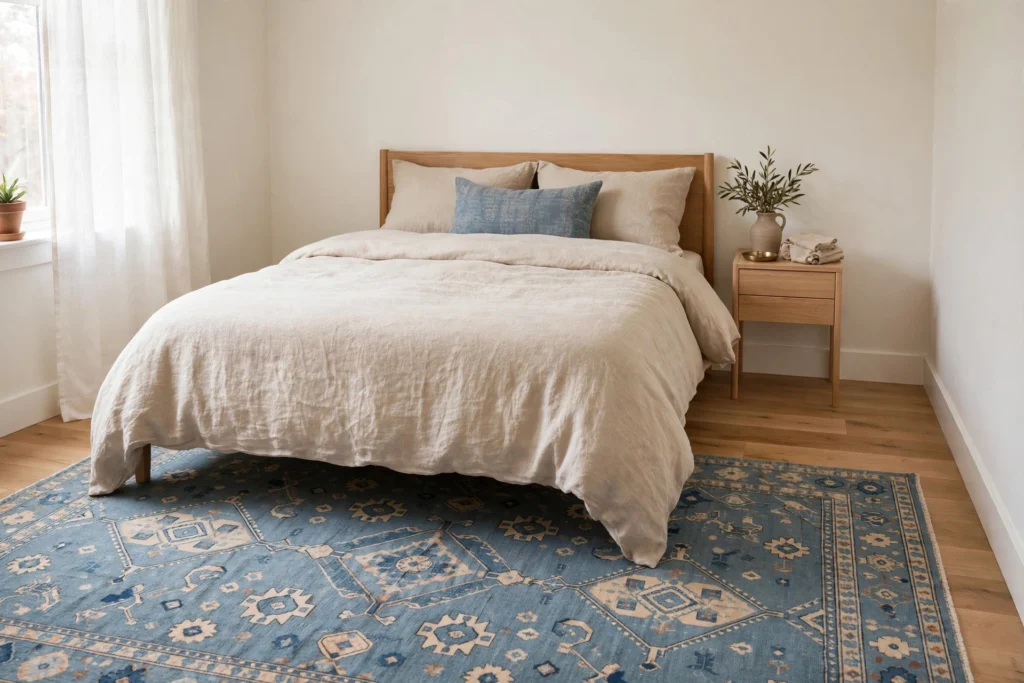
How to test small bedroom furniture sizes before you buy
Run this tape test before you order anything. It takes about 45 to 60 minutes, and it has saved more returns than any review ever will.
- Measure both walls, the door width, and the full door swing arc, then mark the swing on the floor with painter’s tape.
- Tape the bed frame footprint on the floor, using frame numbers from the model’s technical sheet, not the mattress label.
- Tape the dresser footprint where it will sit, then tape a second rectangle 18 inches (46 cm) in front of it for the open drawer.
- Tape the wardrobe footprint, then tape its door swing arc if the doors are hinged.
- Walk all three arcs: the door swing, the drawer pull, and the wardrobe swing. If any two overlap the main walkway at the same time, the piece fails.
- Buy only the pieces that pass all three arcs with at least 24 inches (61 cm) of walkway left. Everything else waits for a bigger room.
The test also settles the 10 by 10 ft question that comes up constantly. A queen frame fits a 10 by 10 ft room for sleeping, with the same 28 inches (71 cm) per side, but the foot space shrinks to 36 inches (91 cm). A foot dresser there leaves only 18 inches (46 cm) of walkway with its drawer closed and none with it open, so it fails. In a 10 by 10 ft room, put the dresser on a side wall or switch to a chest. Our 10×10 bedroom layout ideas show the plans that work around that exact squeeze, and the 10 by 10 bedroom fit guide we checked agrees that a queen leaves minimal room for other furniture in a square 10 ft room.
What does a Small band bedroom set cost?
Prices below are checked market prices as of November 2026, framed as costs, not personal purchases. Queen frames and dressers come from November 2026 retail listings checked for this guide; nightstands and tape are typical retail ranges.
Table: Queen platform frame, $104 to $250, plain frames from $104, wood frames to $250. 6-drawer dresser, 47.2 inches wide, $180 to $250, Target listings checked November 2026, 15.7 inches deep. Slim nightstands, pair, $60 to $140, typical retail range for 22 inch or narrower tables. 8 by 10 ft rug, $55 to $125, washable and low-pile options checked November 2026. Painter’s tape and tape measure, $10 to $15, for the tape test, buy before the furniture. Room total, $409 to $780, frame plus dresser plus pair plus rug plus tape.
The total assumes you already own a mattress. A storage bed frame with drawers costs more, from $220 to $300 for queen models checked, and it can replace a small chest if your room is short on walls. Do not let the storage bed talk you into a king frame, though. Storage does not change the walkway math.
Mistakes to avoid
Measuring the mattress instead of the frame. Every clearance in this guide uses frame numbers. Mattress numbers flatter every plan by 4 inches (10 cm) in width and length, which is exactly the margin a Small band room cannot spare.
Buying the bedroom set as a set. Matching sets force one size across every piece, and the set’s dresser is usually the 60 inch (152 cm) model that fails this band. Buy pieces individually against the caps above. A room that matches loosely and fits beats a room that matches perfectly and blocks the door.
Forgetting the drawer pull. A dresser that fits with its drawers closed and blocks the walkway with one drawer open does not fit. Tape the open-drawer rectangle every time.
Putting a wardrobe opposite a hinged door. Two swing arcs fighting over one walkway means one door stays shut most of the time. Move the wardrobe, change the door swing, or switch to sliding doors.
Choosing a rug by the room, not the bed. A rug sized to the room label instead of the frame width ends up narrower than the bed. Size the rug to the frame first, then check it against the room.
What to skip
Skip the king bed in this band, skip the 60 inch dresser, skip the matching set, and skip the bench at the foot of the bed unless your foot space measures over 60 inches (152 cm) after the dresser test. A bench is lovely in a larger room and a shin hazard in this one. Skip a second wardrobe when a closet already exists; better closet fittings hold more than a second freestanding box and cost less floor. Skip tall headboards over 60 inches (152 cm) in rooms with low windows, because they block light and make the wall feel shorter than it is. If you want more storage without more floor, our small bedroom organization ideas cover under-bed bins and wall shelves that do not touch these caps.
A note for renters
Freestanding furniture needs no landlord permission in most leases, which is one more reason to prefer it in this band. Wall-mounted shelves, wardrobe anchoring, and anti-tip straps are different: anchoring drills into studs, so check your lease first, ask permission where the lease requires it, and keep the fixings so you can reverse the job at move-out. A freestanding wardrobe plus a tall chest usually removes the need to drill anything at all, which keeps the deposit argument short. If your lease bans wall fixings outright, skip the wall shelf and use the slimmer nightstand instead.
What size bed fits a small bedroom?
In a Small band bedroom of 80 to 120 sq ft, a queen frame up to 64 by 84 inches (163 by 213 cm) fits with 28 inches (71 cm) per side on a 10 ft wal. A full frame is the comfortable pick, and a king frame fails the 24 inch (61 cm) minimum walkway.
Can a queen bed fit in a 10×10 bedroom?
Yes for sleeping, with the same 28 inches (71 cm) per side, but a dresser at the foot does not fit: the foot space is only 36 inches (91 cm), so a dresser leaves 18 inches (46 cm) with its drawer closed and none with it open. Put the dresser on a side wall or use a chest instead.
What size dresser fits a small bedroom?
Cap it at 48 inches (122 cm) wide and 18 inches (46 cm) deep. A 47.2 inch (120 cm) six-drawer model fits with under 1 inch (2.5 cm) to spare. If the free wall is shorter than 48 inches (122 cm), use a tall chest up to 36 inches (91 cm) wide instead.
What size rug goes under a queen bed in a small bedroom?
Use an 8 by 10 ft rug (2.4 by 3.0 m). It extends 16 inches (41 cm) beyond each side of a 64 inch queen frame. A 5 by 8 ft rug is narrower than the queen frame, so save it for a twin bed.
How this was made: this guide was built from the room-math band tables, live November 2026 retail listings for frames, dressers and rugs, and the worked 10 by 12 ft subtraction checks above. No hands-on testing is claimed and no piece was bought for this guide.
By Wasim