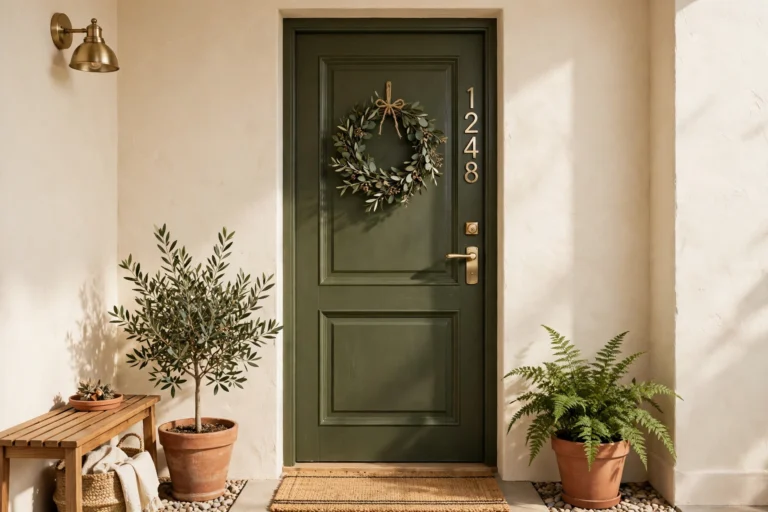
Best Paint Colors for Small Entryways: 7 Colors That Make a Tiny Entrance Feel Bigger
The short answer: pick a warm white or light greige with an LRV above 60, paint it in satin, and test it under your own bulbs first. The best paint colors for small entryways are not the brightest whites on the chip. They are the colors that bounce the most light back in a space that often has no window at all. This post ranks 7 of them by verified LRV, from White Dove at 85.38 down to Revere Pewter at 55.51, and works out the paint math for three real entry sizes. A standard 3 by 5 ft entry needs 1 gallon for two coats, not two.
Most small entries have no window, so the color is judged under artificial light only. Judge every color by its LRV and your bulb temperature.
What are the best paint colors for small entryways for a windowless hall?
For a windowless hall, White Dove OC-17 or Alabaster SW 7008 are the safest picks. Both sit above LRV 80, both stay warm under bulbs, and neither goes stark. Use warm white bulbs at 2700 to 3000K.
A windowless entry still needs contrast, or it reads like a white tunnel. Bring it in with the front door or a rug, not a dark wall. Paint alone will not fix a cluttered entry, so pair the color with the storage system in our small entryway organization ideas before you judge how the paint looks.
The 7 colors, ranked by LRV
LRV, or Light Reflectance Value, runs from 0 (black) to 100 (pure white). It measures how much light a color reflects. The ladder below ranks the best paint colors for small entryways by verified LRV, highest first. Every number comes from manufacturer-published data, with a second source cross-check. The method is the same LRV ladder we used for best paint colors for small living rooms.
| Rank | Color | Code | LRV | Undertone | Best light |
|---|---|---|---|---|---|
| 1 | White Dove | BM OC-17 | 85.38 | Soft warm, faint yellow gray | No windows, north |
| 2 | Alabaster | SW 7008 | 82 | Warm white, creamy beige gray | No windows, north, west |
| 3 | Pale Oak | BM OC-20 | 68.64 | Warm greige, soft taupe | South, east, north |
| 4 | Edgecomb Gray | BM HC-173 | 63.09 | Warm greige, beige gray | South, east |
| 5 | Agreeable Gray | SW 7029 | 60 | Warm greige, soft beige | South, west |
| 6 | Accessible Beige | SW 7036 | 58 | Warm beige greige | South, west |
| 7 | Revere Pewter | BM HC-172 | 55.51 | Warm greige, green brown | South only, end wall only |
1. White Dove OC-17, LRV 85.38
Best for: windowless entries and north-facing doors. Main advantage: reads white without going cold, and forgives bad light. Watch out for: can look slightly creamy next to a bright white ceiling. Verdict: the default pick when unsure. Deposit-Risk: 1/5.
2. Alabaster SW 7008, LRV 82
Best for: entries opening into a living room. Main advantage: soft and warm, never stark, and blends with almost any warm neutral. Watch out for: can drift slightly greige in cool north light. Verdict: the warmest safe white here. Deposit-Risk: 1/5.
3. Pale Oak OC-20, LRV 68.64
Best for: entries with some daylight that need more color than white. Main advantage: reads like an off-white in sun, a gentle greige in shade. Watch out for: a faint purple cast under cool LED bulbs, so use warm bulbs. Verdict: the best step up from white. Deposit-Risk: 2/5.
4. Edgecomb Gray HC-173, LRV 63.09
Best for: south and east facing entries with real daylight. Main advantage: a warm greige that hides scuffs better than any white here. Watch out for: can read flat and gray in a windowless hall. Verdict: the best greige for a lit entry. Deposit-Risk: 2/5.
5. Agreeable Gray SW 7029, LRV 60
Best for: open entries flowing into a gray-toned living room. Main advantage: the most forgiving greige for mixed wood tones. Watch out for: can show a faint green edge in low light, so test it at night. Verdict: the safe greige when the home leans gray. Deposit-Risk: 2/5.
6. Accessible Beige SW 7036, LRV 58
Best for: warm homes with honey oak, travertine, or brass at the door. Main advantage: honest warmth that never reads cold. Watch out for: the yellowest color here, so it can look dated next to cool gray floors. Verdict: the warmest greige here, best in warm homes only. Deposit-Risk: 2/5.
7. Revere Pewter HC-172, LRV 55.51
Best for: one end wall in a long hall, or an entry with strong south light. Main advantage: real depth and contrast. Watch out for: on all four walls of a 3 ft hall it closes the space in. Verdict: an accent color, not a whole-entry color. Deposit-Risk: 3/5.
Pick by your light direction first
Light direction beats personal taste here: the room is too small to fight its light.
| Light direction | Pick | Avoid | Why |
|---|---|---|---|
| North facing | White Dove, Alabaster, Pale Oak | Cool gray, stark white | North light is cool and weak, so warm high-LRV colors do the lifting |
| South facing | Edgecomb Gray, Agreeable Gray, Accessible Beige | Very pale white | South light is strong, so mid-tone colors hold their color instead of washing out |
| East facing | Pale Oak, Edgecomb Gray | Deep greige | Morning light is bright but brief, so a light greige works all day |
| West facing | Alabaster, Accessible Beige | Cool white | Afternoon sun is warm, so warm colors stay true and cool ones turn gray |
| No windows | White Dove, Alabaster | Revere Pewter on all walls, cool gray | Bulbs are the only light, so LRV above 80 and warm bulbs matter most |
The same warm whites in small bedroom paint colors follow the same rule: warm wins when the light is cool.
The end-wall rule, measured
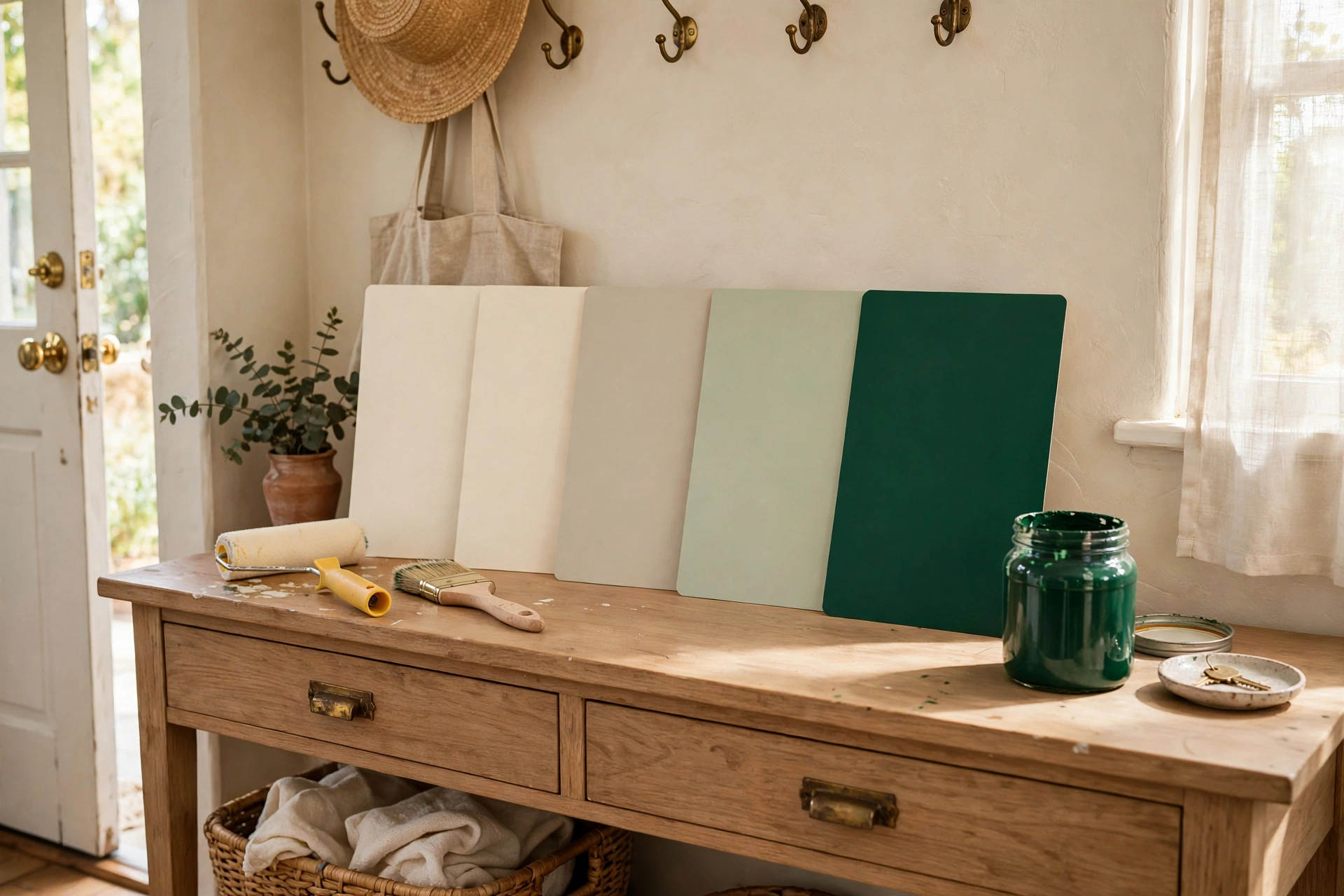
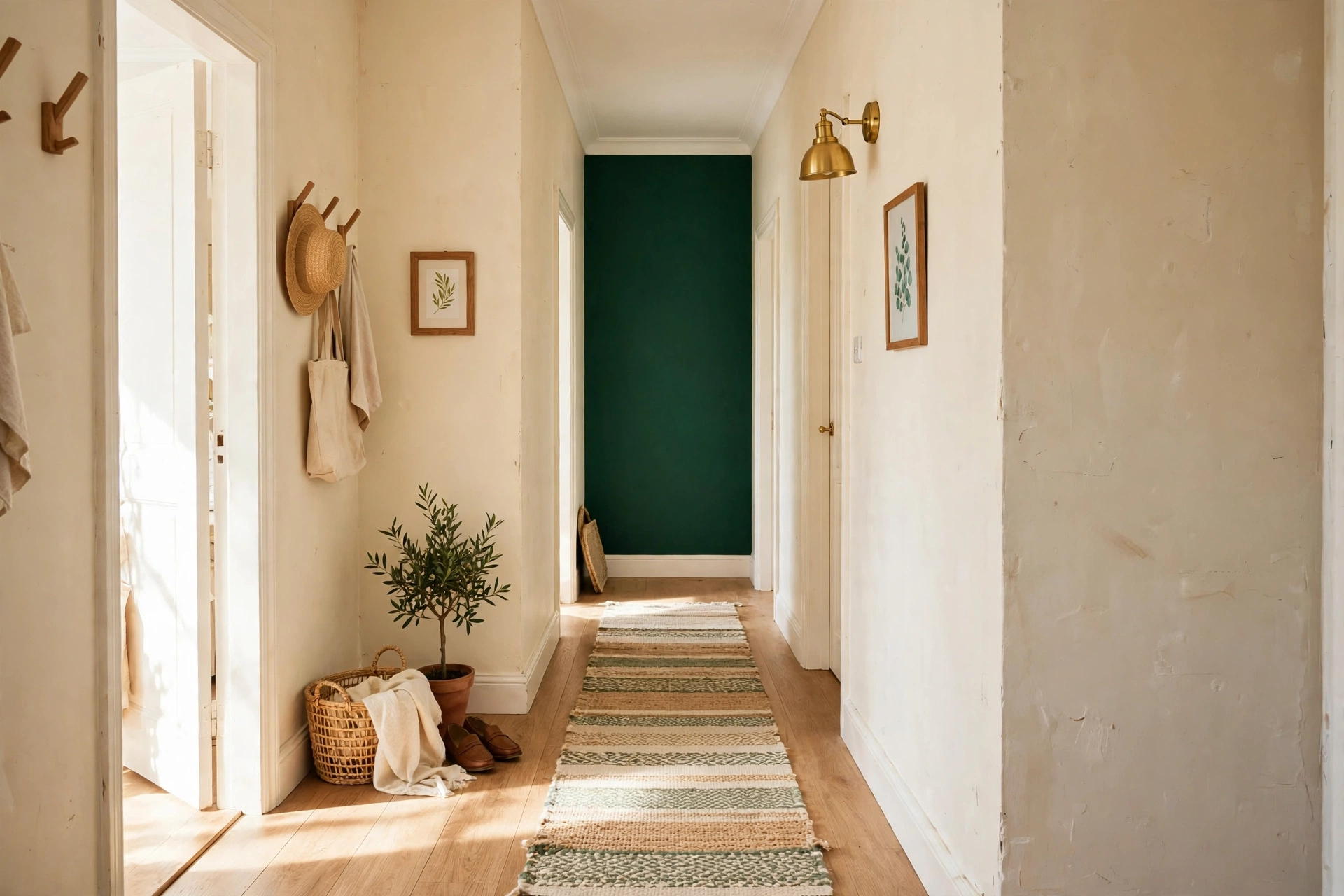
Measure your hall from the front door to the far wall. If the hall is longer than about 10 ft (305 cm), paint the far end wall one to two steps deeper than the side walls, for example Edgecomb Gray sides with Revere Pewter on the end wall. The deeper end wall pulls the far end closer, so the hall feels shorter.
If the hall is under 8 ft (244 cm), keep all walls one color. A deeper end wall in a short hall just makes a small box look smaller. Between 8 and 10 ft, test it with a sample board for two evenings.
The International Residential Code sets the minimum hallway width at 3 ft (91 cm) under section R311.6: the code minimum is a passage, not a room. Keep at least 36 in (91 cm) of clear walkway after furniture.
For trim and the front door, use one of two pairings. Same color as the walls, in a higher sheen, gives a seamless look that makes the entry feel wider. Crisp white trim gives definition, but only when the LRV gap is at least 20 points, for example White Dove trim at 85.38 against Revere Pewter walls at 55.51, a gap of about 30 points. If your entry opens onto dark wood furniture, the logic matches our guide to best paint colors for small dining rooms with dark wood furniture: warm walls, light rug, and let the wood be the dark note.
Which finish survives bags, shoes and dogs?
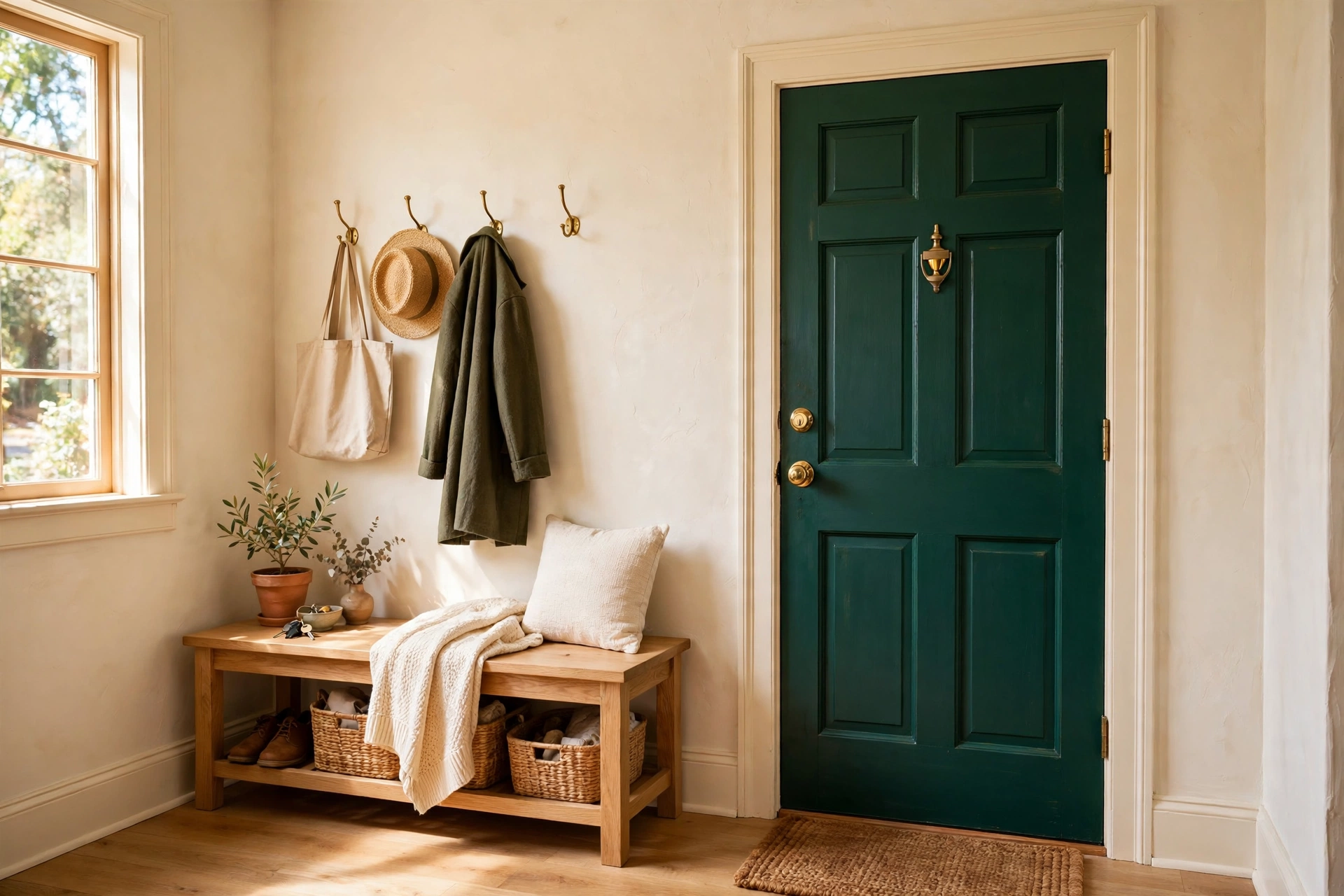
Finish is a durability choice, not a style choice: bags scrape these walls, shoes scuff them, dogs lean on them. Never use gloss or semi-gloss on textured walls: the shine picks out every bump.
| Surface | Finish | Why |
|---|---|---|
| Walls | Eggshell or satin | Wipes clean without the glare of semi-gloss, and hides small wall flaws |
| Trim and baseboards | Semi-gloss | Hard, wipeable, and the sheen contrast defines the trim |
| Front door, inside face | Semi-gloss or urethane enamel | Takes daily hand and bag contact and cleans with a damp cloth |
| Stair wall, if the entry has stairs | Satin | Same washability as the walls, with a little more scuff resistance |
| Ceiling | Flat | Hides flaws and kills glare from the ceiling light |
Keep flat paint on the ceiling only: it marks fast at hand height.
How much paint and what it costs
Wall area is perimeter times ceiling height, minus the door. Coverage is about 350 sq ft per gallon per coat. All three sizes below use 8 ft (244 cm) ceilings and one standard door of 3 by 7 ft (21 sq ft).
| Entry size | Wall area | Paintable after door | Two coats | Gallons to buy |
|---|---|---|---|---|
| Tiny nook, 3 by 4 ft (91 by 122 cm) | 14 ft perimeter x 8 ft = 112 sq ft | 112 minus 21 = 91 sq ft | 182 sq ft, 182 / 350 = 0.52 gal | 1 gallon |
| Standard entry, 3 by 5 ft (91 by 152 cm) | 16 ft perimeter x 8 ft = 128 sq ft | 128 minus 21 = 107 sq ft | 214 sq ft, 214 / 350 = 0.61 gal | 1 gallon |
| Long hall, 3 by 10 ft (91 by 305 cm) | 26 ft perimeter x 8 ft = 208 sq ft | 208 minus 21 = 187 sq ft | 374 sq ft, 374 / 350 = 1.07 gal | 1 gallon + 1 quart |
The standard entry needs 0.61 gallons for two coats, so one gallon covers it with spare for touch-ups. Only the long hall needs a second container, and a quart is enough.
Cost table, as of November 2026, from live-checked listings, per gallon at list before tax and before the frequent Sherwin-Williams 30 to 40 percent sales. The two sample prices were verified live on Sherwin-Williams’ own Color Tools page.
| Product | Price per gallon, as of November 2026 | Source |
|---|---|---|
| BEHR Premium Plus | $29.98 to $37.98 | Home Depot listings, Aug to Nov 2026 |
| Benjamin Moore ben | about $61 | PaintDeck, Benjamin Moore list prices Oct 2026 |
| Benjamin Moore Regal Select | $79 to $85 | PaintDeck, Benjamin Moore list prices Oct 2026 |
| Sherwin-Williams Cashmere | $78 to $88 | UseCalcPro $78 list; PaintDeck $83 to $88 |
| Sherwin-Williams Duration Home | $88 | UseCalcPro $88 list; other 2026 guides $80 to $90 |
| Sherwin-Williams Emerald Interior | $101 to $106 | PaintDeck, Sherwin-Williams list prices Oct 2026 |
| Sherwin-Williams Color to Go sample, quart | $9.59 | sherwin-williams.com Color Tools page, verified live |
| Sherwin-Williams peel-and-stick sample | $3.95 | sherwin-williams.com Color Tools page, verified live |
| Roller, tape, tray, brush, drop cloth kit | TBC | Not priced here; check at the store before you buy |
| Example job, standard 3 by 5 ft entry | Total |
|---|---|
| BEHR Premium Plus, 1 gal + 2 samples | $49.16 to $57.16 |
| Benjamin Moore ben, 1 gal + 2 samples | $80.18 |
| Benjamin Moore Regal Select, 1 gal + 2 samples | $98.18 to $104.18 |
| Sherwin-Williams Cashmere, 1 gal + 2 samples | $97.18 to $107.18 |
| Sherwin-Williams Duration Home, 1 gal + 2 samples | $107.18 |
| Sherwin-Williams Emerald, 1 gal + 2 samples | $120.18 to $125.18 |
Two samples cost 2 x $9.59 = $19.18. Check the sums: $37.98 + $19.18 = $57.16, $61 + $19.18 = $80.18, $106 + $19.18 = $125.18. For the best paint colors for small entryways, the real cost is your time: about 4 to 6 hours of work across one day, including drying time between coats.
How to paint a small entryway
An entryway is a one-day job, and the order matters more than the speed. Do the prep properly and the paint almost applies itself.
Materials: 1 gallon wall paint (satin or eggshell), 1 quart trim paint (semi-gloss), 2 samples, painter’s tape, 9 in roller (3/8 in nap), 2 in angled brush, tray, drop cloth, sanding sponge, filler, putty knife, screwdriver.
Steps:
- Clear the entry, take down hooks and art, and remove outlet and switch covers.
- Wash the walls with warm soapy water, then let them dry fully.
- Fill holes and scuffs, sand smooth when dry, and wipe off the dust.
- Tape the ceiling line, trim, and door frame, and lay the drop cloth.
- Cut in the edges with the angled brush, one wall at a time.
- Roll the walls in a W pattern, top to bottom, keeping each section wet.
- Let the first coat dry 2 to 4 hours, then roll the second coat.
- Paint the trim and the inside face of the front door in semi-gloss.
- Pull the tape off while the last coat is slightly tacky, and refit covers the next morning.
Renters: what to check before you paint
Check your lease before you open a can. Most leases allow painting only with written permission, and some require you to repaint to the original color before you move out. Get the permission in writing, and keep the receipt and leftover paint for the move-out repaint. A landlord sees the entryway first, so a bold color there carries more deposit risk than in a bedroom.
The Deposit-Risk ratings above matter here: the whites score 1 out of 5, the greiges 2, and Revere Pewter 3. If your lease is strict, stay with the whites and bring color in with a rug and art you own. Peel-and-stick samples are the renter-safe test. Never paint over wallpaper, and never paint the front door’s outside face without written permission.
Mistakes to avoid
Stark white in a windowless entry. A pure white above LRV 90 with no warm undertone looks gray and flat under one bulb. Warm whites above LRV 80 are the fix.
Cool gray in north light. North light is already cool, so a cool gray doubles the cold. Warm greige is the north-facing answer.
Dark color on all four walls of a 3 ft hall. It can work in a big foyer with a chandelier. In a 3 ft hall it just makes a tunnel. Keep dark colors to one end wall.
Skipping the bulb check. Test the color under your own bulbs, at night. A color that looks right at noon can turn green or pink by 9 pm.
Painting over dirty walls. Entry walls carry hand grease. Paint over it and the paint peels in a year. Wash first, always.
What to skip
Color drenching the whole entry, ceiling included. It looks great in photos of large foyers. In a small entry, a dark ceiling drops the room on your head. Keep the ceiling white.
Gloss walls to bounce light. Gloss shows every flaw, and a small entry has plenty. Satin bounces enough light without the glare.
A bold accent wall behind the door. The door covers it half the day. Put the deeper color on the end wall you see when you walk in.
The cheapest paint to save $20. The entry is the highest-traffic wall in the home. A washable satin line costs more and lasts years longer. The saving is false.
Sources
- Benjamin Moore, White Dove PM-19 color page (LRV 85.38): https://www.benjaminmoore.com/en-us/paint-colors/color/PM-19
- Sherwin-Williams, Color Tools page (Color to Go $9.59, peel-and-stick $3.95): https://www.sherwin-williams.com/homeowners/lifestyle-collection/color-tools
- LRV cross-checks: Benjamin Moore Pale Oak OC-20 page (LRV 68.64, current manufacturer figure; older roundups print 69.89); Sherwin-Williams and Benjamin Moore published color data via PaintDeck and Shop Spruce, checked November 2026.
- Hallway width: International Residential Code, section R311.6, minimum hallway width 3 ft (91 cm).
- Prices: PaintDeck (list prices, October 2026); UseCalcPro Sherwin-Williams price guide 2026; Home Depot BEHR Premium Plus listings, August to November 2026.
What paint colors help a small entryway feel bigger?
Warm whites and light greiges with an LRV above 60, like White Dove at 85.38, Alabaster at 82, and Pale Oak at 68.64. They bounce the most light back into a small space. Pair them with a satin finish and warm bulbs, and the entry reads wider than it is.
Can I use a bold color if my entryway has no natural light?
Yes, but only on one wall, with strong warm lighting. A deep color on the far end wall of a hall longer than 10 ft can work. A bold color on all four walls of a windowless entry will just make it darker.
What color should I paint a hallway with no windows?
White Dove OC-17 or Alabaster SW 7008. Both sit above LRV 80, both stay warm under bulbs, and neither goes stark or gray. Use warm white bulbs, keep the ceiling white, and bring contrast in with the door or a rug.
What is the best paint color for a dark hallway?
For a dark hallway, White Dove is the safest all-over pick, and Pale Oak is the best pick if you want a little more color. Both reflect enough light for bulbs alone. Avoid cool grays and stark whites, and save deeper colors for one end wall only.
How this was made: I researched the top-ranking entryway paint guides, verified every LRV against manufacturer-published data, live-checked the paint and sample prices on the dates noted, and computed the paint quantities from the room dimensions shown. No real entryway was painted for this post, and no before and after photos exist.
By Wasim