12 Renter-Friendly Entryway Ideas That Won’t Cost Your Deposit
The best renter friendly entryway ideas are the ones that leave nothing behind: adhesive hooks that peel off clean, furniture that stands on its own feet, and a rug that defines the space without a single screw. A full starter set costs $48 to $85, about $66 in the middle, using real prices published in October 2026. And here is the space math that decides everything else. A 12 inch deep console in a 36 inch wide entry leaves only a 24 inch walkway, which is too tight to live with. So in a 3 foot entry, you skip the console entirely and build up the wall instead.
Most renter lists repeat the same advice twelve times: use Command strips. That is not wrong, but it is not a plan. The real skill is matching the fix to your wall, your door, and your lease, and knowing exactly what to do on moving day. Every idea below carries a Deposit-Risk rating from 1 to 5. A 1 means nothing touches the wall at all. A 5 means ask your landlord first. The rating is the whole point. A renter does not need more ideas. A renter needs to know which ideas are safe.
Renter Friendly Entryway Ideas Start With Measuring
Renter friendly entryway ideas work only when they fit the space you actually have, so measure before you buy anything. Keep about 36 inches (91 cm) of clear walkway. Keep furniture no deeper than 10 to 14 inches (25 to 36 cm) in a narrow hall. Check the door swing, the outlet positions, and the wall surface, because a textured wall kills adhesive and a fire door kills over-door hooks.
Take three measurements. First, the width of the entry from the door frame to the opposite wall. Second, the door swing: open the door fully and mark where it stops, because a console that fits the wall can still block a door that swings inward. Third, the wall itself. Run your hand across it. Smooth, well-adhered paint is the safest surface for anything sticky. Textured plaster, fresh paint less than a week old, and wallpaper are not. If your paint is older than the building feels, test a small adhesive patch in a hidden corner first and leave it for a day. A strip that lifts old paint will cost you more than the hook ever saved.
Hooks Without Holes: Coats, Bags and the Dog Leash
Hooks are the hardest working item in a small entry, and they are also where renters get into the most trouble. The fix is not more hooks. It is the right hook, installed the right way, holding only what it is rated for.
1. Adhesive Hooks, Installed Like You Mean It
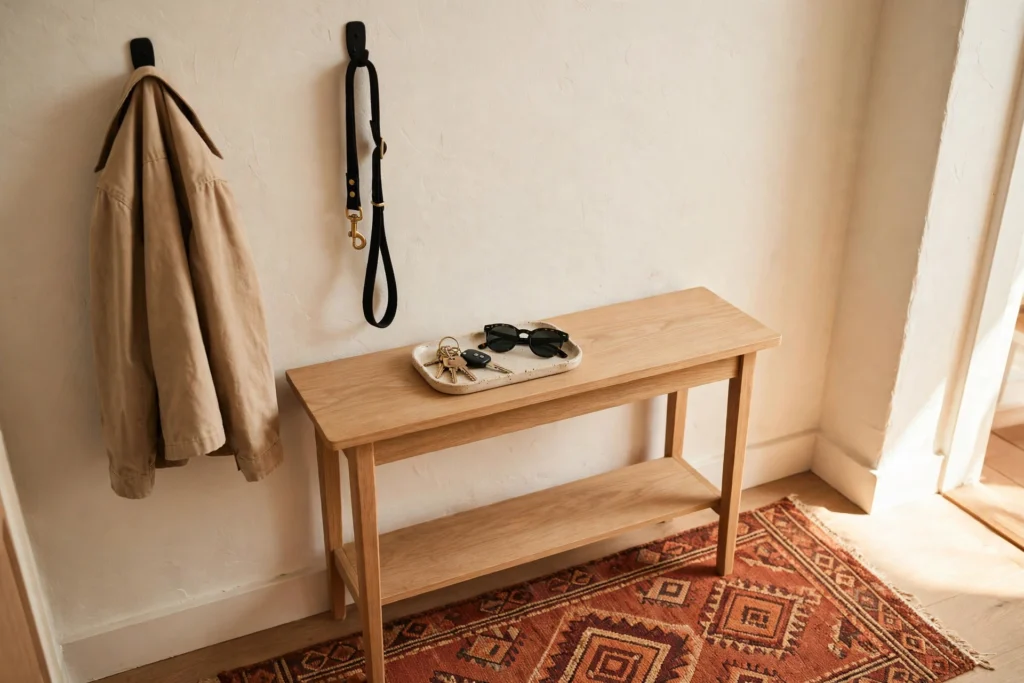
Best for: Keys, dog leashes, light bags, and one coat per hook. Main advantage: Zero holes, and you can take them with you when you move. Watch out for: Weight ratings are real limits, not suggestions. Verdict: The single best renter move, if you respect the rating. Deposit-Risk: 2 out of 5.
3M publishes the numbers, and they are smaller than most people guess. A small Command wire hook holds 0.5 lb. A medium utility hook holds 3 lb. A large hook holds 4 lb. A heavy winter coat can weigh 4 to 5 lb on its own, so one large hook per coat, never two coats on one hook. Clean the wall with rubbing alcohol first, press firmly for 30 seconds, then wait the full 24 hours before hanging anything. That curing wait decides whether the hook holds or peels off with paint. To remove it, hold the top of the strip and pull slowly straight down toward the floor, at least 12 inches, never out toward you. 3M’s own Command hook guide shows the same move.
2. Over-the-Door Hooks and Organizers
Best for: Renters who want hanging space without touching a wall at all. Main advantage: Nothing sticks to anything. The door carries the load. Watch out for: Door thickness and fire doors. Verdict: The safest hanging option in the whole list. Deposit-Risk: 1 out of 5.
The back of your front door is free real estate. An over-the-door rack holds coats, hats, umbrellas, and reusable bags, and a hanging pocket organizer swallows gloves, dog gear, and cleaning cloths. Measure the door first. Most interior doors are 1 3/8 inches (3.5 cm) thick, and standard over-door hooks fit that. Never use one on a fire door in an apartment building. Fire doors are heavy, self-closing, and often part of your lease terms, and wedging hardware over one can stop it closing properly. If your door is a fire door, use the freestanding rack below instead.
3. A Freestanding Coat Rack or Hall Tree
Best for: Heavy coats, families, and anyone with a fire door. Main advantage: It moves with you, holds real weight, and needs no wall at all. Watch out for: It needs floor space, so it only works if your entry is at least 3 feet wide. Verdict: The most honest solution for a household with more than two coats. Deposit-Risk: 1 out of 5.
A slim hall tree or a leaning coat rack in a corner does the job of five wall hooks without asking the wall for anything. Pick one with a heavy base or a low shoe shelf, because a top-heavy rack tips when a wet coat goes on one side. If you have kids, put their hooks at their height. A hook a child cannot reach is a coat on the floor.
The Landing Zone: Keys, Mail and Pocket Stuff
Small items cause the biggest headaches because they disappear. The fix is a landing zone: one dedicated surface where pocket contents live the second you walk in. If you want the full system, our small entryway organization ideas post walks through the same landing-zone logic for owners and renters alike.
4. A Tray With a Rim
Best for: Keys, sunglasses, earbuds, and loose change. Main advantage: It costs almost nothing and changes behavior in one day. Watch out for: Flat trays let small items slide off. Verdict: The cheapest idea on this list, and the one to do first. Deposit-Risk: 1 out of 5.
A shallow tray or a small ceramic bowl near the door catches everything before it spreads across the kitchen counter. Pick one with a rim, because a flat dish is just a plate your keys slide off. Any surface works: a narrow shelf, the top of a shoe rack, a windowsill. Keep one small dish for the odd bits too, the bus card, the dog treat pouch, the spare change.
5. A Key and Mail Organizer on Adhesive Strips
Best for: Households drowning in paper mail. Main advantage: Mail gets sorted at the door instead of piling up on the coffee table. Watch out for: A loaded organizer is heavier than it looks, so use large strips and two mounting points. Verdict: Worth it if mail is your entryway’s biggest problem. Deposit-Risk: 2 out of 5.
A wall-mounted organizer with key hooks and a slot for letters keeps paper clutter from ever reaching a flat surface. Sort the mail while you are standing there. Junk goes straight to recycling, bills go in the action slot, and the action slot gets checked twice a week. If your landlord allows small nail holes, a short hook rail with three to five hooks plus a top shelf is the highest-value upgrade you can make, and a dab of spackle at move-out makes it disappear. Ask first, in writing, and keep the reply.
Shoe Storage for a Rental Entryway
Shoes are the fastest way to make an entryway look defeated, and the mistake most people make is trying to store every shoe by the door. You do not need every shoe. You need daily shoes.
6. A Slim Shoe Cabinet or Flip-Front Cabinet
Best for: Entries where shoes are visible from the living room. Main advantage: Closed fronts make the whole entry look calmer in one move. Watch out for: Tall cabinets should be anchored to the wall, which renters should not do. Verdict: Pick a low, wide cabinet that stands on its own. Deposit-Risk: 1 out of 5.
A slim cabinet 10 to 12 inches deep tucks against the wall and holds four to six pairs, and a flip-front cabinet hides twice that behind a clean front. The top doubles as a mini console for your key tray. Skip anything tall and narrow unless it has a wide, heavy base. Keep the rule simple: two pairs per person by the door, the ones you are wearing today and one backup.
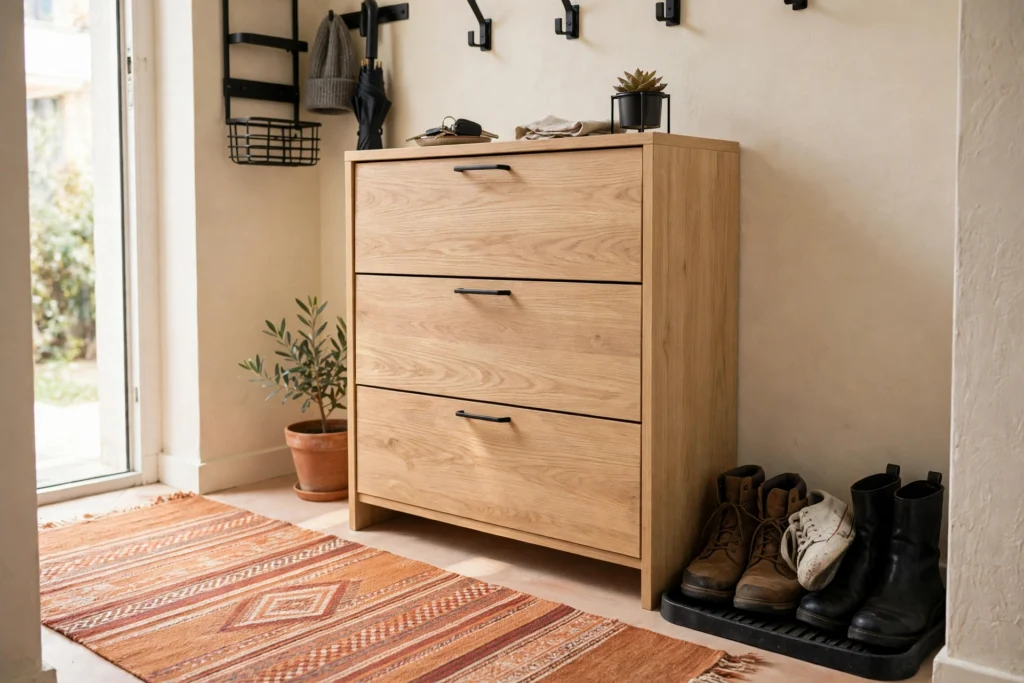
7. A Boot Tray and a Shoe Cap
Best for: Rainy climates, muddy paws, and winter slush. Main advantage: One wipeable tray protects the floor and the rug at the same time. Watch out for: A tray full of wet shoes still smells if you never empty it. Verdict: The cheapest floor protection you can buy. Deposit-Risk: 1 out of 5.
A boot tray catches winter slush and summer rain so wet shoes never migrate onto the rug, and it costs less than a takeaway lunch. Pair it with the two-pair cap from the idea above, because a rack that holds twelve pairs will always look chaotic no matter how nice it is. Tuck a small open container of baking soda behind the shoe storage for smells.
No Foyer? Make One Without Building Anything
In many apartments the front door opens straight into the living room or kitchen. That does not mean you cannot have an entryway. It means you define it yourself, and renters have better tools for this than owners do, because every one of them is removable.
8. A Washable Runner as a Boundary
Best for: Open-plan apartments with no hallway at all. Main advantage: A rug marks the entry as its own zone without adding any furniture. Watch out for: Thick rugs bunch up under the door and trap grit. Verdict: The first thing to buy if your door opens into your living room. Deposit-Risk: 1 out of 5.
A low-pile, washable runner, even two or three feet wide, tells shoes where to stop and gives guests a visual cue to pause. It also traps dirt before it travels through your home. Put a rug gripper underneath. It stops slipping and protects the floor, which matters in a rental.
9. A Freestanding Divider or a Tension Rod and Curtain
Best for: Studios and open-plan flats where a rug alone is not enough. Main advantage: You get a real wall without building one. Watch out for: A solid bookcase blocks light. Verdict: The boldest no-build move on this list, and the one that changes the floor plan. Deposit-Risk: 1 out of 5.
A low bookshelf or a narrow console placed perpendicular to the wall creates a mini foyer, and a floor-to-ceiling slat partition does it better, because the gaps between slats let daylight pass through while still reading as a wall. Even simpler: a tension rod wedged between two walls with a curtain gives you a soft divider for the price of lunch, and it leaves zero marks when it comes down. Apartment Therapy’s small entryway ideas show the same trick in real rentals, a console and a mirror turning a blank wall into an entry that feels like it was always there.
Light and Mirror for a Dark Rental Entry
A dark entryway can make even a tidy home feel gloomy, and bad lighting has a special talent for making every shoe and dust bunny look more dramatic than necessary. Renters cannot rewire, but they do not need to.
10. A Leaning Mirror
Best for: Dark, narrow, or windowless entries. Main advantage: It bounces light, adds depth, and gives you a last look before you leave. Watch out for: A heavy mirror needs a secure lean, not a wobble. Verdict: The highest-impact decor move per dollar in a rental entry. Deposit-Risk: 1 out of 5.
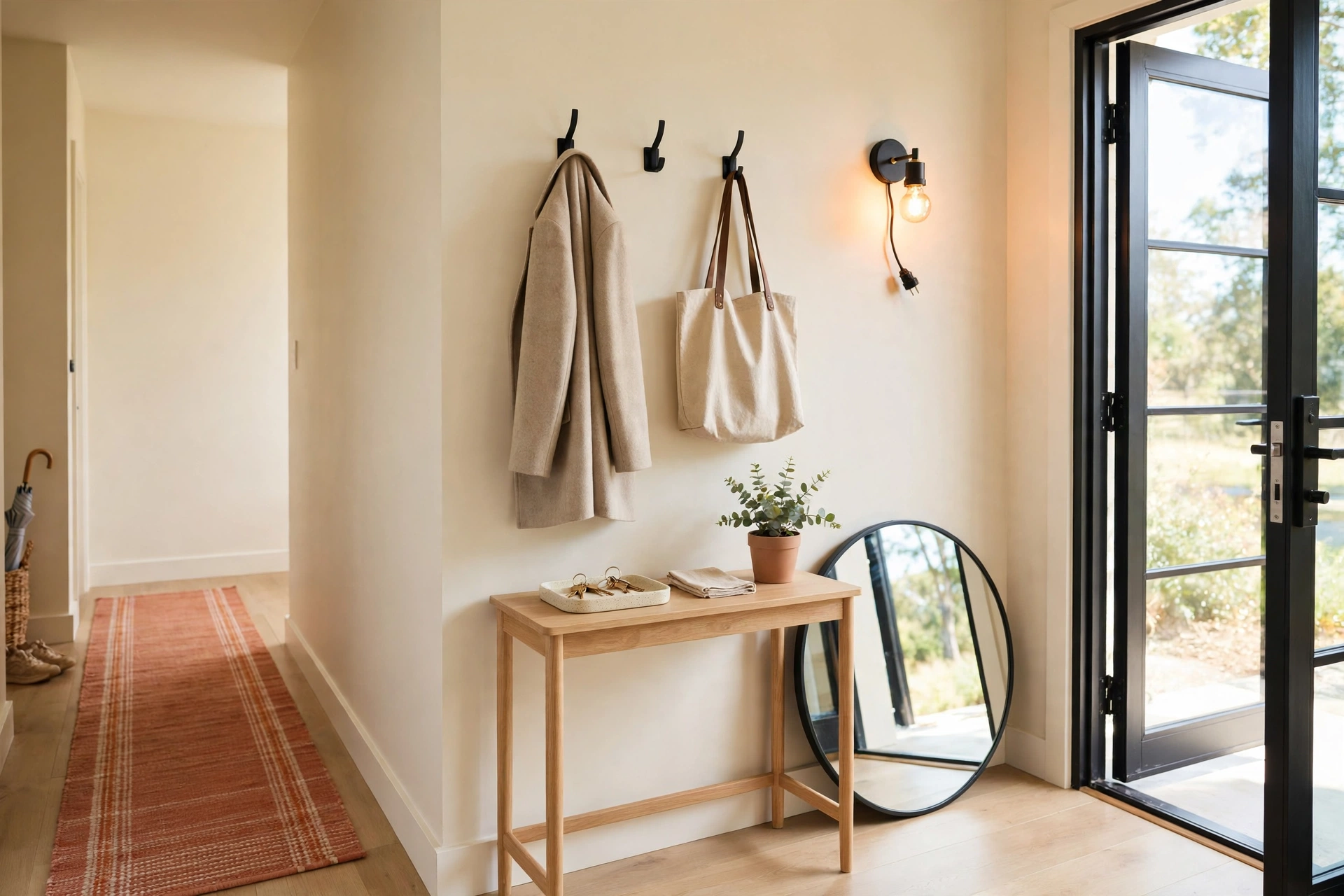
A round or tall rectangular mirror near the door makes a tight space feel bigger and brighter, and leaning a full-length mirror against the wall is stable, easy to move, and needs no hardware at all. Hang it so the center sits about 57 to 60 inches (145 to 152 cm) from the floor, and place it opposite a window or a light source if you can, so it reflects as much brightness as possible. Add a small anti-tip strap at the top if you have kids or a dog that leans.
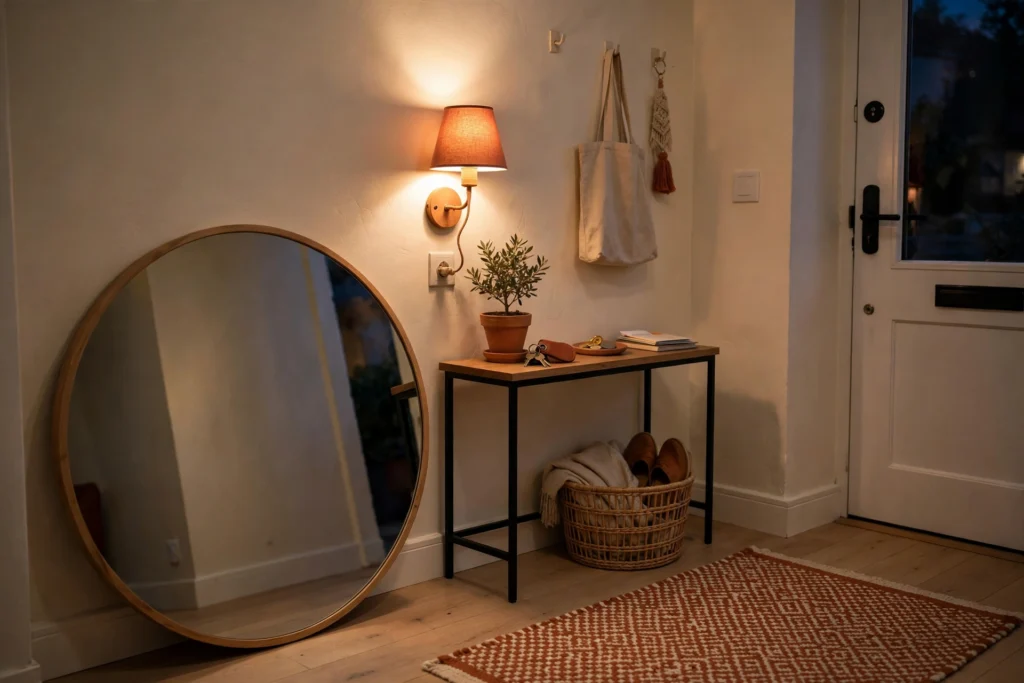
11. A Plug-In Sconce or a Warmer Bulb
Best for: Entries with one weak ceiling light or none at all. Main advantage: Warm light without an electrician, a wire, or a landlord meeting. Watch out for: Visible cords need a cord cover for a clean look. Verdict: The fastest way to make a rental entry feel welcoming after dark. Deposit-Risk: 1 out of 5.
Swap a cold bulb for a warm white one first, because cold, bluish light makes an entry feel like a supermarket aisle. If there is no overhead fixture, a plug-in wall sconce or a small battery-powered LED light fills the gap. Our renter-friendly lighting ideas post covers plug-in sconces, battery lights, and cord covers in detail, and the same rules apply here: keep cords tidy, keep the light warm, and never hang anything over a bed or on wallpaper with adhesive.
Personality Without Paint
Renting does not mean your entry has to look blank. It means the personality comes from things you can carry out the door, not things you paint onto the wall.
12. Peel-and-Stick Accent, Leaning Art, and One Plant
Best for: Renters who want color without asking permission. Main advantage: A small accent panel changes the whole feel of the space in an afternoon. Watch out for: This is the riskiest idea on the list, so read the warning before you buy. Verdict: Do the art and the plant first. Add peel-and-stick only after the patch test. Deposit-Risk: 3 out of 5.
A strip of peel-and-stick wallpaper behind your hooks or mirror gives you a custom look for about $15 to $20, but test a small patch in a hidden corner first and check your lease. Most renter-safe products peel off cleanly, but older paint can lift with them, and textured walls are a hard no. Smooth, well-adhered paint is the safest surface. The safer personality moves need no test at all. Lean framed prints on a console instead of hanging them. Add one plant, a pothos or a snake plant if the light is poor, or a good faux plant if there is no light at all. One piece of art and one plant is plenty. If you want more color ideas that work in rentals, our renter-friendly wall ideas post has ten of them, all damage-free.
Pet and Kid Gear by the Door
If you have a dog, add one dedicated hook for the leash and a small bin or lidded jar for waste bags. A pack of paw wipes tucked into your entry tray is the kind of tiny habit that saves your rugs. For kids, give each child one hook at their height and one basket at floor level. A hook a child cannot reach is a coat on the floor, and a basket per person stops the daily search for a missing glove. Keep the outgoing spot small too: one basket for returns, library books, and borrowed containers.
The Move-Out Plan: Leave Zero Trace
Here is the part no renter friendly entryway ideas list ever writes, and it is the part that actually protects your deposit. Every adhesive strip comes off the same way: warm it gently with a hair dryer on low, then pull the tab slowly straight down toward the floor, at least 12 inches, never out toward you. If a strip snaps, slide dental floss behind the hook base and saw gently until it releases. Wipe the spot with a damp cloth and check it in daylight. If you ever used small nails with permission, fill each hole with a dab of white spackle, smooth it with a damp finger, and touch it up only if the landlord’s paint is on hand. Never repaint a whole wall without asking.
Photograph everything twice: on the day you move in, before you hang a single hook, and on the day you move out, after everything is down. The move-in photos are your evidence that the scuff by the door was already there. Keep the landlord’s permission emails in one folder. A short email beats a remembered conversation every time. Try this: “Hi, I’d like to add a small adhesive hook rail by the front door, no drilling, removable strips only. Is that okay?” Most landlords say yes in one line, and that one line is worth more than any product on this list.
What to Skip in a Rental Entryway
Some ideas look great on social media and cost renters real money. Skip wall-mounted shoe cabinets that need anchors. Skip peel-and-stick wallpaper on textured walls, fresh paint, or old flaking paint. Skip over-door hooks on fire doors. Skip drilling into tile, because a cracked tile is a repair bill, not a cleaning job. Skip the tall shoe tower that invites your whole collection to live by the front door. And skip buying everything at once. Start with hooks and a tray, which together cost under $25 and get you about 80 percent of the benefit, then add the next piece only when you know what is still missing.
What a Full Starter Set Costs
Here is the whole setup priced from real ranges published in October 2026, so you can see the total before you shop.
| Item | Typical cost | Deposit-Risk |
|---|---|---|
| Adhesive hooks, pack of large | $8 to $15 | 2 out of 5 |
| Key tray or bowl | $4 to $10 | 1 out of 5 |
| Slim shoe rack, two tiers | $14 to $20 | 1 out of 5 |
| Mirror, lean or hang | $10 to $20 | 1 out of 5 |
| Washable rug or runner | $12 to $20 | 1 out of 5 |
| Total starter set | $48 to $85 | 1 to 2 out of 5 |
That is about $66 in the middle, as of October 2026, and it covers the four things most entryways need most: somewhere to hang, somewhere to drop, somewhere for shoes, and something on the floor. If your budget is truly tight, start with just hooks and a tray for under $25. If you want to see what a full room refresh costs on the same budget logic, our entryway makeover under $100 post prices a whole hallway the same way.
The Short Version
These renter friendly entryway ideas add up to five things: hooks that hold what they are rated for, a tray for the small stuff, shoe storage that stands on its own, a rug that marks the zone, and a mirror that bounces the light. Buy those, photograph the walls before and after, and ask your landlord in writing before anything sticks. Do that, and the entryway will feel like yours from the first evening, and like nobody ever lived there on the last one.
Are adhesive hooks strong enough for coats and bags?
Yes, if you install them correctly and respect the weight rating. Clean the surface with rubbing alcohol, press firmly for 30 seconds, and wait the full 24 hours before hanging anything. 3M rates its small wire hooks at 0.5 lb, medium utility hooks at 3 lb, and large hooks at 4 lb, so give each heavy coat its own large hook.
How do I make an entryway when my front door opens straight into the living room?
Define the zone yourself. Lay a washable runner to mark the boundary, put one hook and one small mirror on the wall right next to the door, and add a narrow console or a low bookshelf placed perpendicular to the wall to fake a foyer. Even 12 inches of wall space is enough for a hook, a tray, and a mirror.
What is the smallest console depth that still feels usable in a rental entryway?
Six inches can work if you only need a key tray and a small catch-all, but 8 to 10 inches feels more comfortable for setting down mail and a bag. In a narrow hall, keep the console between 10 and 14 inches deep and preserve about 36 inches of clear walkway. If the entry is only 36 inches wide, skip the console and use wall hooks and over-door storage instead.
How can I decorate an entryway on a budget as a renter?
Choose removable options: adhesive hooks, a leaning mirror, a washable rug, and peel-and-stick wallpaper only after a patch test on smooth, well-adhered paint. Add one plant or print, shop secondhand for furniture, and start with hooks and a tray for under $25.