Best Tile Colors for Small Bathrooms: 10 Combos That Make a Tiny Bath Feel Bigger
You know that feeling. You walk into a tiny bathroom and the walls just… close in. The grout grid buzzes at you. Everything looks smaller than the tape measure swears it is.
I’ve stood in enough of these rooms now — ours, friends’, rentals with tile from three different decades — to know it’s rarely the size that’s the problem. It’s the tile.
Get the color right and the same 40 square feet feels calm. Bright. Honestly bigger than it is. One of the quickest wins in our room-by-room whole-home organization guide, and no wall moved. No window added. Just color, size, and grout doing the heavy lifting.
So here’s the short version first, then the ten combos.
The quick answer: warm light neutrals, big tiles, grout that matches the tile. Greige, warm clay, soft sage, mushroom — not stark white, not busy patterns. A 12×24 in (30×60 cm) tile cuts the grout lines way down, and matching grout erases the grid your eye uses to measure the room. That’s really the whole trick. Every combo below is just a version of it.
The 3 rules before you pick a color
Three rules. That’s it. The spacious-feeling bathrooms I’ve seen all follow them, and the cramped ones break at least one.
Rule 1: light, but warm. Light colors bounce light around — that’s why white’s been the default forever. But stark, cool white on its own? It can feel clinical. Smaller, even. Like a lab. Warm light tones give you the same brightness with actual depth. Cream instead of white. Greige instead of gray. Suddenly the bathroom stops feeling like a box and starts feeling like a room.
Rule 2: low contrast. Here’s the thing nobody tells you: every hard color break is a line your eye measures. Dark floor, white walls. Black grout, white tile. A bold accent band halfway up the wall. Each one chops the room into pieces. Keep the floor, walls, and grout in the same family and the room reads as one continuous space. Honestly, this matters more than the exact shade you pick.
Rule 3: big tile, quiet grout. A 12×24 in (30×60 cm) tile has a fraction of the grout lines of a little 4×4 in mosaic. And grout lines are what make a wall look busy. Pair large-format tile with grout matched to the tile color — not white grout on beige tile, not dark grout on white tile — and the wall turns into one calm plane. Angi’s guide to the best tile for small bathrooms says the same thing: lighter colors, medium-to-large formats, matching grout. Most reliable way to open a room up.
One more, before you shop. Run rectangular tiles vertically on the walls. It pulls your eye up toward the ceiling, which is exactly what a low bathroom needs. Horizontal does the opposite — widens a room that doesn’t need widening and pushes the ceiling down. Ask me how I know. (Our first bathroom. Horizontal subway tile. Felt like a tunnel.)
Warm neutrals that never fail
Want a safe pick that still looks designed? Start here. These four are the workhorses of 2026. They show up in basically every small-bathroom roundup, and there’s a reason for that.
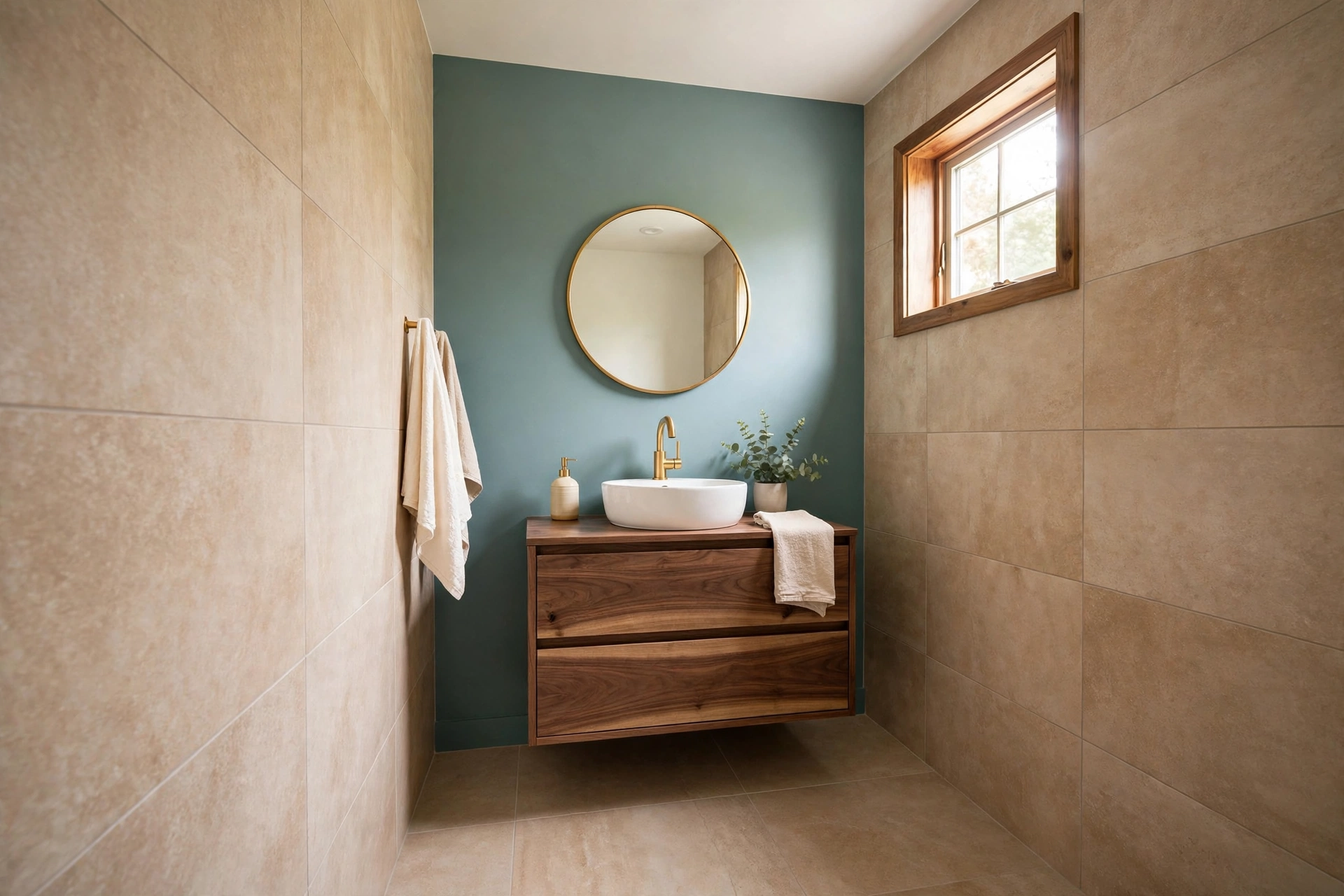
1. Warm greige + white fixtures. Greige — that gray-beige middle ground — might be the most forgiving tile color there is. Hides water spots. Flatters chrome and brass equally. Never fights your towels. Pair it with plain white fixtures and a warm wood vanity and you’re done. If I could only choose one combo from this whole list, it’d be this one.
2. Soft clay + cream. Clay is 2026’s warm, earthy answer to cold gray. A muted terracotta-brown. Feels sunny without shouting about it. Against cream walls it makes a small bath feel like a spa, not a cell. And brushed brass fittings? The two warm tones just get along. That’s all there is to it.
3. Mushroom + pale oak. Mushroom is a soft taupe-gray, sitting right between warm and cool — which makes it the easiest tile to live with if your bathroom gets mixed light. Throw in a pale oak vanity or an open shelf and the whole room warms up. North-facing bathroom, cold light? This is your color. Takes the edge off without going yellow.
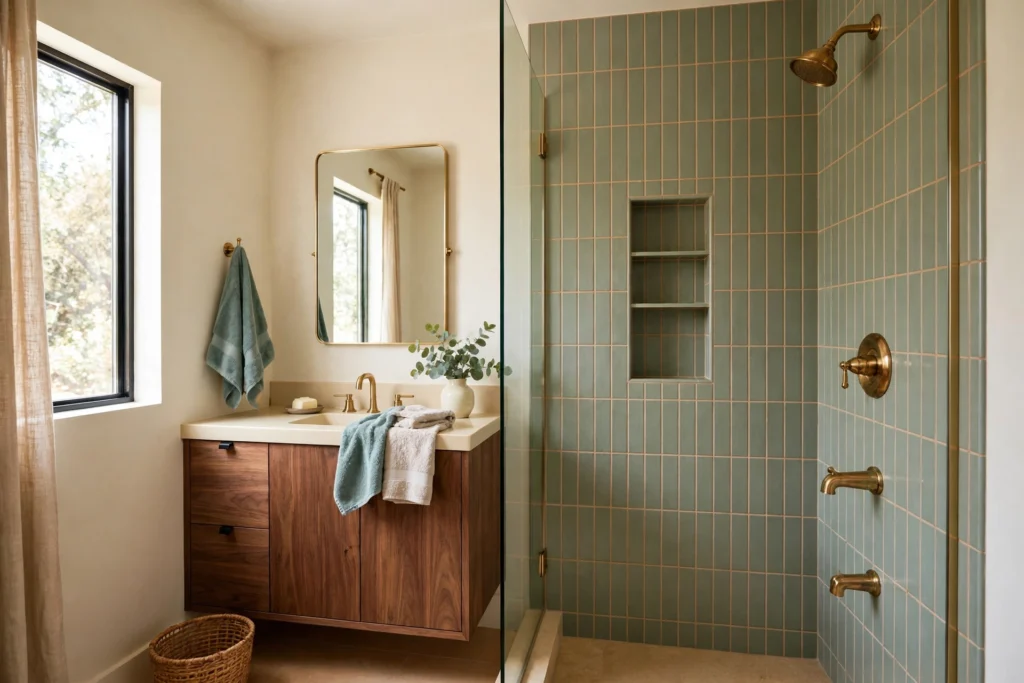
4. Soft sage + warm white. Sage keeps showing up in small bathrooms. The gentle green. And look, it works because green reads as calm, and calm reads as spacious. A sage shower wall with warm white everywhere else gives you color without shrinking anything. Nervous about it? Keep the sage to one wall. Even a single sage accent wall changes the whole feel of the room.
The wall paint matters here too, by the way — the shades in our guide to the best wall colors for small rooms were picked for exactly this kind of pairing. Check it before you commit to a tile.
Two-color combos with personality
Neutrals are safe. But a small bathroom doesn’t have to be boring. These four add character while keeping the room feeling open. The trick — the only trick — is that the second color stays in a supporting role. It doesn’t get to run the show.
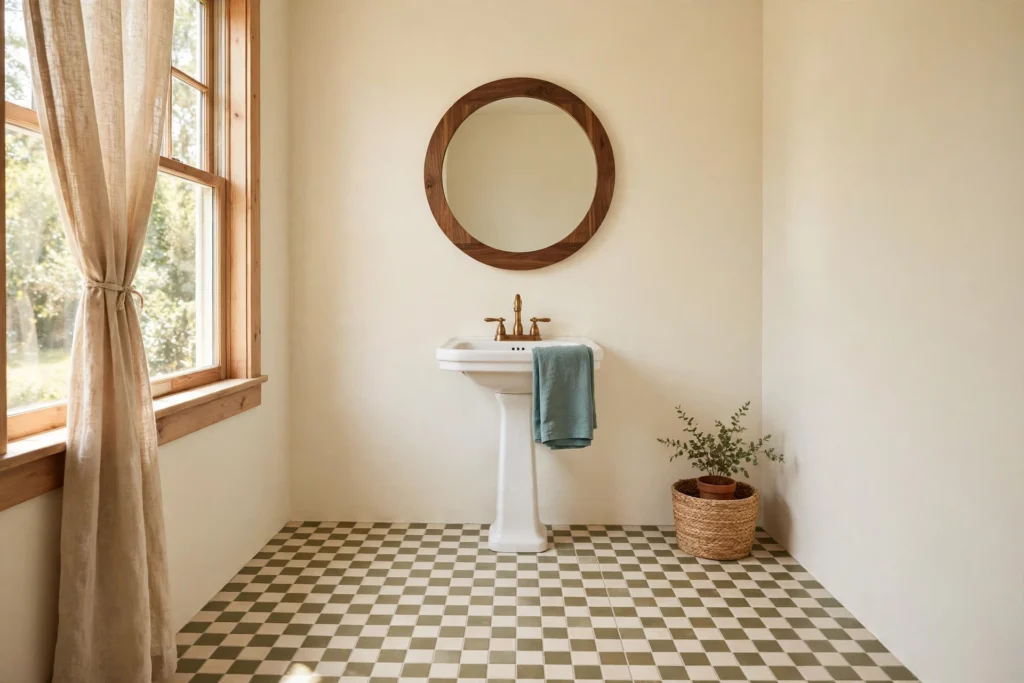
5. Cream-and-olive checkerboard floor. Checkerboard is 2026’s favorite personality move for powder rooms and small baths. Checkatrade’s 2026 bathroom tile ideas roundup says so outright. And the softer version — cream and olive instead of black and white — keeps the graphic energy without the harsh contrast. The yardage is tiny (a powder room floor is often under 25 sq ft), so a bold floor stays affordable. Keep the walls plain. Let the floor do the talking.
6. Terracotta accent + cream field tile. One terracotta shower wall. Or a terracotta band behind the vanity. Plain cream tile everywhere else. The warm accent draws your eye to one spot instead of letting it bounce all over the room — which, weirdly, makes the space feel calmer. This one’s for people who love color but don’t want to live inside it.
7. Forest green + warm white. A deep green vanity wall, or a shower niche in green, with warm white large-format tile doing the rest. Dark colors can work in a small bathroom — but only as an accent, and only against plenty of light tile. The green gives the room depth. The white keeps it from closing in. Matte black fixtures finish it off.
8. Blush + cream. Soft blush tile, cream grout, cream walls. Sounds sweet. It is sweet. But it’s also one of the easiest ways to make a dated bathroom feel current. The 2026 candy-color trend — bubblegum pink, pistachio — works best exactly like this: one soft color, used sparingly, against a warm neutral. Pink feels like too much? Use it only in the shower niche. Done.
The 2026 move: tile drenching
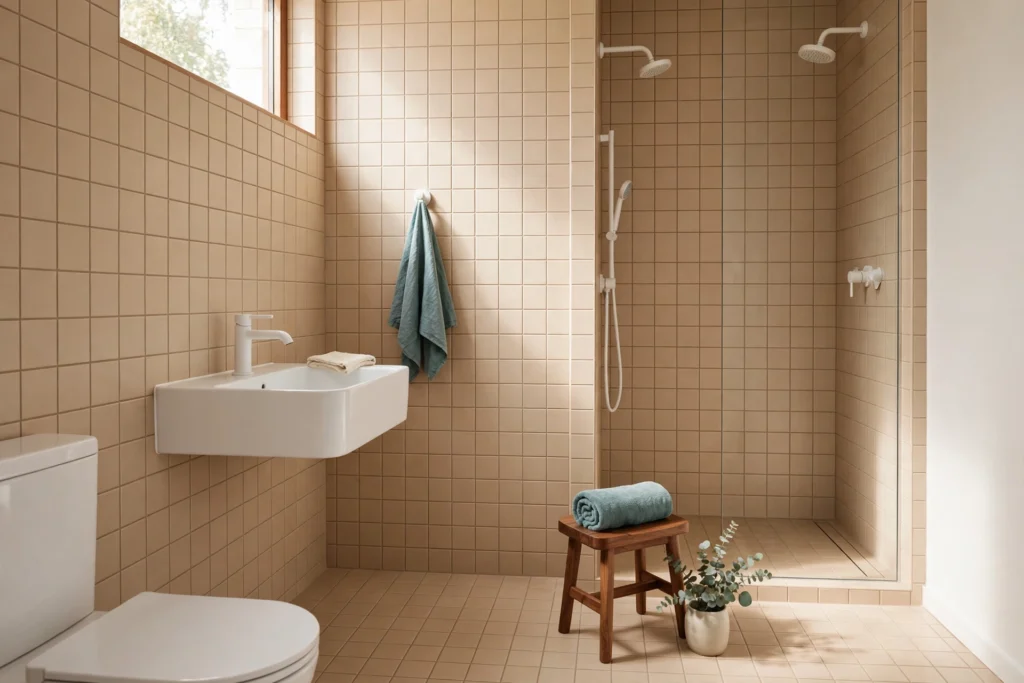
If you want the single most space-expanding thing you can do with tile, here it is. One tile everywhere. Floor, walls, shower — same tile, same color, no breaks. Designers call it tile drenching. It’s the tile version of the color drenching that’s all over 2026 interiors.
Why does it work? Your eye has nothing to measure against. No floor-to-wall color change. No shower zone outlined in a different tile. The room stops reading as a box with a wet corner and starts reading as one continuous volume. A mid-tone warm mineral shade — greige, mushroom, soft clay — is the safest drenching color. Too light and the room can feel washed out. Too dark and it closes in.
Practical notes, because drenching is a commitment. Pick a tile rated for floors as well as walls — most porcelain is. Use a smaller or more textured version of the same tile on the shower floor for grip. Same color family, finer grout lines, better footing. And buy 10% extra. Running one tile everywhere means one dye lot, and you really don’t want to run short mid-wall.
Renter fixes without retiling
Not everyone can retile. If you’re renting, you can still get most of the effect for very little money. And take it all with you at move-out, which is the best part.
Peel-and-stick large-format tile panels go straight over a busy old grid and instantly quiet the wall down. They cost roughly $6–$15 per sq ft as of October 2026. They come off clean. And they deliver the same calm-plane effect as a real retile. A grout pen is the even cheaper trick — recoloring dark, stained grout to match your tile. About $8–$12 a pen. One afternoon, and an old bathroom can look five years newer.
Both are damage-free, which is the whole point of our renter-friendly bathroom upgrades — worth a read if your landlord’s rules are strict. And once the tile looks right, the storage is the next thing to fix. Our small bathroom organization ideas cover the rest of the room.
What to avoid
A few honest warnings. I’ve seen all of these in real bathrooms, and they all do the same thing: make a small room feel smaller.
- Dark grout on light tile. It draws a grid over every wall. Your eye counts the squares. The room shrinks. Match the grout to the tile. Always.
- Busy mosaic everywhere. Small mosaic tiles are beautiful — as an accent. Cover a whole small bathroom in them and it’s visual noise. The grout lines multiply the clutter. One mosaic niche. Plain tile everywhere else.
- Stark white, alone. White tile plus white walls plus white fixtures, with no wood, no warm tone, no texture anywhere? Reads as a clinic. If you love white tile, warm it up. A wood vanity. Brass fittings. A warm greige grout. Anything.
- Too many tile styles. Two tiles is plenty for a small bathroom. Three is the absolute max, and the third one should be an accent, not a competing pattern. Every extra style is another visual break, and small rooms can’t afford many.
Costs, honestly
Tile itself is the cheap part. Ceramic subway tile runs roughly $2–$8 per sq ft as of October 2026. Porcelain large-format, about $3–$12. Handmade-look zellige, $15–$30. For a small bathroom — say 40 sq ft of floor and 60 sq ft of wall — the tile bill is often under $400 even with decent porcelain. The real cost is labor if you hire it out. And that’s where large-format tile actually saves you money: fewer tiles to set, fewer grout lines to finish.
Budget tight? Spend it on the shower wall and the floor. The two surfaces you actually look at. Use the cheapest matching tile on the rest. Nobody will know.
What color tile makes a small bathroom look bigger?
Warm light neutrals — greige, warm cream, soft clay, mushroom, or sage — in a large format with grout matched to the tile color. They reflect light without the sterile feel of stark white, and the low contrast keeps the room reading as one open space.
Should floor and wall tiles match in a small bathroom?
Yes, in most cases. Using the same tile (or the same color family) on the floor and walls removes the hard color break between surfaces, which is one of the strongest ways to make a small bathroom feel larger. If you want variety, change the size or finish, not the color.
What size tile is best for a small bathroom?
12×24 in (30×60 cm) is the sweet spot for floors and walls — big enough to cut grout lines dramatically, small enough to suit a compact room. On shower floors, use a smaller tile (2×2 in / 5×5 cm mosaic or penny rounds) in the same color for slip resistance.
Can renters change tile color without retiling?
Yes. Peel-and-stick large-format tile panels cover old tile and come off at move-out, and a grout pen recolors stained grout to match the tile for about $8–$12. Both are damage-free and landlord-friendly.