Afrohemian Décor on a Budget: 10 Ideas That Bring the Look Home in a Small Space
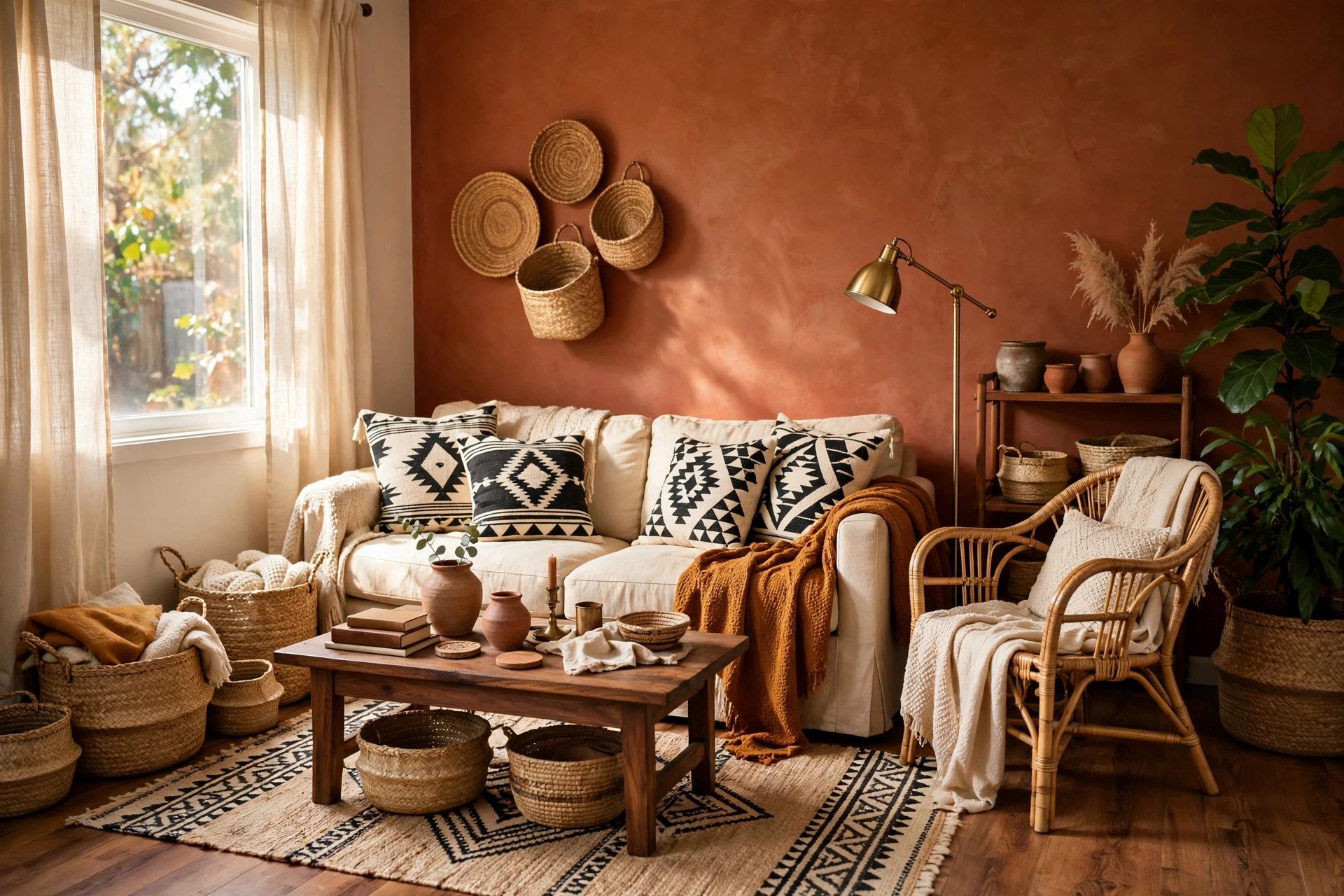
There’s a reason your feed suddenly looks warmer. Afrohemian décor — African craft traditions mixed with relaxed bohemian layering — is the style of the moment, and it’s built from exactly the things small spaces do best: one painted wall, a few honest textiles, and pieces that look collected rather than bought as a set.
The short answer: Afrohemian decor on a budget starts with paint and pillows, not furniture. One terracotta accent wall, a set of mudcloth-look pillow covers (from about $13), and a woven basket wall (about $20) give you the whole look for under $60 — and the full 10-idea room below lands around $100–$200 if you thrift the bigger pieces. All prices below are as of October 2026.
What Is Afrohemian Décor?
Afrohemian is a fusion of African design heritage and bohemian styling. It draws on African craft traditions — mudcloth (bogolanfini), adire indigo cloth, Kente, Kuba cloth, handwoven baskets, carved wood — and mixes them with boho’s layered, collected-over-time feel. The result is warm, earthy, and expressive rather than polished or matchy.
It is also, right now, the trend to know. Pinterest named Afrohemian its #1 home prediction for 2026, with searches for “afrobohemian home decor” up 220% year over year and “adire fabric” up 130%, according to Pinterest’s own data reported in October 2026. It sits alongside Neo Deco as one of 2026’s two big décor directions — the earthy counterpart to neo deco on a budget, which leans geometric and glamorous where Afrohemian leans warm and handmade.
One thing it is not: mass-produced animal print. Leopard-print pillows and safari-themed decoration are not Afrohemian — the references are textiles, fiber, clay, and carved wood, not animal-skin approximations. Keep that line clear and the style stays sophisticated instead of costume.
The Afrohemian Palette
The base is warm earth: terracotta, rust, ochre, clay brown, sand, cream, and caramel. The contrast comes from deep indigo, charcoal black, olive, and brass. Mustard, burnt orange, and a touch of cobalt blue work as accents. If your room already has warm wood floors or cream walls, you’re halfway there — the palette does most of the work before you buy anything, which is why bold paint colors that make small rooms feel bigger pair so naturally with this style.
The 10 Ideas (Cheapest First)
1. Paint one terracotta accent wall
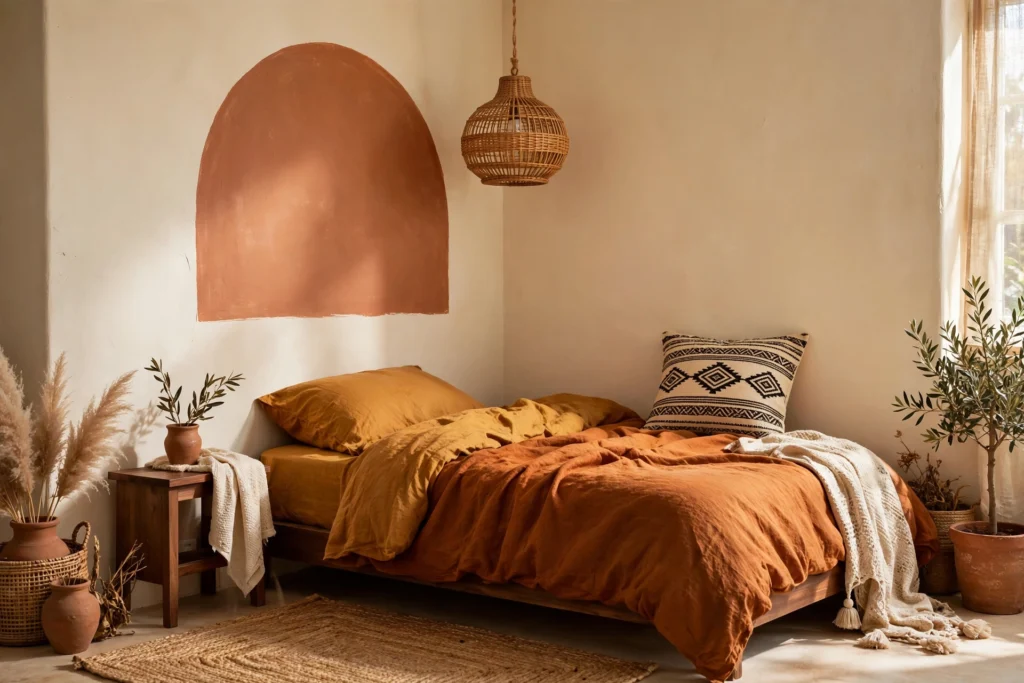
A single warm wall — terracotta, rust, or clay — sets the entire palette, and it’s the cheapest big move in this list. One gallon covers a standard 10×8 ft (3×2.4 m) accent wall with two coats; expect roughly $30–$45 for a gallon of decent interior paint (estimate, as of October 2026). If a whole wall feels like too much commitment, paint just the wall behind the sofa, or an arch shape above the bed — the arch is the Afrohemian signature, and it takes a quart and an afternoon. Keep the other walls cream or warm white so the terracotta reads as a choice, not a cave.
2. Swap in mudcloth pillow covers
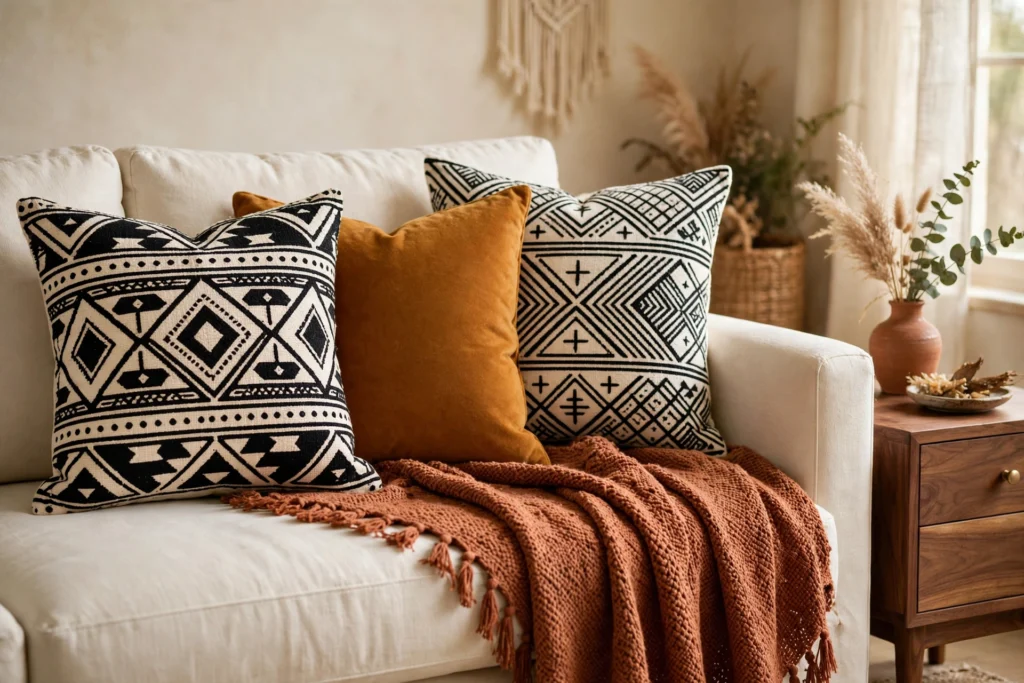
This is the fastest textile win in the room. African-inspired pillow cover sets of two to four (18×18 in / 46×46 cm) run $12.99–$14.99 on Amazon as of October 22, 2026 — black-and-white mudcloth geometry on cotton, no sewing required. The honest upgrade: buy one authentic handmade mudcloth cover (around $59 as of October 2026) for the cushion you actually lean on, and fill the rest of the sofa with the budget set. One real piece raises the integrity of everything around it, and nobody can tell which cover cost what from across the room.
3. Hang a woven basket wall
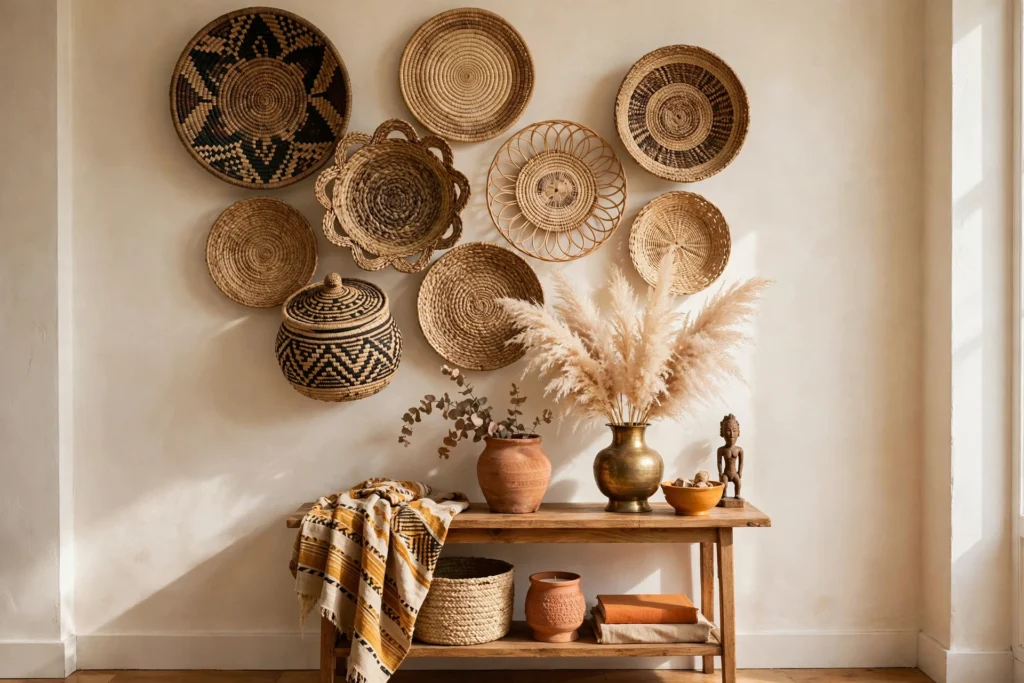
A cluster of seagrass and rattan baskets on the wall is the single most recognizable Afrohemian move — and one of the cheapest. A 7-pack of woven wall baskets runs $19.99 as of October 2026. Arrange them in odd numbers with varied sizes, largest in the center, and leave 2–3 in (5–8 cm) between pieces so each basket reads on its own. Hang them with adhesive hooks and the whole thing is one of the easiest damage-free ways to dress a rental wall — no drilling, no deposit risk. If you already own baskets, check the natural woven baskets we compared first; a storage basket with a flat back doubles as wall art.
4. Layer a jute rug under a patterned kilim-style rug
Layering is the whole boho half of Afrohemian, and rugs are where it shows most. Start with a plain jute base rug — Amazon jute rugs run under $50 as of October 2026 — then lay a smaller patterned kilim-style rug on top at an angle, leaving 6–12 in (15–30 cm) of jute showing around the edges. The jute adds texture and size; the patterned layer adds the African geometry. In a small room this beats one expensive rug every time, because the layers make the floor look intentional instead of just covered.
5. Thrift a rattan or carved-wood piece
One statement piece beats five new small ones. A secondhand rattan chair, a carved wooden bowl, or a wooden serving board typically runs $5–$25 at thrift stores (estimate, as of October 2026). Look for solid rattan with tight weaving, carved wood with visible hand-tool marks, and anything with a story — a chipped edge on a carved bowl is character here, not damage. Clean it, oil the wood if it’s dry, and let it be the one piece in the room that isn’t new.
6. Style a mudcloth runner and brass candlesticks
A mudcloth or adire table runner down the coffee table or dining table, dressed with a carved board, a clay bowl, and thrifted brass candlesticks (typically $3–$8 a pair at thrift stores, estimate) is the cheapest atmosphere in this style. Warm candlelight against terracotta and black-and-white geometry does more for a room at 7 p.m. than any lamp you can buy. Keep the runner narrow — 12–14 in (30–36 cm) wide — so it reads as a layer, not a tablecloth.
7. Frame a piece of African fabric as wall art
A remnant of mudcloth, adire, or Kente in a simple frame is cheaper than a print and it’s real textile. A 24×36 in (61×91 cm) piece is the standard size above a sofa; smaller remnants work in a pair flanking a mirror or a doorway. Buy the remnant, not the finished “African art print” — the fabric’s weave and dye variation is the point, and a plain black or natural-wood frame lets it speak. One large framed textile beats a gallery wall of small prints in a small room, because it gives the eye one place to land.
8. Add a rattan pendant light
Swap a plain ceiling shade for a woven rattan pendant — one runs $23.99 as of October 2026 — or simply replace a lampshade with a woven one. Use a warm bulb (2700K) and keep the wattage low; the woven shade throws patterned shadows on the ceiling at night, which is half the effect. In a rental, a plug-in pendant with a hook does the same job without touching the wiring.
9. Build a plant corner in terracotta and seagrass
Plants are native to this style — literally. The snake plant is native to West Africa, the fiddle-leaf fig to western Africa, the bird of paradise to South Africa. A snake plant in a terracotta pot (about $5 as of October 2026) or a seagrass basket planter is the hard-to-kill starting point; add a bundle of dried pampas ($10–$20 as of October 2026) in a tall clay vase for instant height. Group three plants at different heights in one corner — tall, medium, trailing — and the corner becomes a feature instead of dead space.
10. Create a floor-cushion reading nook
Oversized floor cushions and a leather pouf near a window, with a low table and a stack of books, is the most small-space-friendly seating there is — it adds a whole extra seat without adding a chair’s footprint, and it folds away when you need the floor back. Choose earth tones with one mudcloth-patterned cushion as the anchor. This is the relaxed, layered seating that defines the boho half of Afrohemian, and in a studio it can be the living room’s second zone without a single piece of furniture.
Styling It in a Small Space
Three rules keep it from tipping into clutter. First, keep the base light and neutral — cream walls, pale wood, one terracotta wall — and let the textiles carry the color. Second, choose high-impact, low-footprint pieces: one bold throw, one statement wall piece, baskets that double as storage. Third, use vertical space — the basket wall, the framed textile, the pendant — so the floor stays clear. The style is layered, not crowded, and in a small room the difference is about five objects.
Where to Buy Authentic Pieces
Buy the real thing where it matters. Fair-trade marketplaces, African textile specialists, direct-from-artisan Etsy sellers, and Black-owned makers are the right sources for mudcloth, adire, and Kente. Check listings for “handwoven,” “hand-dyed,” or “handmade,” and read the sourcing story before you buy. One genuine artisan piece — the $59 mudcloth cover, one handwoven basket — carries the room; everything around it can be budget, thrifted, or DIY, and the whole room reads as authentic because its anchor is.
The Starter Combo: Under $50
If you want the look this weekend for the least money, here’s the math: a set of mudcloth-look pillow covers ($13) + a 7-pack of woven wall baskets ($20) + a bundle of dried pampas ($10) + a terracotta pot ($5) = about $48 as of October 2026. Add the terracotta paint later, when you have a free afternoon. That $48 buys you the palette, the pattern, and the texture — which is to say, it buys you the style.
What is Afrohemian decor?
Afrohemian decor is a fusion of African design heritage and relaxed bohemian styling. It blends African craft traditions — mudcloth (bogolanfini), adire, Kente, Kuba cloth, handwoven baskets, and carved wood — with boho’s layered, collected-over-time feel. The palette is warm earth (terracotta, ochre, cream) with deep indigo and black contrast, and the look is soulful and grounded rather than overly styled.
Is Afrohemian decor expensive?
No — it’s one of the cheapest styles to do well on a budget. Start with paint and textiles: a set of mudcloth-look pillow covers runs about $13–$15, a 7-pack of woven wall baskets about $20, and a terracotta accent wall about $30–$45 in paint (all as of October 2026). Thrift the rattan and carved-wood pieces, DIY the framed fabric art, and invest only in one or two authentic artisan pieces — a handmade mudcloth cover is around $59 — where you touch them daily.
How do I style Afrohemian decor in a small space?
Choose high-impact, low-footprint pieces: one bold throw, one statement wall piece, and baskets that double as storage. Keep the base light and neutral (cream walls, pale wood) and let the textiles carry the color. Use vertical space — a basket wall, a framed textile, a rattan pendant — so the floor stays clear, and keep the layering to a few strong pieces rather than many small ones.
Where can I buy authentic African textiles like mudcloth and adire?
Buy from fair-trade marketplaces, African textile specialists, direct-from-artisan Etsy sellers, and Black-owned makers. Look for “handwoven,” “hand-dyed,” or “handmade” in the listing and read the sourcing story before you buy. Avoid mass-market copies of mudcloth and adire patterns — one genuine artisan piece raises the integrity of everything around it.