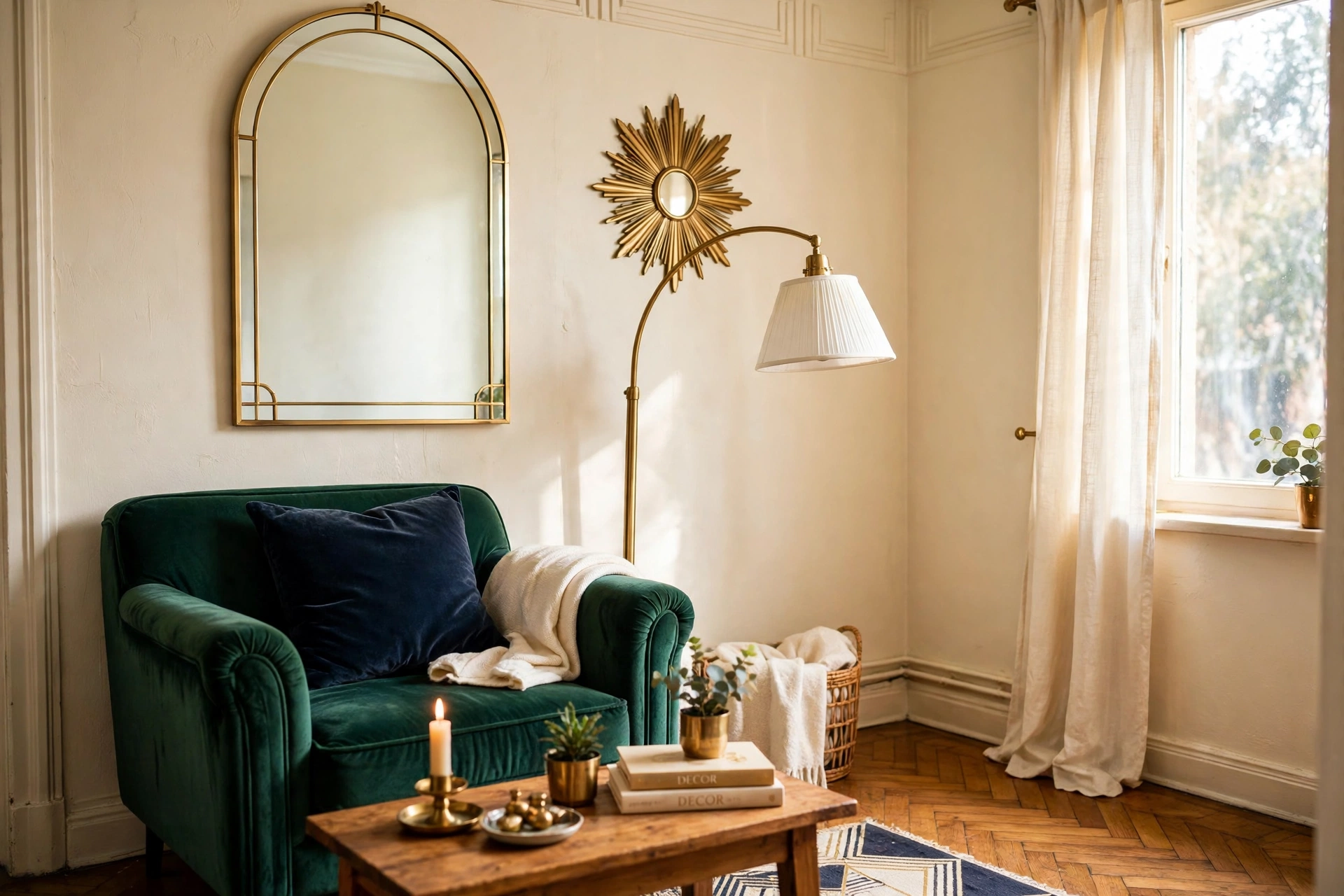
Neo Deco on a Budget: 10 Ways to Get the 2026 Look in a Small Space
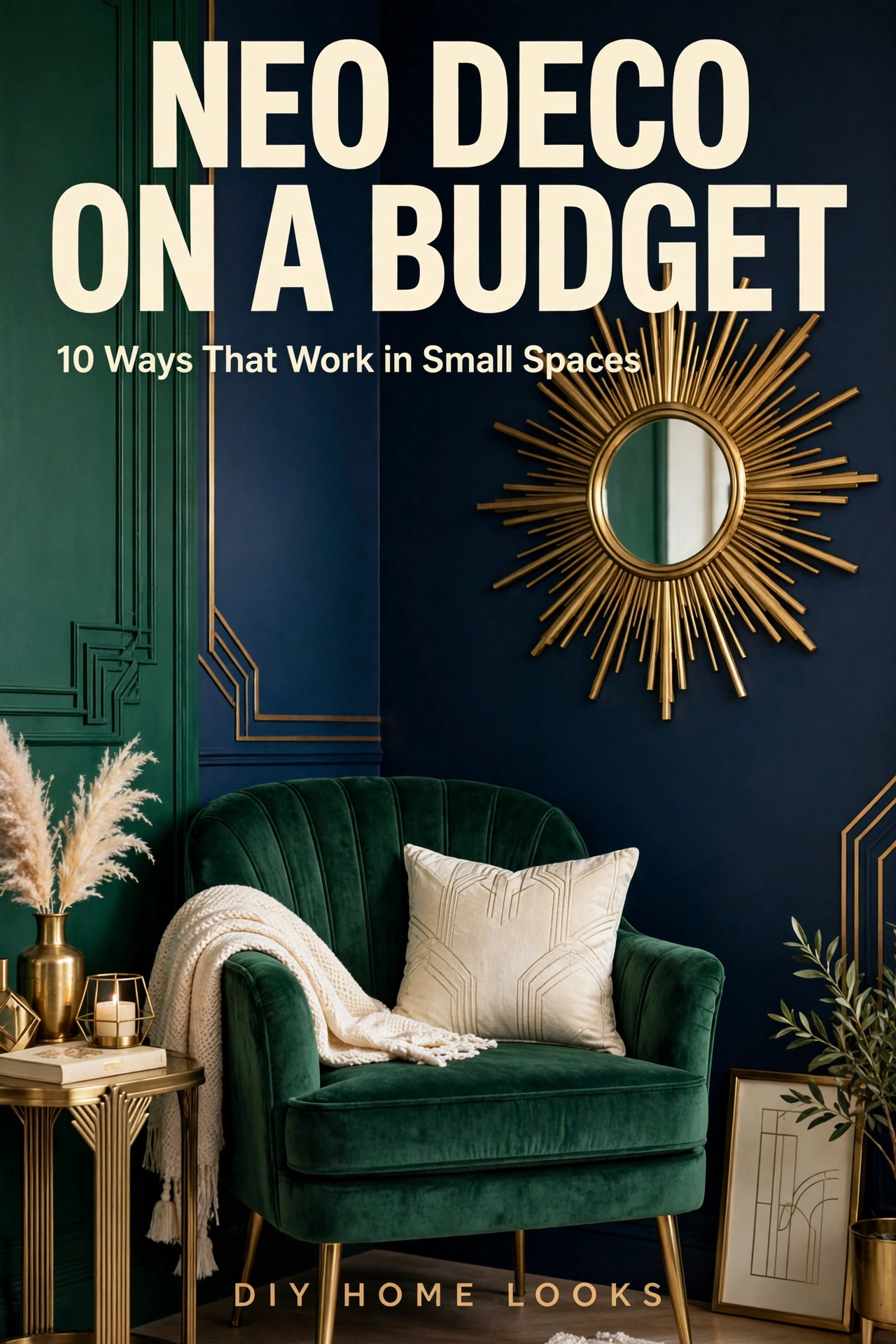
Neo Deco is Pinterest’s defining interior trend for 2026, and here is the good news: it is one of the cheapest “luxury” looks to fake. You don’t need a new sofa, a renovation, or a showroom budget. The whole style lives in geometry and finish — a painted arch, warm brass, one jewel-toned velvet cushion — and the high-impact version of a room costs about $100–$150 as of October 2026. Here are the ten moves that deliver the look in a small space, cheapest first — and for the warm, handmade counterpart, see afrohemian decor on a budget.
What Is Neo Deco (and Why Is It Everywhere in 2026)?
Neo Deco is the modern revival of 1920s Art Deco. It keeps the original glamour — fan arches, chevrons, sunbursts, stepped forms, velvet, brass, lacquered finishes — but updates it with moodier palettes and a more livable, less formal attitude. Think Great Gatsby meets contemporary comfort: the bones are vintage, the feeling is current.
Pinterest named it one of its defining 2026 trends in the Pinterest Predicts report, and the search data backs it up: searches for “red marble bathroom” are up 80% and “antique bar cart” is up 100% over the past year, while brass aesthetics are up 35%. A designer survey from Home Accents Today found 79% of respondents chose brass over chrome for the year ahead. the 2026 Colors of the Year we translated for small rooms already pointed the same way — warm, saturated, and a little bit brave.
What makes Neo Deco different from original Art Deco is restraint. The 1920s version was unapologetically maximalist and expensive: lacquered furniture, exotic woods, whole rooms designed at once. Neo Deco is finish-deep. The same geometry and glamour are achieved through paint, mirrors, hardware, and metallic accents rather than costly furniture, and it mixes Deco pieces with contemporary furniture instead of going full period room. The Encyclopaedia Britannica’s Art Deco overview is a good place to see where the original motifs come from, if you want the history behind the shapes.
That finish-deep quality is exactly why it suits small rooms. You are not buying furniture; you are changing surfaces and silhouettes, and a small room only needs three or four Deco accents to change its whole mood.
The 3 Rules That Keep Neo Deco From Looking Like a Theme Party
Before the shopping list, three guardrails. Break them and the room tips from glamorous into costume.
One jewel tone per room. Emerald, sapphire, burgundy, deep navy, plum — pick one and let it lead. Everything else stays cream, ivory, warm white, or black. Two jewel tones in a small room feel busy; one feels curated.
Follow a 60-30-10 split. Roughly 60% main color (a soft neutral with warm undertones, like creamy white), 30% secondary (your jewel tone, usually carried by the sofa or chairs), 10% accent (brass or gold metallics and black details). It is the same ratio that keeps bold paint colors that make small rooms feel bigger from overwhelming the space.
Two metals, maximum. Brass plus black iron, or brass plus chrome — never all three. Repeat each finish in at least two spots (a lamp and a mirror frame, for example) so it reads as intentional rather than accidental.
1. Paint One Arch, Not One Wall — About $12
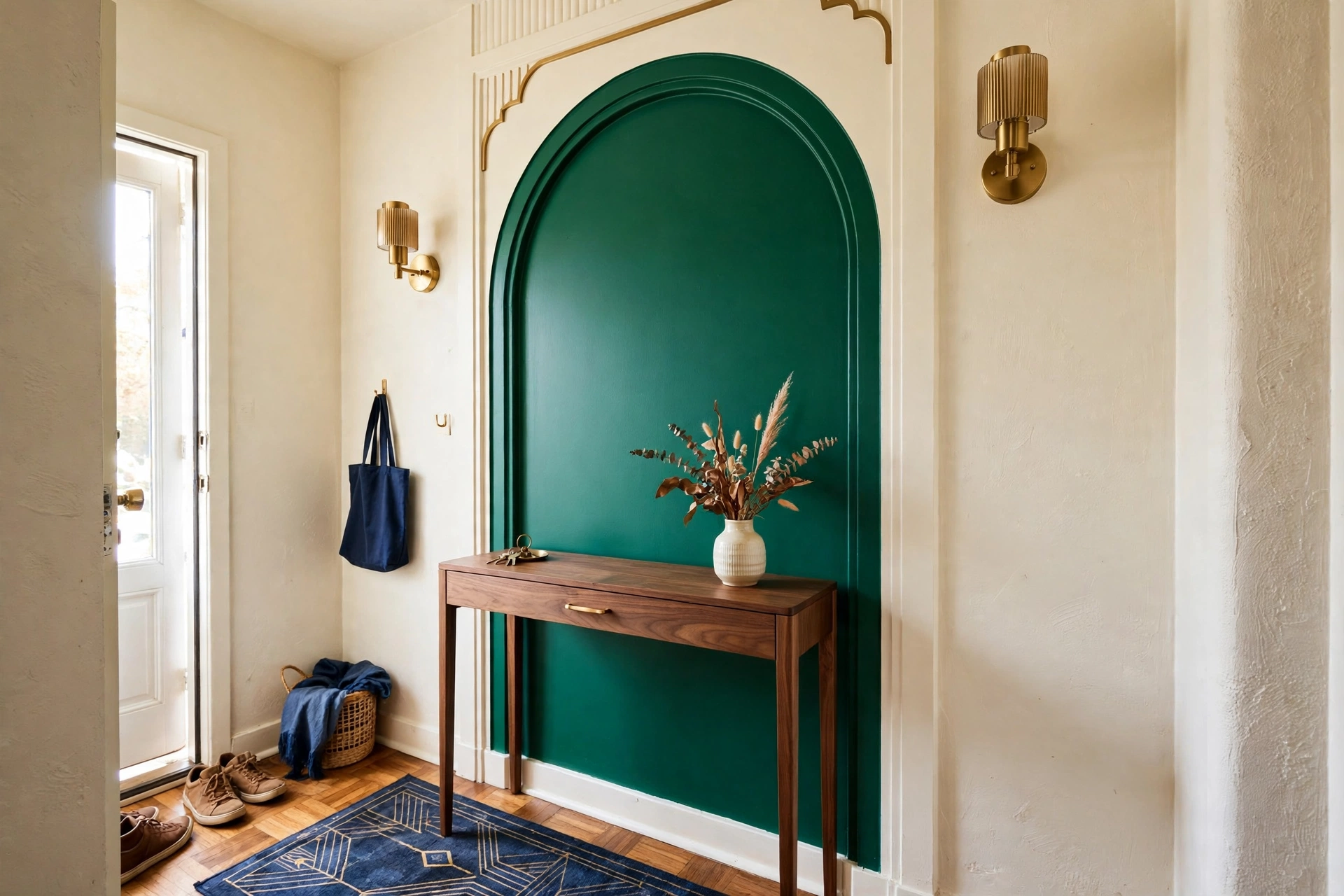
The single highest-impact, lowest-cost Neo Deco move is a painted arch. Mark a wide arch on one wall with a pencil and a piece of string, fill it in with a deep jewel tone — emerald, sapphire, or plum — and you have an instant focal point for the price of a sample pot of paint, roughly $12 as of October 2026.
Place it behind something slim: a console table, a reading chair, a desk. In a hallway 90–120 cm (3–4 ft) wide, a painted arch behind a slim console creates depth without consuming a centimeter of floor. The trick is choosing the right shade — wall colors that make a small room feel bigger are the ones with warm undertones, and a deep green or navy arch on a cream wall gives you drama without darkness.
2. Swap the Hardware to Warm Brass — $30–$40
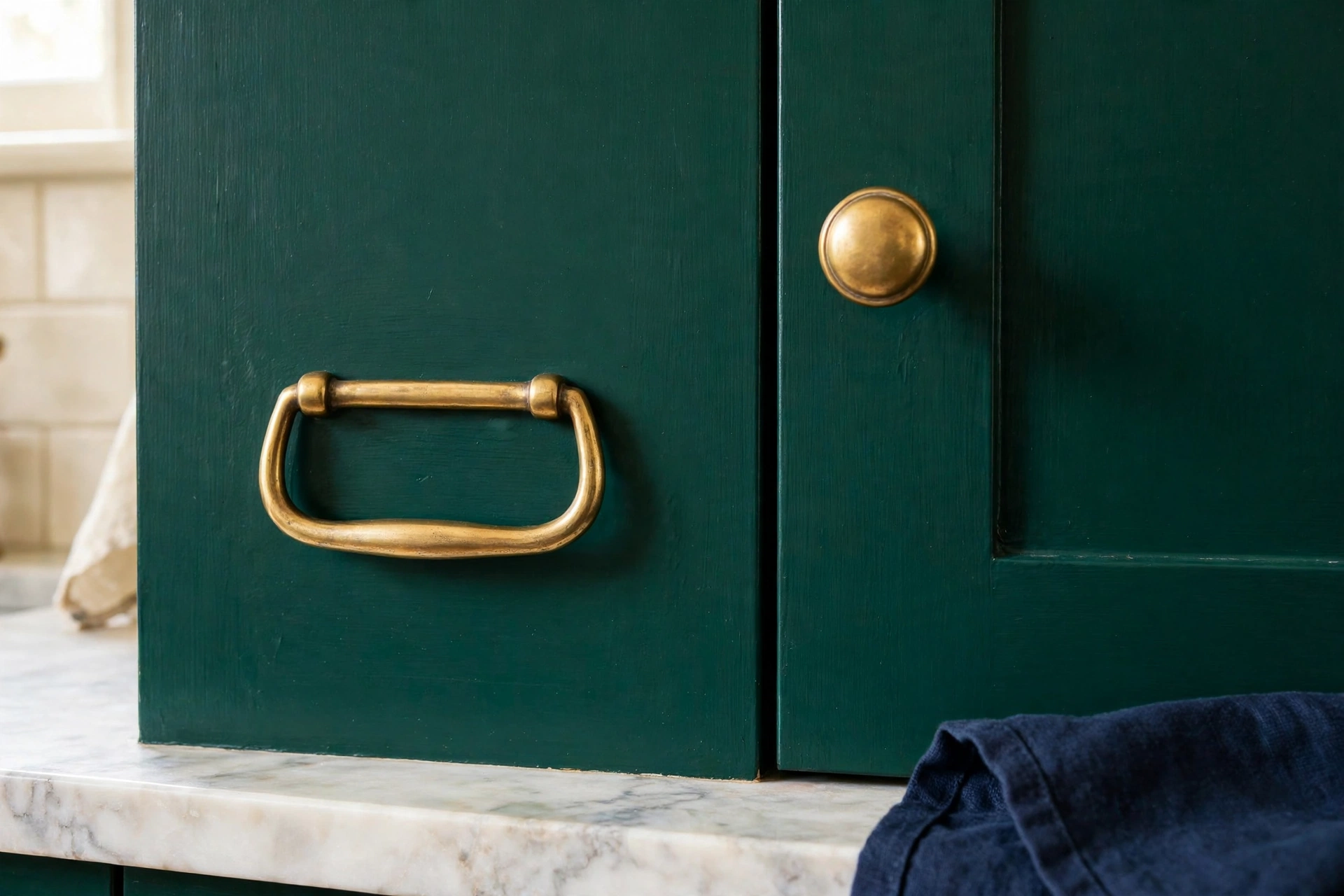
Cabinet pulls, door handles, and dresser knobs are some of the cheapest updates in the whole house, and Neo Deco leans hard on warm brass over the cooler chrome and nickel that dominated the last decade. A weekend spent swapping hardware on a dresser or kitchen cabinets changes the feel of a room without touching the furniture itself.
Unlacquered brass is the sweet spot: it ages gracefully and costs a fraction of solid brass. A set of ten pulls runs about $30–$40 as of October 2026. Look for knurled or hexagonal detail — that little bit of geometry is what makes a plain pull read as Deco.
3. Buy One Velvet Piece, Not a Velvet Room
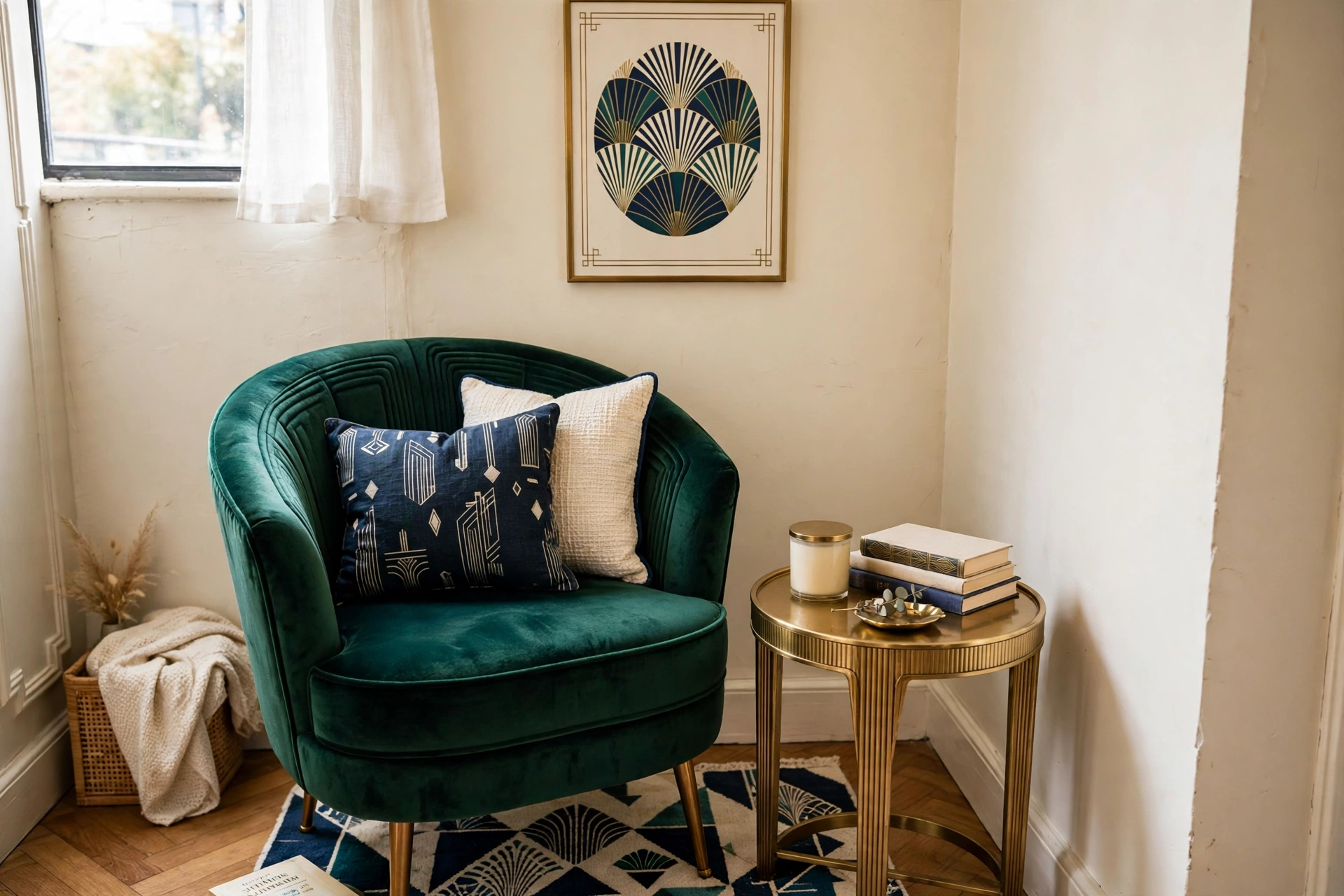
You do not need a full living room set to get the texture right. One velvet accent chair in emerald, sapphire, or deep rust does the work a whole sofa reupholster would, at a fraction of the cost. Pair it with your existing furniture rather than trying to match everything at once.
Thrift stores and Facebook Marketplace are full of velvet chairs for $40–$80 because people buy them, decide velvet is too much, and resell. A chair with curved arms and a tight back already has the Deco silhouette; the velvet just finishes the sentence.
4. Hang a Sunburst or Arched Mirror — $50–$80
Mirrors are Neo Deco’s secret weapon in small spaces, and they do double duty: they carry the geometry (sunburst, fan, arch) and they bounce light and depth into a room that has neither to spare. A large arched floor mirror leaning on a wall echoes a doorway and makes a 10 × 12 ft (3 × 3.7 m) room feel taller.
Budget version: a brass arch mirror for $50–$80 as of October 2026, or a thrifted rectangular mirror with a $10 can of brass spray paint on the frame. Hang it opposite a window if you can — that is where the light-doubling pays off most.
5. Peel-and-Stick Geometric Wallpaper — One Wall Only
If you can paint, you can probably do better: one wall of peel-and-stick geometric wallpaper — fan, chevron, or oversized deco scallop — behind the bed or the sofa. It is the fastest way to get pattern into a room, it costs $25–$40 a roll, and it peels off cleanly, which makes it one of the most renter-friendly wall treatments that don’t cost your deposit.
Keep it to one wall and one pattern. Two patterned walls in a small room fight each other; one patterned wall with the rest in plain cream reads as a decision.
6. Thrift a Sculptural Light
Lighting carries most of the Neo Deco look, which makes it the highest impact, lowest commitment place to start. A single fluted glass pendant, a tiered chandelier, or a wall sconce with a brass arm does more for the aesthetic than swapping out furniture.
This is the move to thrift, not buy new. Brass table lamps, globe floor lamps, and tiered pendants turn up constantly at thrift stores and estate sales for $15–$35, and a $5 warm LED bulb (2700K) finishes the mood. Put the statement light somewhere it gets noticed: over a dining table, above a reading chair, or in the entryway.
7. Let Jewel Tones Lead the Textiles
If paint feels like too much commitment, let the soft furnishings carry the color. A sapphire throw, emerald cushion covers, a burgundy velvet curtain — textiles are the cheapest way to test a jewel tone before you commit to it on a wall.
Mount the curtain rod 4–6 in (10–15 cm) above the window frame and extend it 8–12 in (20–30 cm) past each side. Velvet or heavy linen that just grazes the floor adds height, and the curtain color becomes the room’s 30% in the 60-30-10 split without a drop of paint.
8. Add Fluted Texture With MDF Strips
Fluted panels — those vertical ribs you see on Deco consoles and walls — look expensive and cost almost nothing. Thin MDF strips, cut to length and glued in a row on a flat cabinet door or a narrow wall section, give you the ribbed Deco texture for about $15–$20 in materials.
Paint the strips the same color as the surface behind them for a subtle, tone-on-tone effect, or go one shade deeper for contrast. A fluted panel on the front of a plain IKEA-style cabinet is the difference between flat-pack and custom, and it takes an afternoon.
9. Thrift a Bar Cart (or Fake One With a Tray)
The antique bar cart is the single most-searched Neo Deco object of 2026, and the thrift-store version costs $30–$60 instead of $300. A two-tier brass cart with a few vintage glasses and a small plant is instant Deco — geometry, metallics, and a little bit of theater in one piece.
No room for a cart? A lacquered tray on top of a bookshelf or side table does the same job at a smaller scale: about $15 as of October 2026, and it corrals the clutter into something that looks styled instead of stored.
10. Style It With Symmetry
The last move costs nothing, and it is the one that makes the other nine look expensive. Neo Deco is built on symmetry: pairs of sconces, matching frames, a centered mirror, a rug placed square to the room. Step back, find the room’s center line, and balance the big pieces on either side of it.
If a corner feels off, it is almost always symmetry, not stuff. Move one lamp, center one frame, and the whole room clicks into place. Restraint is the difference between a Deco-inspired room and a Deco-themed one — and restraint is free.
What Does Neo Deco Cost in One Small Room?
The high-impact version — painted arch, brass mirror, hardware swap, lacquered tray — runs $100–$150 as of October 2026. The full ten steps, including a velvet chair and a thrifted light, run $250–$400 depending on what you find secondhand.
Where to spend: the mirror and the light, because they are the pieces your eye lands on. Where to save: paint, hardware, and textiles, because the budget versions photograph and live almost identically to the expensive ones. And where to stop: the moment the room has three or four Deco accents, stop adding. Three accents change a room’s whole mood; seven make it a set.
Renter-Friendly Neo Deco
Almost everything above is reversible, which is why Neo Deco is one of the most renter-friendly “luxury” trends around. Peel-and-stick arch decals instead of paint, plug-in sconces instead of hardwired ones, swapped cabinet hardware (keep the originals in a bag for move-out day), and a leaned — not hung — arch mirror all come with you when you move. The only step that isn’t fully reversible is paint, and even that is one wall, one afternoon, and one coat of primer back to white.
What is neo deco?
Neo Deco is the modern revival of 1920s Art Deco, named a Pinterest Predicts trend for 2026. It keeps the original glamour — velvet, brass, lacquered finishes, sunburst and fan motifs, curved silhouettes — but updates it with moodier palettes and a more livable, less formal attitude. Think Great Gatsby meets contemporary comfort.
How is neo deco different from Art Deco?
Original Art Deco was unapologetically maximalist and expensive: lacquered furniture, exotic woods, whole rooms designed at once. Neo Deco is finish-deep — the same geometry and glamour achieved through paint, mirrors, hardware, and metallic accents rather than costly furniture. It is also more restrained, mixing Deco pieces with contemporary furniture instead of going full period room.
How much does it cost to do neo deco in one room?
As of October 2026, $100–$150 covers the high-impact version: paint for an arch (about $12), a brass arch mirror ($50–$80), brass cabinet pulls ($30–$40), and a lacquered tray (about $15). The full ten steps run $250–$400 depending on lighting choices, and thrifting the chair and light brings that down further.
Does neo deco work in small spaces?
Yes — some of its best moves are small-space friendly. Mirrors, sunburst, arched, or antiqued, double light and depth; a fluted console fits narrow entryways; and one lacquered accent wall adds drama without crowding. Keep the palette to one jewel tone plus metallics so a small room feels curated rather than busy, and most of the moves are renter-friendly too.