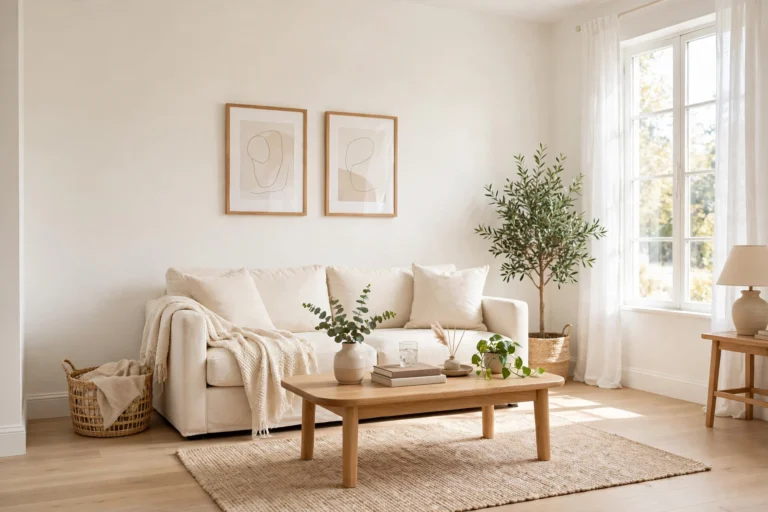
7 Best Paint Colors for Small Home Offices That Make a Tiny Workspace Feel Bigger
Short answer: pick a light color with an LRV above 55 for the walls, and save the deep color for one accent wall behind your desk. The best paint colors for small home offices are the ones that bounce light back into the room instead of swallowing it. I did the math for a real 10 by 10 ft (305 by 305 cm) office first: 320 sq ft of wall, about 284 sq ft once you subtract the door and the window, and two coats means you need 2 gallons, not the 1 gallon most small-room guides assume. That number shapes every price in this guide.
Most office color lists just hand you 15 swatches and wish you luck. This one is narrower on purpose. Seven colors, one ladder from brightest to darkest, each with an honest verdict. You will know what it is best for, what to watch out for, and whether it fits the way you actually work. And since this room is where you earn your living, the guide also covers video calls, paint finish by light direction, real costs as of November 2026, and the renter rules.
How do you pick the best paint colors for small home offices that actually work?
Start with LRV, the number that says how much light a paint reflects. A color with an LRV of 86 reflects about 86 percent of the light that hits it, so the room feels brighter. In a small office, aim for an LRV of 55 or higher on three walls, then add depth with one darker wall if you want it.
LRV stands for Light Reflectance Value, and it runs from 0 to 100. Zero is a black hole. One hundred is a perfect mirror white. Everything in this guide sits on that scale, and the scale does the arguing for you. A pale cream at LRV 66 bounces back two thirds of the light. A charcoal at LRV 6 bounces back almost none. That gap is the whole reason one office feels open and another feels like a cupboard.
Here is the ladder, brightest to darkest. All seven LRV figures come from Home Sentiment’s own review pages for home office colors, read in full on November 15, 2026. They are the figures on those review pages, not the manufacturers’ official figures.
| Paint | HEX | LRV | Best for |
|---|---|---|---|
| White Heron OC-57 (Benjamin Moore) | #F0F1EA | 86.69 | Brightest walls, dark or north-facing offices |
| Muslin OC-12 (Benjamin Moore) | #E1D6C1 | 66.54 | Warm cream walls, soft focus |
| Repose Gray SW 7015 (Sherwin-Williams) | #CCC9C0 | 58 | Any light, the safe all-rounder |
| Boothbay Gray HC-165 (Benjamin Moore) | #AAB2B0 | 43.26 | Cool calm focus, coastal feel |
| Evergreen Fog SW 9130 (Sherwin-Williams) | #95978A | 30 | Calm depth, creative work |
| Svelte Sage SW 6164 (Sherwin-Williams) | #B2AC96 | 30 | Soft sage, gentle green calm |
| Iron Ore SW 7069 (Sherwin-Williams) | #434341 | 6 | Accent wall behind the desk only |
Two things jump out. First, the top three colors all sit above LRV 55, and that is the safe zone for a small office. Second, the bottom of the ladder drops fast. Evergreen Fog and Svelte Sage share LRV 30, and Iron Ore sits at 6, which means it absorbs about 94 percent of the light that hits it. That is a feature on one wall and a problem on four.
Which paint color fits the way you actually work?
Match the color to your work, not to a trend. Deep focus wants a calm mid-tone that sits still behind your screen. Creative work likes a soft green that keeps the room feeling alive. Video calls want a wall that flatters your face and stays quiet on camera. The table below maps each goal to an LRV band.
| Work goal | LRV band | Colors from the ladder | Why it works |
|---|---|---|---|
| Deep focus | 40 to 60 | Repose Gray, Boothbay Gray | Steady, low distraction, still enough light |
| Creative work | 30 to 45 | Evergreen Fog, Svelte Sage, Boothbay Gray | Soft green keeps the room feeling fresh without shouting |
| Video calls | 55 to 87 on the camera wall, or 6 as an accent behind the desk | White Heron, Muslin, Iron Ore accent | A light wall reflects evenly; a dark wall behind the desk adds contrast |
| Small or windowless room | 65 to 87 | White Heron, Muslin | Maximum bounce, no gloom |
Paint is only half the room, so pair the color with the layout. These budget home office ideas for small spaces cover the desk, storage, and lighting side of the same small room, and the color you pick here has to live with that furniture.
The 7 best paint colors for small home offices, one by one
Each color below gets the same honest verdict: best for, main advantage, watch out for, and a final call, plus a Deposit-Risk rating for renters. The rating runs from 1 to 5. A 1 means a landlord will barely notice it. A 5 means you will be repainting with primer before you get your deposit back.
1. White Heron OC-57, LRV 86.69
Best for: the darkest, smallest, or north-facing office in the house.
Main advantage: it reflects 86.69 percent of the light, the highest figure on this ladder. A dim corner office suddenly feels like it has a window it does not have.
Watch out for: pure bright white can wash you out on video calls, and it glares under a ring light. White Heron is softer than a stark white because of its subtle yellow undertone, but test it on camera before you commit.
Verdict: the best default if your office is short on light. Clean, bright, and landlord friendly.
Deposit-Risk: 1 out of 5.
2. Muslin OC-12, LRV 66.54
Best for: a warm, calm office where you sit for long stretches.
Main advantage: a warm cream with a red undertone that feels like late afternoon light, even on a gray day. At LRV 66.54 it still bounces back two thirds of the light, so the room stays bright.
Watch out for: the red undertone can read pink in cool LED light. Sample it under your actual desk lamp, not just in daylight.
Verdict: the coziest bright option on this list. It shares the warm logic behind the paint colors that work in small bedrooms, where soft warmth beats stark white.
Deposit-Risk: 2 out of 5.
3. Repose Gray SW 7015, LRV 58
Best for: anyone who wants one safe answer and no drama.
Main advantage: a warm gray with a yellow undertone that works in any light direction. North-facing, south-facing, windowless, it holds its nerve everywhere. At LRV 58 it sits just inside the bright zone.
Watch out for: it can look a little plain next to a bolder color. That is the trade for safety. If you want personality, put it in the furniture, not the walls.
Verdict: the pick if you hate repainting. It is the hardest color on this list to regret.
Deposit-Risk: 2 out of 5.
4. Boothbay Gray HC-165, LRV 43.26
Best for: deep focus work and long writing or coding sessions.
Main advantage: a cool gray-green with a green undertone that feels calm without feeling cold. It sits behind your monitor like a quiet backdrop, and your eyes rest on it instead of fighting it.
Watch out for: at LRV 43.26 it needs decent light. In a north-facing office with one small window, it can turn murky by late afternoon. Pair it with a bright desk lamp.
Verdict: the focus pick. If your work needs concentration more than cheer, start here. If you like this cool gray-green direction, the same family shows up in these small living room paint colors, so the two rooms can feel connected without matching.
Deposit-Risk: 3 out of 5.
5. Evergreen Fog SW 9130, LRV 30
Best for: creative work and a home office that doubles as a reading nook.
Main advantage: a gray-green chameleon with a yellow undertone. It reads green in daylight, gray in the evening, and calm in both. It gives a small room depth without the heaviness of a true dark color.
Watch out for: the chameleon act cuts both ways. It can look different on every wall, so sample it on two walls before you buy the gallons.
Verdict: the most interesting color on this list, and the one most likely to surprise you. Sample first, then commit.
Deposit-Risk: 3 out of 5.
6. Svelte Sage SW 6164, LRV 30
Best for: a soft, gentle office that never feels loud.
Main advantage: a soft sage with a yellow undertone that feels like a garden through a window. Same LRV as Evergreen Fog at 30, but lighter and warmer in feel, so it suits a small room slightly better.
Watch out for: in a dim room it can drift toward beige and lose the green that makes it special. Give it as much light as you can.
Verdict: the gentle green. Pick it if Evergreen Fog feels a touch too moody for your taste.
Deposit-Risk: 3 out of 5.
7. Iron Ore SW 7069, LRV 6
Best for: one accent wall behind the desk. Nothing else in a small office.
Main advantage: a deep charcoal with a yellow undertone that makes a desk setup look deliberate and expensive. On camera it reads as a considered backdrop, and it makes a light desk and monitor pop.
Watch out for: at LRV 6 it absorbs about 94 percent of the light. Four walls of it would turn a small office into a cave, and it takes extra primer coats to paint back over when you move out.
Verdict: the most underrated move in this guide, used correctly. One wall only, behind the desk, never all four. Our full Iron Ore SW 7069 profile explains why this soft black works as an accent and fails as a four-wall color in a small room.
Deposit-Risk: 4 out of 5.
Will your wall color look good on video calls?
Test it with your actual camera, because your eyes lie and the webcam does not. A wall that looks fine in person can glare, wash you out, or throw a color cast on your face the moment the call starts. This is the gap none of the top-ranking guides test properly.
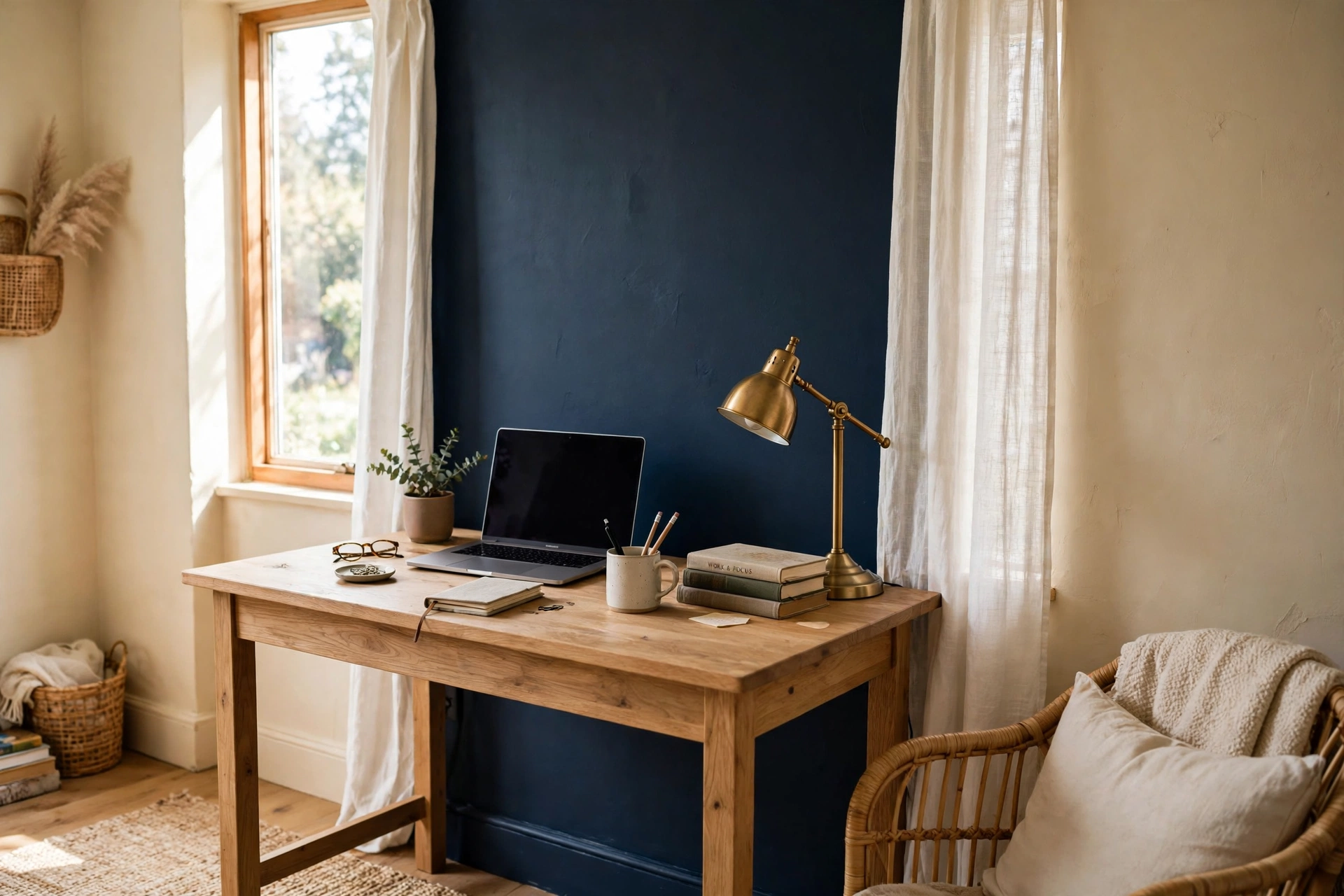
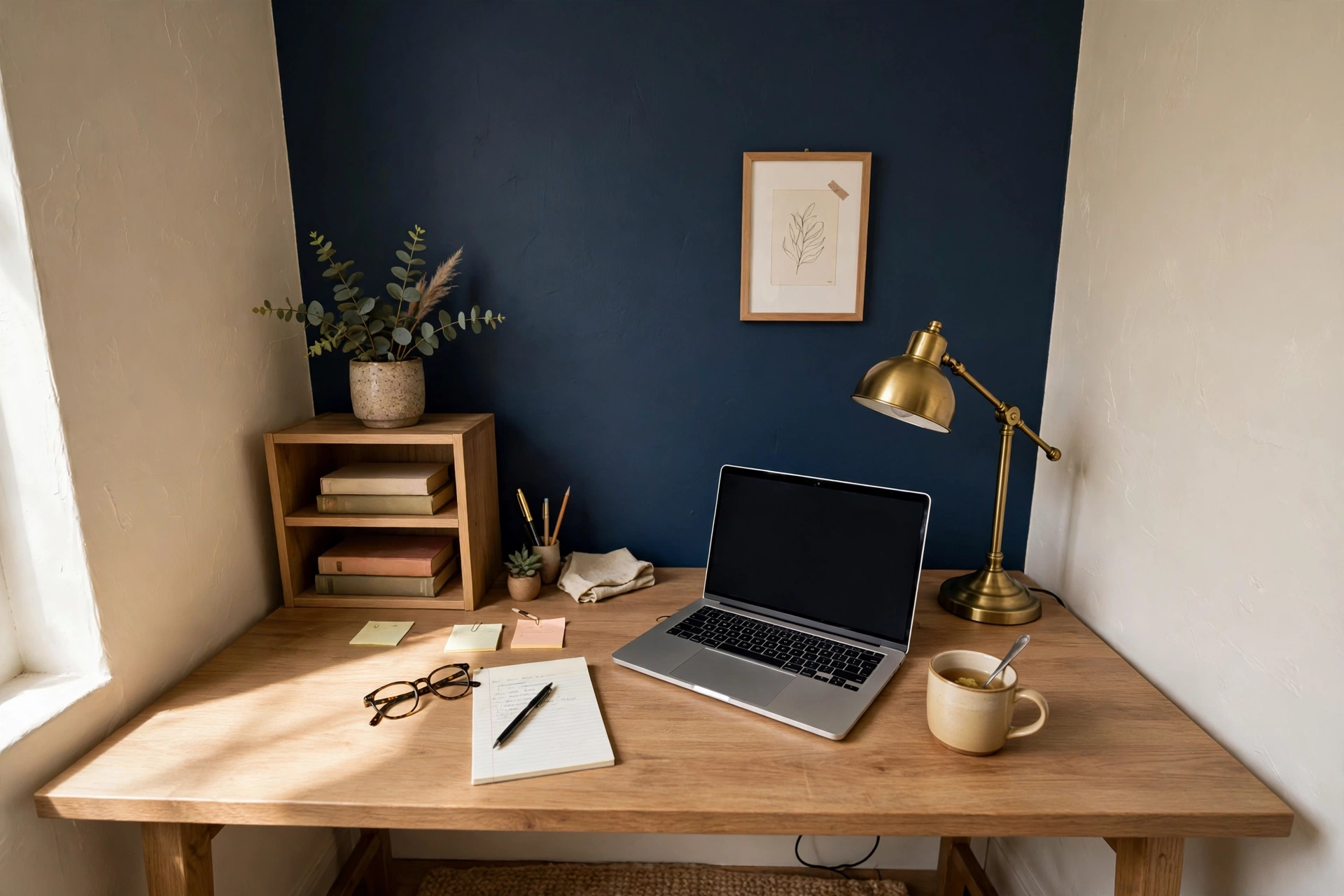
Pure bright white is the most overrated choice for a video-call office. It washes you out on camera and glares under a ring light. A soft off-white like White Heron or Muslin is safer, because it reflects light evenly without blowing out the frame. Mid-tone walls like Boothbay Gray give the camera something to hold onto, so your face stays the brightest thing in the shot. And one deep charcoal accent wall behind the desk is the most underrated move of all. It frames you, hides cable clutter in shadow, and looks considered rather than accidental.
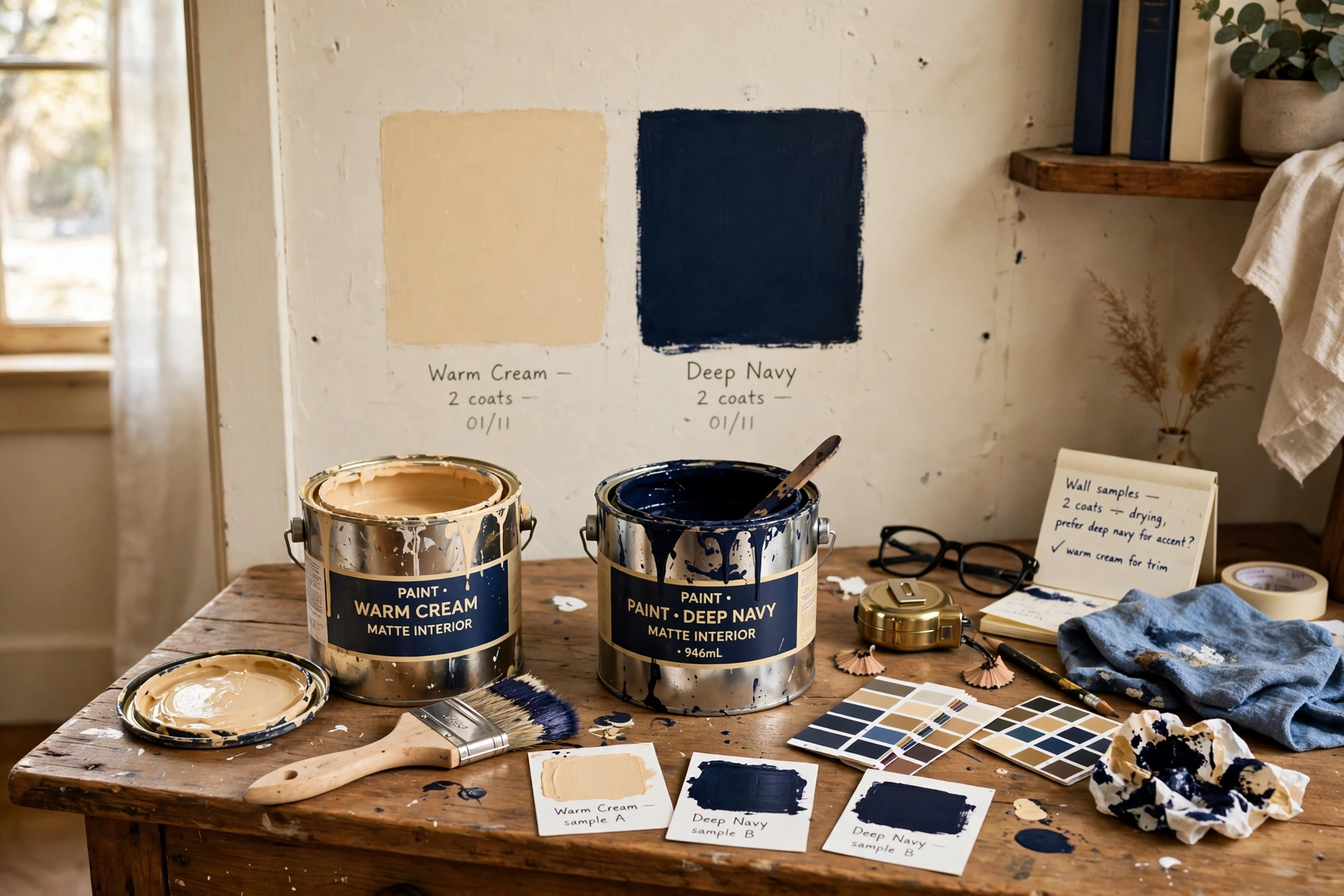
Do this before you buy gallons. Paint 2 ft (61 cm) squares on two walls, one behind your desk and one to the side. Sit down, turn on your usual call lighting, and take a screenshot. Check your face, not the wall. If your face looks gray or washed out, the color is wrong for calls, no matter how good it looks empty.
What paint finish works best in a home office?
The finish matters as much as the color. Even the best paint colors for small home offices can glare under a ring light if you pick high gloss for the walls. Eggshell is the right default, and the table below adjusts it by light direction.
| Light direction | Walls | Trim, doors, and shelving | Notes |
|---|---|---|---|
| North-facing or dim | Eggshell, LRV 55% or higher | Satin | Eggshell hides small flaws and cuts screen glare |
| South-facing or bright | Eggshell or matte, deeper colors OK | Satin or semi-gloss | Strong sun can carry depth; matte softens glare |
| Windowless | Eggshell, LRV 65% or higher | Satin | Pick a low-VOC paint if you work in the room soon after painting |
Eggshell is the sweet spot because it hides the small dents a desk chair leaves behind, wipes clean when coffee splashes, and stays soft on camera. Flat paint marks too easily in a working room. High gloss belongs on trim only, where it takes the knocks and wipes clean. If you paint on a Friday and work in the room on Monday, low-VOC paint is worth the small extra cost, since the smell clears faster and the air feels fresher.
How much paint and money does a small home office really need?
For a 10 by 10 ft office with 8 ft ceilings, buy 2 gallons for two coats. Budget about $134 with a budget paint, about $214 in the mid range, and $234 to $264 at the premium end, all as of November 2026. Plan one full day, roughly 6 to 8 hours including drying time between coats.
Here is the math, checked twice. The room is 10 by 10 ft (305 by 305 cm) with 8 ft (244 cm) ceilings. The perimeter is 40 ft, times 8 ft of height, which gives 320 sq ft (29.7 sq m) of wall. Subtract one door at about 21 sq ft and one window at about 15 sq ft, and you get about 284 sq ft (26.4 sq m) of paintable wall. Two coats means about 568 sq ft (52.8 sq m) of coverage. At roughly 350 sq ft per gallon per coat, that is 1.62 gallons, so you buy 2 gallons. Guides that tell you one gallon is enough are doing the math for one coat, and one coat rarely covers well on a small office wall.
| Route | Paint (2 gallons) | Supplies | Total, as of November 2026 |
|---|---|---|---|
| Budget | BEHR Premium Plus, 2 x $34.98 = $69.96 | Primer $40.64 + tape $7.79 + brush $7.05 + roller kit $8.29 = $63.77 | $133.73 |
| Mid | Benjamin Moore Regal Select, 2 x $74.99 = $149.98 | $63.77 | $213.75 |
| Premium | Sherwin-Williams Emerald, 2 x $85 to $100 = $170 to $200 | $63.77 | $233.77 to $263.77 |
Supplies are the same on every route: Zinsser Bulls Eye 1-2-3 primer in 2 quarts at $40.64, painter’s tape at $7.79, an angled brush at $7.05, and a mini roller kit at $8.29. That adds up to $63.77. Prices were live-checked in November 2026: BEHR Premium Plus at $34.98 to $43.98 a gallon from Home Depot, Regal Select at $74.99 to $84.99, and Emerald at $85 to $100 list. Two honest alternatives if you want them: Sherwin-Williams Duration Home at $88 a gallon comes to $239.77 all in, and Benjamin Moore Aura at $95 to $110 a gallon comes to $253.77 to $283.77 all in. Test color first with a sample. An 8 oz sample pot runs about $3 to $5 at Home Depot, a Sherwin-Williams Color to Go sample is $9.59, and a peel-and-stick sample is $3.95.
Time-wise, call it one full day. About an hour of prep and taping, the first coat, drying time, then the second coat and cleanup. Let the second coat dry overnight before you push the desk back against the wall.
How do you paint a small home office in 7 steps?
Clean, patch, tape, prime, cut in, roll two coats, and peel the tape while the last coat is still tacky. Work one wall at a time so you can keep using the room, and let each coat dry fully before the next one.
Materials: 2 gallons of your chosen paint, 2 quarts of primer, painter’s tape, an angled brush, a mini roller and tray, a drop cloth, stir sticks, and sample paint for the 2 ft test squares.
- Clear the wall and clean it. Move the desk to the center, take down shelves and frames, and wipe the walls with a damp cloth. Paint sticks badly to dust.
- Patch the small stuff. Fill nail holes and dents, let the filler dry, and sand it smooth. A small office shows every bump once the desk lamp hits it.
- Tape the edges. Tape the trim, ceiling line, and outlets. Press the tape edge down firmly so paint cannot creep under it.
- Prime where it counts. Prime patched spots and any dark old color. If you are covering a dark wall with a light color, prime the whole wall.
- Cut in the edges. Brush a 2 to 3 in (5 to 8 cm) band along the ceiling, corners, and trim. Work in short sections so the edge stays wet.
- Roll two coats. Roll in a W pattern, keep a wet edge, and let the first coat dry fully before the second. Two thin coats always beat one thick one.
- Peel the tape and tidy up. Pull the tape off slowly while the last coat is still slightly tacky, so the edge stays sharp. Put the desk back only once the paint is dry to the touch.
Mistakes to avoid
Skip the samples and you are guessing with $134 or more. Paint your 2 ft squares on two walls and live with them for a day, morning light and evening light. The second mistake is painting all four walls in a dark color, which is the fastest way to shrink a small office. The third is picking high gloss for the walls, which turns every screen and lamp into a glare spot. The fourth is one coat only. It looks fine wet and patchy dry, and you will end up buying the second gallon anyway. The fifth is painting over dirty walls. A quick wipe takes ten minutes and saves a peeling mess later. And the last one is ignoring undertones in your own light. Muslin’s red undertone can read pink under cool LEDs, and Evergreen Fog changes with the hour, so your lamp matters as much as the swatch.
What to skip
Skip the accent wall on every wall. One dark wall is a feature, four is a cave. Skip a trendy color you have not sampled, because trends fade and repainting costs a weekend. Skip cheap painter’s tape that bleeds, since the money you save is less than the time you spend fixing wavy edges. Skip painting the ceiling a dark color in a windowless office, because it drops the ceiling onto your head. And skip the idea that you need a designer paint to get a good result. The budget route in the table above uses a $34.98 paint, and the color on the wall is what your eyes see, not the label on the can.
Renting? Read your lease before you open the can
Check your lease first, then paint. Many leases allow painting with written permission and a promise to return the walls to their original color. Ask for that permission in writing, note the original paint color and finish before you start, and keep the leftover paint for touch-ups. Light colors are the easy yes. White Heron and Muslin sit at Deposit-Risk 1 and 2, and a landlord rarely objects to a warm white. Mid-tones at risk 3 need a conversation first. A dark accent wall at risk 4 needs the same conversation plus a plan: two coats of primer when you move out, and a full weekend to reverse it. Never paint over a wall you cannot restore, and never assume a verbal yes is enough. Get it in writing, keep the receipt, and photograph the room before and after.
If you remember one thing, the best paint colors for small home offices earn their place by bouncing light, not by following a trend. Start at the top of the LRV ladder, sample two squares on two walls, and let your work decide the rest. A small office does not need a big color. It needs the right one, in the right light, doing a real job for the person who sits there all day.
How this was made: colors and LRVs come from Home Sentiment’s home-office color reviews, prices were live-checked in November 2026, and the paint math was computed for a 10 by 10 ft office. No room was painted for this guide, and no test is claimed.

What is the best paint color for a small home office?
White Heron OC-57 is the brightest safe pick, with an LRV of 86.69. If you want warmth instead of stark white, Muslin OC-12 at LRV 66.54 is the warmer answer. Both bounce plenty of light back into a small room.
What color should I paint my home office for focus?
A calm mid-tone gray or gray-green works best. Repose Gray SW 7015 (LRV 58) and Boothbay Gray HC-165 (LRV 43.26) sit still behind your screen, so your eyes stay on the work instead of the walls.
What paint finish should I use in a home office?
Eggshell on the walls, because it hides small flaws and cuts screen glare, with satin or semi-gloss on trim, doors, and shelving. Pick a low-VOC paint if you plan to work in the room soon after painting.
Should a home office be light or dark?
Light on three walls and dark on one wall at most. A dark accent wall behind the desk looks considered on video calls, but four dark walls shrink a small office fast. Iron Ore SW 7069 is an accent-wall color only in a small office.