
Dorm Room Storage Ideas: 10 Fixes That Fit a Twin XL (and Move to Your First Apartment)
A shared dorm room gives you about half a room and a whole life to fit in it. A typical double runs 130 to 180 square feet for two people, so your half is roughly 65 to 90 square feet, and that half has to hold a bed, a desk, a share of the closet, and everything you own for nine months. Dorm room storage ideas that actually work start from that number, not from a shopping list. The fixes below are measured against a Twin XL bed, a shared 4 to 6 foot closet, and the housing rules that forbid drilling, and they add up to about 19 cubic feet of usable under-bed storage plus a closet that holds 20 garments per person instead of 12. The starter kit costs $90.97 at prices checked in November 2026, the full setup takes about 90 minutes, and eight of the ten fixes move straight into your first apartment when the dorm year ends.
How much space does a dorm room actually give you?
Less than the photos suggest, and the gap is the whole problem. A standard double dorm room gives two people somewhere between 100 and 200 square feet to share, and the guides that measured real rooms put the typical double at about 130 square feet, with larger rooms near 180. One real double measured by a parent blog was 15 feet 6 inches by 10 feet 8 inches, about 165 square feet for two students. Split that in half and your side is about 65 to 90 square feet, which is roughly the size of a large walk-in closet.
Your furniture is fixed, too. You get a Twin XL bed, 39 by 80 inches (99 by 203 cm), a desk, a dresser or a small set of drawers, and a share of one closet. The closet is usually 4 to 6 feet wide with a single rod at 66 to 68 inches high, and your half of it is 24 to 36 inches of rod. Nothing in that list can be rebuilt or drilled into, and everything you buy has to come out again in May, ideally in a car trunk. That is why dorm room storage ideas are a different problem from small apartment storage: the rules, the roommate, and the move-out date decide what you can buy before taste does.
Dorm room storage ideas start under the bed: the volume table
The bed is the largest object in the room and the largest unused volume, and the math is what makes this fix first. A Twin XL covers 39 by 80 inches, which is 3,120 square inches or 21.67 square feet of floor. Multiply that floor by the clearance under the frame and you get the volume waiting there.
| Clearance under the bed | How you get it | Gross volume | Usable volume (about 70%) |
|---|---|---|---|
| 7 in (18 cm) | The dead gap most dorm frames leave | 12.6 cu ft | About 8.8 cu ft, and almost no real bin fits |
| 12 in (30 cm) | 7 in gap + 5 in risers | 21.7 cu ft | About 15.2 cu ft |
| 15 in (38 cm) | 7 in gap + 8 in risers | 27.1 cu ft | About 19.0 cu ft |
The 70 percent rule is the honest part. Advertised bin capacities are nominal, and in real use you load about 70 percent before the lid stops closing flat, so plan on that fraction, not the number on the box. Even at 70 percent, the 15 inch clearance gives you about 19 cubic feet, which is roughly two small three-drawer dressers. A typical small dresser holds about 9.4 cubic feet, so the space under a raised bed quietly beats the furniture the room gave you. The 7 inch gap, by contrast, is a trap: it looks like storage and fits almost nothing, which is why the most common move-in mistake is buying bins before checking how much room sits under the bed. Measure the gap first, then buy the risers, then buy the bins to match the clearance you actually have.
Dorm room storage ideas: the 10 fixes
1. Raise the bed with risers, or take the school loft kit. Bed risers are the single highest-return move in a dorm, because they create a storage zone you cannot get any other way. Adjustable sets lift 3 to 8 inches, support 1,000 to 1,500 pounds per set, and cost $10 to $25. Check the housing handbook first: some schools prohibit aftermarket risers outright, and some dorms already have adjustable loft beds. If your school offers a loft kit, take it before you buy anything: it is free, it is allowed by definition, and it lifts the bed far higher than risers can. Best for: everyone with a low frame, because it is the fix the other nine depend on. Main advantage: 5 inches of lift adds about 9 cubic feet of gross volume under a Twin XL. Watch out for: a frame with legs too wide for the riser cup. Measure the leg before you order, or the riser will not seat. Verdict: the first purchase, and the only one that creates space instead of organizing it. Deposit-Risk: 1/5.
2. Fill the space with flat rolling bins. Once the bed is up, fill it with bins that roll out, because a bin you have to drag is a bin you will stop using. Two 80 liter bins with wheels hold the off-season clothes, the spare bedding, and the bulky winter coat you will not need until November, and they slide out without moving the bed. Our guide to under-bed storage ideas maps the same space for apartments, and the same measure-first rule applies: buy the bin to fit the clearance, not the clearance to fit the bin. Best for: the off-season half of your wardrobe and anything bulky. Main advantage: the biggest hidden volume in the room, and the bins roll out for laundry day. Watch out for: bins without lids. An open bin under a bed collects dust and stray socks within a week. Verdict: the default home for everything you touch twice a year. Deposit-Risk: 1/5.
3. Double the closet rod. A dorm closet usually has one rod at 66 to 68 inches, and most of your clothes are shirts and pants that need half that height. A hanging closet doubler clips onto the existing rod and adds a second rod below it, which nearly doubles hanging space with zero tools and zero holes. The closet organization guide covers the same doubler for apartment closets, where the rod is longer and the math matters less. Best for: anyone sharing a 4 to 6 foot closet, because it is the cheapest way to double capacity. Main advantage: a $15 to $30 clip-on rod adds a full second level. Watch out for: long coats and dresses. They need the full height, so keep one end of the rod undoubled for them. Verdict: the best closet fix per dollar in the whole list. Deposit-Risk: 1/5.
4. Swap to slim velvet hangers. Thin, non-slip hangers are the biggest upgrade for a short rod, because bulky plastic hangers waste inches and let straps slide onto the floor. One matching pack keeps shirts and light jackets tighter together, and the velvet grip stops the slide that fills the closet floor. A large pack typically costs $12 to $22. Best for: the shared closet, where every inch is split two ways. Main advantage: about 20 garments fit in 24 inches of rod instead of about 12, which is the difference between fitting your wardrobe and living out of a laundry pile. Watch out for: heavy coats. Velvet hangers are for shirts and light layers, not a winter parka. Verdict: the cheapest capacity gain in the room. Deposit-Risk: 1/5.
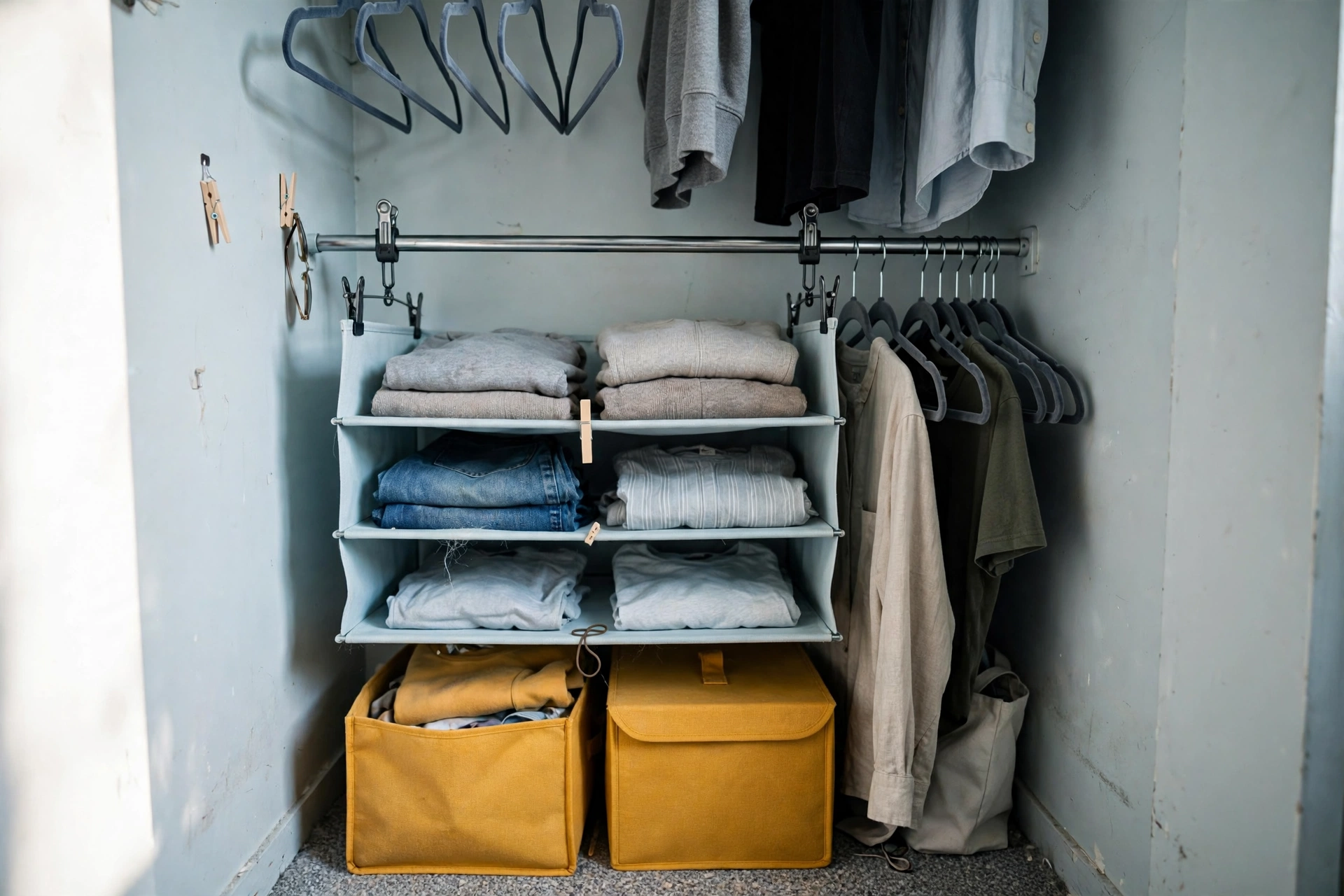
5. Hang a fabric shelf unit for folded clothes. A fabric hanging organizer with four to six shelves claims the side of the rod for sweaters, jeans, and tees that fold better than they hang. It hangs from the same rod, needs no tools, and costs about $15 to $28. Best for: folded clothes, socks, and accessories that slide off a single shelf. Main advantage: it turns one rod into a rod plus a shelving unit. Watch out for: overloading the top shelf. Heavy stacks pull the whole unit sideways and crowd the hanging clothes next to it. Verdict: the fix that stops the folded pile from sliding. Deposit-Risk: 1/5.
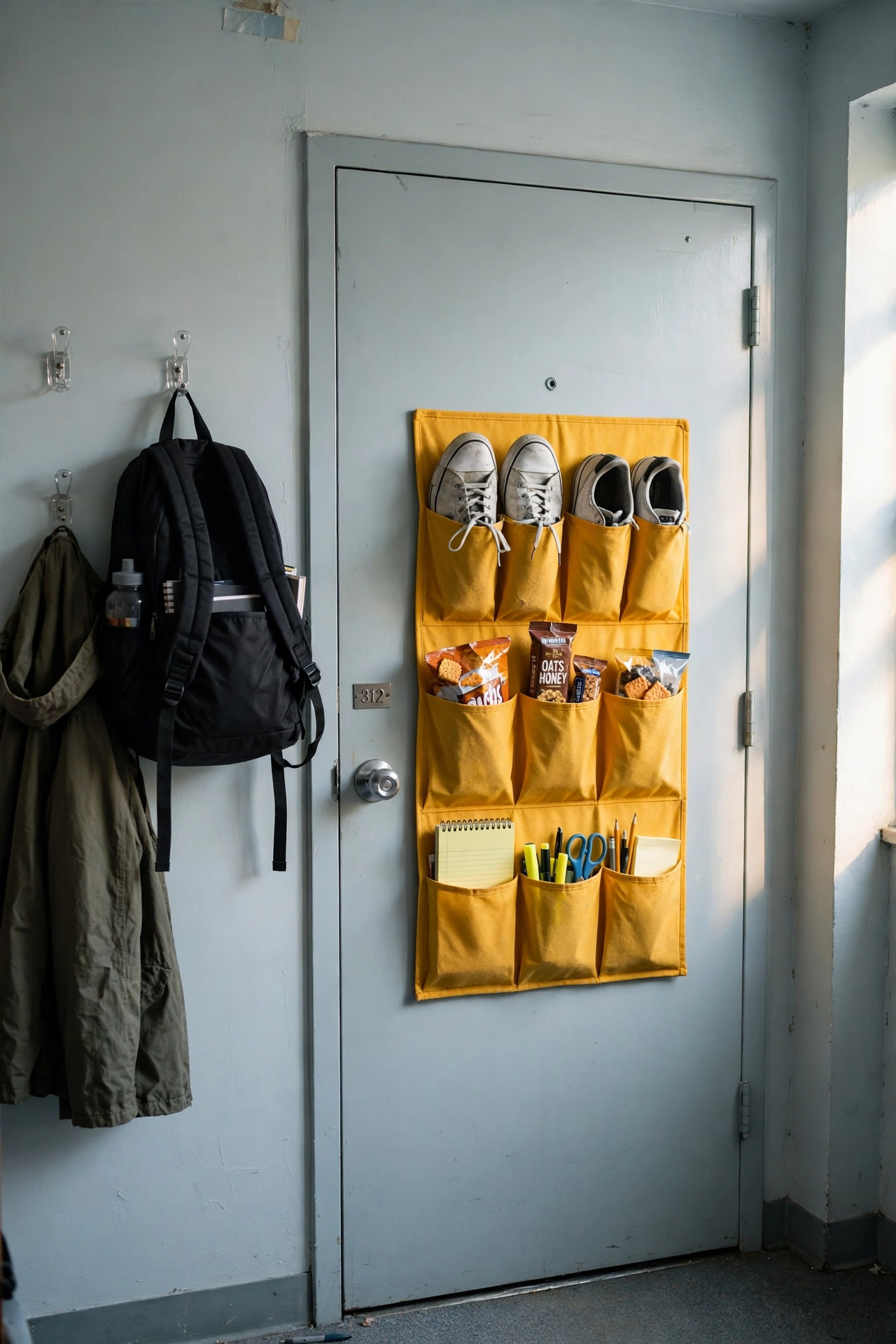
6. Put an over-door organizer on the room door. The back of the door is free vertical space, and a 24-pocket organizer turns it into shoes, snacks, school supplies, cleaning supplies, and chargers, all visible at a glance. The 20-pocket versions run about $17, the 10-tier versions with slanted pockets run about $23.99 and are rated to hold up to 90 pounds, and both hang from hooks over the door with no drilling. Best for: the small stuff that otherwise lives in piles on the desk and the floor. Main advantage: 20 or more extra compartments in zero floor space, installed in five minutes. Watch out for: the door still closing fully. Load the organizer, then close the door and check, because a door that will not shut gets the organizer moved to the floor within a week. Verdict: the fastest win in the room. Deposit-Risk: 1/5.
7. Place Command hooks where hands naturally go. Command hooks are the most versatile dorm tool because they work on most surfaces without damaging the walls, and the large utility hooks hold bags, coats, towels, and backpacks right where you drop them. A 7-hook pack with 12 strips costs $11.99. Put one by the door for the coat and bag, one on the closet frame for tomorrow’s outfit, and one beside the desk for headphones and the tote. Best for: the daily grabs that otherwise become floor piles. Main advantage: five minutes to install, and the pull-tab removal leaves no mark when the strips are used as directed. Watch out for: the weight rating. A large hook is rated for a few pounds, not a packed backpack, so check the rating on the pack and do not hang the heaviest bag on the smallest hook. Verdict: the habit fix, not the storage fix, and the room stays tidy because of it. Deposit-Risk: 2/5, because a strip pulled off wrong can take paint with it.
8. Claim the wall above the desk. The desk is where studying happens, and a messy desk makes studying feel harder, so keep only three things on the surface: the laptop, a lamp, and a pen cup. Everything else goes up. A small over-desk shelf or a set of wall pockets with Command strips holds notebooks, folders, mail, and cables, and a desk caddy or a small set of stacking drawers keeps pens and highlighters from taking over. Best for: students whose desk doubles as the only table in the room. Main advantage: the study surface stays clear without losing anything. Watch out for: weight on adhesive strips. Wall pockets are for paper and cables, not textbooks, so keep the heavy books on the desk or the shelf the room provided. Verdict: the fix that protects study time, not just floor space. Deposit-Risk: 2/5.

9. Stack crates that double as move-out boxes. Crates are the dorm workhorse because they are cheap, light, and stack, and they solve the May problem at the same time: in September they are shelves and a nightstand, in May they are the boxes everything goes home in. A stack of two or three by the desk holds books, snacks, and the printer, and a single crate under the desk holds the shoes. Each crate costs about $10 to $25 and adds 2 to 3 cubic feet. Best for: the student who will move out in a car trunk, because the storage is the moving box. Main advantage: nothing to disassemble, nothing to throw away, and the car fits more on move-out day. Watch out for: tall stacks. Three crates high is a shelf, five crates high is a landslide, so cap the stack at three and keep the heavy crate at the bottom. Verdict: the only storage that pays for itself twice. Deposit-Risk: 1/5.
10. Shrink the soft stuff with vacuum bags and a collapsible hamper. Soft goods are half the volume problem, and vacuum bags cut them by 50 to 70 percent, which is the difference between the off-season half fitting under the bed and living on the chair. Bag the winter coat, the spare bedding, and the out-of-season clothes, and they slide into the under-bed bins in half the space. A collapsible laundry hamper does the same job for the dirty half: it stores flat during breaks and carries the load to the laundry room with handles. Our off-season clothes storage guide covers the full twice-a-year swap, including which fabrics should never be vacuum sealed, and the same rules apply to the dorm version. Best for: the winter half in spring, and the summer half in fall. Main advantage: the biggest volume cut per dollar in the room. Watch out for: wool and down. Vacuum sealing can crush loft and crease wool, so bag the synthetics and fold the wool. Verdict: the fix that makes the other nine fit. Deposit-Risk: 1/5.
How do two people split one dorm closet?
By inches, agreed on day one, before anything is hung. A shared closet is 4 to 6 feet wide, and the split is the whole negotiation: half the rod, half the shelf, half the floor, and nothing crosses the line without asking. The table below shows what each half actually holds, because the argument is usually about a number nobody measured.
| Shared closet width | Your half of the rod | Garments on plastic hangers | Garments on slim velvet hangers |
|---|---|---|---|
| 4 ft (122 cm) | 24 in (61 cm) | About 12 | About 20 |
| 5 ft (152 cm) | 30 in (76 cm) | About 15 | About 25 |
| 6 ft (183 cm) | 36 in (91 cm) | About 18 | About 30 |
Plastic hangers need about 2 inches of rod per garment. Slim velvet hangers need about 1.2 inches, because the hanger itself is thin and the grip lets garments sit closer without sliding. The difference is 8 garments on a 4 foot closet, which is a full week of outfits, and that is why the hanger swap is fix 4 and not an afterthought. Agree the split, mark it with a hanger or a small label on the rod, and put the shared rules in writing on the door: shared surfaces stay clear, borrowed items go back the same day, and the laundry pile never crosses the line. A 10-minute Sunday reset together keeps the agreement alive.
The dorm rules that decide what you can buy
Every dorm runs on a housing handbook, and the handbook outranks any storage guide, including this one. Read it before you buy a single container, because the rules are specific and the charges at move-out are real. The four rules below show up in nearly every handbook, and each one changes what you should buy.
First, no drilling. Most housing contracts prohibit nails, screws, and adhesive hooks that pull paint, and some ban aftermarket bed risers outright. Removable strips are usually allowed, but only where the handbook says so, and only within the weight rating on the pack. Second, nothing blocks the door or the window. University housing policies state plainly that windows and doorways may not be obstructed, and the fire code behind that rule sets a minimum egress window opening of 24 by 24 inches, so a tall shelf in front of the window is not a storage win, it is a violation that fails inspection. Third, no permanent furniture. Anything you buy has to come out in May, ideally in a car trunk, which rules out flat-pack wardrobes and anything that needs assembly with tools. Fourth, inspections are real. Housing staff check rooms during the year, and a blocked egress path or a drilled wall is a fine, not a warning.
Photograph the room on move-in day, every wall and the inside of the closet, so a mark that was already there is not charged to you in May. Remove Command strips with the pull tab, slowly and straight down, never by yanking the hook off the wall. And if a fix needs permission, ask in writing and keep the answer.
The move-in plan
Materials: tape measure, bed risers (only if the handbook allows them), two flat rolling under-bed bins with lids, a hanging closet doubler, one pack of slim velvet hangers, a fabric hanging shelf unit, an over-door organizer, a 7-hook Command pack, a desk caddy, two or three stackable crates, vacuum bags, a collapsible hamper, labels and a marker.
- Measure your half before you unpack anything: bed clearance to the floor, closet width and rod height, desk depth, and the door thickness for the over-door hooks.
- Photograph every wall, the closet, and the desk, and agree the roommate line down the middle of the shared floor.
- Raise the bed with the risers or the school loft kit, then slide the empty bins underneath to confirm the fit before you fill them.
- Set up the closet: doubler rod on, slim hangers on, hanging shelf unit hung, and the split marked on the rod.
- Hang the over-door organizer and the Command hooks, then close the door fully to confirm nothing catches.
- Claim the desk wall with the shelf or wall pockets, set the three-things rule for the desktop, and stack the crates by the desk.
- Bag the off-season half in vacuum bags, load the bins, put the collapsible hamper by the closet, and run the 10-minute reset so the room starts tidy.
Active work: about 90 minutes for one person, including the measuring. Two roommates doing it together should allow an hour, plus a pizza break. Do the measuring on move-in morning and the buying after, not before: the students who buy first and measure second are the ones with bins that do not fit and a receipt they cannot return.
How much does the whole setup cost?
Prices checked in November 2026. No affiliate links. The starter kit covers the four highest-return dorm room storage ideas in the list above: the lift, the bins, the door, and the hooks.
| Item | Price, as of November 2026 |
|---|---|
| Utopia Bedding adjustable bed risers, 4-pack (3, 5 or 8 in lift, supports 1,300 lb) | $19.99 |
| Budding Joy under-bed storage bins with wheels, 80L, 2-pack | $41.99 |
| UVIAHOMI over-door shoe organizer, 20 pockets | $17.00 |
| Command Large Utility Hooks, 7-hook 12-strip pack | $11.99 |
| Starter kit total | $90.97 |
| Budget route: Home-it adjustable bed risers, 4-pack | $18.99, kit total $57.31 |
| Budget route: large under-bed bin, 66-quart, with wheels | $26.33, included above |
| Budget route: Command Large Utility Hooks, 7-hook pack | $11.99, included above |
| Optional add-ons: slim velvet hangers, typically $12 to $22 per pack; closet doubler rod, typically $15 to $30; fabric hanging shelf unit, typically $15 to $28 |
The budget route swaps the adjustable risers for the Home-it set and the two-pack of bins for a single 66-quart bin, and skips the over-door organizer in favor of the hooks you already have. It does the same job for $57.31. Everything in the kit lasts for years: the risers and bins move to the first apartment, the organizer hangs on the next door, and the hooks peel off cleanly. The setup itself costs nothing after the first one, and the most expensive item, the bins, is the one you will use every single week.
Mistakes to avoid
Buying bins before measuring the bed. The dead gap under most dorm frames is about 7 inches, and a bin that needs 12 will not fit. Measure the clearance, buy the risers, then buy the bin to match. This is the single most common move-in mistake, and it is the easiest to avoid.
Drilling anything, ever. A floating shelf looks great in a photo and costs a deposit in May. If it needs a screw, it does not belong in a dorm. Over-door, hanging, and clamp-on options are the whole toolkit.
Blocking the door or the window. A tall crate stack in front of the window fails inspection and blocks the second way out. Keep the egress path clear and the window reachable, always.
Bringing the whole wardrobe. A 4 foot shared closet holds about 20 garments per person on slim hangers. If you bring 40, half of them live on the chair, and the chair is not storage. Pack for the season you are in, and swap the rest at break.
Letting the desk become storage. The desk is the only work surface in the room. The moment it holds more than the laptop, the lamp, and the pen cup, studying moves to the bed, and the bed is where sleep lives, not work.
What to skip
A second mini-fridge. One shared fridge is the rule in most dorms, and a second one eats 3 square feet of floor, hums all night, and holds snacks you could keep in a crate. Skip it unless the handbook explicitly allows two and your roommate agrees.
Matching storage sets. A matching set of pretty boxes costs twice the crates and holds the same things. Buy the cheap crates, spend the difference on the bins that actually roll.
A full-length leaning mirror with no stand. It slides, it falls, and it leans against the one wall that already holds the desk. An over-door mirror, or the mirror on the closet door if there is one, does the same job without the floor space.
Heavy wall shelves on adhesive strips. Strips are rated for a few pounds. A shelf of textbooks is not a few pounds, and the crash at 2 a.m. is not worth the photo. Keep books on the desk or in the crates.
A note for dorm residents
Check the housing handbook before you buy anything, because the handbook, not this guide, decides what is allowed in your room. Bed risers, adhesive strips, loft kits, and over-door hooks are all rules-dependent, and the charge for a drilled wall or a stripped paint patch comes out of the housing deposit or appears as a damage bill at move-out. Photograph the room on day one, keep receipts for everything you install, and remove strips with the pull tab so the wall looks the way it did when you arrived. Everything in this guide reverses in under an hour on move-out day, and that reversibility is the point: the room should look untouched when you hand the key back.
Which dorm room storage ideas move to your first apartment?
Eight of the ten, and that is the real value of buying dorm-safe storage instead of dorm-only storage. The risers, the rolling bins, the over-door organizer, the Command hooks, the slim hangers, the hanging shelf unit, the crates, and the vacuum bags all move, because none of them was ever attached to the dorm. The school loft kit stays behind, because it belongs to the school, and the desk shelf stays if it was sized to a desk you do not own.
Your first apartment is a studio with the same problem at a larger scale, and the same fixes apply with more room to use them. Our studio apartment layout ideas show how the zones work when the whole room is yours, and the under-bed volume table above works the same way under a full or queen bed, with bigger numbers. The habit transfers too: measure first, buy second, keep the desk to three things, and run the 10-minute Sunday reset. The storage bought in September is still working in June, in a different room, for the same $90.97.
Frequently asked questions
How do I maximize storage in a dorm room?
Raise the bed first, because the space underneath is the biggest volume in the room: 5 inches of lift adds about 9 cubic feet of gross space under a Twin XL. Then double the closet rod, swap to slim hangers, and put an over-door organizer on the room door. Those four moves recover more usable storage than everything else combined, and none of them needs a drill.
Can you use bed risers in a dorm?
Usually, but not always, so check the housing handbook before you buy. Some schools prohibit aftermarket risers outright, and some dorms have adjustable loft beds that already sit high enough. If your school offers a loft kit, take it first: it is free, it is allowed by definition, and it lifts the bed higher than risers can. If risers are allowed, buy an adjustable set and measure the bed leg first, because the leg has to seat inside the riser cup.
How do I organize a shared dorm closet?
Split it by inches on day one: half the rod, half the shelf, half the floor, and mark the split on the rod. A 4 foot shared closet gives each person 24 inches, which holds about 12 garments on plastic hangers or about 20 on slim velvet hangers. Add a clip-on doubler rod for a second level and a fabric hanging shelf for folded clothes, and agree two rules with your roommate: shared surfaces stay clear, and borrowed items go back the same day.
What should I not bring to a dorm room?
Do not bring the whole wardrobe, a second mini-fridge, matching storage sets, or anything that needs a drill to install. A shared closet holds about 20 garments per person, so pack for the season you are in and swap the rest at break. Leave the tall unanchored shelves and the heavy wall-mounted storage at home: the room has to be handed back untouched in May, and everything you bring has to fit in a car trunk.
Sources
Room-size figures come from the dorm guides reviewed for this post, which put a typical shared double at about 130 to 180 square feet, and a real double at 15 feet 6 inches by 10 feet 8 inches. Riser capacities and prices come from the product listings and guides checked in November 2026, including the Utopia Bedding adjustable risers at $19.99 with a 1,300 pound rating and the Budding Joy 80 liter bins at $41.99 for two. The egress rule comes from University of Nebraska Housing policy, which states that windows and doorways may not be obstructed, and the Ohio Administrative Code, which sets a minimum egress window opening of 24 by 24 inches. The 70 percent usable-volume rule comes from a dorm gear guide that warns advertised bin capacities are nominal. All prices are as of November 2026 and will move with sales.
How this was made: the volume and closet tables were computed from standard Twin XL and closet dimensions, the prices were checked live in November 2026, and the rules were checked against a real university housing policy and a state egress code.