Where to Store Suitcases in a Small Apartment: 10 Fixes That Free Up Real Floor Space
A suitcase is the bulkiest thing in a small apartment that you almost never use. Three bags standing in a corner eat about 3.5 square feet of floor, which in a 400 square foot studio is nearly 1 percent of the whole home, sitting there doing nothing between trips. The fix is not a bigger closet. It is a system: nest the set, give it one measured spot, and keep only the bag you use monthly within reach. Where to store suitcases in a small apartment comes down to that system, and the numbers behind it are smaller than most people expect. A nested three-piece set takes 1.45 square feet, the same as one large bag standing alone. The starter kit below costs $48.97 at prices checked in November 2026, and the whole put-away takes about 45 minutes. Ten fixes follow, and they work for one carry-on or a full family set.
How much floor space do suitcases actually take?
More than you think, until you nest them. A carry-on, a mid-size checked bag and a large checked bag each have a different footprint, and the table below uses the standard US sizes you can check with a tape measure. The point is the last two rows.
| Bag | Size | Standing footprint |
|---|---|---|
| Carry-on | 22 x 14 x 9 in (56 x 36 x 23 cm) | 14 x 9 in = 126 sq in = 0.88 sq ft |
| Mid-size checked | 25 x 17 x 10 in (64 x 43 x 25 cm) | 17 x 10 in = 170 sq in = 1.18 sq ft |
| Large checked | 28 x 19 x 11 in (71 x 48 x 28 cm) | 19 x 11 in = 209 sq in = 1.45 sq ft |
| All three standing apart | 3.51 sq ft | |
| All three nested | 1.45 sq ft |
Nesting gives back about 2 square feet, roughly 60 percent of the space the set was taking. That is the whole trick, and it costs nothing. The large bag is the only footprint that matters after nesting, so every fix below starts from that one bag. Lying flat, the nested set needs 28 x 19 in, or 3.69 square feet. Under a queen bed, which offers 60 x 80 in (33.3 square feet) of floor, the flat nested set uses about 11 percent of the space. That is the scale of the problem: one bag, one spot, about a tenth of the space under the bed.
Where to store suitcases in a small apartment: the 10 fixes
1. Nest the set first, before you pick a spot. Open every case, put the carry-on inside the mid-size bag, and put both inside the large checked bag. Zip the large bag shut. You now have one bag to place instead of three, and its footprint is 1.45 square feet. Best for: everyone, because it is free and it halves the problem before anything else happens. Main advantage: every spot below gets easier, because you are placing one bag, not a set. Watch out for: nesting a damp bag. If any case came home wet, dry it first, or the trapped moisture turns musty inside the nest. Verdict: the only step you cannot skip. Deposit-Risk: 1/5.
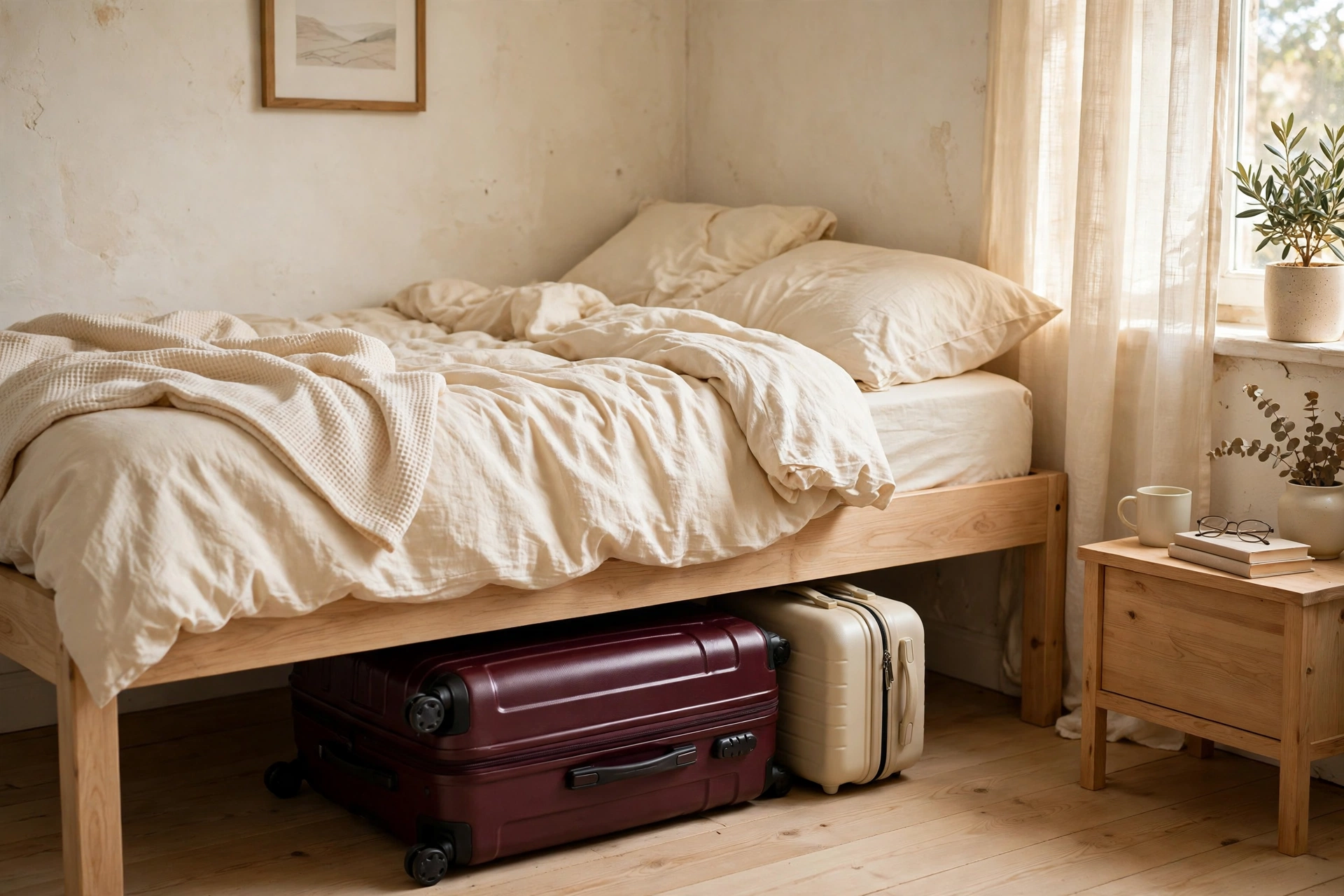
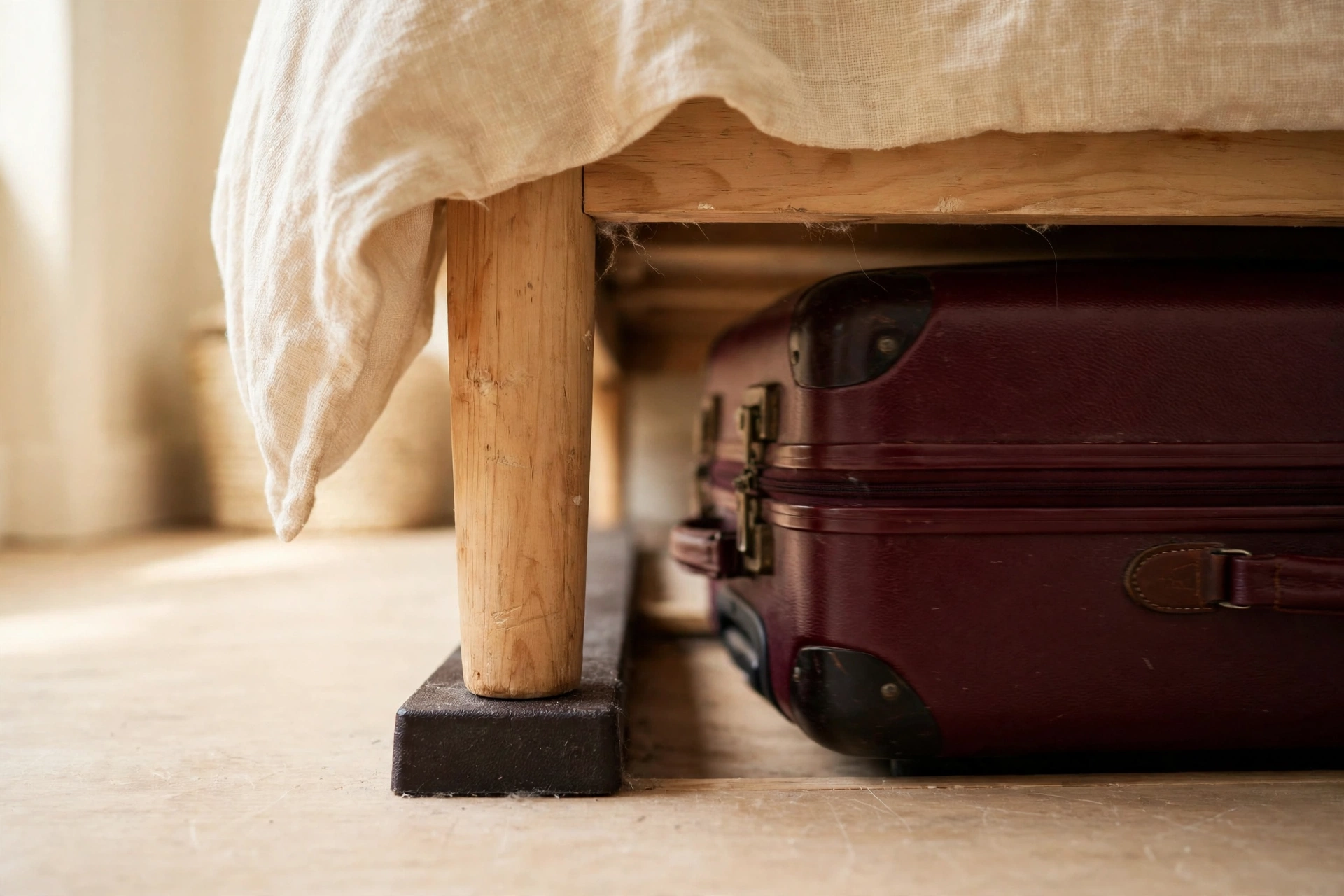
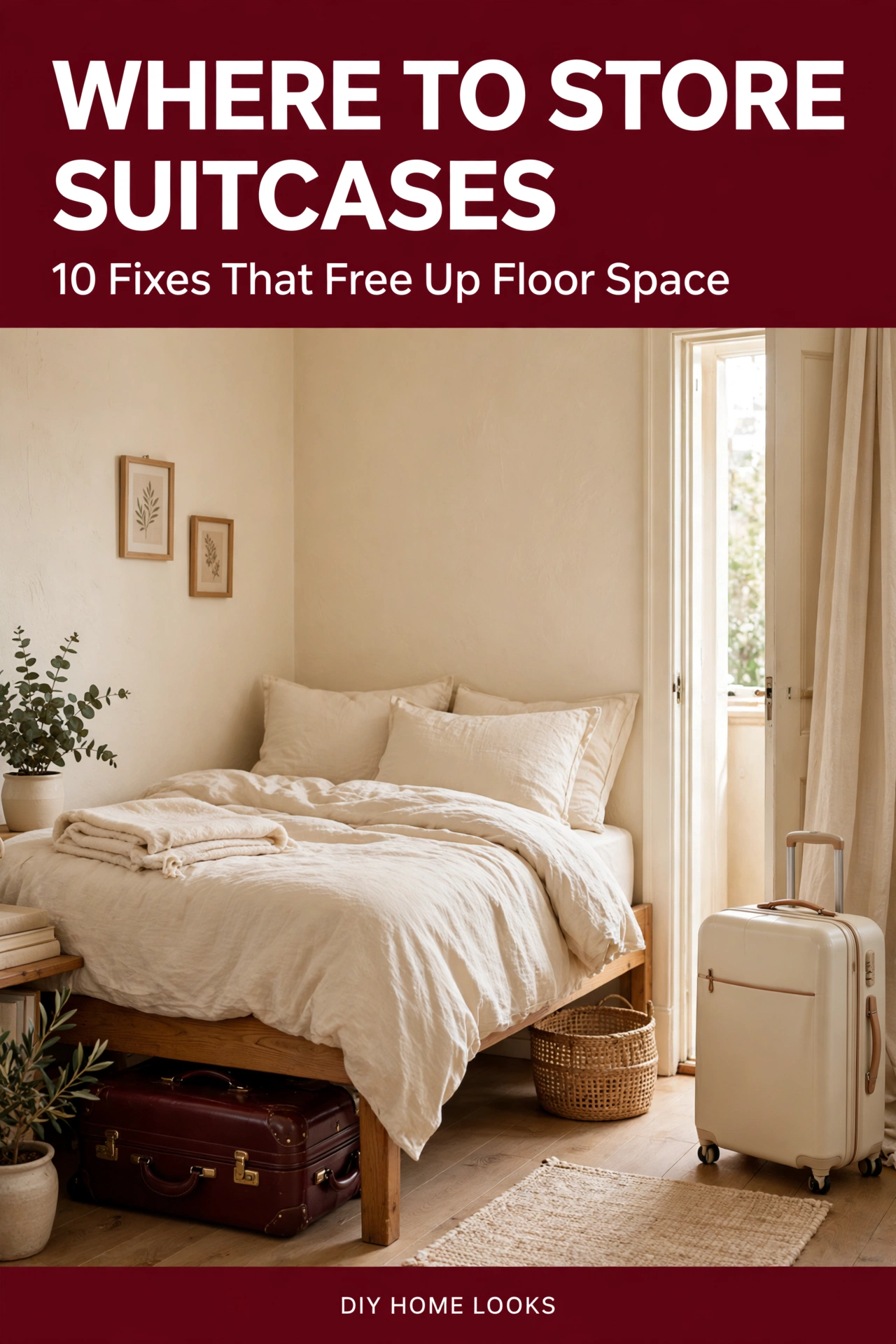
2. Slide the nested set under the bed. This is the best spot in most apartments, because it stays at room temperature, it is out of sight, and it costs no floor space. Measure from the floor to the underside of the frame, not the mattress. A carry-on lying flat needs about 10 in (25 cm) of clearance, a mid-size bag about 11 in (28 cm), and a large checked bag about 12 in (30 cm). Most frames give 6 to 8 in (15 to 20 cm), so the large bag will not fit as it stands. Bed risers fix that: a 5.3 in (13 cm) lift on a 7 in frame gives 12.3 in of clearance, just enough for the large bag lying flat. Our guide to under-bed storage bins maps the same space for bins, and the same measure-first rule applies. Best for: the full nested set, especially the large bag you touch twice a year. Main advantage: the biggest hidden volume in the bedroom, and the bags stay clean and dry. Watch out for: a frame with less than 6 in of clearance and no risers. Measure before you buy anything, or the bag will not fit and you will own risers with nowhere to go. Verdict: the default home for the set. Deposit-Risk: 1/5.
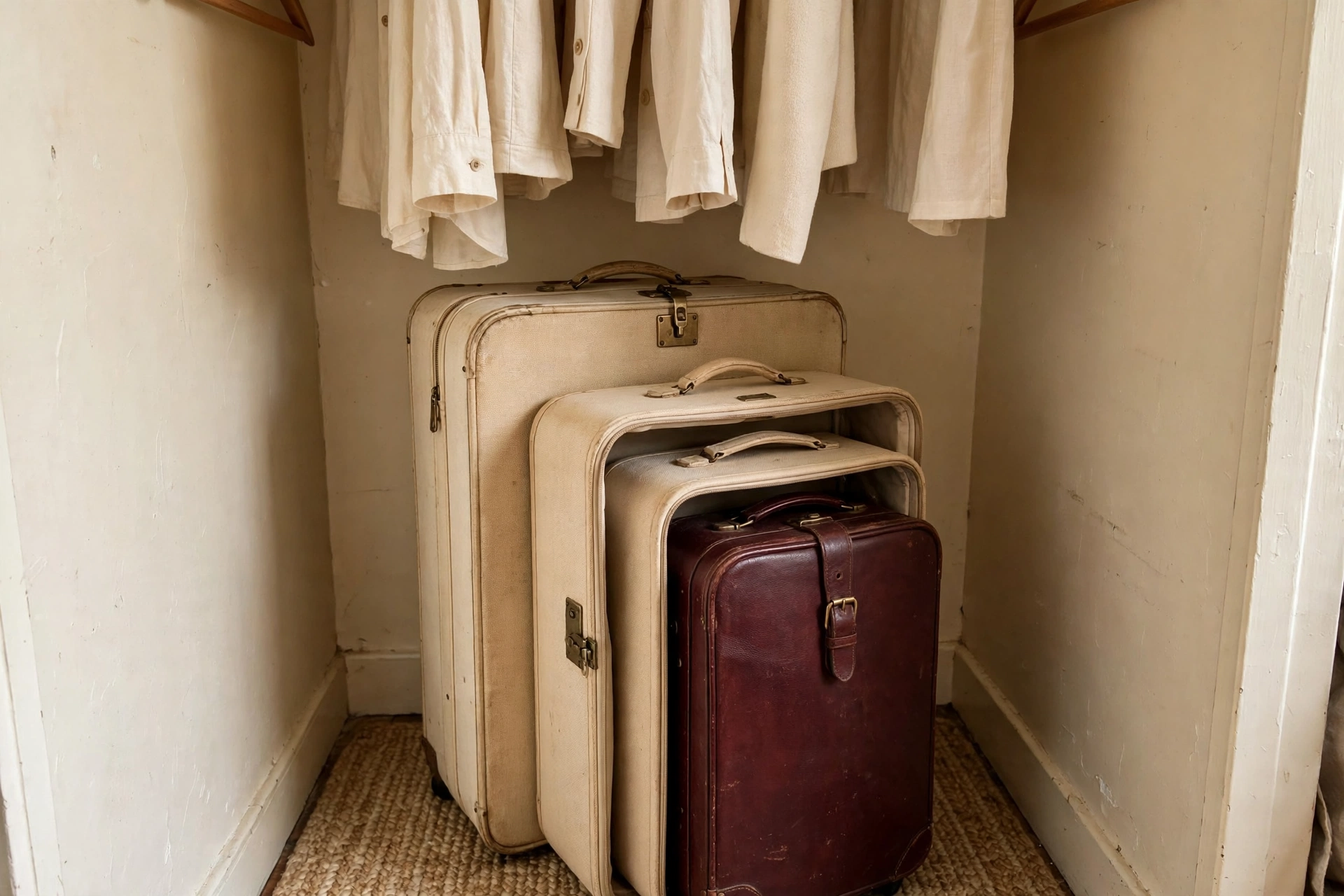
3. Stand it in the closet back corner. Standing upright in the back corner, under the hanging clothes, the nested set uses its 1.45 square feet and leaves the shelf free. Nothing gets stacked on top of it, which matters for a soft-sided case, because weight on top crushes the frame and strains the zippers. The closet organization guide covers how to keep the rail and the floor from fighting over the same space, and the suitcase belongs to the floor, not the rail. Best for: homes where the bed has no clearance at all, like a low platform frame. Main advantage: the bag is inside the bedroom, dry, and reachable without moving furniture. Watch out for: the corner behind the door swing. If the closet door hits the bag, the bag lives in the wrong corner. Verdict: the best backup when the bed is too low. Deposit-Risk: 1/5.
4. Use the closet top shelf for the light bag only. The high shelf that is awkward for daily clothes suits one light carry-on or a weekender, never the large checked bag. A packed large bag can hit the 50 lb (23 kg) airline limit, and lifting 50 lb above shoulder height is how backs get hurt and shelves get pulled off the wall. Keep the heavy bag low, and put only the bag you can lift with one hand up high. Best for: the carry-on you use monthly, kept light and empty. Main advantage: it turns dead shelf space into the luggage zone. Watch out for: shelf depth. A standard closet shelf is about 12 in (30 cm) deep, and a carry-on lying flat needs 14 in (36 cm), so measure the shelf before you assume it fits. Verdict: good for the light bag, never for the heavy one. Deposit-Risk: 1/5.
5. Lay it flat above the wardrobe. The gap between a wardrobe top and the ceiling often fits a carry-on laid on its side, about 14 in (36 cm) tall when the bag lies flat. Cover it with a breathable cover or an old sheet so it does not collect a year of dust. Best for: the bag you use once a year or less, in a home with tall ceilings. Main advantage: it uses space that holds nothing else. Watch out for: the lift. You are still lifting a bag above your head, so keep it empty and light, and never store a packed bag up there. Verdict: the best high spot, used sparingly. Deposit-Risk: 2/5.
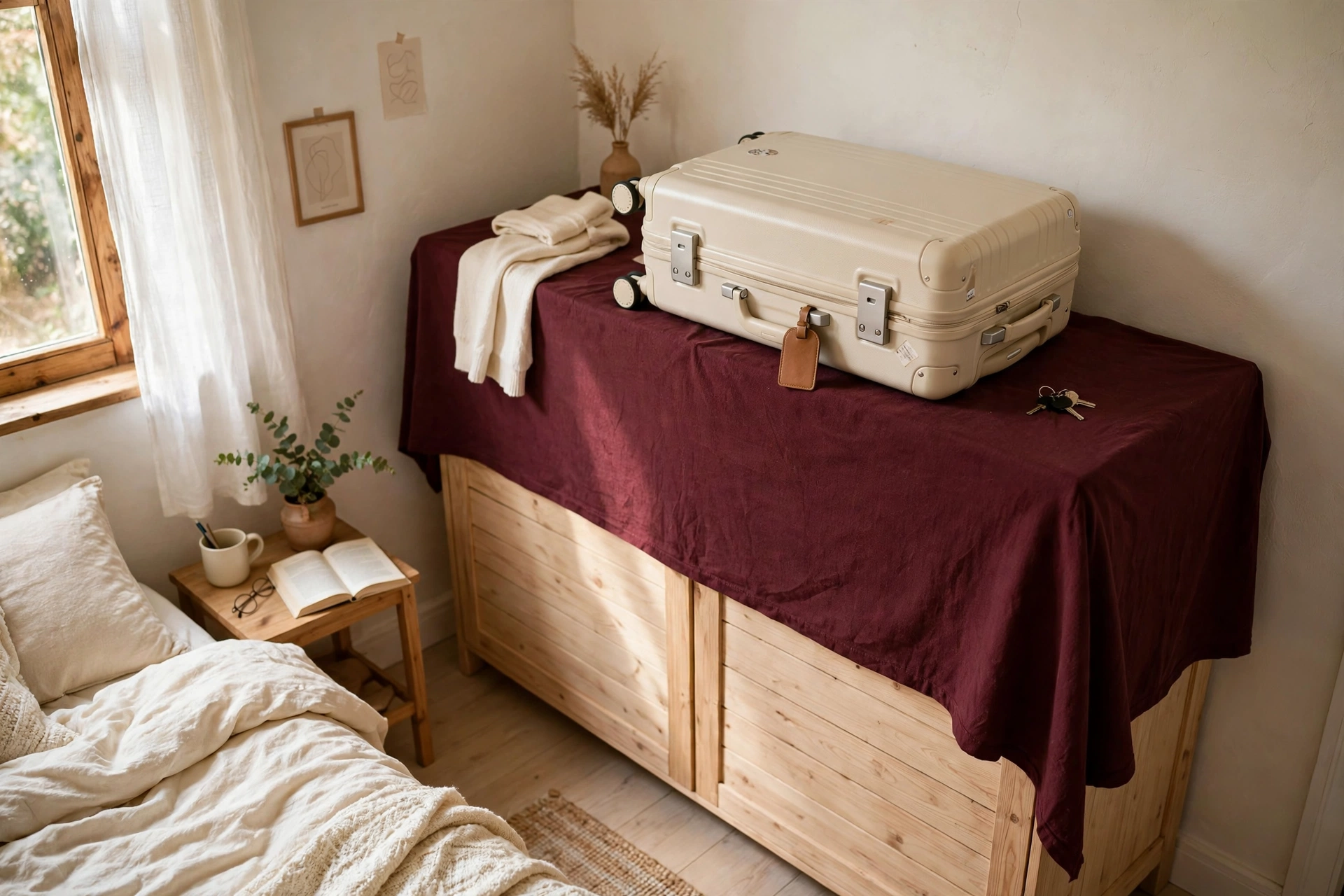
6. Hang a slim case behind the door. A sturdy over-door hook pair can hold a slim carry-on or a garment bag flat against the back of a closet or bedroom door. Over-door hooks rated for 20 lb (9 kg) each are common, and a pair costs about $6, but that rating is for the hook, not an invitation to hang a packed 50 lb suitcase. This spot is for the empty carry-on or the garment bag only. Best for: renters, because over-door hooks need no drilling and no permission. Main advantage: the bag is visible, reachable, and off the floor. Watch out for: the door closing. A bag that stops the door from shutting fully will get moved to the floor within a week, and then it is clutter again. Verdict: the best no-drill spot for one light bag. Deposit-Risk: 1/5.
7. Fill the biggest case with off-season clothes. An empty suitcase is a ready-made storage box with a handle. Fill it with scarves, thermals and fleece, and it holds about the same volume as one under-bed bin, for free, because you already own it. Our off-season clothes storage guide shows the full twice-a-year swap, and the suitcase is the container that guide uses for the soft stack. Best for: renters and anyone with one big case and no spare bins. Main advantage: zero cost, and the case is easy to pull out when travel season comes. Watch out for: hard-shell cases trap damp the same way sealed bags do, so everything inside must be fully dry. Verdict: the best free container in the flat. Deposit-Risk: 1/5.
8. Keep the monthly bag out of the nest. The carry-on you use every month should not be buried inside the large bag. Keep it under a little-used desk, or under the entry bench, stood upright or laid flat, so a trip means grabbing one bag, not un-nesting a set. Our small entryway organization guide covers the bench and the drop zone, and the carry-on fits under the bench the same way shoes fit beside it. Best for: anyone who travels monthly for work or family. Main advantage: no lifting, no un-nesting, no moving other things to reach it. Watch out for: letting the “out” bag become the dumping ground. If it starts collecting random items, it is not a travel bag any more, it is a junk drawer with wheels. Verdict: the one bag that earns floor space. Deposit-Risk: 1/5.
9. Prep every bag before it goes away. Empty every pocket, wipe the shell and the lining, and let the bag air-dry completely. Drop two or three silica gel packs inside, then cover the bag loosely with a breathable cover or an old cotton sheet. Never wrap a suitcase in plastic. Plastic traps moisture, and trapped moisture is what grows mold and mildew inside a bag you will not open for six months. Best for: every bag, every time, but especially soft-sided cases, which hold damp longer than hard shells. Main advantage: the bag comes back smelling like nothing, which is exactly what you want. Watch out for: the forgotten wet swimsuit in a side pocket. One damp item is enough to mildew the whole case. Verdict: ten minutes now, or a ruined bag later. Deposit-Risk: 1/5.
10. Let the annual bag live somewhere else. The large checked bag you use once a year or less is the one item in a small apartment worth storing out of it. A friend or family member with a spare closet shelf, a building storage cage if your building has one, or a storage unit you already rent for other things are all honest options. A storage unit rented for one bag alone is a bad deal, because the monthly fee buys back less space than the bag was taking. Best for: the once-a-year bag in a home with genuinely no spot for it. Main advantage: the bag stops being the thing you trip over every day. Watch out for: paying for storage you do not need. If the bag fits under the bed, it already has a home. Verdict: the last resort, not the first move. Deposit-Risk: 1/5.
Which spot fits which bag?
Pick the spot by the bag, not by what is free. Heavy things go low, light things go high, and the bag you use most stays reachable.
| Spot | What fits there | Clearance needed | Access |
|---|---|---|---|
| Under the bed | Nested set, lying flat | 10 in (25 cm) carry-on, 12 in (30 cm) large | Easy, twice a year |
| Under the bed with 5.3 in risers | Nested set, lying flat | 12.3 in (31 cm) total | Easy, twice a year |
| Closet floor, back corner | Nested set, standing | 1.45 sq ft of floor | Easy |
| Closet top shelf | Light carry-on or weekender only | Shelf 14 in (36 cm) deep or more | Needs a step stool |
| Above the wardrobe | Empty carry-on, on its side | 15 in (38 cm) gap to the ceiling | Needs a step stool |
| Behind the door | Slim carry-on or garment bag | Door clears the wall by 10 in (25 cm) | Easiest of all |
| Under a desk or entry bench | Monthly carry-on | Knee space 22 in (56 cm) wide | Easiest of all |
Where to store suitcases in a small apartment depends on two measurements, the clearance under the bed and the depth of the closet shelf. Measure both before you buy a single thing, and the table above tells you which spots are real and which are wishful thinking.
Can you store suitcases in the garage?
Only if the garage is dry, and most are not. Mold is the real risk, and the rule is simple: mold cannot grow without moisture. The US EPA advises keeping indoor humidity below 60 percent, ideally between 30 and 50 percent relative humidity, and drying anything damp within 24 to 48 hours. A garage, attic or basement that swings with the seasons will sit above 50 percent humidity for long stretches, and a suitcase stored damp in that air grows mold and mildew, warps at the shell, and picks up a smell that is hard to remove. Heat does its own damage: high heat can warp hard-shell luggage and dry out rubber seals and wheels. If the garage is your only option, clean and dry the bag first, raise it off the floor on a shelf or pallet, use a breathable cover, drop silica gel packs inside, and check it every few months. Even then, treat it as temporary storage, not a home. For most small apartments, the honest answer is that there is no garage, attic or basement at all, so the question answers itself: the bag lives inside, in a cool, dry spot, at room temperature. The EPA mold guide linked in the sources below is the authority on the humidity numbers.
What is the keep-out bag?
The monthly carry-on from fix 8 is the keep-out bag, and it needs a rule, not just a spot. It stays packed light, with the travel essentials that never leave it: the packing cubes, the toiletry bag, the charger kit. When a trip comes, you add clothes and go. When you come home, you unpack the clothes, wipe the bag, and put it straight back in its spot. The bag never becomes storage for things that belong elsewhere, and it never gets nested with the annual bags, because the moment it does, the next trip starts with twenty minutes of digging. One bag out, the rest away. That is the system.
The put-away checklist
Materials: tape measure, bed risers (optional, only if the large bag needs the lift), silica gel packs, a breathable luggage cover or an old cotton sheet, labels and a marker, over-door hooks (optional, only for the behind-door spot).
- Measure the clearance under the bed and the depth of the closet top shelf, and write both numbers down.
- Empty every suitcase completely, check every pocket, and wipe the shells and linings.
- Let every bag air-dry fully. If anything came home damp, give it a full day, not an hour.
- Nest the set: carry-on inside the mid-size bag, both inside the large checked bag.
- Fill the large bag with off-season clothes if you use it as a storage box, or leave it empty.
- Drop silica gel packs inside, cover the nested set loosely with a breathable cover or a sheet, and label it with the size and the date.
- Slide the set into its spot, put the keep-out carry-on under the desk or bench, and set a reminder to check the stored bags when the next trip season starts.
Active work: about 45 minutes for a three-piece set, including the drying check. Two people with a family set of five or six bags should allow an hour.
How much does the whole setup cost?
Prices checked in November 2026. No affiliate links. The starter kit covers a three-piece set in a home that needs the under-bed lift.
| Item | Price, as of November 2026 |
|---|---|
| EclatBain adjustable bed risers, 4-pack (3, 4.3 or 5.3 in lift) | $22.99 |
| Dry & Dry silica gel packs, 5 g, 50-pack | $9.99 |
| ZHIGOU luggage cover, 22 to 24 in | $9.99 |
| FYY over-door hooks, 4-pack | $6.00 |
| Starter kit total | $48.97 |
| Budget route: Target Brightroom bed risers 4-pack | $9.00, kit total $21.29 |
| Budget route: 15-pack silica gel, 20 g | $6.29, included above |
| Budget route: FYY over-door hooks, 4-pack | $6.00, included above |
The budget route swaps the adjustable risers for the basic $9 set and the 50-pack silica for the 15-pack, and skips the luggage cover in favor of an old sheet. It does the same job for $21.29. Everything in the kit lasts for years: the risers stay under the bed, the silica packs recharge in a low oven or get replaced for a few dollars, and the cover washes. The put-away itself costs nothing after the first one.
Mistakes to avoid
- Storing a damp bag. Mildew starts in days, and you will not smell it until the next trip. If it is not bone dry, it does not go away.
- Wrapping the bag in plastic. A plastic cover traps moisture against the shell, which is the opposite of protection. Breathable fabric or nothing.
- Using the garage, attic or basement as the default. Temperature swings and damp ruin luggage faster than any moth. Keep the bags inside the flat, in a cool, dry spot.
- Lifting a packed bag onto a high shelf. A 50 lb bag above shoulder height is a back injury and a falling hazard. Heavy bags stay low, always.
- Stacking heavy things on a soft-sided case. The frame bends, the zippers strain, and the bag comes back misshapen. Nothing heavy sits on top of luggage.
What to skip
- A dedicated luggage wardrobe. A whole extra cabinet just for bags is the most expensive way to store them, and it eats the floor space the system is meant to save.
- Vacuum-compressing a suitcase. A rigid case is not a soft bag. Compressing it can damage the shell, the wheels and the telescopic handle, and most makers do not allow it.
- Specialist “luggage storage” furniture. A plain spot under the bed and a $6 pack of hooks do the same job as a purpose-built luggage cabinet at ten times the price.
- Mothballs in a suitcase. They work, but the chemical smell takes weeks to air out of fabric linings, and clean, dry storage plus silica does the same job without it.
A note for renters
Everything in this post is reversible, which is the point. Bed risers slide under the legs and come out at move-out. Over-door hooks lift off the door. Nothing here needs a drill, a screw, or a landlord’s permission, and every fix carries a Deposit-Risk rating of 1 out of 5, except the above-wardrobe spot at 2 out of 5, because a scuff on the wardrobe top is the one small risk. Check the lease before you mount anything on a wall or a door frame, and if the lease bans adhesives on painted surfaces, skip the adhesive hooks and use the over-door kind. At move-out, the whole system reverses in one afternoon: risers out, hooks off, bags nested, nothing to repair.
FAQ
Where is the best place to store luggage in a small apartment?
Under the bed, if the frame clears about 12 in (30 cm) for a large checked bag lying flat, or about 10 in (25 cm) for a carry-on. Where to store suitcases in a small apartment comes down to that one measurement: if the bed is too low, the closet back corner is the next best spot, standing upright, using 1.45 square feet. Both spots stay at room temperature and out of sight.
Can you store suitcases in the garage?
Only as a temporary fix, and only if the garage stays dry. Garages, attics and basements usually swing above 50 percent humidity, which is where mold grows, and high heat can warp hard-shell luggage. If the garage is the only option, dry the bag fully, raise it off the floor, use a breathable cover, add silica gel packs, and check it every few months.
How do you store suitcases under the bed?
Nest the set first, so three bags become one, then measure the clearance from the floor to the underside of the frame. A carry-on lying flat needs about 10 in (25 cm), a large checked bag about 12 in (30 cm). If the frame is short, bed risers add 3 to 5.3 in (8 to 13 cm) of lift. Cover the set loosely with a breathable cover or a sheet, and never wrap it in plastic.
Can you store clothes inside a suitcase?
Yes, and it is the best free container in the flat. Fill the largest case with off-season clothes, scarves and thermals, and slide it under the bed or stand it in a corner. Everything inside must be fully dry first, because a hard-shell case traps damp the same way a sealed bag does. Our off-season clothes storage guide covers the full swap and the fabrics that pack well.
How this was made
This post was researched from live search results on 2026-11-10, including the top five results for the primary keyword, and every price, measurement and humidity figure was checked against a live source before publishing. The footprint and clearance numbers were computed from standard US suitcase sizes, not copied from a competitor’s table. No product was tested hands-on, and no claim in this post comes from personal testing.
Sources
Prices checked in November 2026 via live search results: EclatBain bed risers $22.99 (theinventory.com), Target Brightroom risers $9.00, Dry & Dry silica gel 50-pack $9.99 (Amazon), ZHIGOU luggage cover $9.99 (Amazon.ca), FYY over-door hooks about $6 (umtsmarttool.com, November 2 2026). Humidity and mold guidance: the US EPA’s “A Brief Guide to Mold, Moisture and Your Home” (keep indoor humidity below 60 percent, ideally 30 to 50 percent; dry damp items within 24 to 48 hours), at https://www.epa.gov/mold/brief-guide-mold-moisture-and-your-home. Suitcase sizes and nesting advice cross-checked against the top five search results for the primary keyword.