Renter-Friendly Living Room Upgrades: 12 Damage-Free Ideas That Make a Rental Feel Like Home
If your living room still looks like the listing photos — blank walls, one sad ceiling light, a floor you did not choose — you are not stuck with it. Every upgrade below is fully reversible, needs no drilling into anything you cannot patch, and travels with you to the next place. Start with the one that bugs you most, and stop when the room feels like yours. Most of these take an afternoon or less, and none of them should cost you a cent of your deposit.
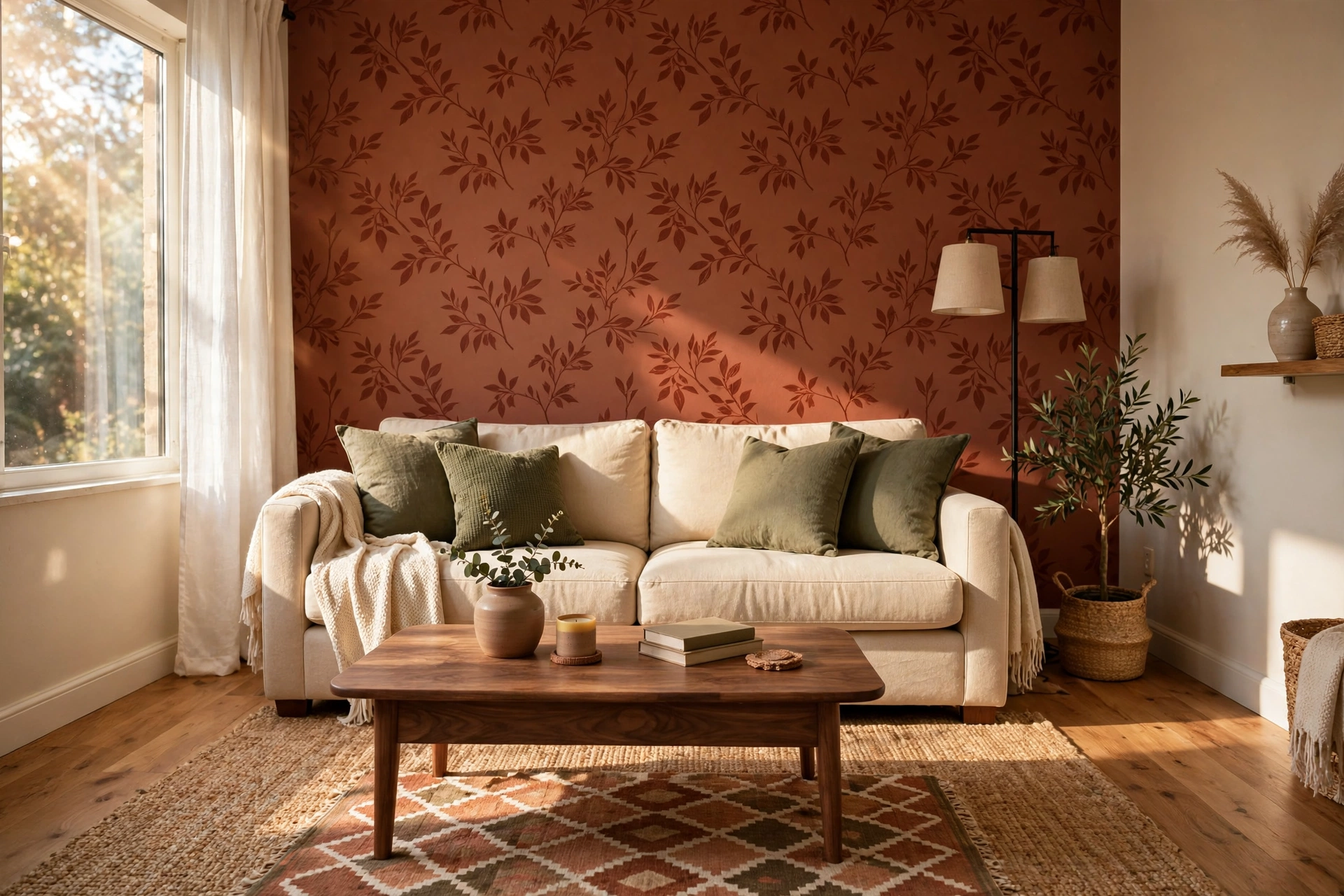
1. Give One Wall a Peel-and-Stick Wallpaper Moment
A single accent wall changes the whole room faster than anything else you can do in a rental. Peel-and-stick wallpaper goes up without paste, peels off without tearing paint (on healthy, primed walls), and comes in everything from grasscloth looks to bold geometrics. Pick the wall your sofa sits against, measure twice, and start at the top corner, smoothing as you go. A standard 10-foot (3 m) wall takes about two rolls and one patient hour. The one rule: skip it on freshly painted walls less than 4 weeks old, and on textured walls where the adhesive cannot grip — it will bubble and frustrate you.
2. Build a Gallery Wall With Strips, Not Nails
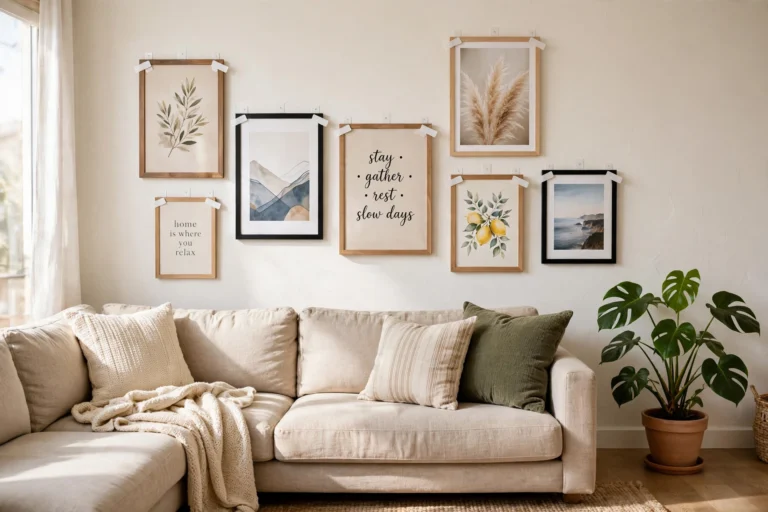
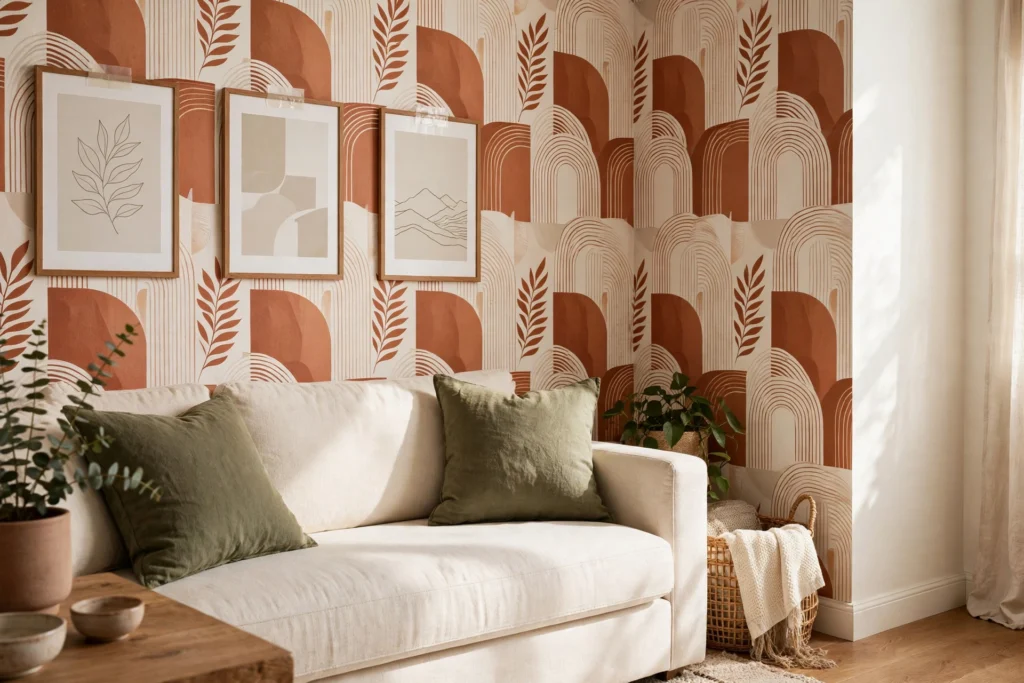
Adhesive hanging strips hold framed art up to 16 pounds (7 kg) per set, which covers most framed prints. Plan the arrangement on the floor first, keep the center of the grouping at eye level — about 57 inches (145 cm) from the floor — and press each strip firmly for 30 seconds. For anything heavier, or for a big mirror, lean it: a large frame leaning against the wall on a console or the floor looks deliberately styled, not unfinished, and it needs zero hardware. If you want the deeper playbook for walls specifically, these damage-free wall treatments cover every option from washi tape to wall decals.
3. Hang Curtains High and Wide on a Tension Rod
Curtains are the cheapest way to make a rental window look expensive, and a tension rod means no brackets at all. Mount the rod as close to the ceiling as the window frame allows, and extend it 8 to 12 inches (20 to 30 cm) past the window on each side so the panels stack on the wall, not over the glass. The window instantly looks bigger, the room feels taller, and you get privacy without a single screw. In a window that is too wide for one rod, two rods meeting in the middle with a center support that wedges into the frame works just as well.
4. Add Plug-In Sconces for That Hardwired Look
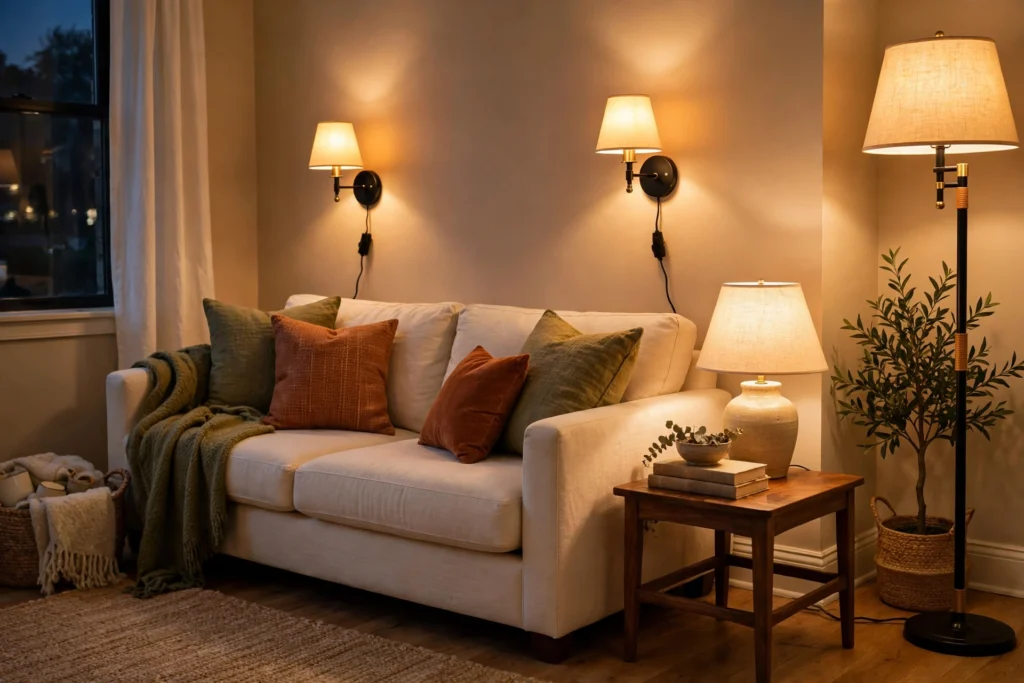
Plug-in wall sconces are the rental world’s best-kept secret: they mount with a strip or two small hooks, plug into a nearby outlet, and give you the flattering, eye-level light that ceiling fixtures never do. Hang a pair flanking the sofa or a reading chair, 60 to 66 inches (152 to 168 cm) from the floor, and run the cord down the wall in a paintable cord cover. For under $40 a pair, the room suddenly has the layered, designed lighting of a much more expensive home.
5. Build Three Layers of Lamp Light
If your only light is the ceiling fixture, the room will always feel like a waiting room. You need three layers: ambient (a floor lamp bouncing light off the ceiling), task (a table lamp beside the reading spot), and accent (a small lamp or puck light on a shelf). Keep every bulb at the same warm temperature — 2700K — or the room will feel patchy. Three lamps, one warm tone, and the same room you hated at 7 p.m. becomes the room you want to sit in.
6. Layer Rugs Over the Floor You Did Not Choose
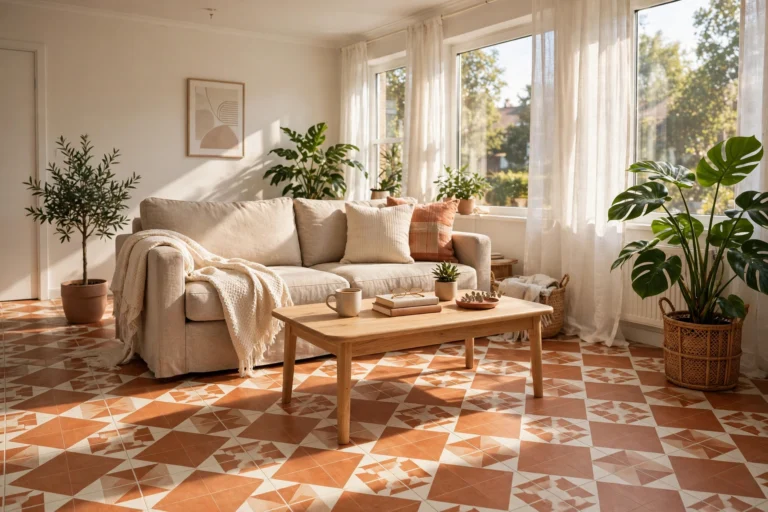
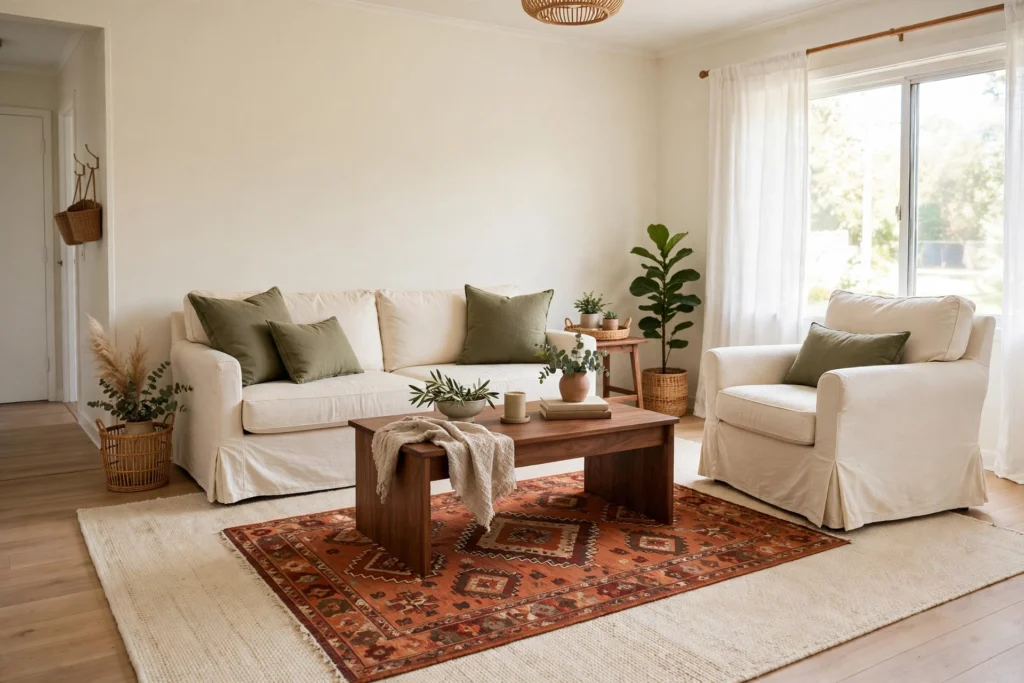
Ugly rental floors are a fact of life, and rugs are the reversible answer. Layer a large, inexpensive flatweave rug as the base — big enough that the sofa’s front legs sit on it, ideally 8 by 10 feet (244 by 305 cm) in a standard living room — then add a smaller patterned rug on top for personality. Always use a rug pad: it stops sliding, protects the floor underneath, and adds the plushness cheap rugs lack. If your floor problem runs deeper than one ugly patch, fixing ugly rental floors without glue or nails goes room by room through every damage-free flooring fix.
7. Slipcover the Sofa You Are Stuck With
If your sofa is fine to sit on but painful to look at, a slipcover is a $60 to $120 reset instead of a $900 replacement. Stretch-fit covers in washed linen looks or soft twill hug the shape properly; loose, baggy covers are what give slipcovers their bad name. Measure the sofa’s back height and arm width before ordering, wash the cover first (most shrink slightly), and add two throw pillows in a color from the rug. The sofa you inherited suddenly looks chosen.
8. Bring in Freestanding Shelves Instead of Wall Units
A tall, freestanding bookcase or a leaning ladder shelf gives you display and storage without a single wall anchor. Ladder shelves are especially good in rentals because they lean, hold books, plants, and art, and leave the wall untouched. Style them with the two-thirds rule: fill about two-thirds of each shelf and leave the rest breathing, or the shelf reads as clutter instead of decor. These same small living room organization tricks — a shelf that earns its footprint, a basket that hides the mess — are what keep a styled room from sliding back into chaos.
9. Use Window Film for Privacy and Soft Light
If your living room faces a parking lot or a neighbor’s window, static-cling window film fixes it in twenty minutes. It sticks with water, peels off cleanly, and comes in frosted, linen, and stained-glass looks. Frosted film on the lower half of the window gives you privacy while keeping the daylight; full coverage turns harsh afternoon sun into soft, even light. Cut it 1/8 inch (3 mm) smaller than the pane on every side, spray generously, and squeegee out the bubbles.
10. Float the Sofa and Zone the Room
Most renters push every piece of furniture against the walls, which actually makes a room feel smaller and more awkward. Pull the sofa 6 to 12 inches (15 to 30 cm) off the wall, or float it entirely with its back to the rest of the room, and put a narrow console behind it. The sofa becomes a room divider, the space behind it becomes a walkway or a work spot, and the room gains a layout instead of just a perimeter. Keep walkways at least 30 inches (76 cm) wide so the floating arrangement still moves easily.
11. Let Plants Do the Decorating
A few well-placed plants soften every hard rental edge: a tall fiddle-leaf or olive tree in an empty corner, trailing pothos on top of the bookcase, a cluster of three small pots at different heights on the coffee table. Plants add color, height, and life that no landlord finish ever will, and they move with you. If you have no floor space to spare, a tension rod across a window holds hanging planters without a single hook in the ceiling.
12. Pack a Move-Out Kit Before You Need It
The most deposit-saving upgrade is boring, and it takes ten minutes on move-in day: photograph every wall, floor, and fixture before your furniture goes in, and keep the originals of anything you swap — switch plates, shower heads, curtain rods — in one labeled bag. When you leave, everything goes back exactly as it was, and your dated photos settle any argument before it starts. Renters who do this almost never lose deposit money over decor.
Putting It Together
You do not need all twelve. Pick the wall, the light, or the floor — whichever one you notice every single day — and fix that first. The room will feel so different that the second upgrade will suggest itself. And if you want the whole home to follow the same logic, this room-by-room organization system applies the same reversible thinking to every room in a small place, one weekend at a time.
What upgrades can renters do without losing their deposit?
Anything fully reversible: peel-and-stick wallpaper, adhesive hooks and strips, tension rods, rugs, slipcovers, freestanding furniture, plug-in lighting, and static-cling window film. Avoid drilling, painting without written permission, and anything glued to a finished surface. Photograph everything on move-in day so you can prove the room’s original condition.
Does peel-and-stick wallpaper damage walls?
On healthy, primed, fully cured paint it peels off cleanly. It can pull paint on fresh paint (under 4 weeks old), unprimed drywall, or already-flaking walls, so test a small hidden patch first and peel it back slowly at a low angle when you remove it.
How do I hang heavy art without nails?
Use adhesive strips rated above the frame’s weight (most hold 12 to 16 pounds per set), or lean large pieces against the wall on a console, shelf, or the floor. For anything over 20 pounds (9 kg), leaning is safer than any adhesive — and it looks intentional when the frame is large.
Can I change light fixtures in a rental?
You can usually swap a fixture if you keep the original and restore it before moving out, but many leases require written permission for anything wired. Plug-in sconces and lamps give you the same effect with zero electrical work, so they are the safer default.